Best Bee-Friendly Plants for UK Gardens
Attract bees and pollinators to your garden with plants that thrive in British conditions. Covers spring, summer, and autumn flowering for year-round forage.
Last updated: 6 March 2026
Key takeaways
- UK bee populations have declined by a third since 1980, with 270 species at risk
- Lavender 'Hidcote' is the single best bee plant for British gardens, flowering June to August
- Plant in blocks of 3+ of the same species for efficient bee foraging
- Cover February to November with spring bulbs, summer perennials, and autumn ivy
- Avoid double-flowered varieties, which look showy but provide no pollen
- A simple 2m x 4m bee border costs under 50 pounds and needs minimal upkeep
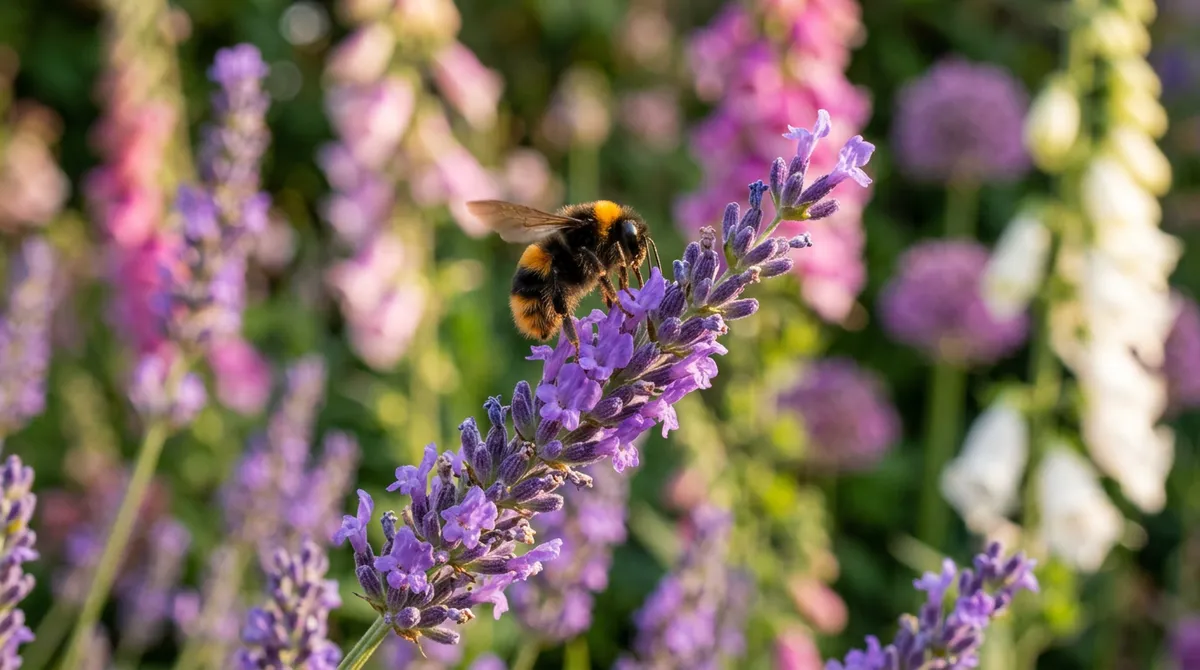
The UK has 270 species of bee, including 25 bumblebee species and around 240 solitary bee species. Their numbers have dropped by a third since 1980. Habitat loss, pesticide use, and climate shifts are the main drivers. A garden planted with the right flowers provides vital forage, especially in early spring and late autumn when wild sources are scarce.
You do not need a large garden to make a difference. Even a few containers on a balcony or a small garden planted with the right species will attract and sustain local bee populations. This guide covers the best plants for each season, how to arrange them, and what to avoid. For more on supporting garden wildlife, see our wildlife gardening guides.
What makes a plant bee-friendly?
Bees need two things from flowers: nectar (energy) and pollen (protein). Not all garden plants provide both. Understanding what bees look for helps you choose plants that genuinely support them rather than just looking pretty.
Flower shape matters
Different bee species have different tongue lengths. Long-tongued bumblebees like Bombus hortorum can reach into tubular flowers such as foxgloves and honeysuckle. Short-tongued species need flat, open flowers like daisies and sedums where the nectar is easy to reach.
The best bee gardens include a mix of flower shapes. This supports the widest range of species.
Single flowers beat doubles
Double-flowered varieties are bred for extra petals. Those extra petals replace the pollen-producing anthers, which means the flower looks fuller but offers bees nothing useful. A double rose like ‘Bonica’ is decorative but bee-useless. The single species rose Rosa canina feeds dozens of bee species.
When buying plants, check that the flower centre is visible and open. If you can see the stamens, bees can reach the pollen.
Planting density
Bees are more efficient when they can move between identical flowers without flying between different species. Group plants in blocks of at least three of the same type. A drift of 50 crocus bulbs is far more valuable to bees than 50 different bulbs scattered across a border.
Spring flowers: February to April
Spring is the most critical period for bees. Queen bumblebees emerge from hibernation in February and March, exhausted and hungry. Without immediate food, they die. Early-flowering plants are literally life-saving.
Crocus (Crocus vernus)
Plant in drifts of 50+ bulbs in October, 8cm deep in free-draining soil. Bees visit within days of flowering. Purple varieties produce more pollen than white or yellow forms. Naturalise in lawns by scattering and planting where they land.
Pulmonaria (lungwort)
One of the first perennials to flower, often starting in late February. Pink-to-blue flowers on the same plant. Shade tolerant, which makes it useful for north-facing borders where little else flowers early. ‘Blue Ensign’ and ‘Sissinghurst White’ are reliable varieties.
Hellebores
Single-flowered types of Helleborus x hybridus provide early nectar from February onwards. Plant in shaded or part-shaded borders in humus-rich soil. They are long-lived perennials that need almost no maintenance once established.
Willow catkins (Salix caprea)
An outstanding early pollen source. The male catkins of goat willow appear in March and produce masses of yellow pollen. For small gardens, plant the compact weeping form ‘Kilmarnock’, which reaches just 2-3m in height.
Flowering currant (Ribes sanguineum)
A common hedging plant that flowers in March and April. Tubular pink flowers attract early bumblebees in large numbers. ‘King Edward VII’ is a compact form reaching 1.5m. Easy to grow in any reasonable soil.
Gardener’s tip: Leave a patch of dead leaves and hollow stems over winter. Many solitary bees use these as nesting sites, and clearing them out in autumn removes habitat. Tidy up in late April instead, once bees have emerged.
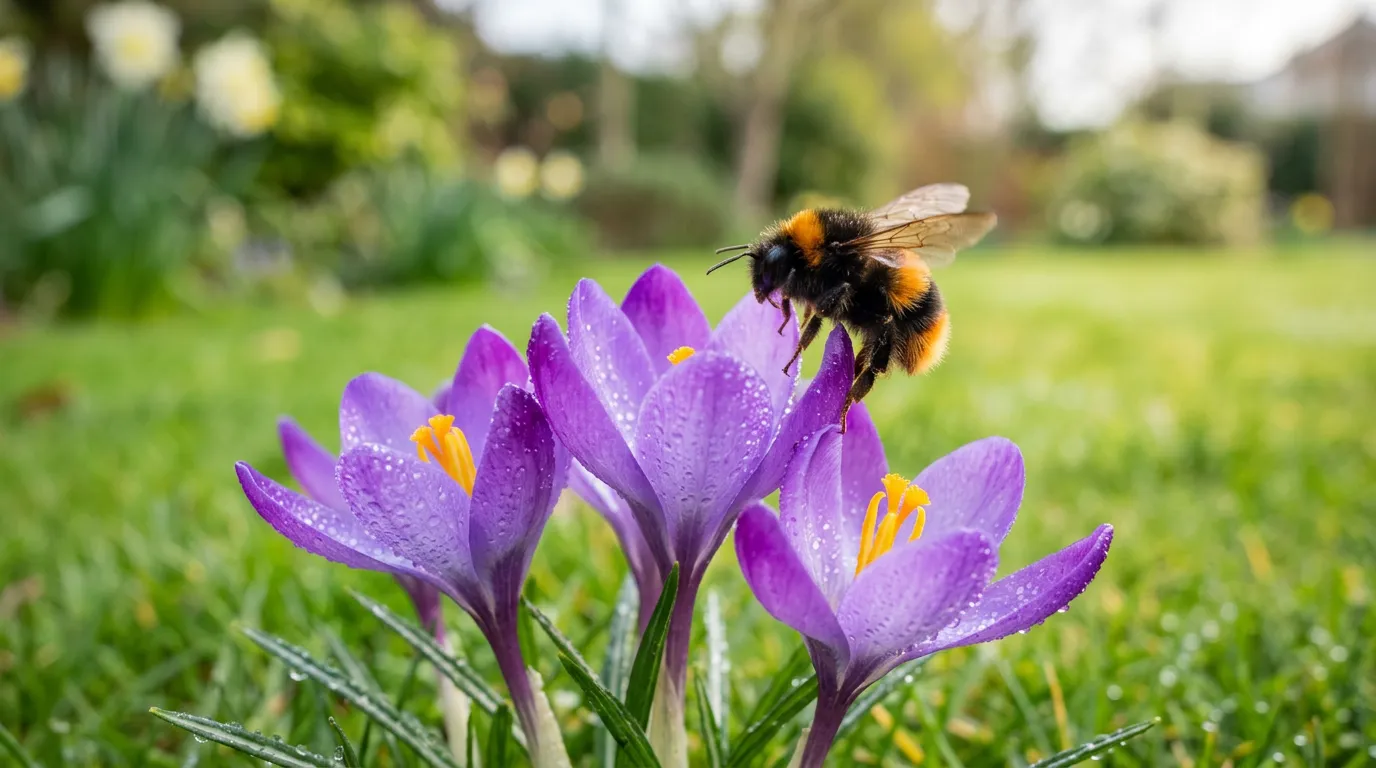 A bumblebee queen visiting purple crocus in early spring. Plant in drifts of 50+ bulbs for the best effect.
Summer flowers: May to August
Summer provides the main foraging period. Flowers are abundant, but not all garden plants are useful to bees. Focus on species with proven nectar and pollen production.
Lavender (Lavandula angustifolia ‘Hidcote’)
The single best bee plant for UK gardens. Flowers from June to August, drought tolerant, and evergreen. A single lavender hedge attracts more bee species than almost any other garden planting. Plant in full sun in well-drained soil, 30cm apart for a hedge. Cut back after flowering but never into old wood.
Foxglove (Digitalis purpurea)
Tubular flowers perfectly shaped for bumblebees. Self-seeds freely in most gardens. Biennial, so sow in May for flowers the following June. The native purple form is more attractive to bees than white or pastel cultivars. Reaches 1.2-1.5m in height.
Catmint (Nepeta x faassenii)
Flowers for months if cut back hard after the first flush in July. Bees prefer it over almost everything else in the border. ‘Walker’s Low’ and ‘Six Hills Giant’ are the best cultivars. Plant in full sun at the front of borders. Drought tolerant once established.
Phacelia (Phacelia tanacetifolia)
An annual, sow direct in April. Flowers in 6-8 weeks. One of the highest nectar-producing plants by weight, originally grown as a cover crop. Lavender-blue flowers on 60cm stems. Let it self-seed or re-sow annually. A great companion plant near tomatoes and other crops.
Alliums
Large spherical flower heads attract multiple bee species simultaneously. Allium hollandicum ‘Purple Sensation’ is the most widely grown, reaching 90cm with 10cm flower heads. Plant bulbs in November, 15cm deep, in groups of 7-10. They grow through low perennials without taking border space.
Borage (Borago officinalis)
Bright blue flowers from June to September. Produces nectar continuously and refills every few minutes, making it one of the most bee-visited plants in any garden. Self-seeds prolifically. Annual, easy to grow from seed sown direct in April.
Herbs in flower
Allow herbs to flower rather than cutting them back. Thyme, oregano, rosemary, sage, and chives all produce nectar-rich flowers that bees visit daily. A single flowering thyme plant in a pot on a sunny patio attracts dozens of bees per hour.
| Plant | Flowers | Height | Soil | Sun |
|---|---|---|---|---|
| Lavender ‘Hidcote’ | Jun - Aug | 60cm | Well-drained | Full sun |
| Foxglove | Jun - Jul | 1.2-1.5m | Moist, humus-rich | Part shade OK |
| Catmint ‘Walker’s Low’ | May - Sep | 60cm | Any well-drained | Full sun |
| Phacelia | Jun - Sep | 60cm | Any | Full sun |
| Allium ‘Purple Sensation’ | May - Jun | 90cm | Well-drained | Full sun |
| Borage | Jun - Sep | 60cm | Any | Full sun |
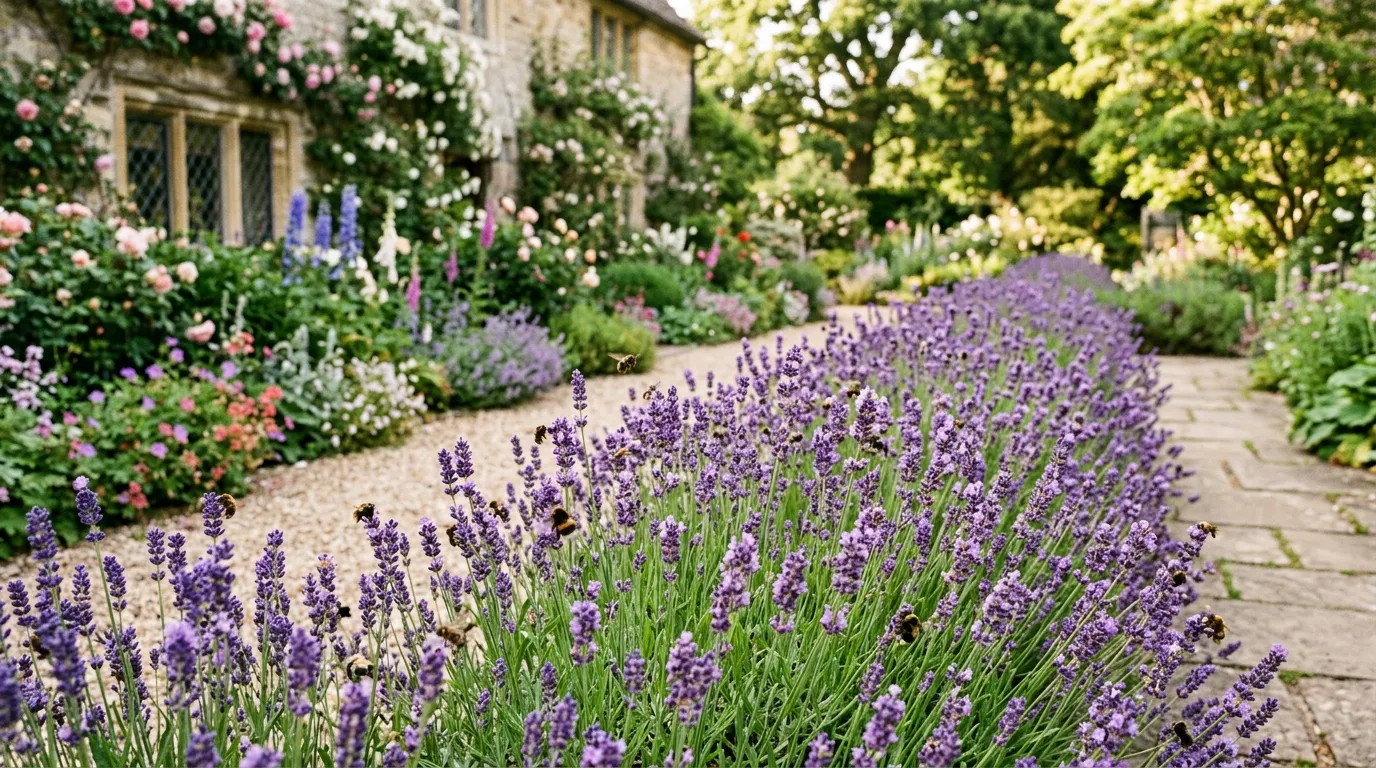 A lavender hedge in full summer bloom. Lavender is the single best bee plant for UK gardens, flowering from June to August.
Autumn flowers: September to November
Late-season forage helps bees build fat reserves before winter. Many gardeners neglect this period, creating a gap in food supply just when bees need it most.
Sedum (Hylotelephium spectabile)
Flat flower heads covered in bees from September onwards. ‘Herbstfreude’ (Autumn Joy) is the classic variety, reaching 50cm with pink flower heads that age to copper. Plant in full sun in well-drained soil. Extremely drought tolerant. Cut back dead stems in spring, not autumn.
Ivy (Hedera helix)
The single most important late-season nectar source for bees in Britain. Ivy flowers in October when almost nothing else does. The small yellow-green flowers produce copious nectar. Do not cut ivy back in autumn. Wait until January if pruning is needed.
Single dahlias
Not all dahlias help bees. Only single-flowered varieties with open centres are accessible. ‘Bishop of Llandaff’ has dark foliage and red single flowers that bees visit heavily. ‘Twyning’s After Eight’ is another excellent single form. They flower from July until the first hard frost.
Michaelmas daisies (Aster novi-belgii)
Choose mildew-resistant varieties. ‘Professor Anton Kippenberg’ is compact (40cm) and covered in lavender-blue flowers from September. ‘Little Carlow’ is taller (90cm) and produces masses of small blue flowers. Both attract late-flying bumblebees and hoverflies.
Japanese anemones (Anemone x hybrida)
Single-flowered forms provide late nectar from August to October. ‘Honorine Jobert’ has white flowers and grows to 1.2m. Tolerates shade, which makes it useful for north-facing borders. Spreads gradually by runners.
Gardener’s tip: Ivy is often seen as a nuisance, but its autumn flowers support more bee species than any other single UK plant at that time of year. Let at least one patch of ivy grow and flower undisturbed.
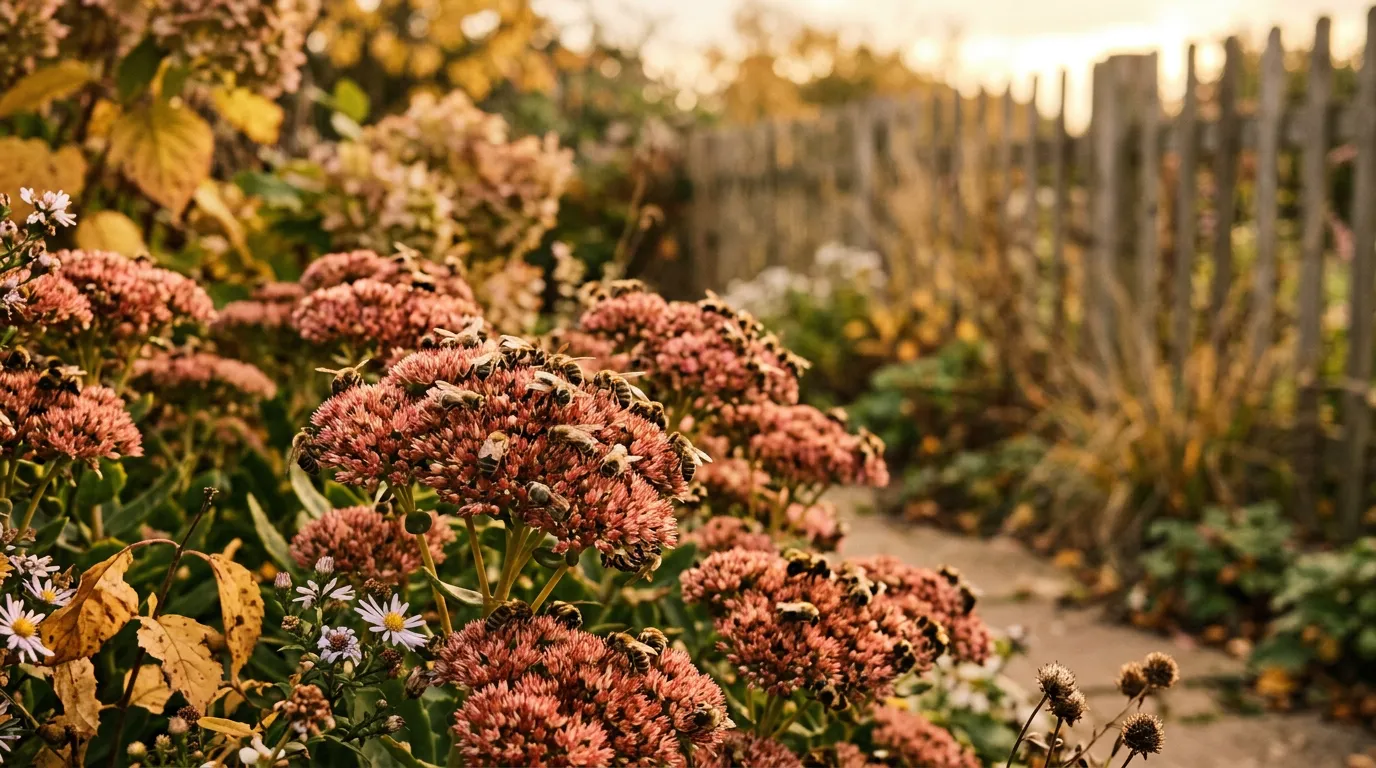 Sedum ‘Herbstfreude’ (Autumn Joy) in October. The copper-pink flower heads are covered in bees from September onwards.
How to plan a year-round bee border
The goal is continuous flowering from February to November, with no gaps. Here is a planting plan for a 2m x 4m border that achieves this.
A simple bee border layout
Back row (tallest, 80-150cm):
- 3x foxglove (Digitalis purpurea) - Jun/Jul
- 1x single dahlia ‘Bishop of Llandaff’ - Jul to frost
- 1x Japanese anemone ‘Honorine Jobert’ - Aug to Oct
Middle row (40-80cm):
- 5x lavender ‘Hidcote’ - Jun to Aug
- 3x catmint ‘Walker’s Low’ - May to Sep
- 3x sedum ‘Herbstfreude’ - Sep to Nov
Front row (ground level to 30cm):
- 30x crocus ‘Remembrance’ (purple) - Feb to Mar, planted through the sedum
- 5x pulmonaria ‘Blue Ensign’ - Feb to Apr
- 3x thyme (flowering) - Jun to Aug
Flowering calendar
| Month | What’s flowering |
|---|---|
| February | Crocus, pulmonaria |
| March | Crocus, pulmonaria |
| April | Pulmonaria |
| May | Catmint |
| June | Catmint, lavender, foxglove, thyme |
| July | Catmint, lavender, foxglove, dahlia, thyme |
| August | Catmint, lavender, dahlia, Japanese anemone |
| September | Catmint, dahlia, sedum, Japanese anemone |
| October | Sedum, Japanese anemone |
| November | Sedum (late flowers) |
This combination costs under 50 pounds if bought as plug plants or bulbs. It provides 10 months of continuous bee forage with minimal maintenance.
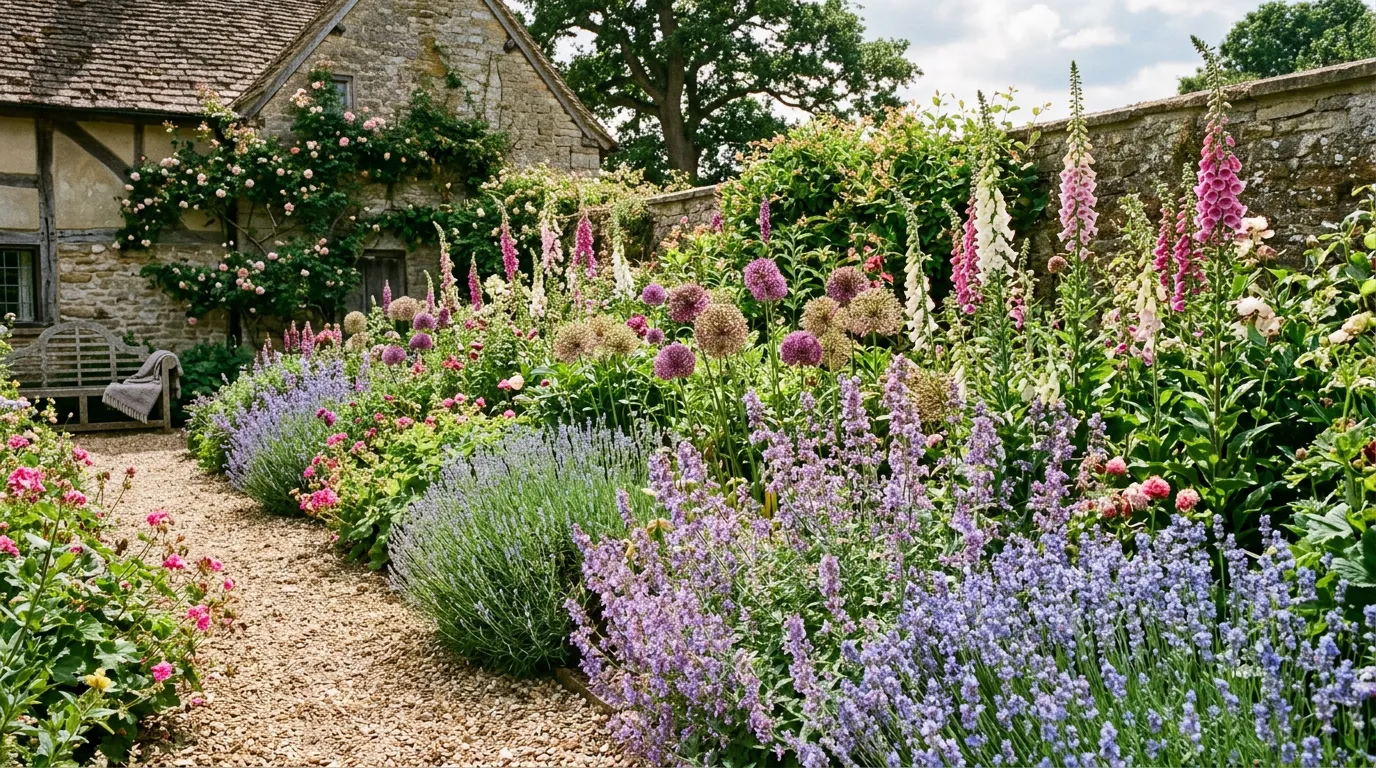 A mixed pollinator border with foxgloves, alliums, catmint, and lavender. Planting in dense blocks helps bees forage efficiently.
Things to avoid
Pesticides
Neonicotinoids are banned in the UK for outdoor use, but other insecticides harm bees too. Pyrethroid sprays marketed as “natural” still kill bees on contact. If you must spray against a pest, do it at dusk when bees are not flying, and never spray open flowers.
Double flowers
Breeding for extra petals removes the pollen-producing anthers. Many popular garden plants are sold in double forms that offer bees nothing. Common offenders include double roses, double dahlias, double hollyhocks, and pompom chrysanthemums. Always check that the flower centre is visible before buying.
Sterile bedding plants
Many common bedding plants produce little or no nectar. Petunias, busy lizzies, begonias, and lobelia are popular but almost useless for bees. Replace them with single-flowered alternatives: cosmos, calendula, nasturtiums, and snapdragons all attract pollinators.
Artificial grass
Removes ground-nesting habitat for solitary bees, which make up 90% of UK bee species. Around 240 species nest in the ground, in tunnels 10-30cm deep. Replacing a lawn with plastic removes these nesting sites completely. Even a small patch of real grass or bare, sandy soil helps ground-nesting bees.
Excessive tidiness
Dead stems, leaf litter, and bare patches of soil are nesting and overwintering habitat. Leaving a corner of the garden slightly wild provides shelter for bees from autumn through to spring. Cut back perennials in late April rather than autumn.
Beyond plants: other ways to help bees
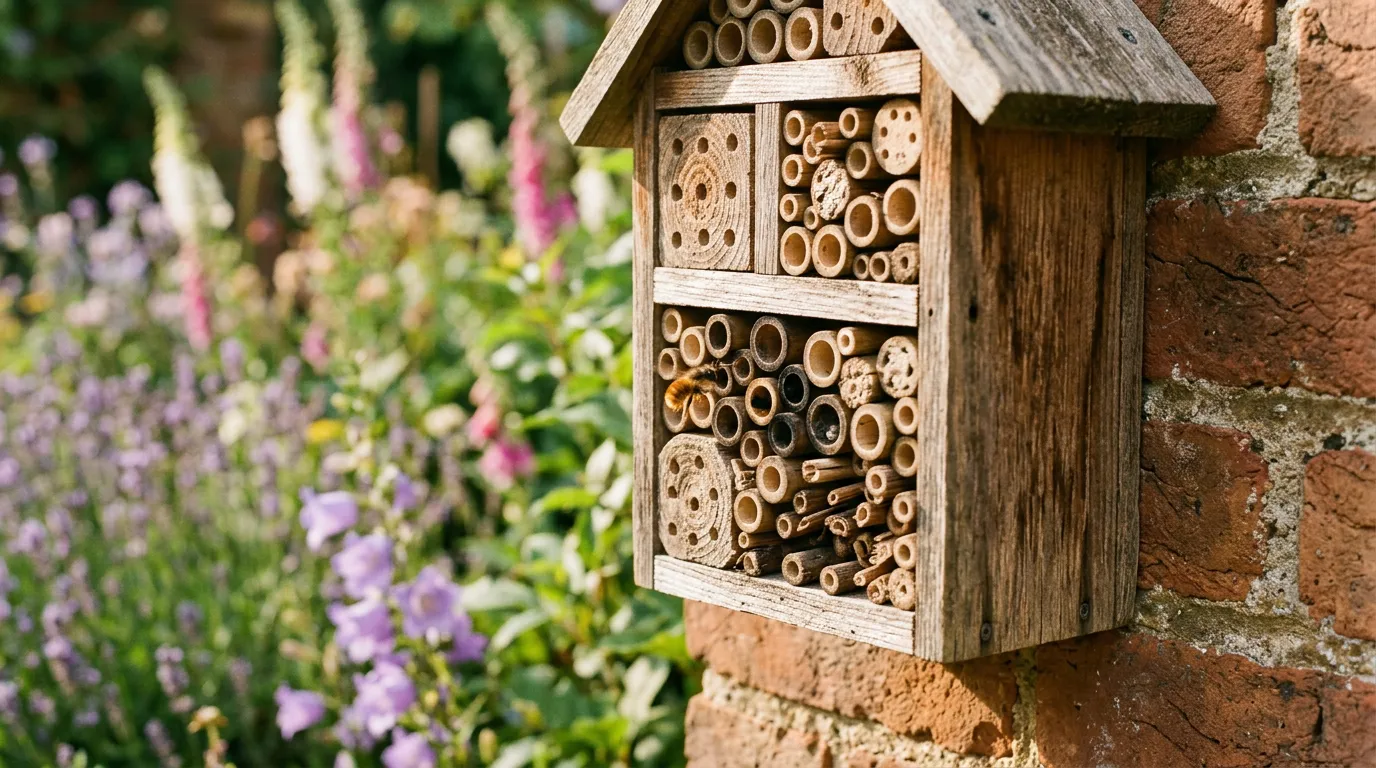 A bee hotel on a south-facing wall. The different tube diameters attract various solitary bee species.
Bee hotels provide nesting sites for solitary bees such as red mason bees and leafcutter bees. Place them in a sunny, sheltered spot 1-1.5m above ground, facing south or south-east. Buy or build one with tubes 6-10mm in diameter and 15cm deep.
Water sources matter in hot weather. A shallow dish with pebbles and water gives bees a safe drinking spot. Keep it topped up in summer.
Bare soil patches help ground-nesting bees. Leave a few square metres of south-facing bare soil uncovered. Firm it down lightly. Mining bees and other solitary species will excavate nesting tunnels.
Frequently asked questions
What is the best plant for bees in the UK?
Lavender is the single best bee plant for UK gardens. Lavandula angustifolia ‘Hidcote’ flowers from June to August, is drought tolerant, and attracts bumblebees, honeybees, and solitary bees. Catmint runs a close second and flowers for even longer if cut back after the first flush.
Do bees like double flowers?
No, double flowers are poor for bees. The extra petals replace the pollen-producing anthers, removing the protein source bees need. Always choose single-flowered varieties where you can see the centre of the bloom. Double roses, double dahlias, and pompom chrysanthemums are common offenders.
When do bees need flowers most?
Early spring and late autumn are the critical periods. Queen bumblebees emerge from hibernation in February and March needing immediate food. Late-season forage in October and November helps all bee species build reserves for winter. Ivy is the single most important late-season plant.
How many bee species are in the UK?
The UK has 270 bee species. This includes 1 honeybee species, 25 bumblebee species, and around 240 solitary bee species. Solitary bees make up 90% of UK bee species. They do not live in hives or colonies and are non-aggressive.
Do bees like herbs?
Yes, bees are strongly attracted to flowering herbs. Thyme, oregano, rosemary, sage, borage, and chives all produce nectar-rich flowers. Let herbs go to flower rather than cutting them back. A single flowering thyme plant on a sunny patio attracts dozens of bees per hour.
Is artificial grass bad for bees?
Yes, artificial grass removes habitat for ground-nesting solitary bees. Around 90% of UK bee species nest in the ground in tunnels 10-30cm deep. Replacing even a small lawn with artificial grass eliminates these nesting sites entirely.
Lawrie has been gardening in the West Midlands for over 30 years. He grows his own veg using no-dig methods, keeps a wildlife-friendly garden, and writes practical advice based on real UK growing conditions.