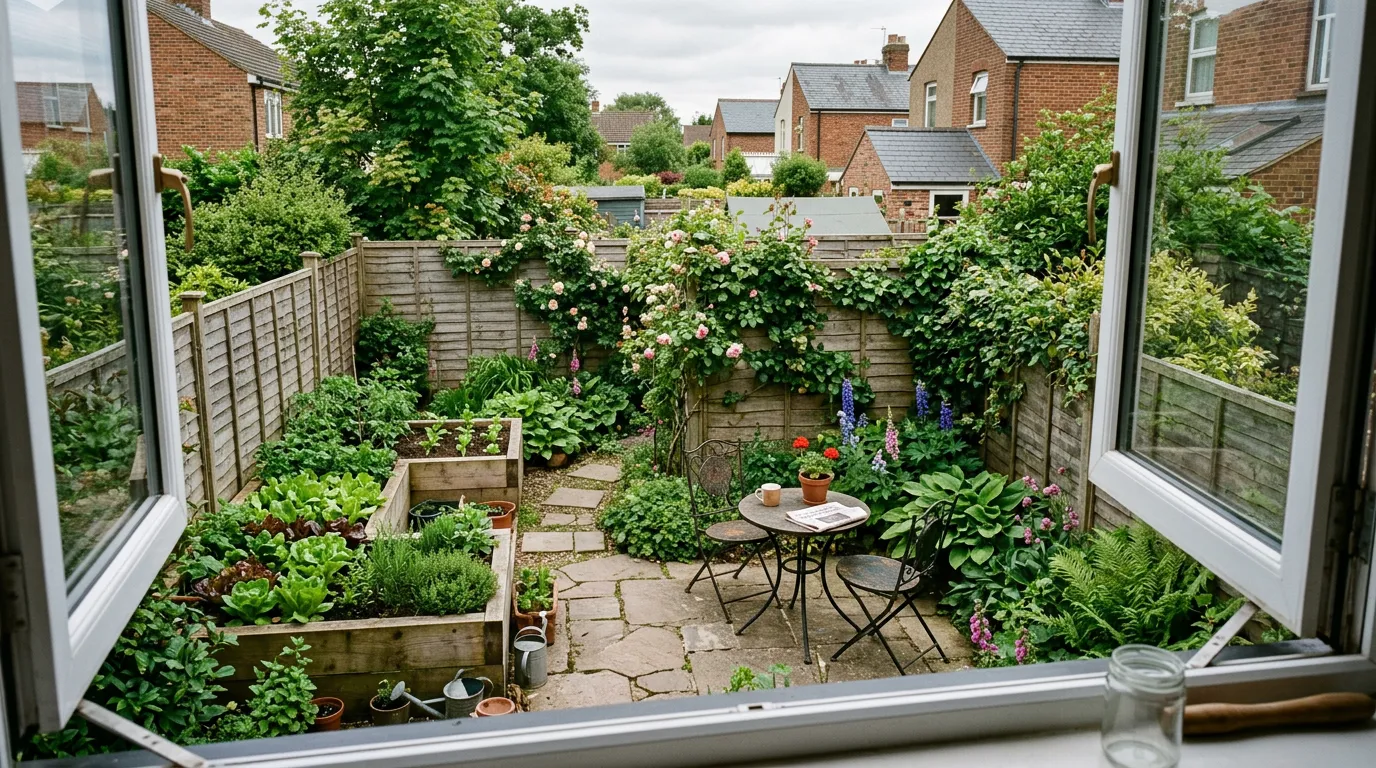
Cottage Garden Planting Plan for the UK
How to plan and plant a cottage garden in the UK. Covers classic plants, colour schemes, seasonal structure, path layouts, and a ready-to-use planting plan with variety lists.
Key takeaways
- A 3m x 6m cottage border needs 80-120 plants across 15-25 varieties
- Roses, foxgloves, delphiniums, and lavender form the structural backbone
- Plant in odd-numbered groups of 3, 5, or 7 for natural-looking drifts
- Layer heights: tall at the back (1.5m+), mid (60-90cm), low at the front (under 40cm)
- Peak colour runs June to August, with March to October possible with the right mix
- Self-seeding plants like foxgloves, aquilegia, and nigella fill gaps naturally
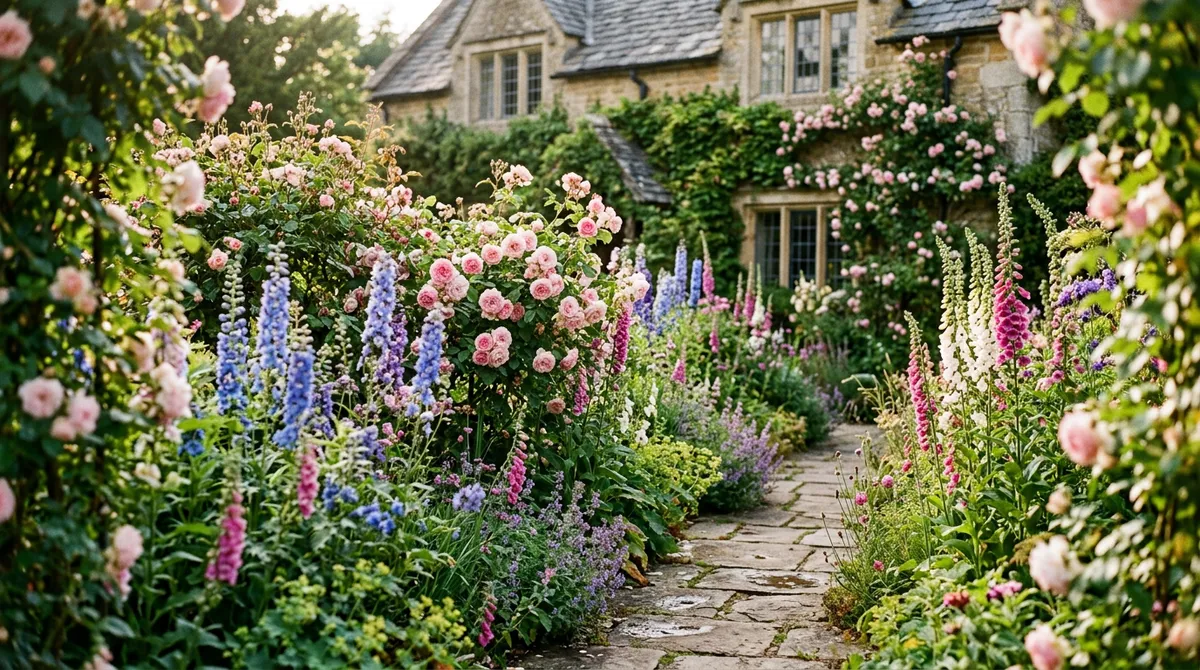
The cottage garden is the most loved garden style in Britain. Roses tumbling over doorways. Foxgloves standing tall against a stone wall. Lavender lining a path, buzzing with bees. It looks effortless and wild, but there is structure underneath the abundance. A good cottage garden is planned, not random.
This guide provides a ready-to-use planting plan for a UK cottage garden border, with specific varieties, quantities, and positions. It also covers the design principles, colour palettes, and seasonal planning that make the style work. Whether you have a full border or a small garden to work with, the cottage garden approach scales beautifully. Browse more in our garden design section.
The cottage garden principles
Dense, layered planting
Cottage gardens pack plants tightly with no bare soil visible. Three layers create depth: tall plants at the back (1.5m+), mid-height plants in the middle (60-90cm), and low plants spilling over the front edge (under 40cm). Within each layer, plants overlap and mingle.
Informal grouping
Plant in odd-numbered groups of 3, 5, or 7. Odd numbers look more natural than even pairs. Stagger groups so they overlap with neighbouring plants. Avoid rigid rows or geometric patterns. The look is abundant and casual, not regimented.
Mix of plant types
The classic cottage garden combines:
- Shrub roses for structure and scent
- Tall perennials for height and drama
- Ground cover perennials for the front of borders
- Self-seeding annuals that fill every gap
- Climbing plants on walls, fences, and obelisks
- Herbs for scent and practical use
- Spring bulbs for early colour before perennials emerge
Repeat and rhythm
Repeat key plants along the border. Three clumps of lavender at regular intervals. Roses at each end and the centre. This creates rhythm without formality. The eye recognises the pattern subconsciously, giving coherence to the abundant planting.
Essential cottage garden plants
The backbone: roses
No cottage garden is complete without roses. Shrub roses and climbing roses provide structure, scent, and flower power from June to October.
Best cottage garden roses:
| Variety | Type | Height | Colour | Scent | Repeat flowering |
|---|---|---|---|---|---|
| Gertrude Jekyll | Shrub | 1.2m | Deep pink | Strong | Yes |
| The Generous Gardener | Climber | 3m | Pale pink | Strong | Yes |
| Munstead Wood | Shrub | 1m | Crimson | Strong | Yes |
| Queen of Sweden | Shrub | 1.2m | Soft pink | Light | Yes |
| Constance Spry | Climber/shrub | 2m | Blush pink | Strong | Once (June) |
All are David Austin English roses, bred for the cottage garden look with repeat flowering and disease resistance.
Tall perennials (back of border)
- Delphiniums - spires of blue, purple, or white to 1.8m. The quintessential cottage garden plant. Stake in May. Cut back after first flowering for a second flush.
- Hollyhocks (Alcea rosea) - single or double flowers to 2m. Biennial/short-lived perennial. Self-seeds freely. Rust is common but rarely fatal. Plant against walls and fences.
- Verbena bonariensis - airy purple flower clusters to 1.5m on wiry stems. See-through quality allows planting mid-border despite its height. Self-seeds prolifically.
- Phlox paniculata - fragrant flower heads in pink, white, purple from July to September. 1.2m. Divide every 3-4 years to maintain vigour.
Mid-height perennials (middle of border)
- Peonies - extravagant flowers in May-June, intoxicating scent. Sarah Bernhardt (pink) and Duchesse de Nemours (white) are classics. Long-lived plants that improve with age.
- Hardy geraniums - low maintenance and endlessly useful. Rozanne for long flowering. Johnson’s Blue for true blue colour. Mrs Kendall Clark for pale blue with white veins.
- Astilbes - feathery plumes in pink, red, and white. Thrive in moist soil and partial shade. Good for the cooler, damper side of a border.
- Nepeta (catmint) - lavender-blue spires from May to September. Soft, grey-green foliage. Walker’s Low is the best variety. Cut back by half for a second flush.
- Achillea - flat flower heads in yellow, pink, and terracotta. Excellent for cutting. Tolerates poor, dry soil.
Front of border (low and spreading)
- Lavender - the cottage garden essential. Hidcote is compact and deep purple. Line paths with it for scent as you brush past. Attracts bees and butterflies.
- Alchemilla mollis (lady’s mantle) - lime-green flower sprays in June-July. Scalloped leaves catch raindrops. Softens border edges perfectly.
- Campanula poscharskyana - trailing blue bellflowers. Spills over walls and path edges. Flowers May to August.
- Dianthus (pinks) - clove-scented flowers in pink, red, and white. Grey-green evergreen foliage. Mrs Sinkins is the classic scented cottage garden variety.
- Erigeron karvinskianus - tiny daisy flowers, white fading to pink. Self-seeds into walls, cracks, and path edges. Flowers May to October.
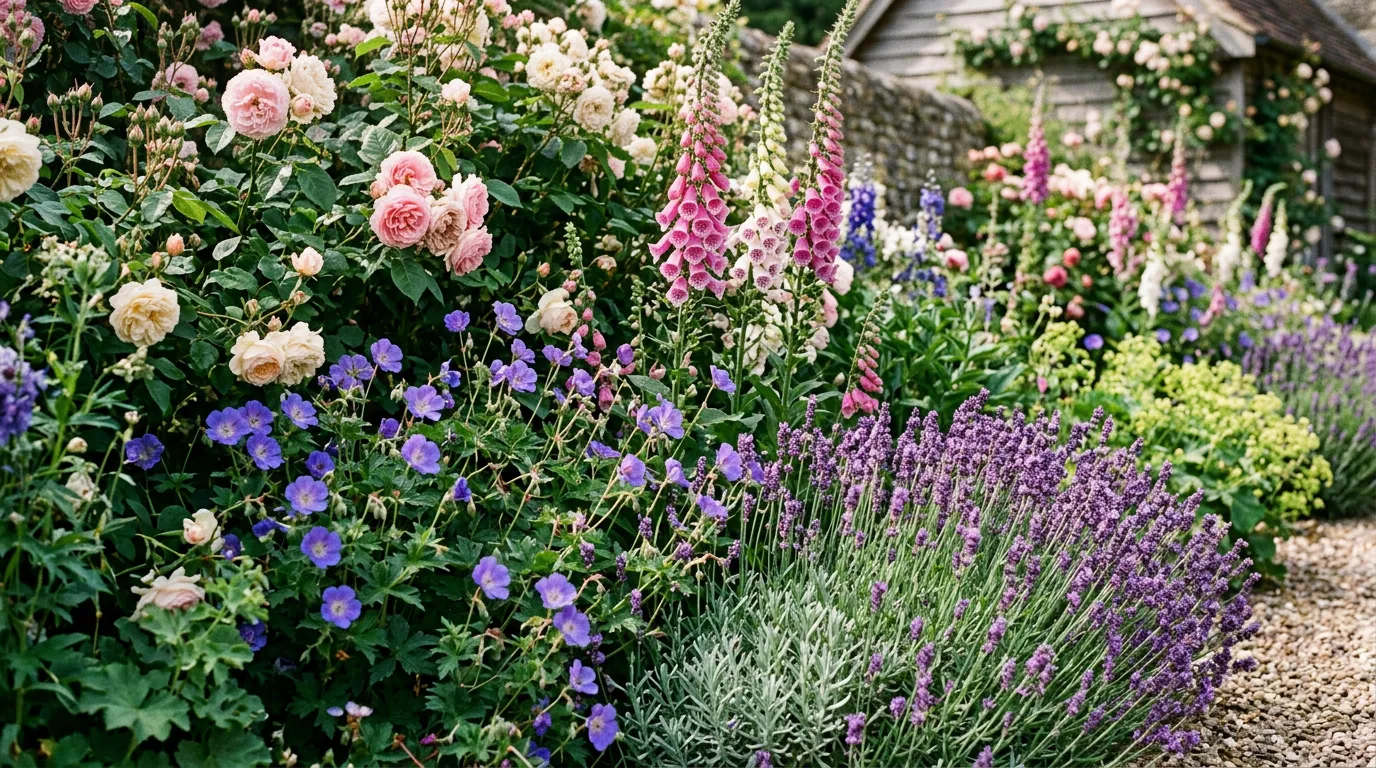 Layered cottage border planting. Tall foxgloves at the back, roses and geraniums in the middle, lavender at the front.
Self-seeding plants
Self-seeding plants are the secret weapon of cottage gardens. They fill every gap, create natural-looking combinations, and save you replanting costs. Once established, these plants maintain themselves.
Best cottage garden self-seeders
- Foxgloves (Digitalis purpurea) - biennial. Flowers in year two, seeds, dies. Seedlings appear everywhere in autumn. Thin rather than weed out.
- Aquilegia (columbine) - cross-pollinates freely, producing new colour combinations. Flowers in May. Short-lived perennial that replaces itself by seed.
- Nigella (love-in-a-mist) - annual. Scatter seed once, have it forever. Blue flowers followed by decorative seed pods.
- Verbena bonariensis - self-seeds into gravel paths and border gaps. Flowers August to October. Pull out unwanted seedlings.
- Calendula - annual. Orange and yellow daisy flowers. Scatter seed in March and let it self-seed in subsequent years.
- Honesty (Lunaria annua) - biennial. Purple or white flowers followed by translucent seed pods for winter arrangements.
Gardener’s tip: Learn to recognise self-seeding plant seedlings so you do not weed them out. Foxglove seedlings form flat rosettes of textured leaves. Aquilegia seedlings have distinctive three-lobed leaves. Let them grow where they land for the most natural effect.
A ready-to-use planting plan
This plan suits a south or west-facing border, 3m deep by 6m long. It needs full sun or light shade. Soil should be reasonably fertile and well-drained.
Plant list
| Position | Plant | Quantity | Spacing | Flowering |
|---|---|---|---|---|
| Back | Rosa Gertrude Jekyll | 2 | 1.2m apart | June-October |
| Back | Delphinium Pacific Giants | 5 | 40cm apart | June-July |
| Back | Hollyhock mixed | 7 (seed) | 45cm apart | July-August |
| Back | Verbena bonariensis | 5 | 45cm apart | July-October |
| Middle | Peony Sarah Bernhardt | 3 | 90cm apart | May-June |
| Middle | Phlox Blue Paradise | 3 | 45cm apart | July-September |
| Middle | Geranium Rozanne | 5 | 45cm apart | June-November |
| Middle | Nepeta Walker’s Low | 5 | 40cm apart | May-September |
| Middle | Achillea Terracotta | 3 | 40cm apart | June-August |
| Front | Lavender Hidcote | 7 | 40cm apart | June-August |
| Front | Alchemilla mollis | 5 | 35cm apart | June-July |
| Front | Dianthus Mrs Sinkins | 5 | 25cm apart | June-July |
| Front | Erigeron karvinskianus | 5 | 30cm apart | May-October |
| Fill | Foxglove (seed) | Scatter | Self-seeds | June |
| Fill | Aquilegia mixed (seed) | Scatter | Self-seeds | May |
| Fill | Nigella (seed) | Scatter | Self-seeds | June-July |
| Bulbs | Allium Purple Sensation | 30 | 15cm apart | May-June |
| Bulbs | Tulip Queen of Night | 30 | 10cm apart | April-May |
Total plants: approximately 100 (plus self-seeders and bulbs)
Estimated cost: one hundred and fifty to two hundred and fifty pounds for all plants and bulbs.
Planting order
- Autumn (October-November): plant bare-root roses, peonies, and all bulbs
- Spring (March-April): plant container-grown perennials and scatter self-seeder seed
- Late spring (May): plant out tender seedlings, stake delphiniums
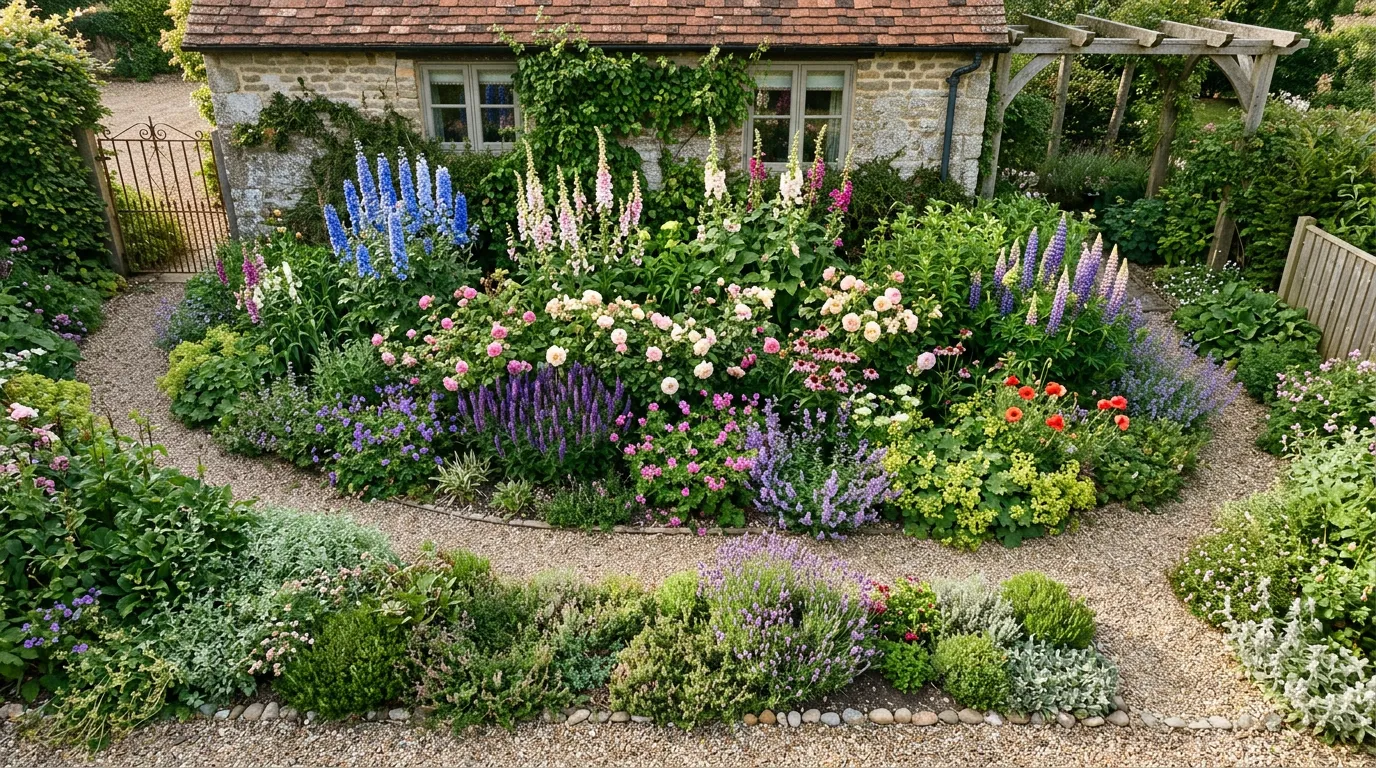 Planting plan layout. Tall plants at the back, grading to low spillers at the front. Groups of 3-5 for natural effect.
Colour schemes
Soft pastels (traditional)
Pink, mauve, white, pale blue, and lavender with touches of deep purple. This is the classic cottage garden palette. Roses provide the pinks. Delphiniums the blues. Foxgloves the mauves. White phlox and peonies lighten the scheme. This colour combination works in any UK setting.
Hot cottage
Orange, deep red, golden yellow, and magenta. Less traditional but dramatic. Use dahlias, crocosmia, helenium, rudbeckia, and dark red roses. This scheme peaks in late summer (August-September) rather than the early summer peak of pastels.
White cottage garden
All-white flowers with green and silver foliage. Sophisticated and calming. White roses (Iceberg), white foxgloves, white delphiniums, white phlox, white cosmos, and silver Artemisia. Inspired by the famous White Garden at Sissinghurst Castle in Kent.
Seasonal flowering calendar
| Month | Key plants in flower |
|---|---|
| March | Spring bulbs: snowdrops, crocuses, early daffodils |
| April | Tulips, wallflowers, primroses, forget-me-nots |
| May | Alliums, aquilegia, peonies, early roses, wisteria |
| June | Roses peak, foxgloves, delphiniums, lavender begins, sweet peas |
| July | Roses, phlox, hollyhocks, lavender peak, achillea |
| August | Verbena bonariensis, dahlias, Japanese anemones begin |
| September | Japanese anemones, late roses, sedums, grasses |
| October | Asters, cyclamen, autumn crocus, rose hips |
Cottage garden paths and structure
Paths
Every cottage garden needs a path through the planting. It creates structure, provides access for maintenance, and lets you brush past fragrant plants at close quarters.
- Brick - traditional, warm colour, slightly uneven surface adds character
- Stone flags - natural, random-sized. Let plants self-seed into gaps between stones
- Gravel - cheapest option, soft crunch underfoot, plants colonise the edges
- Grass - traditional but high maintenance (weekly mowing, edging)
Vertical structure
- Arches and pergolas - climbing roses and clematis create vertical flower tunnels
- Obelisks and wigwams - support sweet peas and clematis mid-border
- Walls and fences - essential backdrops. Train climbers for wall coverage
- Hedges - yew, box, or beech make formal backgrounds for informal planting
Warning: Avoid modern metal arches and plastic obelisks. They look out of place in a cottage garden. Use wooden or wrought iron structures that weather and age naturally. Rust on iron is an asset, not a problem.
Common mistakes
Planting too formally
Cottage gardens are not bedding displays. Straight rows, colour blocks, and geometric spacing destroy the cottage feel. Plant in irregular drifts. Allow plants to lean and mingle. Accept some untidiness. This is the style.
Forgetting winter
Many cottage garden plants are deciduous perennials that disappear in winter. Without structure, the garden looks bare from November to March. Include evergreen elements: box balls, yew hedging, rosemary, and winter-flowering shrubs like Viburnum tinus.
Overcleaning in autumn
Resist the urge to cut everything back in October. Seed heads of verbena, grasses, and phlox provide winter structure and food for garden birds. Cut back in late February or March instead, just before new growth emerges.
Ignoring scent
Scent is half the cottage garden experience. Include fragrant roses, lavender, phlox, sweet peas, nicotiana, and jasmine. Position them along paths where you walk past them daily. A cottage garden should smell as good as it looks.
Starting too small
A 1m-deep border cannot achieve the layered cottage look. Borders need a minimum of 2m depth for three layers of planting. If space is tight, make the border deeper rather than longer. A 2m x 3m border is more effective than a 1m x 6m strip.
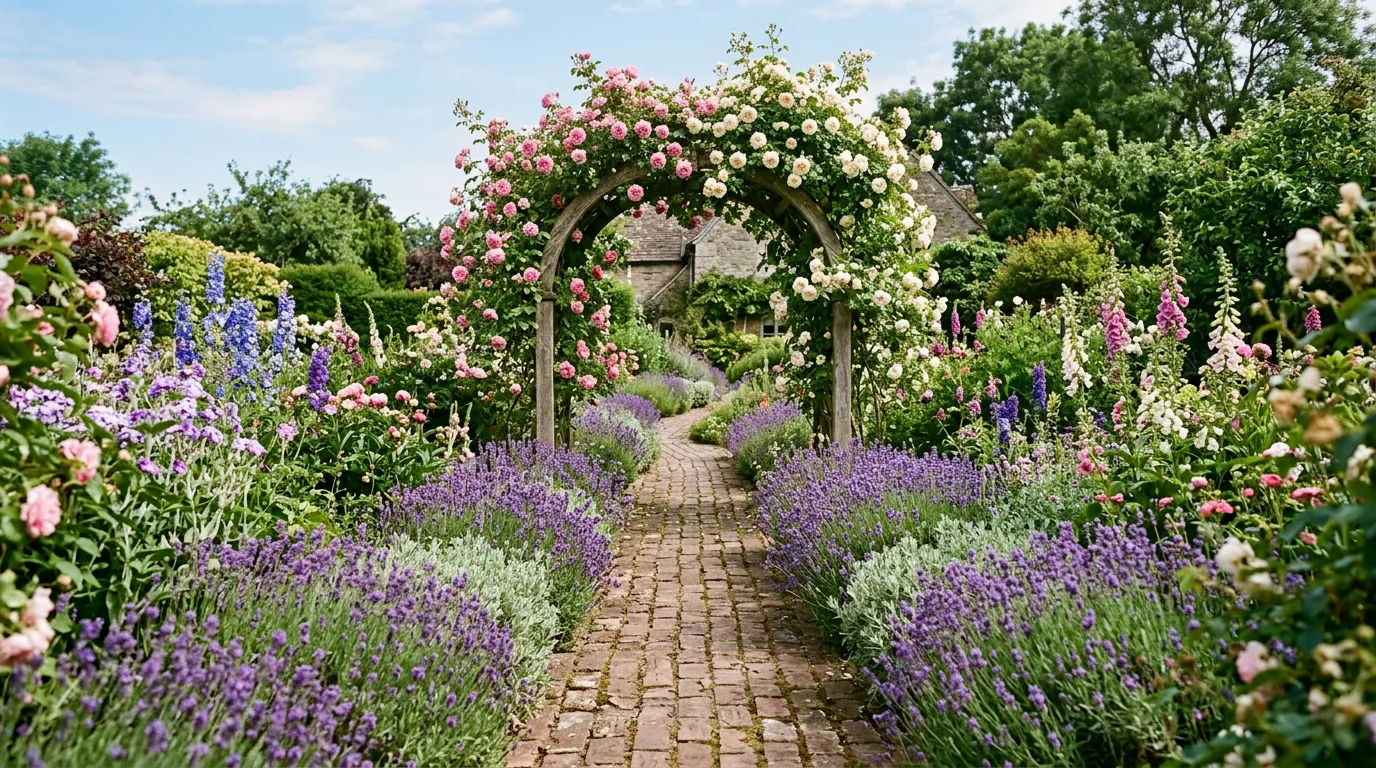 A brick path through deep cottage borders. Climbing roses on the arch and lavender edging create the classic cottage entrance.
Cottage gardens in small spaces
The cottage style works in surprisingly small areas. A front garden of 3m x 3m, a side passage, or even a collection of containers can capture the feel.
Small space adaptations
- Use climbers to add height without floor space: roses, clematis, jasmine on walls and fences
- Window boxes and pots with cottage-style planting: trailing geraniums, lavender, violas, and small roses
- Compact varieties of classic plants: miniature delphiniums, patio roses, dwarf lavender
- A single obelisk or wigwam with sweet peas creates a cottage focal point in any garden
- Herbs (rosemary, thyme, sage) do double duty as fragrant cottage plants and kitchen ingredients
Frequently asked questions
What are the best cottage garden plants UK?
Roses, foxgloves, delphiniums, lavender, and hardy geraniums form the essential five. Add peonies, phlox, sweet peas, hollyhocks, and aquilegia for the complete cottage palette. All are fully hardy across every UK region and available from any good garden centre or nursery.
How do I start a cottage garden from scratch?
Begin with structure: lay a path and plant 3-5 shrub roses. Add tall perennials at the back, mid-height in the middle, and low spillers at the front. Scatter self-seeding annuals (foxgloves, nigella, aquilegia) into gaps. A cottage garden takes 2-3 years to reach full maturity as perennials establish.
What is the best layout for a cottage garden?
A central path with deep borders on both sides is the classic layout. Borders need at least 2m depth for proper layered planting. A gently winding path through the planting feels more cottage-like than a straight line. Include an arch or focal point where the path draws the eye.
Do cottage gardens need a lot of maintenance?
Moderate maintenance, mostly in summer. Deadhead roses and delphiniums for repeat flowering. Stake tall plants in May before they flop. Cut back perennials in late February or March. Self-seeding plants reduce replanting work. Expect 2-3 hours per week in summer, much less in winter.
What colours work in a cottage garden?
Soft pastels are traditional: pink, mauve, white, pale blue, and lavender with accents of deep purple and occasional warm tones. Hot schemes using orange, red, and yellow work too but need careful handling. The key is the mix. A cottage garden should look like a generous, slightly random tapestry of colour.
Can I have a cottage garden in shade?
Yes, though the plant palette changes. Replace sun-loving roses and lavender with foxgloves, aquilegia, astilbes, Japanese anemones, ferns, and hellebores. The layered, informal planting style works in partial shade. Full shade limits flowering options significantly.
When is the best time to plant a cottage garden?
Autumn (October-November) is ideal for bare-root roses, peonies, and hardy perennials. Roots establish through the dormant season, giving plants a head start in spring. Spring planting (March-April) works well for container-grown plants. Avoid planting in summer heat or during winter frost.
Lawrie has been gardening in the West Midlands for over 30 years. He grows his own veg using no-dig methods, keeps a wildlife-friendly garden, and writes practical advice based on real UK growing conditions.