Key takeaways
- Pale walls bounce light around and make a courtyard feel bigger and brighter
- Porcelain paving copes with frost and shade and stays cleaner than most stone
- An outdoor mirror on a dark wall makes a small space look deeper
- Self-contained water features need no plumbing
- Ferns, hostas and fatsia are happy with just a couple of hours of sun
- Warm white lights turn a courtyard into a cosy evening room
A courtyard can be the cosiest spot in the house, as long as you work with its light. Most get only a few hours of sun a day, and walls cast long shadows, especially in winter. Paving stays damp and moss creeps in. The good news is that loads of beautiful plants love these conditions, and a few simple tricks make the space feel much brighter. Here’s how to pick flooring, brighten walls, choose shade plants and add water features, furniture and lighting.
Assessing your courtyard
Before you buy anything, spend a week watching how your courtyard behaves.
Sun: note where the sun falls in the morning, at midday and mid-afternoon. A south-facing courtyard may get a good few hours in summer and almost none in winter. This decides your plants and where the seat goes.
Wind: courtyards are usually sheltered, but gaps between buildings can funnel sudden gusts.
Drainage: watch where rainwater goes. Courtyards often collect run-off from several roofs. Puddles that hang around after rain need sorting before you lay a new floor.
Walls and floors: look for crumbling mortar, damp patches and wobbly paving. Fix those before anything pretty goes in.
Flooring options for courtyard gardens
The floor is the biggest surface in a courtyard, so it sets the tone for everything else.
Flooring comparison
| Material | Copes with frost | Copes with shade and moss | Upkeep | Good for |
|---|---|---|---|---|
| Porcelain paving | Very well | Very well | Easy | Best all-rounder |
| Sandstone | Well | Poorly unless sealed | Seal and wash | Traditional look |
| Slate | Well | Fairly well | Easy | Modern look |
| Limestone | Fairly well | Poorly unless sealed | Seal | Formal courtyards |
| Gravel | Not an issue | Not an issue | Top up now and then | Budget, informal |
| Brick pavers | Well | Fairly well | Occasional jet wash | Period homes |
| Composite decking | Well | Fairly well | Occasional clean | Raised areas |
Porcelain paving
Porcelain is the best all-rounder for a courtyard. It soaks up almost no water, so it shrugs off frost, doesn’t grow much moss and doesn’t stain in the shade. It comes in finishes that look like stone, concrete or wood, with far less fuss.
Lay it on a full bed of mortar over a firm, compacted base. Brush a priming slurry onto the back of each slab first, because porcelain is so smooth that mortar won’t grip it otherwise.

A sunny Mediterranean-style courtyard with pale stone paving and pots of olive trees and lavender
Natural stone
Sandstone and slate suit period and traditional courtyards. Sandstone is warm and lovely but soaks up water, so in shade it soon turns green. Seal it with a breathable stone sealer and clean it once a year.
Gravel
The cheapest option. It drains by itself, is easy to lay and comes in lots of colours. Lay a good layer of angular gravel over compacted hardcore with a weed membrane underneath.
Gravel is best for planted areas. For seating and main paths, use paving, as dragging chairs across gravel is no fun.
Tip: In a small courtyard, stick to one flooring material from edge to edge. Mixing paving and gravel in a tiny space looks busy. One material makes it feel bigger and calmer.
Wall treatments to maximise light
Walls shape a courtyard’s look and how bright it feels. What you do with them makes more difference than almost anything else.
Painting courtyard walls
White or pale cream bounces the most light around. In a courtyard with only a couple of hours of sun, you’ll notice the difference straight away, and so will your plants.
Use an exterior masonry paint in a warm white or soft cream. Brilliant white gives the most light, while a creamy white feels softer against brick and stone.
Dark feature walls work on one wall only. Paint the darkest or furthest wall in charcoal, deep green or navy, and put pale plants in front of it, like white foxgloves or pale ferns. The dark backdrop makes them glow.
Using mirrors
A big outdoor mirror on the darkest wall makes the courtyard look much deeper. Go for at least 60cm x 90cm. Bigger is better.
Use a mirror made for outdoors, in acrylic rather than glass, which is heavy and dangerous if it falls. Fix it with mirror adhesive and proper screw fixings. Frame it with climbers so it looks like a window into another garden.
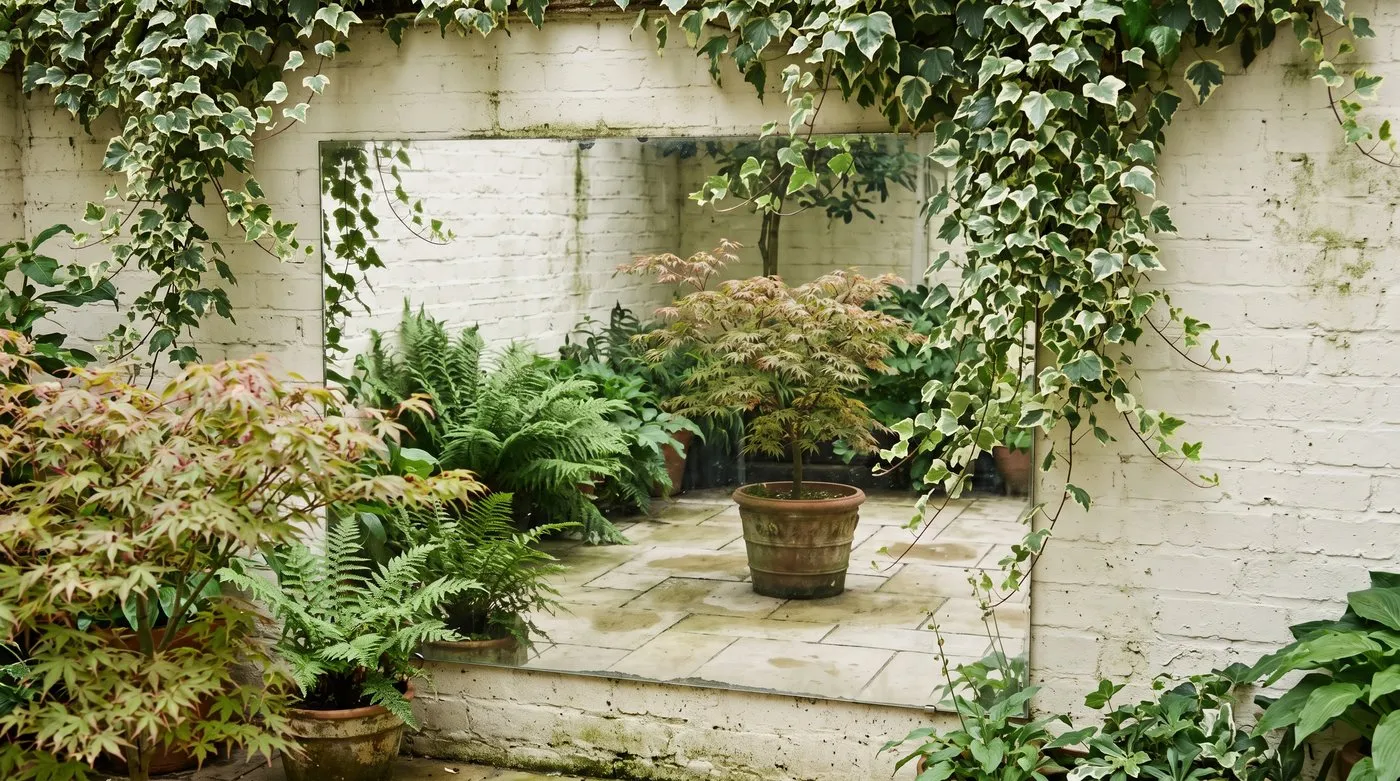
A big outdoor mirror on the darkest wall makes a courtyard look much deeper. Frame it with climbers so it reads like a window.
Climbers on courtyard walls
Good climbers for courtyard walls:
- Climbing hydrangea for shady walls. It clings on by itself and has white lacy flowers in summer.
- Star jasmine for sunny south or west walls. Evergreen and beautifully scented, grown on wires.
- Ivy for any wall. Quick, evergreen and self-clinging. Variegated forms like ‘Goldchild’ brighten a dark corner.
- Trachelospermum asiaticum as a more compact cousin of star jasmine, with smaller leaves.
See our best climbing plants for UK gardens for more ideas for every wall.
Planting for shade and shelter
Most courtyards get little direct sun, and that’s fine. Some of the loveliest garden plants are happiest in exactly these conditions.
Shade-tolerant structural plants
These are the backbone of your planting, giving shape and leaves all year.
- Fatsia japonica has big, glossy leaves that catch the light. Evergreen and bold, it’s the best single structural plant for a shady courtyard.
- Japanese maple (Acer palmatum) brings elegant shape and fiery autumn colour. It’s happy in a large pot, and a sheltered courtyard protects its delicate leaves from wind.
- Tree fern (Dicksonia antarctica) adds instant jungle drama. Wrap the crown to protect it from hard frost in winter.
- Box clips into balls, cubes or low hedges and copes with shade. Great in pots for a smart, formal look.
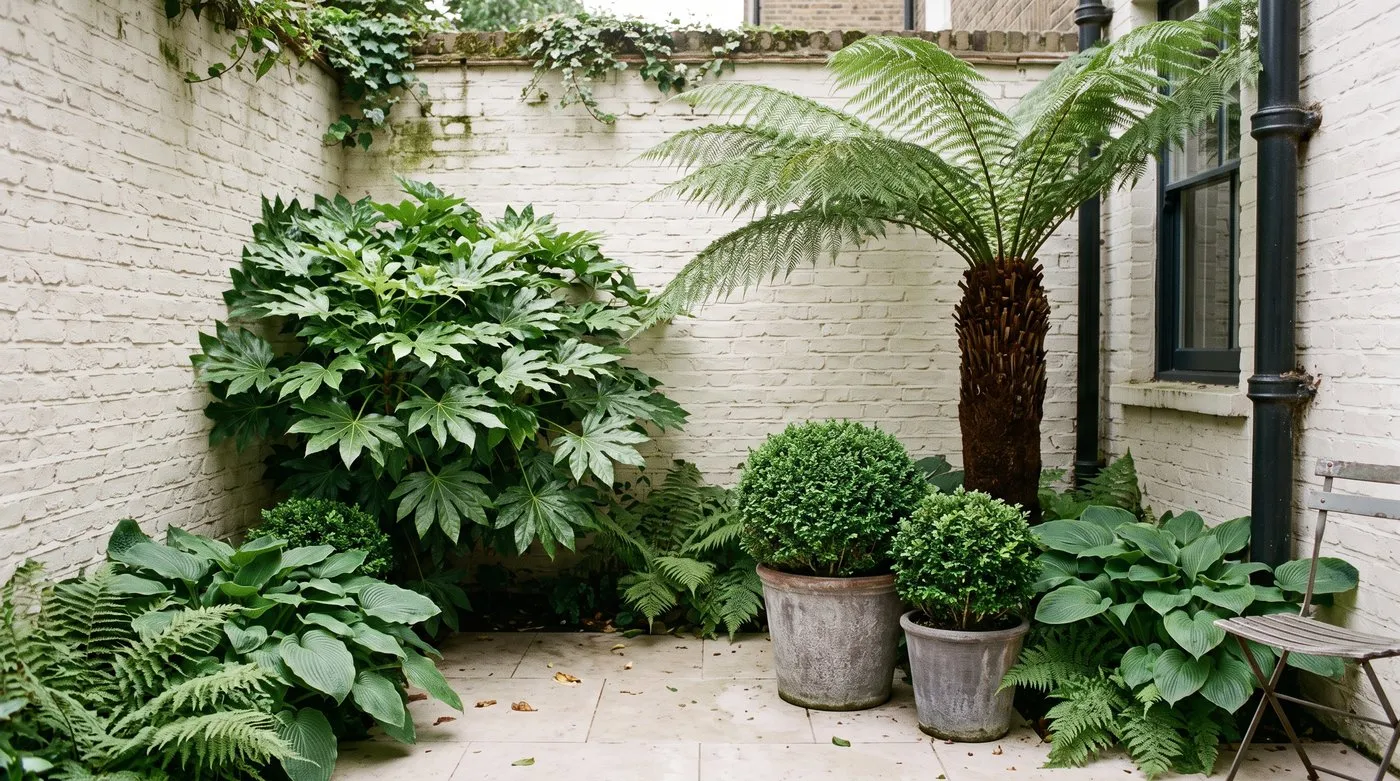
Bold evergreen leaves give a shady courtyard shape all year. Pale walls bounce what light there is onto the plants.
Shade-tolerant flowering plants
- Foxgloves send up tall flower spires in shade. They flower in their second year and then seed themselves around.
- Astilbe has feathery pink, red or white plumes in summer. It likes damp soil, which suits a shady courtyard.
- Brunnera has clouds of tiny blue forget-me-not flowers in spring. ‘Jack Frost’ has lovely silvery leaves that look good all season.
- Hellebores flower from late winter, when little else does. Hybrid hellebores come in the widest range of colours.
The RHS shade planting guide has more ideas, and so does our guide to the best plants for shade.
Courtyard planting plan (3m x 4m)
| Where | Plant | Why |
|---|---|---|
| Back wall (shady) | Climbing hydrangea | Covers the wall, summer flowers |
| Back corner | Fatsia japonica | Evergreen structure |
| Side wall | Star jasmine (if sunny) or ivy | Screening and scent |
| Centre pot | Japanese maple | A centrepiece with autumn colour |
| Floor pots (x4) | Hostas, heuchera, ferns | Leaf colour and texture |
| Wall or railing pots | Trailing ivy, cyclamen | Softens edges, seasonal colour |
Water features in courtyard gardens
Water brings sound, movement and sparkle to a courtyard. Even a small feature changes the whole feel of an enclosed space, and the trickle helps drown out traffic noise.

A wall spout pouring into a stone trough, surrounded by ferns and hostas
Self-contained features
These need no plumbing. A small pump hidden in a reservoir moves the water round. Plug it into an outdoor socket, or use a solar pump.
Types:
- Wall spouts: a lion’s head, modern blade or simple copper spout pouring into a basin. Needs only a small patch of wall.
- Bubbling spheres: water rises from the top of a drilled stone or ceramic ball and drains into a hidden reservoir under gravel. With no open water, it’s a safer choice when small children are around.
- Bowl features: a big ceramic or stone bowl with a small fountain. You can add a miniature waterlily or floating plants.
Running costs
Small pumps use very little electricity, so mains-powered features are cheap to run. Solar pumps cost nothing to run but only work in daylight.
Tip: Put your water feature where it catches whatever sun there is. Light dancing on moving water bounces onto the walls and plants and brightens the darkest corner.
Container gardening in courtyards
Container sizing guide
| Plant | Pot size | Best pot | Good to know |
|---|---|---|---|
| Small tree (maple, olive) | Large, 50 to 60cm across | Terracotta or fibreglass | A heavy pot stops it tipping |
| Shrub (box, fatsia) | 40 to 50cm | Any | Repot every few years |
| Perennial (hosta, heuchera) | 30 to 40cm | Any | Divide every few years |
| Herbs | 20 to 30cm | Terracotta | Group them together |
| Seasonal flowers | 25 to 35cm | Plastic pot inside a pretty one | Swap the inner pot each season |
Group pots in threes and fives at different heights for a natural, layered look. Stand them on pot feet so they drain well and don’t stain the paving.
Year-round container displays
If you can see the courtyard from the house, it needs to look good in every season. Keep some permanent plants and swap seasonal colour around them.
All year: Japanese maple, box balls, fatsia, tree fern, evergreen ferns. Spring: tulips, daffodils, primroses, wallflowers. Summer: hostas, astilbe, trailing fuchsias, begonias. Autumn: cyclamen, ornamental grasses, heathers. Winter: hellebores, snowdrops, winter violas, skimmia.
Lighting a courtyard garden
Lights turn a courtyard into an evening room. Light bounces off the walls, so a little goes a long way.
Lighting types and placement
| Type | Where | What it does |
|---|---|---|
| LED uplights | At the base of a special plant or wall | Drama and shadows |
| Festoon lights | Strung from wall to wall above head height | A warm, party feel |
| Wall lights | On the walls | A soft background glow |
| Candles and lanterns | Tables, shelves, the floor | Cosy and flickery |
| Solar path lights | Along paving edges | Helps you find your way |
Two uplights and one string of festoon lights are enough for a small courtyard. Shine an uplight up into your best plant, like the maple or tree fern, and enjoy the shadows on the walls. String the festoons from wall to wall, comfortably above head height.
Tip: Choose warm white bulbs (around 2700K on the box) rather than cool white. Cool white looks harsh and clinical, while warm white makes brick, stone and leaves look rich and inviting.
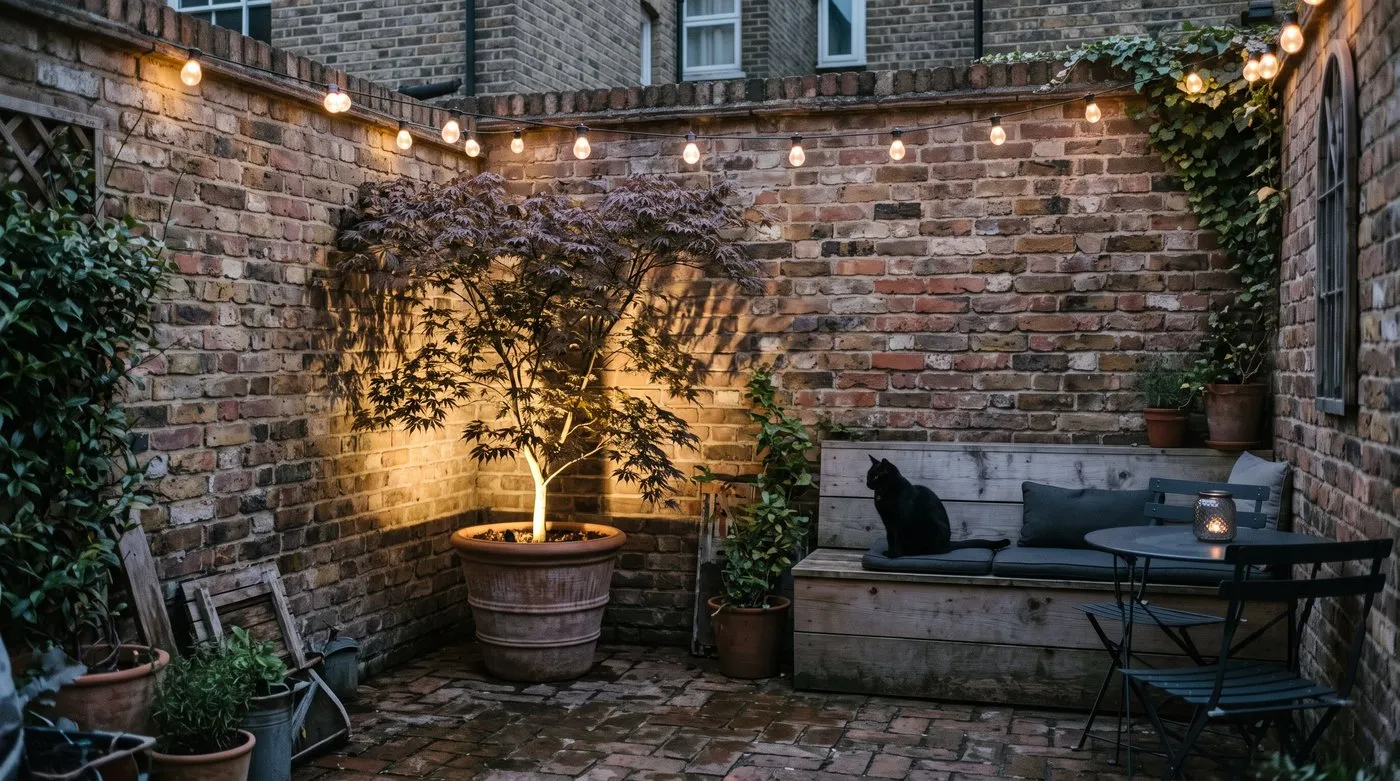
One string of warm white festoons and an uplight under your best plant is plenty for a small courtyard.
Furniture for small courtyard gardens
Pick furniture to suit the space. A big dining table and six chairs will swamp a small courtyard, so scale down.

A little bistro table under fairy lights, with climbing roses and jasmine on the walls
Bistro sets (a small round table and two chairs) take up about 1m square and fold flat when you need the space. Cast aluminium is light and weatherproof.
Built-in benches along a wall save floor space and can hide storage underneath. A 2m bench seats three.
Fold-down wall tables lie flat against the wall when not in use, then flip up for drinks or dinner.
For ideas on bringing indoor living outside, see our guide to garden room ideas.
Budget breakdown for courtyard garden projects
| Level | What it usually includes |
|---|---|
| Budget | Gravel, a fresh coat of pale paint, a few pots and plants, solar lights, your existing furniture |
| Mid-range | Porcelain paving, paint plus a mirror, a fuller planting scheme, a self-contained water feature, LED lights, a bistro set |
| High-end | Natural stone, rendered and painted walls, a made-to-measure water feature, professionally fitted lighting, built-in seating |
Paving is usually the biggest cost, and paint is the cheapest big change you can make. Get a few quotes if you’re paying for design and fitting.
Common mistakes with courtyard gardens
1. Using dark flooring in a shaded space
Dark paving soaks up what little light there is and makes the space feel smaller and gloomier. Go for pale porcelain, buff sandstone or light gravel, and save dark materials for small accents.
2. Planting sun-loving species
In a courtyard with only a couple of hours of sun, lavender, roses and Mediterranean herbs will stretch, flower poorly and look sad. Pick shade lovers instead and enjoy ferns, hostas and evergreen leaves.
3. Overcrowding the floor
A table, four chairs, six big pots and a water feature in a small courtyard leaves no room to breathe. Keep a good chunk of the floor clear. That space is what makes the planting look generous. Our guide to garden design on every budget has ideas for doing more with less.
4. Ignoring drainage
Courtyards collect rain from every roof and wall around them. Without good drainage, water pools against the house and can cause damp inside. Paving should slope gently away from the house towards a drain, channel or soakaway. Sort drainage out before laying the floor.
5. Skipping winter planning
If you see the courtyard from your kitchen window, it needs to look good all year. Summer-only planting leaves months of bare pots. Make plenty of the planting evergreen, and add winter flowers like hellebores, cyclamen and skimmia.
Now your courtyard is taking shape, read our guide on the best plants for shade to fill it with plants that will thrive.
Frequently asked questions
What plants grow best in a shaded courtyard?
Ferns, hostas, fatsia and climbing hydrangea all love shade. Heuchera gives coloured leaves all year in purple, bronze, lime and silver. Japanese maples like dappled light. For flowers, try foxgloves, astilbe and brunnera, which manage with just a couple of hours of sun.
How do I make a small courtyard feel bigger?
Paint the walls white or pale cream to bounce light around. Use one flooring material from edge to edge. Hang an outdoor mirror on the darkest wall. Keep furniture low and foldable, and leave plenty of the floor clear.
What is the best flooring for a courtyard garden?
Porcelain paving is the best all-rounder. It copes with frost, doesn’t grow much moss in shade and is easy to clean. Natural stone looks beautiful but needs sealing in a shady spot. Gravel is the cheapest choice, but it’s awkward under a table and chairs.
Can I have a water feature in a small courtyard?
Yes, a self-contained feature needs no plumbing. A wall spout, bubbling sphere or bowl fountain fits in a tiny corner and adds lovely sound and movement. Run the pump from an outdoor socket or use a solar pump.
How do I light a courtyard garden?
Use warm white uplights and a string of festoon lights. Shine uplights into your best plant or up a wall for depth, and string festoons from wall to wall above head height. Add candles or lanterns on the table. Skip floodlights, which kill the atmosphere.
What colour should I paint courtyard walls?
White or pale cream bounces the most light around. That really matters in a shady courtyard. If you fancy something bolder, paint just one wall a dark colour like charcoal, deep green or navy, and put pale plants in front of it.
How much does it cost to design a courtyard garden?
It depends mostly on the paving and who does the work. A DIY refresh with paint, gravel and pots is the cheapest. Porcelain paving, a water feature and lighting cost more. Paying a designer and installer costs the most, so get a few quotes.
Do courtyard gardens need drainage?
Yes, courtyards collect rain from the roofs and walls around them. Paving should slope gently away from the house towards a drain or soakaway. Without that, water can pool against the walls and cause damp indoors. A channel drain is a common fix.
Our team produces practical UK gardening guidance from source research, contributor records and established horticultural practice. Editorial standards are overseen by Matt W.