
Key takeaways
- Sow carrots straight into the ground from March to July, never in pots to move later
- Rake out stones and skip fresh manure, or you'll get forked roots
- Nantes varieties are the easiest all-rounders for UK gardens
- Keep carrot fly out with a 60cm mesh barrier or fleece over the row
- Short types like Chantenay and Amsterdam Forcing grow well in a 20cm-deep pot
- Sow a short row every three or four weeks for carrots all summer and autumn
Carrots are a favourite in British veg patches, and it’s easy to see why. They’re simple to grow from seed, don’t need much space, and taste so much better pulled fresh than anything from a supermarket bag.
Choosing carrot varieties
Start by picking the right type. There are dozens in the seed catalogues, but they all fall into a handful of groups by shape and speed.
| Type | Shape | Length | Ready in | Best for |
|---|---|---|---|---|
| Amsterdam Forcing | Slim and straight | 10-15cm | About 10-12 weeks | Pots, early sowings, baby carrots |
| Nantes | Straight with a blunt tip | 15-20cm | About 12-14 weeks | All-round use |
| Chantenay | Short and stumpy | 10-15cm | About 12-14 weeks | Heavy soil, pots, stews |
| Autumn King | Long and tapered | 20-30cm | About 16-20 weeks | Winter storage |
| Purple and rainbow | Mixed | 15-25cm | About 14-16 weeks | Colourful salads and roasting |
Good varieties for UK gardens
Nantes types are the best all-rounders. They grow straight, sweet roots with hardly any core. Nantes 2 is the classic. Nairobi is another good Nantes, and Bolero stores well.
Chantenay Red Cored is the one for heavier soils where longer carrots would fork. Its short, stumpy roots push through lumpy ground better. Chantenay Royal has richer colour.
Amsterdam Forcing 3 is the pick for pots and early sowings under cloches. The slim roots grow fast and taste lovely pulled young.
Autumn King is the classic winter storage carrot, with long, tapered roots that keep well. Sow it in April or May and lift it in October.
Purple Haze and rainbow mixes add a splash of colour to salads and roasting trays.
Handy tip: Grow at least two kinds. A quick Nantes for summer eating and Autumn King for winter storage gives you home-grown carrots for most of the year.
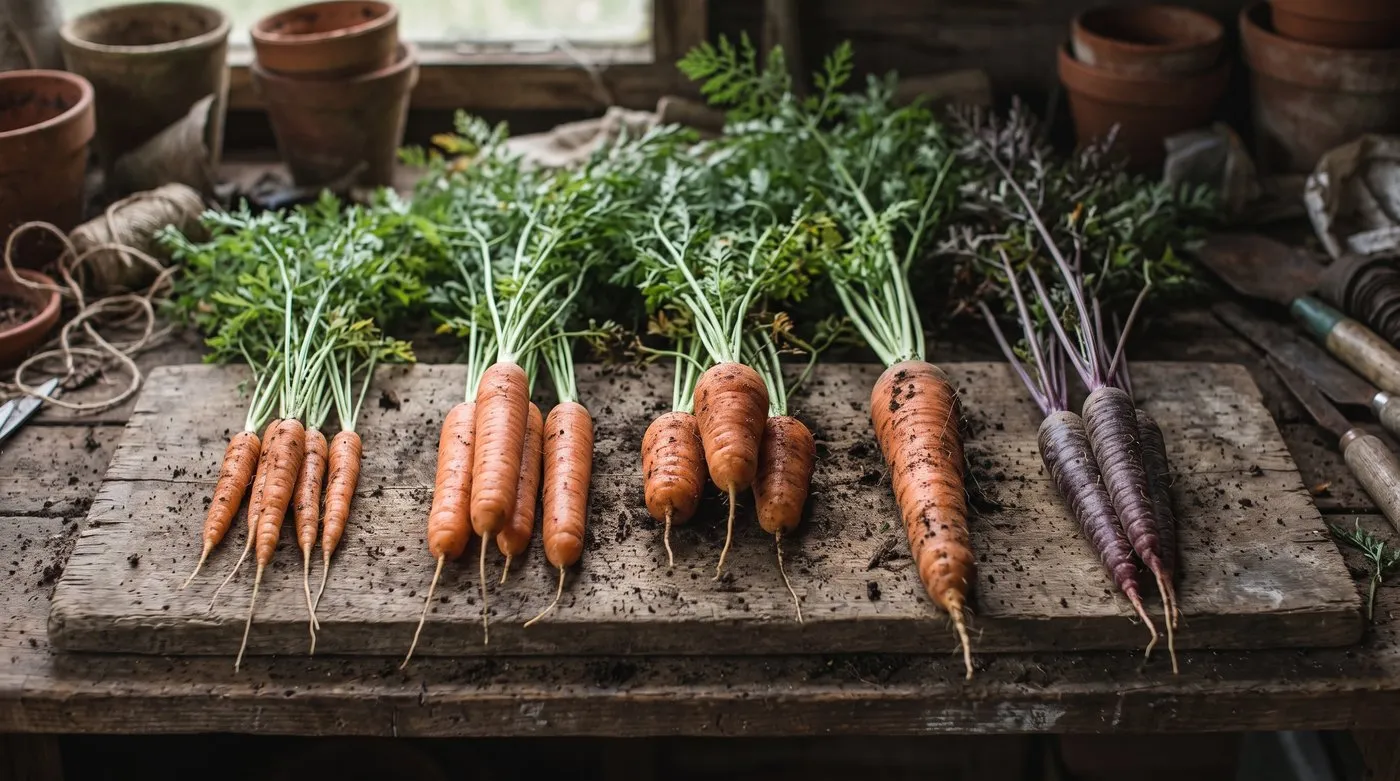
Short stumpy types cope best with heavy soil and pots, while long Autumn King is the one for winter storage. Growing two kinds stretches the season.
Getting the soil ready
Good soil matters more for carrots than for most veg. The roots grow straight down, and anything in the way makes them fork, split or stay stubby.
Get the stones out. Rake the bed well and remove stones, lumps and old roots. Even a small stone can make a carrot split around it. Light, sandy soil that drains well and warms up early is ideal.
Never add fresh manure. It makes roots fork wildly. If you want to add goodness, dig in well-rotted compost the autumn before and let it settle over winter.
Heavy clay isn’t ideal, but you can still grow carrots in it. Mix sharp sand and fine compost into the top 20-30cm, or grow short varieties like Chantenay or Amsterdam Forcing. Raised beds filled with a light mix solve the clay problem completely.
Feeding the soil
Carrots aren’t hungry plants. Too much feed gives you lots of leaves and small roots. A bed that grew well-fed cabbages or potatoes last year will usually have enough goodness left.
If you rotate crops, carrots go in the root veg bed. Don’t grow them in the same spot two years running, as pests and diseases build up.
How to sow carrots
Always sow carrots where they’re going to grow. They don’t like being moved. Even a gentle transplant damages the root and makes it fork.
When to sow
Carrot seed needs the soil to warm up a bit before it sprouts. In most of southern England that’s from early to mid-March. In northern England and Scotland, wait until late March or April.
For more timings, see our UK vegetable planting calendar.
- Early sowings (March to April): use quick varieties like Nantes or Amsterdam Forcing. Cover with cloches or fleece to warm the soil.
- Main sowings (April to June): the best time for all varieties, including Autumn King.
- Late sowings (June to July): quick Nantes types for an autumn crop. Sow by mid-July.
How to sow
- Rake the soil fine and pick out any stones
- Make a shallow drill 1-2cm deep with a cane or the edge of a hoe
- Water the drill first if the soil is dry
- Sprinkle the seed thinly along the drill. It’s tiny, so take your time
- Cover lightly with fine soil and firm gently with the back of a rake
- Space rows 15-20cm apart for early types, 25-30cm for maincrops
Carrot seed is slow to sprout, so expect to wait two to three weeks. Don’t give up on it. Sow a few radish seeds along the row too. They pop up in days and show you where the row is.
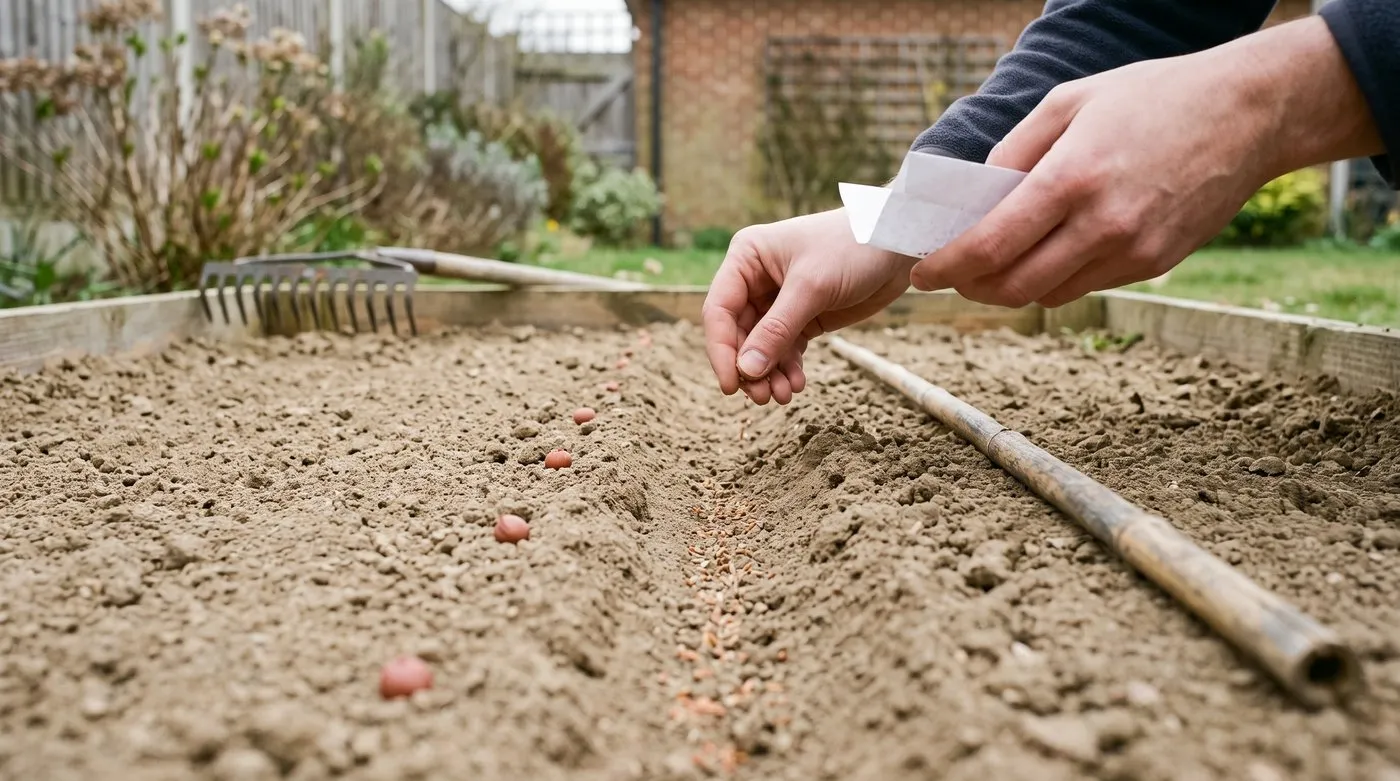
Sow carrot seed thinly and no deeper than 2cm. A few radish seeds along the row pop up in days and show you where it is.
Sowing little and often
A common mistake is sowing all your carrots at once. You end up with loads in late summer and none after. The fix is succession sowing: a short row every three or four weeks.
Sow from March to July and you’ll have fresh carrots from June to November. Here’s a simple plan:
| Sow | Type | Ready to pull |
|---|---|---|
| Early March (under cloches) | Amsterdam Forcing, early Nantes | June |
| Late March | Nantes | July |
| Mid-April | Nantes, Chantenay | August |
| Early May | Autumn King, Nantes | September |
| Late May | Autumn King | October |
| Mid-June | Nantes | October to November |
| Early July | Quick Nantes | November |
Our guide to how to sow seeds indoors covers general seed sowing, but remember carrots always go straight into the soil outside.
Thinning seedlings
Crowded carrots grow small and spindly, so thinning matters. The catch is that crushed carrot leaves give off a smell that draws in carrot fly. So be quick and tidy about it.
Thin in two goes. When seedlings are 2-3cm tall, pull out the weakest to leave about 3cm between plants. A few weeks later, thin again to 5-8cm apart. More space means bigger carrots.
Pick a still day. Water the row before and after, so the soil settles back around the carrots that stay. Pinch unwanted seedlings off at soil level rather than pulling them, which disturbs the others less. Take all thinnings away from the bed.
You can skip most thinning by sowing very thinly in the first place. Pelleted seed, where each seed has a little clay coat, makes this much easier.
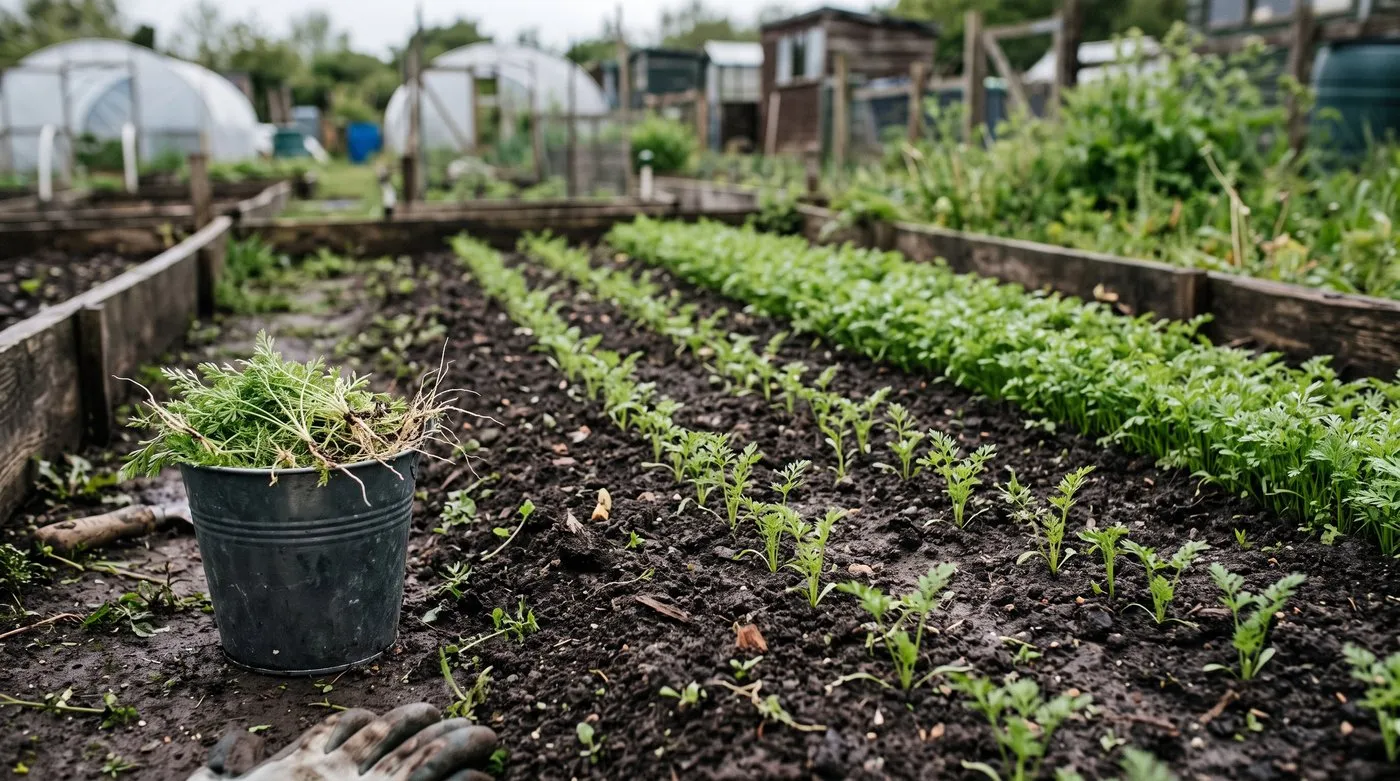
Thin on a still day and water before and after. Take the thinnings away, as their smell draws in carrot fly.
Keeping carrot fly away
Carrot fly is the biggest carrot problem in the UK. The female lays eggs at the base of the plants, and the maggots tunnel into the roots. A bad attack can ruin most of a row.
How carrot fly finds your carrots
It follows its nose. Crushed or bruised carrot leaves give off a smell the fly can pick up from a long way off, and thinning is the main trigger. It’s a weak flier and stays low, within about 60cm of the ground.
Barriers and covers
The best defence is a barrier at least 60cm tall around the bed. Use fine insect mesh held up on canes or a wooden frame. Or cover the whole bed with fleece or fine mesh straight after sowing and leave it on until harvest.
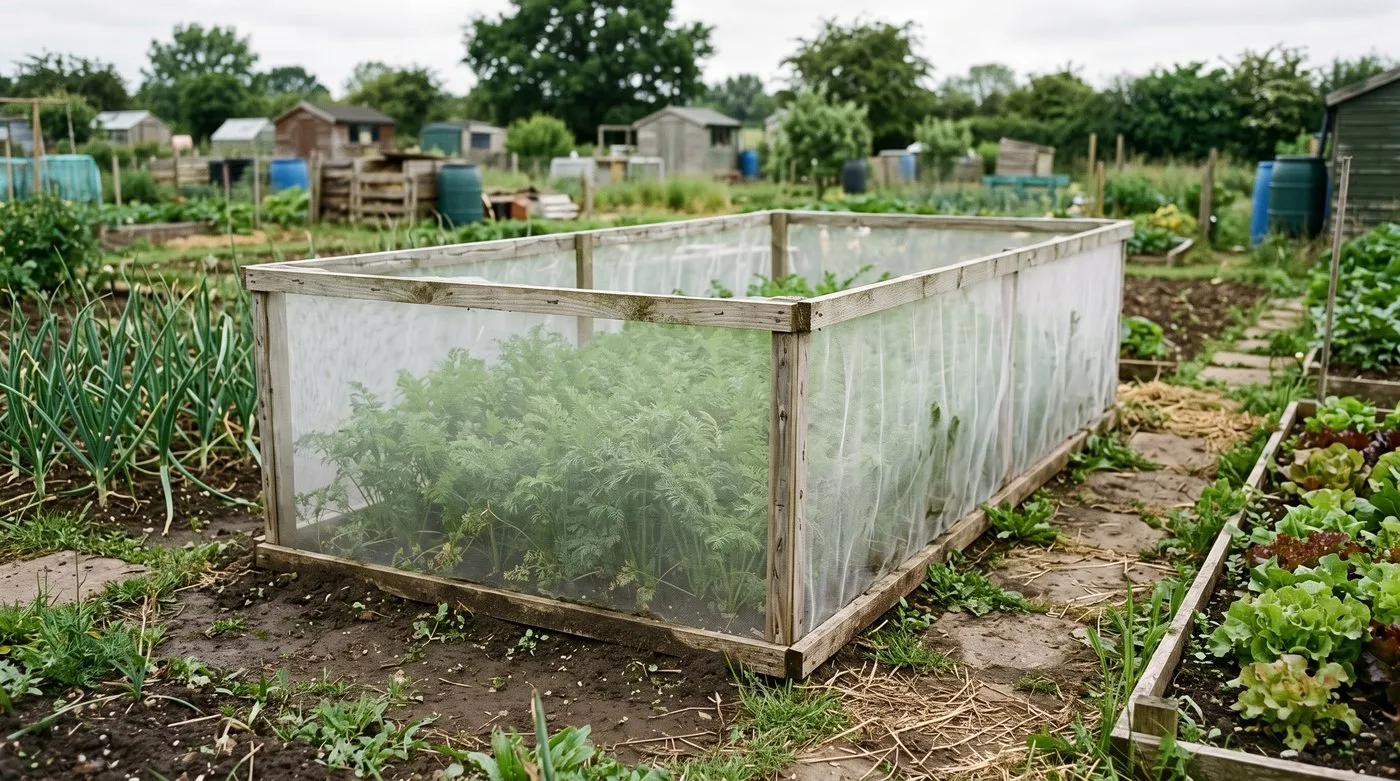
Carrot fly stays low to the ground, so a mesh wall at least 60cm tall keeps most of them out. A full fleece cover works too.
Companion planting
Some gardeners grow onions, spring onions or chives between carrot rows to hide the carrot smell. It won’t stop carrot fly on its own, but it’s an easy extra to try alongside a barrier.
Resistant varieties
Flyaway, Resistafly and Sytan are less tempting to carrot fly and get less damage. They aren’t immune, but they help.
Sowing time
Carrot fly comes in waves, first in late spring and again in late summer. Sowing after early June misses the first wave, which is why later sowings often give the cleanest roots.
Growing carrots in pots
Pots are a great answer if your soil is stony, heavy clay, or plagued by carrot fly. You choose the compost, and a tall pot lifts the crop up and out of the fly’s way.
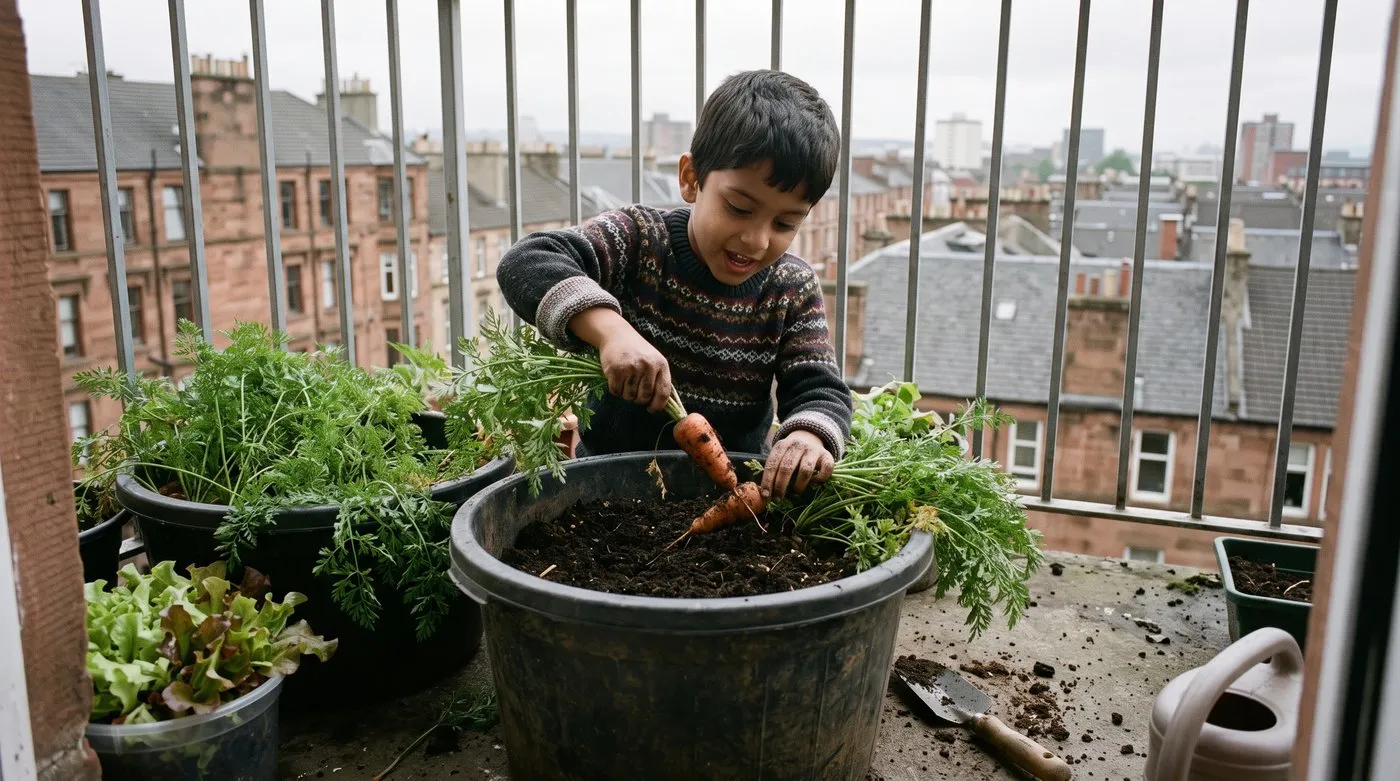
A deep tub of compost and sand gets around stony or clay soil, and lifts the crop up away from carrot fly. Short types suit pots best.
Picking a pot
Any pot at least 20cm deep works for short types like Amsterdam Forcing and Chantenay. For Nantes, go for 30cm. Old wooden crates, big pots, grow bags and window boxes all work, as long as there are drainage holes.
What to fill it with
Use multipurpose compost mixed half and half with sharp sand or perlite. This gives the light, free-draining mix carrots like. Don’t use garden soil, which can bring in stones, weeds and carrot fly.
Sowing and care
Scatter seed thinly over the surface or sow in rows 10cm apart. Cover with 1cm of fine compost and water gently with a fine rose. Thin seedlings to 3-5cm apart.
Pots dry out faster than the ground, and uneven watering makes roots split. Check them every day in hot weather. Fresh compost usually has enough food, so you rarely need to feed.
Month-by-month carrot calendar
| Month | What to do |
|---|---|
| February | Order seed. Rake out stones. Put cloches over the bed to warm the soil |
| March | First sowings under cloches in the south. Sow outside in late March in mild areas |
| April | Main sowing time. Sow Nantes, Chantenay and maincrops |
| May | Keep sowing short rows. Thin early sowings. Put up carrot fly barriers |
| June | Pull the first baby carrots. Last sowing of Autumn King. Sow more Nantes |
| July | Last sowings of quick types. Water steadily in dry spells |
| August | Harvest summer sowings. Watch for the second wave of carrot fly |
| September | Lift maincrops for storage. Leave some in the ground for fresh pulling |
| October | Cover the rows left in the ground with straw. Store lifted roots in damp sand |
| November | Keep pulling from the ground as needed. A light frost makes them sweeter |
Our UK vegetable planting calendar covers what to sow when across the whole veg patch.
Watering and feeding
Carrots aren’t demanding, but they do like steady moisture. Uneven watering is the main cause of split roots. If the soil dries out and then gets a soaking, the roots swell suddenly and crack.
Water once or twice a week in dry weather, giving a good soak each time. A soaker hose along the row makes it easy.
Carrots don’t need much feeding. Too much feed gives bushy leaves and small, hairy roots. If you prepared the soil with compost, you won’t need any more. On very poor soil, sprinkle a little general fertiliser before sowing.
Common carrot mistakes
These catch out plenty of gardeners, so here’s how to dodge them.
Sowing too deep. Carrot seed is tiny and can’t push up through much soil. Sow 1-2cm deep and no deeper.
Sowing too thickly. Crowded seedlings fight for space. Thinning feels wasteful, but fewer well-spaced carrots give you more to eat.
Adding fresh manure. This is the main cause of forked carrots. Use only well-rotted compost, ideally dug in the autumn before.
Forgetting to thin. Unthinned carrots tangle together and stay thin. Thin twice, as above.
Skipping carrot fly protection. Once the maggots are in the roots, that crop can’t be saved. A barrier or cover is the only real answer.
Uneven watering. A dry spell followed by a soaking splits roots. Water steadily and mulch to hold moisture.
Leaving them too long. Oversized maincrops can turn woody. Pull one to check before the whole row is past its best.
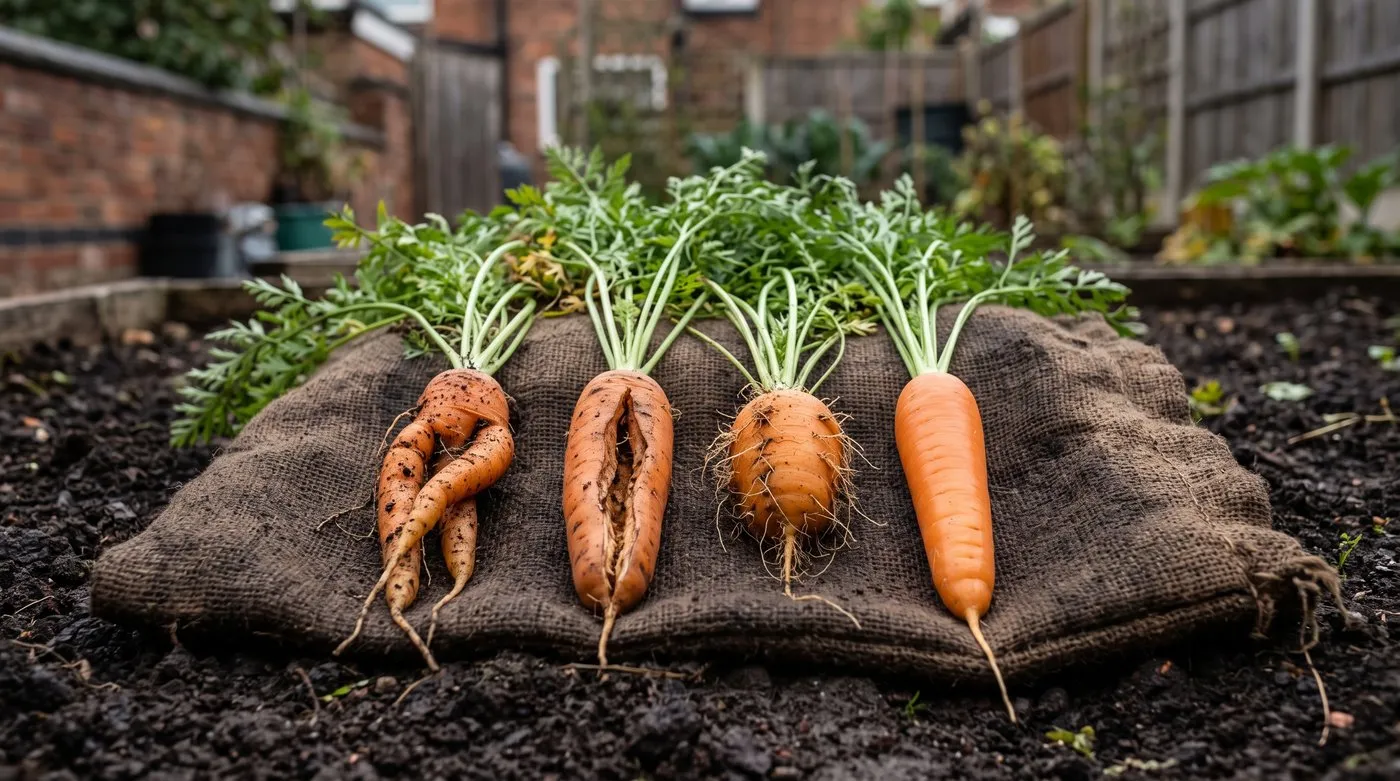
Forked roots usually come from fresh manure or stones, and splits from a soaking after a dry spell. Steady watering and stone-free soil give straight carrots.
Harvesting carrots
Most carrots are ready about three to four months after sowing. You’ll see the shoulders of the roots at the soil surface as they get close. For baby carrots, pull them when they’re finger-thick.
Loosen the soil beside the row with a fork before pulling. Yanking them out of firm ground snaps the tips off. Watering the row an hour before helps too.
Early types like Amsterdam and Nantes are best eaten fresh, as they don’t store well. Pull them as you need them and eat within a few days.
Maincrops like Autumn King and Chantenay keep well and can stay in the ground until you want them. A light frost makes them taste sweeter. If a hard frost is on the way, cover the row with a thick layer of straw or fleece.
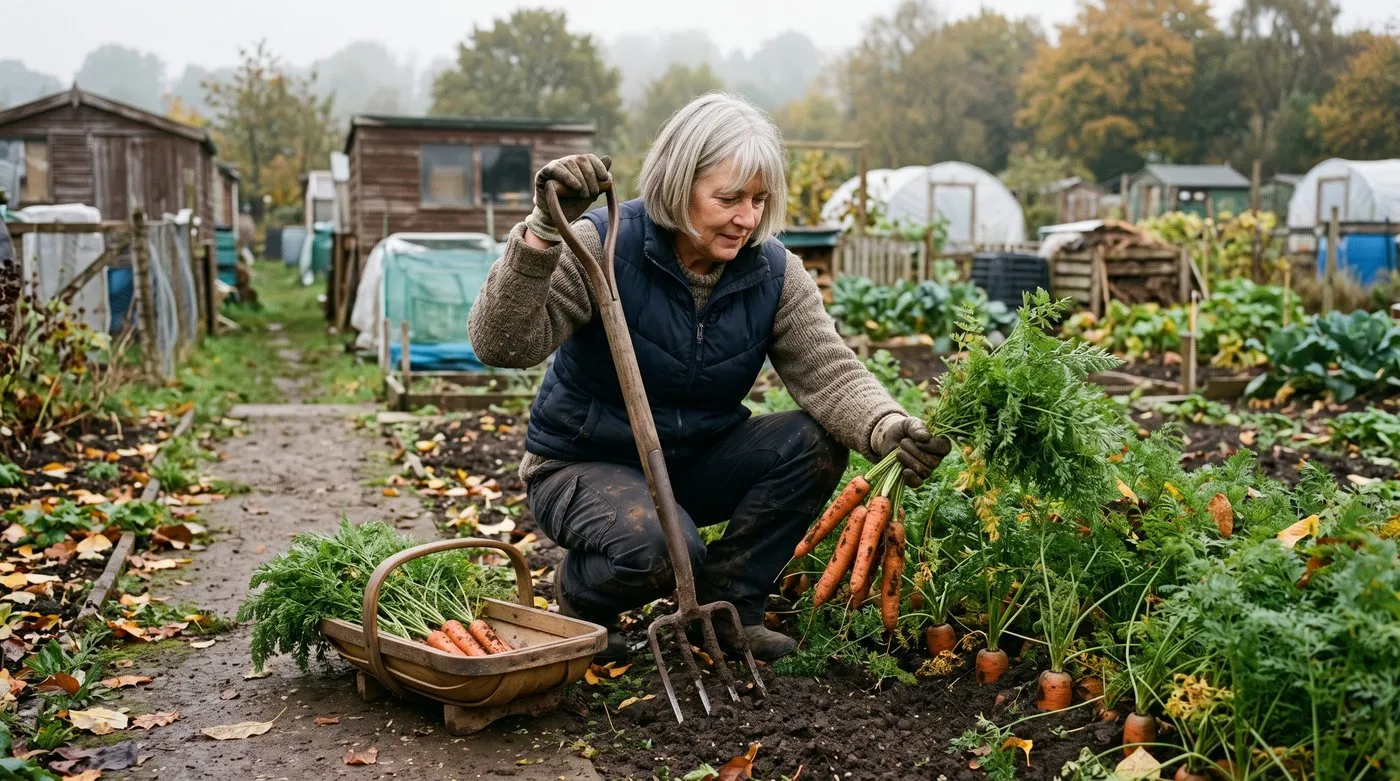
Loosen the soil with a fork first so the tips don’t snap off. Watering the row an hour before makes pulling easier too.
Storing your carrots
For winter storage, lift maincrops on a dry day in October, before the ground gets waterlogged. Twist the leaves off rather than cutting them, as a cut stump can rot. Brush off loose soil but don’t wash them.
In sand
The old way is still the best. Layer unwashed carrots in boxes of damp (not wet) sand, so no roots touch. Keep the boxes somewhere cool, dark and frost-free, like a garage, cellar or unheated shed. Check every few weeks and remove any with soft spots.
Stored like this, maincrops keep for months, often until March.
In the freezer
Wash, peel and cut into batons or slices. Blanch them in boiling water for 3 minutes, then plunge into iced water. Drain, bag and freeze. Blanching keeps their colour and crunch.
In the ground
In mild winters, especially in southern and western England, maincrops can stay in the ground. Cover the row with 10-15cm of straw, held down with fleece or netting, and pull them as you need them.
Good companions for carrots
The best-known pairing is carrots and onions. Onions may help hide the smell of carrots from carrot fly, and the two grow well side by side on the allotment.
Lettuce and radishes make good quick crops between carrot rows. They’re ready and gone before the carrots need the space.
Keep carrots in the same part of the rotation as their relatives, like parsnips, celery and celeriac, as they share pests and diseases.
Now you’ve mastered carrots, read our guide on growing parsnips in the UK, the natural next root vegetable for your veg patch.
Frequently asked questions
When should I sow carrots in the UK?
Sow outdoors from March to July. In the south you can start in late February under cloches. March sowings give you your first carrots in June. Sow quick Nantes types by mid-July for an autumn crop.
Why are my carrots forked and misshapen?
Stones or hard, lumpy soil are usually to blame. The root splits when it hits something in its way. Fresh manure causes forking too. Rake out stones and use only well-rotted compost. Loose, sandy soil gives the straightest carrots.
How do I stop carrot fly?
Cover the crop or put up a barrier. Carrot fly sniffs out carrots and flies close to the ground, so a 60cm wall of fine mesh or fleece around the bed keeps it out. Thin as little as you can, and resistant varieties like Flyaway and Resistafly help too.
Can I grow carrots in pots?
Yes, short-rooted types do really well in pots. Use a pot at least 20cm deep for Chantenay or round types, or 30cm for Nantes. Fill it with multipurpose compost mixed with sharp sand. Thin seedlings to 3-5cm apart and water often.
Do carrots need full sun?
They grow best in full sun. They’ll cope with light shade, but the roots grow more slowly and end up smaller. Avoid deep shade.
How do I know when carrots are ready to harvest?
Most are ready about three to four months after sowing. You’ll see the orange tops of the roots peeping out of the soil. For baby carrots, pull them when they’re finger-thick. Maincrops can stay in the ground until you need them, and a light frost makes them taste sweeter.
How should I store harvested carrots?
Twist off the leaves straight after lifting. Store unwashed carrots in boxes of damp sand somewhere cool, dark and frost-free, and they’ll keep for months. You can also leave maincrops in the ground over winter under a thick layer of straw.
Our team produces practical UK gardening guidance from source research, contributor records and established horticultural practice. Editorial standards are overseen by Matt W.


