
Key takeaways
- Make beds about 1.2 metres wide so you never need to step on the soil
- Main paths of 75-90cm fit a wheelbarrow, and 45cm is fine between beds
- A quarter plot is a great size for a first allotment
- Put the shed and compost bays at the north end so they don't shade your crops
- Split your growing beds into four groups and move crops round each year
A good allotment layout makes everything easier. Get the bed widths, paths and rotation beds right at the start and the rest falls into place.
UK allotment plot sizes
A full plot is traditionally 10 rods, about 250 square metres, and a half plot is about 125. Councils call them different things, but the National Allotment Society uses “5-rod” for a half plot and “10-rod” for a full one.
| Plot | Roughly | Beds that fit | Who it suits |
|---|---|---|---|
| Quarter plot | 62 sq m | 6-8 | Beginners and busy people |
| Half plot | 125 sq m | 10-14 | The most common size |
| Three-quarter plot | 187 sq m | 14-18 | Keen growers |
| Full plot | 250 sq m | 18-24 | Lots of time and a big appetite |
Quarter-plot starter layout plan
A quarter plot, roughly 5m x 12.5m, is the perfect first allotment. It grows enough to make a real difference to your shopping without taking over your life.

A simple starter layout with six beds, a central path and a compost bay in the north corner.
Layout for a 5m x 12.5m plot:
- 6 beds, each 1.2m wide and 2.4m long
- A central path 75cm wide down the full length
- Side paths 45cm wide between beds
- A compost bin in the north corner
- A water butt on a stand at the south end
That gives four beds for rotation, plus two spare.
What to grow where:
- Beds 1-4: crop rotation (cabbage family, peas and beans, roots, potatoes)
- Bed 5: herbs, strawberries or winter crops
- Bed 6: salad leaves, radishes and other quick crops
Our raised bed gardening guide for beginners covers building beds, timber choices and no-dig set-up for a plot this size.
Half-plot layout plan (5 rods / 125 sq m)
A half plot of about 125 square metres is the most common size. It’s big enough for a full rotation, a fruit corner, compost and a small shed, without being too much.
Layout for a 10m x 12.5m plot:
- 12 beds, each 1.2m x 3m
- A main path 90cm wide down the full length
- A cross path 75cm wide halfway along
- Side paths 45cm wide between beds
- A small shed and two compost bays at the north end
- A water butt next to the shed, fed from the gutter
Split the beds into three areas:
- South end (sunniest): four rotation beds for your main crops
- Middle: salads, herbs, squash and courgettes
- North end (some shade from the shed): compost, rhubarb, mint and winter crops
The RHS allotment advice suggests keeping permanent crops like rhubarb and soft fruit out of the rotation beds.
Full-plot layout plan (10 rods / 250 sq m)
A full plot of about 250 square metres takes real commitment. The reward is fresh vegetables most of the summer and plenty to pick in winter too.

A full plot with 20 beds, a fruit area, two compost bays and a proper shed.
Layout for a 10m x 25m plot:
- 20 beds, each 1.2m x 3.6m
- A main path 90cm wide down the full length
- Three cross paths 75cm wide, spaced evenly
- Side paths 45cm wide
- A shed, two compost bays and water storage at the north end
- A soft fruit area at the south end for strawberries, raspberries and gooseberries
How to split a full plot:
| Area | Size | What goes there |
|---|---|---|
| Fruit area, south end | About 18 sq m | Strawberries, raspberries, currants |
| Main growing area | 12 beds | Crop rotation and main crops |
| Second growing area | 8 beds | Salads, herbs, cabbages, squash |
| Working area, north end | About 20 sq m | Shed, compost and potting space |
With this many beds, it’s easy to forget what went where. Our crop rotation planner helps you keep track.
Bed sizes that make life easy
About 1.2 metres is the ideal bed width. Most people can reach the middle from either side without stepping on the soil. If you’re shorter or don’t reach far, go for 90cm.
Don’t go wider than 1.5 metres. Any wider and you’ll tread in the middle, squashing the soil just where the roots need it loose.
Length is up to you. Most allotment beds are 2.4-3.6m long. Shorter beds are easier to get round. A 1.2m x 3m bed fits neatly on most half plots.
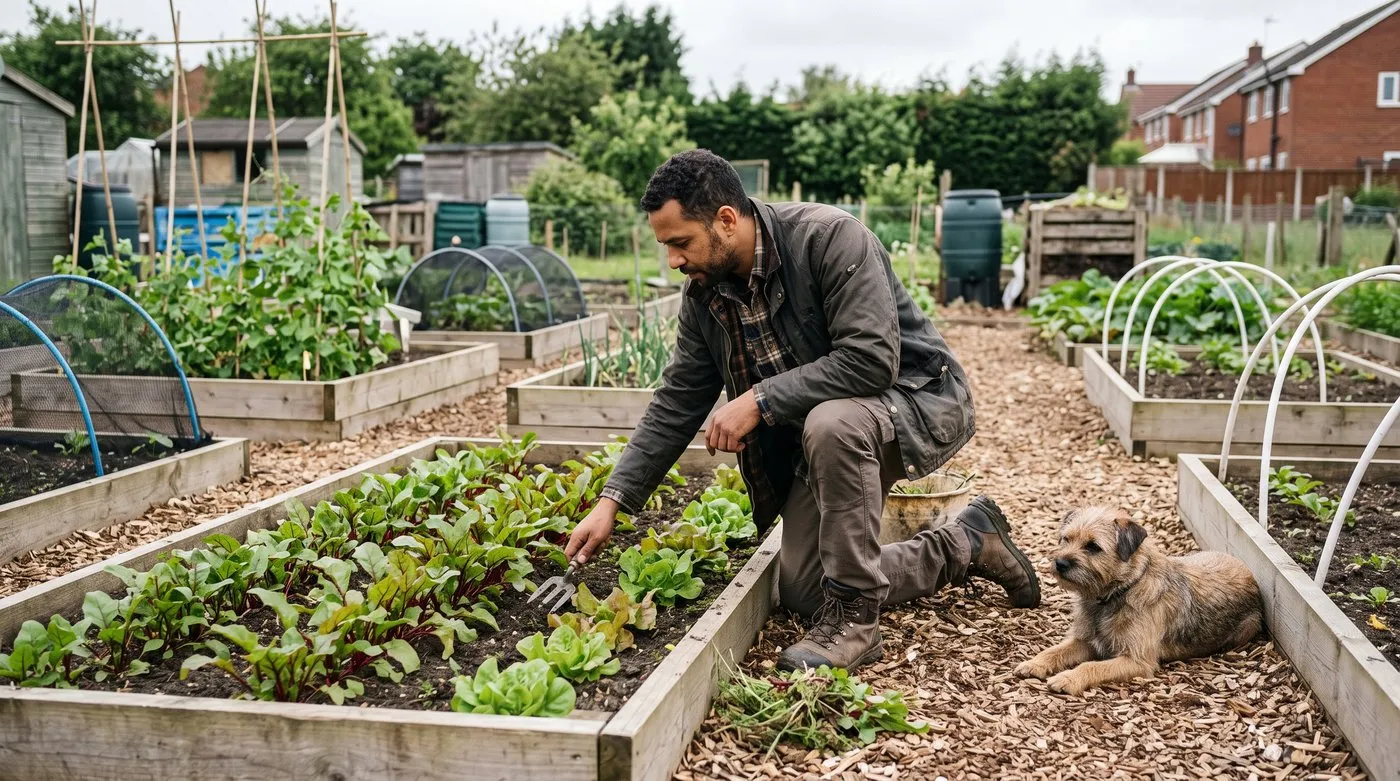
At about 1.2 metres wide you can reach the middle from the path, so you never tread on the soil.
Path widths most new growers get wrong

Wide bark chip paths stay usable in all weathers and keep your feet off the beds.
Make paths wider than you think. Narrow paths look fine in spring but disappear under crops by midsummer.
| Path | At least | Better | Why |
|---|---|---|---|
| Main path | 60cm | 75-90cm | Room for a wheelbarrow and your harvest |
| Cross paths | 45cm | 60-75cm | Room to kneel and carry buckets |
| Between beds | 30cm | 45cm | Room for your feet and knees |
| Under bean poles and arches | 60cm | 90cm | Room to get under climbing crops |
Cover your paths to keep them usable all year. On heavy clay, bare paths soon turn rutted and muddy. Some easy options:
- Wood chip, often free from tree surgeons, keeps weeds down
- Membrane with gravel on top, tidy and long-lasting for main paths
- Cardboard with wood chip on top, a cheap short-term fix
- Slabs or stepping stones, permanent but pricier, best for main paths
Crop rotation: the four-bed system
Split your growing beds into four groups and move each crop family on every year. It helps stop pests and diseases building up and shares out the goodness in the soil.
The four groups:
| Group | Crops | What they like | Next year they move to |
|---|---|---|---|
| Cabbage family | Cabbage, kale, broccoli, sprouts, cauliflower, swede | Firm soil, limed if acid | Roots bed |
| Peas and beans | Runner, French and broad beans, peas | Leave goodness in the soil | Cabbage bed |
| Roots | Carrots, parsnips, beetroot, celery, celeriac | Loose soil, no fresh manure | Potato bed |
| Potatoes and onions | Potatoes, tomatoes, onions, garlic, leeks | Rich, well-manured soil | Peas and beans bed |
Four-year plan:
| Year | Bed 1 | Bed 2 | Bed 3 | Bed 4 |
|---|---|---|---|---|
| Year 1 | Cabbage family | Peas and beans | Roots | Potatoes |
| Year 2 | Roots | Cabbage family | Potatoes | Peas and beans |
| Year 3 | Potatoes | Roots | Peas and beans | Cabbage family |
| Year 4 | Peas and beans | Potatoes | Cabbage family | Roots |
Each family only comes back to the same bed every four years. Rotation won’t cure every problem, though. Clubroot in cabbages can last in the soil for many years once it’s there.
Our crop rotation planner goes into more detail, including odd-shaped plots and how to fit in companion planting.
Where to put the shed, compost and water
Put the shed at the north end. Its shadow then falls away from your beds. A shed at the south end shades your best beds from autumn to spring, when light is already short.
Most sites have rules on shed size and height, so check your tenancy agreement before you buy.
Compost bays go next to the shed, also at the north end. Two bays is the minimum for a half plot: one filling up and one rotting down. A full plot is better with three. Our guide on how to make compost covers building bays and what to put in.
Water butts go by the shed, fed from the gutter. Every 10mm of rain on a 3m x 2m roof gives you about 60 litres. To spread out how much water you need at once, use succession planting rather than sowing everything together.
Layout tips for a productive plot
Run beds north to south if you can, so both sides get even light during the day.
Put tall crops on the north side. Sweetcorn, Jerusalem artichokes and climbing beans should go where they won’t shade shorter crops. Sweetcorn at the south end shades everything behind it by midsummer.
Give heat-lovers the sunniest spot. Tomatoes, cucumbers, aubergines and courgettes love a warm, sheltered bed, ideally against a south-facing fence or wall.
Plan for winter too. Leave room for kale, leeks, parsnips and garlic, and space for broad beans and onion sets sown in autumn. Our vegetable growing guide helps you plan the whole year.
Frequently asked questions
What is the standard size of a UK allotment plot?
A full plot is traditionally 10 rods, about 250 square metres. A half plot is around 125 square metres and a quarter plot around 62. A rod is an old measure, and one square rod is about 25 square metres. Many councils now offer half plots to new tenants, as they’re easier to fit round work and family.
How wide should allotment beds be?
About 1.2 metres wide works best for most people. You can reach the middle from either side without stepping on the soil. Up to 1.5 metres is fine if you have a long reach. Any wider and you’ll end up treading in the middle. Length is up to you, usually 2.4 to 3.6 metres.
How wide should paths be on an allotment?
Make main paths 75-90cm wide for a wheelbarrow. Paths between beds work well at about 45cm. Narrower paths vanish under crops by midsummer and turn muddy when wet. Covering paths with wood chip, gravel or membrane cuts weeding and keeps them usable all year.
Where should I put the shed on my allotment?
Put it at the north end of the plot. That way its shadow falls away from your beds. Fit guttering and a water butt to catch rain from the roof. Most sites have rules on shed size and materials, so check with your site manager before you build.
How do I plan crop rotation on an allotment?
Split the plot into four beds or areas of about the same size. Give each one a crop group: potatoes, peas and beans, the cabbage family, and roots. Onions can share the potato bed. Each year, move every group on to the next bed. It helps keep pests and diseases down and takes four years to go full circle.
How many raised beds fit on a half-plot allotment?
Roughly 8-12 beds of 1.2 x 2.4 metres, depending on your paths. Or go for four longer beds of 1.2 x 3.6 metres for a simple four-bed rotation with roomy paths. Either way, you’ll still have room for a shed, compost bays and a water butt.
Are raised beds allowed on a council allotment?
Most councils allow them, but check your tenancy agreement first. Some sites limit height or materials, though many allow taller beds for easier access. Raised beds warm up faster in spring, drain better on clay and save bending. They’re a popular choice, especially with new plot holders.
Related reading
- How to Start an Allotment in the UK, applying, waiting lists and first costs
- Allotment Rules UK, what your tenancy agreement covers
- Crop Rotation Planner UK, the four-bed rotation in more detail
- Raised Bed Gardening for Beginners, building beds, soil and no-dig
- Succession Planting Guide UK, sowing little and often for steady harvests
Our team produces practical UK gardening guidance from source research, contributor records and established horticultural practice. Editorial standards are overseen by Matt W.


