
Key takeaways
- Summer and autumn raspberries are pruned in completely different ways
- Plant bare-root canes from November to March while they're dormant
- Space canes 40-50cm apart in rows about 1.8m apart
- Summer types need posts and wires to hold them up
- A well-kept row crops for many years
- Net the fruit as soon as it starts to colour, or the birds get there first
Raspberries are one of the most generous soft fruits you can grow. A healthy row crops for many years, and fresh-picked berries taste far better than anything from a punnet. They freeze well and make brilliant jam, so nothing goes to waste.
Our cool, damp climate suits them perfectly. They cope with a bit of shade, and grow well everywhere from Cornwall to the Highlands. The one thing to get right is knowing whether you’re growing summer or autumn raspberries, because they’re pruned differently. Browse our growing guides for more fruit and veg ideas.
Summer-fruiting vs autumn-fruiting raspberries
This is the big one to understand before you plant. Prune the wrong way and you’ll cut off next year’s fruit.
Summer-fruiting types (floricanes)
 Summer raspberry canes tied to posts and wires.
Summer raspberries fruit on canes that grew last year. In year one, a cane grows tall and green. In year two, it flowers, fruits in June and July, then dies. New canes grow alongside it each summer, ready for next year.
After picking, cut out the old brown canes and tie in the new green ones. Summer types grow tall, so they need posts and wires.
Autumn-fruiting types (primocanes)
Autumn raspberries fruit on canes that grew this year. The canes come up in spring and fruit from August to October.
Pruning couldn’t be easier. In February, cut every cane to the ground. New canes appear in spring and off you go again. Autumn types are shorter and often stand up on their own.
Choosing the best raspberry varieties
Summer types give a big crop over a few weeks. Autumn types spread the picking out and are easier to look after. Grow both and you’ll have raspberries from June to October.
Best summer-fruiting varieties
- Glen Ample: a popular, reliable choice. Spine-free canes and big crops of large, firm berries.
- Glen Moy: an early one, fruiting from mid-June. Spine-free, with good flavour. Great for northern gardens.
- Tulameen: famous for its flavour, with large berries. Best in a sheltered southern or Midlands garden.
- Malling Jewel: compact and reliable in exposed spots. Good for smaller gardens.
Best autumn-fruiting varieties
- Autumn Bliss: the classic. Large, dark red berries from August to October, and very reliable.
- Polka: big, glossy, sweet berries. Can start in late July in a warm year.
- Joan J: spine-free canes and large, tasty berries. Lovely for easy picking.
- All Gold: golden-yellow berries, sweeter and milder. Birds seem less keen on them than on red ones.
Variety comparison table
| Variety | Type | Picking | Flavour | Spines | Good for |
|---|---|---|---|---|---|
| Glen Ample | Summer | Late June to July | Good | No | A reliable main crop |
| Glen Moy | Summer | Mid-June to July | Good | No | Early fruit, northern gardens |
| Tulameen | Summer | July | Excellent | Yes | The best summer flavour |
| Malling Jewel | Summer | July | Good | Yes | Exposed sites, small gardens |
| Autumn Bliss | Autumn | August to October | Very good | Yes | A reliable autumn crop |
| Polka | Autumn | Late July to October | Very good | Yes | Big crops, long season |
| Joan J | Autumn | August to October | Excellent | No | Easy picking |
| All Gold | Autumn | August to October | Sweet, mild | Yes | Something different |
Tip: Plant one summer and one autumn variety, such as Glen Ample and Autumn Bliss. You’ll be picking from late June right through to October.
How to plant raspberry canes
When to plant
Plant bare-root canes from November to March, while they’re dormant. November and December are ideal, as the roots settle in over winter. Don’t plant into frozen or waterlogged ground.
 Planting bare-root raspberry canes in a trench, with the roots spread out.
Pot-grown plants can go in at any time, but autumn and winter planting still works best.
Choosing a site
Pick a sunny or lightly shaded spot, out of strong wind. Full sun gives the sweetest berries, but raspberries cope with a bit of shade better than strawberries or blueberries. Avoid deep shade and soggy ground.
They like soil that holds moisture but drains well, and slightly acid to neutral. Thin, chalky or very dry soil doesn’t suit them. Dig in plenty of garden compost or well-rotted manure first. Our peat-free compost guide has more soil-improving ideas.
Planting method
- Dig a trench about 30cm wide and 20cm deep along the row
- Mix in a good layer of compost or well-rotted manure
- Space canes 40-50cm apart
- Leave about 1.8m between rows
- Spread out the roots and cover with soil
- Plant to the same depth as the soil mark on the cane
- Cut the canes back to about 25cm above the ground
- Water well and mulch
Cutting back newly planted canes feels brutal. But it makes the plant put its energy into roots, so you get a stronger row for years to come.
Building a post-and-wire support system
Summer raspberries grow tall and need support. Without it the canes flop, snap in the wind, and the fruit rots on the ground. A post-and-wire frame takes about an hour to put up and lasts for years.
How to build the framework
 A tidy raspberry row on posts and wires.
- Knock in a sturdy 2m timber post at each end of the row, about 50cm deep.
- For rows longer than 4m, add a post every 3-4m.
- Run galvanised wire at three heights: about 60cm, 1m and 1.5m.
- Pull the wires tight with straining bolts at one end.
- Tie the canes to the wires with soft twine in spring.
Autumn raspberries are shorter and often fine without support in a sheltered spot. In a windy garden, one wire at 1m keeps them upright. Raised beds work nicely for autumn types too.
How to prune raspberries
This is where most people go wrong, but the rules are simple once you know them.
Pruning summer-fruiting raspberries
Prune straight after the last berries are picked, usually in August.
- Spot the old canes. They’re brown and woody, with the remains of fruiting shoots. They won’t fruit again.
- Cut them to the ground. Use secateurs or loppers.
- Pick 6-8 strong new canes per plant. These are the green ones that grew this year.
- Remove weak or damaged new canes.
- Tie the new canes to the wires, spaced out evenly.
- In February, trim any canes poking above the top wire to about 15cm above it.
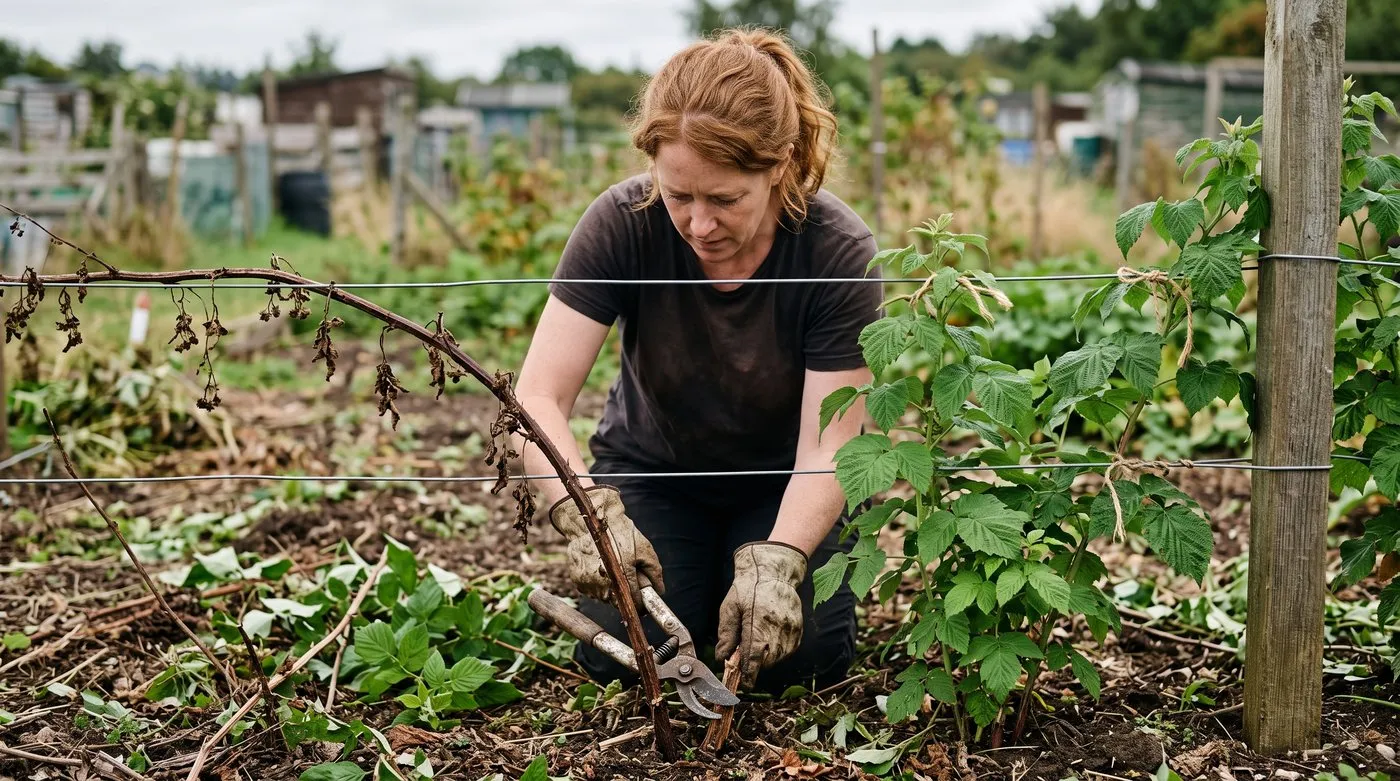
After picking, cut the old brown canes to the ground and keep six to eight strong green ones. Those green canes carry next summer’s crop.
Pruning autumn-fruiting raspberries
Prune in February, before new growth starts.
- Cut every cane to the ground. Every single one.
- Cut just above soil level, taking care not to damage the base.
- Clear away the cuttings and compost them, unless they look diseased.
- New canes appear from April and fruit from August.
That’s all there is to autumn raspberry pruning. No sorting, no tying in.
Not sure which type you’ve got? Watch when it fruits. June and July means summer. August onwards means autumn. Prune to match next year.
Feeding, watering, and mulching
Feeding
Raspberries aren’t greedy, but they like a yearly boost.
 Picking autumn raspberries, which fruit on this year’s canes.
- March: Sprinkle a general fertiliser such as Growmore along the row, at the rate on the pack.
- April: Mulch with compost, manure or bark, keeping it a little away from the canes.
- Plants in pots: Give tomato feed every fortnight from flowering until the fruit ripens.
Steer clear of high-nitrogen feeds. They give you lots of leaves and fewer berries.
Watering
Raspberries need steady moisture while they’re fruiting. Dry soil gives small, crumbly berries.
- In the ground: Water well once a week in dry spells from June to September.
- In pots: Water daily in summer, and twice a day in a heatwave.
- Mulch: It keeps moisture in and feeds the soil as it rots down.
Mulching
A yearly mulch is the best thing you can do for raspberries. Put it on in April. Good choices are:
- Garden compost
- Well-rotted farmyard manure
- Peat-free compost
- Bark chips (great for weeds, but less feeding)
Raspberries have shallow roots that dry out fast, so the mulch really helps.
Protecting raspberries from pests and diseases
Bird protection
Birds are the biggest threat. Blackbirds, thrushes and pigeons go for the berries as soon as they colour.
Put bird netting over the row as soon as the fruit starts to colour. That’s mid-June for summer types and early August for autumn types. Hold the net clear of the fruit on your posts or on canes. Check it daily, in case a bird or hedgehog gets tangled.
Raspberry beetle
Raspberry beetle is the most common pest. You’ll find small greyish-white grubs inside picked berries. The RHS raspberry beetle guide has good photos.
What to do:
- Pick often, and throw away any grubby berries
- In autumn, lightly fork the soil under the canes so birds can find the pupae
- If it’s really bad, spray an approved insecticide at dusk, when bees aren’t about, exactly as the label says
Cane blight
A fungus that makes canes wilt and die, often with dark patches at the base. It gets in through wounds.
To prevent it:
- Prune with clean, sharp tools
- Cut out and bin infected canes straight away
- Take care not to knock the canes when hoeing
- Don’t let canes get crowded
Grey mould (botrytis)
Grey, fluffy mould on ripening fruit, worst in wet summers. It also hits strawberries, gooseberries and blackberries.
To prevent it:
- Thin to 6-8 canes per plant for good airflow
- Water the soil, not the fruit
- Pick ripe berries promptly
- Bin any mouldy fruit
Raspberry cane spot
Purple spots on the canes that later turn silvery. It weakens the canes.
To prevent it:
- Cut out and bin badly affected canes
- Thin canes so air can move
- Water the soil, not the leaves
Growing raspberries in containers
Raspberries will grow in big pots, though they do best in the ground. Autumn types are the best choice, as the yearly cut-back keeps them tidy.
What you need:
- A pot at least 45cm across and 40cm deep
- John Innes No. 3 compost with some perlite mixed in
- One plant per pot
- Tomato feed every fortnight from flowering
- Daily watering in summer
- Fresh compost every few years
Stand the pot in a sunny, sheltered spot. In winter, group pots together against a sheltered wall, as roots in pots feel the cold more.
Month-by-month raspberry calendar
| Month | What to do |
|---|---|
| January | Order bare-root canes. Plan your rows and posts. |
| February | Cut autumn canes to the ground. Trim summer canes above the top wire. |
| March | Feed along the rows. Plant any last bare-root canes. |
| April | Mulch. Tie in summer canes as they grow. |
| May | Remove canes growing outside the row. Water in dry spells. |
| June | Net summer types. Start picking early varieties. |
| July | Main summer picking, every 2-3 days. Pull up stray suckers. |
| August | Prune old summer canes. Autumn picking starts. Net autumn types. |
| September | Keep picking autumn berries. Tie in new summer canes. |
| October | Autumn picking ends. Clear fallen leaves. |
| November | Plant new canes. Check posts and wires. |
| December | Canes are dormant. Plan any new varieties. |
Common mistakes when growing raspberries
Pruning the wrong canes
The number one mistake. Cutting summer types to the ground in February removes the canes that would fruit in June. Pruning autumn types selectively leaves a tangle that fruits poorly. Know your type and prune to match.
Planting too close together
Canes closer than 40cm compete for light and water. The row becomes a thicket, disease moves in, and berries stay small. It looks sparse at first, but it soon fills out.
Skipping the supports
Summer canes without support flop onto the ground, and the fruit rots. Put up your posts and wires when you plant, not later.
Not netting against birds
Birds can strip an unnetted row in no time. Net as soon as the fruit colours.
Letting suckers spread
Raspberries send up new shoots from their roots, often a metre or more from the row. Left alone, they’ll pop up in paths and lawns. Pull them out as you see them, and mow any in the grass.
Harvesting and storing raspberries
Pick when the berries are fully coloured and come away easily, leaving the white core behind on the plant. If you have to tug, they’re not ready.
Pick every 2-3 days in season. Ripe berries go soft and mouldy fast, and wasps love them.
Storing: Fresh raspberries keep for 2-3 days in the fridge. Don’t wash them until you eat them. To freeze, spread them on a tray, freeze until solid, then tip into bags.
Once your raspberries are going, try growing redcurrants and blackcurrants. They’re perfect partners in summer puddings and jams.
For a bigger crop, get the feed right with our guide to feeding fruit bushes.
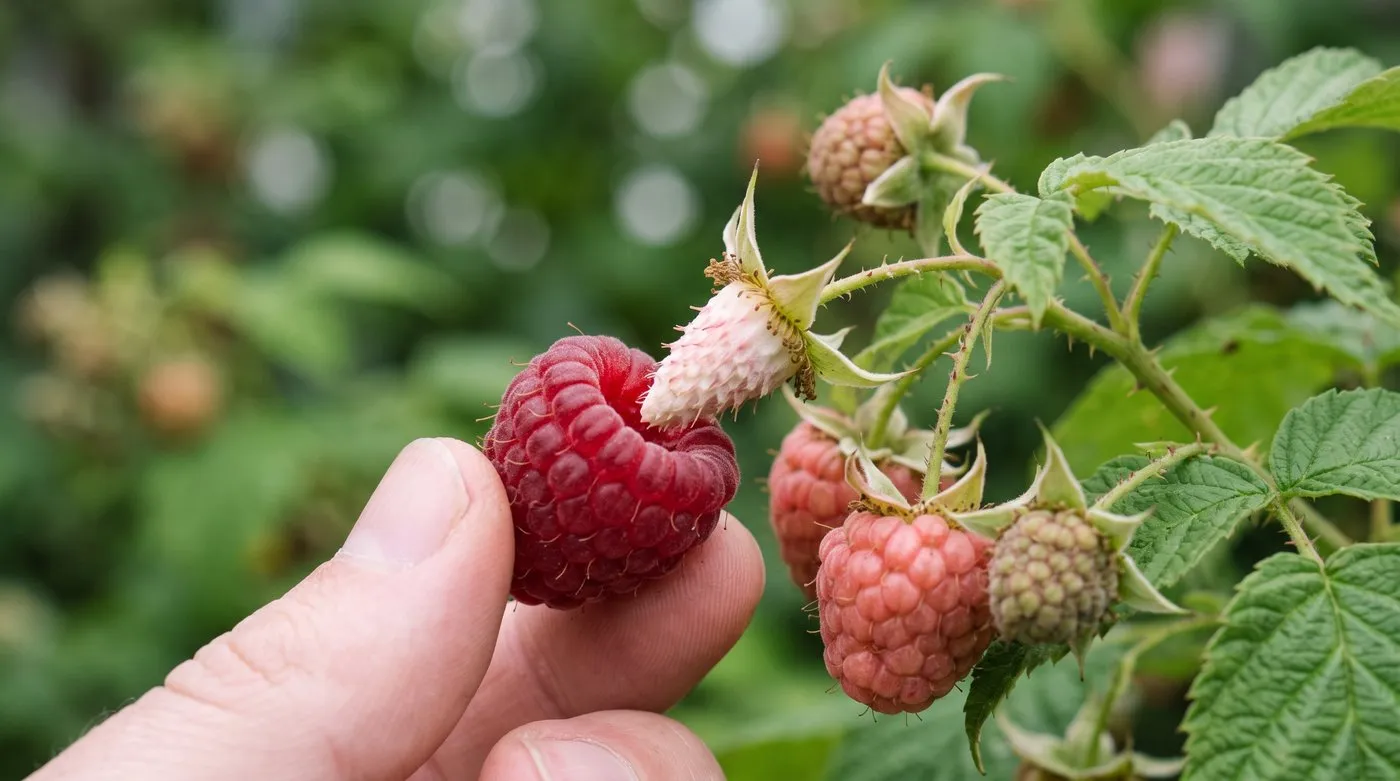
A ripe raspberry slips off and leaves its white core on the plant. If you have to tug, give it another day.
Frequently asked questions
When is the best time to plant raspberries in the UK?
Plant bare-root canes from November to March. They’re dormant then, so the roots settle in before spring. Pot-grown plants can go in at any time. Avoid frozen or waterlogged ground.
How far apart should I plant raspberry canes?
Space canes 40-50cm apart along the row. Leave about 1.8m between rows so you can get in to pick and air can move. Closer than that and the row turns into a crowded, disease-prone thicket.
What is the difference between summer and autumn raspberries?
Summer types fruit on last year’s canes in June and July. Autumn types fruit on this year’s canes from August to October. They’re pruned differently, so it pays to know which you’ve got.
How do I prune summer-fruiting raspberries?
Cut the canes that have fruited down to the ground after picking. They’re the brown, woody ones. Keep 6-8 strong green new canes per plant and tie them to the wires. In February, trim any tips poking above the top wire.
How do I prune autumn-fruiting raspberries?
Cut every cane down to the ground in February. That’s it. New canes grow in spring and fruit from late summer. It’s the easiest pruning job in the fruit garden.
Do raspberries need a support system?
Summer raspberries do need posts and wires. Put a post at each end of the row and run wires at about 60cm, 1m and 1.5m. Autumn types are shorter, though a single wire at 1m helps in a windy garden.
Can I grow raspberries in containers?
Yes, and autumn types are the best for pots. Use a pot at least 45cm across and 40cm deep, with one plant in it. Feed with tomato food every fortnight from flowering, and water daily in summer.
Why are my raspberry plants not fruiting?
Usually it’s pruning at the wrong time. Cutting summer types to the ground in winter removes next year’s fruiting canes. Check which type you have and prune to match. New summer canes also need a season to grow before they fruit.
Our team produces practical UK gardening guidance from source research, contributor records and established horticultural practice. Editorial standards are overseen by Matt W.


