Key takeaways
- Roses need at least four hours of direct sun a day, though a few cope with light shade
- Plant bare-root roses from late autumn to early spring, while they're dormant
- Plant with the graft union at soil level, not buried
- Feed twice a year, in March or April and again after the first flush
- Deadhead weekly to keep repeat-flowering roses blooming
- Choosing disease-resistant varieties is the best way to beat black spot
Roses are one of the great joys of a British garden. Our mild, damp weather suits them well, though it also brings black spot.
Here’s how to choose, plant, feed, prune and look after them. The RHS rose growing guide is a handy extra read.
Types of roses for UK gardens
The main groups are hybrid teas, floribundas, climbers, ramblers, shrub roses, English roses and patio roses. Each grows, flowers and needs pruning a little differently.
Hybrid tea roses
Hybrid teas have the classic, pointed blooms, one to a long, straight stem. They flower again and again from June to October and are perfect for cutting. Popular ones include ‘Peace’ (yellow-pink), ‘Mister Lincoln’ (deep red) and ‘Elina’ (pale cream-yellow).
They need a hard prune each year between late February and mid-March. Cut stems back to about 15-20cm from the base.
Floribunda roses
Floribundas carry clusters of smaller flowers, so you get more colour. They flower from June to late October. ‘Iceberg’ (white) is a long-time favourite, and ‘Trumpeter’ (red, compact) is great for borders and low hedges.
They’re pruned less hard than hybrid teas. Cut to about 25-30cm from the base in early spring.
Climbing roses
Climbers have long, stiff stems you can train on walls, fences, arches and pergolas. ‘New Dawn’ (blush pink) is a reliable favourite, and ‘Compassion’ (salmon-pink) is fragrant and flowers again and again. For more ideas, see our guide to climbing plants for UK gardens.
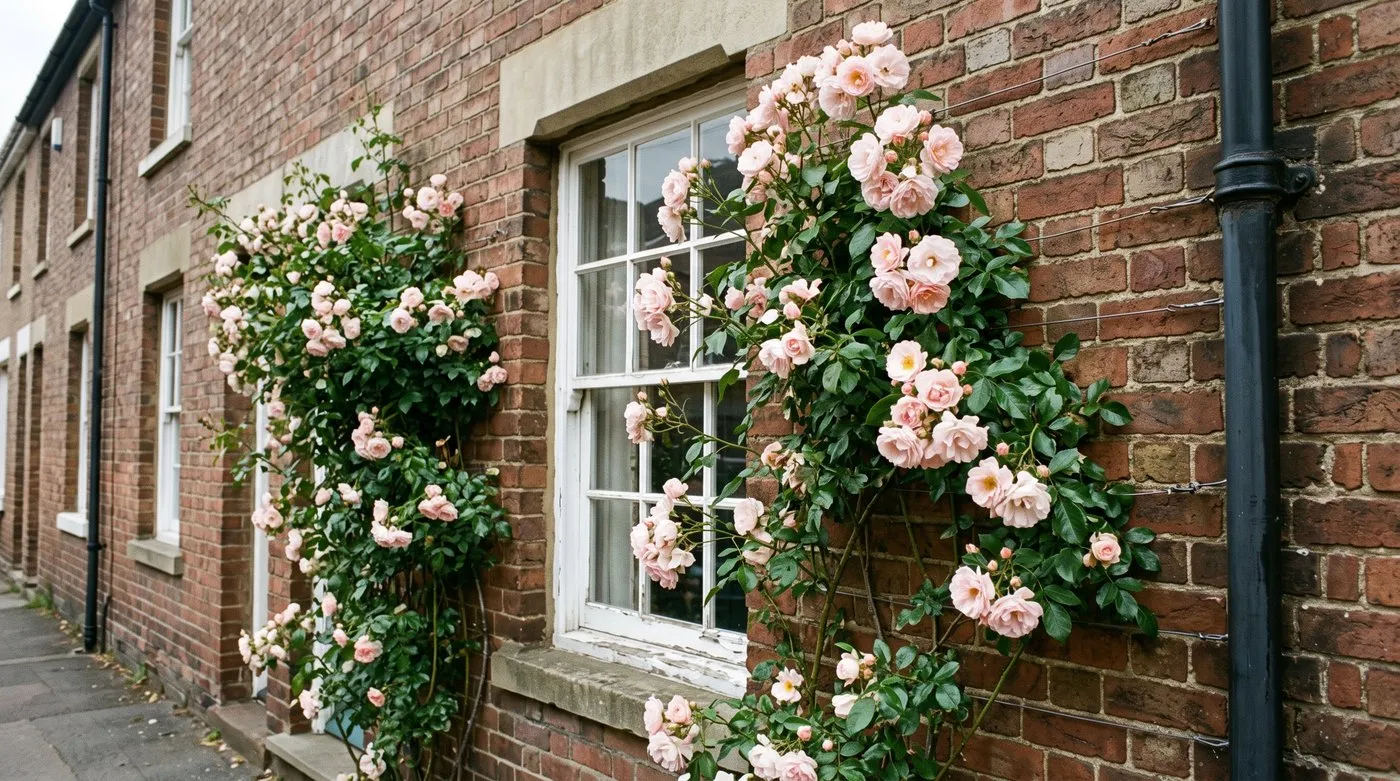
Training the long stems sideways along wires gives far more flowers than letting them shoot straight up. Plant climbers about 45cm out from the wall.
Shrub and species roses
Shrub roses include old garden roses and modern shrub roses. They tend to be bigger, tougher and easier to look after than hybrid teas. Many have hips in autumn, which birds love in winter. Rosa rugosa is almost indestructible and copes with salty wind, so it’s great by the sea.
David Austin English roses
English roses from David Austin, bred in Shropshire, mix old-fashioned flower shapes with modern repeat flowering and better disease resistance.
Good ones for UK gardens:
- ‘Gertrude Jekyll’: rich pink with a strong scent
- ‘The Generous Gardener’: a pale pink climber with good disease resistance
- ‘Lady of Shalott’: salmon-orange, tough and easy for beginners
- ‘Boscobel’: salmon-pink and compact, great for pots and small gardens
- ‘Olivia Rose Austin’: soft pink and very good at resisting black spot
Rose type comparison table
| Type | Size | Flowers | Flowers again? | Pruning | Good for |
|---|---|---|---|---|---|
| Hybrid tea | Medium | One big bloom per stem | Yes | Hard | Cutting, formal beds |
| Floribunda | Small to medium | Clusters | Yes | Moderate | Borders, hedges |
| Climbing | Tall | Clusters on long stems | Most do | Light | Walls, fences, arches |
| Rambler | Very tall | Big clusters | Usually once | After flowering | Pergolas, trees |
| Shrub/species | Large | Single or semi-double | Varies | Light | Mixed borders, wildlife |
| David Austin | Medium | Old-fashioned cups | Yes | Moderate | Borders, scent, cutting |
| Patio/miniature | Small | Small clusters | Yes | Light | Pots, edging |
Choosing the right spot
Pick a sunny, open spot with at least four hours of direct sun a day. More sun usually means more flowers. Morning sun is especially good, as it dries the dew off the leaves and helps keep diseases away.
Airflow matters almost as much. Roses in stuffy, enclosed corners get far more disease. Leave at least 60cm between bushes and any wall or fence.
Avoid spots where roses grew before. New roses often sulk in old rose soil, which is called rose replant disease. If you must use the same spot, dig out the soil about 45cm deep and wide, and swap in soil from elsewhere in the garden.
Tip: Another trick is to sink a large pot with its base cut out into the old spot and fill it with fresh compost. The roots get a clean start while they grow.
Soil preparation
Roses like rich soil that holds moisture but drains well. A fertile clay loam that doesn’t dry out in summer is ideal. Sandy soil dries out too fast, and very heavy clay stays too wet.
Testing your soil
Roses aren’t fussy about pH. A cheap test kit tells you if your soil is very acid or very chalky. On very acid soil, add lime in autumn at the rate on the pack. On thin chalk, add lots of organic matter to hold moisture.
Improving soil structure
On clay soil, dig in a good layer of well-rotted compost or manure to a spade’s depth. Do it a few weeks before planting.
On sandy soil, dig in plenty of garden compost and mulch each year to help it hold water.
Planting roses
Plant bare-root roses while they’re dormant, and potted roses whenever the ground is workable.
Bare-root roses
Bare-root roses are sold from late autumn to early spring. They’re cheaper than potted ones and come in more varieties. Plant them as soon as you can after they arrive. The RHS rose planting guide has step-by-step pictures. For timings, see our guide on when to plant roses in the UK.
- Soak the roots in a bucket of water for an hour or two if they look dry.
- Dig a hole about twice as wide as the roots and a spade’s blade deep. Loosen the bottom with a fork.
- Make a mound of soil in the middle and spread the roots over it.
- Set the graft union (the knobbly bit where stems meet roots) at soil level. Don’t bury it, as that can make dieback more likely.
- Fill in with the soil you dug out, mixed with some well-rotted compost.
- Firm gently with your boot and water well.
- Mulch with composted bark or garden mulch, leaving a gap of about 10cm around the stems.
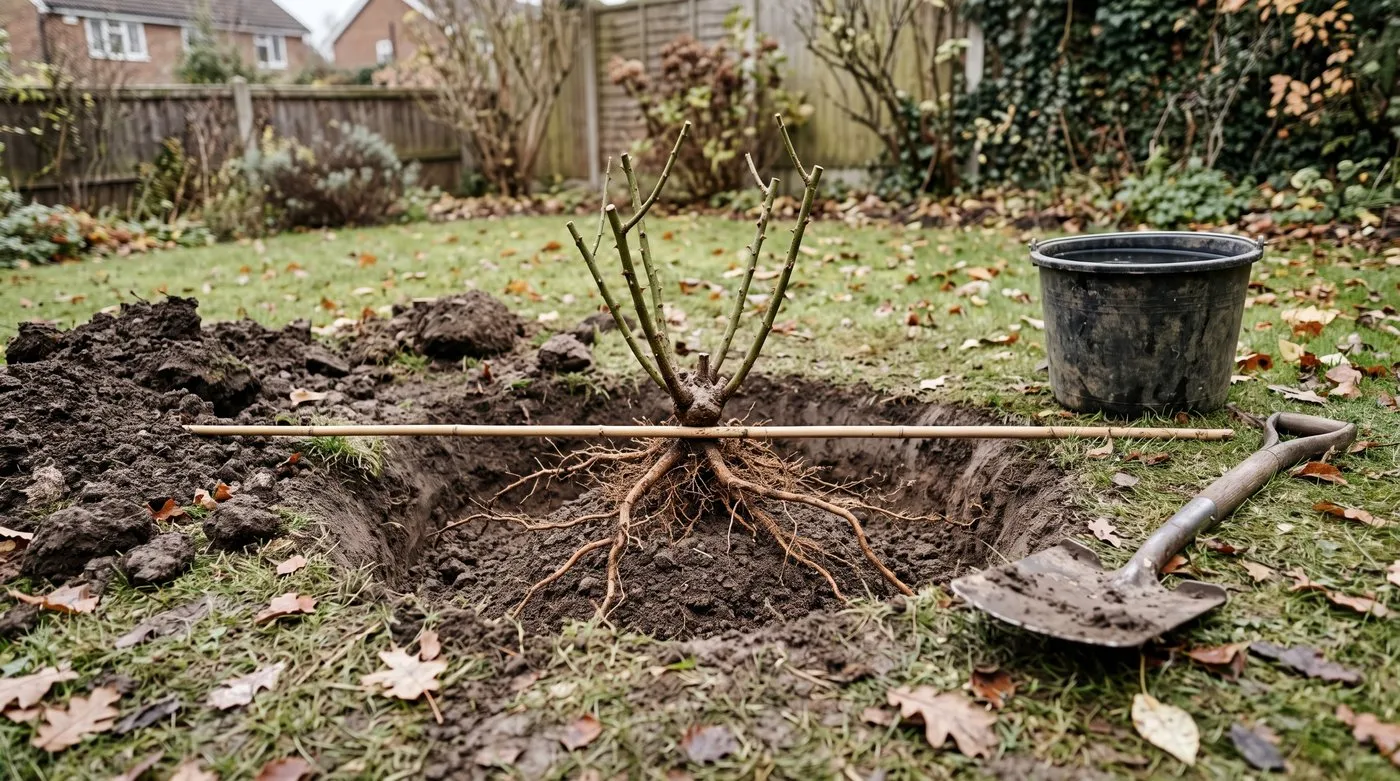
A cane laid across the hole helps you set the knobbly graft union right at soil level. Burying it can make dieback more likely.
Container-grown roses
Potted roses can go in at any time, as long as the ground isn’t frozen or very dry. Autumn is ideal, while the soil is still warm and the rain does the watering.
Dig a hole twice as wide as the pot and plant with the graft union at soil level. Tease out any circling roots. Water well and mulch. Plant climbers at least 45cm from a wall, where the soil is less dry, and lean the stems towards their support.
Planting distances
Check the label, as spacing depends on the variety. These are good starting points.
| Rose type | Space between plants | Distance from wall or fence |
|---|---|---|
| Hybrid tea | 60-75cm | At least 45cm |
| Floribunda | 45-60cm | At least 45cm |
| Climber | 2-3m along the wall | 45cm out from the wall |
| Shrub/David Austin | 90-120cm | At least 60cm |
| Rambler | 3-5m | 45cm out from the wall |
| Patio/container | 30-45cm | - |
Month-by-month rose care calendar
| Month | What to do |
|---|---|
| January | Order bare-root roses. Plan new plantings. |
| February | Plant bare-root roses if the ground isn’t frozen. Check ties on climbers. |
| March | First feed. Finish pruning hybrid teas and floribundas. |
| April | Look for aphids on new shoots. Remove suckers from below the graft. |
| May | Start deadheading as the first flowers fade. Tie in new climbing shoots. |
| June | Water well in dry spells. Deadhead weekly. |
| July | Second feed after the first flush. Stop deadheading roses grown for hips. Look for black spot and mildew. |
| August | No more feeding. Keep deadheading. Take cuttings. |
| September | Leave hips on species roses and rugosas for the birds. |
| October | Plant potted roses. Start planting bare-root roses. Clear fallen leaves. |
| November | Cut tall stems back by a third so the wind doesn’t rock them. Plant bare-root roses. Mulch. |
| December | Check stakes, ties and supports. Mulch if you haven’t already. |
Feeding roses
Feed roses twice a year: in March or April before flowering, and again after the first flush. Well-fed roses give more flowers and stronger growth.
Two-feed programme
- March or April: Scatter a granular rose fertiliser around the roots at the rate on the pack and lightly fork it in. Water if the soil is dry.
- Midsummer: After the first flush of flowers, feed again to fuel the next round.
Don’t feed late in summer. It makes soft new growth that frost can damage.
Organic alternatives
Fish, blood and bone at the same times works well. Well-rotted manure as a mulch feeds slowly too. Avoid fresh manure, which can scorch the roots.
Mulching
Mulch between November and February with a good thick layer of composted bark, garden compost or well-rotted manure. It keeps moisture in, smothers weeds and feeds the soil. Leave a gap around the stems.
Pruning basics
Prune most roses in late winter or early spring, as they start to grow. Our full pruning guide covers every type, but here are the basics.
When: Late February to March for most roses, a bit later in cold northern gardens.
The basic cut: Find a bud facing outwards. Cut just above it, on a slant sloping away from the bud. Use sharp bypass secateurs for thin stems and loppers for thick ones.
What to remove first: Dead, diseased and crossing stems. Then thin the middle to let air in. Finally, shorten the rest to suit the type of rose.
Climbers and ramblers are different. Prune climbers in late winter. Prune ramblers after they flower in summer, as they bloom on last year’s growth.
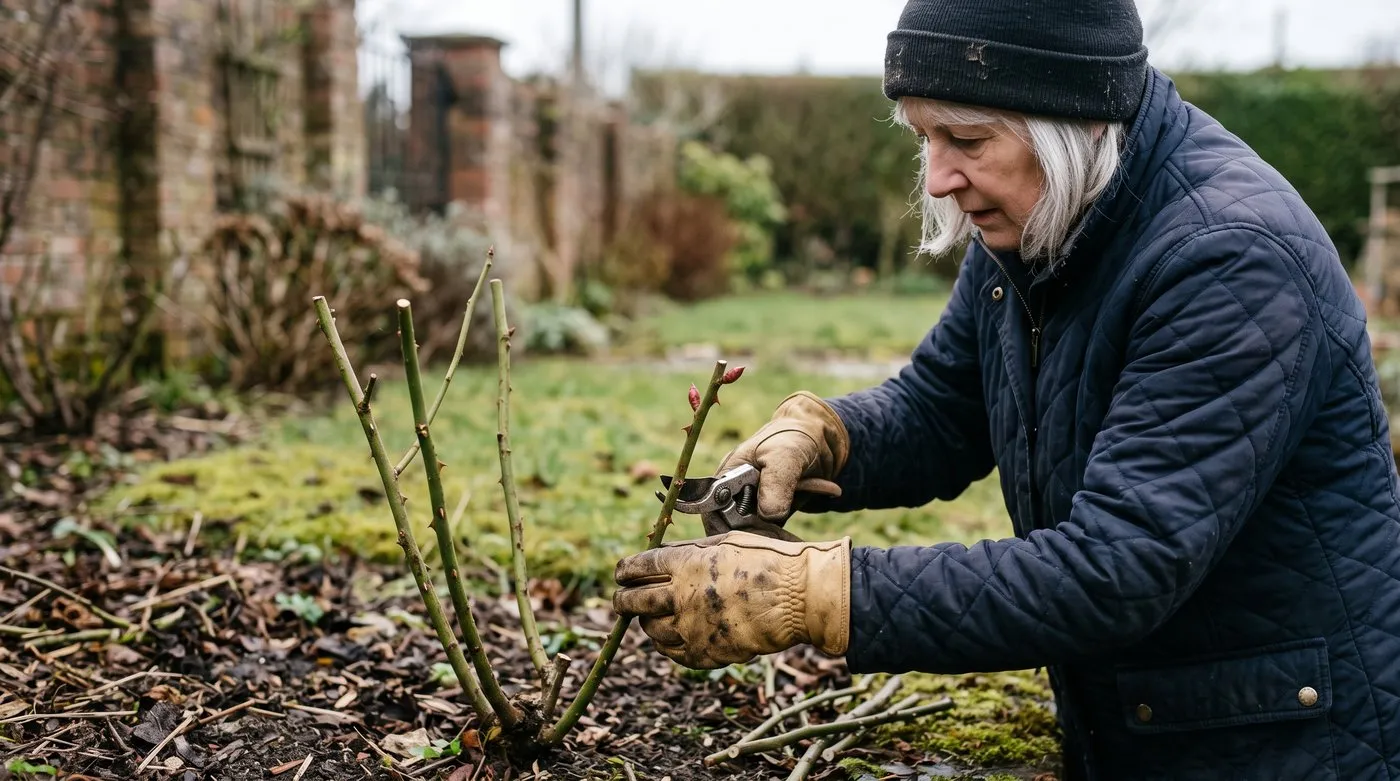
Cut just above an outward-facing bud, on a slant sloping away from it. Take out dead and crossing stems first, then open up the middle.
Should you deadhead roses?
Yes, for roses that repeat flower. Deadheading once a week keeps new flowers coming. Without it, many roses make hips and stop flowering. Snip off each faded bloom just above a leaf, or remove the whole cluster on floribundas.
Stop deadheading in midsummer on roses grown for hips, such as rugosas and many species roses. That gives the hips time to colour up for autumn, and the birds will thank you in winter. Once-flowering roses and ramblers won’t flower again, so deadheading them is just for tidiness.
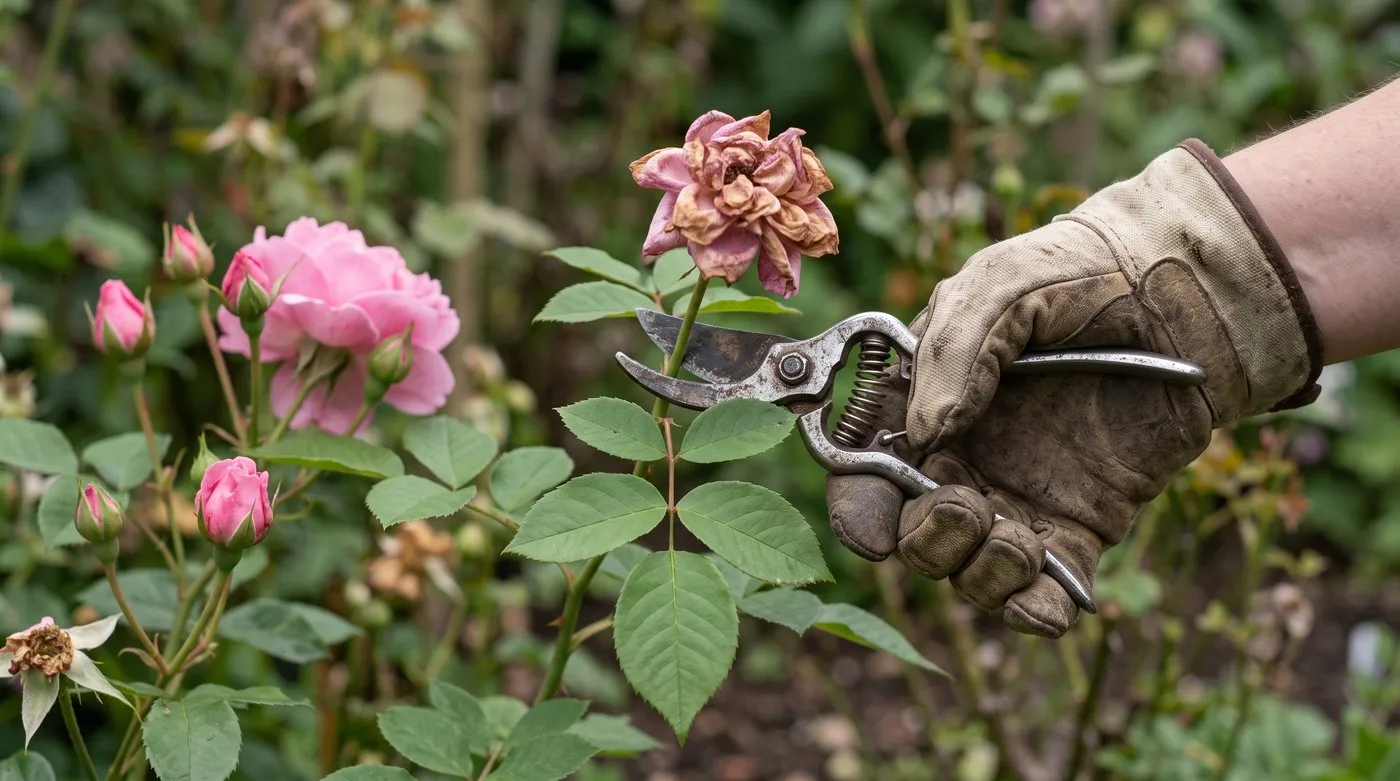
Snip each faded flower just above a leaf, once a week. It stops the rose making hips and keeps new flowers coming.
Why are my roses not flowering?
Usually it’s too little sun, hungry soil, missed deadheading or pruning at the wrong time. Roses in shade grow leggy and flower poorly, so check yours gets at least four hours of direct sun. Trees and hedges grow, so shade can creep up over the years.
Feed in spring and again after the first flush. Ramblers and some climbers flower on last year’s growth, so a hard winter prune cuts off the flowers. Young plants may also need a season to settle in.
Pests and diseases
Black spot (Diplocarpon rosae)
Black spot is one of the most common rose problems, especially in wet summers. Dark, ragged spots appear on the leaves, which then yellow and drop.
Prevention is better than cure:
- Choose resistant varieties such as ‘Olivia Rose Austin’, ‘Boscobel’ and ‘Roald Dahl’.
- Rake up and bin fallen leaves in autumn, as the fungus spends winter on them.
- Mulch to stop spores splashing up from the soil.
- Water the soil, never the leaves.
- If it keeps coming back, use a fungicide approved for black spot on roses, exactly as the label says.
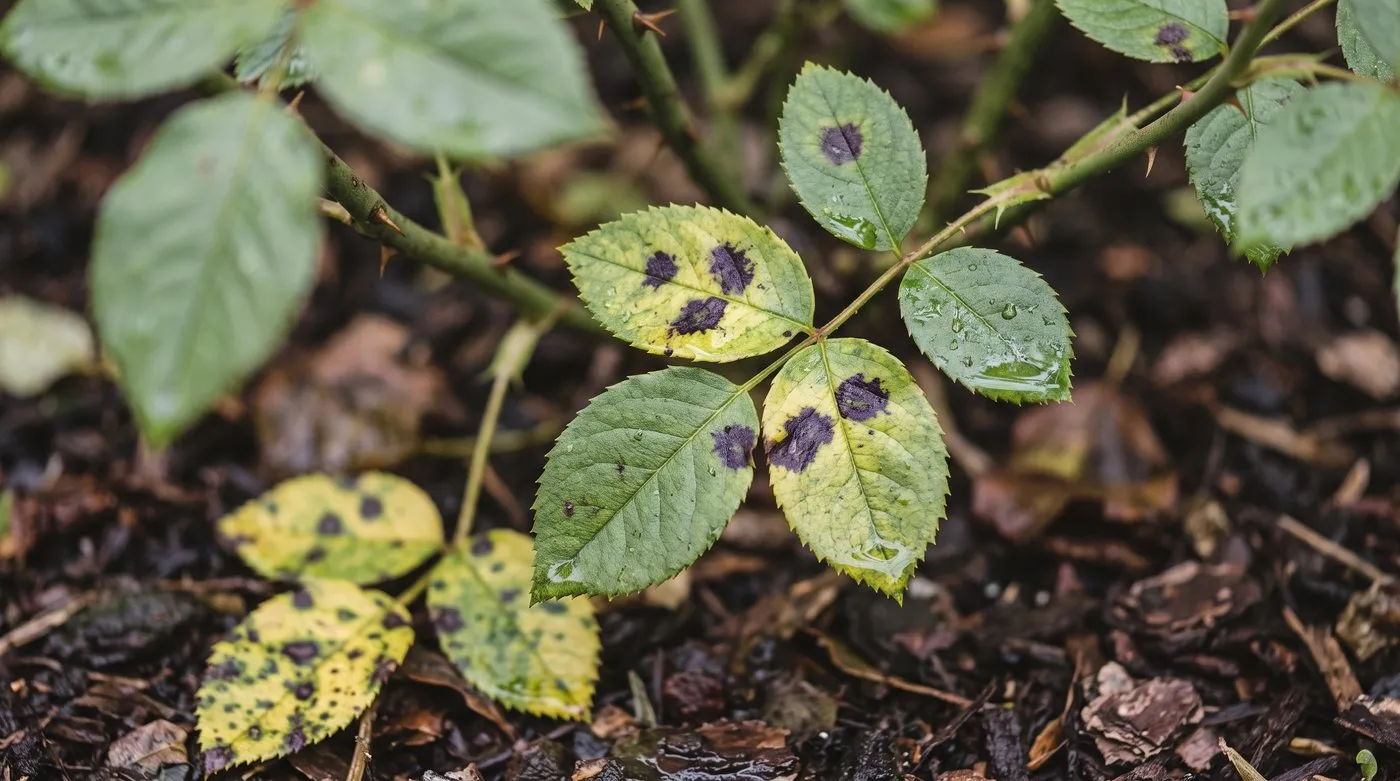
Ragged black spots and yellowing leaves are black spot. Rake up and bin fallen leaves in autumn, as that’s where the fungus spends the winter.
Powdery mildew
A white, powdery coating on leaves, stems and buds. It’s worst in hot, dry weather with cool nights, and on thirsty plants. Keep air moving and water well in dry spells.
Rose rust
Orange spots under the leaves, mostly from July. Pick off and bin affected leaves. If it spreads, use a fungicide whose label covers rose rust. Some older hybrid teas get it more than others.
Flower balling
In a wet summer, rose buds can rot and fail to open. This is called balling, and it hits full, many-petalled and pale roses worst. Our guide on flower balling in roses and peonies explains why and what to do.
Aphids
Green or pink aphids cluster on new shoots and buds from April. Wash small groups off with a jet of water. Bring in ladybirds, lacewings and hoverflies by planting bee-friendly flowers nearby.
Tip: Don’t reach for a spray at the first sign of aphids. Ladybirds, hoverfly larvae and blue tits love them, and often sort out an early outbreak within a few weeks.
Rose replant disease
New roses planted where old ones grew often struggle. Swap the soil to about 45cm deep and wide, or plant somewhere else.
Companion planting for roses
Good companions cover bare soil and bring in aphid-eating insects, without hogging water. Try:
- Lavender: loved by pollinators. Plant it about 45cm from the rose.
- Catmint (Nepeta ‘Walker’s Low’): long-flowering and softens the base of rose bushes.
- Alliums: ‘Purple Sensation’ flowers with the early roses in late spring.
- Hardy geraniums: ‘Rozanne’ flowers from May to November and covers bare soil.
- Foxgloves: classic rose partners in cottage garden schemes, and they seed themselves around.
Avoid planting big, hungry shrubs like privet or elder right next to roses, as they compete for water and food. If you have pets, the thorns can hurt a curious mouth. For more on what’s safe to grow, see our guide to pet-safe garden plants.
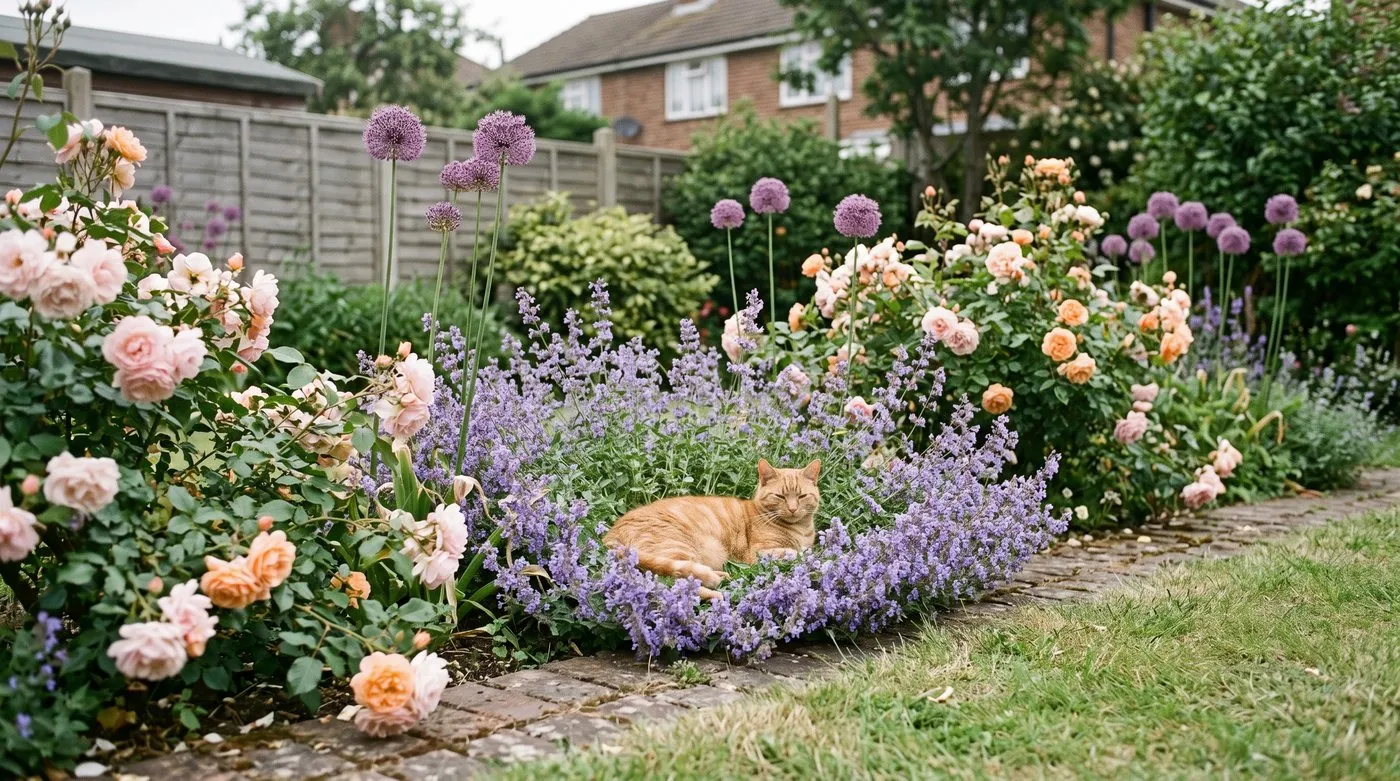
Catmint softens the base of roses and flowers for months. It brings in plenty of insects too, though cats may well claim it as a bed.
Growing roses in containers
Roses grow well in pots if you choose a compact variety and a big pot.
Pot size: At least 40cm across and 40cm deep, and bigger is better. A half-barrel suits shrub roses. Terracotta looks lovely but dries out faster. Stand pots on feet so they drain.
Compost: Use John Innes No. 3. It holds water and food better than multipurpose compost and makes a heavy, stable base. Don’t let it dry out or get soggy.
Good roses for pots:
| Variety | Type | Colour | Notes |
|---|---|---|---|
| ’Boscobel’ | David Austin | Salmon-pink | Compact, fragrant, disease resistant |
| ’Harlow Carr’ | David Austin | Rose-pink | Compact, fragrant |
| ’Trumpeter’ | Floribunda | Red | Long-flowering and bushy |
| ’Sweet Dream’ | Patio | Apricot | Great for small pots |
| ’Top Marks’ | Miniature | Vermillion | Very compact |
Watering: Potted roses dry out faster and may need water daily in hot weather. Feed every fortnight from mid-spring to late summer. Repot into fresh compost every 2-3 years in autumn.
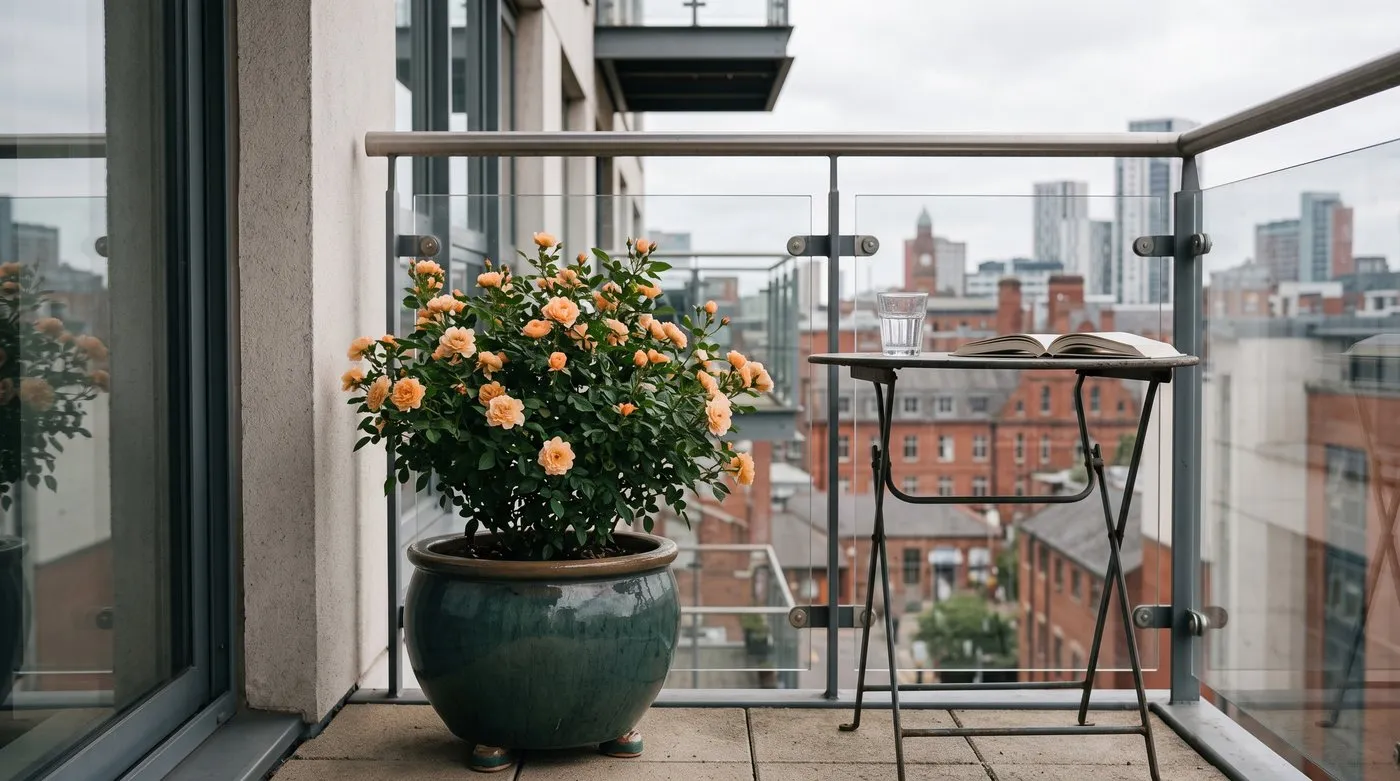
Pick a compact rose and a pot at least 40cm across. Potted roses dry out fast, so they may need water every day in hot weather.
Common mistakes when growing roses
Burying the graft union
Old advice was to bury the graft a few centimetres down. Now the advice is to plant it at soil level, as burying it can make dieback more likely. If a rose is struggling, check how deep it’s planted.
Ignoring drainage
Roses cope with heavy soil but not waterlogged roots. If water pools around the base after rain, add grit and compost. In very wet gardens, plant on a slight mound.
Overwatering newly planted roses
New roses need regular water, but soggy soil kills roots. Water deeply once or twice a week rather than a little every day. Push a finger 5cm into the soil. If it’s moist, leave it.
Skipping the autumn tidy-up
Black spot spends winter on fallen leaves. Leave them, and the disease is back in spring. Rake up and bin them rather than composting.
Using the wrong secateurs
Anvil secateurs crush rose stems, which invites disease. Use bypass secateurs, which cut like scissors. Keep them sharp and clean.
Choosing disease-resistant varieties
Picking a resistant variety is the easiest way to avoid disease. Modern roses are much better at resisting black spot, mildew and rust. Look for the RHS Award of Garden Merit (AGM) on the label too, as it marks plants that do well in UK gardens.
Good disease-resistant picks:
- ‘Olivia Rose Austin’: soft pink English rose with excellent resistance
- ‘Roald Dahl’: apricot-orange English rose, bred for good resistance
- ‘Flower Carpet’ series: ground-cover roses in lots of colours
- ‘Absolutely Fabulous’: a yellow floribunda with good black spot resistance
Older favourites like ‘Super Star’ and ‘Blue Moon’ are still loved but tend to suffer more from disease.
For another long-lived cottage garden favourite, see our guide to growing peonies in the UK.
Related reading: leave some late flowers on and you’ll get hips. See our guide to harvesting rose hips and what to make.
Frequently asked questions
When is the best time to plant roses in the UK?
Plant bare-root roses from late autumn to early spring, while they’re dormant. Potted roses can go in at any time, as long as the ground isn’t frozen or very dry. Autumn planting gives roots time to settle before summer.
How much sun do roses need?
At least four hours of direct sun a day. More sun usually means more flowers. Some roses, including many Alba roses and some climbers and ramblers, cope with light shade. No rose is happy in deep shade.
How often should I water roses?
Established roses usually only need water in dry summer spells. Then, a good soak of about a bucketful once a week is plenty. Water the soil, not the leaves. New roses need regular watering until they settle, and pots may need water daily in hot weather.
What is the best fertiliser for roses?
A granular rose fertiliser suits most roses. Feed in March or April, then again after the first flush of flowers. Don’t feed late in summer, as soft new growth gets hit by frost. Fish, blood and bone or well-rotted manure are good organic options.
Why are my rose leaves turning yellow?
Usually too much water or poor drainage. Check the soil isn’t sitting wet. Yellowing from the bottom of the plant upwards can mean it’s hungry. Black spot also turns leaves yellow before they drop, so look for dark spots too.
Can I grow roses in pots?
Yes, in a big pot at least 40cm across. Use John Innes No. 3 compost and feed every fortnight from mid-spring to late summer. Patio and miniature roses suit pots best, but compact shrub roses like ‘Boscobel’ do well too.
How do I stop black spot on roses?
Start by choosing resistant varieties. Rake up and bin fallen leaves in autumn, as the fungus spends winter on them. Mulch around the base and water the soil, not the leaves. If it keeps coming back, use a fungicide approved for black spot on roses, exactly as the label says.
Our team produces practical UK gardening guidance from source research, contributor records and established horticultural practice. Editorial standards are overseen by Matt W.