Key takeaways
- Sunflowers, roses and snapdragons are bright, easy flowers that are safe around pets
- Rosemary, thyme, basil, sage, coriander and dill are fine for pets to brush past or nibble
- Lilies, foxgloves, daffodils, yew and rhododendrons are the big ones to keep away from pets
- Dahlias, chamomile, periwinkle and lavender can upset pets, so they're not on the safe list
- Cocoa shell mulch and blood, fish and bone can make dogs ill
- If you think your pet has eaten something harmful, call your vet straight away
A pet-friendly garden starts with knowing exactly what you’re planting. Dogs and cats react to some plants differently, and how much harm a plant does depends on which part gets eaten and how much. Check new plants before you buy, keep an eye on pets that like to chew, and call your vet quickly if you think something’s wrong.
Pet-safe flowers for UK gardens
 Sunflowers, snapdragons, roses, calendula and cornflowers are all safe for dogs and cats.
Flowers bring colour and bees into the garden. These are happy in British gardens and safe around pets, with one to check first.
Sunflowers (Helianthus annuus)
Sunflowers are safe for dogs and cats, seeds, petals, leaves and all. ‘Dwarf Sunshine’ stays around 60cm, perfect for pots, while ‘Russian Giant’ can reach 3m. Sow seeds outdoors in April or May, 2cm deep, in full sun. They flower from July to September and kids love them too. See our guide on how to grow sunflowers.
Snapdragons (Antirrhinum majus)
Snapdragons are safe for pets and give spikes of flowers from June to October. Dwarf types suit pots and the front of borders, and tall ones go at the back. Sow under cover in March or buy plug plants in May. Give them sun and well-drained soil, and deadhead to keep them flowering into autumn.
Roses (Rosa species)
Roses are safe for dogs and cats. Petals, leaves and hips are all fine. The only risk is thorns catching a curious nose or paw. ‘Zephirine Drouhin’ is a fragrant, thornless pink climber for areas where pets play. ‘Bonica’ is a low shrub rose for borders. Deadhead and they’ll flower from June to October. Our guide on how to grow roses covers pruning and care.
Calendula (Calendula officinalis)
Pot marigolds are safe for pets. They seed themselves about and give orange and yellow flowers from May to November. Sow straight into the ground in March or April. They cope with poor soil and part shade, though they flower best in sun. Hoverflies love them, and hoverfly young eat aphids. Don’t mix them up with French or African marigolds (Tagetes), which can irritate skin.
Cornflower (Centaurea cyanus)
Cornflowers are safe for pets and give bright blue flowers from June to August. Grow them in sun in any soil that drains well. Sow in autumn for earlier, sturdier plants, or in spring for summer flowers. They’re great bee-friendly garden plants and butterflies like them too. ‘Blue Ball’ is the classic, and ‘Black Ball’ has deep maroon flowers.
Zinnia (Zinnia elegans)
Zinnias are safe for pets and bring bold, bright flowers from July to October. They want sun and a warm, sheltered spot. Sow indoors in April and plant out after the last frost in late May. They hate cold and wet, so in the north grow them in pots you can move. The ‘Profusion’ series copes better with cooler summers.
Aster (Aster novi-belgii)
Michaelmas daisies give pet-safe colour in autumn, when much else has finished. They flower from August to October in purple, pink and white. Plant in sun or light shade in soil that stays damp but not soggy. Split clumps every few years. ‘Little Carlow’ is a lovely blue variety that resists mildew. Bees adore them.
Echinacea (Echinacea purpurea)
Coneflowers are safe for dogs and cats and flower from July to September. Give them sun and well-drained soil, and once settled they cope well with dry spells. Leave the seed heads over winter for goldfinches. ‘Magnus’ (deep pink) and ‘White Swan’ are reliable. They look great in drought-tolerant planting schemes with grasses and sedums.
Dahlia (Dahlia species)
Dahlias aren’t on the safe list after all. They can cause a mild upset tummy and skin irritation in dogs and cats, so they’re best kept out of areas where pets chew plants. For late summer colour, zinnias and asters are safe swaps.
Fuchsia (Fuchsia species)
Fuchsias are safe for pets. Trailing types are perfect for baskets, while hardy shrubs like ‘Mrs Popple’ stay outside all winter. Tender types need moving somewhere frost-free. Fuchsias like part shade and damp soil, and flower from June to October. In mild coastal spots, fuchsia hedges can flower for months.
Pet-safe shrubs for structure
 Camellia, magnolia and buddleia give the garden shape all year.
Shrubs give your garden shape, privacy and something to look at in every season. These six are fine for homes with dogs and cats.
Camellia (Camellia japonica)
Camellias are safe for dogs and cats. They flower from January to April, when little else does. They need acid soil, part shade and shelter from cold east winds. ‘Donation’ (pink) and ‘Adolphe Audusson’ (red) are popular. They grow well in pots of ericaceous compost. Water with rainwater if your tap water is hard.
Magnolia (Magnolia species)
Magnolias are safe for pets and their flowers are a real showstopper. Magnolia stellata stays small and suits little gardens with its white, starry spring flowers. M. x soulangeana grows much bigger, with large pink-and-white goblets in April. Both like damp soil and shelter from late frosts, which can brown the flowers. Plant young and leave them be, as they hate being moved.
Buddleia (Buddleja davidii)
Butterfly bush is generally regarded as safe for pets and is brilliant for wildlife. It flowers from July to September and pulls in butterflies, bees and moths. ‘Black Knight’ (deep purple) and ‘White Profusion’ are reliable. It grows almost anywhere. Cut it back hard to about 30cm in March for the best flowers. It seeds itself about, so snip off seed heads in autumn.
Hawthorn (Crataegus monogyna)
Hawthorn is a pet-friendly choice for hedges. White blossom comes in May, then red berries (haws) from September. Hawthorn hedges are wonderful for insects and nesting birds. It grows in any soil, copes with windy spots and takes hard pruning. One of our toughest native plants.
Dogwood (Cornus sanguinea / Cornus alba)
Dogwood is safe for pets and gives bright winter stems. Cornus alba ‘Sibirica’ has red stems from November to March, and C. sericea ‘Flaviramea’ has lime-green ones. Cut all stems down to about 15cm in March for the brightest colour next winter. It’s happy in wet soil and part shade, so it’s handy for tricky spots.
Viburnum (Viburnum tinus / Viburnum opulus)
Viburnums are a pet-friendly choice for structure. Viburnum tinus is evergreen and flowers from November to March, pink in bud and white when open. V. opulus (guelder rose) loses its leaves in winter and has white lacecap flowers in May and shiny red berries in autumn. Both grow in sun or shade. V. tinus makes a lovely hedge and feeds bees in winter. ‘Eve Price’ is a good compact one.
Pet-safe herbs you can grow
 Rosemary, thyme, basil and sage in pots, all safe for cats and dogs.
Herbs are useful and safe. These six are fine for dogs and cats, even if they have a nibble. Grow them by the kitchen door for cooking. For planting tips, see our guide on how to grow herbs.
Rosemary (Salvia rosmarinus)
Rosemary is safe for dogs and cats. It makes a bushy evergreen shrub with blue flowers in spring that early bees love. Give it sun and well-drained soil, and it’ll cope with dry spells once settled. ‘Miss Jessopp’s Upright’ is great for cooking, and trailing types tumble nicely over walls. Replace plants when they get very woody. Our guide on how to grow lavender covers growing similar Mediterranean plants.
Thyme (Thymus vulgaris)
Thyme is safe for pets. Common thyme forms a small, scented mound with pink or purple flowers in early summer. It needs sun and really good drainage, so add grit to heavy clay. It’s perfect for path edges, paving gaps and pots. Trim after flowering to keep it neat. Lemon thyme is just as safe and smells wonderful.
Basil (Ocimum basilicum)
Basil is safe for dogs and cats. It’s tender in the UK, so sow indoors from March and keep it warm. Only move it outside after the last frost in late May, to a sunny, sheltered spot. Pinch out the tips often to keep it bushy and stop it flowering. ‘Genovese’ is the classic for cooking, and ‘Purple Ruffles’ adds colour.
Sage (Salvia officinalis)
Sage is safe for pets and makes a pretty silver-leaved bush with purple-blue flowers in June. It loves sun and well-drained soil. Purple sage and gold-variegated ‘Icterina’ add colour to borders. Sage gets woody after a few years, so take cuttings in early summer for new plants. Bees love the flowers.
Coriander (Coriandrum sativum)
Coriander is safe for pets. It grows fast and runs to seed quickly in hot weather, so sow a little every three weeks from April to August. ‘Leisure’ and ‘Calypso’ are slower to bolt. It likes a bit of shade in summer and damp, rich soil. Let a few plants flower, as hoverflies love them, and save the seeds for cooking.
Dill (Anethum graveolens)
Dill is safe for dogs and cats. It has feathery leaves and flat yellow flower heads from June to August. Sow straight into the ground in April, 1cm deep, as it hates being moved. Give it sun and shelter, and prop tall stems up with twiggy sticks. Hoverflies and small bees love the flowers.
Pet-safe climbers for walls and fences
Climbers cover walls and fences, adding height, privacy and homes for wildlife. These four work in gardens with pets, with a note on two of them.
Jasmine (Jasminum officinale)
Common jasmine is safe for dogs and cats. It has heavenly scented white flowers from June to September. Plant it against a sunny, sheltered wall for the best scent. It needs tying in, as it doesn’t cling on its own. Prune after flowering. Star jasmine (Trachelospermum) is a different plant, but also fine for pets.
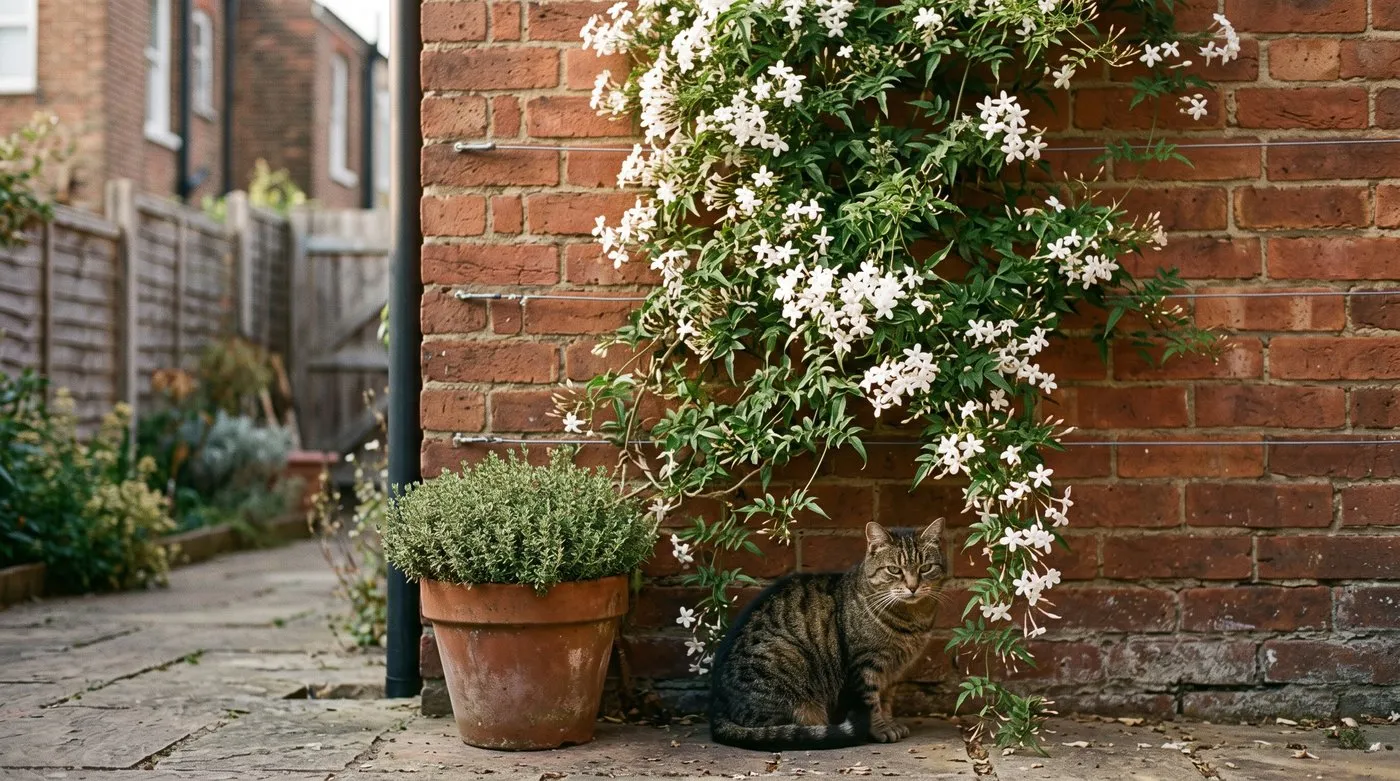
Common jasmine is safe for cats and dogs and smells wonderful on summer evenings. Tie the stems in, as it won’t cling by itself.
Honeysuckle (Lonicera periclymenum)
Native honeysuckle is a pet-friendly climber, though its berries can upset a tummy if eaten in quantity. Sweetly scented flowers come from June to September and bring in moths and bees. ‘Graham Thomas’ (creamy yellow) and ‘Belgica’ (pink and cream) are reliable. It grows in sun or part shade and looks lovely scrambling over arches. Prune in late winter.
Climbing roses (Rosa species)
Climbing roses are safe for pets. As with shrub roses, thorns are the only worry, so pick thornless types near pet paths. ‘Climbing Iceberg’ (white), ‘New Dawn’ (pale pink) and ‘Compassion’ (apricot-pink) are reliable. Plant about 30cm from a wall or fence, leaning towards it. Spread the stems out sideways along wires for the most flowers, and feed in March and July.
Virginia creeper (Parthenocissus quinquefolia)
Virginia creeper has leaves that are fine for pets, but its berries can cause mouth irritation and sickness if eaten. It clings on by itself and covers walls fast, turning fiery red and orange in autumn. It grows in any soil, sun or shade. It’s very vigorous, so give it a big wall and cut it back from windows and gutters every year.
Pet-safe ground cover plants
Ground cover fills gaps, keeps weeds down and leaves less bare soil for dogs to dig. Two of these are good picks, and two are best skipped.
Ajuga (Ajuga reptans)
Bugle is safe for pets and forms low, spreading mats. Blue flower spikes appear in April and May. ‘Burgundy Glow’ has pink, cream and green leaves, and ‘Atropurpurea’ has deep bronze ones. It grows in part shade or sun and copes with clay. It’s handy under shrubs to keep weeds down. Snip off flower stems afterwards to keep it tidy.
Creeping thyme (Thymus serpyllum)
Creeping thyme is safe for pets. It hugs the ground, so it’s ideal for paving gaps, path edges and sunny spots where dogs run. Tiny pink or purple flowers appear in summer and bees love them. It smells lovely when walked on. It needs sun and sharp drainage. ‘Coccineus’ (crimson) and ‘Albus’ (white) are popular. Trim once after flowering to keep it tight.
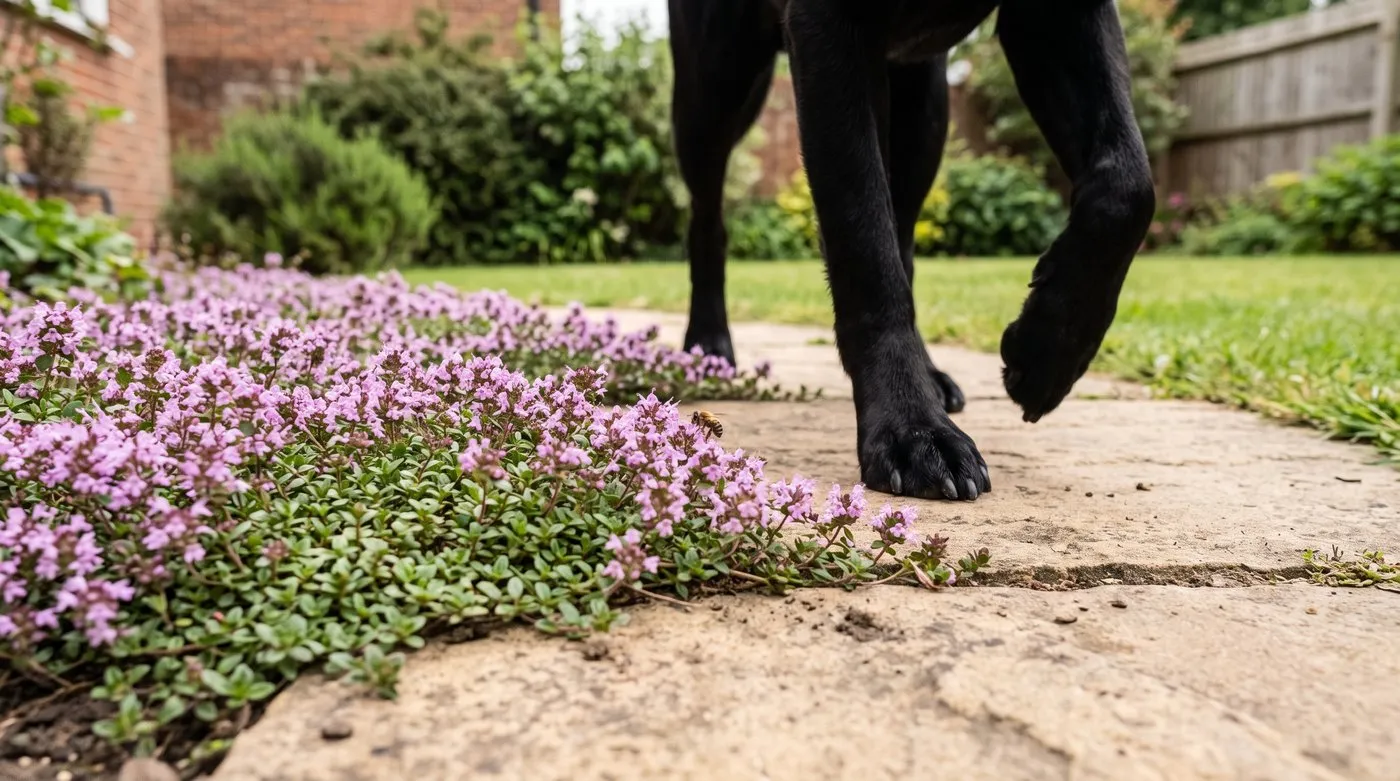
Creeping thyme is safe for pets and copes with light paws. Keep it to path edges and gaps rather than your dog’s main racing track.
Chamomile (Chamaemelum nobile)
Chamomile is a lovely lawn alternative, but it’s listed as harmful to dogs and cats, as it can cause skin irritation and sickness. If your pets like to lie on or nibble plants, choose creeping thyme instead.
Lesser periwinkle (Vinca minor)
Lesser periwinkle is a tough, evergreen ground cover for shade, but periwinkles are flagged as harmful to pets on toxic-plant lists. It’s best left out of a pet garden. Under shade-loving plants, ajuga is a safer way to cover the ground.
Complete pet-safe plants comparison table
Here are the safe plants from this guide at a glance.
| Plant | Type | Flowers | Sun or shade |
|---|---|---|---|
| Sunflower | Annual | Jul-Sep | Sun |
| Snapdragon | Annual or short-lived perennial | Jun-Oct | Sun |
| Rose | Shrub or climber | Jun-Oct | Sun |
| Calendula | Annual | May-Nov | Sun or part shade |
| Cornflower | Annual | Jun-Aug | Sun |
| Zinnia | Annual | Jul-Oct | Sun |
| Aster | Perennial | Aug-Oct | Sun or light shade |
| Echinacea | Perennial | Jul-Sep | Sun |
| Fuchsia | Shrub | Jun-Oct | Part shade |
| Camellia | Evergreen shrub | Jan-Apr | Part shade |
| Magnolia | Tree or shrub | Mar-May | Sun or part shade |
| Buddleia | Shrub | Jul-Sep | Sun |
| Hawthorn | Tree or hedge | May | Sun or part shade |
| Dogwood | Shrub | Jun | Sun or part shade |
| Viburnum | Shrub | Nov-Mar or May | Sun or shade |
| Rosemary | Evergreen herb | Spring | Sun |
| Thyme | Herb | May-Jul | Sun |
| Basil | Tender annual | Summer | Sun |
| Sage | Herb | Jun | Sun |
| Coriander | Annual herb | Jun-Aug | Sun or part shade |
| Dill | Annual herb | Jun-Aug | Sun |
| Jasmine | Climber | Jun-Sep | Sun |
| Honeysuckle | Climber (watch the berries) | Jun-Sep | Sun or part shade |
| Climbing rose | Climber | Jun-Oct | Sun |
| Virginia creeper | Climber (watch the berries) | Grown for leaves | Sun or shade |
| Ajuga | Ground cover | Apr-May | Part shade or sun |
| Creeping thyme | Ground cover | Jun-Aug | Sun |
Plants often wrongly thought to be toxic
Some popular plants have a scary reputation they don’t deserve. Here are the common mix-ups.
Roses are not poisonous
Some people avoid roses because of the thorns. Thorns can scratch, but roses aren’t poisonous. If scratches worry you, train climbers away from where your dog plays.
Sunflowers are completely safe
Sunflowers turn up on a few unreliable online lists. Seeds, petals, stems and leaves are all fine for dogs and cats, so you can grow them happily.
Buddleia is not harmful
Buddleia sometimes gets lumped in with risky shrubs, but it’s generally regarded as safe for dogs and cats. The worst that usually happens is a dog chewing a stem and spitting it out because it tastes bitter.
The lavender confusion
Lavender is a grey area. Lavender oil is harmful to cats in concentrated form, but a plant growing in the garden is a low risk. A cat brushing past it or a dog lying next to it won’t come to harm. Eating a lot of the leaves can cause a mild upset tummy. For zero worry, grow rosemary instead. For what to avoid, see our guide to plants toxic to cats.
Virginia creeper leaves vs berries
The leaves of Virginia creeper are fine. The berries can irritate the mouth and upset the stomach. Most dogs leave them alone, but if yours eats everything, snip off the berries in autumn.
Where to buy pet-safe plants in the UK
Finding these plants is easy. Knowing which are safe is the tricky bit.
Garden centres
Big garden centres and local independents stock roses, snapdragons, sunflowers, herbs and the shrubs here. They’re rarely labelled as pet-safe, so keep this guide on your phone. Staff won’t always know which plants are toxic to pets, so check a trusted list too.
Online nurseries
Crocus (crocus.co.uk) lets you filter by growing conditions. Thompson and Morgan sell seeds for the annuals and herbs, and Gardening Express offers bigger shrubs and climbers. Search by Latin name so you get exactly the right plant.
The Dogs Trust database
Before buying anything not on this list, check the Dogs Trust’s list of poisonous plants. It’s a reliable UK resource. The American ASPCA list is very thorough too, though it includes plants we don’t often grow here.
Growing from seed
Seed is the cheapest way to fill a pet-safe garden. Sunflowers, calendula, cornflowers, zinnias, coriander, dill and basil are all easy from a packet. You’ll also know exactly what you’ve planted, with no surprise extras in the pot.
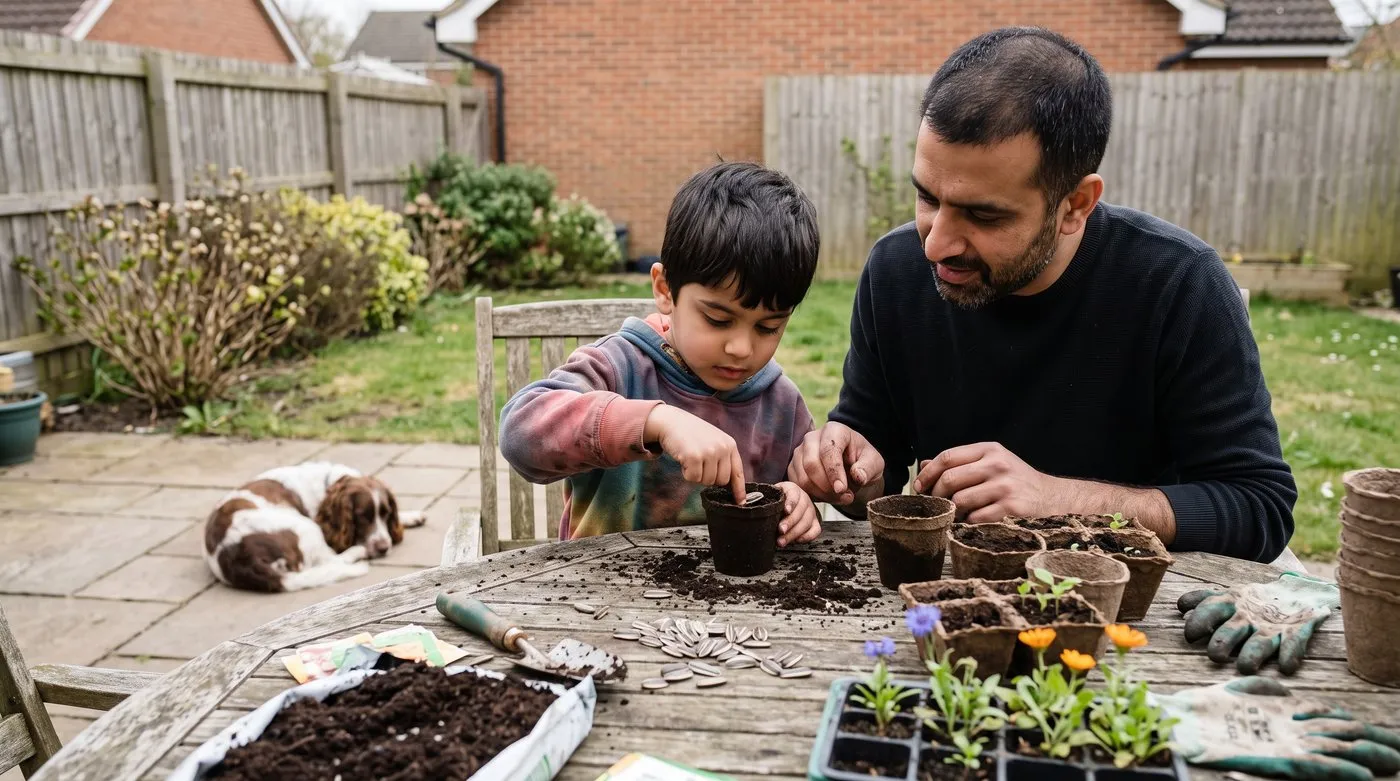
Sowing from seed is the cheapest way to fill a pet-safe garden, and you know exactly what’s in every pot. Sunflowers are a great first sow with children.
Common mistakes with pet-safe gardening
Creeping thyme is lovely for sunny path edges and gaps in lightly used paving. It smells great when brushed and stays low. It won’t stand up to a busy dog route, though, and any plant can upset a tummy if a pet eats a lot of it.
Assuming all parts of a safe plant are safe
Most plants here are safe all over. Virginia creeper and honeysuckle are the exceptions, with fine leaves but berries that can upset a tummy. Check whether the flowers, leaves, roots and berries are all listed as safe.
Confusing similar plant names
Pot marigold (Calendula) is safe, but French marigold (Tagetes) can irritate skin. Common jasmine (Jasminum) is safe, but Carolina jasmine (Gelsemium) is very poisonous. Use the Latin name when you buy.
Ignoring compost and fertiliser toxicity
It’s not just plants. Cocoa shell mulch is toxic to dogs, as it contains the same harmful stuff as chocolate. Blood, fish and bone smells irresistible to dogs and can make them sick if eaten. Leaf mould, bark mulch and seaweed feeds are safer choices.
Not checking new purchases
Mixed pots and hanging baskets can combine safe and harmful plants. A basket of petunias (safe) might include trailing ivy or lobelia, which can both upset pets. Check every plant in a mixed pot before you bring it home.
Relying on outdated or unreliable lists
Online pet-plant lists vary a lot. Some flag plants on very little evidence, while others miss really dangerous ones. Stick to the Dogs Trust, the ASPCA and the RHS guidance on potentially harmful plants, and check two sources before planting anything not in this guide. Our toxic plant guides cover the most dangerous plants for dogs and cats.
How to design a pet-safe border
 A layered pet-safe border: tall sunflowers at the back, snapdragons in the middle and creeping thyme at the front.
A pet-safe border can still be gorgeous. Mix plants from each section for colour all year.
Spring: Camellia, magnolia and ajuga, flowering from January to May.
Summer: Sunflowers, snapdragons, roses, calendula, cornflowers, zinnias, echinacea, fuchsias, buddleia, jasmine and honeysuckle. Peak colour from June to September.
Autumn: Asters, zinnias and calendula keep going, with Viburnum tinus starting to flower in November.
Winter: Camellia, Viburnum tinus, dogwood stems and evergreen rosemary give shape and colour even in January.
Handy tip: Plant herbs along path edges where pets walk. Rosemary and thyme smell wonderful when brushed and are safe. Creeping thyme between paving slabs copes with light paws and scents the air on warm evenings.
Frequently asked questions
Are roses safe for dogs and cats?
Yes, roses are safe for dogs and cats. The petals, leaves and hips are all fine. Thorns can scratch noses and paws, so try a thornless rose such as ‘Zephirine Drouhin’ near paths your pets use.
Which common garden plants are toxic to dogs?
Lilies, foxgloves, daffodils and rhododendrons are all toxic. Yew is one of the most dangerous and can kill. Laburnum seeds, autumn crocus bulbs and oleander are also seriously poisonous. See our full list of plants toxic to dogs.
Is lavender safe for dogs?
Not completely, though the risk is low. Eating a lot of it can upset a dog’s tummy, but it’s not one of the high-risk plants. Rosemary gives a similar look and scent and is a safer choice.
Are sunflowers poisonous to cats?
No, sunflowers are safe for cats. The seeds, petals, stems and leaves are all fine. They’re one of the easiest flowers to grow in a garden with cats.
Can dogs eat herbs from the garden?
Rosemary, thyme, basil, sage and dill are all safe for dogs. A small nibble does no harm. Don’t let dogs eat big amounts of any plant, though, as a bellyful of greenery can make them sick.
What ground cover is safe for dogs?
Creeping thyme is a great choice. It copes with light paws, smells lovely when stepped on and is safe for pets. Ajuga is another safe option for part shade.
Are hydrangeas poisonous to pets?
Yes, mildly. The leaves and flower buds can cause sickness and diarrhoea if eaten. It’s rarely serious, but leave them out if your pets like to chew plants.
Where can I buy pet-safe plants in the UK?
Most garden centres sell them, just without a pet-safe label. Online nurseries like Crocus, Thompson and Morgan, and Gardening Express sell the plants in this guide. Check any unfamiliar plant against a trusted toxic-plant list before you buy.
Our team produces practical UK gardening guidance from source research, contributor records and established horticultural practice. Editorial standards are overseen by Matt W.