Key takeaways
- Give Japanese maples shelter from cold wind and some shade from hot afternoon sun
- They like moist, well-drained, slightly acid to neutral soil, not chalk or soggy clay
- They grow slowly and most stay around 2-4m tall for many years
- Every variety grows well in a pot at least 45cm across
- Prune only if needed, between July and January
- Crispy brown leaf edges are scorch from wind, frost or drought, not disease
Japanese maples are happy in UK gardens as long as you give them three things: shelter from wind, dappled shade and moist, well-drained, slightly acid soil. They stay small, love our mild, damp weather and grow beautifully in pots. Here’s how to choose one, where to put it and how to keep those lovely leaves looking their best. For more small trees, see our guide to the best trees for small gardens.
Choosing a Japanese maple variety
There are hundreds of varieties, but for most UK gardens ‘Bloodgood’, ‘Osakazuki’, ‘Sango-kaku’ or a lace-leaf type is a great place to start.
‘Atropurpureum’ is the classic purple-leaved maple. Leaves open dark red-purple in spring and keep their colour through summer if they get enough light. In deep shade they fade to bronze-green. It turns deep crimson in autumn and makes a rounded tree. A reliable, good-value choice for beginners.
‘Bloodgood’ has even darker, richer purple leaves that hold their colour better through summer. Autumn brings intense crimson. It’s a little more upright, with dark bark for winter interest. One of the best all-rounders for UK gardens.
Lace-leaf (Dissectum) types have finely cut, feathery leaves and a weeping habit, slowly forming a mushroom-shaped mound about 1.5-2m tall. ‘Dissectum Atropurpureum’ has purple leaves, while ‘Dissectum Viride’ is green and turns gold in autumn. Both need shelter, as the fine leaves scorch easily.
‘Sango-kaku’ (coral bark maple) is the one for winter. Its young stems turn bright coral-red once the leaves drop, glowing in low winter sun. Leaves open pinkish, turn green, then clear gold in autumn. It’s a four-season tree and grows more upright than most.
‘Osakazuki’ is famous for its autumn show. Its green leaves turn brilliant scarlet in October. If you only have room for one Japanese maple, this is a lovely choice.
Acer japonicum ‘Aconitifolium’ is a close cousin with bigger, deeply cut leaves. In autumn it puts on a firework display of crimson, orange, scarlet and purple all at once. It grows a little bigger than most Acer palmatum varieties.
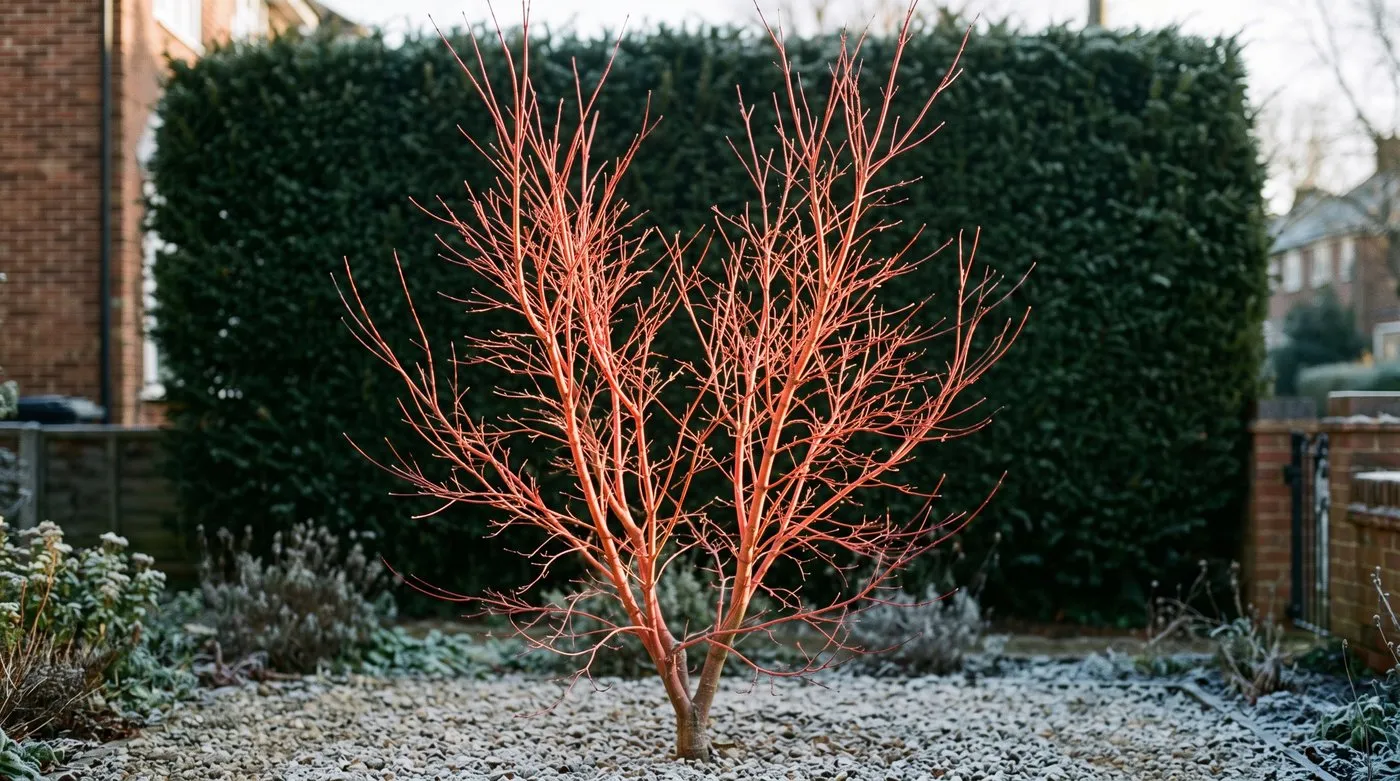
‘Sango-kaku’ is the one for winter. Its young stems turn bright coral-red once the leaves fall.
Japanese maple variety comparison
| Variety | Height | Spread | Summer leaf | Autumn colour | Why grow it |
|---|---|---|---|---|---|
| ’Atropurpureum’ | 3-4m | 3-4m | Dark red-purple | Deep crimson | Reliable, easy |
| ’Bloodgood’ | 3-4m | 2.5-3m | Rich dark purple | Crimson-red | Stays purple in summer |
| ’Dissectum Atropurpureum’ | 1.5-2m | 2-3m | Purple, lacy | Orange-crimson | Weeping, feathery |
| ’Dissectum Viride’ | 1.5-2m | 2-3m | Fresh green, lacy | Golden-orange | Soft, mounded shape |
| ’Sango-kaku’ | 4-5m | 3-4m | Pinkish, then green | Golden-yellow | Coral-red winter stems |
| ’Osakazuki’ | 3-4m | 4-5m | Fresh green | Intense scarlet | Stunning autumn colour |
| A. japonicum ‘Aconitifolium’ | 4-5m | 4-5m | Deep green, deeply cut | Mixed crimson-orange | Multicoloured autumn |
Where to plant a Japanese maple
Pick a spot that’s sheltered from wind, out of hot afternoon sun and away from frost pockets. Get this right and most problems never happen.
Shelter from wind matters most. Cold north and east winds in spring blacken new leaves, and summer wind dries them out. A spot protected by a wall, fence, hedge or bigger trees is ideal. Woodland edges and courtyards are perfect.
Dappled shade suits most varieties. A taller tree overhead filters the harsh midday sun while still giving enough light for good colour. Purple varieties need a bit more light than green ones to stay purple. Morning sun and afternoon shade is the safe bet, and a shady garden corner is often just right.
Avoid frost pockets. Cold air sinks and gathers in hollows and enclosed spaces. Late frosts in April and May then catch the new leaves and turn them black. A gentle slope where cold air can drain away is better.
Skip south-facing walls in the south of England. The reflected heat scorches the leaves from June onwards. A spot by a north or west-facing wall is much kinder.
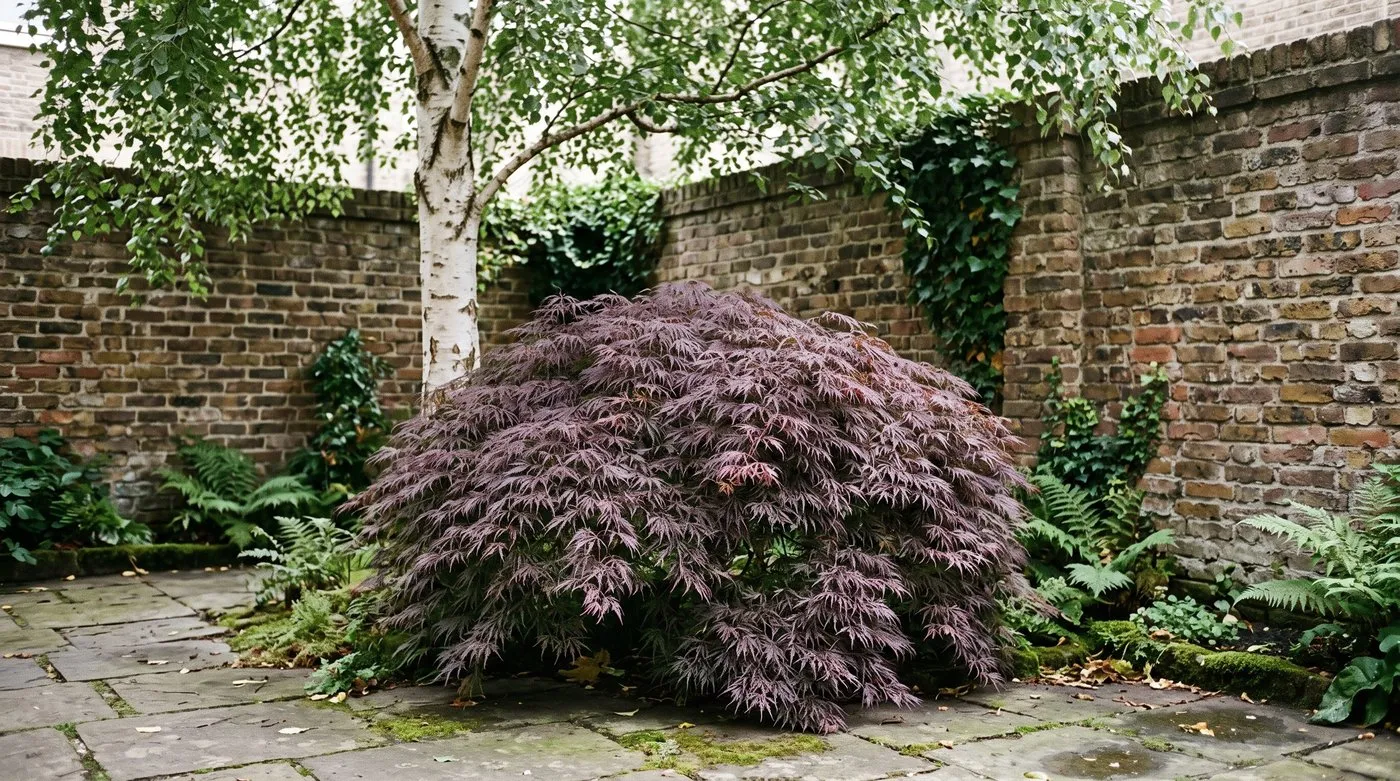
Shelter from wind matters most. Courtyards and spots under taller trees give the dappled shade lace-leaf maples love.
Why is my purple Japanese maple turning green?
Usually it’s in too much shade. Purple and red varieties need some sun to keep their colour, and in deep shade they fade to bronze-green.
Many purple varieties also look a bit duller in high summer, then colour up again in autumn. That’s normal. But if one branch has plain green leaves that look quite different, check where it’s growing from. Most named maples are grafted onto green-leaved roots. Shoots from below the graft (the swollen bump near the base of the trunk) come from those roots and will take over. Cut them off flush with the trunk as soon as you see them.
Gardener’s tip: No sheltered spot in the ground? Grow your maple in a big pot. You can place it exactly where the light is right, and move it somewhere safer when frost or strong wind is on the way.
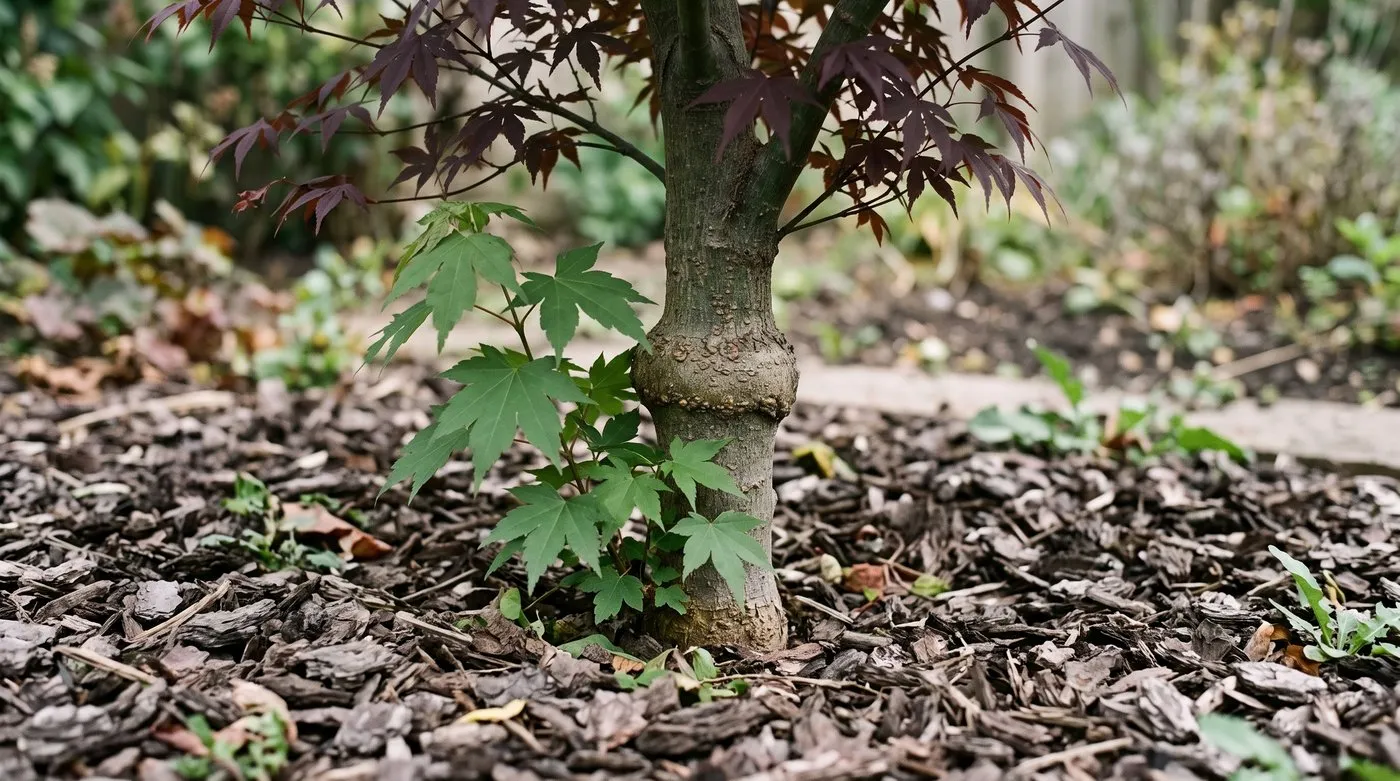
A green shoot from below the graft comes from the rootstock and will take over. Cut it off flush with the trunk as soon as you see it.
Soil requirements
Japanese maples like moist, well-drained, slightly acid to neutral soil. On chalky or limy ground they struggle, and the leaves turn yellow between the veins.
The perfect soil is rich and crumbly and holds moisture without getting soggy. Heavy clay that stays wet in winter rots the fine roots, while sandy soil dries out too fast in summer. Fix either by digging in plenty of garden compost and leaf mould before planting.
A cheap soil test kit from the garden centre will tell you what you’ve got. If your soil is limy, the easiest answer is to grow your maple in a pot of ericaceous compost. Trying to make limy ground acid is hard work and never lasts.
Each spring, spread a 5-8cm mulch of leaf mould, bark or compost around the tree, keeping it 10cm clear of the trunk. It holds in moisture, keeps the roots cool and feeds the soil as it rots down.
How to plant a Japanese maple
Plant in autumn (October to November) or spring (March to April). Autumn is usually best, as the warm soil helps roots grow before winter. In cold, wet northern gardens, spring can be easier.
- Dig a hole three times as wide as the root ball and the same depth
- Loosen the bottom and sides of the hole with a fork
- Mix the soil you dug out with an equal amount of compost or leaf mould
- Ease the tree out of its pot and gently tease out any circling roots
- Set it so the top of the root ball is level with the ground. Never plant it deeper
- Fill in with the soil mix, firming gently as you go
- Water well with 15-20 litres to settle the soil
- Mulch 5-8cm deep with bark or leaf mould, keeping it off the trunk
- Don’t stake unless the spot is very windy. A little movement makes the trunk stronger
Water weekly through the first spring and summer. Once settled in, after two or three years, they cope with short dry spells, though a long drought will still scorch the leaves.
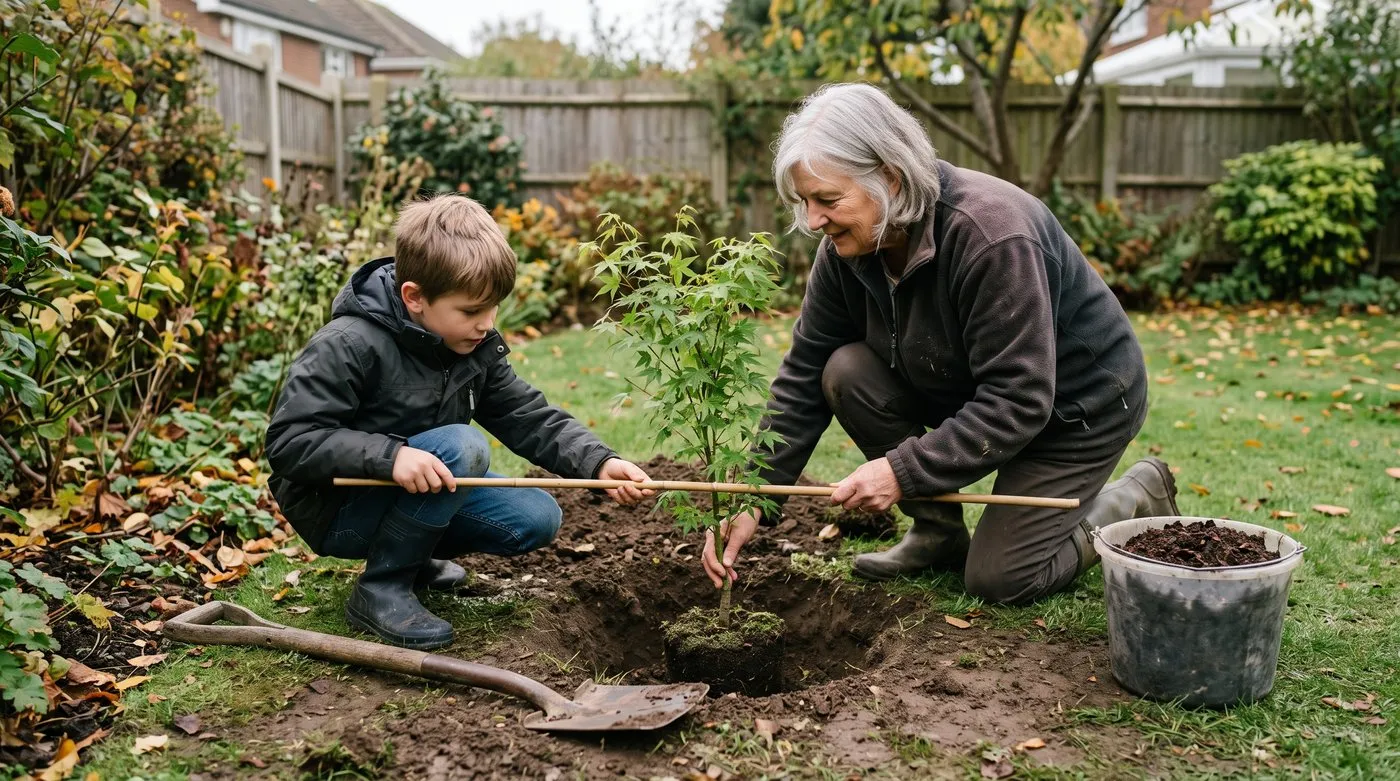
Dig a hole three times as wide as the root ball but no deeper. The top of the root ball should sit level with the soil.
Growing Japanese maples in containers
Pots are a brilliant way to grow Japanese maples, especially if your soil is chalky or you’ve no sheltered border. Every variety is happy in one.
Choose a pot at least 45cm across and 40cm deep, with good drainage holes. Terracotta and stone look lovely but are heavy and can crack in hard frost. Frost-proof glazed or resin pots are lighter and safer. Avoid black plastic, which cooks the roots in summer.
Fill with ericaceous compost mixed with some perlite for drainage. The RHS suggests peat-free John Innes No. 2 with some sharp sand instead, which holds water and food well and makes the pot heavier and steadier in wind. If you fancy something tiny, acers are classic bonsai subjects, as our bonsai tree care guide for beginners shows.
Water regularly. Pots dry out much faster than the ground, so check daily in hot weather. If the top 2cm feels dry, water until it runs out of the bottom.
Feed in spring and early summer with a general granular feed or a half-strength liquid feed. Stop by August so new growth can toughen up before winter.
Repot every two or three years in April or September. Ease the tree out, trim about 5cm off the bottom and sides of the root ball, and replant in fresh compost in the same pot. That keeps it healthy without needing ever-bigger pots.
Protect pots in winter. Roots in a pot freeze much more easily than roots in the ground. In hard frost, wrap the pot in bubble wrap or hessian and move it against a house wall. In a really cold snap, pop it in an unheated greenhouse, garage or shed for a few days.
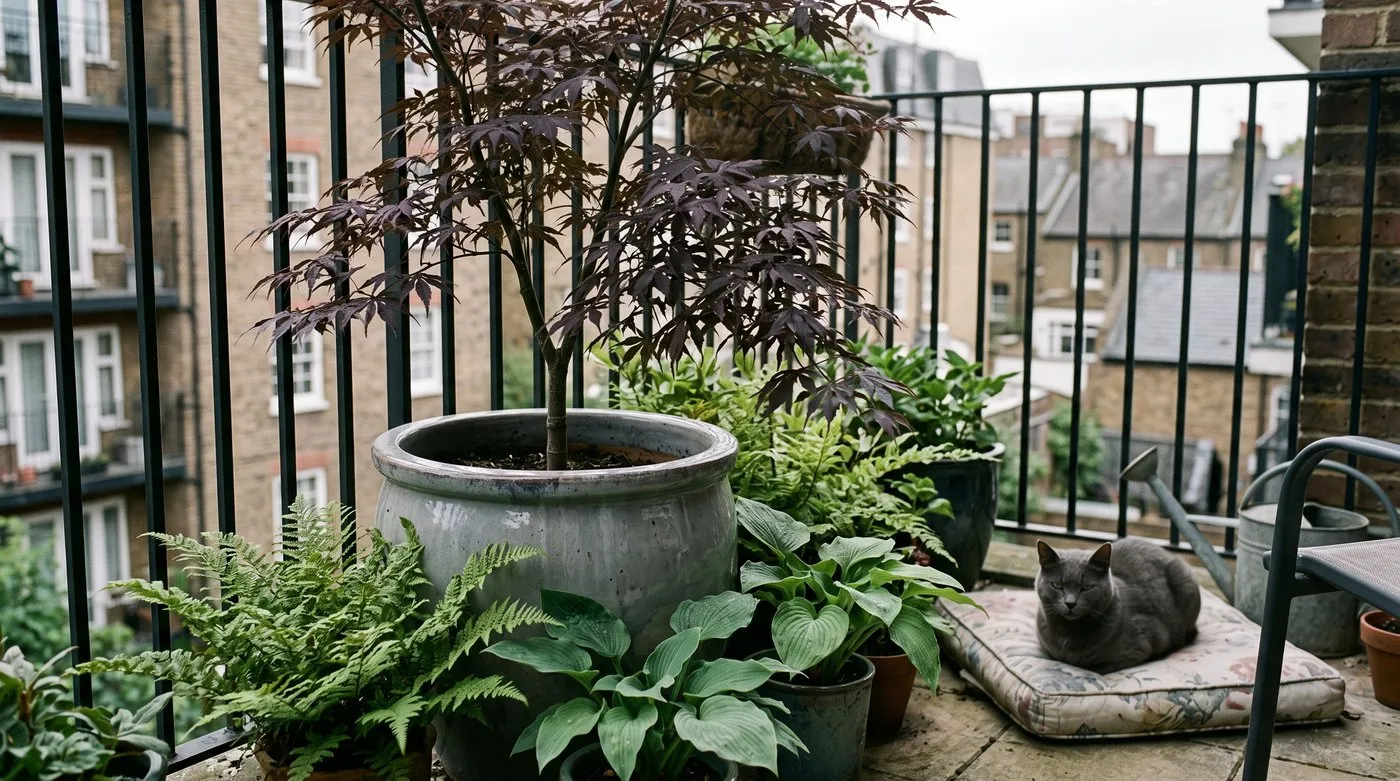
Choose a pot at least 45cm across with good drainage. Check it daily in hot weather, as pots dry out far faster than the ground.
Pruning Japanese maples
Japanese maples need very little pruning, and heavy cutting spoils their graceful shape.
Prune only between July and January, as the RHS Japanese maple guide advises. Cuts made in late winter and spring bleed sap. Late autumn, once the leaves are off, is the easiest time to see the branches.
Start with dead, damaged and crossing branches. Step back and look at the tree from all sides. You’re helping its natural shape, not creating a new one. Thin out crowded growth in the middle to show off the lovely layered branches.
Never shorten healthy branches to make the tree smaller. It just sends up a mess of whippy shoots. If a maple has outgrown its spot, moving it is kinder than hacking it back.
Can you move a Japanese maple?
Yes, young and medium-sized ones move well while they’re dormant, between late October and early March. Avoid moving them in leaf, or when the ground is frozen or waterlogged.
Water the tree well the day before. Dig around it at least as wide as the branches spread, and lift as big a root ball as you can manage. Wrap it in hessian or an old sheet to hold the soil together. Replant at the same depth in a sheltered spot, firm in and water well. Keep watering weekly through the next spring and summer. Big, old trees are much harder to move and are often best left alone.
For lace-leaf types, remove any shoots that grow straight up through the top instead of cascading down. Cut back to a downward-facing bud or branch, and keep the inside open so light and air can get through.
Gardener’s tip: Young maples sometimes grow two main stems competing to be the trunk. Remove the weaker one early. Left alone, two leaders can split apart in wind or snow.
Stopping leaf scorch
Brown, crispy leaf edges are the most common Japanese maple worry in the UK. It looks alarming, but it’s rarely serious. Wind shelter, shade from afternoon sun and steady moisture are the cure.
What causes it:
- Cold spring wind dries out new leaves faster than the roots can keep up
- Late frost in April or May blackens new leaves
- Hot sun, especially heat bouncing off south-facing walls and paving
- Drought, when the tree lets the leaf edges go to save water
- Root damage from digging or building work nearby
Scorched leaves won’t recover this year, but the tree grows fresh, healthy leaves next spring. Give it wind shelter, dappled shade, steady moisture and a thick mulch.
Pots get scorch more often, because they dry out faster. Water daily in warm weather and group pots together, which keeps the air around them a little more humid. A sheltered small garden space with pots clustered together is ideal.
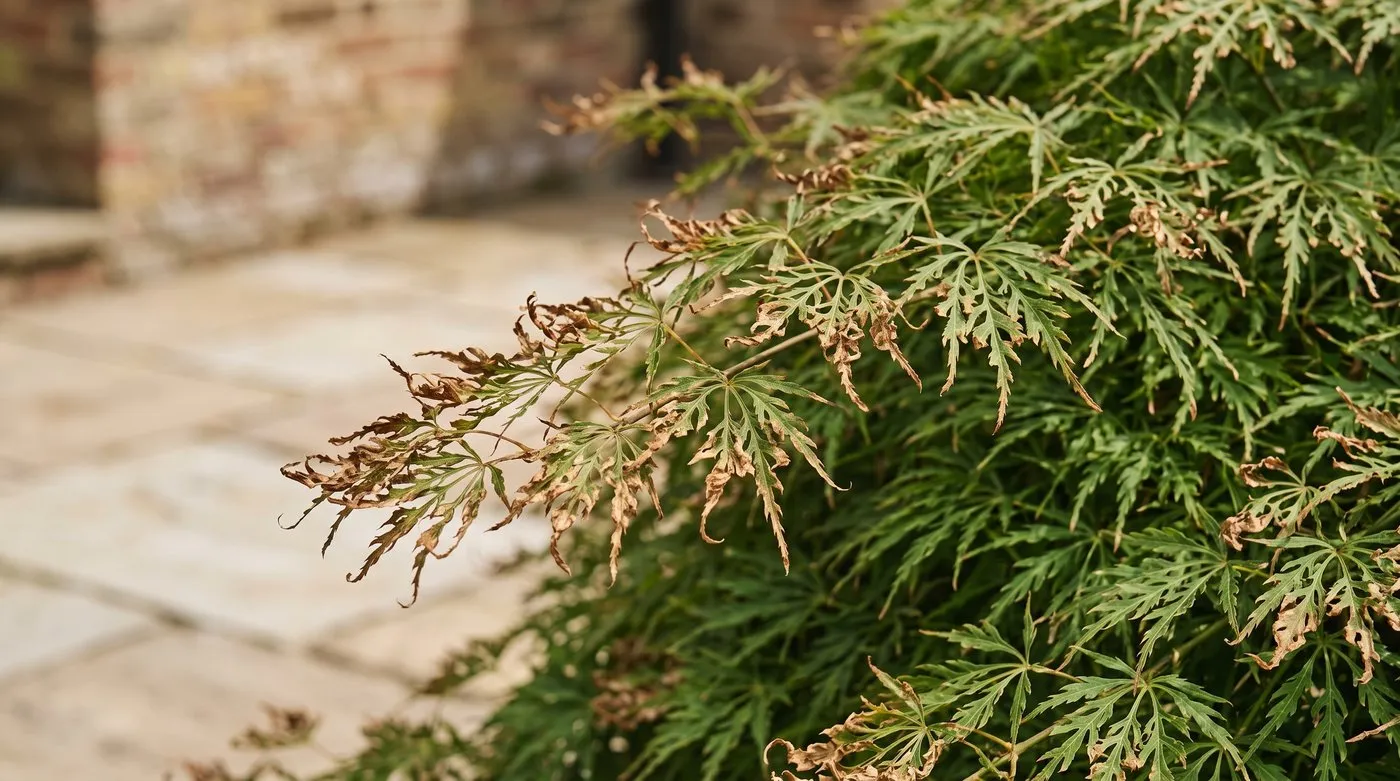
Brown, crispy edges look alarming but are rarely serious. Wind shelter, shade from afternoon sun and steady moisture are the cure.
Autumn colour and why it varies
Autumn colour depends on the variety, the weather and the spot, so the same tree can look different every year.
Bright colour needs sunny days, cool nights, a gradual cool-down and enough moisture through September and October. A warm, dry autumn followed by a sudden hard frost gives dull, brownish colour. A cool, damp autumn with clear October days gives the most dazzling reds and golds.
Trees with good light colour up better than those in deep shade and very rich soil. But a tree that’s too dry drops its leaves before they colour. Aim for enough water and plenty of light.
Peak colour in most UK gardens is from mid-October to mid-November, a little earlier in the north and on high ground.
Plant your maple where it catches low autumn sun from the south-west or west. The thin leaves glow when the sun shines through them.
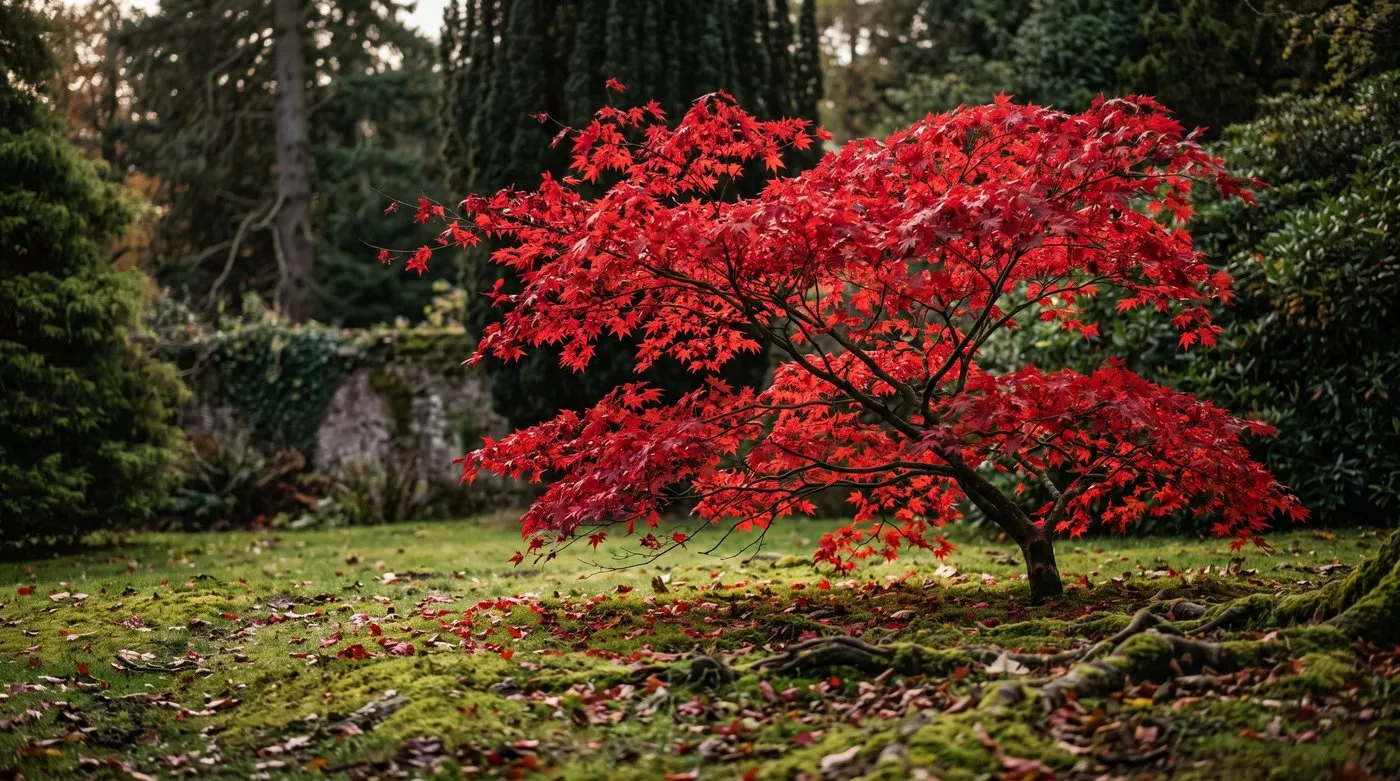
Plant where the maple catches low autumn sun from the west or south-west. The thin leaves glow when the light shines through them.
Month-by-month care calendar
| Month | What to do |
|---|---|
| January | Check potted trees for frost damage and make sure pots aren’t waterlogged. |
| February | Order new trees. Bare-root trees are available until March. |
| March | Finish planting. No pruning until July. |
| April | Watch for late frost and cover new leaves with fleece if needed. Repot potted trees. Start watering pots. |
| May | Feed potted trees if you haven’t already. |
| June | Water in dry spells. Watch for scorch on exposed trees. |
| July | Water pots daily in hot weather. Light pruning can start. |
| August | Keep watering. Stop feeding. |
| September | Water a little less. Autumn colour starts in the north. You can repot this month. |
| October | Enjoy the autumn colour. Collect fallen leaves for leaf mould. |
| November | Prune after leaf fall if needed. Plant new trees. Wrap pots before hard frost. Mulch. |
| December | Finish any pruning. Protect pots from hard frost. |
Is my Japanese maple dead or just dormant?
A bare Japanese maple in winter is perfectly normal. They drop all their leaves after the autumn show and stay bare until new leaves open, usually in April.
If yours hasn’t leafed up by May, scratch a little bark on a twig with your thumbnail. Green and moist underneath means it’s alive. Brown and dry means that bit is dead, so work down the branch until you find green. Cut dead wood back to live growth from July onwards, not in spring. Late starters in cold gardens, or after a hard spring frost, often pull through. Black, shrivelled leaves after a frost are damaged, but the tree usually pushes out a second set within a few weeks.
Common problems and solutions
Verticillium wilt is the most serious disease. Branches suddenly die back, often on one side. There’s no cure. Cut dead branches back to healthy wood, cleaning your secateurs between cuts. Mild cases are sometimes outgrown, but bad ones kill the tree. Avoid planting where potatoes, tomatoes or strawberries have grown recently, as they can carry the same soil fungus.
Coral spot shows as bright orange-pink pimples on dead twigs. It gets in through wounds and dead wood. Prune out affected branches well below the spots and get rid of the prunings. Removing dead wood promptly keeps it away.
Aphids sometimes gather on young shoot tips in spring and curl the new leaves. Blast them off with a hose. Ladybirds and lacewings usually sort them out if you let them.
Scale insects look like small brown bumps on the stems and leave sticky honeydew. Wipe them off with a damp cloth.
Honey fungus can kill trees by rotting the roots. Look for white, fan-like sheets under the bark at the base and black “bootlaces” in the soil. There’s no cure. Remove the tree and as much root as you can, and replace it with something more resistant.
Now your maple is sorted, read our guide on Japanese garden design for the UK to build the perfect setting around it.
Frequently asked questions
Can Japanese maples grow in full sun in the UK?
In cooler parts of the UK, yes. In northern England, Scotland and Wales many cope with full sun. In the south, hot summer sun can scorch the leaves, especially on lace-leaf types. Green-leaved varieties like ‘Osakazuki’ take more sun than purple ones. Morning sun with afternoon shade is the safest spot anywhere.
Why are the leaves on my Japanese maple turning brown?
Brown, crispy edges are leaf scorch. Cold spring wind, late frost and summer drought are the usual causes. It looks bad but isn’t a disease and won’t spread. The tree grows fresh new leaves next spring. Give it shelter from wind, steady moisture, a mulch and some shade.
When should I prune a Japanese maple?
Between July and January, as the RHS advises. Late autumn, once the leaves have dropped, makes it easiest to see what you’re doing. Avoid late winter and spring, when cuts bleed sap. Only remove dead, damaged or crossing branches, and never try to reshape the tree.
Can I grow a Japanese maple in a pot?
Yes, every variety grows well in a pot. Use one at least 45cm across with good drainage holes. Fill with ericaceous compost mixed with some perlite, or John Innes No. 2 with sharp sand. Water often, checking daily in hot weather. Feed in spring and early summer, and repot every two to three years.
How fast do Japanese maples grow?
Slowly, usually 15-30cm a year. Most Acer palmatum varieties reach about 2-4m after many years. Lace-leaf types are slower and smaller, around 1.5-2m. That slow pace is a bonus, as they stay in scale with small gardens and pots for decades.
Do Japanese maples need ericaceous soil?
No, but they don’t like chalk. They’re happiest in slightly acid to neutral soil and grow well in ordinary neutral garden soil. On chalky or limy soil the leaves turn yellow between the veins. If that’s your soil, grow one in a pot of ericaceous compost instead.
Which Japanese maple has the best autumn colour?
‘Osakazuki’ is hard to beat. Its green leaves turn a blazing scarlet from mid-October. ‘Bloodgood’ turns deep crimson, and ‘Sango-kaku’ goes clear gold against its coral-red stems. Lace-leaf types mix orange, gold and crimson all on one plant.
Are Japanese maples hardy in the UK?
Yes, established trees are fully hardy across the UK. Young trees and fresh spring leaves can be blackened by late frost in April and May. Shelter from cold north and east winds helps a lot. Trees in pots are more at risk, so wrap the pot in hard frost.
Our team produces practical UK gardening guidance from source research, contributor records and established horticultural practice. Editorial standards are overseen by Matt W.