Key takeaways
- Closed terrariums recycle their own water and need watering only now and then
- Open terrariums suit succulents and cacti, which rot in a damp closed jar
- Build in layers of gravel, activated charcoal, moss, compost, then a pretty top layer
- Fittonia, small ferns and moss are the best plants for closed terrariums
- Keep closed terrariums out of direct sun, as they heat up fast and cook the plants
- Go easy on the water at the start, as there are no drainage holes
A terrarium is a little garden inside glass. Closed ones, with a lid, make their own mini water cycle and need hardly any care. Open ones suit succulents and cacti that like dry air. Both look lovely and fit in any home, garden or not.
You can make one in about half an hour. Here’s how, from picking a jar to keeping it going.
What is a terrarium and how does it work?
A closed terrarium looks after itself. Water rises from the soil and leaves, mists up the glass, and runs back down into the soil. That loop just keeps going, so you rarely need to water.
The idea goes back to Victorian London. Nathaniel Bagshaw Ward, a doctor, noticed a fern growing happily inside a sealed glass jar he’d been using for a moth chrysalis. His “Wardian cases” went on to carry live plants around the world. Today’s terrariums come straight from his lucky find.
Open terrariums work differently. Without a lid, moisture escapes. That suits plants that like dry air and a breeze, such as succulents, cacti and air plants.
Choosing the right container
Your container decides what you can grow and how it looks. Here are some easy options.
Wardian case. A glass and metal case with a hinged lid, like the original. Gorgeous in period homes, though pricier.
Sweet jar. Cheap, easy to find and works a treat. A big glass jar with a cork or clip lid has a wide neck, so planting is easy.
Fish bowl or brandy glass. Great for open terrariums. The wide opening gives succulents the fresh air they need.
Geometric glass terrarium. Angular glass panels in fun shapes. Most are open, so they suit succulents and air plants.
Cloche or bell jar. A glass dome on a wooden base. It makes a closed home for tropical plants and looks smart on a table. You lift the whole dome to get in.
Kilner jar. Cheap and practical. The rubber seal makes a good closed terrarium for 3 or 4 small plants.
New to houseplants? Our beginner houseplant guide covers the basics.
How to build a terrarium step by step
The layers are the same for closed and open terrariums. Only the plants change.
Step 1: Clean the container
Wash it with warm soapy water, rinse well and let it dry completely.
Step 2: Add the drainage layer (2-3cm)
Pour in a 2-3cm layer of small pebbles, gravel or clay pebbles. There are no drainage holes, so this gives spare water somewhere to go. Rinse the gravel first to get rid of dust.
Step 3: Add activated charcoal
Sprinkle a thin layer of horticultural activated charcoal over the gravel. It helps keep things fresh and stops stale smells. It’s well worth it in a closed jar and optional in an open one.
Step 4: Add a moss layer
Lay a thin layer of dried sphagnum moss over the charcoal. It stops the compost sinking down into the gravel. Tear it into pieces and cover the whole surface.
Step 5: Add compost (5-7cm)
For closed terrariums, use peat-free houseplant compost with a little perlite mixed in. For succulents, use cactus compost with extra grit. Dampen the compost slightly before you add it. Shape a few little hills and dips to make it look natural.
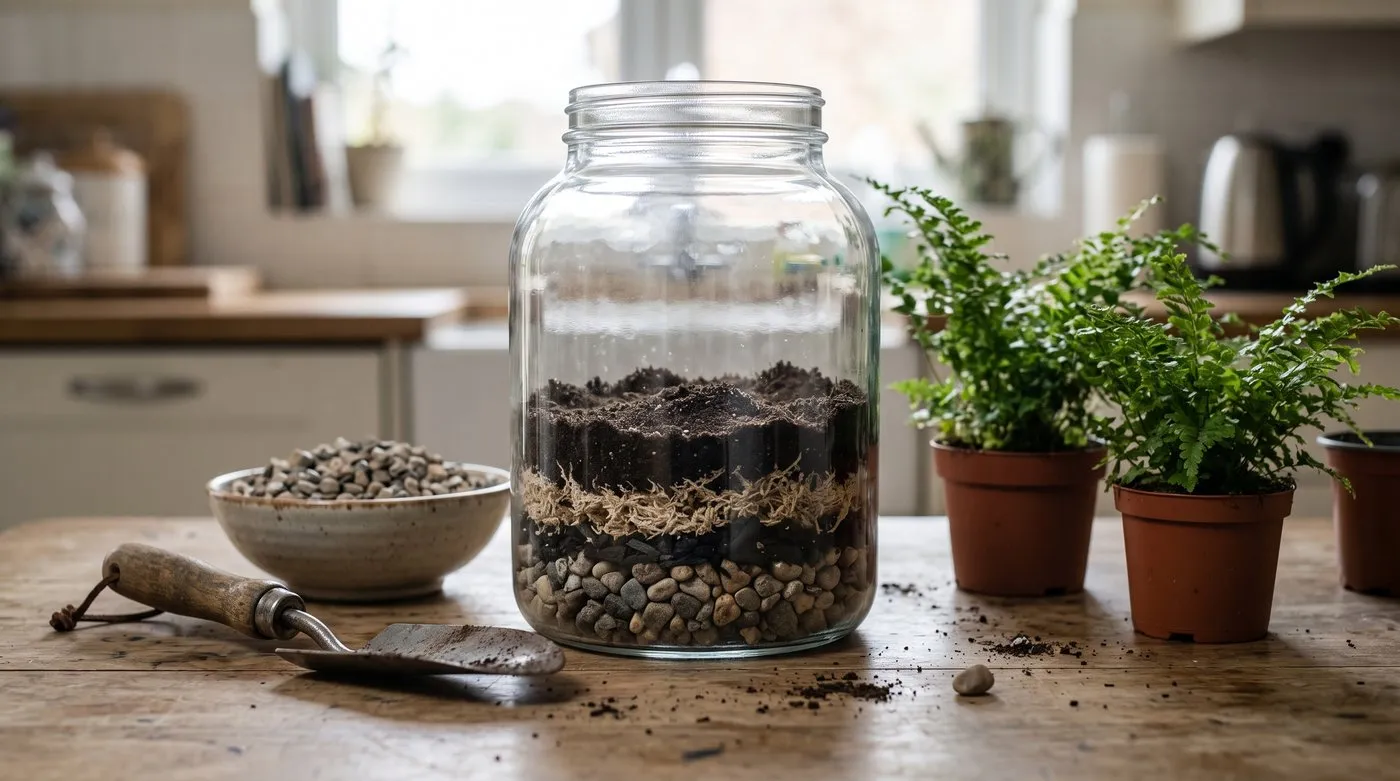
The moss layer stops compost sinking into the gravel. Shape the compost into small hills and dips for a natural look.
Step 6: Plant your choices
Start with the tallest plant at the back or in the middle. Use a long spoon or chopstick to dig small holes. Ease each plant out of its pot, shake off some soil, lower it in and firm it down. Leave a little space between plants so they can grow.
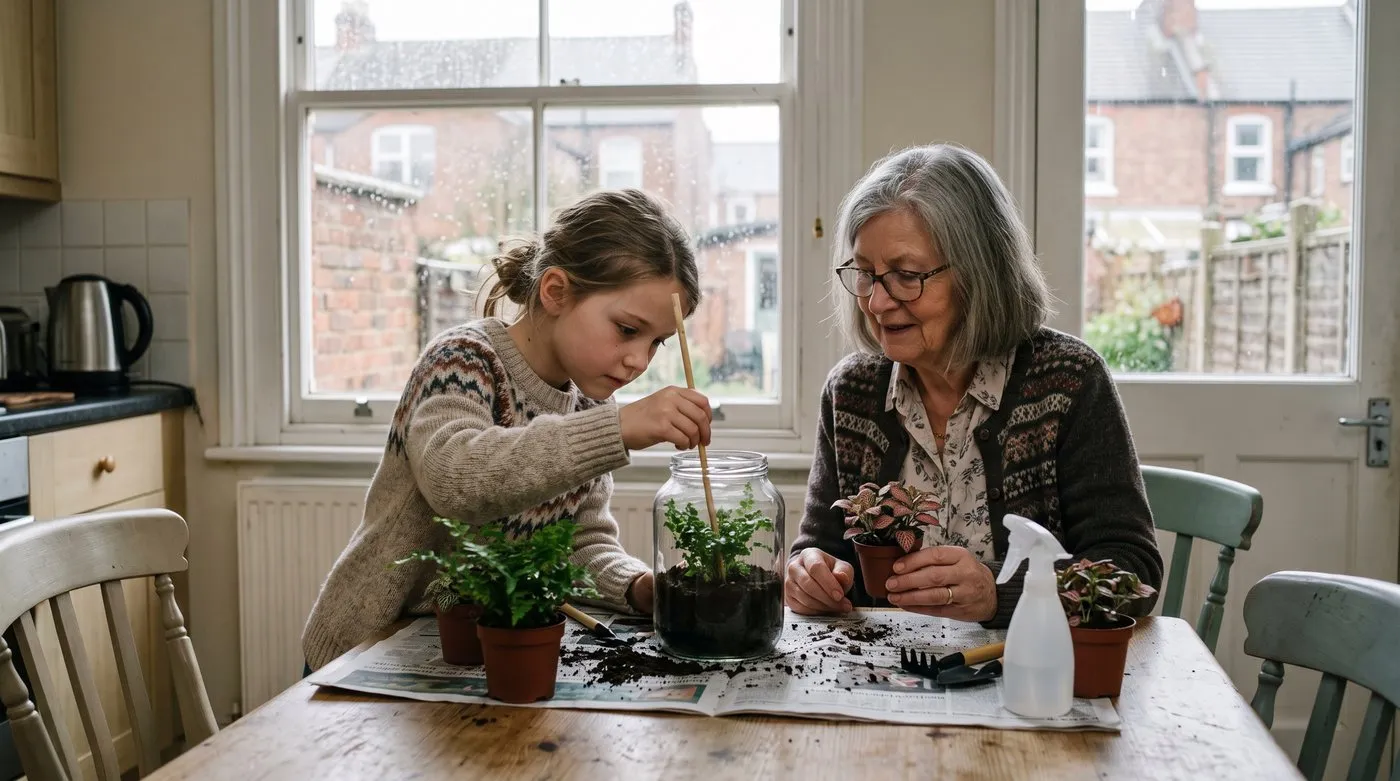
Start with the tallest plant at the back or middle. A long chopstick or spoon makes planting through the neck of a jar much easier.
Step 7: Add the finishing touches
Top the compost with moss, small stones, bark or tiny ornaments. It looks great and stops soil splashing when you water. Sheet moss gives a lovely forest-floor feel.
Step 8: Water and seal
For a closed terrarium, mist the inside lightly with a spray bottle. The compost should be damp, not wet. Then pop the lid on. For succulents, water very lightly, or not at all if the compost was already damp.
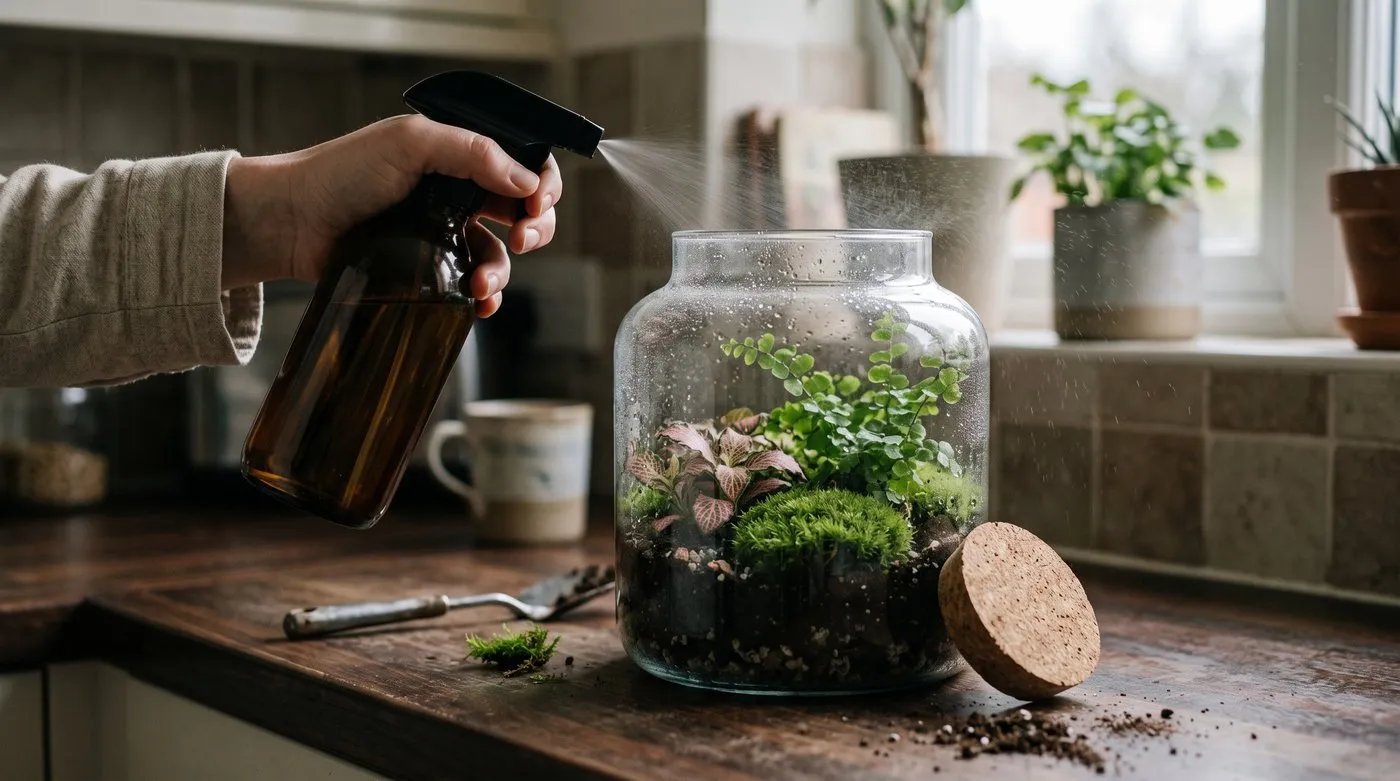
A light misting is all a new closed terrarium needs. The compost should feel damp, not wet, before you seal it.
Best plants for closed terrariums
Closed terrariums are warm and humid. Pick small, slow-growing plants that love damp air.
Fittonia (nerve plant)
The terrarium favourite. Little leaves with pink, white or red veins, and it stays small. It loves humidity and copes with low light. Pinch the tips to keep it bushy.
Maidenhair fern
Delicate, fan-shaped fronds on thin black stems. It hates dry air, so it struggles in a room but loves a closed terrarium. Give it a bit more space, as it grows taller than some.
Button fern
Small, round leaflets on arching stems. A bit less fussy than maidenhair, slow-growing and a good choice for beginners.
Moss
Sheet moss, cushion moss and mood moss all love closed terrariums. They make a soft, green forest floor. Trim with scissors if they get too thick. Buy moss from a terrarium supplier rather than taking it from the wild.
Peperomia
Compact plants with thick leaves in green, red or patterned types. Most stay small. String of turtles trails nicely through a terrarium.
Selaginella (spikemoss)
Not a real moss, but it looks like one. It forms a dense green carpet and loves constant damp air and low light.
Pilea
Small pileas like the friendship plant, with bronze-green crinkled leaves, and Pilea glauca, with tiny silvery leaves, stay compact and like humid air.
Best plants for open terrariums
Open terrariums suit plants that like dry air. Our succulent care guide has more on looking after these.
Succulents
Echeveria, jade plant (Crassula) and houseleeks (Sempervivum) all work well. They need lots of light, so a sunny windowsill is best. Water sparingly, as they rot quickly in damp conditions.
Cacti
Small cacti like Mammillaria, Gymnocalycium and Rebutia are happy in open glass. Give them very bright light, water only every few weeks, and use gritty cactus compost.
Air plants (Tillandsia)
Air plants take in water through their leaves, so they need no soil at all. Sit them on stones, driftwood or moss. Mist them twice a week, or soak them in water for 20 minutes once a week. They like bright light without hot sun.
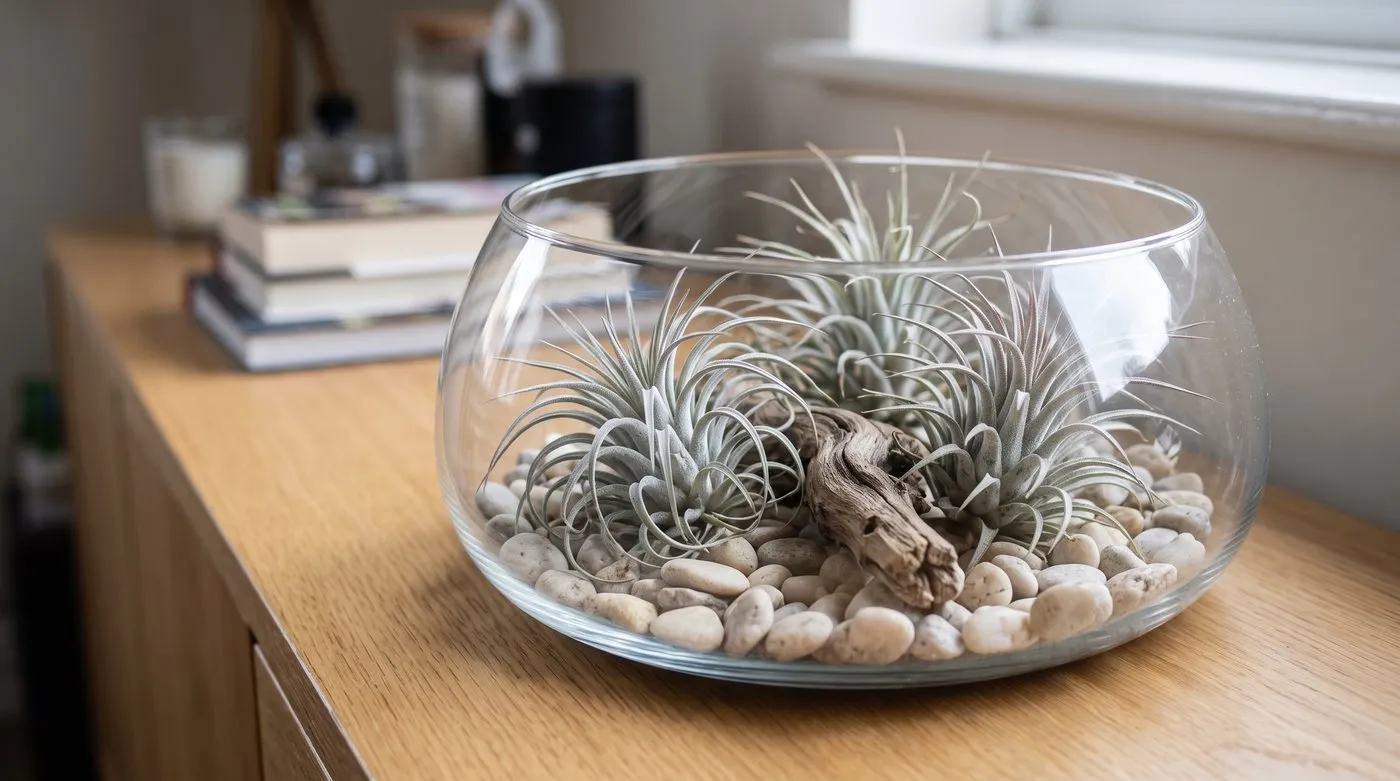
Air plants need no soil at all, just stones or driftwood to sit on. Mist them twice a week or give them a weekly soak.
Haworthia
Small, rosette-shaped succulents that cope with less light than most. They’re happy on an east or west-facing windowsill and grow very slowly. Water every few weeks. Our guide to low-light houseplants has more ideas for darker rooms.
Terrarium plant comparison table
| Plant | Terrarium type | Light | Growth | Ease |
|---|---|---|---|---|
| Fittonia | Closed | Low to medium | Moderate | Easy |
| Maidenhair fern | Closed | Medium | Moderate | Medium |
| Button fern | Closed | Low to medium | Slow | Easy |
| Sheet moss | Closed | Low | Slow | Easy |
| Peperomia | Closed | Low to medium | Slow | Easy |
| Selaginella | Closed | Low | Moderate | Easy |
| Pilea | Closed | Medium | Moderate | Easy |
| Echeveria | Open | Bright | Slow | Easy |
| Haworthia | Open | Medium | Very slow | Easy |
| Tillandsia | Open | Bright, no hot sun | Slow | Medium |
| Mammillaria | Open | Bright | Very slow | Easy |
| Crassula | Open | Bright | Slow | Easy |
How to maintain your terrarium
Closed and open terrariums need quite different care.
Closed terrarium care
Watering. A closed jar needs water only now and then. Watch the glass. A little mist in the morning that clears by afternoon is just right. If it stays heavily misted all day, take the lid off for a few hours. If there’s no mist for several days, add a spoonful of water.
Light. Bright light, but no direct sun. A north or east-facing windowsill is ideal. The glass traps heat, and direct sun can cook the plants very quickly.
Trimming. Snip off anything touching the glass, and anything shading smaller plants. Pick out dead or yellow leaves so they don’t go mouldy.
Cleaning the glass. Wipe the outside with a damp cloth. For the inside, wrap a cloth round a chopstick. Green algae on the glass means it’s getting too much light, so move it somewhere a little shadier.
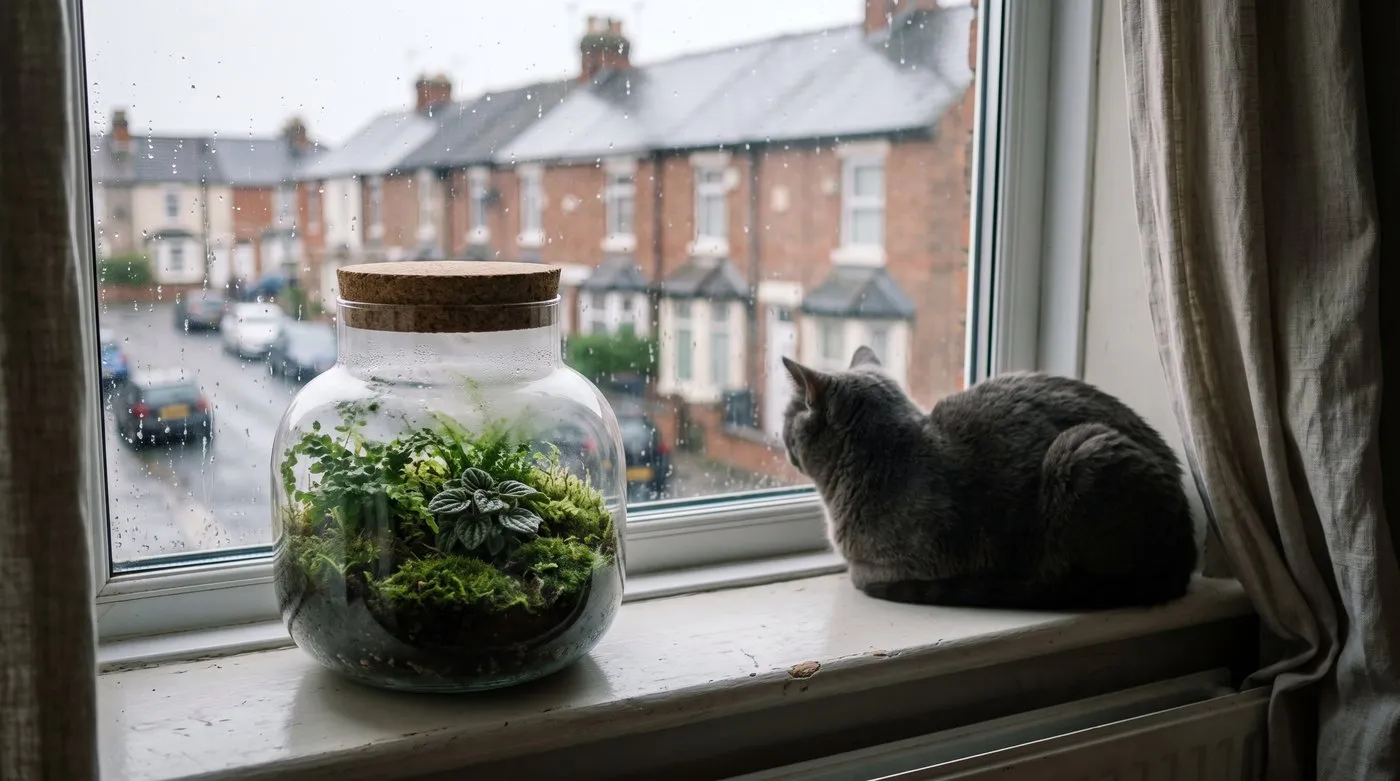
A little mist in the morning that clears by afternoon means the water is just right. Keep it out of direct sun, which cooks a closed jar.
Open terrarium care
Watering. Water succulents and cacti every few weeks with a pipette or small can. Aim at the soil, not the plants. Mist air plants twice a week or give them a weekly soak.
Light. Succulents need plenty of light, so a sunny windowsill suits them. Air plants like bright light without hot sun.
Air. Open terrariums need fresh air, so don’t tuck them inside a bookshelf.
For more ideas, browse our best indoor plants guide.
Common mistakes when building a terrarium
Mixing closed and open plants. Succulents and ferns want opposite things. A succulent rots in a closed jar, and fittonia dries up in an open one.
Too much water at the start. The most common mistake. There’s nowhere for extra water to go. If water is pooling in the gravel, take the lid off for a couple of days and use less next time.
Direct sunlight. Closed jars heat up fast in the sun, and plants scorch and wilt within hours. These plants come from shady forest floors, so give them bright shade.
Plants that grow too big. A big fern will swamp a small jar in no time. Check how large a plant gets before you buy.
Skipping the charcoal. Without it, closed terrariums can start to smell swampy over time. It’s cheap and well worth adding.
Using garden soil. Garden soil can bring in weed seeds, bugs and mould. Use fresh houseplant or cactus compost.
Overcrowding. It’s tempting to fill every gap, but plants need room. Leave small gaps and they’ll fill in within a few months.
A brief history of the terrarium
The terrarium began as a happy accident. Around 1829, Nathaniel Bagshaw Ward, a doctor in smoky East London, sealed a moth chrysalis in a glass jar with some soil. A fern and some grass sprouted inside and grew happily in the clean, damp air.
Ward kept experimenting and published his findings in 1842. His sealed glass cases let plant hunters send living plants on long sea voyages, which had been very hard before. The RHS has a nice page on terrariums if you’d like to know more.
Today’s terrariums are just for enjoying, but they work the same way: a sealed jar makes a warm, damp little world that tropical plants love.
If you like shade-loving plants, our guide to the best plants for shade covers plenty for indoors and out.
Now you’ve made your terrarium, read our guide on the best indoor plants for UK homes for the next step in creating an indoor garden.
Frequently asked questions
How often do you water a closed terrarium?
Hardly ever, often just a few times a year. A closed jar recycles its own water. If the glass stays heavily misted all day, take the lid off for a few hours. If you see no misting for several days, add a small splash of water.
Can you use any glass container for a terrarium?
Any clear glass container will do. Sweet jars, fish bowls, big Kilner jars, wine carafes and glass cases all work well. Just make sure the glass is clear, as tinted glass lets in too little light.
Why is my terrarium going mouldy?
It’s usually too wet or too stuffy. Take the lid off for a day to let it dry out. Pick out any mould with tweezers, water less and remove dead leaves quickly. A little white fluff on new compost often clears up by itself as things settle.
Do terrariums need sunlight?
They need bright light, but never direct sun. A north or east-facing windowsill is ideal. Direct sun heats a closed jar very fast, a bit like a car in summer, and cooks the plants. Find a bright spot where the sun doesn’t hit the glass.
Can you put succulents in a closed terrarium?
No, they’ll rot. Succulents come from dry places and can’t cope with the damp air in a closed jar. Use an open terrarium for succulents, cacti and air plants, and keep closed jars for ferns, fittonia and moss.
How long do terrariums last?
A well-made closed terrarium can last for many years. One famous bottle garden, planted in 1960, was last watered in 1972 and kept on growing. Open terrariums usually need replanting after a few years as plants outgrow them.
What is the charcoal layer for in a terrarium?
It helps keep a closed terrarium fresh. A thin layer of activated charcoal helps stop stale, swampy smells building up in the water at the bottom. Use horticultural activated charcoal, not barbecue charcoal.
Our team produces practical UK gardening guidance from source research, contributor records and established horticultural practice. Editorial standards are overseen by Matt W.