Key takeaways
- Softwood is the cheapest choice but needs cleaning, sanding and staining
- Composite costs more at first but only needs a wash, and doesn't splinter or rot
- In England, decking more than 30cm off the ground usually needs planning permission
- Grooved boards, textured composite or anti-slip strips stop winter slips
- Leave air space under the deck and lay weed membrane first
- East and west-facing decks catch morning or evening sun without baking
Decking gives you a flat, dry place to sit when the ground is bumpy, sloping or muddy. A good deck feels like an extra room outside the back door, with space to eat, relax and have friends round from spring to autumn.
Timber vs composite vs hardwood
The boards are the big decision. They decide the cost, how much care the deck needs, how long it lasts and how it looks.
Softwood (pressure-treated pine)
Pressure-treated pine or redwood is the most common decking timber in the UK. The treatment pushes preservative deep into the wood to protect it from rot. It starts off with a greenish tint and fades to grey within a year unless you stain it.
It’s the cheapest option and easy to cut, drill and fix with ordinary tools. It takes stain and oil well. Look after it each year and it should last well over a decade.
The downsides are real, though. Softwood gets splintery as it ages and needs sanding every few years. Algae grows on it quickly in our damp climate, which makes it slippery in autumn and winter unless you keep it clean.
Hardwood (balau, ipe, iroko)
Tropical hardwoods are much denser and tougher than softwood. They can last for decades, rarely splinter and have a lovely tight grain.
They cost more, are heavy and are harder to work. You’ll need good saw blades and to drill a pilot hole for every screw. Use stainless steel screws, as ordinary ones can stain and corrode in some hardwoods.
Buy hardwood with the Forest Stewardship Council (FSC) label, which shows the timber was sourced responsibly.
Composite (wood and plastic mix)
Composite decking is made from wood fibre and plastic. It doesn’t rot, splinter or warp and never needs staining. Most come with long warranties, and good ones have a textured surface that looks like timber.
It costs more than softwood. The best brands look almost like real wood, while cheaper ones can look plasticky and get hot underfoot in strong sun.
Composite boards grow and shrink a little with the temperature. Stick to the maker’s gap sizes: too tight and they buckle in summer, too loose and they look untidy and trap leaves.

Grey composite boards and a glass balustrade make a sleek, low-maintenance deck for a modern garden.
Decking material comparison
| Softwood | Hardwood | Composite | |
|---|---|---|---|
| Price | Cheapest | Most expensive | Mid to high |
| How long it lasts | Over a decade with care | Decades | Decades |
| Yearly care | Clean, sand now and then, stain or oil | Clean, oil if you like | Just clean |
| Grip when wet | Poor unless grooved or with strips | Fair | Good if textured |
| Splinters | Yes, more as it ages | Rarely | Never |
| Colours | Stain any colour | Natural wood tones | Lots of factory colours |
| DIY | Easy | Hard | Medium |
| In hot sun | Fine | Fine | Dark colours get hot |
For most gardens, it comes down to this: softwood now and replace it one day, or composite once and forget about it. Hardwood suits people who love real timber and don’t mind paying more.
Ground-level vs raised decking
Ground-level decking sits low, no more than 30cm off the ground. The frame rests on concrete pads, adjustable feet or firm hardcore. Leave space underneath for air to flow, or it will rot.
Raised decking sits higher. It’s common on sloping gardens or where the back door is well above the lawn. A raised deck needs a proper structure, with posts set firmly in concrete and a sturdy balustrade around the edge.

A raised deck with built-in seats, step lights and pots makes a lovely outdoor living space.
Building regulations for raised decks
In England, decking usually counts as permitted development, so it doesn’t need planning permission as long as it’s no more than 30cm above the ground and doesn’t cover more than half the garden with other extensions and outbuildings. A higher deck usually needs planning permission. The rules are different for flats, listed buildings, conservation areas and in Scotland, Wales and Northern Ireland, so check the Planning Portal or ask your council before you build.
Whatever the paperwork, a raised deck has to be safe:
- Joists and beams sized for the span and the weight of people and furniture
- Posts set deep and firm so the deck can’t sway
- A strong balustrade with gaps too narrow for a child to slip through
- A solid fixing to the house wall, if it’s attached
For anything high or complicated, it’s worth paying a builder or structural engineer to check the design.
Decking layout and design ideas
The simple rectangle
A rectangle of about 4m x 3m outside the back doors is the most popular choice. It fits a table for four to six or a couple of loungers. Boards running away from the house make the garden look longer, and boards running across make the deck look wider.

A timber deck under a wisteria-covered pergola makes a gorgeous spot for eating outside.
Multi-level decks
On a slope, two or three levels joined by steps give you separate areas: dining up top, lounging below, planting alongside. Make each level at least about 2m x 2m so it’s actually useful, and keep steps an even, comfortable height.
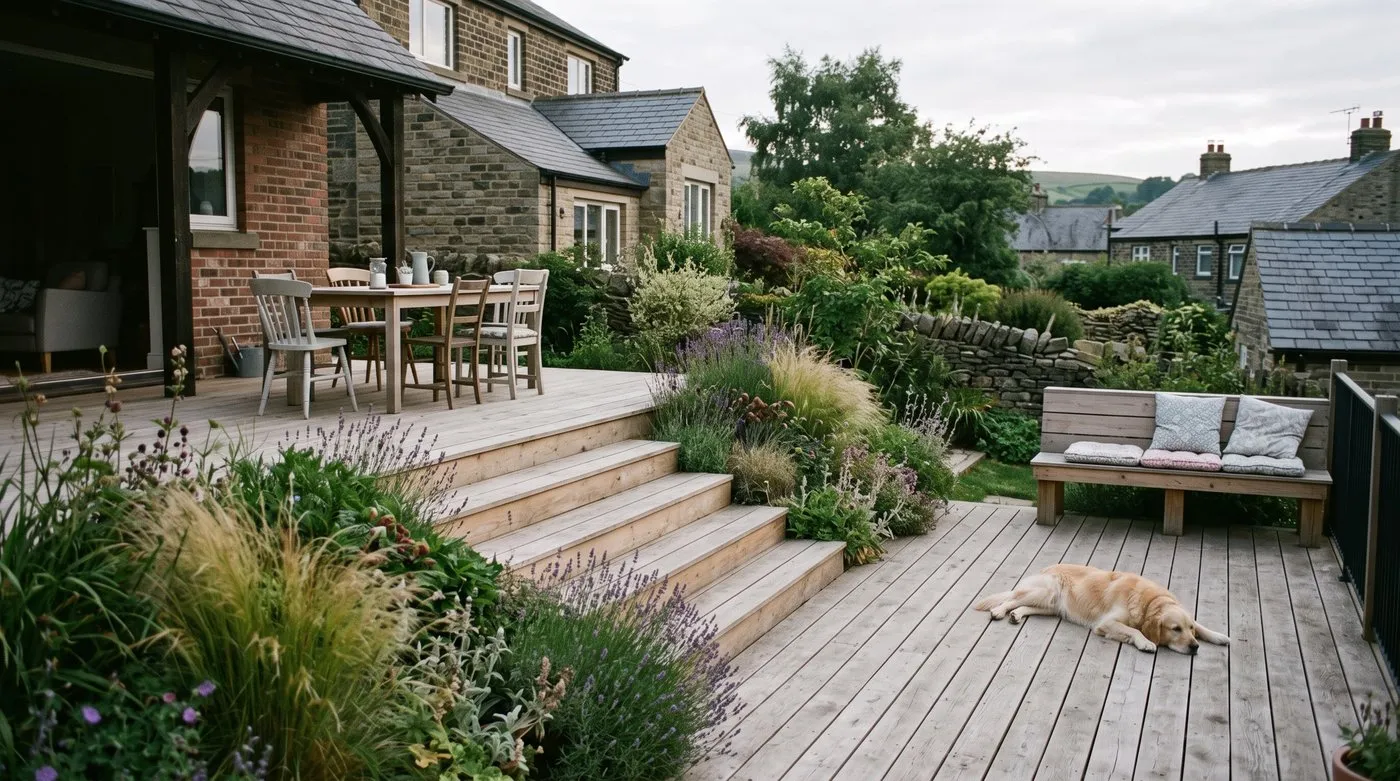
On a slope, separate levels give you a dining spot and a lounging spot. Make each one at least 2m square and keep the steps even.
Wraparound decks
An L or U-shaped deck around a corner of the house links different rooms to the garden. The kitchen opens onto the dining area and the lounge onto the seating. It works well alongside patio garden spaces where every bit of space counts.
Integrated features
Built-in benches around the edge save floor space and can hide storage underneath. Built-in planters soften the edges. Leave holes around existing trees to keep them. Lights set into the boards or steps give gentle garden lighting without lamps cluttering the floor.
Anti-slip solutions for UK decking
Slippery decking is the most common moan. Algae and moss love wood in our damp weather, and an untreated softwood deck can be properly slippery from autumn to spring.
Anti-slip strips are strips with a gritty surface that you screw onto each board. They’re the best fix for an existing deck.
Grooved boards have ridges that channel water and give more grip. They’re better than smooth boards but still need cleaning, as the grooves can fill with dirt and algae.
Textured composite boards have a moulded grain that gives grip without grooves. Good ones are made to stay grippy in the wet.
Regular cleaning matters most. Brush the deck with a stiff broom every couple of weeks in autumn and winter. Use a decking cleaner in spring and autumn. A pressure washer on a low setting shifts stubborn algae, but go gently on softwood.
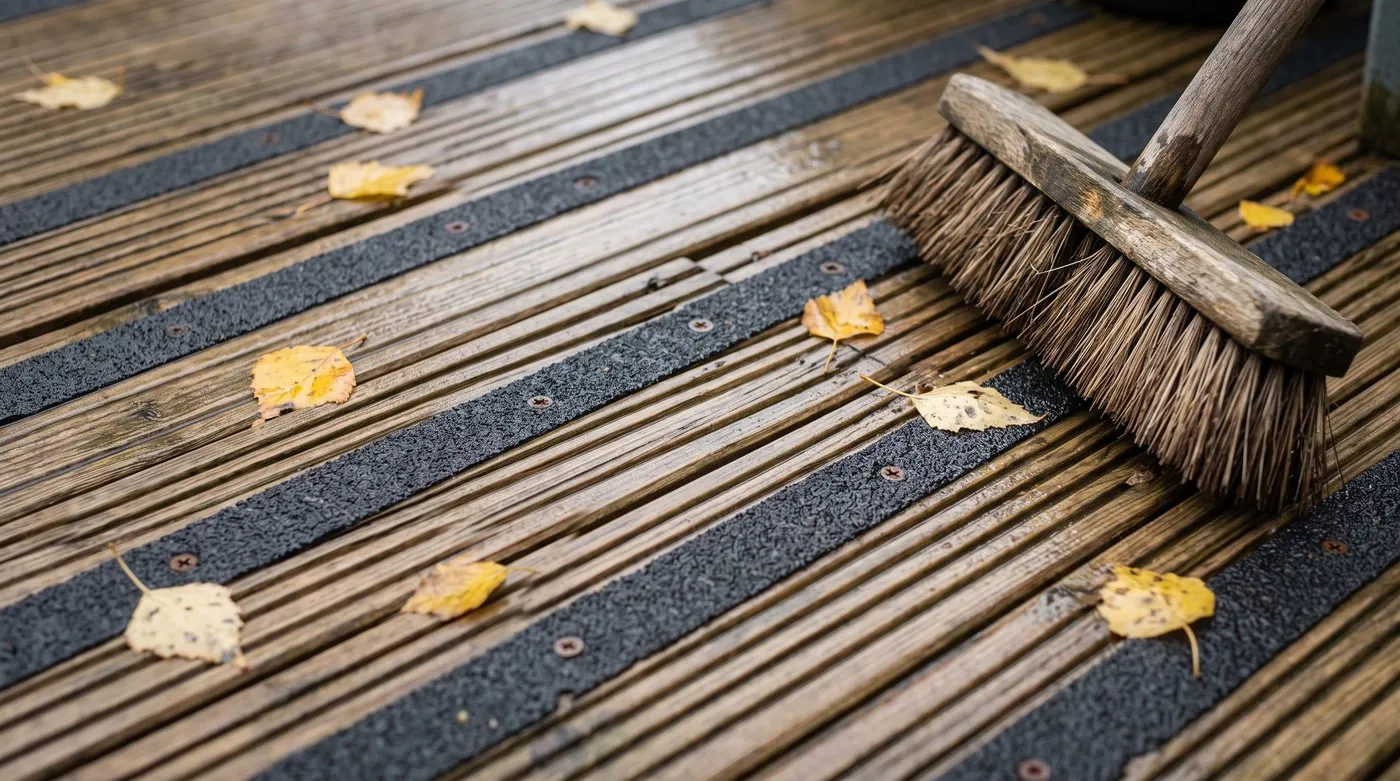
Gritty strips are the best fix for an existing slippery deck. A brush with a stiff broom every couple of weeks in autumn helps too.
Maintenance schedules by material
| Job | Softwood | Hardwood | Composite |
|---|---|---|---|
| Sweep | Weekly | Weekly | Weekly |
| Algae clean | Spring and autumn | Once a year | Once a year |
| Sanding | Every few years | Rarely | Never |
| Stain or oil | Every year | Every few years, if you like | Never |
| Check screws and fixings | Every year | Every year | Every year |
| Replace boards | When damaged | Rarely | Rarely |
Softwood needs a weekend each spring. Sand the surface, clean it with decking cleaner, let it dry for a couple of days, then apply decking oil or stain. Skip a year and it starts to green and wear.
Composite is a quick job. Brush it off, wash with soapy water and check the fixings. That’s why so many people happily pay more for it.
Decking costs: full budget breakdown
For a typical 4m x 3m deck, here’s where the money goes.
| What you pay for | Softwood | Composite | Hardwood |
|---|---|---|---|
| Boards | Lowest | Higher | Highest |
| Joists and frame | Similar for all | Similar for all | Similar for all |
| Screws or hidden clips | Low | Higher (special clips) | Medium (stainless steel) |
| Pads or adjustable feet | Similar for all | Similar for all | Similar for all |
| Weed membrane | Low | Low | Low |
| Stain or oil | Every year | None | Now and then |
| Anti-slip strips | Usually worth it | Not needed if textured | Sometimes |
| Fitting | Easiest to DIY | Medium | Hardest, often paid for |
Boards make the biggest difference to the price. Extras like steps, balustrades, built-in seats and planters add to it, and raised decks cost noticeably more because of the stronger frame and rails. Get a few quotes if you’re paying someone to fit it.
Colour and finish options
Colour changes how the deck feels in the garden, and how hot it gets in summer.
Light grey and silver suit modern gardens and stay cooler. They show dirt more but make small gardens feel bigger.
Mid-brown and teak tones are the most popular. They go with brick, stone, timber fences and most planting.
Dark grey and charcoal look striking and modern, but they soak up heat. Bare feet on dark boards in July is not fun, so pick lighter colours for south-facing decks.
Natural silver-grey is what untreated softwood turns to after a year or so. If you like that weathered look, a clear oil with UV protection still helps stop the surface cracking.
Planting around and through decking
Plants soften the hard edges of a deck and help it sit happily in the garden.
Beside the deck: low evergreens like lavender, box or pittosporum mark the edge without blocking the view. Grasses such as miscanthus and stipa add movement. Climbing plants on trellis behind built-in seating make a green backdrop.
In built-in planters: fill them with herbs, trailing plants or seasonal colour. Line wooden planters with pond liner to protect the wood, with drainage holes so they don’t get soggy.
Through the deck: leave a generous gap around tree trunks so they can grow. An established tree gives a new deck instant shade and character. For tricky shady spots, see our guide to plants for shade.
Common mistakes with garden decking
1. Poor ventilation underneath
Air needs to move under the deck, or damp builds up and the frame rots. Leave a decent gap between the ground and the joists, and don’t box in the sides completely. Leave gaps for air.
2. Incorrect joist spacing
Joists 400mm apart suit standard timber boards. Wider spacing makes boards bouncy. Composite boards often need closer joists, so always follow the board maker’s guidance.
3. No slope for drainage
Build a slight slope away from the house so rain runs off. A dead-level deck can leave water sitting against the house wall and cause damp.
4. Skipping the weed membrane
Weeds poking up between the boards look awful and are a pain to pull out. Lay a heavy-duty weed membrane over the ground before you build the frame, overlap the sheets and pin them down.
5. Choosing the wrong colour for the aspect
Dark boards on a sunny south-facing deck get too hot for bare feet. Pale boards in a shady north-facing garden show algae and marks. Match the colour to the spot. For designs on a budget, mid-tones are a safe middle ground.
Frequently asked questions
How much does decking cost in the UK?
It depends mostly on the boards you choose. Softwood is the cheapest, composite costs more and hardwood costs the most. Paying someone to fit it adds a good chunk, and raised decks cost more than ground-level ones. Get a few quotes.
Does decking need planning permission UK?
Not usually, if it’s no more than 30cm off the ground. In England, low decking is normally permitted development, as long as it doesn’t cover more than half the garden with other buildings. Higher decks usually need planning permission. Rules differ for flats, listed buildings and outside England, so check the Planning Portal first.
Is composite decking worth it?
For many people, yes. It costs more at first, but it never needs sanding, staining or oiling. It doesn’t splinter or rot. If you want a deck that lasts years with little effort, the extra cost usually pays off.
How do I stop decking being slippery?
Fit anti-slip strips or choose grooved or textured boards. Brush the deck often in autumn and winter and give it a decking clean in spring and autumn. Shady, north-facing decks need the most attention.
How long does timber decking last?
Pressure-treated softwood lasts well over a decade with yearly care. Leave it neglected and it wears out much sooner. Hardwoods like balau and ipe can last for decades, and good composite boards come with long warranties.
What is the best direction for a deck to face?
West-facing is lovely for evening sun. South-facing gets the most sun but can get very hot. East-facing is perfect for breakfast in the sun. North-facing stays shady and cool, which limits it a bit here. Pick lighter boards for a south-facing deck.
Can I build decking myself?
Yes, a simple ground-level softwood deck is a good DIY job. You need a level base, joists about 400mm apart and good outdoor screws. A small deck can be a weekend’s work. Leave raised decks and complicated shapes to a professional.
Our team produces practical UK gardening guidance from source research, contributor records and established horticultural practice. Editorial standards are overseen by Matt W.