Key takeaways
- 12V plug-in kits are the easiest way to light a garden yourself, no electrician needed
- New mains wiring outdoors is a job for a registered electrician
- Buy IP65 lights for open, rainy spots and IP44 for sheltered ones
- Solar lights are great for summer accents but fade in winter
- Mix uplights, downlights and low path lights for a natural look
- Warm white lights pointing down, on a timer, are kindest to wildlife
Good lighting lets you enjoy your garden long after sunset. It turns paths and borders into something lovely to look at in the dark and stretches outdoor evenings into autumn.
So which lights should you buy, what does that IP number mean, and where should they go? Here’s the friendly, practical version.
Types of garden lighting compared
There are four types, and each has its place.
| Solar | Mains | 12V plug-in | Battery | |
|---|---|---|---|---|
| Brightness | Low to medium | Brightest | Medium to high | Low to medium |
| Running cost | Free | Low with LEDs | Low with LEDs | Batteries |
| Fitting | DIY | Electrician | DIY | None |
| In winter | Weaker | Fine | Fine | Batteries run down faster |
| Best for | Paths, accents | Security, patios | Feature lighting | Parties, temporary |
12V plug-in kits are the sweet spot for most gardens. A transformer plugs into an outdoor socket and turns the mains into a safe low voltage, then cable runs out to the lights. No electrician needed, and they’re bright and reliable all year.
How bright should garden lights be?
Brightness is given in lumens. Most people buy lights that are far too bright. You want atmosphere, not daylight. If you can read a book by your path lights, they’re too strong.
| Where | Rough brightness |
|---|---|
| Path markers | 50-100 lumens |
| Step lights | 30-50 lumens |
| Patio glow | 100-300 lumens |
| Spotlights on trees or walls | 300-600 lumens |
| Front door or porch | 300-600 lumens |
| Security lights | The brightest, on a sensor |
What IP rating do outdoor lights need?
The IP rating tells you how well a light keeps out dust and water. The second number is the one to watch for rain.
| Rating | Use it for |
|---|---|
| IP44 | Sheltered spots like a porch or covered patio |
| IP65 | Open spots: paths, borders, open patios |
| IP67 | Lights sunk into the ground |
| IP68 | Ponds and water features |
For most gardens, IP65 is the safe choice. British weather throws sideways rain and puddles at lights, and cheaper IP44 lights in open spots don’t last. Check the rating before you buy.
Solar or mains lighting?
Solar lights have come a long way, but our grey winters still hold them back.
Solar is great for: path markers, stake lights, string lights you use now and then, and summer accents. Panels still charge on cloudy days, just less. Face them south, away from the shade of fences and trees.
Solar struggles with: winter evenings, security lighting and strong spotlights. A light that glows all evening in July may only last a short while in December.
12V or mains is better for: lights you use every night, all year, and anything that needs to be bright and dependable.
A good plan is solar for the pretty extras and 12V or mains for the lights you rely on.
Where to put garden lights
Where you point a light matters more than which one you buy.
Uplighting: a spotlight at the foot of a tree, wall or feature, pointing up. It shows off texture and casts dramatic shadows. A narrow beam suits tall trees, a wider one suits walls. It looks great along garden paths with hedges or special plants either side.
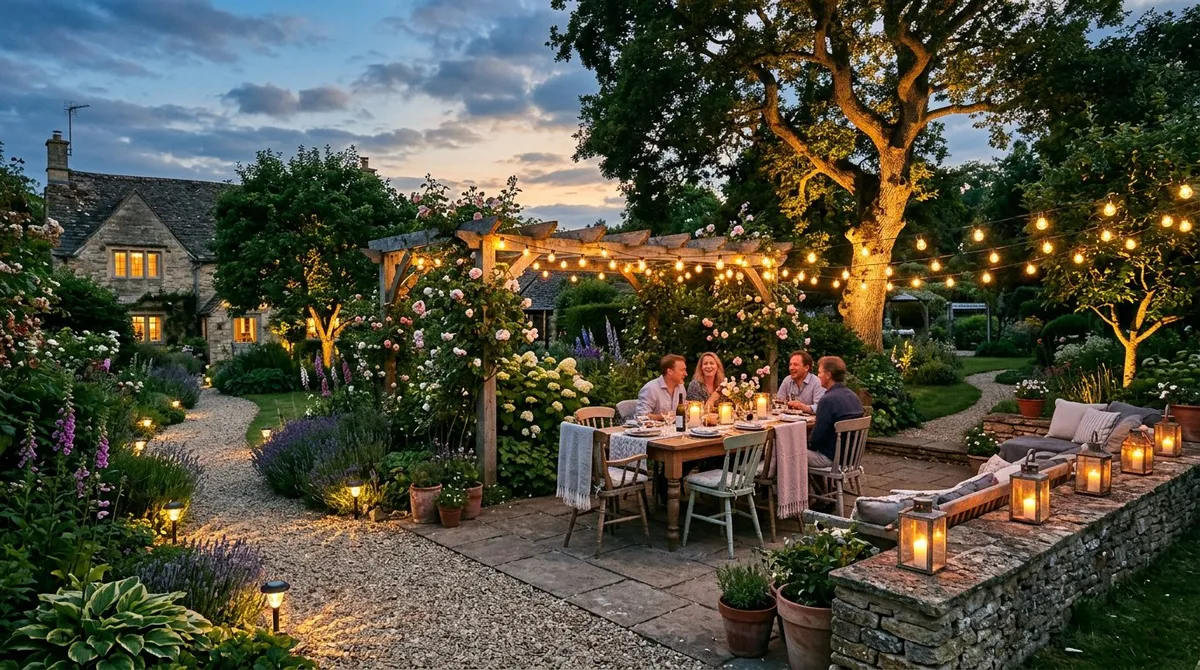
Downlighting: lights fixed high in a tree, on a wall or under a pergola, pointing down. It looks like moonlight and is the most natural of all. Ideal over dining and seating areas.
Path lighting: space stake or bollard lights about 2-3m apart. Staggering them on alternate sides looks more natural than a straight line. Keep them low so they don’t shine in your eyes.
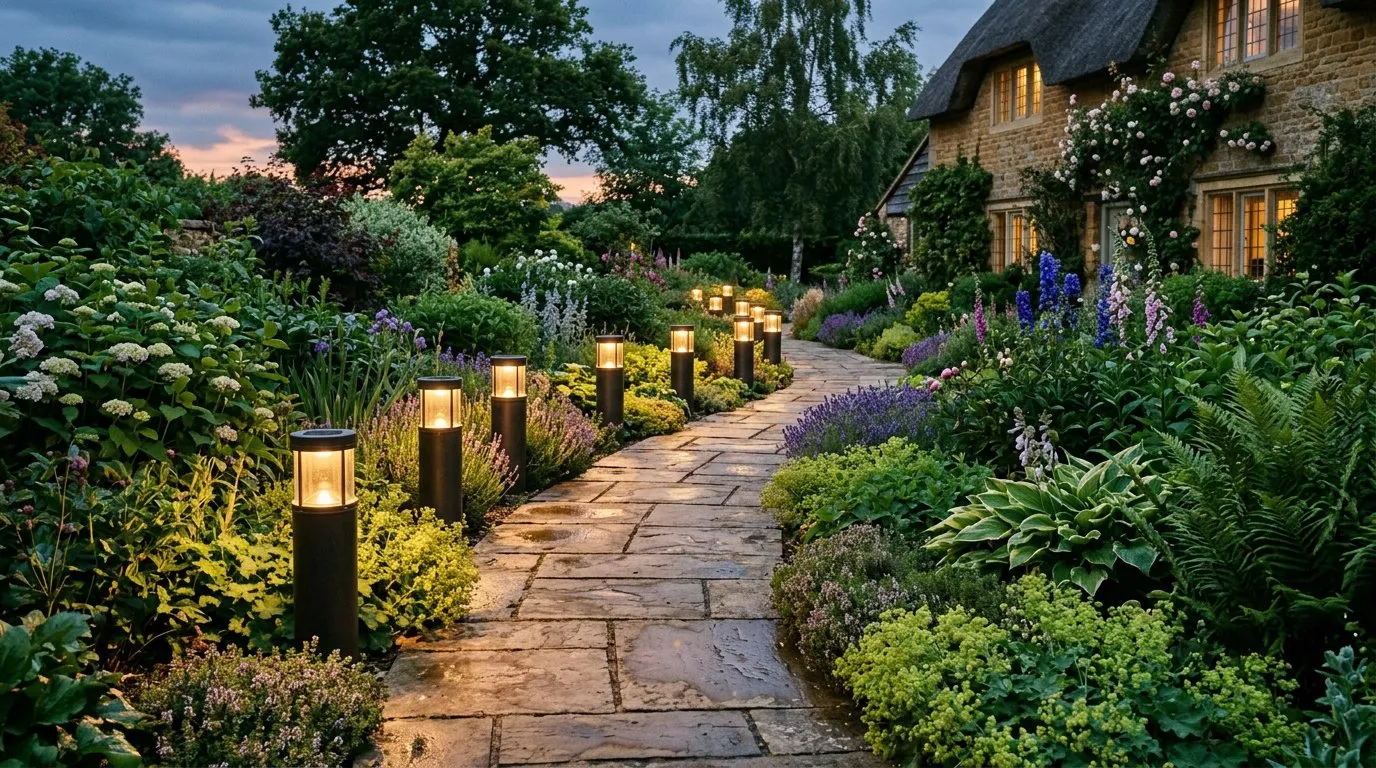
Solar bollard lights guiding the way along a curving stone path at dusk.
Cross-lighting: two lights on one feature from different angles. It gives depth and works well on statues, water features and special trees.
Silhouetting: a light behind a plant, shining on a wall. The plant shows up as a dark shape. Bamboo, palms and grasses look fantastic like this.
Handy tip: Before you buy anything, walk round the garden after dark with a torch. Shine it at trees and walls from different angles and take photos. Ten minutes shows you where lights will look best.
What garden lights cost to run
LED bulbs have made garden lighting cheap to run. They use a fraction of the power of old halogen spotlights for the same brightness. Swapping old halogen bulbs for LEDs soon pays for itself.
What you’ll pay depends on how many lights you have and how long they’re on. Put them on a timer so they’re not burning all night. Even a full 12V system in a small garden design costs little to run.
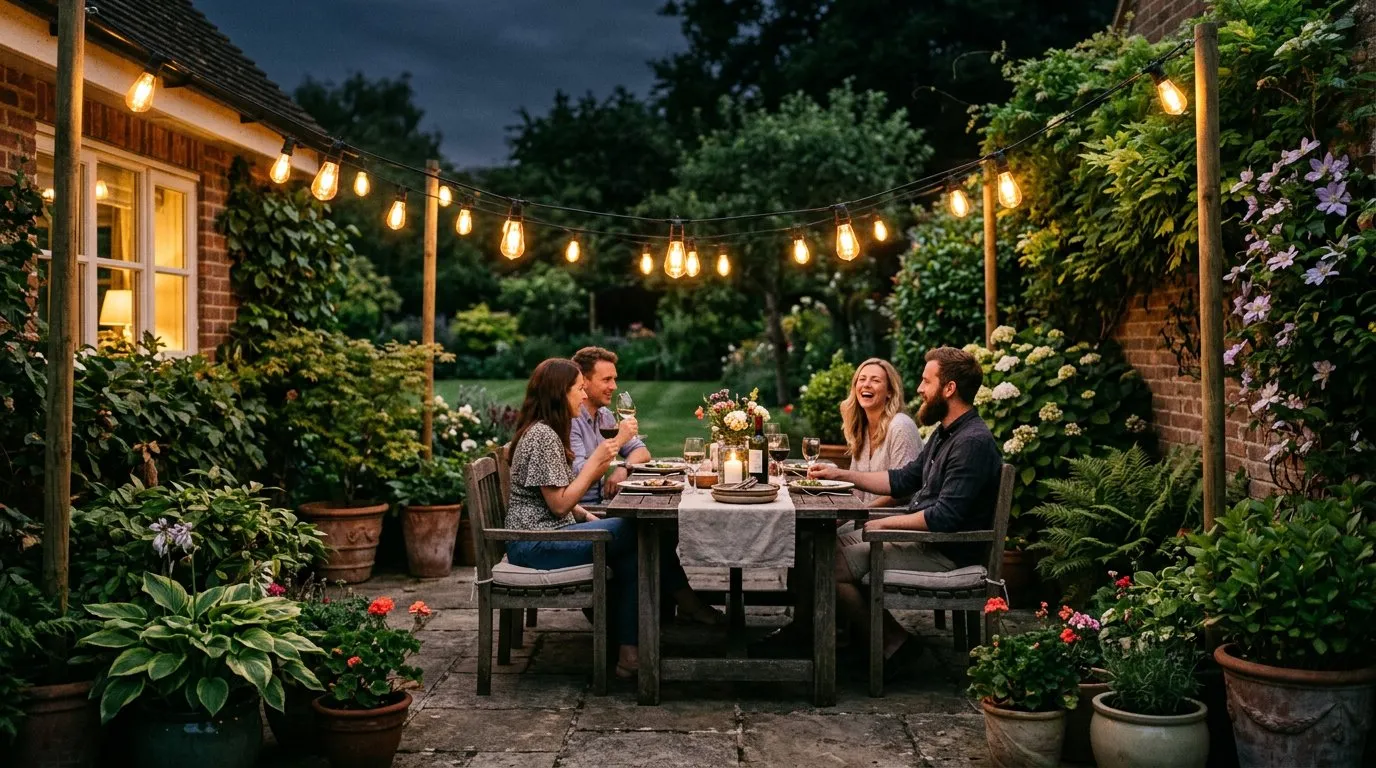
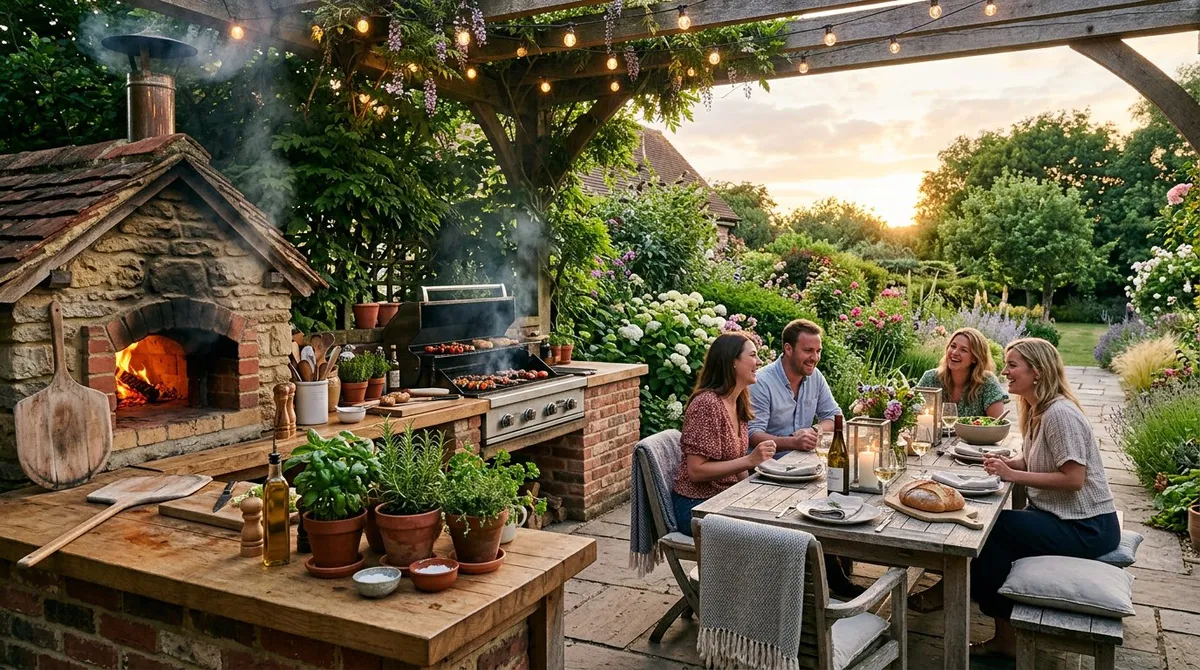
Festoon lights give a warm, welcoming glow over a patio table on a summer evening.
Wildlife-friendly garden lighting
Lights at night can upset moths, bats, hedgehogs and nesting birds. A few simple choices let you enjoy the garden after dark without bothering them. The Bat Conservation Trust has helpful advice. In short:
- Choose warm white bulbs rather than cool white.
- Point lights downwards, and avoid bare bulbs near the boundary.
- Keep hedges, big trees and pond edges dark, as animals use them as routes.
- Use timers or motion sensors so lights aren’t on all night.
- Switch off when you’ve gone indoors.
Moths find their way by moonlight, and bright lights pull them off course. Warm, low, downward lights do the least harm.
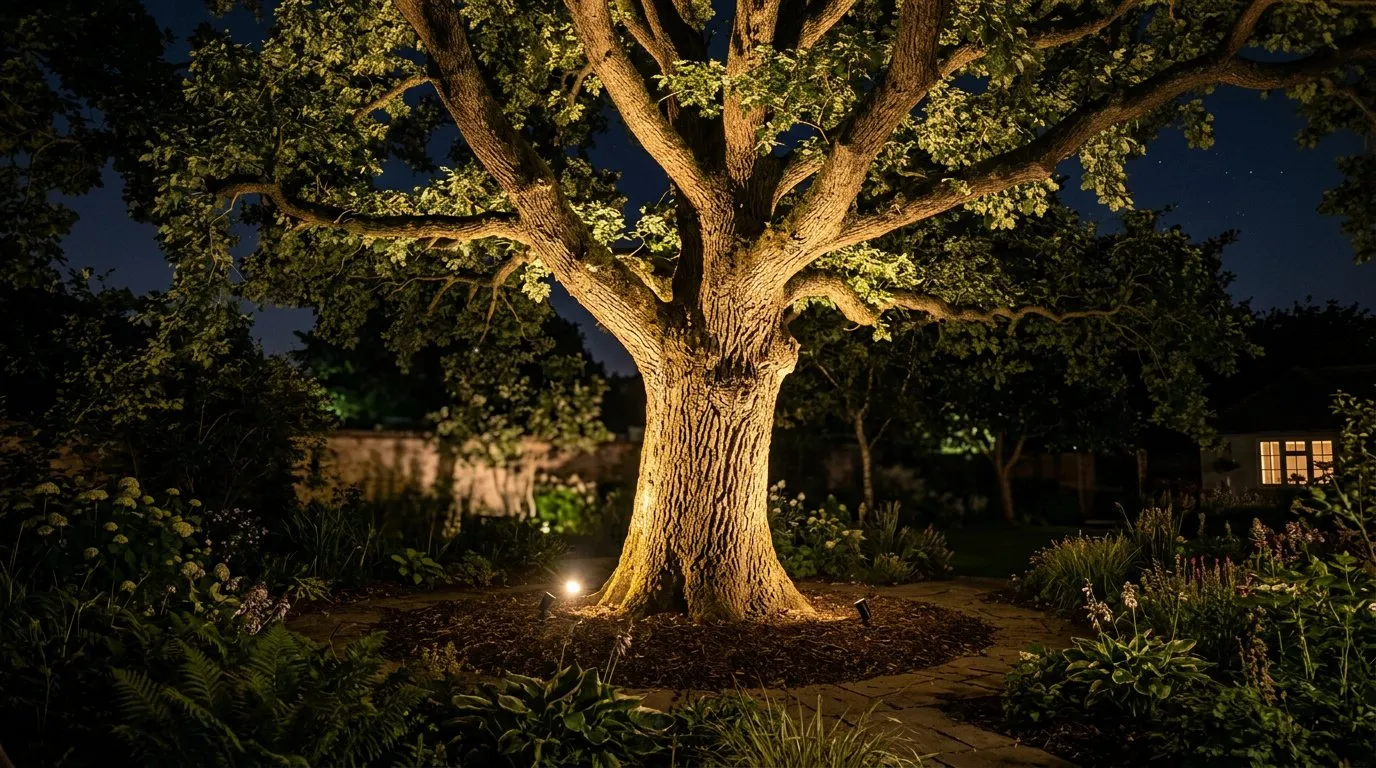
Uplighting picks out the bark and branches of a mature tree, making it the star of the garden at night.
If you love attracting wildlife to your garden, leave some corners dark for good. A shady spot with a log pile and some fallen leaves is worth far more to a hedgehog than another spotlight.
Smart garden lighting
Smart lights let you change brightness, colour and timings from your phone or a voice assistant.
Smart outdoor light ranges like Philips Hue Outdoor work with the main voice assistants. They give you control over each light, but they cost more.
A smart plug on a 12V kit is the cheaper route. Plug the transformer into an outdoor smart plug and you can switch everything on and off by voice or timer.
Solar smart lights exist, but they’re still limited. Mains or 12V smart setups are more reliable for now.
Mains lighting and electrical safety
New mains wiring outdoors comes under Part P of the Building Regulations in England and Wales. Use a registered electrician, who can sign off the work for you.
Needs an electrician: any new mains circuit for garden lights and any buried mains cable. They’ll know how deep to bury it and how to protect it.
Fine to do yourself: 12V plug-in kits, solar lights, battery lights and swapping a fitting like-for-like on an existing circuit.
Outdoor mains circuits should be protected by an RCD, a safety switch that cuts the power fast if something goes wrong. Older fuse boxes may need upgrading. Keep 12V cable where a spade won’t catch it.
Garden lighting through the seasons
Spring (March to May): Show off blossom, bulbs and fresh leaves. Solar lights perk up again.
Summer (June to August): Entertaining season. Light the patio and dining area. Step lights on a raised deck make it safe to use after dark, and festoons over the table set the mood.
Autumn (September to November): Warm light suits autumn colour. Uplight trees as the leaves turn. Wipe leaves off solar panels and reset timers when the clocks change.
Winter (December to February): Solar is at its weakest, so rely on 12V or mains. Uplighting looks wonderful on bare branches. Check seals on fittings after bad weather.
Frequently asked questions
What IP rating do I need for garden lights?
IP44 for sheltered spots, IP65 for anywhere open to rain. A porch or covered patio is fine with IP44. Path lights and spotlights out in the open need IP65. Pond lights, and anything sunk into the ground where water can sit, need IP67 or IP68.
Do solar garden lights work in winter UK?
Yes, but they’re dimmer and don’t last as long. Short, grey days mean less charging. Face the panels south, keep them out of shade and wipe off leaves and dirt. For lights you rely on all year, go for 12V or mains.
How many lumens do I need for garden lighting?
Less than you’d think, around 50-100 lumens for a path light. Patio glow lights need a bit more, and spotlights on trees a few hundred. Security lights are the brightest. Pick the lowest brightness that does the job to avoid glare.
Do garden lights need an electrician?
Only for mains lighting. New mains circuits and buried mains cable outdoors are a job for a registered electrician. 12V plug-in kits and solar lights are fine to do yourself, and battery lights need no fitting at all.
How much does it cost to run garden lights?
Not much if you use LED bulbs. LEDs use a fraction of the power of old halogen spotlights. Your cost depends on how many lights you have and how long they’re on, so a timer helps. Solar lights are free to run.
Are garden lights bad for wildlife?
Bright, cool-white lights can upset bats, moths and birds. Choose warm white bulbs, point them downwards and use a timer so they go off later in the evening. Keep hedges, big trees and pond edges dark.
More garden ideas
- Small garden design ideas, making the most of a little space after dark
- Garden path ideas, paths that look even better lit up
- Garden fence ideas, including fence-mounted lights
- Front garden ideas, for a welcoming entrance
- Attract birds to your garden, more wildlife-friendly ideas
Our team produces practical UK gardening guidance from source research, contributor records and established horticultural practice. Editorial standards are overseen by Matt W.