
Key takeaways
- Rules vary by council, so read your tenancy agreement before you build anything
- Sheds, greenhouses and polytunnels are usually fine with written permission
- The law lets you keep hens and rabbits, as long as they're not a nuisance or a business
- You can't stay overnight or run a commercial business from your plot
- A neglected plot is the most common reason for losing a tenancy
Allotments are one of the best deals in UK gardening. You get a big patch of growing land for a fairly small yearly rent. But it comes with rules, and not knowing them is the quickest way to a warning letter.
The rules come from two places. The Allotments Acts set the legal basics, and your council’s tenancy agreement adds the details. Every council writes its own rules, so what’s fine in one borough may be banned in the next. Our history of UK allotments explains how the Acts came about.
Getting an allotment
Your right to ask for one
If six or more local voters ask their council for allotments, the council has to consider providing them. That’s under the Allotments Act 1908. Most councils already run sites. Land held as statutory allotments also can’t be sold off without government consent.
How to apply
Contact your local council. Most have an online form or an allotments office you can phone. You’ll go on a waiting list for your chosen site, or for any site nearby, depending on how your council works.
Waiting times vary a lot. Some rural sites have plots free straight away. In many cities you may wait several years. Most waits run from 18 months to 4 years: 63% of councils in APSE’s 2025 survey said people wait more than 18 months. Asking for a half or quarter plot can be quicker.
What it costs
Rent is set by your council or site association and is usually a fairly small yearly charge. Half plots usually cost about half as much. Many councils offer discounts for pensioners and people on certain benefits.
| Cost | What to expect |
|---|---|
| Yearly rent, full plot | Set by your council, varies by area |
| Yearly rent, half plot | Usually about half the full-plot rent |
| Discounts | Often for pensioners and some benefits |
| Gate key | Some sites charge a small fee or deposit |
| Water | Some councils charge separately |
What you can do on your allotment
Grow food
Growing food is what allotments are for, and every council supports it. Vegetables, fruit and herbs are all welcome. Raised beds, no-dig, polytunnels and cloches are all normal allotment practice.
Grow flowers
Most councils are happy for you to grow flowers alongside your food. Cut flowers, pollinator plants and companion flowers are generally fine. The catch is that most of the plot, often around three quarters, needs to be food. A cutting bed is usually fine if the rest is productive.
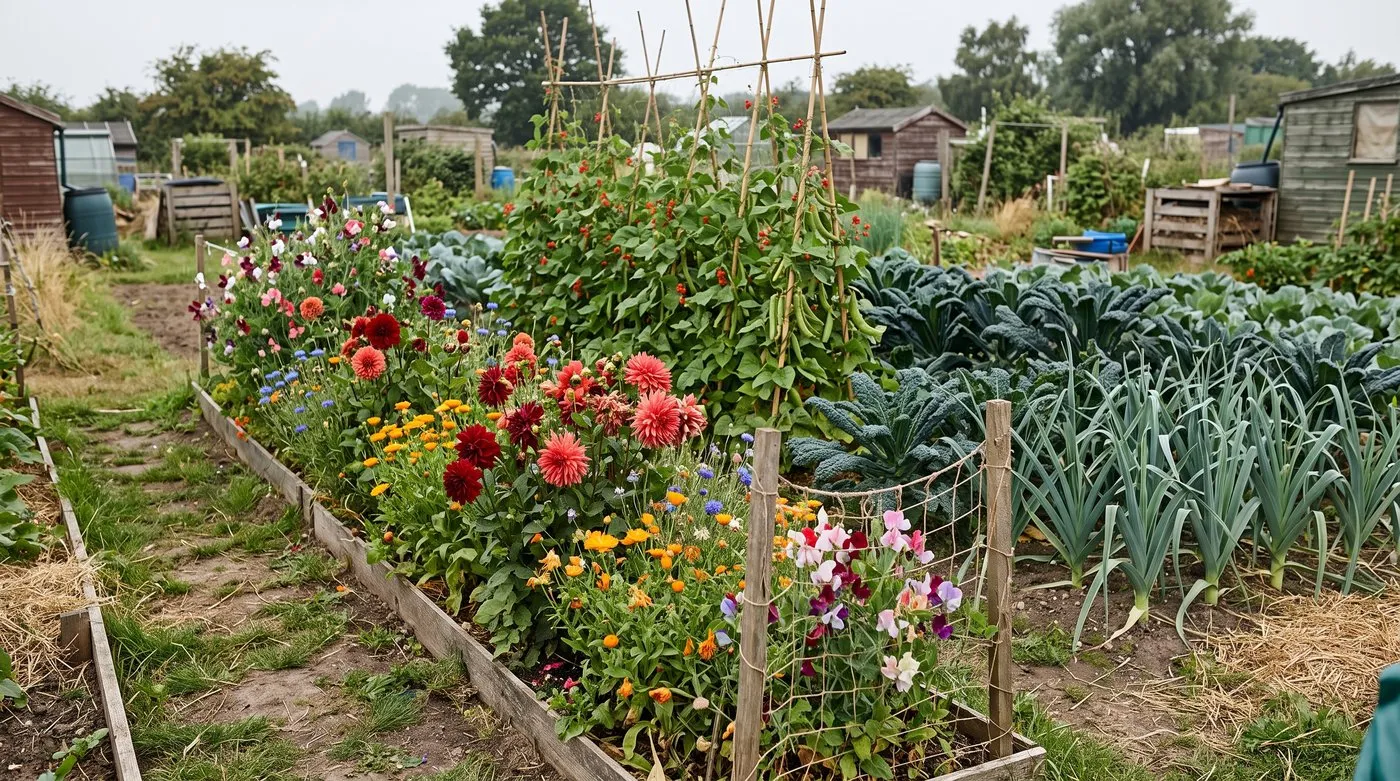
A flower bed is usually fine as long as most of the plot is growing food. Cut flowers also bring in pollinators for your beans.
Put up structures (with permission)
Most councils allow:
- Sheds for storing tools, often up to about 6x4ft. Some allow bigger. Storage only, not living.
- Greenhouses, with size limits that vary by site.
- Polytunnels, with written permission.
- Cold frames and cloches, which are usually fine without asking.
- Water butts, which are encouraged.
- Raised beds, which are fine at most sites.
Grow fruit trees and soft fruit
Fruit trees are allowed on most allotments. Some councils ask for trees on dwarfing rootstocks, so they stay small and don’t shade your neighbours. Soft fruit such as strawberries, raspberries, blackcurrants and blueberries is usually fine.
Make compost
Every plot should have a compost heap, and councils encourage it. Two or three bays made from pallets is the classic allotment set-up.
Keep bees
Many councils allow beekeeping with written permission. They often ask for some beekeeping training, insurance and hives placed so they don’t bother other plot holders. Not every site is suitable, so the committee looks at each request.

A tidy plot with a small shed, greenhouse, raised beds and compost bays. Get written permission before putting up any of them.
What you can’t do
Stay overnight
Allotments are for growing, not living. Tenancy agreements almost always ban staying overnight, whether in a shed, a tent or anywhere else on the plot. Breaking this rule can cost you your tenancy.
Run a business
Allotments are for feeding you and your family. Selling a few spare veg is a grey area: some councils turn a blind eye and others ban it. Growing to sell to shops, restaurants or online breaks most tenancy agreements.
The law defines an allotment garden as land “wholly or mainly cultivated by the occupier for the production of vegetable or fruit crops for consumption by himself or his family.” A business doesn’t fit that.
Keep most livestock
The Allotments Act 1950 gives tenants a general right to keep hens and rabbits. They mustn’t cause a nuisance or health risk, or be kept as a business. Most sites still set conditions on numbers and housing, cockerels are usually banned, and you’ll need written permission first. Other animals:
- Rabbits: covered by the same right as hens, within your site’s conditions
- Pigs: rarely allowed
- Goats and sheep: almost never allowed on council plots
- Dogs: must be on a lead at most sites, and some sites ban them
Have bonfires (on most sites)
Bonfires cause more arguments than anything else on allotments. Many councils have banned them because smoke drifts into nearby homes. Where they’re allowed, there are usually rules: dry garden waste only (no plastic or treated wood), set days or times, and put it out if the smoke causes a nuisance. Our guide to bonfires on allotments explains more.
Composting is the easy alternative. Anything you’d burn can usually be composted, shredded or taken to the council tip.
Let the plot go
Not looking after your plot is the most common reason for losing it. Most councils expect a good chunk of the plot, often around three quarters, to be growing or ready for crops. Many sites inspect plots in early summer.
Looking after your plot means beds dug or planted, paths kept clear, weeds under control and structures in good repair. A plot that’s mostly weeds will usually get a warning letter first, giving you time to put things right before any notice to leave.
| Not allowed | Why | Good to know |
|---|---|---|
| Staying overnight | Tenancy agreement | Almost always banned |
| Running a business | The legal definition of an allotment | Food for you and your family only |
| Animals without permission | Tenancy agreement and the 1950 Act | Hens and rabbits allowed if no nuisance |
| Bonfires | Many councils ban them | Check your own rules |
| Letting the plot go | Tenancy agreement | Many sites inspect in early summer |
| Permanent buildings | Tenancy agreement | Structures usually need to be removable |
| Using chemicals | Tenancy agreement | Some sites are organic only |

Well-kept plots in early summer, with crops growing, clear paths and weeds under control.
What’s in your tenancy agreement
Your tenancy agreement sets the rules for your plot, so read all of it before you sign. It covers:
Rent: When it’s due, usually once a year in advance, and what happens if you don’t pay.
Looking after the plot: How much needs to be cultivated, what counts as cultivated, and when inspections happen.
Structures: What you can build, how big, how to ask, and whether you must remove it when you leave.
What’s banned: Bonfires, chemicals, animals, overnight stays, subletting and being a nuisance.
Leaving: How much notice you need to give, and when the council can end your tenancy, such as for unpaid rent, a neglected plot or breaking the rules.
Tips for new allotment holders
Start small. A full plot is a lot of ground. If a half plot is on offer, take it. You can always ask for more later, and a half plot grows plenty for a family.
Chat to your neighbours. The people on the plots around you know the soil, the frost pockets, the committee and the unwritten rules. Five minutes’ chat saves a lot of trial and error.
Sort out paths first. Mark out paths between beds from day one. It keeps your feet off the soil and makes the plot look cared for at inspection time.
Join the committee. Most sites are run by a committee of plot holders. Joining gives you a say and helps you understand how the rules work in practice.
Keep notes. Write down what you grow, when you sow and what works. A planting calendar makes next year even better.

A new plot in March. Mark out beds and paths first, then clear one bed at a time rather than the whole plot at once.
Allotment law in a nutshell
Three Acts of Parliament set the basics for allotments in England and Wales.
Allotments Act 1908: Says councils must consider providing allotments when there’s demand, such as six or more local voters asking.
Allotments Act 1922: Defined an allotment garden as land mainly for growing food for your own household, and set out how tenancies work.
Allotments Act 1950: Gave tenants the right to keep hens and rabbits, and added compensation rules.
These Acts give allotments more protection than most people realise. Statutory allotment land can’t be sold or used for something else without government consent.
Frequently asked questions
Can I put a shed on my allotment UK?
Yes, most councils allow one with written permission. Many sites cap sheds at around 6x4 feet, though some allow bigger ones on full plots. Rules on where it goes, its colour and its base vary too. Check your tenancy agreement and get the go-ahead from the council or site committee before you build.
Can I have a greenhouse on my allotment?
Yes, most councils allow a greenhouse or polytunnel with permission. Size limits vary by site. Some councils want it to be removable rather than fixed on a permanent base. Many prefer polycarbonate to glass for safety. Check your tenancy agreement before you buy.
Can I keep chickens on an allotment UK?
Often, yes. The Allotments Act 1950 gives tenants a general right to keep hens and rabbits. They mustn’t cause a nuisance or be kept as a business. Cockerels are usually banned because of the noise. Most sites still set rules on numbers, housing and welfare, so get written permission first.
Can I sleep on my allotment UK?
No, staying overnight is almost always against the rules. Allotments are for growing, and sheds and greenhouses are for storage and plants, not for living in. Breaking this rule can cost you your plot. If you want to be there early or late, check your site’s gate times instead.
How long is the allotment waiting list UK?
It varies hugely from place to place. Some rural sites have plots free straight away, while city lists can run to several years. Ask your council how long its lists are and whether half or quarter plots come up faster. Joining several lists, or trying private and association-run sites, can shorten the wait.
Can I have a bonfire on my allotment?
It depends on your site. Many councils have banned bonfires on allotments. Where they’re allowed, there are usually limits: dry garden waste only, set times, and calm weather. Smoke mustn’t bother nearby homes. Composting is the usual alternative, so check your agreement before you light anything.
Can I grow flowers on my allotment UK?
Yes, most councils are happy for you to grow flowers. By law, an allotment garden is used wholly or mainly for fruit and vegetables. So many agreements ask for most of the plot, often around three quarters, to be food. A cutting flower bed or flowers among your crops is usually fine.
Related reading
Our team produces practical UK gardening guidance from source research, contributor records and established horticultural practice. Editorial standards are overseen by Matt W.


