
Key takeaways
- Amelanchier gives you spring blossom, summer berries and autumn colour in one tree
- Japanese maples stay small and love a sheltered, lightly shaded spot
- Crab apples also pollinate nearby eating apples
- Magnolia stellata flowers in March and stays around 3m tall
- Narrow trees like cherry 'Amanogawa' and hawthorn 'Stricta' suit tight spaces
- Plant bare-root trees from November to March, when they're cheaper
Every garden has room for a tree. Even a small courtyard can hold one that gives you blossom, autumn colour, food for wildlife and shape all year. The trick is picking one that stays small without endless pruning, and suits your soil and light.
Here are eight of the best trees for small UK gardens, plus evergreen and pot-friendly options. Whether you want spring flowers, autumn berries, beautiful leaves or all three, there’s one here for you. For more ways to make the most of a small space, see our small garden design ideas.
Amelanchier lamarckii
Amelanchier is the best tree for a small UK garden. It looks good in every season: clouds of white starry blossom in April, purple-black berries in June that birds adore, bright orange and red leaves in October, and elegant grey bark in winter.

Amelanchier lamarckii in full blossom against a brick wall, one of the best trees for a small garden.
It grows slowly to 5-6m tall and about 4m wide. Its upright, airy shape casts only light, dappled shade. It’s happy in sun or part shade on most soils, and copes with city air, wind and the coast. The only thing it hates is waterlogged clay.
The berries are edible and taste a bit like blueberries. In North America they’re called serviceberries and go into pies and jams. Most UK gardeners leave them for the blackbirds and thrushes, who strip the tree in days.
Gardener’s tip: Buy a multi-stemmed amelanchier rather than a single trunk. It looks more natural, stays a little more compact and shows off its bark and autumn colour at eye level.
Crab apple (Malus)
Crab apples are real workhorses. They flower heavily in spring, carry colourful fruit from September to December, and pollinate any eating or cooking apple trees nearby. Triploid apples such as ‘Bramley’s Seedling’ still need two suitable pollinators close by.

A crab apple in full blossom with bulbs underneath. A lovely small tree that helps your other apples too.
Malus ‘Evereste’ is the best all-rounder. It can reach 6-8m but takes its time. White flowers open from pink buds in May, followed by orange-red fruit that hangs on well into winter. It resists scab and mildew better than most crab apples. Pollination Group 4.
Malus ‘Red Sentinel’ keeps its deep red, cherry-sized fruit right through to February. They’re too sharp to eat raw but make great crab apple jelly. It grows to 6-7m. Pollination Group 4. Gorgeous in winter when most trees are bare.
Malus x robusta ‘Red Jade’ is a weeping crab apple that only reaches about 4m. Its tumbling branches carry white blossom in spring and shiny red fruit in autumn. It looks wonderful in a lawn or courtyard. If you grow fruit, our cherry tree guide covers another good small garden choice.
Japanese maple (Acer palmatum)
Japanese maples are the aristocrats of small garden trees. Their finely cut leaves, graceful shape and stunning autumn colour make them a favourite for sheltered gardens. Most stay well under 4m.

A Japanese maple in a big terracotta pot, glowing red in autumn. Perfect for a small garden or patio.
Acer palmatum ‘Bloodgood’ has deep purple-red leaves from spring to autumn, turning bright crimson in October. It grows slowly to 3-4m tall and 3m wide. The dark leaves look superb against a green hedge or pale stone.
Acer palmatum ‘Sango-kaku’ (coral bark maple) has bright coral-red stems that glow in winter sun. Spring leaves come out salmon-pink, go green in summer, then golden yellow in autumn. That’s four seasons from one tree. It grows to 4-5m. For long-term care, see our guide to Japanese maple care.
Acer palmatum var. dissectum makes a low mound just 1.5-2m tall with feathery, finely divided leaves. It’s lovely in a big pot or beside a path or pond. Green-leaved forms cope with more sun than purple ones. For a cheaper splash of pot colour, the flamingo tree (Salix ‘Hakuro-nishiki’) has pink-flushed spring leaves on a small standard.
Japanese maples need shelter from cold winds, and no early morning sun after a frost, which scorches frozen leaves. They like moist, well-drained, acid to neutral soil and don’t do well on thin chalk. Dappled shade suits them nicely, so they’re great under bigger trees.
Silver birch (Betula pendula ‘Youngii’)
Young’s weeping birch is the best weeping tree for a small garden. A normal silver birch shoots up to 15-20m, but ‘Youngii’ makes a graceful dome of hanging branches. It can eventually reach 6-8m tall and wide, but takes many years to get there. The white, papery bark starts to show after a few years.
It grows on almost any soil except waterlogged ground, and copes with wind, the coast and cold northern gardens. It grows fairly quickly once settled. Full sun gives the best bark and shape.
Native birch feeds lots of insects. Catkins appear in spring, and the small leaves turn golden yellow in autumn. The light canopy means you can plant spring bulbs, ferns and shade-lovers underneath.
Plant bare-root trees in winter and stake for the first two years. Birch roots spread wide near the surface, so don’t plant right over drains. At 4m from the house on normal soil, the roots won’t trouble foundations.
Magnolia stellata
Star magnolia is one of the first trees to flower each year. White, starry blooms open in March before the leaves, covering the bare branches. Each flower has lots of narrow petals and a faint sweet scent. It’s fully hardy across the UK.
It grows slowly to just 2-3m tall and 2.5m wide, so it’s one of the smallest true trees you can buy. It suits the tiniest gardens, courtyards and big pots. It’s naturally neat and bushy and needs no regular pruning.
Plant it somewhere sheltered from cold north and east winds. Late frosts brown the open flowers, so avoid frost pockets. It likes acid to neutral, moist soil, and grows on clay if you add organic matter. It doesn’t like thin, chalky ground.
Its cousin Magnolia x loebneri ‘Leonard Messel’ is a little bigger at 4-5m, with pink buds opening to pale pink-white flowers. Both look lovely with hellebores, pulmonaria and spring bulbs underneath.
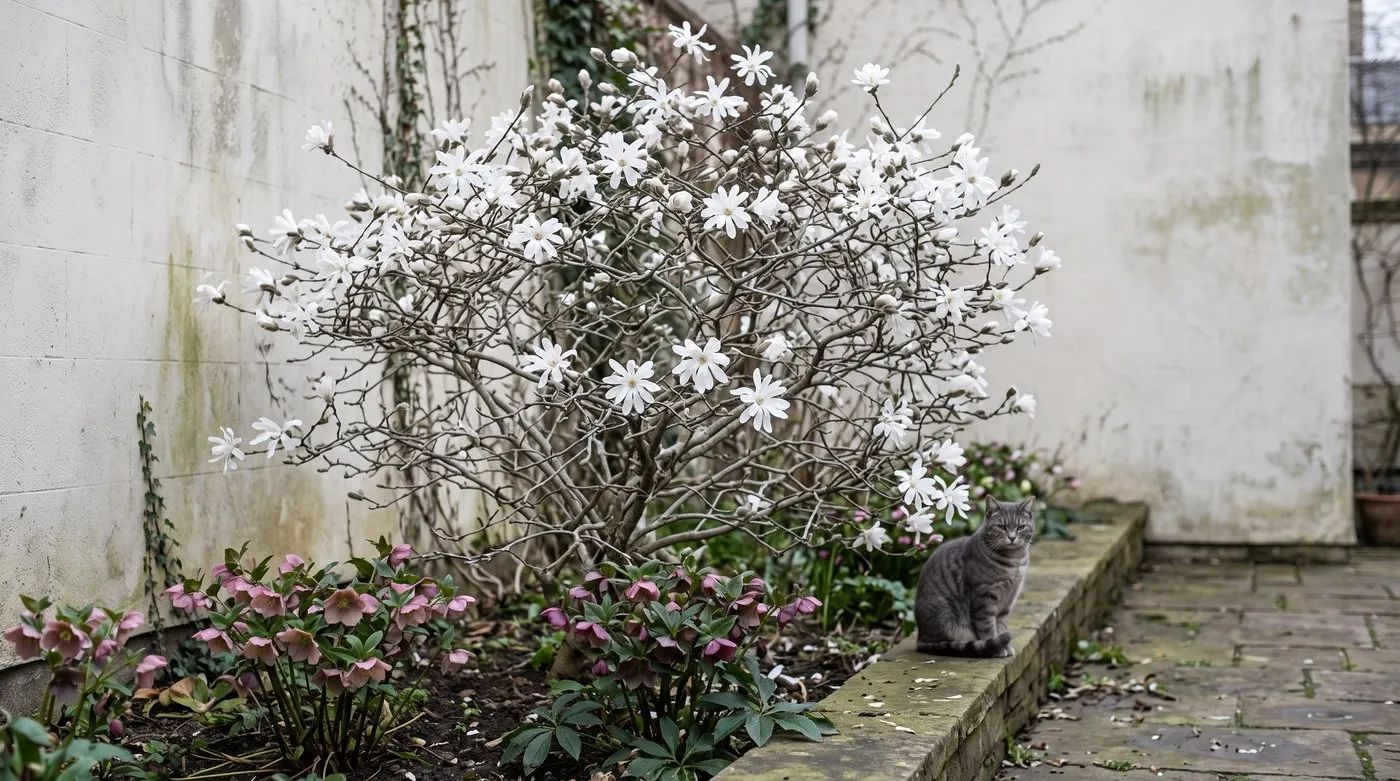
Star magnolia stays at 2-3m, so it suits even a tiny courtyard. A sheltered wall protects the March flowers from frost.
Rowan (Sorbus)
Rowans are tough native trees that are great for wildlife. They do well in cold, windy and acid spots where many ornamental trees struggle. Their autumn berries feed fieldfares, redwings, waxwings and blackbirds. Most garden varieties stay under 8m.
Sorbus ‘Joseph Rock’ is the finest garden rowan. It has big clusters of amber-yellow berries from September, which birds leave longer than red ones, so the show lasts. The autumn leaves turn orange, red and purple. It grows to 6-8m with a narrow, upright crown just 3-4m wide.
Sorbus aucuparia (native rowan, or mountain ash) grows all over the UK, even high in the hills. It has heavy clusters of orange-red berries from August. It can reach 8-10m, but you can keep it under 6m with the odd trim. It grows on the poorest, most acid soils. It’s one of the best trees for attracting birds.
Sorbus cashmiriana (Kashmir rowan) has white or pale pink berries that shine against dark autumn leaves. It reaches 6-8m with a light, open canopy. Birds tend to leave the white berries, so they last well into December.
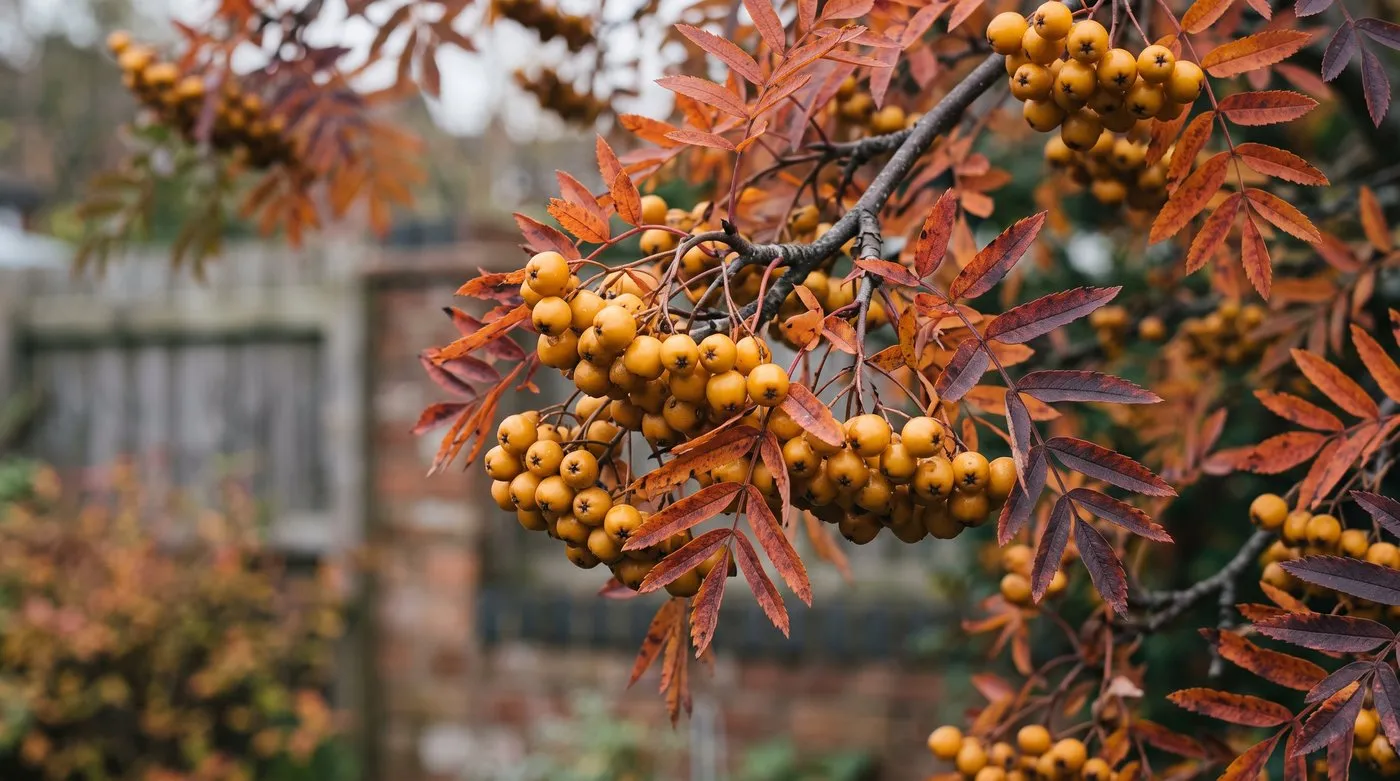
Birds leave yellow rowan berries longer than red ones, so ‘Joseph Rock’ holds its show well into winter. Its narrow crown suits a small plot.
Hawthorn (Crataegus)
Hawthorn is the backbone of British hedgerows, but grown as a single-stemmed tree it makes a cracking small garden tree. It’s covered in white or pink blossom in May, has red haws from September and feeds lots of insects. It’s almost impossible to kill.
Crataegus monogyna ‘Stricta’ is a narrow, upright form that grows 6-7m tall but only 2-3m wide. That makes it perfect for tight spaces, boundaries and front gardens where a spreading tree would hang over paths or next door.
Crataegus laevigata ‘Paul’s Scarlet’ has double, deep pink-red flowers in May. Double flowers mean no haws, but the blossom is gorgeous. It grows to 5-6m and looks great in a lawn.
Hawthorn copes with any soil, including heavy clay, thin chalk and windy hilltops. It puts up with sea air, pollution and neglect. The only thing it dislikes is deep shade, and full sun gives the best flowers and fruit. Its thick, thorny branches are a safe place for birds to nest. For more pollinator-friendly ideas, see our bee-friendly garden plants guide.
Cherry (Prunus)
Ornamental cherries give the most dramatic spring blossom of any garden tree. For small gardens, choose a narrow or compact variety, not the wide-spreading ‘Kanzan’, which reaches 10m.
Prunus ‘Amanogawa’ is the best cherry for tight spaces. It grows straight up to about 8m but only 2-3m wide. Its upright branches carry clusters of semi-double, pale pink, scented flowers in April. It fits against walls, in corners and along boundaries, and turns warm orange-yellow in autumn.
Prunus incisa ‘Kojo-no-mai’ (Fuji cherry) is a twisty little tree just 2-3m tall. White flowers appear on its bare, zig-zag branches in March. It looks great in a big pot or a gravel garden, and its twisting stems are interesting all year.
Prunus ‘The Bride’ is a graceful, spreading tree 4-5m tall. White flowers smother the branches in April, followed by dark fruits that birds enjoy. It spreads to about 4m, so give it some room. For small fruit trees, our dwarf fruit tree guide covers rootstocks and varieties that stay under 2.5m.
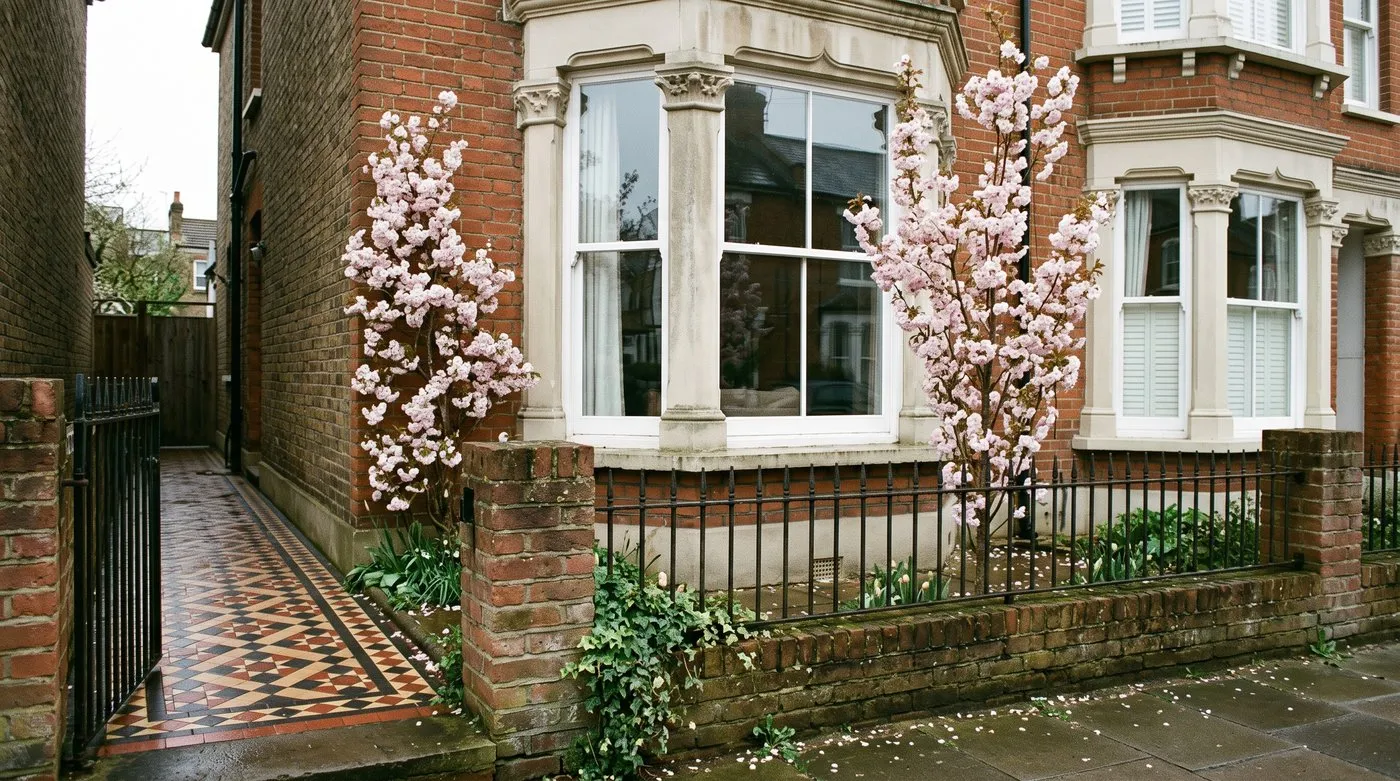
‘Amanogawa’ grows up, not out, so it fits beside a path or wall where a spreading cherry would block the light.
Which evergreen trees suit a small garden?
Portugal laurel, Pittosporum tenuifolium ‘Warnham Gold’ and holly are the most practical evergreen trees for a small garden. All three keep their leaves in winter and take regular clipping, so you can keep them the size you want.
Prunus lusitanica (Portugal laurel) grows 4-6m with a 4m spread and clips well into a lollipop or multi-stem shape. It copes with dry soil once settled but dislikes cold, wet ground. Pittosporum ‘Warnham Gold’ has golden leaves that brighten in winter, and you can remove its lower branches to lift the crown. It can reach 8m, so it needs clipping in a small plot and does best in mild, sheltered gardens. Holly copes with shade and pruning, and female plants carry red berries if there’s a male nearby.
The RHS also suggests Cryptomeria japonica ‘Elegans’, a slim Japanese cedar about 5m tall and 1.5m wide, for sheltered spots with well-drained soil.
Small tree comparison table
| Tree | Height | Spread | Best feature | Soil | Looks good |
|---|---|---|---|---|---|
| Amelanchier lamarckii | 5-6m | 3-4m | Interest all year | Any well-drained | All year |
| Malus ‘Evereste’ | 6-8m | 6-8m | Blossom and winter fruit | Any, including clay | Spring, autumn, winter |
| Acer palmatum ‘Bloodgood’ | 3-4m | 2-3m | Deep purple leaves | Acid to neutral, moist | Spring to autumn |
| Betula pendula ‘Youngii’ | 6-8m (slowly) | 6-8m | Weeping shape and white bark | Any except waterlogged | All year |
| Magnolia stellata | 2-3m | 2-2.5m | Early March blossom | Acid to neutral, moist | Spring |
| Sorbus ‘Joseph Rock’ | 6-8m | 3-4m | Amber berries and autumn colour | Any, including acid | Autumn, winter |
| Crataegus ‘Stricta’ | 6-7m | 2-3m | Narrow shape and May blossom | Any, including clay and chalk | Spring, autumn |
| Prunus ‘Amanogawa’ | 8m | 2-3m | Narrow, pink blossom | Any well-drained | Spring, autumn |
How to choose the right tree for your garden
Pick a tree that fits your space, soil and light when it’s fully grown. Ask yourself three simple questions before you buy.
How much space do you have? Measure the spot and check the final height and spread in the table above. Leave at least 1m between the edge of the grown canopy and any fence. For gardens under 6m wide, choose the narrowest options: cherry ‘Amanogawa’ or hawthorn ‘Stricta’.
What’s your soil like? Squeeze a handful of damp soil. If it holds its shape and feels sticky, it’s clay. If it crumbles and feels gritty, it’s sandy. Chalky soil fizzes if you drip vinegar on it. Japanese maples and magnolias need acid to neutral soil. Crab apples, hawthorn and rowan cope with almost anything.
Which way does the spot face? A south-facing wall makes a warm, sheltered spot for magnolia and cherry. A north-facing spot suits birch and rowan. East-facing spots catch early sun after a frost, which can damage magnolia flowers. For most trees, shelter from wind matters more than which way they face.
Gardener’s tip: Visit a garden centre in October rather than spring. You’ll see the autumn colour for real, and bare-root trees arrive from November at lower prices than pot-grown ones.
Can you grow a small tree in a pot?
Yes. Japanese maples, dwarf fruit trees, Magnolia stellata and clipped bay or holly all grow well in pots for years. Avoid vigorous trees, which go leggy and hungry in a pot.
The RHS guide to growing trees in containers suggests moving up a pot size at a time rather than jumping straight to a huge pot. Aim for a final pot about 45cm across with plenty of drainage holes. Use a loam-based compost such as John Innes No 3, or the ericaceous version for acid-lovers.
Trees in pots dry out much faster than those in the ground. Water well whenever the top few centimetres feel dry, even in windy winter weather. Each spring, scrape off about 5cm of old compost and replace it with fresh compost mixed with slow-release feed. In cold, windy gardens, wrap the pot in hessian or bubble wrap to stop the roots freezing.
How to plant a small garden tree
Bare-root trees planted between November and March settle in fastest and cost much less than pot-grown ones. This method works for all eight trees above.
- Dig a hole three times as wide as the roots, and as deep as the old soil mark on the trunk
- Fork over the bottom and sides of the hole to loosen the soil
- Knock in a short stake before you put the tree in
- Set the tree so the base of the trunk is at soil level, never buried
- Backfill with the soil you dug out. There’s no need to add compost, which can rot and make the tree sink
- Firm the soil with your foot, working in from the edges
- Tie the trunk to the stake with a rubber tree tie and spacer
- Water well straight away, even in winter
- Mulch with 5-8cm of garden compost or bark chips, keeping it 10cm away from the trunk
Take the stake away after two or three years. Birch and cherry settle quickly and can come off their stake after one growing season. Japanese maples in windy spots may like a permanent low stake.
The RHS planting guide for trees and shrubs has more on tricky sites.
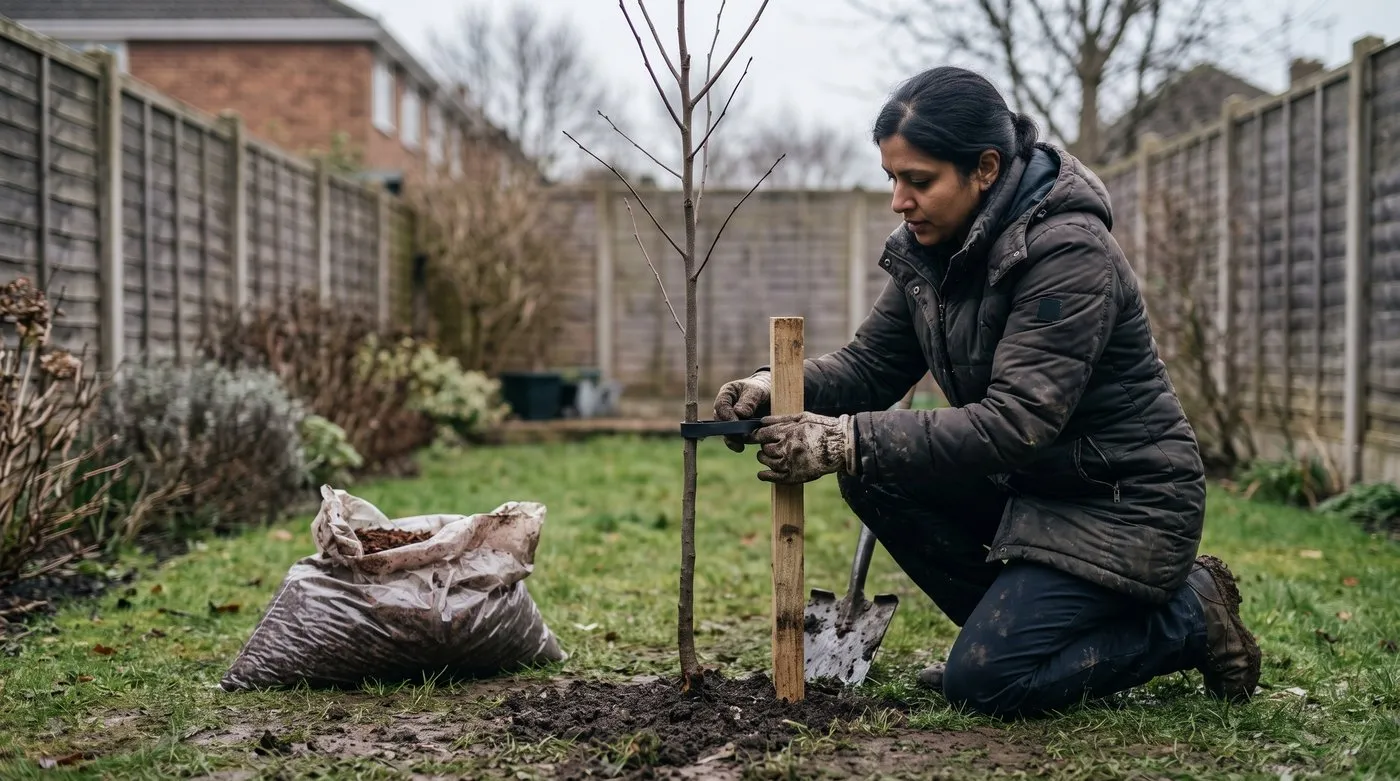
Knock the stake in before the tree goes in, so you don’t spear the roots. A rubber tie with a spacer stops the bark rubbing.
Aftercare in the first two years
New trees need regular watering, mulching and a quick check for their first two growing seasons. After that, all eight are easy to look after.
Watering matters most from April to September in the first year. Give a good soak once a week in dry spells. Water at the base of the trunk, not over the leaves. A hose left trickling slowly for 20 minutes does more good than a quick splash. Water every other week in the second year.
Mulching each spring with 5-8cm of bark or compost holds moisture, stops weeds and feeds the soil. Top it up each year. Never pile mulch against the trunk, as it rots the bark.
Pruning is minimal for most small trees. Remove dead, damaged or crossing branches in winter. Prune Japanese maples only when fully dormant, from November to January, as they bleed sap if cut in spring. Avoid heavy pruning in the first two years.
Feeding isn’t needed on ordinary garden soil. On very poor or sandy ground, scatter a handful of general feed, such as blood, fish and bone, around the roots in March.
Now you’ve picked your tree, read our guide on best trees for privacy to see which screening options suit small gardens too.
Frequently asked questions
What is the best small tree for a front garden in the UK?
Amelanchier lamarckii is the best all-rounder for a front garden. It grows to 5-6m with white spring blossom, summer berries and bright autumn colour. Its airy canopy won’t darken your windows, and it copes with city air. For a tighter spot, the narrow cherry ‘Amanogawa’ fits neatly beside a path or drive.
How close to a house can I plant a small tree?
Keep small trees at least 3-4m from the house. Amelanchier, magnolia and Japanese maple have gentle roots and are fine at that distance on most soils. On shrinkable clay, go to 5m or more, as roots can dry the clay and make it move. Check your buildings insurance for any rules about trees.
Which small trees grow well in shade?
Japanese maples and hawthorn cope well with part shade. Amelanchier flowers in light shade but gives fewer berries. Holly and yew handle deep shade but grow slowly. No tree flowers or fruits well in dense, all-day shade. A few hours of direct sun is enough for most small trees.
Do small trees damage foundations?
Small trees with compact roots pose very little risk. Amelanchier, magnolia, crab apple and Japanese maple are fine 3-4m from buildings. The risk goes up on shrinkable clay, where any tree can add to ground movement. Birch roots spread near the surface and can lift paving close by.
When is the best time to plant a tree in a small garden?
Plant bare-root trees from November to March while they’re dormant. Roots settle over winter before spring growth starts. Pot-grown trees can go in any time, but autumn is still best. If a bare-root tree arrives in frost, heel it into a trench of moist soil and plant within two weeks.
What is the fastest growing small tree for the UK?
Birches and rowans settle in quickest on most UK soils. Weeping birch ‘Youngii’ and amelanchier also grow steadily once settled. Japanese maples and magnolias are the slowest, which is why they rarely outgrow a small garden. Stake quicker growers for their first couple of seasons.
Can I plant a tree in a small garden with clay soil?
Yes, plenty of trees are happy in clay. Crab apples, hawthorn, rowan and amelanchier all do well. Dig a wide, shallow hole rather than a deep, narrow one, and break up the sides so roots can spread. Avoid Japanese maples and magnolias in soggy clay. On heavy clay, plant on a slight mound.
How do I choose between an ornamental and a fruit tree for a small garden?
A crab apple gives you the best of both. It has pretty blossom, colourful fruit and pollinates nearby apple trees. For eating fruit, dwarf trees on M9 or M27 rootstock stay under 2.5m. For the least work, go for amelanchier or magnolia, as fruit trees need yearly pruning and picking.
Our team produces practical UK gardening guidance from source research, contributor records and established horticultural practice. Editorial standards are overseen by Matt W.


