Key takeaways
- There's a flowering cherry for every size of garden, from tiny to large
- Prune only in summer, from June to August, to help keep disease out
- Amanogawa is tall and narrow, perfect for a small front garden
- Autumnalis flowers in mild spells through winter
- Give cherries full sun and soil that drains well
- Single-flowered kinds are better for bees than frilly double ones
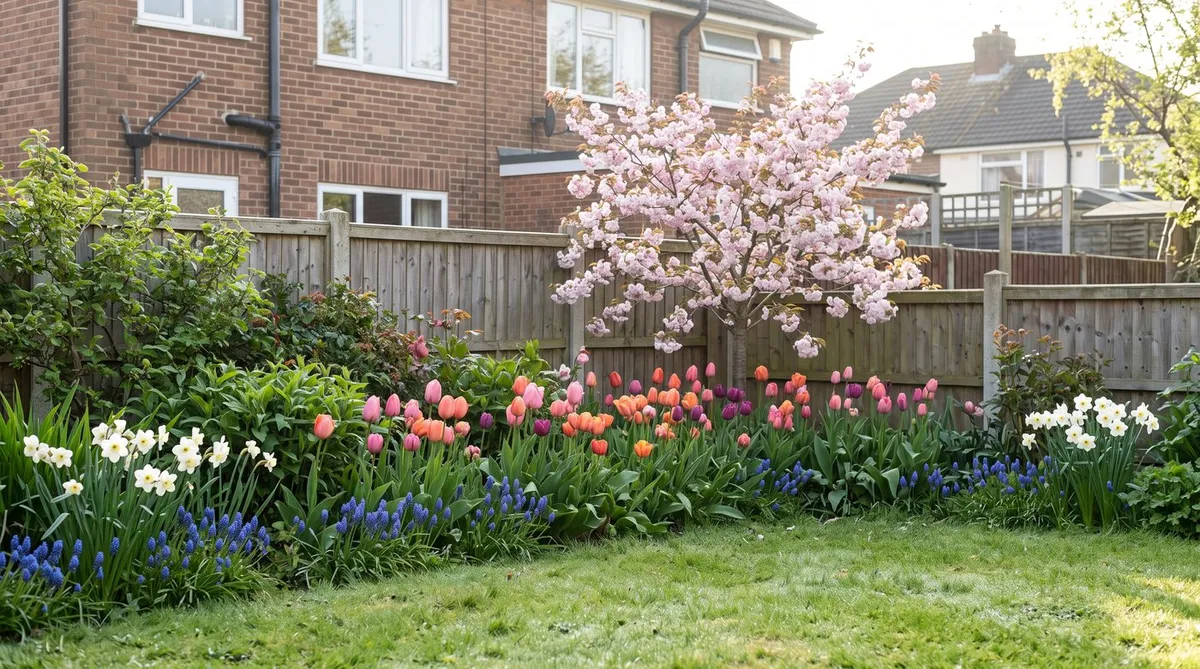
Flowering cherries give some of the most beautiful spring blossom you’ll see in a British garden. A Kanzan in full bloom is smothered in frilly pink flowers, and every April these trees stop people in their tracks in streets and parks up and down the country.
There are lots of cherries out there, but a dozen or so are reliable garden favourites. They range from the slim Amanogawa to the wide, spreading Tai-haku. There are weeping ones, upright ones, white ones, pink ones and even one that flowers in winter. Below you’ll find the best varieties for UK gardens, plus planting, care, pruning and common problems.
What type of flowering cherry suits your garden?
Start with the shape. Cherries come in four main shapes, and picking the right one narrows things down fast.
Spreading. The classic rounded or vase-shaped tree. Kanzan, Tai-haku and Shirotae grow like this and get big, both tall and wide. Give them plenty of room, well away from the house and boundaries.
Columnar. Tall and slim. Amanogawa is the classic. It’s ideal for small gardens, front gardens, driveways and narrow borders.
 Amanogawa stays slim, so it’s perfect for a small front garden.
Weeping. Branches that tumble down towards the ground. Kiku-shidare-zakura (Cheal’s weeping cherry) is the best-known and stays small. It makes a lovely centrepiece on a lawn, with a clear space around it.
Compact. Naturally small, no pruning needed. Okame stays fairly compact, and Kojo-no-mai is tiny. Kojo-no-mai is one of the few cherries that’s happy in a big pot on a patio.
Best flowering cherry varieties for UK gardens
Prunus Kanzan
The most popular flowering cherry in the UK. Frilly double pink flowers smother every branch in late April and May, and the new leaves come out a lovely bronze. It’s a big, vigorous tree, so it needs space.
Prunus Tai-haku (great white cherry)
Huge single white flowers in mid-April, set off beautifully by coppery-red young leaves. A big tree that looks magnificent on a large lawn.
Prunus Amanogawa
The slim, upright cherry. Soft pink, lightly scented flowers in late April and early May. It’s the go-to for front gardens and tight spaces, and councils often use it as a street tree. A row of three looks wonderful, even in a modest garden.
Prunus Kiku-shidare-zakura (Cheal’s weeping cherry)
The best weeping cherry for gardens. Deep pink double flowers hang from cascading branches in April. It stays small and is usually grafted onto a clear stem. Lovely beside a pond, at the end of a path or in the middle of a lawn.
 Cheal’s weeping cherry, with petals falling like confetti.
Prunus Okame
One of the earliest, flowering in March. Bright pink flowers open on bare branches before the leaves. It’s fairly compact and has great orange and red autumn colour, so it’s good value all year.
Prunus x subhirtella Autumnalis
The winter-flowering cherry. Small white or pale pink flowers open on and off in mild spells from November to March, when little else is in bloom. You can cut branches to bring indoors from December. It’s a medium to large tree.
Prunus Shirotae (Mount Fuji)
Big white, lightly scented flowers in April on wide, almost flat branches. It grows wider than it does tall, giving it a lovely layered look as it matures.
Prunus Sargentii (Sargent’s cherry)
Single pink flowers in April, then some of the best autumn colour of any cherry. The leaves turn bright orange-red, often early in autumn. A big tree that needs space, but it gives you two great seasons.
Prunus incisa Kojo-no-mai
The tiniest cherry. Pale pink buds open to white flowers in March on charming zigzag branches, followed by orange and red autumn leaves. Perfect for pots and small borders.
Flowering cherry variety comparison table
| Variety | Shape | Size | Flowers | When |
|---|---|---|---|---|
| Kanzan | Spreading | Large | Double pink | Late April to May |
| Tai-haku | Spreading | Large | Single white | Mid-April |
| Amanogawa | Tall and slim | Medium, narrow | Pale pink | Late April to May |
| Kiku-shidare-zakura | Weeping | Small | Double deep pink | April |
| Okame | Compact | Small to medium | Single bright pink | March |
| Autumnalis | Spreading | Medium to large | White or pale pink | November to March |
| Shirotae | Spreading | Medium, very wide | White | April |
| Sargentii | Spreading | Large | Single pink | April |
| Kojo-no-mai | Compact | Tiny | Single white | March |
How to plant a flowering cherry tree
When to plant
Plant bare-root cherries from November to March, while they’re dormant. Early winter is ideal, as the soil is still a little warm. Potted trees can go in at any time, but autumn gives them the best start. Our guide to planting bare-root trees shows you how.
Choosing the right spot
Full sun gives the best blossom. In part shade you’ll get fewer flowers and a thinner tree. Cherries need soil that drains well and hate wet roots. On heavy clay, dig plenty of compost into a wide area around the planting spot.
Avoid frost pockets, as a late frost can turn open blossom brown overnight. Most importantly, leave room for the final size. A big cherry squeezed next to a fence will cause trouble later.
 Planting a bare-root cherry in late autumn, with a little help.
Planting steps
- Dig a hole twice as wide as the roots and just as deep.
- Loosen the soil at the bottom with a fork.
- Knock in a sturdy stake before you put the tree in.
- Set the tree so the graft (the bulge near the base of the trunk) stays above the soil.
- Backfill with the soil you dug out, mixed with some garden compost.
- Firm gently with your heel.
- Water well.
- Tie the trunk to the stake with a proper tree tie.
- Mulch with bark or woodchip, keeping it clear of the trunk.
Aftercare and feeding
Once settled, cherries need very little care. The first couple of years are the important ones.
Watering. Water new trees well once a week in dry spells from spring to late summer, for the first two years. Give a good soak slowly at the base. After that, they rarely need it unless there’s a long drought. Trees in pots need watering for life.
Feeding. A sprinkle of general fertiliser around the roots in March, following the packet, is plenty. Don’t feed after midsummer. Mature trees in decent soil don’t need feeding at all.
Mulching. Top up the mulch each autumn, keeping it clear of the trunk. It holds in moisture and keeps weeds down.
Staking. Check the ties in spring and autumn and loosen them as the trunk thickens. Most cherries can lose their stake after two or three years. Weeping cherries on a tall stem may need a stake for life.
How to prune a flowering cherry tree
Here’s the golden rule for all cherries: prune only in summer, between June and August.
Why summer pruning is essential
Cherries can catch silver leaf, a fungal disease that gets in through cuts, mostly in the damp months. Infected branches get a silvery sheen on the leaves and slowly die back, and there’s no cure. In summer, the tree is growing strongly and cuts seal quickly, so the risk is much lower. The same rule applies to plums and other stone fruit, as our guide to fruit tree pruning explains.
What to prune
Flowering cherries need very little pruning. Each summer, simply:
- Remove dead, diseased or damaged branches
- Cut out crossing branches that rub together
- Remove suckers from the base of the trunk
- Thin a crowded middle so air can move through
- Shape young trees in their first few years
Don’t try to shrink a big, mature cherry by cutting hard. They hate it and often respond with ugly, whippy shoots or dieback. If a tree has outgrown its space, replacing it with a smaller variety is kinder. That’s why choosing the right size at the start matters so much.
Pruning cuts
Use clean, sharp tools. Cut just above an outward-facing bud, or back to the slight swelling where a branch joins the trunk. Don’t leave stumps.
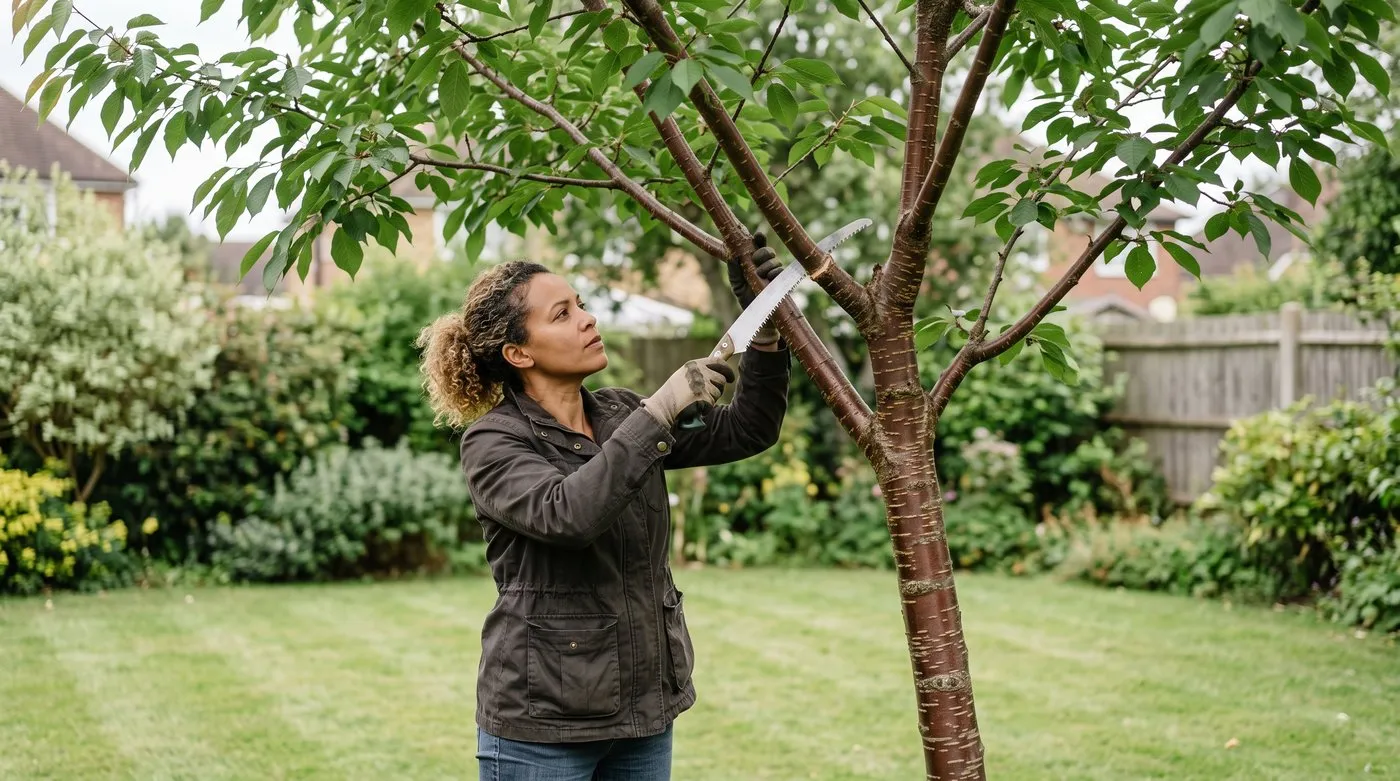
Prune cherries in summer, when cuts seal fastest. Cut back to the swelling at the branch base and don’t leave a stump.
Common problems
Silver leaf disease
The most serious cherry problem in the UK. The leaves turn a silvery, metallic colour and branches die back. If you cut through an affected branch, you’ll see a brown stain in the wood. Cut infected branches back to clean wood, well below the stain, and dispose of the prunings away from the garden. Prune only in summer. The RHS page on Prunus has more help.
Bacterial canker
Sunken patches on branches and trunk that ooze gum. Leaves get small brown holes, as if shot through. Cut out affected branches in summer, well below the damage. It’s more common on trees stressed by wet soil or drought.
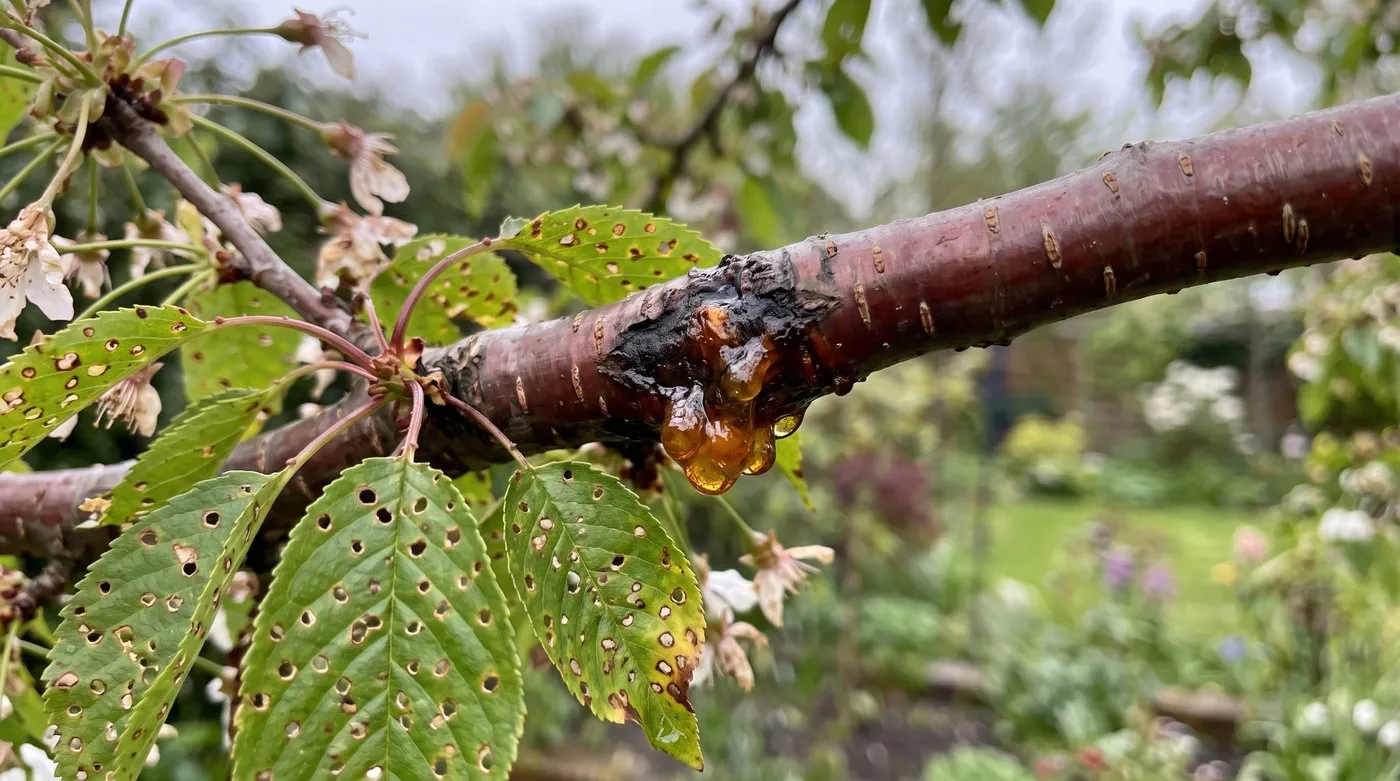
Sunken bark that weeps gum, plus leaves full of small holes, points to bacterial canker. Cut out affected branches in summer.
Cherry blackfly
Clusters of black aphids on shoot tips in early summer, curling the young leaves. Pinch out the worst tips. Ladybirds, lacewings and blue tits will help. It looks bad but rarely harms the tree.
Blossom wilt
Flowers and young shoots wilt and turn brown, as if scorched. It’s worst in wet springs. Cut off affected shoots and thin a crowded canopy so air can move. It’s usually more unsightly than serious.
Honey fungus
A fungus that can attack older trees, especially near old stumps. Look for white fungal sheets under the bark at the base and black bootlace-like strands in the soil. There’s no cure. Removing old stumps and planting in soil that drains well help.
Autumn colour bonus
Many cherries give you a second show in autumn. Sargent’s cherry is the star, turning bright orange-red. Kojo-no-mai and other incisa cherries go orange and bronze, and Okame usually colours well too.
Kanzan and Tai-haku turn yellow, orange and bronze. Colour is best in full sun. For an autumn border, pair cherries with other trees grown for autumn colour. Fancy fruit too? Our guide to growing cherry trees covers eating cherries.
Flowering cherries and wildlife
Flowering cherries are great for early wildlife. March-flowering Okame and Kojo-no-mai give queen bumblebees, solitary bees and hoverflies a much-needed early meal.
Single-flowered kinds (Tai-haku, Okame, Sargentii) are much better for bees than frilly doubles (Kanzan, Kiku-shidare-zakura), where the extra petals get in the way. If wildlife matters to you, go single.
Any small fruit is eaten by blackbirds, thrushes and starlings. The branches give birds nesting spots, and the leaves feed caterpillars that in turn feed baby birds.
For a wildlife garden, mix cherries with native trees and crab apples, which give autumn fruit for winter thrushes.
Growing flowering cherries in containers
Small varieties grow happily in big pots for several years. Try Kojo-no-mai, Okame or a young Amanogawa. Use a pot at least 45cm wide and deep, filled with John Innes No. 3 compost with some perlite mixed in.
Water regularly from spring to late summer and feed every couple of weeks while it’s growing. Repot every few years into fresh compost and a slightly bigger pot. In a hard winter, wrap the pot or move it somewhere sheltered.
A cherry in a pot stays much smaller than one in the ground, so it’s a great option for patios, balconies and paved front gardens.
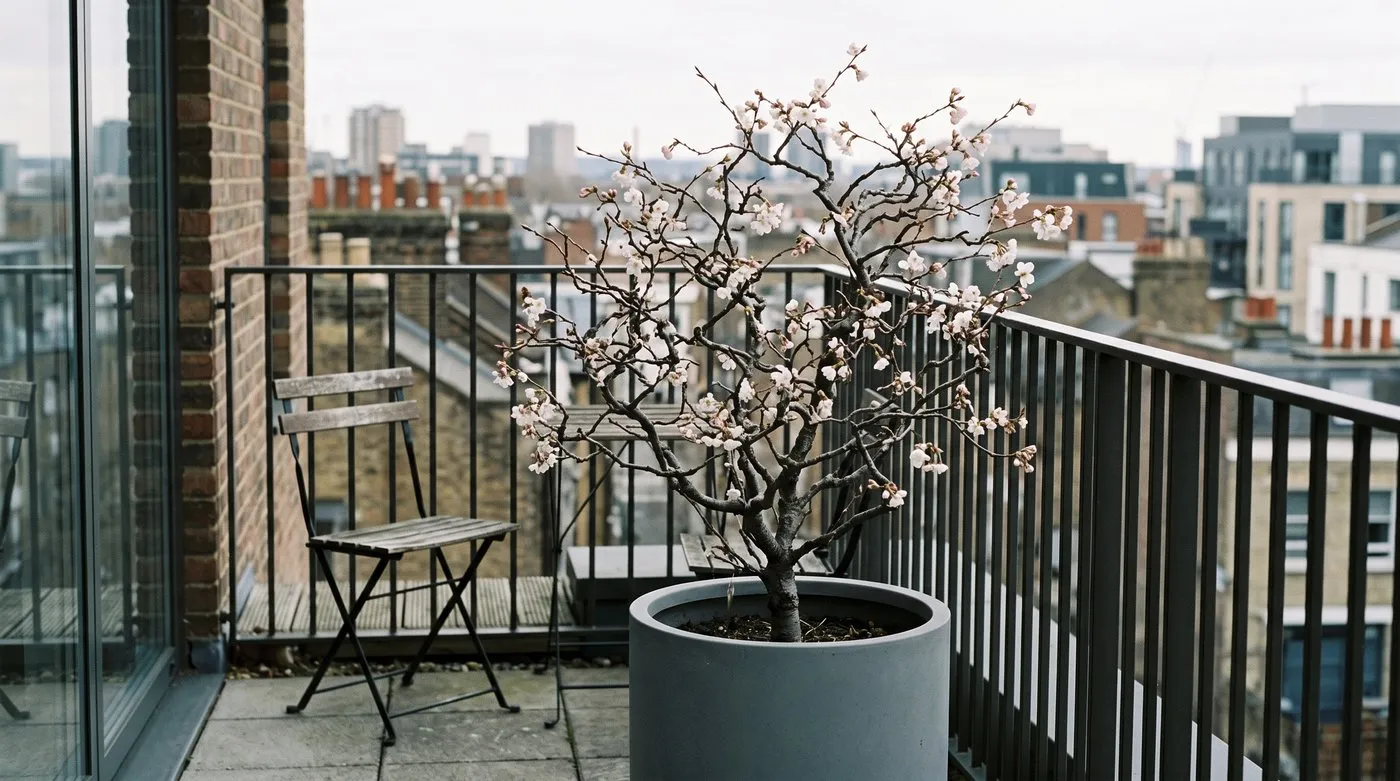
Kojo-no-mai stays tiny, so it’s happy in a big pot on a balcony. Water regularly and feed while it’s growing.
Flowering cherry tree planting calendar
| Month | Jobs |
|---|---|
| November to December | Best time to plant bare-root trees. Mulch afterwards. |
| January to February | Check stakes and ties. Firm in any trees lifted by frost. |
| March | Sprinkle general feed. Enjoy early blossom (Okame, Kojo-no-mai). |
| April | Peak blossom for most varieties. |
| May | Look out for blackfly on shoot tips. Water new trees in dry spells. |
| June | Start any pruning. The safest month to prune. |
| July to August | Finish pruning by the end of August. |
| September | Enjoy autumn colour. Clear up diseased fallen leaves. |
| October | Get planting spots ready. Order bare-root trees. |
Bare-root trees are usually cheaper than potted ones and settle in well when planted in winter.
Frequently asked questions
When do flowering cherry trees bloom in the UK?
Most bloom in April. Early ones such as ‘Okame’ flower in March. ‘Autumnalis’ opens flowers in mild spells from late autumn to early spring. Later ones such as ‘Kanzan’ and ‘Shirotae’ carry on into late April or May. Grow a few different kinds and you’ll have blossom for weeks.
How big do flowering cherry trees get?
It depends on the variety. ‘Amanogawa’ grows tall but stays narrow. The weeping ‘Kiku-shidare-zakura’ stays small. Spreading kinds such as ‘Kanzan’ and ‘Tai-haku’ become big trees, both tall and wide. Always check the final size on the label before you buy.
Can I grow a flowering cherry in a small garden?
Yes, several suit small gardens. ‘Amanogawa’ is tall and very narrow. ‘Kiku-shidare-zakura’ is a small weeping cherry for patios and front gardens. ‘Okame’ is fairly compact too. Check the final size and plant away from walls and drains.
Why is my flowering cherry tree dying?
Silver leaf and bacterial canker are the usual culprits. Silver leaf gives the leaves a silvery sheen, then branches die back. Bacterial canker causes sunken patches on the bark that ooze gum. Both often get in through wounds, so prune only in summer. Soggy soil and honey fungus can also kill cherries.
When should I prune a flowering cherry tree?
In summer, from June to August. Cuts heal quickly then, and disease is less likely to get in. Avoid pruning in autumn, winter and early spring. Cherries need very little pruning anyway, so just remove dead, damaged and crossing branches.
Do flowering cherry trees have good autumn colour?
Yes, several are lovely in autumn. Sargent’s cherry turns brilliant orange and red. ‘Kanzan’ and ‘Tai-haku’ also turn yellow, orange and bronze. Colour is best in an open, sunny spot.
Are flowering cherry trees good for wildlife?
Yes, especially for early bees. Bees and other insects feed on the spring blossom. Single-flowered kinds such as ‘Tai-haku’ and ‘Okame’ are much better for them than frilly doubles such as ‘Kanzan’. Birds use the branches for cover and nesting, and any fruit feeds them too.
Our team produces practical UK gardening guidance from source research, contributor records and established horticultural practice. Editorial standards are overseen by Matt W.