
Key takeaways
- Japanese maples give the brightest reds, especially on acid soil
- Sweetgum (Liquidambar) has one of the longest displays, changing colour over several weeks
- Plenty of sun gives the best colour, so avoid deep shade
- Field maple and ginkgo colour well on chalk
- Bare-root trees are cheaper and best planted November to March
- Shelter from wind keeps the leaves on the tree for longer
A tree in full autumn colour is one of the best sights in any garden. But plant the wrong tree, or the right tree in the wrong spot, and you get muddy browns instead of fiery reds and clear yellows.
Here are 12 of the best trees for autumn colour in UK gardens, why leaves change colour, and the three main reasons a display lets you down. Picking a tree that suits your soil is the most important step.
Why leaves change colour in autumn
Autumn colour isn’t random. Weather, light and soil all play a part, and knowing a little about it helps you pick a tree that will put on a show.
How leaves change colour
In summer, leaves are green because of chlorophyll, the pigment plants use to make food from sunlight. As the days shorten in autumn, the tree starts to shut down its leaves and the green fades away.
Yellows and oranges are in the leaf all summer, hidden by the green. As the green fades, they show through. That’s why yellow is the most reliable autumn colour. It happens whatever your soil.
Reds and purples are made fresh in autumn. They need bright sunny days and cool nights to develop well. Too much shade, or a mild, cloudy autumn, means fewer reds.
Why soil matters for reds
Red-colouring trees generally do best on acid soil. On chalky or limy soil, the same tree often turns dull brown or purple-brown instead. That’s why a Japanese maple can be brilliant scarlet on Surrey’s acid sand but disappointing on Cotswold limestone.
Test your soil before you choose. A simple kit from a garden centre is cheap and quick. If your soil is alkaline, go for trees that turn yellow or orange rather than fighting it.
 Mature trees at their best in mid-October. Different trees and soils give the mix of reds, oranges and yellows.
Best trees for autumn colour ranked
These 12 trees are ranked by how brilliant and reliable their colour is in UK gardens.
| Rank | Tree | Colour | How long | Height | Soil |
|---|---|---|---|---|---|
| 1 | Acer palmatum ‘Osakazuki’ | Scarlet | A few weeks | 4-6m | Acid to neutral |
| 2 | Liquidambar styraciflua | Yellow, orange then crimson | Several weeks | 8-12m | Any, best on acid |
| 3 | Cercidiphyllum japonicum | Pink-apricot, smells of toffee | A few weeks | 8-12m | Moist, best on acid to neutral |
| 4 | Amelanchier lamarckii | Orange-red | A few weeks | 5-8m | Acid to neutral |
| 5 | Nyssa sylvatica | Scarlet, orange and purple | A few weeks | 6-10m | Acid, moist |
| 6 | Acer campestre (native) | Golden yellow | Two to three weeks | 8-12m | Any, including chalk |
| 7 | Parrotia persica | Yellow, orange and crimson | Several weeks | 6-8m | Any |
| 8 | Betula pendula (native) | Bright yellow | Two to three weeks | 10-15m | Any |
| 9 | Prunus sargentii | Orange-red | Two to three weeks | 8-12m | Any |
| 10 | Ginkgo biloba | Butter yellow | Short but stunning | 8-15m | Any, including chalk |
| 11 | Sorbus commixta | Orange, red and purple | Two to three weeks | 6-8m | Acid to neutral |
| 12 | Fagus sylvatica (native) | Copper-bronze | Through winter on hedges | 12-20m | Any, including chalk |
The top five trees in detail
1. Acer palmatum ‘Osakazuki’: the ultimate red
Acer palmatum ‘Osakazuki’ is one of the finest autumn trees you can buy. The RHS has given it an Award of Garden Merit. Fresh green leaves in spring turn a glowing scarlet in October.
It grows to 4-6m tall and 3-4m wide over many years, so it fits most gardens. It likes acid to neutral soil, sheltered from cold east winds and late frosts. Morning sun and dappled afternoon shade is perfect. Hot afternoon sun can scorch the leaves in summer and spoil the autumn show.
Plant bare-root trees from November to March. Our Japanese maple care guide has lots more growing advice.
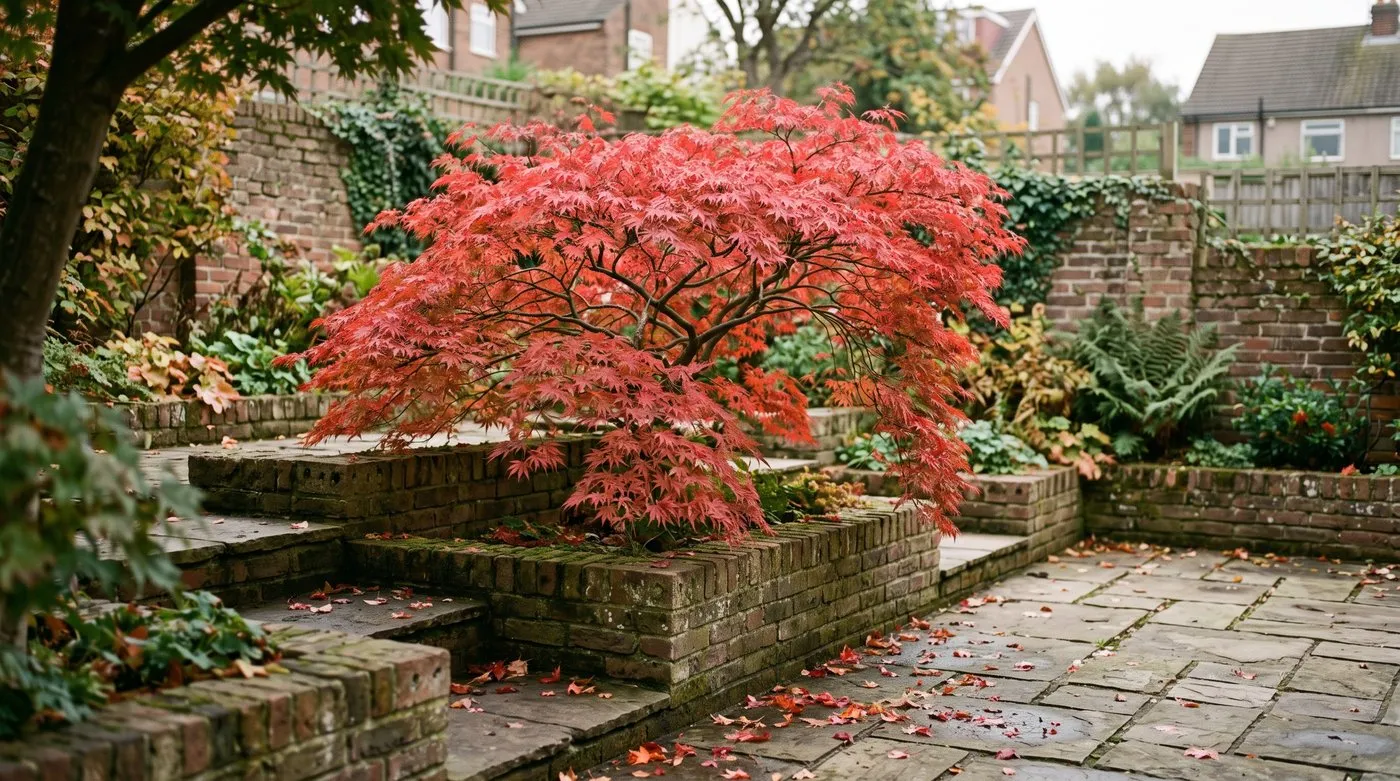
Osakazuki colours best with morning sun, afternoon shade and shelter from cold winds. A walled back garden suits it perfectly.
2. Liquidambar styraciflua: the longest display
Liquidambar styraciflua (sweetgum) has one of the longest autumn shows of any tree in UK gardens. From late September, the leaves slowly change through green, yellow, orange and deep crimson. Branches often show several colours at once, like a patchwork.
It grows to 8-12m tall and 4-6m wide, faster on moist, well-drained soil. It copes with most soils but gives the deepest reds on acid to neutral ground. On chalk it leans more towards yellow and orange, which is still lovely.
Sweetgum needs room, and it hates being moved once settled. Plant a young tree where it can stay, then leave it be.
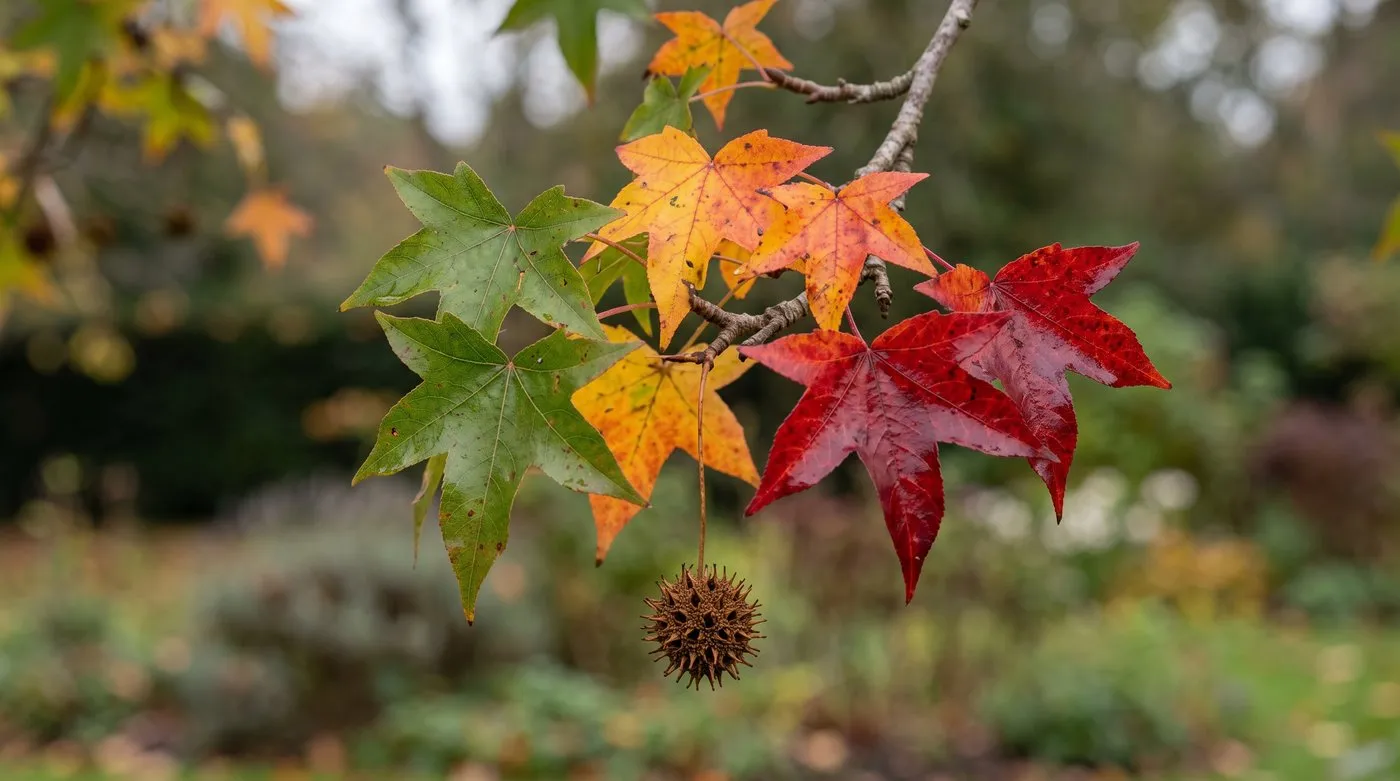
Sweetgum leaves change at different speeds, so one branch can hold four colours at once. That’s why its display lasts for weeks.
3. Cercidiphyllum japonicum: the toffee apple tree
Cercidiphyllum japonicum (katsura tree) is special for two reasons, its colour and its smell. As the heart-shaped leaves turn pink, apricot and soft orange in October, they give off a sweet scent like burnt toffee or candyfloss. On a still autumn morning you can smell it from a good distance.
It can reach 8-12m, but often grows with several stems and can be kept at 5-6m with some pruning. It’s fully hardy. It grows on most soils, though its colour is best on acid to neutral soil.
Plant it out of strong wind so the scent hangs around. It likes moist but well-drained soil, and drops its leaves early in a dry year. Water young trees well in dry spells for their first three summers.
 A katsura tree in late October, with its pink-apricot autumn colour and heart-shaped leaves.
4. Amelanchier lamarckii: something for every season
Amelanchier lamarckii (snowy mespilus) works hard all year. White blossom in April, purple-black berries in summer that birds love, and brilliant orange-red leaves from mid-October.
It grows to 5-8m tall and 4-6m wide. It likes acid to neutral soil and copes with part shade, though the colour is best in full sun. Its light, airy canopy doesn’t cast heavy shade on plants below.
Amelanchier is one of the easiest autumn trees to get going. It moves well, grows steadily and rarely has pest or disease problems. It’s a perfect choice for small gardens where you want lots of seasonal interest.
5. Nyssa sylvatica: the tupelo
Nyssa sylvatica (tupelo or black gum) has some of the most dramatic autumn colour of any tree. Its leaves turn scarlet, orange and deep purple all at once.
It needs acid, moist soil. On chalk or dry clay it struggles and colours poorly. Plant it where the soil stays damp but not waterlogged. It grows slowly to 6-10m, cone-shaped when young and broader with age. It’s fully hardy.
The downside is that it’s harder to find than Japanese maples or sweetgum. Try a specialist nursery and order early. On acid soil, it’s the tree for the biggest autumn show.
Native UK trees for autumn colour
You don’t need an exotic tree for great autumn colour. Three native British trees colour reliably, help local wildlife and grow happily in most UK soils.
Acer campestre (field maple) is our only native maple. It turns rich golden yellow in October and grows on any soil, even thin chalk. It can reach 8-12m, but takes pruning well and makes a good hedge. Bare-root trees are cheap.
Betula pendula (silver birch) has bright yellow autumn leaves against its white bark, which looks wonderful in low autumn sun. It grows to 10-15m on any soil, even poor, sandy ground.
Fagus sylvatica (common beech) turns copper-bronze in November. Grown as a hedge, it keeps its dead leaves through winter, so you get warm copper tones when most trees are bare. As a tree it reaches 12-20m, but as a hedge it’s easy to keep at 1.5-3m. Beech and oak both have boom-and-bust years, dropping loads of nuts in a bumper seed year known as a mast year and few in between. Oak turns a warm russet in late autumn but gets far too big for most gardens, and in the south east it now faces oak processionary moth too.
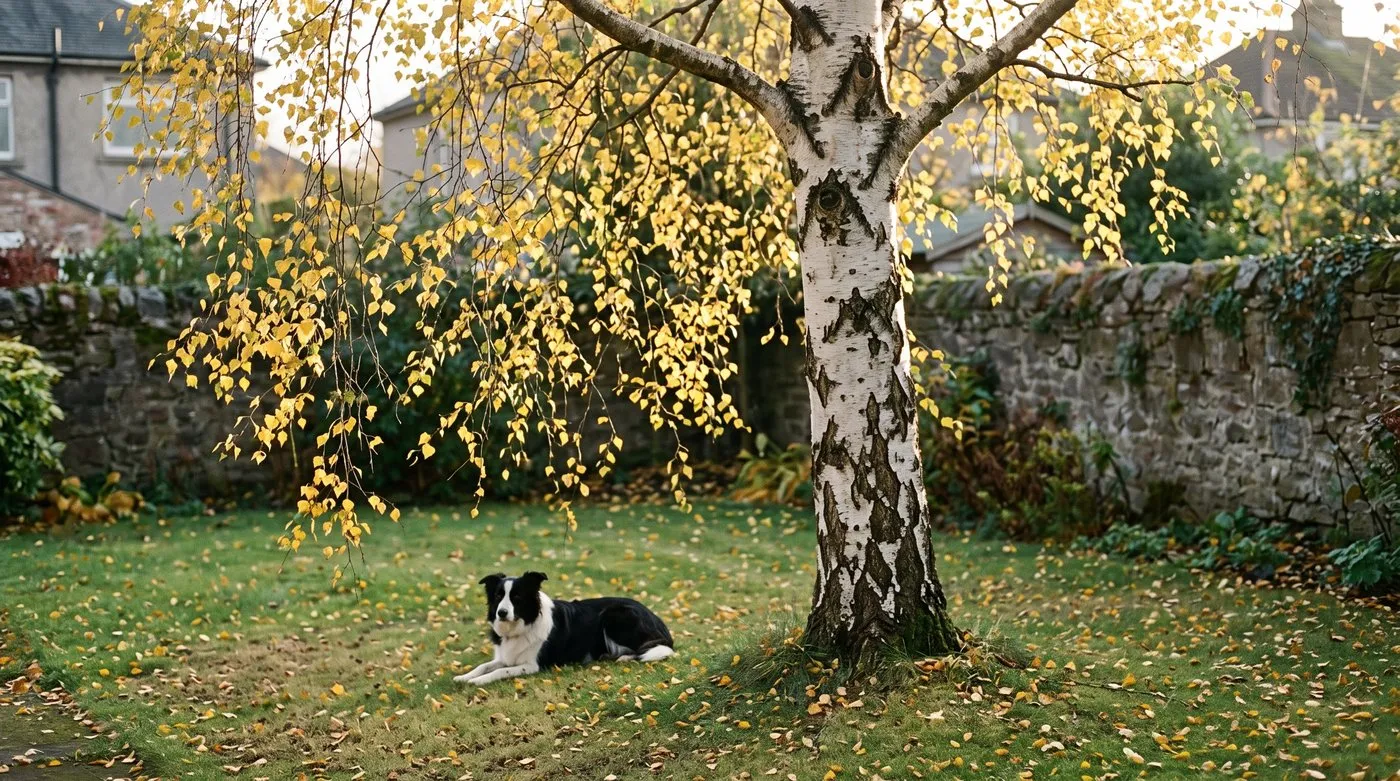
Silver birch turns clear yellow on almost any soil, even poor sand. Its light canopy lets plenty of light through to the lawn below.
Why autumn colour disappoints
Most disappointing autumn displays come down to three things. Get these right and you’ll save money on trees that were never going to perform.
The wrong soil for the tree
This is the big one. People plant a Japanese maple or amelanchier on chalky clay and wonder why the leaves go brown instead of red. Test your soil before you buy, and match the tree to it.
The fix: On chalky or alkaline soil, choose trees that turn yellow or orange, like ginkgo, parrotia or field maple. If you really want reds, grow a Japanese maple in a big pot of ericaceous compost.
Too much shade
Reds need bright sun. A tree under a big canopy or against a north-facing wall won’t get enough light. The leaves turn pale yellow at best, or go brown and drop.
The fix: Plant autumn colour trees where they get at least five or six hours of direct sun a day from September. A spot that catches the low autumn sun from the south or west is ideal.
Unreliable seed-grown trees
Trees grown from seed can vary a lot, so one may colour beautifully while its neighbour barely bothers.
The fix: Buy named varieties from good UK nurseries rather than unnamed seedlings. Varieties such as Liquidambar ‘Worplesdon’ and Nyssa ‘Wisley Bonfire’ were picked for their colour, and they’re grafted, so every tree behaves the same. They cost a bit more, but they’re worth it.
 A field maple hedge turning golden yellow along a country lane. It colours well on any soil, chalk included.
Month-by-month autumn colour care calendar
| Month | What to do |
|---|---|
| January | Order bare-root trees while there’s plenty of choice |
| February | Dig planting holes, about 60cm square, and break up heavy clay |
| March | Last chance to plant bare-root trees before the buds open |
| April | Mulch with 7-10cm of composted bark to hold moisture and stop weeds |
| May | Water new trees well once a week if it’s dry |
| June | Check stakes and ties, and loosen them if they rub the bark |
| July | Keep watering young trees in dry spells, as drought spoils autumn colour |
| August | Stop high-nitrogen feeds by mid-August so growth can toughen up |
| September | Enjoy the first colour on Prunus sargentii and parrotia |
| October | Peak colour. Take photos and note which trees do best |
| November | Plant new bare-root trees. Collect fallen leaves for leaf mould |
| December | Check stakes and ties before winter gales, and make sure nothing is too tight |
How to plant autumn colour trees
Good planting helps a tree settle in quickly and colour well. Follow these steps for any tree.
Planting method
Dig a hole twice as wide as the roots but no deeper. The point where the trunk widens into the roots must sit at soil level, never buried. On heavy clay, plant on a slight mound so it sits a few centimetres above the ground around it. That stops water pooling at the base.
Backfill with the soil you dug out. There’s no need to add compost to the hole, as roots grow outwards better into ordinary soil. Water in well with a couple of full cans to settle the soil.
Use a single stake at an angle, on the side the wind usually comes from, with a flexible rubber tie. Take the stake away after two growing seasons. Trees that sway a little grow stronger trunks and roots.
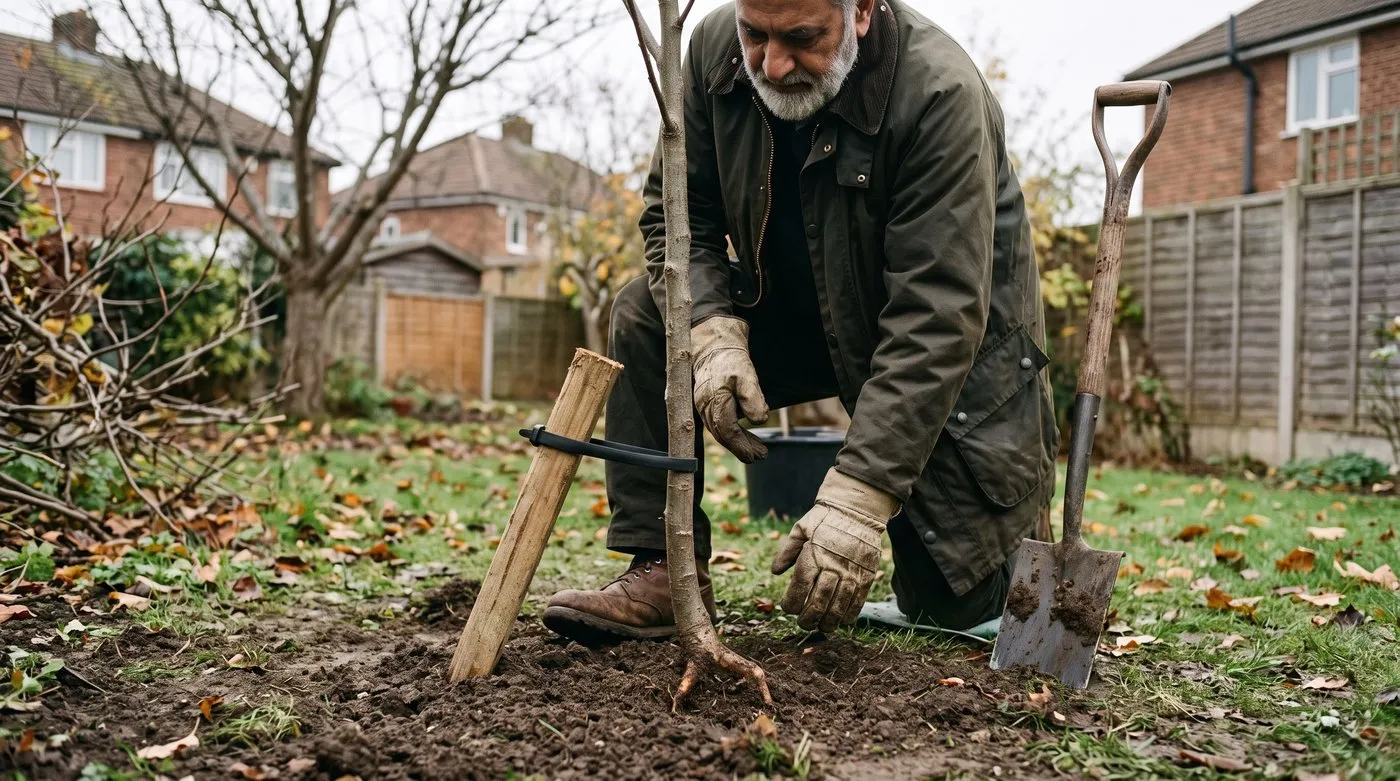
Keep the flare of the trunk at soil level, never buried. A low angled stake on the windward side holds it steady while it roots.
Bare-root vs pot-grown
Bare-root trees are sold from November to March. They’re much cheaper than pot-grown trees and settle in quickly, as their roots grow straight out into your soil.
Pot-grown trees can go in any time and look good straight away. They’re your only option from April to October. But roots that have circled the pot can take a year or two to grow outwards. Our bare-root tree planting guide walks you through it.
Common mistakes with autumn colour trees
Planting in a windy spot
Strong autumn winds strip the leaves before the show gets going. A tree that holds its colour for weeks in a sheltered garden can be bare in days on a windy hillside. Plant where buildings, walls or bigger trees give shelter from the south-westerly wind.
Choosing a tree that’s too big
A 12m sweetgum doesn’t belong in a small front garden. Check the final height and spread of every tree before you plant. For small spaces, stick to Japanese maples (4-6m), amelanchier (5-8m) or Sorbus commixta (6-8m).
Feeding too late in summer
High-nitrogen feeds after August push out soft, green growth that frost can damage. The tree is slower to shut down for winter. Stop nitrogen feeds by mid-August. A sprinkle of sulphate of potash around the roots in September, following the packet, helps toughen up growth.
Not watering for the first three years
Young trees that go thirsty in their first few summers struggle to build good roots. Dry trees drop their leaves early to survive, so you get brown and crispy instead of orange and glorious. Water new trees well once a week in dry spells for their first three summers.
Planting too deep
Burying the base of the trunk keeps the bark wet and can cause rot. A sickly tree won’t colour well. Check six months after planting that the base of the trunk is still visible. If soil has washed over it, scrape it back.
Trees for tricky situations
Best autumn colour trees for chalk
If your soil is alkaline, these still colour well:
- Ginkgo biloba: clear butter yellow, and drops its leaves almost overnight
- Parrotia persica: crimson, orange and yellow all on the same tree
- Acer campestre: golden yellow, native and not fussy about soil
- Fagus sylvatica: copper-bronze, kept through winter on hedges
Best autumn colour trees for small gardens (under 8m)
- Acer palmatum ‘Osakazuki’: 4-6m, scarlet
- Amelanchier lamarckii: 5-8m, orange-red, interest all year
- Sorbus commixta: 6-8m, orange, red and purple, neat shape
- Acer griseum (paperbark maple): 5-8m, orange-red, with peeling cinnamon bark
Best autumn colour trees for wet soil
- Nyssa sylvatica: scarlet, orange and purple, loves moisture
- Liquidambar styraciflua: likes moist ground
- Betula pubescens (downy birch): yellow, native, good for boggy ground
Now you’ve picked your tree, read our guide on autumn gardening jobs to make the most of the season.
Frequently asked questions
What is the best tree for autumn colour in a small UK garden?
Acer palmatum ‘Osakazuki’ is the best choice. It only reaches 4-6m, copes with light shade, and turns a brilliant scarlet in autumn. Plant it in acid to neutral soil, sheltered from cold winds. It holds its colour for a few weeks before the leaves drop.
Why do my trees not change colour in autumn?
Chalky or alkaline soil is a common cause. Red colour tends to be best on acid soil, so reds can turn dull brown on chalk. Trees in heavy shade also colour poorly, as they need sun. Test your soil with a cheap kit. If it’s alkaline, choose trees that turn yellow, such as ginkgo or field maple.
When do trees change colour in the UK?
Most UK trees start turning in early October. Peak colour is between mid-October and mid-November in southern and central England. Northern Scotland is a little earlier. Sunny days followed by cold nights in early autumn give the best displays.
Do trees need acidic soil for autumn colour?
Only the red-colouring trees really need it. Maples, sweetgum and amelanchier give their best reds on acid soil. Yellow and orange trees like ginkgo, birch and field maple colour well on any soil, including chalk. Match the tree to your soil rather than trying to change it.
How long does autumn colour last on trees?
Most trees hold their colour for two to four weeks. Sweetgum lasts longer, slowly changing from green to yellow, orange and deep crimson. Strong winds and heavy rain shorten the show. Sheltered gardens keep their colour much longer than exposed ones.
Can I grow autumn colour trees in pots?
Yes, Japanese maples grow well in big pots, at least 50cm across. Use ericaceous compost for the best red colour. Water daily in summer, and wrap the pot in fleece or bubble wrap so it doesn’t freeze solid in winter. Repot every 3-4 years.
What is the fastest growing autumn colour tree UK?
Sweetgum (Liquidambar styraciflua) is one of the quickest. It can grow 40-60cm a year in good conditions and eventually reaches 8-12m. Plant a young bare-root tree in November. It will settle in faster than a big pot-grown tree and costs much less.
Which native UK trees have the best autumn colour?
Field maple is the standout native, turning golden yellow in October. Wild cherry turns orange-red. Silver birch goes bright yellow. Beech turns copper-bronze, and keeps its dead leaves through winter when grown as a hedge. All four are fully hardy and suit most UK soils.
Our team produces practical UK gardening guidance from source research, contributor records and established horticultural practice. Editorial standards are overseen by Matt W.


