Key takeaways
- Caterpillars feed on oak from April to July and travel in nose-to-tail processions
- Nests are white silk on the trunk or big branches, not wrapped round leaves
- The tiny hairs cause rashes and sore eyes and throats in people and dogs
- Old brown nests still carry irritating hairs, so leave them alone too
- Report suspected nests to TreeAlert and never remove one yourself
- Webbing over a hedge is almost always harmless small ermine moth
Oak processionary moth (often shortened to OPM) is a caterpillar to learn on sight if you live in or near London. Its tiny hairs give people itchy rashes and sore eyes, and dogs that sniff the nests can react badly. Spot the white silk nests on oak trunks, keep well back, and report what you find.
It arrived in London on imported oak trees in the mid-2000s and has spread out from there. This guide covers what it looks like, how to tell it from harmless webbing, what to do if you or your dog gets hairs on you, and who to tell.
What does oak processionary moth look like?
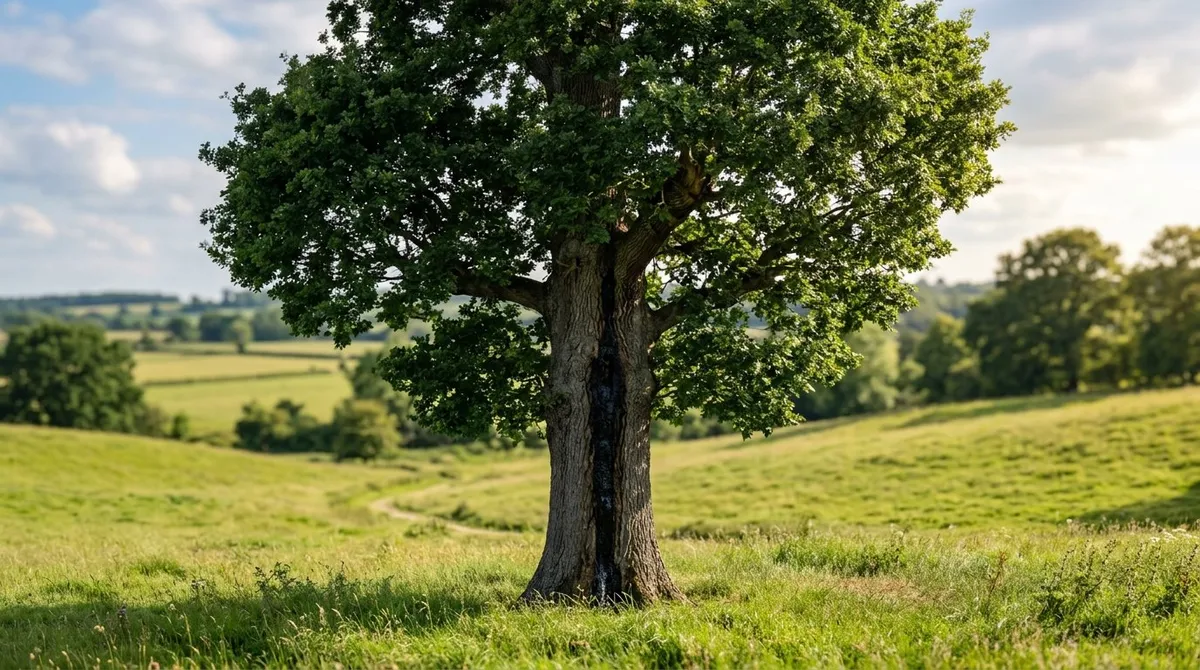
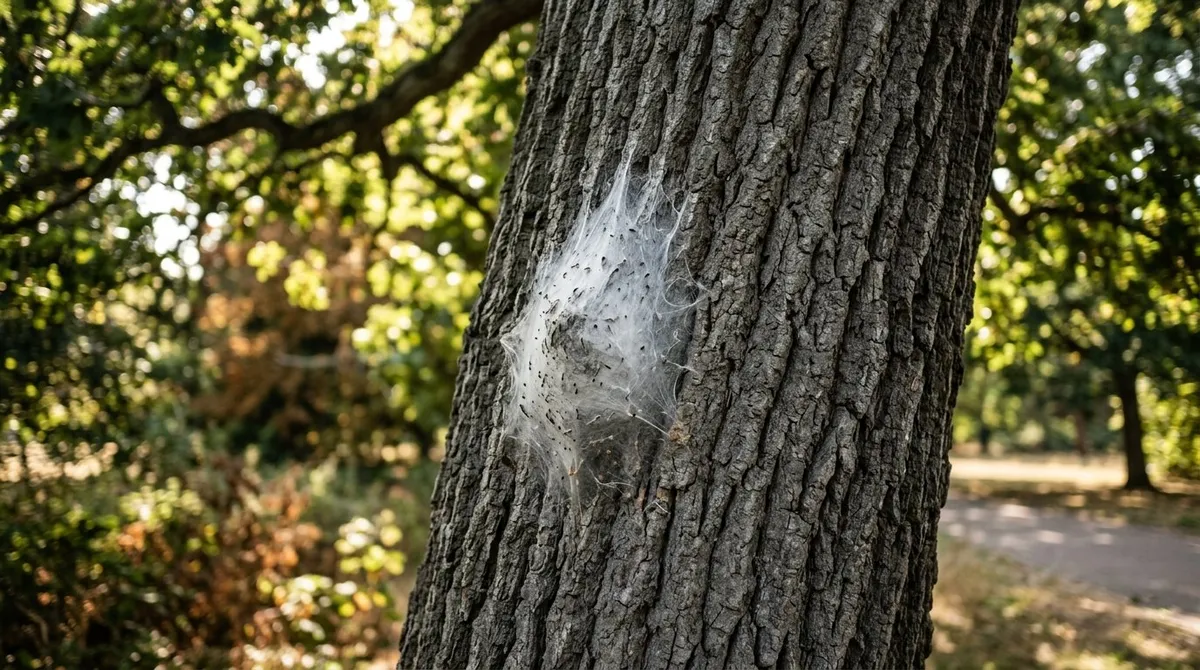
Look for white silken nests stuck to the trunk or a big branch of an oak. The caterpillars themselves are grey with long white hairs and grow to about 3cm. They travel in single file, nose to tail, along the bark. Nothing else on a British oak does this, which gives the moth its name.
You will usually notice the nest before the caterpillars. Nests start bright white and fade to dirty brown over the season. They can be domes, teardrops or flat sheets wrapped round the bark, from a few centimetres across to the size of a rugby ball.
The caterpillars only feed on oak. They rest together in the nest by day and head out along the branches to feed. The adult moths are plain grey-brown, fly at night and are harmless. Only the caterpillar hairs cause trouble.
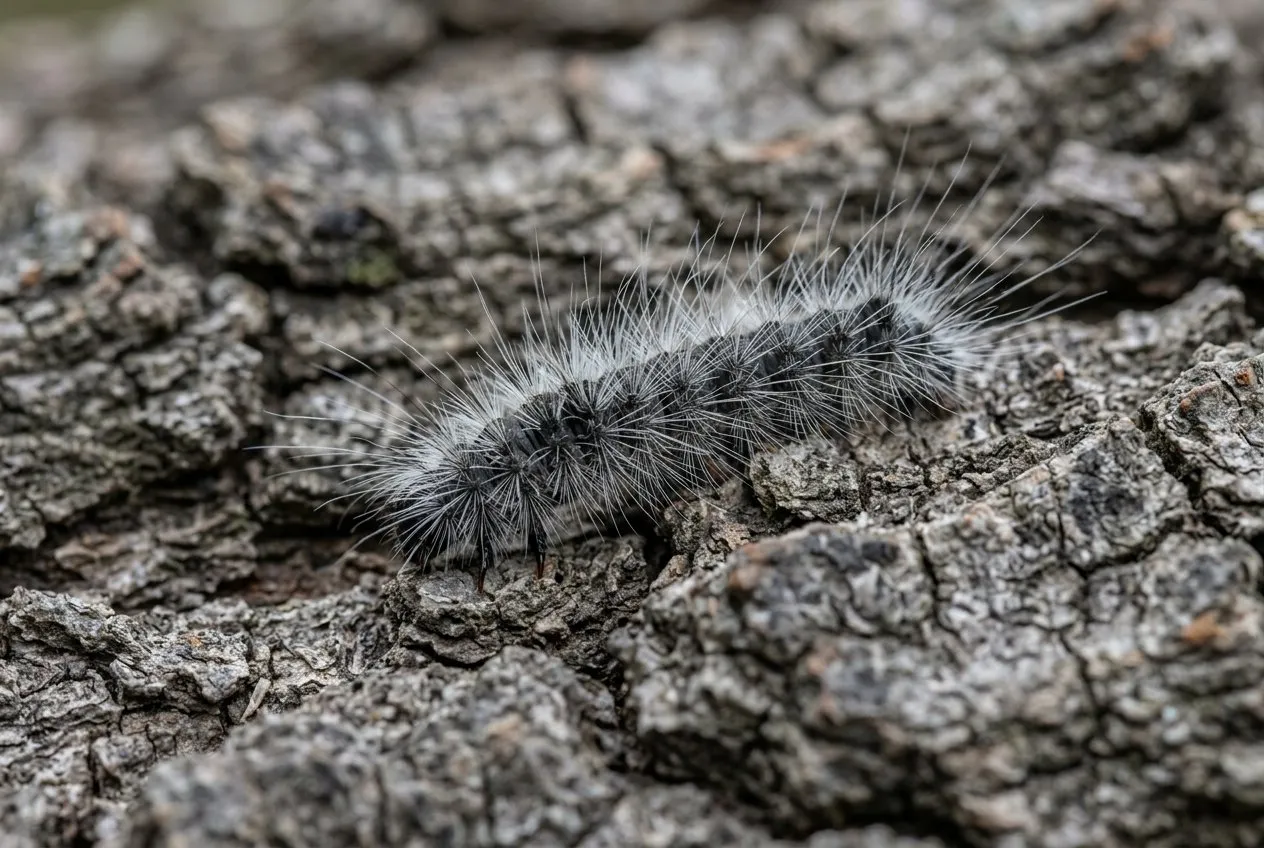
A single caterpillar up close. Those long white hairs, and the much tinier ones you can’t see, are what cause the rashes.
How to tell OPM from harmless ermine moth webbing
Most scary-looking webbing in gardens is small ermine moth, not OPM. It is completely harmless to people and pets. Two quick checks sort it out.
First, check the plant. OPM lives only on oak. Webbing on a hedge, spindle, bird cherry, hawthorn or blackthorn is not OPM. Small ermine caterpillars can cover a whole shrub in grey gauze. It looks alarming, does no harm, and the plant usually grows new leaves within weeks.
Second, check where the silk sits. OPM nests sit flat on the bark of the trunk or a large branch. Ermine webbing is wrapped through the leaves and outer twigs.
One lookalike does need care. Brown-tail moth caterpillars also have irritating hairs. They live on hawthorn, blackthorn and bramble, mostly near the coast in the south and east of England. Their nests are tight white silk tents at the tips of branches.
| Feature | Oak processionary moth | Small ermine moth | Brown-tail moth |
|---|---|---|---|
| Plant it lives on | Oak only | Hedges, spindle, hawthorn, cherry | Hawthorn, blackthorn, bramble |
| Where the silk sits | Flat on trunk and branches | Wrapped over leaves and twigs | Small tents on branch tips |
| Caterpillar | Grey, long white hairs, moves in lines | Pale with black dots | Dark, white tufts, two orange spots |
| Irritating hairs? | Yes | No | Yes |
| Where in the UK | London and nearby counties | Everywhere | Coasts of the south and east |
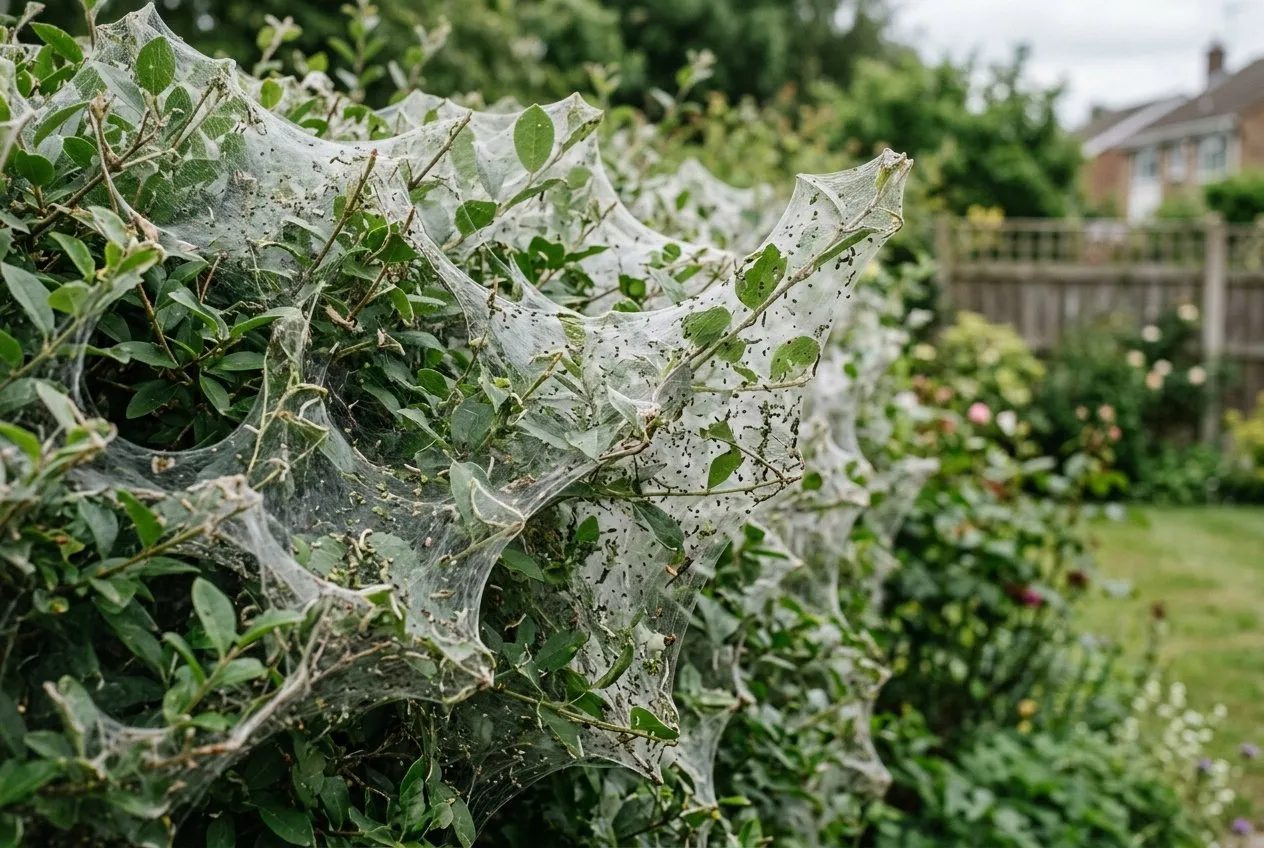
Webbing draped over a hedge like this is harmless small ermine moth. No oak, no oak processionary moth.
Why are the caterpillar hairs a health risk?
The trouble is the hairs, not a bite or a sting. Older caterpillars carry thousands of tiny hairs that break off easily, blow on the wind and build up in and under the nests. That is why you can react without touching anything.
On skin, the hairs cause an itchy, sometimes painful rash, usually on arms, necks and hands. In the eyes they cause soreness and redness. Breathed in, they can make your throat sore and set off coughing, which is worse for people with asthma.
The risk is highest from May to July, when the caterpillars are big and the nests are busy. It does not stop there, though. Hairs stay in old nests, in bark cracks and in the leaf litter under the tree.
Warning: Old brown nests are not safe. The hairs stay irritating for years after the caterpillars have gone, so treat every nest on an oak as a hazard.
Dogs are most at risk because they explore with their noses. A dog sniffing a nest or a fallen caterpillar can get hairs in its mouth and throat. Keep dogs on a lead near affected oaks. It is worth knowing alongside the plants that are poisonous to dogs.
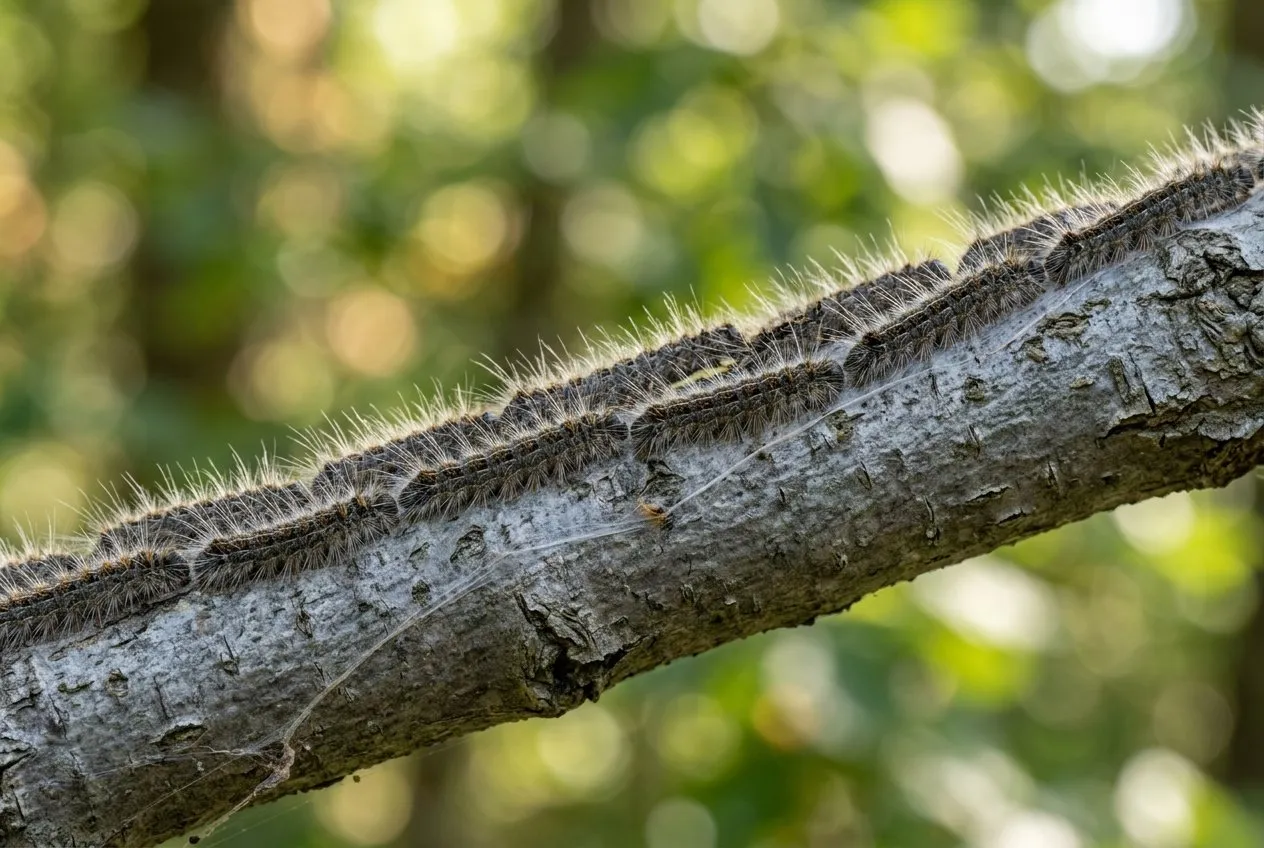
Caterpillars on the move in a nose-to-tail line. If you see this on an oak, step back and take a photo from a distance.
When to look: the OPM year
OPM has one generation a year, so the risky months are easy to predict. Eggs laid high in the oak hatch in April. Caterpillars feed from April to July, and nests are easiest to spot from June. The caterpillars turn into pupae inside the nest in summer, and the moths fly in late summer.
So do your looking in late spring and early summer. A nest you spot in winter is an old one. It is still worth avoiding and still worth reporting if it hasn’t been logged.
| Month | What is happening | What to do |
|---|---|---|
| January to March | Eggs wait in the canopy. Old nests still on the bark | Keep away from old nests |
| April | Caterpillars hatch | Start checking oaks you pass often |
| May | Caterpillars growing and getting hairier | Keep dogs and children back from nests |
| June | Big caterpillars, processions, fresh nests | Peak risk. Report new nests |
| July | Caterpillars mature, nests easy to see | Peak risk continues |
| August | Pupae inside the nests | Nests still irritating. Do not touch |
| September | Moths lay eggs | Note where nests are |
| October to December | Nests fade to brown | Avoid contact. Report any not yet logged |
Where is oak processionary moth found in the UK?
OPM is settled across most of Greater London and has spread into neighbouring counties. Small outbreaks have also turned up further afield on imported trees.
The Forestry Commission manages its spread using zones. In the Established Area, around London, the moth is here to stay and the focus is on protecting people. Around that is a Buffer Zone, and beyond it a Pest Free Area, where surveys and control try to stop it moving out. The zone lines are reviewed as new sightings come in, so check the Forestry Commission’s latest map if you’re near the edge.

Big park oaks in and around London are where OPM turns up most, which is why you’ll see warning signs there.
What to do if you find oak processionary moth
Don’t touch it, and report it. Use Forest Research’s TreeAlert form, which lets you upload a photo and pin the location. Reports from outside London matter most, because that is how new outbreaks get caught.
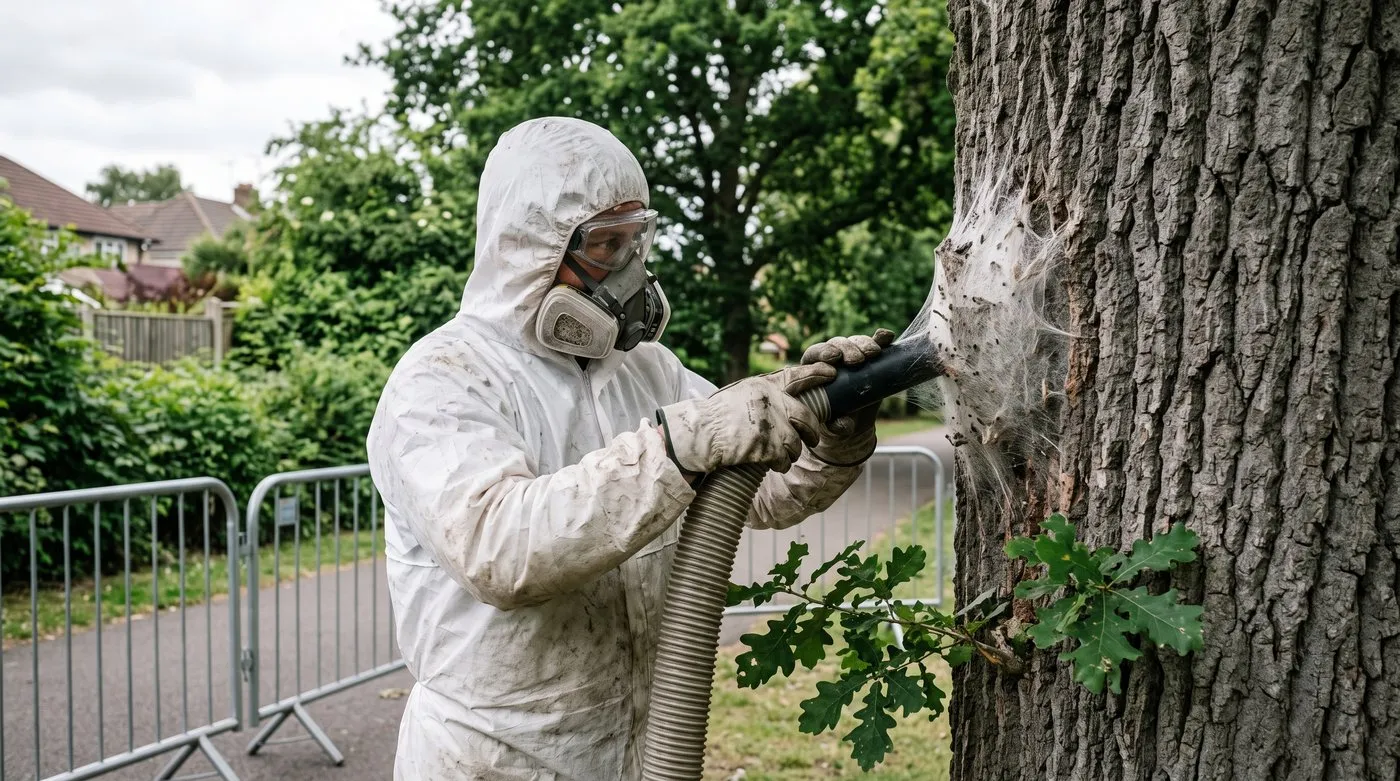
Nest removal is a job for trained operators in full protective kit, never a ladder and a bin bag.
A clear photo of the nest and the tree, the exact spot, and whether it is public or private land all help. If the tree is in a park or on council land, the council or landowner usually deals with it. If it is your own tree, you need to bring in a specialist contractor.
While you wait, keep children and dogs well clear. If you brushed past a nest, change your clothes and wash them separately.
Never try to remove a nest yourself. Trained operators take nests down in full protective suits and masks, usually with special vacuum kit. The Woodland Trust’s oak processionary moth guidance gives the same advice.
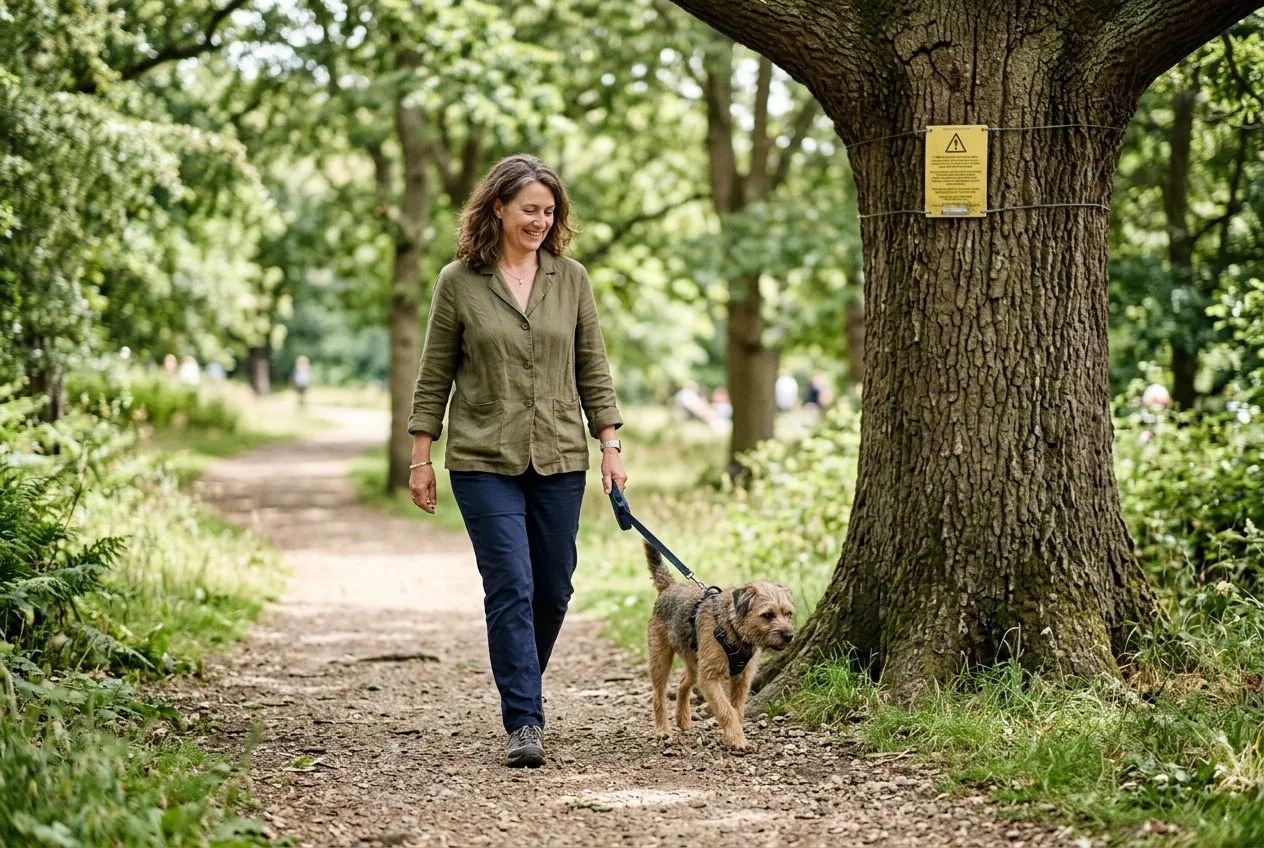
A short lead near signed oaks keeps noses away from nests and fallen caterpillars.
What to do if you or your dog are exposed
Most reactions in people are mild and settle with simple care. Don’t scratch or rub, as that pushes the hairs in. Wash the skin with soap and water and wash your clothes separately. An antihistamine or a soothing cream helps with the itch, and so does a cool compress.

If your dog has nosed a nest, rinse its mouth and face gently, then phone your vet straight away.
Rinse your eyes with clean water if hairs get in them, and see a pharmacist or GP if soreness carries on. Ring NHS 111 for a bad or spreading rash. Ring 999 if someone has real trouble breathing.
For a dog, act quickly. Rinse its mouth and face with water if you can do so safely, and stop it pawing at its face. Then phone your vet straight away. Swelling of the mouth or throat, heavy drooling or distress needs a vet the same day.
The best protection is not getting close in the first place. At home, a dog-friendly garden layout keeps pets away from risky corners, and on walks a short lead near oaks does the job.
Do oaks recover after OPM?
Yes, most do. A healthy oak usually grows new leaves later the same summer or the next spring, even after losing a lot of its canopy. Being stripped once rarely kills a mature tree.
The worry is repeated attacks. An oak hit hard several years running, or one already weakened by drought or root damage, has less strength to bounce back. That makes it easier prey for other problems, such as acute oak decline.
Oaks are among the most valuable native trees for gardens, so they are worth protecting. If you are planting an oak or another of the best small native trees, buy UK-grown stock. It is the simplest way to avoid bringing pests in on imported plants.
Common mistakes with oak processionary moth
Panicking over webbing that isn’t on an oak. Webbing over a hedge or shrub is almost always small ermine moth. Check the tree first.
Trying to remove a nest yourself. A broom or a bin bag spreads the hairs and can leave you with a nasty reaction. Report it instead.
Thinking old brown nests are safe. The hairs stay irritating for years. Don’t prune near an old nest, and warn anyone doing tree work nearby.
Letting dogs nose around affected oaks. Shed hairs and fallen caterpillars collect at the base of the trunk, right where dogs sniff.
Assuming you are too far from London. Outbreaks have turned up well outside the main area on imported trees. Report any real nest on an oak, wherever you are. Other moth caterpillars are worth knowing too, such as the box tree moth that strips box hedges.
Frequently asked questions
How do I identify oak processionary moth?
Look for white silken nests stuck to an oak trunk or branch. The caterpillars are grey with long white hairs. They move in single-file, nose-to-tail lines along the bark. If the tree is not an oak, it is not oak processionary moth.
Is oak processionary moth dangerous to humans?
Its hairs can give you an itchy rash, sore eyes and a sore throat. The hairs blow on the wind, so you can react without touching a nest. Most reactions settle with simple care, but get medical help for any breathing trouble.
Can oak processionary moth harm my dog?
Yes, mostly when dogs sniff nests or fallen caterpillars. The hairs can make the mouth swell and cause drooling and pawing at the face. Keep dogs on the lead near affected oaks and ring your vet straight away if your dog reacts.
What should I do if I find an oak processionary moth nest?
Leave it alone, keep people and pets back, and report it. Use Forest Research’s TreeAlert form with a photo and the exact location. Never try to remove a nest yourself, as that is a job for trained operators in protective kit.
How long do old oak processionary moth nests stay dangerous?
Old nests can stay irritating for years. The hairs remain in the empty webbing long after the caterpillars have gone. Treat a faded brown nest with the same care as a fresh one.
What is the webbing on my hedge if it is not OPM?
It is almost certainly small ermine moth, which is harmless. Its caterpillars wrap hawthorn, blackthorn, spindle and similar shrubs in sheets of white webbing. It looks dramatic, but the plants usually grow new leaves within weeks.
Do oak trees survive oak processionary moth?
Yes, healthy oaks almost always survive. A stripped oak usually grows new leaves later in summer or the next spring. Repeated attacks on a tree already weakened by drought or disease do more harm.
Find more tree and garden troubles in the problems hub. For another pest spreading across UK trees, read the guide to elm zigzag sawfly.
Our team produces practical UK gardening guidance from source research, contributor records and established horticultural practice. Editorial standards are overseen by Matt W.