Key takeaways
- Pick a level spot with plenty of sun, well away from trees
- A butyl rubber liner lasts for decades and fits any shape
- Always lay underlay first, even on soil that looks smooth
- Go at least 60cm deep if you want goldfish
- Add fish slowly, a few at a time, once the filter has had time to settle
A garden pond changes the whole feel of a garden. Water catches the light, brings in wildlife and gives you a lovely focal point. Whether you’d like a formal raised pond with a fountain, a planted pool with goldfish or a still pond edged with stone, the steps are much the same.
This guide is about ornamental and fish ponds. If you mainly want frogs, newts and dragonflies, our guide to building a wildlife pond is the one for you. The two share some building steps, but differ in depth, kit, edging and what lives in them.
Where to site a garden pond
Choose level ground with 5-6 hours of direct sun a day, at least 3m from trees, and with no pipes or cables underneath. Getting the spot right saves a lot of hassle later.
Sun matters most. With too little, water lilies won’t flower. With blazing sun all day, you’ll get more algae in summer. A bit of afternoon shade from a wall or fence is ideal.

Dig the shallow shelf first, then the deep middle. Check the levels before the underlay goes in.
Keep away from trees. Leaves drop into the water in autumn, rot down, turn the water brown and feed blanket weed. Roots can also damage a liner. Stay at least 3m from the edge of the nearest tree canopy.
Level ground is a must. Water always sits level, so even a small slope means liner showing on the high side. Check with a spirit level on a straight plank before you dig. If your garden slopes, a raised or half-raised pond saves a lot of digging.
Check for pipes and cables before you dig deeper than about 30cm. Ask your utility companies, or use a cable detector if you’re unsure.
Make it visible from the house. A pond you can see from the kitchen window or a seat gets enjoyed far more. Some garden lighting nearby makes it lovely in the evening too.
Choosing between a liner and a preformed pond
For most ponds, go with a flexible liner. A preformed shell only really suits a small, formal feature.
Flexible liner
A flexible liner sits in a hole you dig, so you can have any shape and depth you like. It suits curvy shapes, gentle slopes, planting shelves and deep fish areas.
Good points: any shape or size, you choose the depths, and butyl lasts for decades.
Downsides: it needs careful fitting and underlay, and you’ll get a few folds in the corners.
Preformed rigid pond
A preformed pond is a moulded plastic or fibreglass shell. You dig a hole to fit, drop it in, backfill and fill it up.
Good points: quick to fit, no folds, shelves built in, and easy for beginners.
Downsides: limited shapes and usually small sizes, steep sides that are hard to plant, and tricky to make look natural.
For anything wider than about 1.5m, a flexible liner gives a better result. Preformed ponds are great for small formal features, such as a raised pond on a patio.
Liner types compared
Butyl rubber is the best liner for most garden ponds. PVC and polythene are cheaper but wear out much sooner.
| Butyl rubber | PVC | Polythene | Preformed shell | |
|---|---|---|---|---|
| Lasts | Decades | Some years | A few years | Many years |
| Cost | Highest of the liners | Medium | Cheapest | Priced per shell |
| Fits any shape | Yes | Yes | Not well | No |
| Copes with sun | Very well | Fairly well | Poorly | Well |
| Can be patched | Yes | Hard | No | No |
| Best for | Most ponds | Tight budgets | Temporary ponds | Small formal features |

Lay the liner on a warm day, when it’s softer, and let the water push it into shape.
Butyl rubber is the one to choose for most ponds. It costs more at first than PVC but lasts far longer, so it works out cheaper over the years. A 0.75mm liner is fine for any garden pond. Go for 1.0mm if you’ll have lots of rocks in it.
Calculating liner size
Measure the longest length, widest width and deepest depth of your pond, then work it out like this:
- Liner length = pond length + (2 x deepest depth) + 60cm
- Liner width = pond width + (2 x deepest depth) + 60cm
So a 3m x 2m pond that’s 75cm deep needs a 5.1m x 4.1m liner. Always round up, as you can’t neatly join two pieces.
Underlay is not optional
One sharp stone under the liner will slowly push through once the weight of water is on it. Lay proper pond underlay over the whole hole. Old carpet will do at a push but breaks down and may contain chemicals. A layer of sand helps on the base, but won’t stay on the sides.
How to build a garden pond step by step
These steps work for any lined pond from 1m to 5m across. Allow a full weekend for a medium pond of about 2m x 3m.
Tools and materials
- Butyl liner, cut to size
- Pond underlay
- Spade, half-moon edger and wheelbarrow
- Spirit level and a 2m straight plank
- Hosepipe or rope for marking out
- Pond pump and filter, sized for your pond
- Paving slabs, stone or cobbles for edging
- Aquatic baskets, aquatic compost and pea gravel
- Pond plants (oxygenators, marginals and water lilies)
Step 1: Mark the outline
Lay a hosepipe or rope on the ground in the shape you want. Walk round it and look at it from the house, your seat and the path. Tweak it until it looks right. Formal ponds suit neat shapes like rectangles and circles. Informal ones suit soft curves.
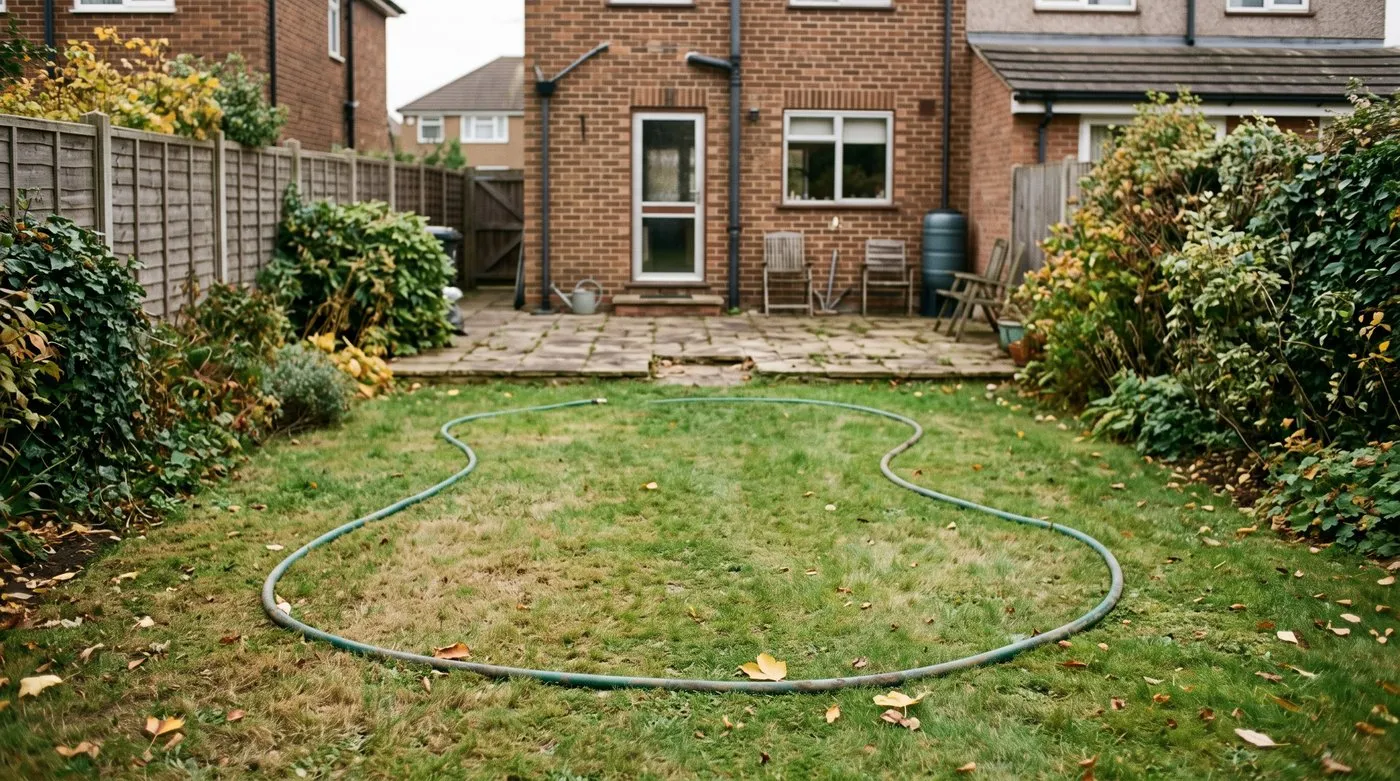
A hosepipe makes it easy to try out shapes. Look at it from the kitchen window and your favourite seat before you lift any turf.
Step 2: Remove the turf
Cut along the line with a half-moon edger and lift the turf. Keep any good turf to patch the lawn elsewhere.
Step 3: Dig the first shelf
Dig the whole area down to about 25cm. This is the shelf for shallow-water plants. Keep the sides straight and the shelf flat.
Step 4: Mark the deeper zone
Mark a smaller shape about 30cm in from the edge. This becomes the deep middle.
Step 5: Dig the deep zone
Dig the middle down to your final depth. For fish, go at least 60cm, ideally 75-90cm. For plants only, 45-60cm is enough. Add a second shelf at about 40cm if you’d like more planting levels.
Step 6: Check the levels
Lay the plank across the hole with the spirit level on top. Check in several directions. The rim must be level all the way round, or liner will show on the high side. Add or take away soil until it’s level everywhere.
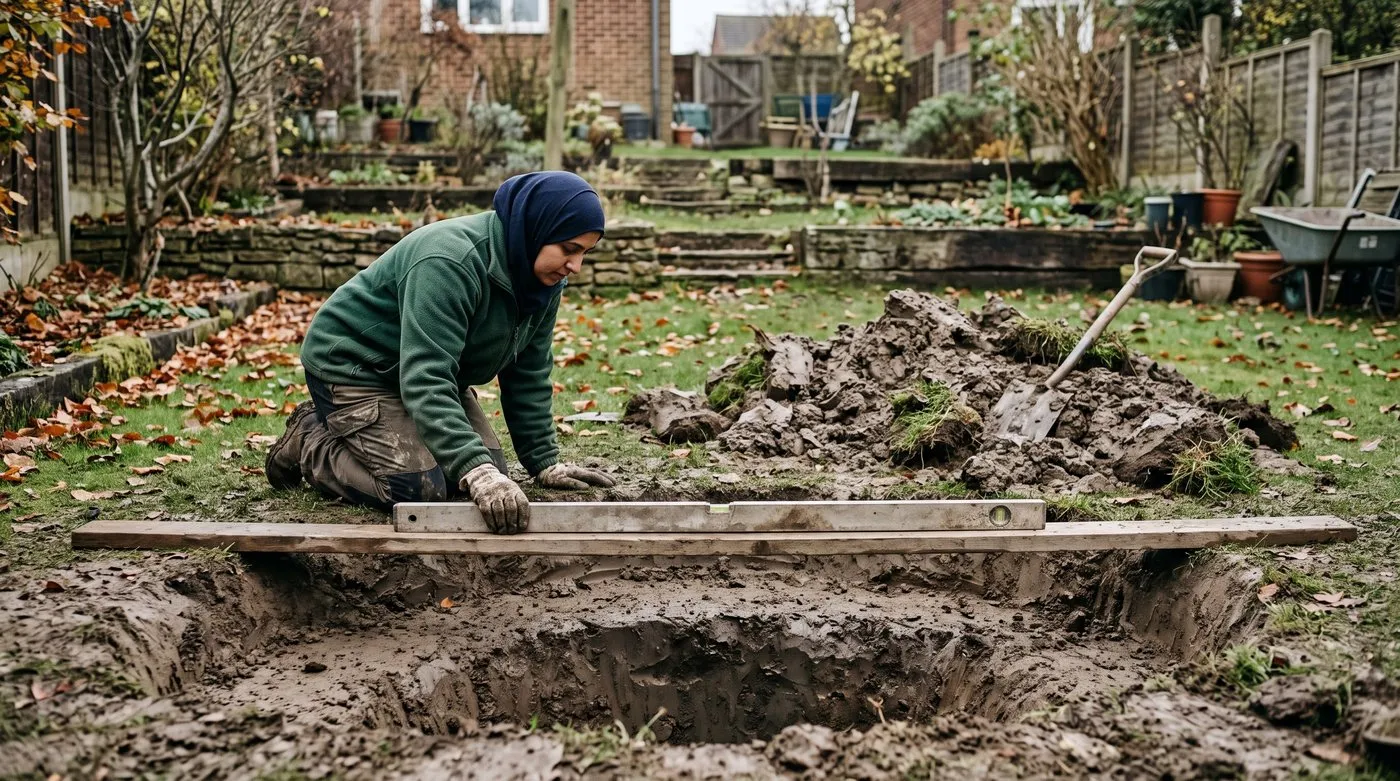
Check the rim in several directions before the underlay goes in. If one side is even slightly high, the liner will show there once the pond is full.
Step 7: Remove debris
Pick out every stone, root and sharp bit from the base and sides. Run your hand over the surfaces to be sure. One missed flint can make a hole.
Step 8: Lay the underlay
Spread underlay over the whole hole, overlapping pieces by about 30cm. Press it into the corners and shelves. It doesn’t need to be tight, just everywhere between soil and liner.
Step 9: Install the liner
Unfold the liner loosely over the hole on a warm day, when it’s softer. Let it sag into the hole under its own weight. Don’t stretch or pull it.
Step 10: Fill with water
Start filling with a hose. As the water rises, its weight pushes the liner into shape. Smooth out big creases by hand as you go. Small folds in the corners are normal and will be hidden later.
Step 11: Trim and edge
When it’s full, leave it for a day to settle. Then trim the liner, leaving about 30cm spare round the rim, and tuck that under your edging. Stone, slabs or sleepers all work. Let the edging hang 3-5cm over the water to hide the liner.
Can you fill a new pond with tap water?
Yes, but rainwater is better if you have enough. Tap water contains nutrients that feed algae, which is why new ponds filled from the tap often go green for the first few weeks. The RHS advice on making a new pond suggests rainwater from a butt for this reason.
Tap water is also treated with chlorine or chloramine. If you’ll have fish, add a pond dechlorinator when filling from the tap. A sensible plan for a medium pond is to fill from the mains, treat it, then use rainwater for top-ups.
What should you do with the soil you dig out?
Plan where it’s going before you start. A pond makes far more soil than you’d expect, and dug soil takes up more room than it did in the ground.
- Keep the topsoil separate. Spread it on borders or build a bank behind the pond.
- Use the subsoil for landscaping. Shape it into a raised bed, a rockery or a gentle mound planted with shrubs.
- Make a bog garden. Use some to make a damp, lined planting area next to the pond.
- Get a skip or bulk bag for the rest. Check if you need a council permit for a skip on the road.
Edging options for garden ponds
Good edging hides the liner completely and protects it from sunlight. It also sets the style of the pond. Visible liner never looks good.
Flat stone is the most popular edge for informal ponds. Lay flat stones hanging about 5cm over the water. Set them on mortar for a permanent edge, or on firm sand for a more natural look. Sandstone, slate and York stone all look lovely.

Plant marginals in aquatic baskets on the shelf, with pea gravel on top to stop the compost floating away.
Paving slabs suit formal, rectangular ponds. Match them to your patio for a smart look. Lay them on mortar with a 5cm overhang.
Timber sleepers make a raised or half-raised edge. Use new, untreated oak or larch. Avoid pressure-treated softwood, as the chemicals can leak into the water and harm fish and plants. Pin sleepers in place with steel pins.
A pebble beach gives a natural edge where one side slopes gently out of the water. Lay cobbles and pebbles over the liner on the slope. Birds and hedgehogs can then reach the water to drink and bathe. If you’d like to attract birds to your garden, a shallow pebble beach works a treat.
Turf to the edge suits ponds set into a lawn. Run the turf right up to the rim. It looks clean and natural, but you’ll need to trim the edge by hand.
Pumps and filters for garden ponds
A garden pond needs a pump and filter if it has fish, a fountain or you want clear water. A wildlife pond can do without.
Sizing a pump
The pump moves water through the filter and back. Choose one that moves at least half the pond’s volume every hour. So a 2,000-litre pond needs a pump of at least 1,000 litres per hour.
To work out the volume: length (m) x width (m) x average depth (m) x 1,000 = litres. A 3m x 2m pond with an average depth of 0.6m holds about 3,600 litres, so it needs a pump of about 1,800 litres per hour.
Types of filter
Box filters sit at the edge of the pond, above the water. The pump pushes water up into the box, and it trickles back into the pond. Helpful bacteria inside break down fish waste. They need several weeks to get going before you add fish.
Pressurised filters can be buried for a neater look. Most have a UV clarifier built in. They cost more than box filters but are easier to hide.
UV clarifiers clear green water by killing the tiny algae that cause it. If your filter doesn’t have one, add one between the pump and filter. Change the bulb every spring.
How do you get power to a pond pump safely?
Get a qualified electrician to fit an outdoor supply protected by an RCD. Water and mains electricity are a dangerous mix, so don’t make do with extension leads.
In England, a new garden circuit falls under Approved Document P of the Building Regulations. A registered electrician can sign it off for you. The cable is usually buried armoured cable running to a weatherproof socket near the pond.
For small ponds, a low-voltage pump is simpler. It runs from a transformer kept indoors, so only safe low-voltage cable goes outside. Solar pumps need no wiring at all but only work well in direct sun.
Fountain or waterfall?
A fountain adds movement and a lovely sound, and puts oxygen into the water, which fish like. Small solar fountains need no wiring. For a fountain that works whatever the weather, run it from the main pump.
A waterfall needs a stronger pump, because the water has to be lifted to the top. The higher the waterfall, the more power you need. Water tumbling over rocks also helps keep the pond healthy.
Planting a garden pond
Plants add oxygen, soak up the nutrients that feed algae and make the pond look beautiful. For lots of ideas, see our guide to the best pond plants for UK gardens.
Oxygenating plants

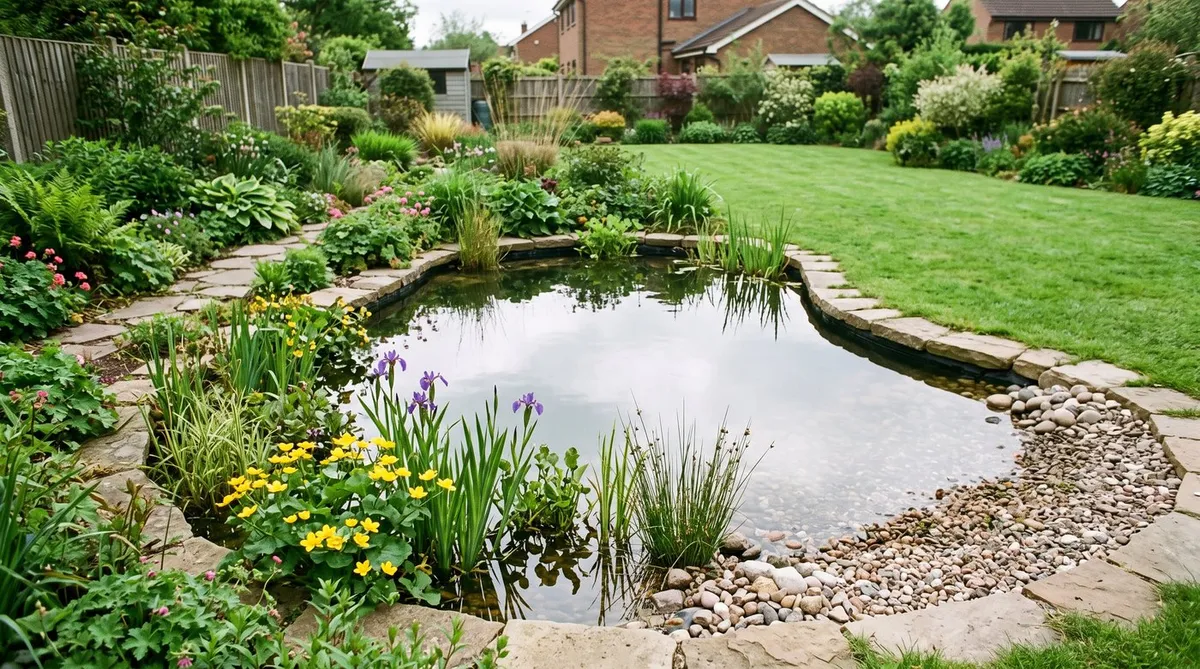
A finished pond with stone edging, water lilies and a gentle fountain. Plants on the shelf soften the edges.
Every pond needs underwater oxygenating plants. They add oxygen during the day and compete with algae for food. Hornwort is a great choice. It floats freely, needs no planting and stays green all year. Drop bunches into the deep part from April.
Marginal plants
Marginals grow with their roots in shallow water and their stems in the air. Plant them on the shelf in aquatic baskets of aquatic compost, topped with pea gravel. Marsh marigold, water forget-me-not and water mint are lovely native choices that flower from spring into summer.
Water lilies
Water lilies are the classic pond plant. Their floating leaves shade the water, help keep algae down and give fish somewhere to hide. Plant them in large baskets in the deep part. For ponds under 2m across, pick a miniature kind such as ‘Pygmaea Helvola’. For medium ponds, ‘Marliacea Chromatella’ (yellow) and ‘James Brydon’ (red) are reliable choices.
How many plants?
Aim to cover a third to a half of the water surface with leaves. That gives enough shade to keep algae down while letting light reach the oxygenators. A 2m x 3m pond needs about 3-4 marginals, 2-3 bunches of oxygenator and 1-2 water lilies.
Stocking fish in a garden pond
Goldfish are the best choice for most UK garden ponds. They’re tough, colourful, long-lived and much easier than koi.
Goldfish vs koi
Koi need a very big, deep pond, heavy-duty filtering and make a lot more mess than goldfish. They also dig up plants and stir up the water. For an ordinary garden pond, stick with goldfish, shubunkins or comets.
Stocking density
No more than one goldfish per 200 litres. So a 1,000-litre pond suits about five, and a 2,000-litre pond about ten. Too many fish is the most common cause of murky water, algae and sick fish. Start with 3-4 and only add more once the filter has had time to settle.
When to introduce fish
Give the pond and filter a few weeks to settle before adding fish. If you filled from the tap, treat the water with a dechlorinator first. Float the fish in their bag on the pond for about 20 minutes so the temperature evens out, then let them go.
Fish and wildlife ponds don’t mix. Fish eat tadpoles and other pond creatures. If you want frogs and newts, keep the pond fish-free. Our guide to building a wildlife pond explains the difference.
Winter fish care
Goldfish get through UK winters fine in a pond at least 60cm deep. As the water cools in autumn they slow down, so feed less, then stop altogether in winter. Start again in spring once the water is reliably above about 8C.
Keep a patch of the surface free of ice so gases can escape. A floating pond heater or a ball on the surface helps stop it freezing over. Never smash the ice, as the shock can harm the fish.
Budget breakdown: what does a garden pond cost?
The cost depends mostly on size and how fancy the edging is. Here’s where the money goes.
- Liner and underlay, the core cost for any lined pond
- Pump and filter, bigger and pricier for bigger ponds
- Edging, from almost free (turf or pebbles) to costly (natural stone)
- Plants, a handful for a small pond, more for a big one
- Fish, if you want them
- Odds and ends, such as baskets, gravel and a hose
A preformed pond saves on the liner but limits the design. The pump, filter, edging and plants cost the same either way.
Edging makes the biggest difference. Natural stone costs the most on a large pond, while pebble beaches and turf edges cost very little.
Seasonal maintenance calendar
A well-built pond only needs a few light jobs each season, mostly filter care, feeding and keeping leaves out.
Spring (March to May)
- Switch the pump and filter back on if they were off. Rinse filter sponges in a bucket of pond water, never tap water, which kills the helpful bacteria.
- Change the UV bulb. They stop working well after a year, even if they still light up.
- Start feeding fish once the water is reliably around 8C. Begin with wheatgerm food, which is easier to digest when it’s cool.
- Add new pond plants from late April.
- Check the liner for frost damage, especially round the edges.
Summer (June to August)
- Feed fish daily with floating pellets. Scoop out anything not eaten after 5 minutes.
- Top up in hot weather, ideally with rainwater from a butt. A water butt nearby is handy for a water-efficient garden too.
- Pull out blanket weed by twisting it round a stick. Leave it on the edge overnight so little creatures can crawl back in.
- Cut back marginals if they’re shading more than half the surface.
- If the water stays green, the UV bulb may need changing or the filter may be too small.
Autumn (September to November)
- Stretch a fine net over the pond to catch falling leaves. Take it off once the leaves have finished falling.
- Feed less as the water cools, and switch back to wheatgerm food.
- Cut dead marginal stems back to about 10cm above the water. Leave some hollow stems for insects to shelter in.
- Give the filter a last rinse in pond water before winter.
Winter (December to February)
- Stop feeding fish altogether.
- Keep a patch of the surface clear of ice with a floating heater or by standing a pan of hot water on it. Never smash the ice.
- In mild spells the pump can keep running. In a long, hard freeze, switch it off so it doesn’t freeze and crack.
- Don’t clean the filter in winter. The helpful bacteria are resting.
| Month | Main job | Time |
|---|---|---|
| March | Restart pump, change UV bulb, start feeding | About an hour |
| May | Add new plants, check the water | Half an hour |
| July | Top up, pull out blanket weed, trim plants | Half an hour |
| September | Net the pond, feed less, rinse filter | About an hour |
| November | Remove net, switch to wheatgerm food | A few minutes |
| January | Check the ice, top up if needed, don’t feed | A few minutes |
Five common mistakes that ruin garden ponds
Most pond troubles come from the same five slip-ups.
1. Building too small
A tiny pond is harder to look after than a bigger one. Small ponds heat up and cool down fast, and the water quality swings about. Fish feel it most. If you have room, go bigger than you think. Nobody wishes their pond was smaller! At the grandest scale, a natural swimming pond uses plants instead of chlorine.
2. Skipping the underlay
One sharp stone under the liner can cause a slow leak that takes ages to find. By then you’ve lost water, upset the fish and need to drain the pond to patch it. Laying underlay takes minutes. Always use it.
3. Wrong pump size
Too small a pump means poor filtering, green water and unhappy fish. Too big wastes electricity and makes a current that pushes fish and plants about. Work out your pond volume and match the pump to it.
4. Too many fish too soon
The filter needs several weeks to build up the bacteria that deal with fish waste. Too many fish before then can poison the water, and you’ll see fish gasping at the surface. Add 2-3 fish first, test the water with a pond test kit, and add more only once it reads clear.
5. Placing the pond under a tree
Falling leaves are the biggest ongoing headache for pond owners. They rot, turn the water brown and feed blanket weed. A pond under trees needs netting every autumn and lots of clearing out. Keep at least 3m from the nearest canopy.
Pond safety and children
Any open water is a drowning risk for young children, even when it’s shallow. If little ones use your garden, take precautions.
A rigid mesh grid fitted just below the surface is almost invisible but takes a child’s weight.
Raised ponds with walls about 60cm high or more make it hard for small children to fall in. They also bring the fish and plants closer to eye level.
A fence with a self-closing, self-latching gate keeps children out.
Wait a few years until children are old enough to understand. A bog garden or a sealed water feature, where water flows over stones into a hidden tank, gives you the sound of water without the risk.
Related reading: once the pond is dug, stock it with the best oxygenating pond plants to keep the water clear.
Once your pond is built, you can even grow edible aquatic plants like watercress and water mint. With the pond filled and settled, plant it up: start with our guide to planting a water lily that will flower.
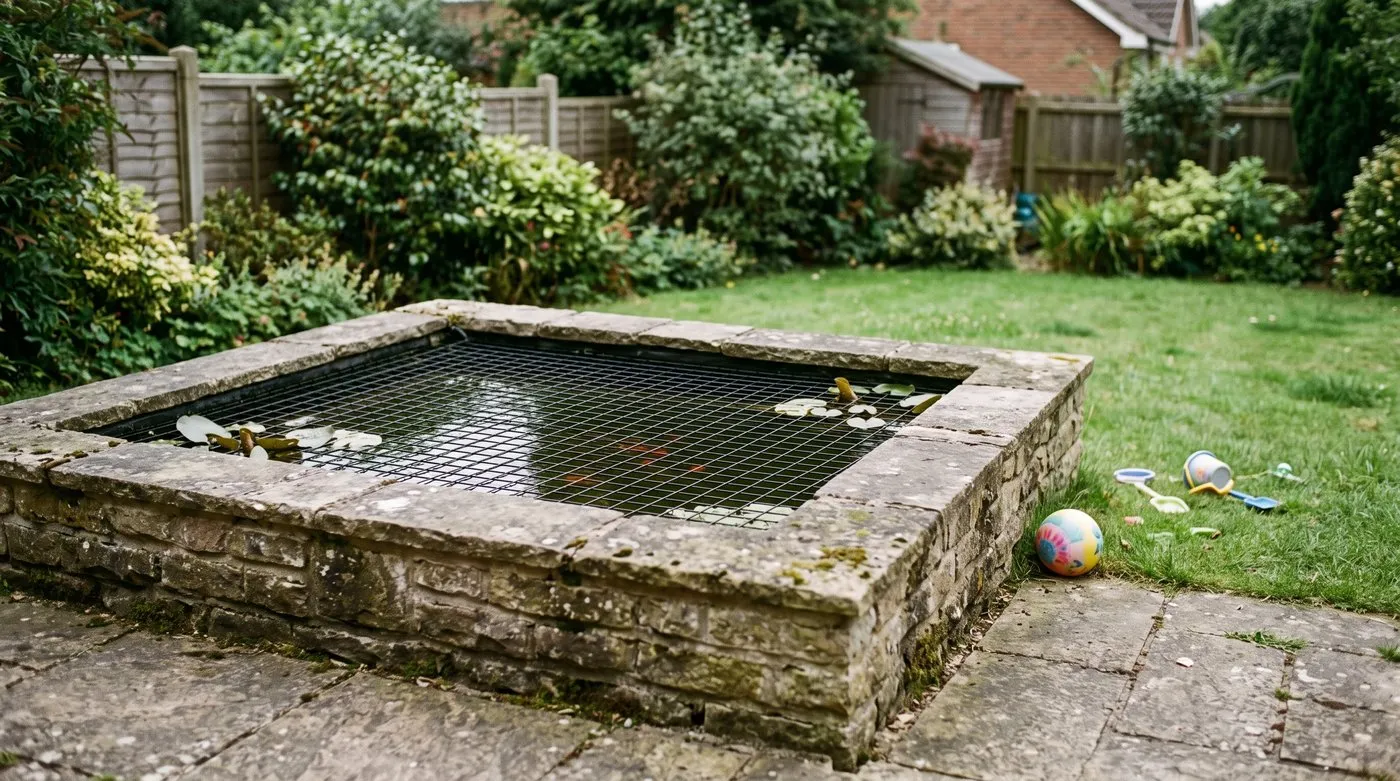
A rigid mesh just under the water is almost invisible but strong enough to take a child’s weight. A raised wall adds another layer of safety.
Frequently asked questions
How deep should a garden pond be?
At least 60cm deep if you want fish, or 45cm for plants only. Deeper water stays a steadier temperature and won’t freeze solid in a hard winter. For goldfish, 75-90cm at the deepest point is ideal.
Do I need a pump and filter for a garden pond?
Yes, if you want fish or clear water. The pump pushes water through a filter, where helpful bacteria break down fish waste. Without one, a fish pond soon turns green. A plant-only pond can manage without, as long as it’s well stocked with oxygenating plants.
Can goldfish survive winter in a UK garden pond?
Yes, in a pond at least 60cm deep. They slow right down in cold water and stop eating. Stop feeding in late autumn and start again in spring. Keep a small patch of the surface free of ice with a floating heater or a pan of hot water, and never smash the ice.
How much does it cost to build a garden pond?
It depends mostly on size and edging. The liner and pump are the main costs, and stone edging can add a lot on top. A small pond with a simple pebble or turf edge is the cheapest to make. Reusing stone from around the garden saves money too.
When is the best time to build a garden pond?
Autumn is ideal, from September to November. The soil is moist and easy to dig, and the pond has the winter to settle before spring. Spring is fine too. Avoid midsummer, when the ground is hard and new plants struggle in the heat.
What is the best pond liner to use?
Butyl rubber is the best liner for most ponds. It lasts for decades, stretches into any shape, copes with sunlight and can be patched if it gets a hole. PVC is cheaper but wears out much sooner. Preformed ponds suit small, formal features but limit your design.
How many fish can I put in a garden pond?
Keep to no more than one goldfish per 200 litres. So a 1,000-litre pond suits about five. Too many fish means murky water, algae and sick fish. Start with three or four and add more slowly once the filter has settled. Shubunkins and comets suit garden ponds too.
Do I need planning permission for a garden pond?
Usually not, for an ordinary garden pond. Check with your council first if you live in a listed building or conservation area. Ask too if you’re planning a raised pond with tall retaining walls or lots of earth moving.
Our team produces practical UK gardening guidance from source research, contributor records and established horticultural practice. Editorial standards are overseen by Matt W.