Key takeaways
- Holm oak, Portugal laurel, holly and Western red cedar screen all year round
- Clipped beech and hornbeam keep their dead leaves in winter, so they still give privacy
- Most screens reach 2m in three to five years from young plants
- Councils can order evergreen hedges over 2m cut back, but not below 2m
- Pleached trees screen at eye level without blocking light lower down
- Check the final height and spread before planting near a boundary
Privacy is one of the top reasons people plant trees. A good screen hides overlooking windows, softens road noise and makes your garden feel sheltered. The best tree for you depends on your space, your soil and how fast you need cover.
Below are the best evergreen and deciduous trees for privacy in UK gardens. You’ll also find planting distances, screening techniques including pleaching, and the rules on hedge height near boundaries. For other kinds of boundary, see our guide to garden fence ideas.
Best evergreen trees for year-round privacy
Holm oak, Portugal laurel, holly, Western red cedar and Scots pine are the most reliable evergreen privacy trees. They keep their leaves all year, so your screen works in every season.
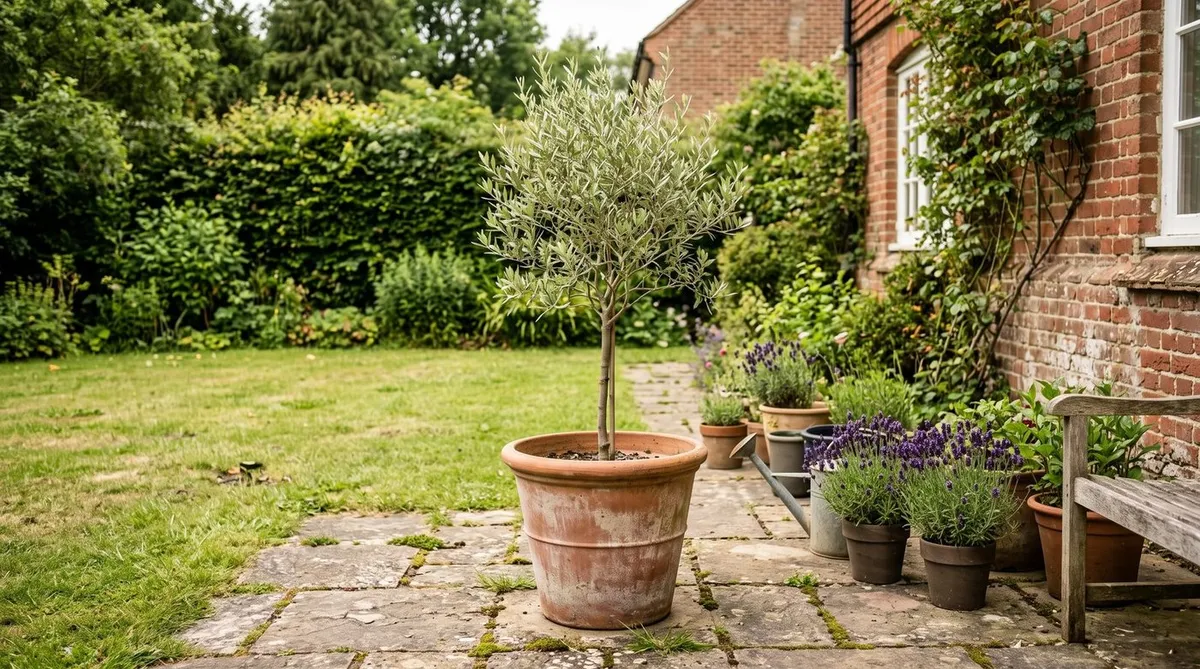
Holm oak (Quercus ilex) is a handsome evergreen oak that grows well in southern and central England. It gets very big if left alone, but clips beautifully into a dense screen at almost any height from 2m up. Its tough, dark leaves shrug off salty sea air, so it’s great by the coast. Plant 1.5-2m apart for a hedge. In London and parts of the south east, keep an eye on older oaks for oak processionary moth. Its caterpillars strip leaves and have irritating hairs, so don’t touch them.
Portugal laurel (Prunus lusitanica) has glossy dark leaves on red stems. It grows in any soil, including chalk and heavy clay. Unlike cherry laurel, it stays neat without constant trimming, so one clip in late summer is enough. It makes a smart hedge at 2-3m. Plant 60-90cm apart. Its white flower spikes in June bring in pollinators.
Holly (Ilex aquifolium) is a native evergreen with dense, prickly leaves that make a barrier nobody wants to push through. Female plants have red berries in winter if there’s a male nearby. Holly copes with deep shade, wind and poor soil. It grows slowly, so buy the biggest plants you can afford. ‘J.C. van Tol’ fruits on its own and is almost spineless, so it’s kinder to clip.

A mature holly full of red berries screens a suburban garden through winter.
Western red cedar (Thuja plicata) is the best alternative to Leylandii. It grows fairly fast and clips into a neat, dense hedge with a lovely fresh scent. It’s easier to keep in check than Leylandii, but like most conifers, don’t cut it back into bare brown wood. ‘Atrovirens’ stays rich green through winter. Plant 60-75cm apart.
Scots pine (Pinus sylvestris) suits bigger country gardens where you want a natural-looking screen. Its orange upper bark and blue-green needles make a striking outline. It grows tall, so use it as a loose, informal screen rather than a clipped hedge. Plant 3-4m apart and add holly or hawthorn underneath for lower cover. It’s one of only three native UK conifers.
Best deciduous trees for privacy
Hornbeam and beech are the best deciduous choices, because clipped plants hold their dead leaves through winter. Other deciduous trees give a lighter, seasonal screen.
Hornbeam (Carpinus betulus) is the most adaptable deciduous screen for UK gardens. Clipped as a hedge, it keeps its dead leaves from November to April, so you still get privacy in winter. The leaves turn a warm tawny brown in autumn. It copes with heavy clay, wet ground and part shade better than beech. Plant 45-60cm apart for a formal hedge. It also makes a superb pleached screen.
Beech (Fagus sylvatica) works just like hornbeam in winter, holding copper-brown leaves on a clipped hedge. Spring leaves are a zingy lime green, turning deep green in summer. Beech likes well-drained soil and struggles on waterlogged clay, so pick hornbeam on heavy ground. Plant 45-60cm apart. Copper beech adds deep purple leaves for a more dramatic look.
Silver birch (Betula pendula) makes a graceful, airy screen rather than a solid wall. The white bark looks great in winter. Plant birch 2-3m apart in groups of three, five or seven for a little woodland feel. It grows fast. Birch suits front gardens, where a light screen softens the view without feeling like a fortress. Multi-stemmed birches give more cover than single trunks.

Three silver birches make a dappled screen, with ferns planted underneath.
Screening comparison table
| Tree | Type | Growth | Height | Screen width | Best use |
|---|---|---|---|---|---|
| Holm oak | Evergreen | Medium | Very tall, clip to 2m+ | 1-2m clipped | Formal hedge, coast |
| Portugal laurel | Evergreen | Medium | Tall, clip to 2-3m | 60cm-1m clipped | Small to medium gardens |
| Holly | Evergreen | Slow | Tall, clip to 2-3m | 60-90cm clipped | Shade, security |
| Western red cedar | Evergreen | Fast | Very tall, clip to 3-4m | 60cm-1m clipped | Quick evergreen hedge |
| Scots pine | Evergreen | Medium | Very tall | 4-6m natural | Big country screens |
| Hornbeam | Deciduous | Medium | Very tall, clip to 2-4m | 45-60cm clipped | Clay, wet ground |
| Beech | Deciduous | Medium | Very tall, clip to 2-4m | 45-60cm clipped | Well-drained soil |
| Silver birch | Deciduous | Fast | Tall | 3-4m natural | Light, airy screens |
Gardener’s tip: If you need privacy within a year, buy ready-pleached hornbeam with a 1.8m clear stem. They cost far more than hedging plants but screen at eye level from the day they go in. Ordinary hedge plants take three to five years to catch up.
Screening techniques
There are three main ways to screen: a hedge-style row, pleached trees on clear stems, or groups of trees placed to block particular views.
Hedgerow-style planting
This is the most common way. Plant in a single or double row, close together, and let the plants merge into one screen. Single rows suit formal hedges of hornbeam, beech or yew. Double, staggered rows give faster, thicker cover on bigger boundaries. Space plants 45-90cm apart in a single row, or 90cm apart in each of two rows set 45cm apart. Trim the top each year once it reaches the height you want. It’s also the cheapest option. If speed matters most, compare these fast-growing hedging plants.
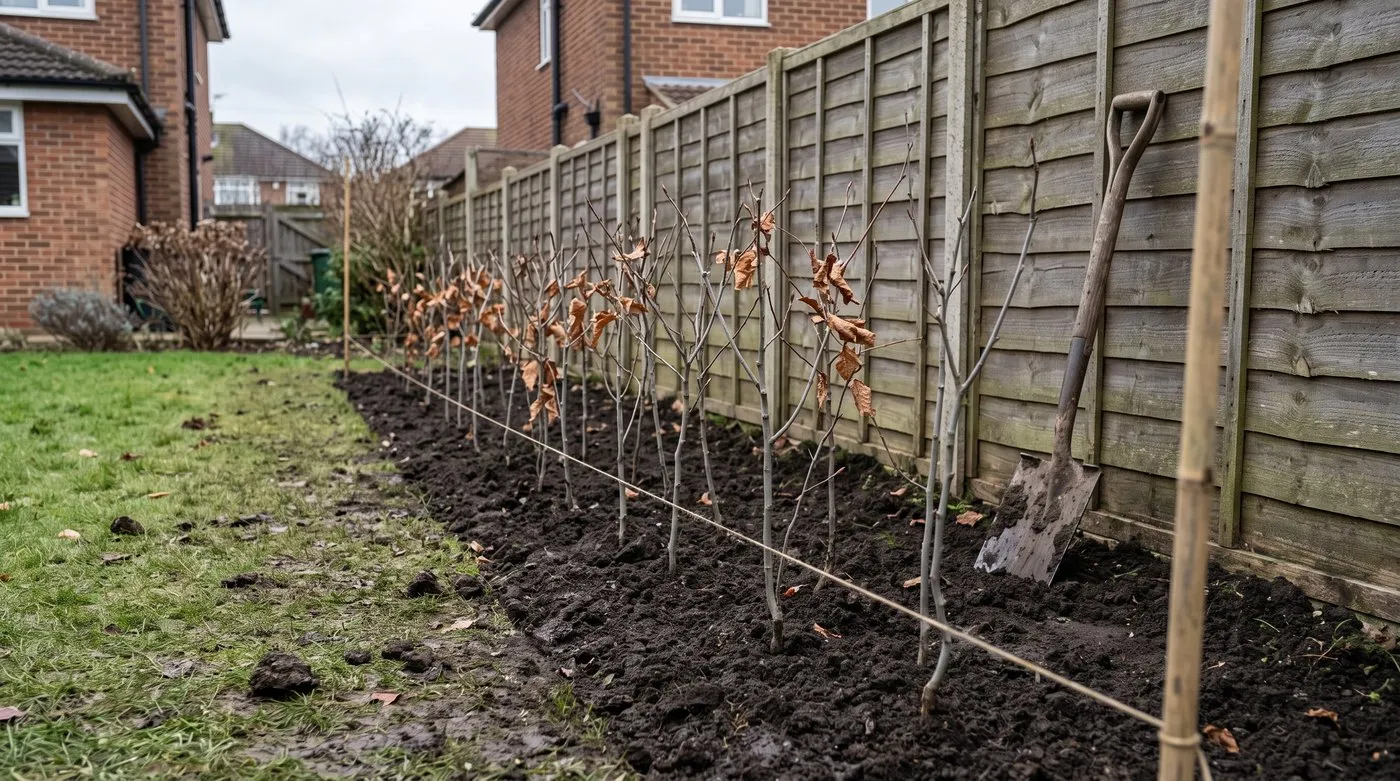
A double, staggered row thickens up faster than a single line. Stretch a string between two canes first so the screen runs straight.
Pleached trees for targeted screening
Pleached trees have a clear trunk up to about 1.8m, with branches trained flat along a frame above. They make a raised screen that blocks views at eye level and from upstairs windows, without shading the ground below. Hornbeam, lime and beech are the usual choices. Buy them ready-trained from a specialist nursery, or train your own from young trees over a few years. Plant 2.5-3m apart. They’re perfect for small garden design, where a full hedge would swamp the space.

Pleached hornbeams with square tops on clear stems make a raised screen along a Cotswold boundary.
Can you get evergreen pleached trees?
Yes. Nurseries sell evergreen pleached trees, usually holm oak, Portugal laurel, Photinia ‘Red Robin’ and cherry laurel. They give the same raised screen as hornbeam but stay green all year, which is handy for blocking an upstairs window that looks onto your patio in winter. They grow more slowly and cost more. Holm oak and photinia can suffer in hard frosts on exposed northern sites, so Portugal laurel is the safer choice in cold areas. Clip once a year in late summer to keep the shape crisp.
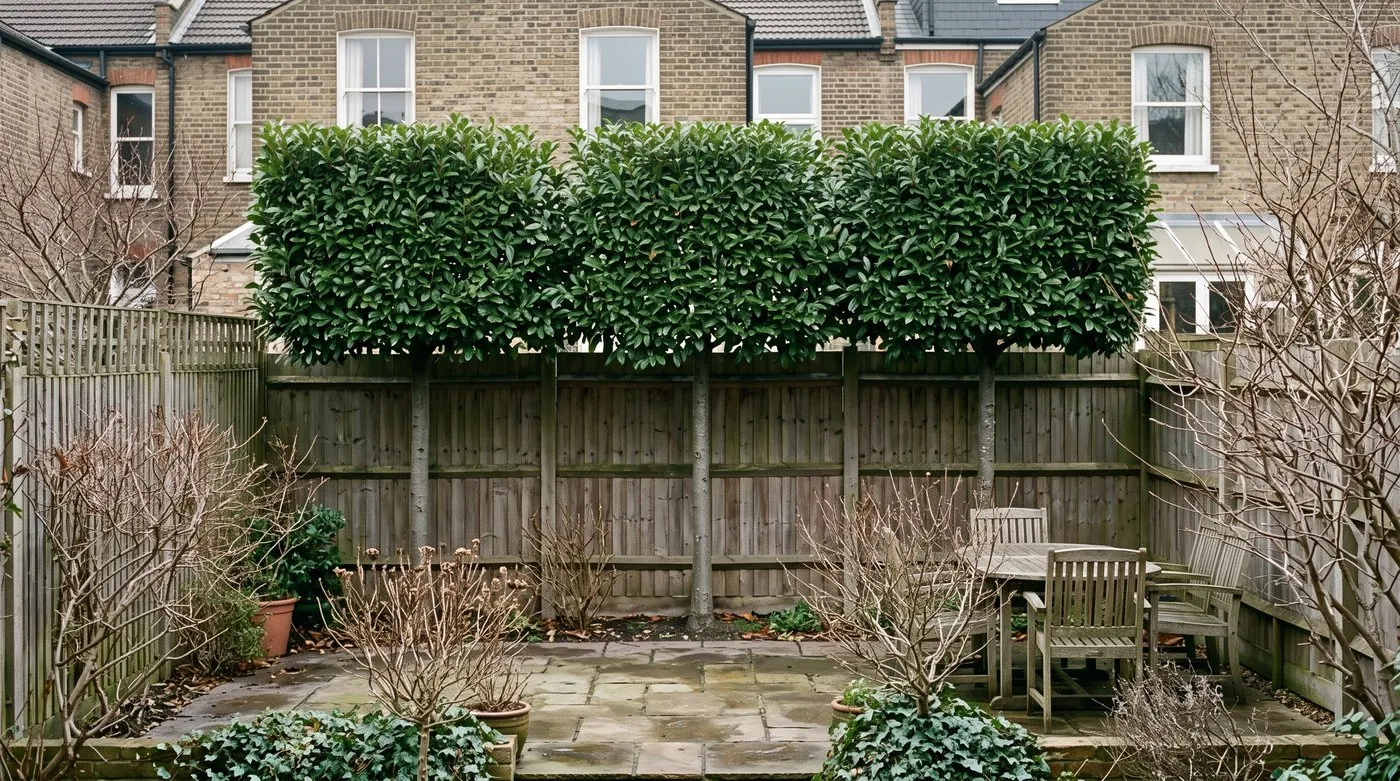
Evergreen pleached trees block upstairs windows all year while leaving room to plant underneath. Portugal laurel is the safest choice in colder areas.
Specimen tree groups
In bigger gardens, plant a few trees in groups to block particular views. Three silver birches in a triangle make a lovely feature and a light screen. A single Scots pine placed in front of an overlooking window gives privacy right where you need it. Combine this with planting for shade under the canopy.
How to plant a privacy screen
Plant bare-root screening trees between November and March, while they’re dormant. They’re much cheaper than pot-grown plants.
Ground preparation
Mark out the line with string stretched between two canes. For a formal hedge, dig a trench 45cm wide and 30cm deep. For single trees, dig holes twice as wide as the roots. Mix some well-rotted compost or composted bark into the soil you dug out, roughly one part compost to three parts soil. On heavy clay, add coarse grit to the bottom of the trench to help drainage.
Spacing guide
Space hornbeam, beech and yew 45-60cm apart. Space Portugal laurel and holly 60-90cm apart. Space bigger trees like holm oak 1.5-2m apart for a hedge, or further apart if you’re growing them as single trees. Our guide to how to plant bare-root trees covers the method step by step.
Aftercare in the first two years
Water new plants weekly from April to September for the first two years, giving each one a good soak. Mulch along the row with 5-8cm of composted bark or garden compost to hold moisture and stop weeds. Keep grass at least 30cm from the trunks. Stake anything over 1m tall with a short angled stake for two growing seasons. Feed each March with a general fertiliser such as blood, fish and bone.
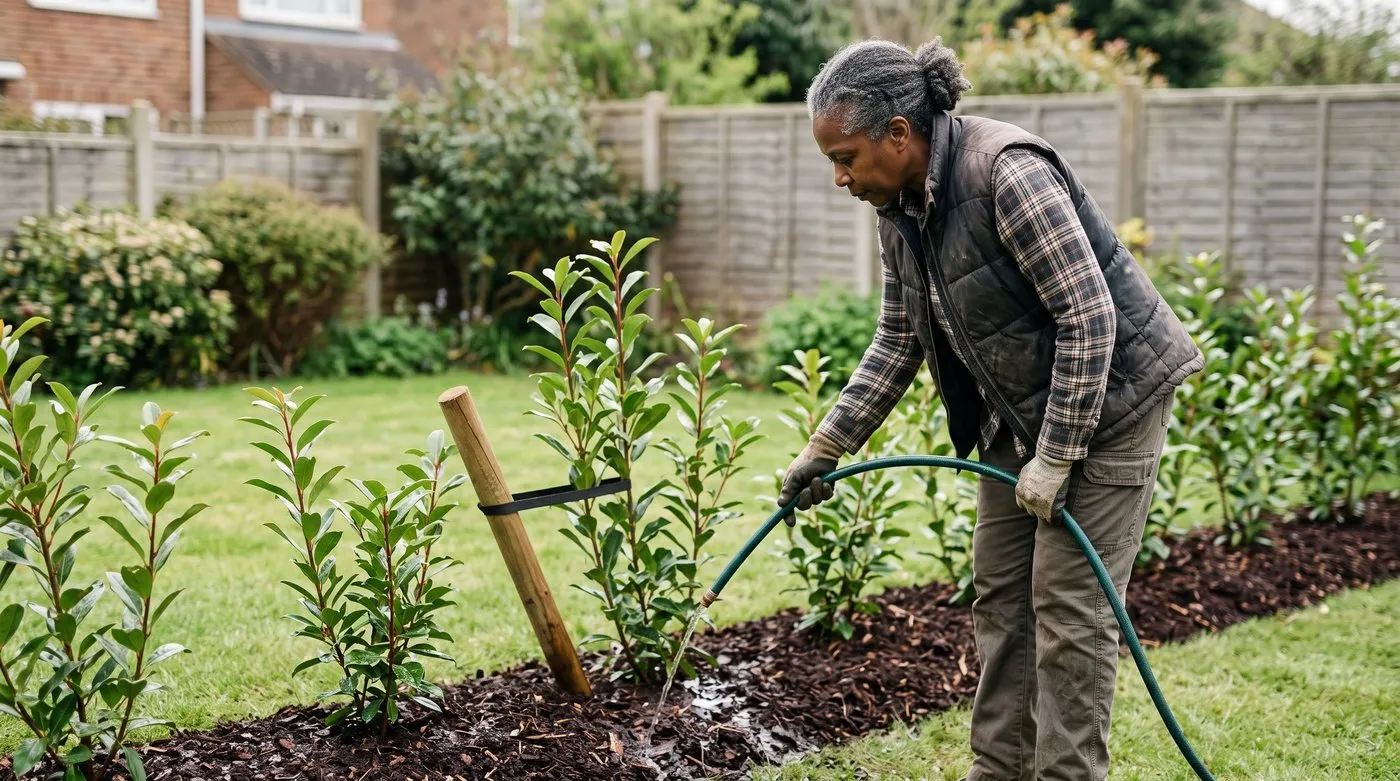
A slow, deep soak once a week through the first two summers is what gets a screen established. The bark mulch keeps the moisture in.
How far from a house should you plant a privacy tree?
On shrinkable clay, keep thirsty trees at least their final height away from the house. The RHS guidance on trees near buildings explains why. Less thirsty trees rarely cause problems beyond half their height.
Thirsty trees include oaks (holm oak among them), willow, poplar, eucalyptus and Leyland cypress. Clay areas such as London clay carry the most risk, especially for older houses with shallow foundations. On chalk or sand, trees are very unlikely to damage buildings. On clay, keep tall hedges no higher than their distance from the house.
When to clip and maintain screening trees
Most screening trees need just one clip a year in late summer, though the exact timing depends on the tree.
Clip hornbeam and beech once a year in late July or August, after the main growth spurt. If an old hedge needs cutting back hard, do it in midwinter while it’s dormant.
Trim Portugal laurel and holly once a year in late August. Use secateurs rather than a hedge trimmer, which shreds the big leaves. Shredded leaves go brown at the edges and look tatty for months.
Cut Western red cedar and yew once in late August or early September. Yew is the exception among conifers, as it regrows well even after hard cutting. Leylandii and most other conifers won’t regrow from old wood, so trim them little and often.
Scots pine and birch screens don’t need regular clipping. Remove dead, damaged or crossing branches in autumn. If you need to walk underneath birch, remove the branches below 2m.
Hedge height law in the UK
The high hedges law, part of the Anti-social Behaviour Act 2003, lets councils in England and Wales step in when a tall evergreen hedge spoils a neighbour’s enjoyment of their home.
A hedge is covered if it’s a line of two or more mostly evergreen or semi-evergreen trees or shrubs, forms a barrier to light or access, and is over 2m tall. Deciduous hedges aren’t covered, however tall they are. Hornbeam and beech count as deciduous, even though they hold their dead leaves.
If a neighbour complains and the council agrees, it issues a remedial notice saying what work is needed. It can’t order the hedge cut below 2m or removed. Ignoring a notice is a criminal offence. Councils charge the person complaining a fee, which varies from council to council.
The gov.uk guidance on high hedges says you must try to sort things out with your neighbour first. Many disputes end with both sides agreeing on a height.
Can my neighbour cut branches from my privacy trees?
Yes. Your neighbour can trim branches or roots that cross onto their side, but only up to the boundary line. Cutting further could land them with a claim for damaging your property. Trees with a Tree Preservation Order, or in a conservation area, may need council permission before anyone prunes them.
That’s a good reason to plant privacy trees well inside your own boundary. A screen that hangs over the fence will be cut flat on the other side, leaving it thin and lopsided. Agree who will trim each side before you plant.
Gardener’s tip: If you want an evergreen screen over 2m near a boundary, plant it 2-3m inside your garden rather than right on the line. It’s easier to look after, avoids root disputes and lets the plants grow a natural shape.
Best privacy trees for small gardens
Photinia ‘Red Robin’, compact Portugal laurel, ‘J.C. van Tol’ holly and pleached hornbeam suit small gardens best. Avoid anything that grows huge unless you’ll keep it clipped as a formal hedge.
Photinia ‘Red Robin’ grows to 4-5m and has bright red new leaves in spring. It clips well into a hedge or screen at 2-3m. Plant 60cm apart. It can lose some leaves in a hard winter, so it’s not ideal for the most exposed northern gardens.
Prunus lusitanica ‘Myrtifolia’ is a compact Portugal laurel with smaller leaves. It only grows to 3-4m and makes a dense, easy screen. Great for small boundaries and narrow side passages.
Ilex aquifolium ‘J.C. van Tol’ is a holly that fruits on its own and is easy to keep at 2-3m. Its almost spineless leaves make clipping much less painful. For more trees for small plots, see our guide to trees for small gardens.
Pleached hornbeam screens at eye level and leaves the ground free. With a 1.8m clear stem, you can plant underneath and use every bit of space.
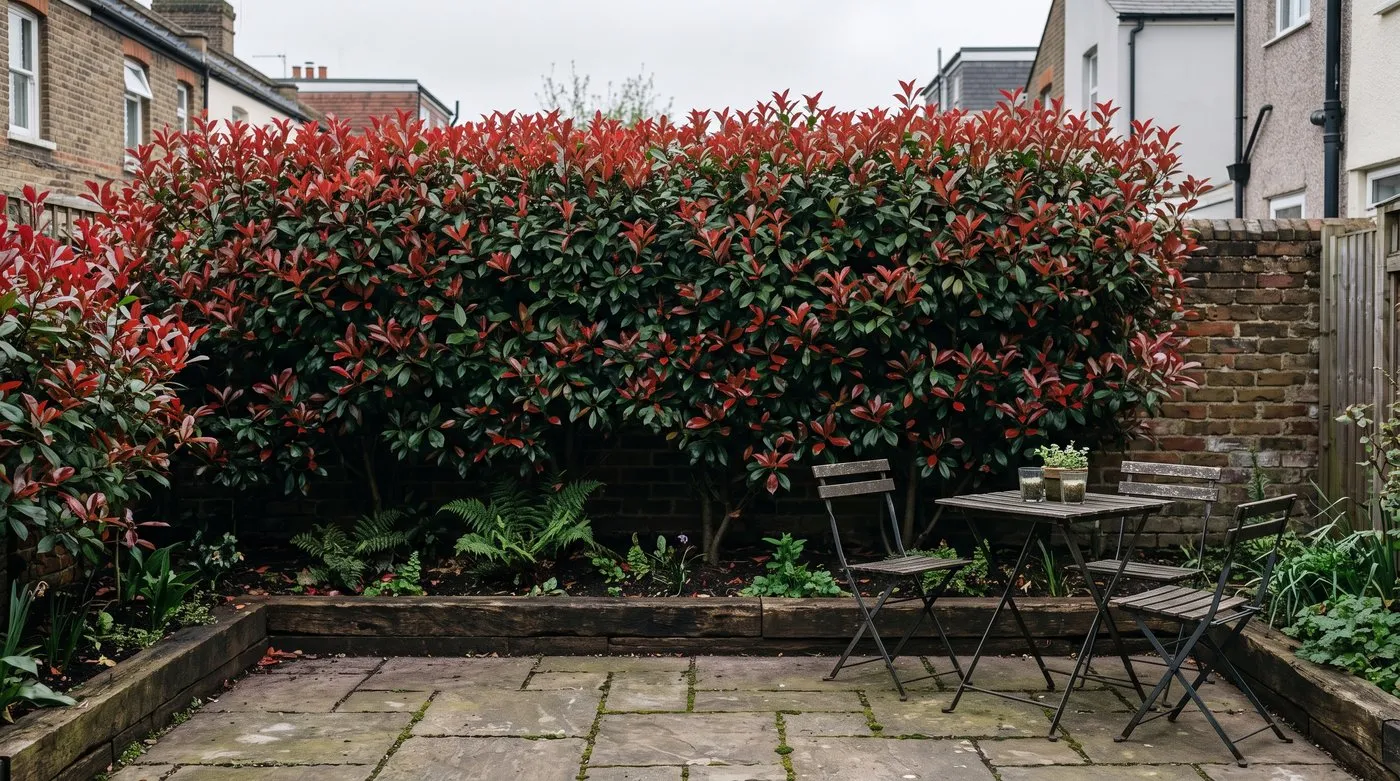
Photinia ‘Red Robin’ clips into a neat 2-3m screen for a small plot. The red spring growth brightens a narrow garden.
Common mistakes when planting for privacy
Planting right on the boundary
Trees planted hard against a fence or wall cause trouble within a few years. Roots lift paving and branches hang over next door. Plant at least 1m from any fence, and further for trees with strong roots. Check the final spread before you dig.
Choosing Leylandii without a plan
Leylandii grows very fast. Leave it uncut for a couple of years and a 2m hedge becomes a 4m wall. Like most conifers apart from yew, it won’t regrow from old brown wood. If it gets away from you, the only fix is taking it out. If you do plant it, cut it twice a year without fail.
Planting just one kind of tree
A screen of a single plant looks a bit flat, and one disease can wipe it all out. Box blight ruined box hedges across the UK, and ash dieback is killing huge numbers of ash trees. Mix two or three kinds in an informal screen. A native mix of holly, yew and hawthorn is tough and great for wildlife.
Ignoring the soil
Beech fails on wet clay. Scots pine struggles on chalk. Holm oak dislikes cold, exposed northern gardens. Match the tree to your soil and site. If in doubt, hornbeam copes with the widest range of UK conditions.
Now you’ve picked your privacy tree, read our guide on how to plant bare-root trees for the next step.
To keep boundary trees in check, see our guide to pruning trees for privacy and light.
Near a busy road, choose pollution-busting plants and hedges that help trap traffic grime as well as hiding the view.
Frequently asked questions
What is the fastest-growing privacy tree in the UK?
Leylandii is the fastest common screening tree, growing up to about 90cm a year. Left unclipped it soon towers over everything. Western red cedar is slower but tidier and much easier to keep in check. For a fast deciduous screen, silver birch grows quickly too.
How close to a boundary can I plant a privacy tree?
There is no legal minimum distance in England and Wales. A good rule is to plant at least half the tree’s final spread away from the boundary. So a tree that spreads 4m should sit at least 2m from the fence. That stops branches hanging over and roots wandering next door.
Can my neighbour force me to cut my hedge?
Possibly, if it’s a tall evergreen hedge. Under the high hedges law, a neighbour can complain to the council about a line of mostly evergreen trees over 2m tall. The council can order you to cut it back, but not below 2m. Deciduous hedges aren’t covered.
Do I need planning permission to plant trees for screening?
No, you don’t need permission to plant trees on your own land. But check for Tree Preservation Orders and conservation area rules before removing existing trees. Some new-build estates have covenants that limit planting near boundaries, so check your deeds.
Which privacy trees grow well in shade?
Holly and yew are the best screening trees for shade. Both are native evergreens that cope with deep shade under bigger trees. Portugal laurel and hornbeam are fine in part shade. Avoid Leylandii, Western red cedar and Scots pine in heavy shade, as they go thin and gappy.
How long does it take to grow a privacy screen?
Most screens reach 2m in three to five years from 60-90cm plants. Bigger plants give you a head start but cost more and take longer to settle. Ready-pleached trees give eye-level privacy from the day you plant them.
What is the best tree for a narrow garden boundary?
Pleached hornbeam or lime is ideal for narrow spaces. The trunks take up very little ground, while the trained branches screen from about 1.8m up. For an evergreen in a tight spot, yew or Portugal laurel can be clipped to a slim hedge. Avoid holm oak and Scots pine, which spread too wide.
Are evergreen privacy trees bad for wildlife?
No, they’re great for wildlife. Dense evergreen hedges give birds such as wrens and goldcrests shelter and nesting spots. Holly berries feed thrushes and blackbirds in winter. A mixed native hedge of holly, yew and hawthorn is the best of both worlds.
Our team produces practical UK gardening guidance from source research, contributor records and established horticultural practice. Editorial standards are overseen by Matt W.