Key takeaways
- Look for hollow, bamboo-like stems with purple speckles and spade-shaped leaves with a flat base
- Having knotweed isn't an offence, but letting it spread into the wild is
- Tiny pieces of root can regrow, so don't dig it or move the soil
- Mortgage surveyors now judge knotweed by the harm it's doing, not by distance alone
- Weedkiller treatment takes at least three growing seasons
- Waste that leaves your land must go with a registered waste carrier
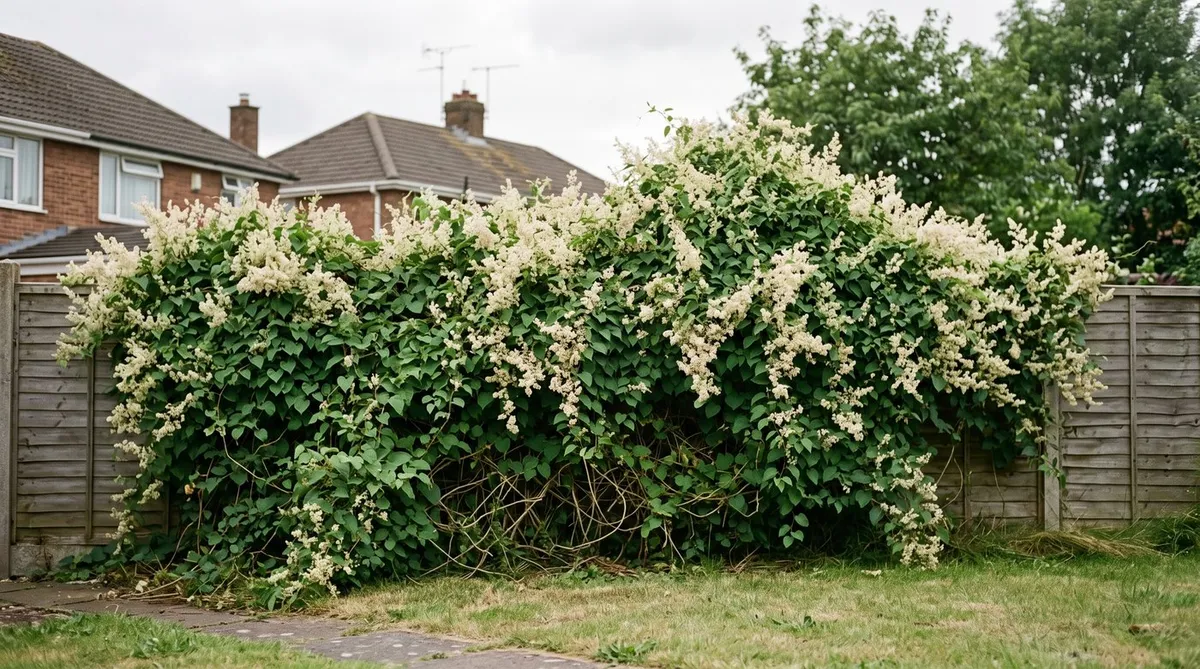
Japanese knotweed is the weed most likely to cause a headache when you sell or remortgage a UK home. It arrived in Britain as a garden plant in the 1800s and soon escaped onto riverbanks, railway lines and waste ground. As the RHS explains, UK plants spread from bits of root and stem rather than seed. Another fast-spreading invader to watch for is tree of heaven.
The first job is to be sure it’s really knotweed. Several common plants look similar, and mistakes cause needless panic or a missed problem. Here’s how to spot it in every season, what the law expects and what to do next.
How to identify Japanese knotweed in spring
In spring, look for reddish-purple shoots, a bit like asparagus, pushing up from pink buds at ground level. They usually appear from late March or April.
The shoots grow very fast. By mid-May they’ve opened into proper stems:
- Stems are hollow and bamboo-like, green with purple-red speckles
- Joints along the stem are obvious, and the stem zig-zags slightly between them
- Leaves are spade or shield-shaped, with a flat base and a pointed tip
- Leaves alternate up the stem in a zig-zag pattern
By late spring it’s around 1-1.5 metres tall.
Gardener’s tip: Look at where the leaf meets its stalk. Knotweed leaves have a straight, flat base, as if cut off with scissors. Most look-alikes have rounded, notched or lobed bases.
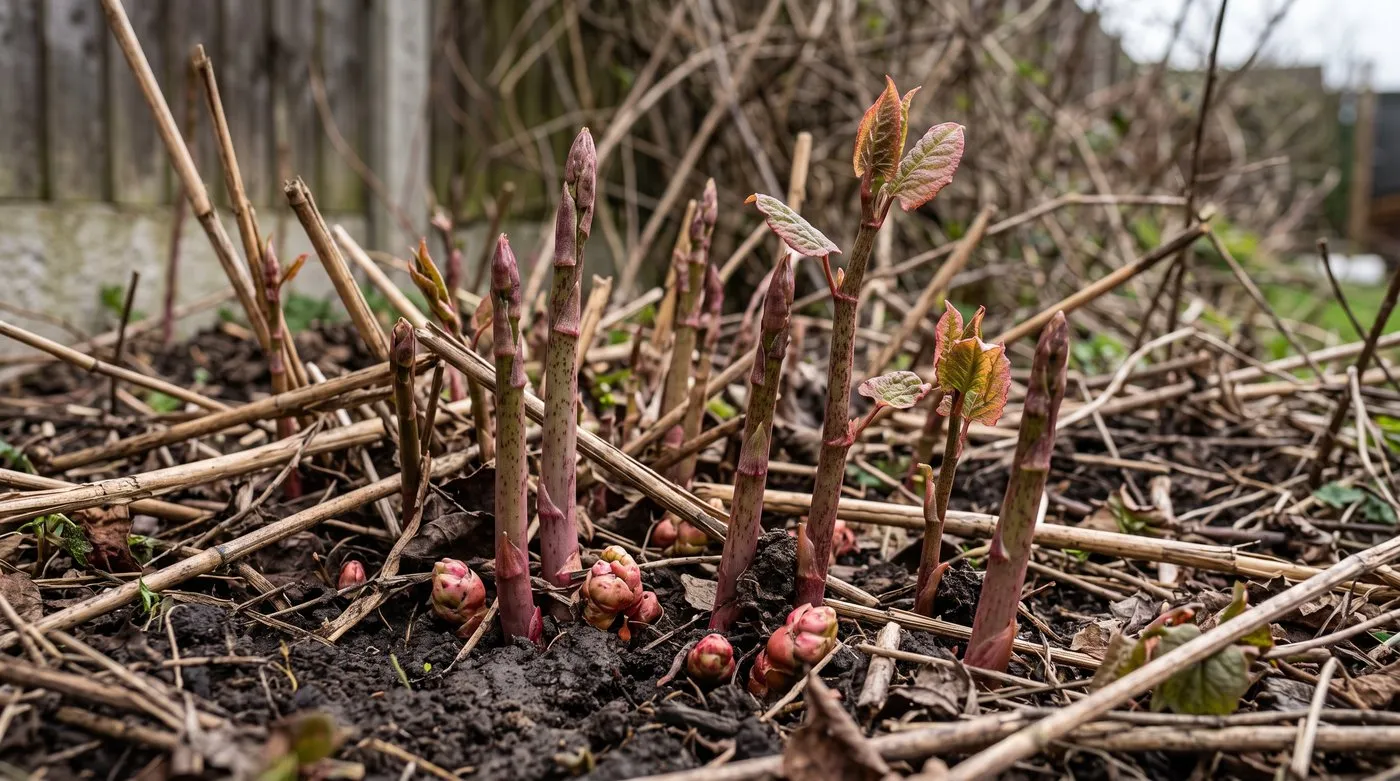
In spring, look for reddish-purple shoots like asparagus coming up from pink buds at ground level. They grow very fast from April.
How to identify Japanese knotweed in summer
By summer it forms dense thickets of hollow, bamboo-like stems 2-3 metres tall, with big spade-shaped leaves. From July it’s at its easiest to recognise.
Key summer features
- Height: usually around 2 metres, often more in sheltered, rich soil
- Stems: hollow, green with purple speckles, often arching at the top by late summer
- Leaves: spade-shaped, up to about 14cm long, alternating up the stem
- Colour: bright green on top, paler underneath
- Canopy: so dense that little grows beneath it
- Habit: stems packed tightly together in clumps
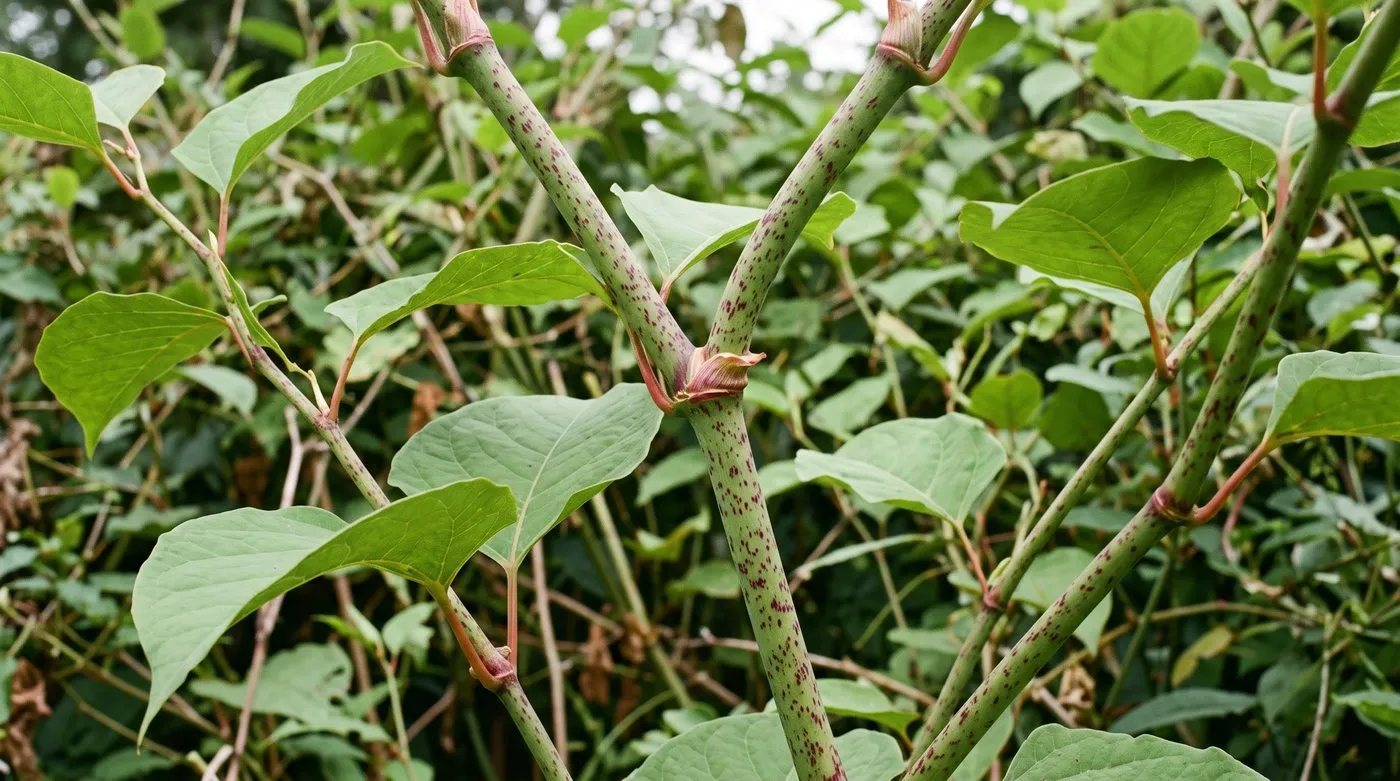
Check where the leaf meets its stalk. Knotweed leaves have a straight, flat base, and they alternate up a zig-zag, speckled stem.
Flowers
In late summer and early autumn, creamy-white flower sprays hang from the upper leaf joints. Each flower is tiny, but together they make loose, frothy tassels.
UK plants don’t set seed, so new plants almost always come from bits of root or stem.
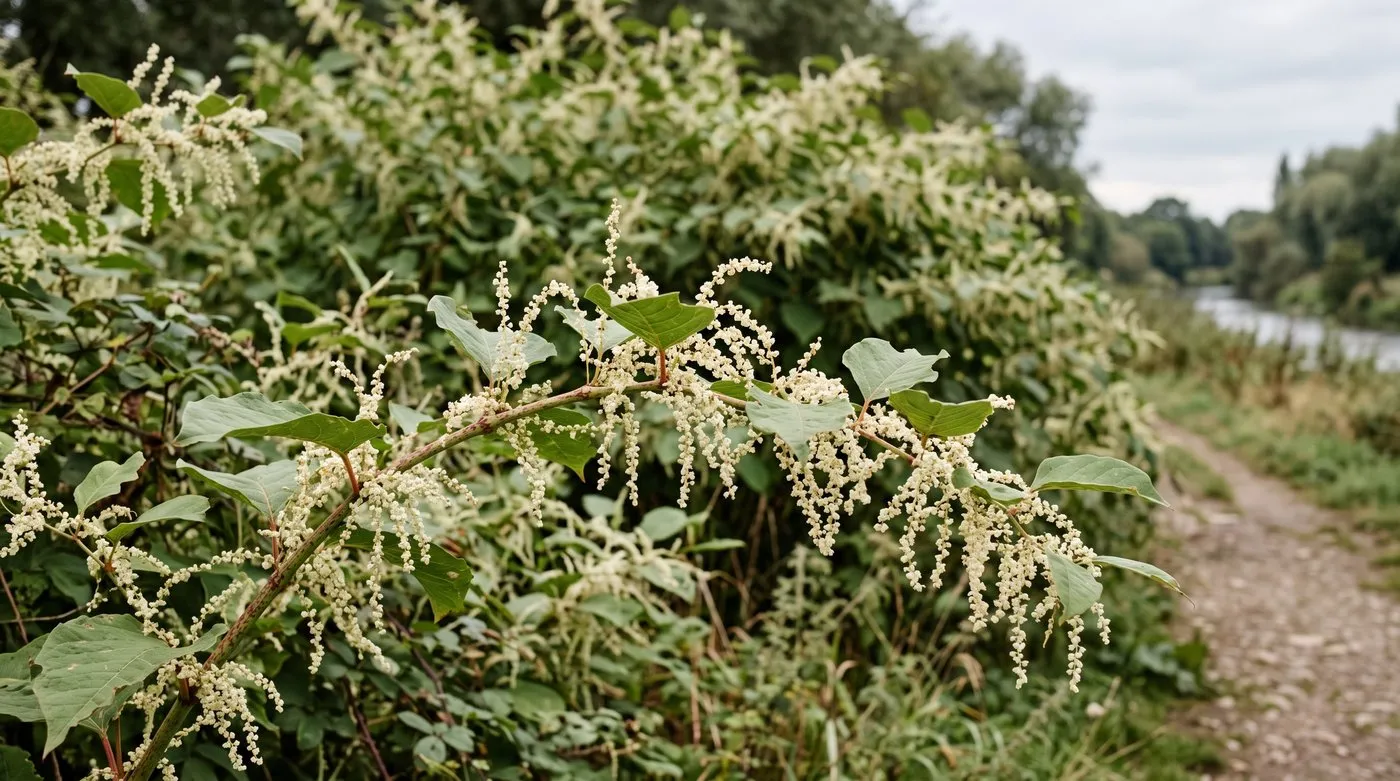
The frothy creamy flowers appear in late summer. UK plants don’t set seed, so new patches almost always start from bits of root or stem.
What do Japanese knotweed roots look like?
The underground stems (rhizomes) are thick and woody, dark brown outside and orange inside. They can spread a metre or more from the plant.
You’ll usually only see them where soil has been dug, such as a building trench. Snap one and the orange inside is the giveaway. But don’t dig to check, as any bit left behind can become a new plant. If you suspect roots in soil brought in from elsewhere, take a photo and ask a specialist rather than moving it.
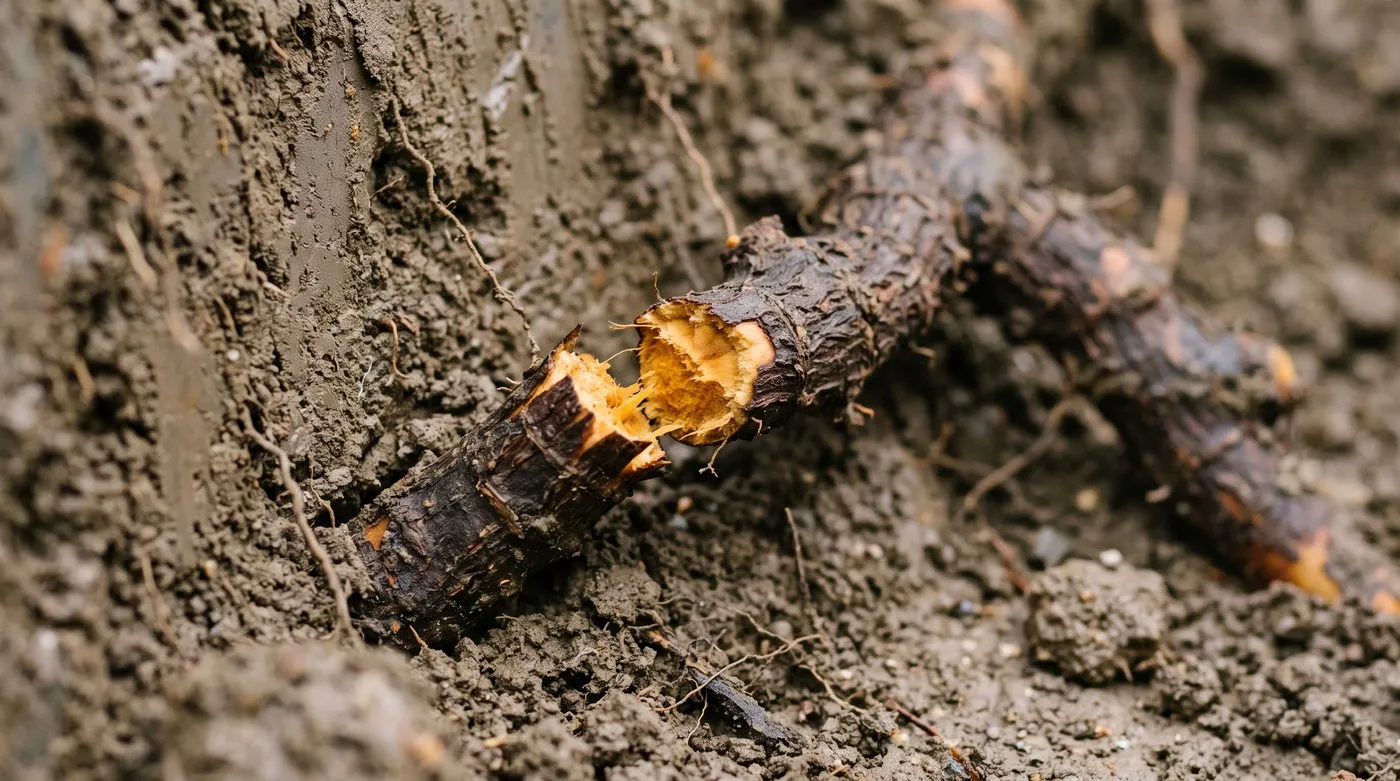
The underground stems are dark brown outside and orange inside. Don’t dig to check, as any piece left behind can grow into a new plant.
How to identify Japanese knotweed in autumn and winter
In autumn the leaves turn yellow, then brown, and fall. In winter, look for clumps of dead, pale brown, hollow canes.
Autumn (October-November)
The leaves yellow and drop later than many native plants. Stems turn brown and brittle. Dry, papery flower tassels often hang on.
Winter (December-March)
The canes look like dead bamboo, with clear joints, and they snap when bent rather than bending. Many fall over in exposed spots but stay upright where it’s sheltered.
At ground level, look for knobbly reddish-purple or pink buds on or just below the soil. These are next year’s shoots and one of the best winter clues.
| Season | What to look for | How easy to spot? |
|---|---|---|
| Spring (March-May) | Red-purple asparagus-like shoots, zig-zag stems, spade-shaped leaves with a flat base | Easy from late April |
| Summer (June-September) | 2-3m bamboo-like stems in dense clumps, creamy flower sprays in late summer | Very easy |
| Autumn (October-November) | Yellow-brown leaves, dry flower tassels, browning stems | Easy |
| Winter (December-February) | Pale brown hollow canes, reddish-purple buds at ground level | Harder, so ask a specialist |
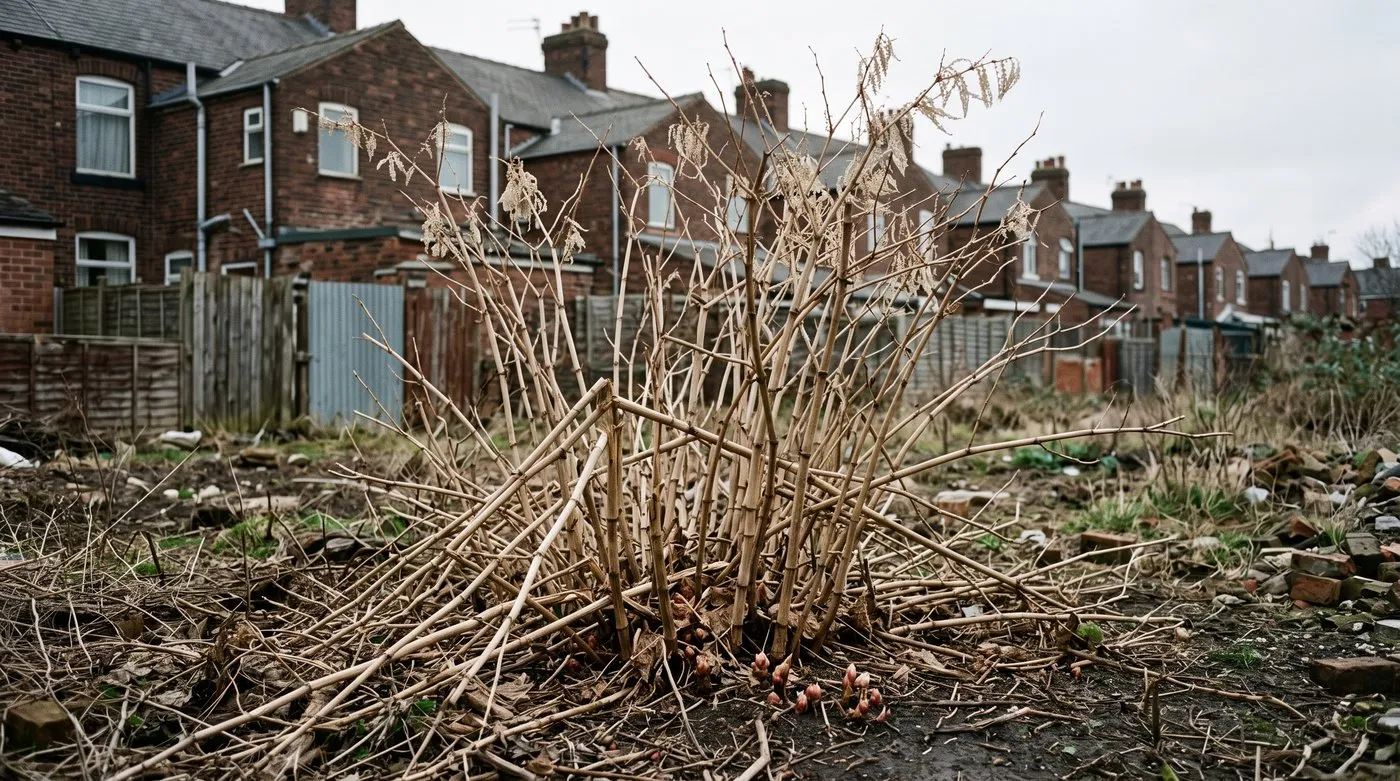
In winter, look for pale brown hollow canes that snap rather than bend, and reddish buds at ground level ready for spring.
Plants commonly confused with Japanese knotweed
Russian vine, Himalayan honeysuckle and houttuynia are the usual mix-ups. Bindweed, lilac, dock and bamboo fool people too.
| Plant | How to tell it apart |
|---|---|
| Russian vine | A climber, not free-standing. Twining stems, smaller leaves and big sprays of white or pinkish flowers. |
| Himalayan honeysuckle (Leycesteria) | Hollow stems, but arching. Leaves grow in pairs, not alternately. Dark purple berries. |
| Broad-leaved dock | Much longer, narrower leaves. Grows as a low rosette, with no bamboo-like canes. |
| Lilac | Heart-shaped leaves with a rounded base. Solid, woody branches, not hollow canes. |
| Bindweed | A twining climber with arrow-shaped leaves and white trumpet flowers. |
| Houttuynia | Heart-shaped leaves, but much smaller. Low ground cover with a citrusy smell when crushed. |
| Bamboo | Evergreen, with narrow, grassy leaves. Woody stems that don’t die back in winter. |
Still not sure? Take clear photos of the stem, a whole leaf (including the base) and the whole plant. Many specialist firms will give a free opinion from photos, and the RHS knotweed page has pictures to compare.
For bindweed, see our guide to getting rid of bindweed.
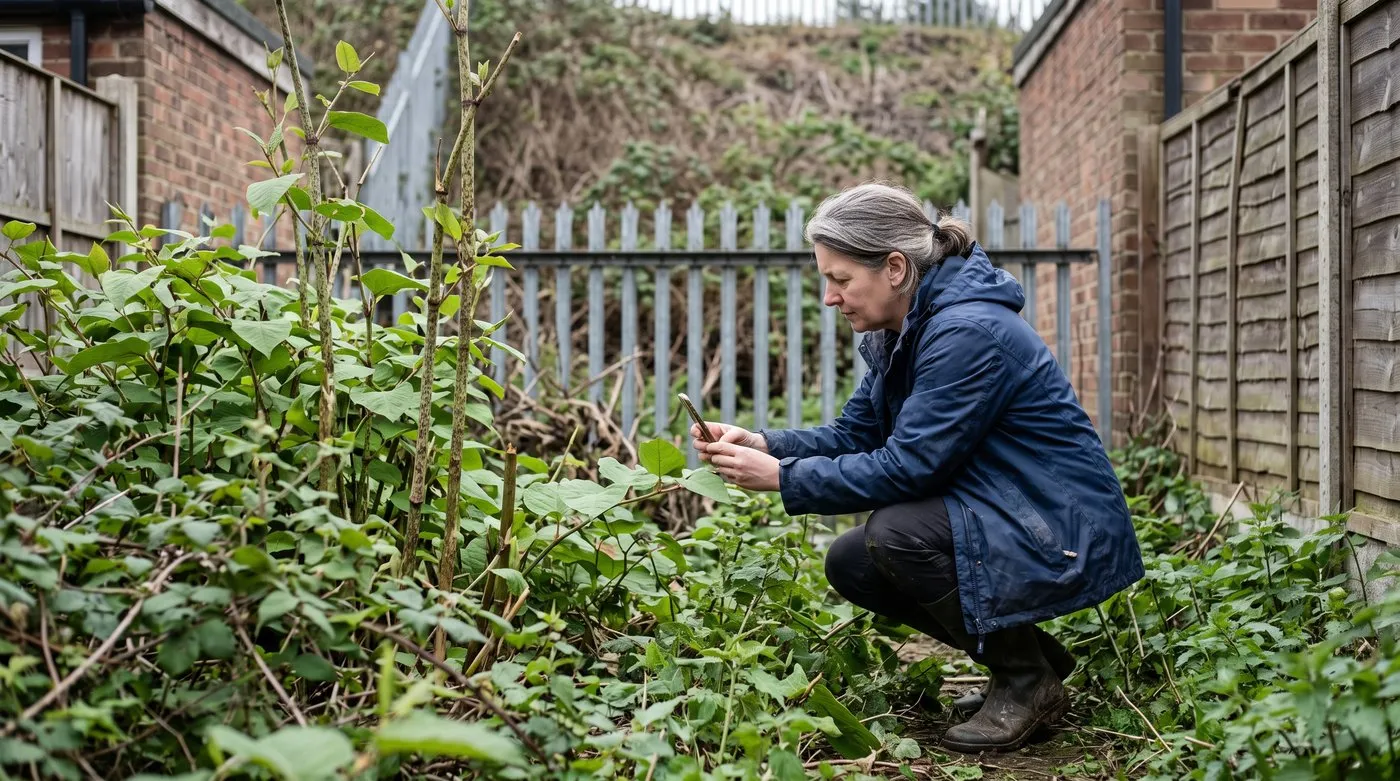
Not sure? Photograph the stem, a whole leaf including its base, and the whole plant. Many specialists will give an opinion from photos.
Is it illegal to have Japanese knotweed in your garden?
No. It isn’t an offence to have knotweed growing on your land, and you don’t have to remove it unless it’s causing a nuisance.
What you must do is stop it spreading. GOV.UK’s guidance on how to prevent Japanese knotweed from spreading is clear that letting it spread into the wild can lead to prosecution.
In practice, you get into trouble by dumping cuttings or soil outside your garden, letting it grow into next door, or hiding it when you sell. Treat it, deal with waste properly and be honest on the sale forms, and you’re fine.
Legal obligations for UK landowners
Here are the key rules in plain English.
Wildlife and Countryside Act 1981
It’s an offence to plant knotweed or “otherwise cause it to grow in the wild”. Dumping garden waste or soil with bits of root in it is the usual way people fall foul of this.
Anti-social Behaviour, Crime and Policing Act 2014
If knotweed is causing a persistent problem for the area, your council can serve a Community Protection Notice telling you to control it. Ignoring one is an offence.
Environmental Protection Act 1990
Knotweed, and soil with it in, counts as controlled waste once it leaves your land. It must go with a registered waste carrier to a site permitted to take it. Household bins, green waste collections and the local tip are not the place for it.
Property sales (TA6 form)
If you sell a home in England or Wales, the TA6 property information form asks whether it’s affected by knotweed and whether there’s a management plan. Answer honestly. A wrong answer can lead to the buyer taking you to court.
Warning: Don’t tick “No” just because treated knotweed looks dead. The roots can lie dormant for years. Give details of any treatment and guarantee, and ask your conveyancer if you’re unsure.
Civil liability
If knotweed spreads from your land into a neighbour’s, they can take you to court for nuisance. The courts have backed neighbours in these cases, so it pays to deal with it early.
Can you get a mortgage on a house with Japanese knotweed?
Usually, yes. Most lenders will still lend, though many want a specialist treatment plan with an insurance-backed guarantee first.
Since March 2022, surveyors follow RICS guidance that judges knotweed by the harm it’s actually doing, rather than the old “within 7 metres” rule. There are four categories:
| Category | What it means | What lenders usually do |
|---|---|---|
| A: Action | Knotweed is damaging a building or structure | Hold back part of the loan until a specialist report arrives |
| B: Action | No damage, but it stops you using or reaching part of the garden | Hold back part of the loan until a specialist report arrives |
| C: Manage | It’s there, but causing no damage or nuisance | No hold-back. Treatment is up to the owner |
| D: Report | It’s next door, within 3 metres of the boundary | No hold-back, as the buyer can’t control the neighbour’s land |
In every case, surveyors should suggest getting advice from a knotweed specialist.
Warning: If a survey flags knotweed while you’re buying, get a specialist survey before you exchange contracts. Otherwise you could end up with a home that’s hard to remortgage or sell.
Professional treatment: methods and costs
Most knotweed in the UK is treated with glyphosate over several seasons. Digging it out is quicker but much more expensive. A professional firm is usually the easiest route, and can give you the treatment plan and guarantee that lenders like.
Herbicide treatment (standard approach)
The usual method is a glyphosate weedkiller, either injected into each hollow stem or sprayed on the leaves, over at least three growing seasons.
Both work best from late summer into early autumn, when the plant is drawing food down into its roots. The same timing helps when treating brambles. Home gardeners can use a glyphosate weedkiller sold for garden use, following the label exactly. Treating knotweed near water needs the Environment Agency’s agreement first.
| Year | What happens | What to expect |
|---|---|---|
| Year 1 | Treat in late summer or early autumn | Top growth dies back, but the roots survive |
| Year 2 | Treat any regrowth | Regrowth is often small-leaved and bushy |
| Year 3 | Treat what’s left | Little or no regrowth on many sites |
| After that | Keep checking, spot-treat if needed | Watch for dormant roots waking up |
Cost: It depends on the size of the patch and access. Get quotes from at least two specialist firms and check what the guarantee covers.
Will Japanese knotweed come back after treatment?
Often, yes. Dormant roots can sit in the soil for years, so regrowth after a clear year is common.
Regrowth after treatment is usually small and bushy and looks nothing like the original canes, so it’s easy to miss. It still needs treating. Check every few weeks from April to October for at least two years after you last saw any growth. Don’t dig, rotavate or lay a new path there in that time, as it can wake dormant roots and spread bits around.
Excavation and removal
If you need it gone fast, say before a sale or building work, a specialist can dig it all out after mapping where the roots go. A registered waste carrier then takes the soil to a permitted landfill.
It’s the most expensive option, so it’s usually saved for building sites or urgent sales.
On-site burial
Contaminated material can be buried on site instead, but it has to be very deep (or wrapped in a special membrane), and you must tell the Environment Agency a month beforehand. Leave this to the professionals.
Choosing a treatment provider
Pick a firm that belongs to a trade body, such as the invasive weed section of the Property Care Association. Members follow a code of practice and can offer insurance-backed guarantees that lenders accept.
Disposal rules for knotweed waste
Knotweed waste either stays on your land or goes with a registered waste carrier to a permitted site. It never goes in household or green waste bins.
- Stems, leaves, crowns, roots and soil with roots in it all count as controlled waste
- Off-site waste needs a registered waste carrier and a properly permitted site
- Keep the waste transfer note for at least 2 years
- Burning on site: check with your council first
- Composting: the RHS advises against composting knotweed at home
- Burial on site follows the rules above
GOV.UK’s guidance has the full details. If you also find a towering, cow-parsley-like plant, see the giant hogweed identification and removal guide, as its sap can badly burn skin.
Warning: Dumping knotweed or soil containing it is fly-tipping, which is a criminal offence. Even a small amount can start a new patch wherever it lands.
Common mistakes with Japanese knotweed
Digging it up without professional guidance
Digging breaks the roots into pieces, and tiny bits can regrow. It often turns a small patch into a bigger one, and leaves you with waste that needs special disposal.
Putting knotweed in garden waste bins
Council green waste goes to composting sites that may not kill knotweed. The compost could then spread it to other gardens and allotments.
Ignoring it and hoping it goes away
It won’t. It keeps spreading underground, and a bigger patch costs more to treat. Act while it’s small.
Treating it once and assuming it is dead
One dose kills the top growth but rarely the roots. It takes at least three growing seasons. Stop because nothing shows one spring, and it’s often back the year after.
Not disclosing on the TA6 form
Treated knotweed still counts. The roots can lie dormant, and a wrong answer can land you in court. Give full details of past treatment and any guarantee.
For another stubborn garden weed, read our guide on how to get rid of bindweed.
Frequently asked questions
How do I identify Japanese knotweed in winter?
Look for clumps of tall, pale brown, hollow canes, like dead bamboo. The canes are brittle and snap when you bend them. At ground level, look for knobbly reddish-purple or pink buds, which become next year’s shoots. It’s harder to be sure in winter, so ask a specialist if in doubt.
Will Japanese knotweed devalue my property?
It can, depending on the harm it’s doing. Surveyors are most concerned when it’s damaging a building or stopping you using your garden. Where it’s causing no damage, the effect is much smaller. A specialist treatment plan with an insurance-backed guarantee reassures lenders and buyers.
Can I remove Japanese knotweed myself?
Yes, with a glyphosate weedkiller used as the label says. Expect it to take at least three growing seasons. Don’t dig it, as tiny bits of root regrow. Never put it in home compost or the council green bin. You’re still responsible for stopping it spreading.
How quickly does Japanese knotweed spread?
Very fast above ground in spring, reaching 2-3 metres by midsummer. Underground it creeps outwards, and tiny bits of root or stem can grow into new plants. It doesn’t spread by seed in the UK. Moving soil with bits of root in it is the usual way it ends up somewhere new.
Do I have to tell my neighbour about Japanese knotweed?
There’s no general legal duty to tell them. But if it spreads onto their land, they could take you to court for nuisance. Your council can also step in if it’s a persistent problem for the area. A friendly chat early on heads off most disputes.
How long does it take to get rid of Japanese knotweed?
At least three growing seasons with weedkiller, then a couple of years of checking. Dormant roots can lie in the soil for years. Digging it all out and taking it away is much quicker, but costs a lot more.
What is the legal position on Japanese knotweed in the UK?
It’s legal to have it, but not to let it spread into the wild. That’s an offence under the Wildlife and Countryside Act 1981. Waste must be handled properly, councils can order you to control it, and if you sell your home you must say whether it’s affected.
Can Japanese knotweed damage buildings and foundations?
It mostly exploits cracks and weak spots that are already there. It can push through tarmac, paving, poorly built walls and drains. Sound, well-built foundations are far less likely to be harmed. Damage to a building is what concerns surveyors most.
Our team produces practical UK gardening guidance from source research, contributor records and established horticultural practice. Editorial standards are overseen by Matt W.