
Key takeaways
- Sow indoors in mid to late April and plant out after the last frost
- Give each plant 90cm of space in rich soil and full sun
- Water deeply at the base, especially once fruits start forming
- Feed plants in pots with tomato feed every 10-14 days once fruits swell
- Pick at 10-15cm every two or three days to keep plants cropping
- If small fruits rot in cool weather, try hand-pollinating
Courgettes are one of the most generous crops you can grow. In good weather, one plant can give you three or four courgettes a week. Two or three plants will keep a family supplied from July to October.
They need warmth, rich soil and plenty of water. They can’t take frost, so timing matters. If you’re starting a vegetable garden, courgettes are a brilliant first crop. The RHS courgette growing guide is handy for more detail.
Which courgette varieties grow best in the UK?
Compact bush types like Defender F1 and Black Beauty are the most reliable. They set fruit well even in a so-so British summer.
Dark green types are the most popular. Black Beauty is the classic, with glossy dark fruit. Defender F1 is bred to resist cucumber mosaic virus and crops reliably. Midnight F1 is very dark and compact, so it suits small gardens.
Italian and unusual types add fun to the harvest. Romanesco has ridged, nutty fruit that’s great for grilling. Tromboncino is a climber with long, curvy, pale fruit. Train it up a strong trellis to save space.
Yellow types like Atena Polka F1 and Soleil F1 give golden fruit that keeps its colour when cooked.
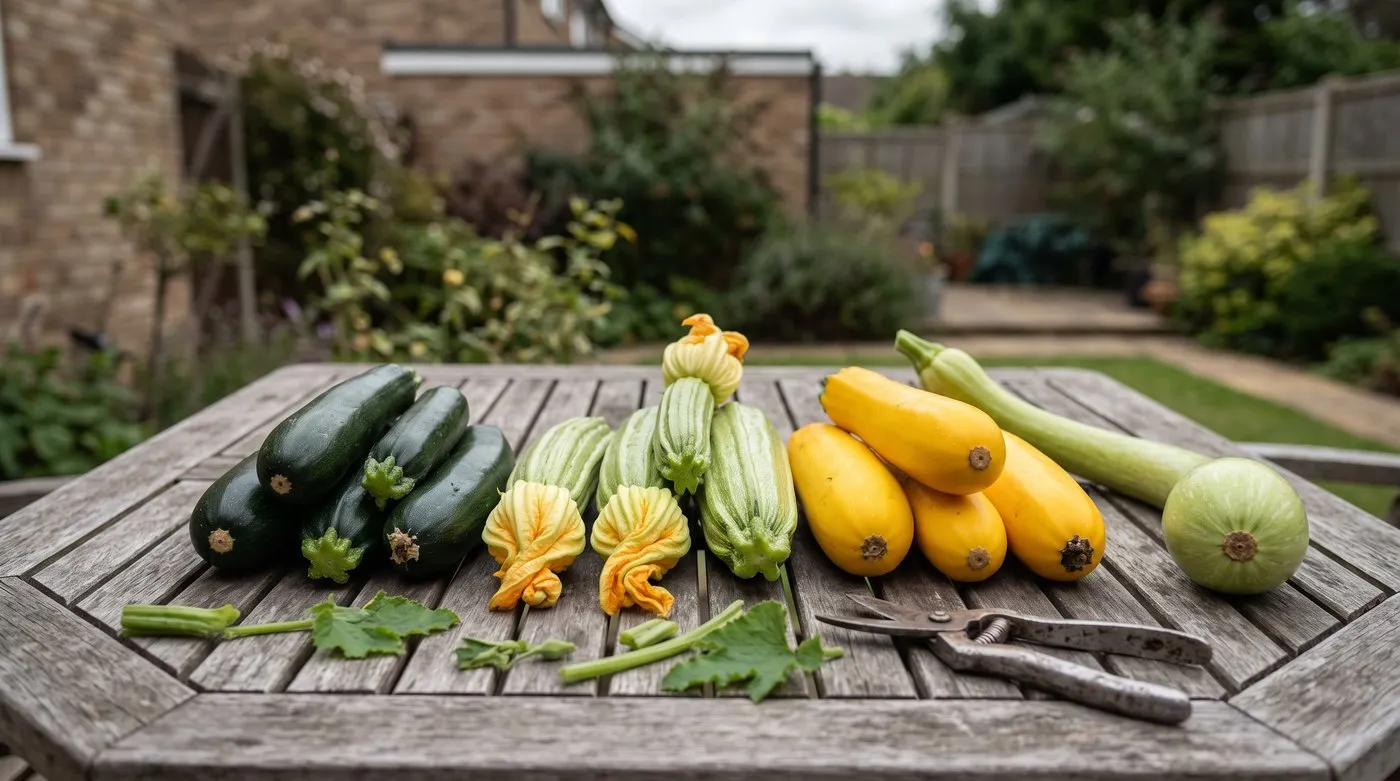
Dark green bush types are the most reliable croppers, while ridged, yellow and climbing types add a bit of fun to the harvest.
Variety comparison
| Variety | Colour | Habit | Best for |
|---|---|---|---|
| Black Beauty | Dark green | Bush | Reliable cropping |
| Defender F1 | Dark green | Bush | Beginners |
| Midnight F1 | Very dark green | Compact bush | Small gardens, pots |
| Romanesco | Pale green, ridged | Bush | Flavour, grilling |
| Tromboncino | Pale green | Climbing | Saving space |
| Atena Polka F1 | Golden yellow | Bush | Colour, milder taste |
Gardener’s tip: Each plant has both male and female flowers, so one plant can fruit on its own. Two plants still help early on, as it’s more likely a male and female flower will be open on the same day.
How to sow courgettes indoors
Sow in mid to late April, one seed per pot, on its edge. Our guide to sowing seeds indoors covers the set-up.
When: Mid to late April in most of the UK. In the north or on high ground, wait until late April or early May. Sowing earlier just gives you leggy plants waiting for the weather.
How:
- Fill 9cm pots with multipurpose compost.
- Water the compost first.
- Push one seed on its edge 1-2cm into the compost. Sideways seeds are less likely to rot.
- One seed per pot is plenty, as they come up reliably.
- Keep them warm on a windowsill or in a propagator.
- Seedlings usually appear in about a week.
Can you sow courgettes directly outside?
Yes, in late May or early June once the soil has warmed. Sow two or three seeds 2.5cm deep at each spot, at least 90cm apart. Water well and cover with a cloche or fleece. Thin to the strongest seedling.
Outdoor-sown plants start cropping later, usually from late July. Slugs love them while they’re small, so check on damp evenings. In the north, sowing indoors is more reliable.
After they come up: Keep seedlings in good light and turn the pots daily so they grow straight. Water when the top of the compost feels dry, and don’t leave them sitting in water.
When to plant courgettes outside
Plant out after the last frost, once the soil has warmed. In most of southern England that’s late May. In the north, Scotland and high gardens, wait until early June.
Hardening off
Spend a week to ten days getting plants used to the outdoors. Put them out by day and bring them in at night. By the end, leave them out overnight if no frost is forecast.
Planting out
Pick a spot in full sun with rich soil that holds moisture. Courgettes are hungry. Dig a hole twice the size of the rootball and mix plenty of garden compost into the bottom. On heavy clay, plant on a slight mound.
- Spacing: 90cm between plants every way
- Depth: the same level as in the pot. Don’t bury the stem.
- Water well after planting
- Cover with a cloche or fleece if cold nights are forecast
Raised beds are great for courgettes, as they warm up sooner and drain well. One plant per 90cm square is about right.
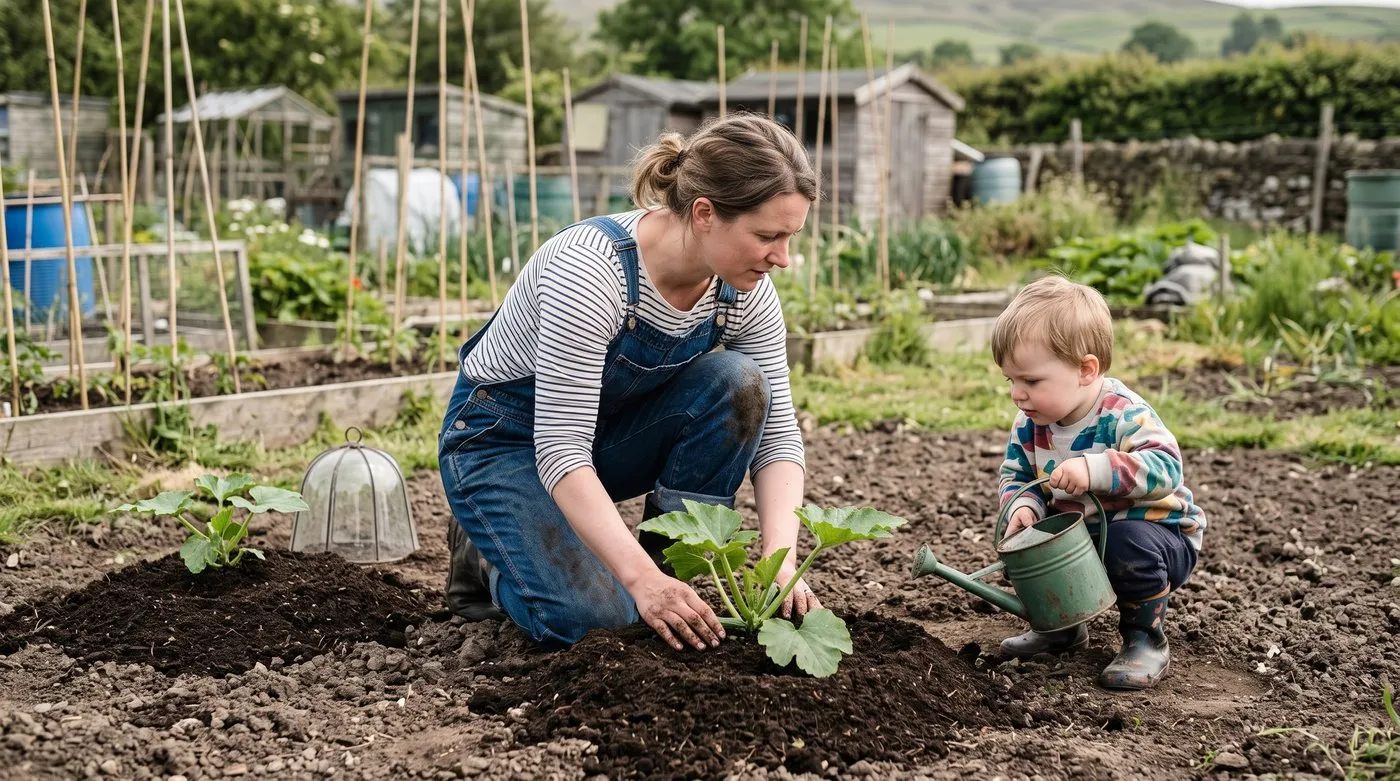
Plant into a hole full of compost, at the same depth as in the pot, and leave 90cm between plants. On heavy clay a slight mound helps drainage.
How to feed and water courgettes
Courgettes need moist, rich soil. Plants in pots need regular feeding too.
Watering
Water deeply two or three times a week, at the base of the plant. Once fruits are forming, give each plant a full watering can rather than a splash. In hot spells, water daily. A small pot sunk beside each plant helps water reach the roots.
Mulch with compost, straw or well-rotted manure once the soil has warmed in June. It keeps moisture in and weeds down.
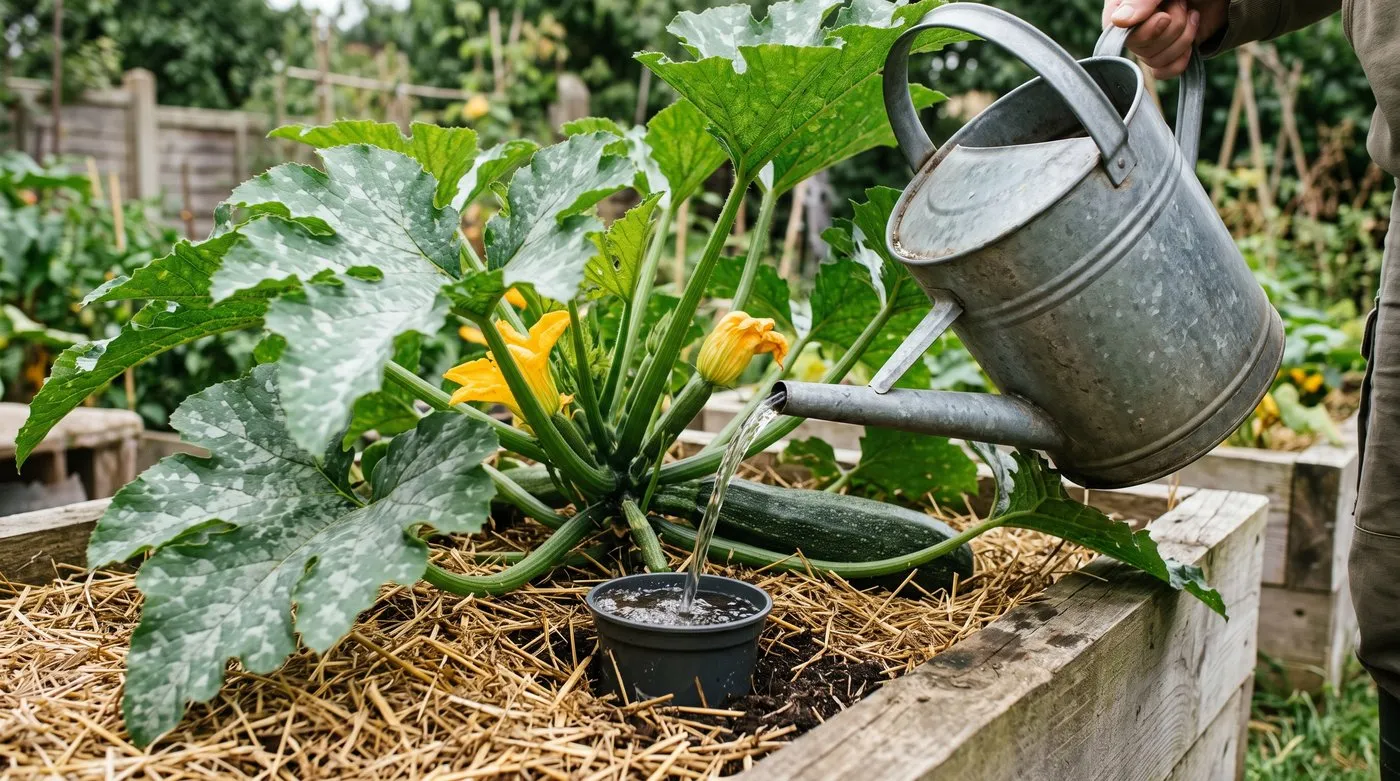
A small pot sunk beside each plant sends water straight down to the roots. Give a full can two or three times a week once fruits are forming.
Feeding
In rich garden soil, courgettes usually don’t need feeding. Plants in pots and growing bags do. Start when the first fruits begin to swell, usually late June or July.
| Stage | In the ground | In pots and growing bags |
|---|---|---|
| Planting to first fruit | None if soil is rich | None |
| Fruiting (July to September) | Tomato feed only on poor soil | Tomato feed every 10-14 days |
| October | None | None |
Use a high-potash feed like tomato feed, which helps flowers and fruit. Skip high-nitrogen feeds, which just make leaves.
Understanding courgette pollination
Bees carry pollen from male to female flowers. When that doesn’t happen, the fruit fails. Both kinds need to be open at once.
Male vs female flowers
- Male flowers sit on a thin, straight stalk. They usually appear first.
- Female flowers have a tiny courgette behind the petals.
If a female flower isn’t pollinated, the little fruit turns yellow, shrivels and rots from the end. It’s not a disease, and it usually sorts itself out once the weather warms.
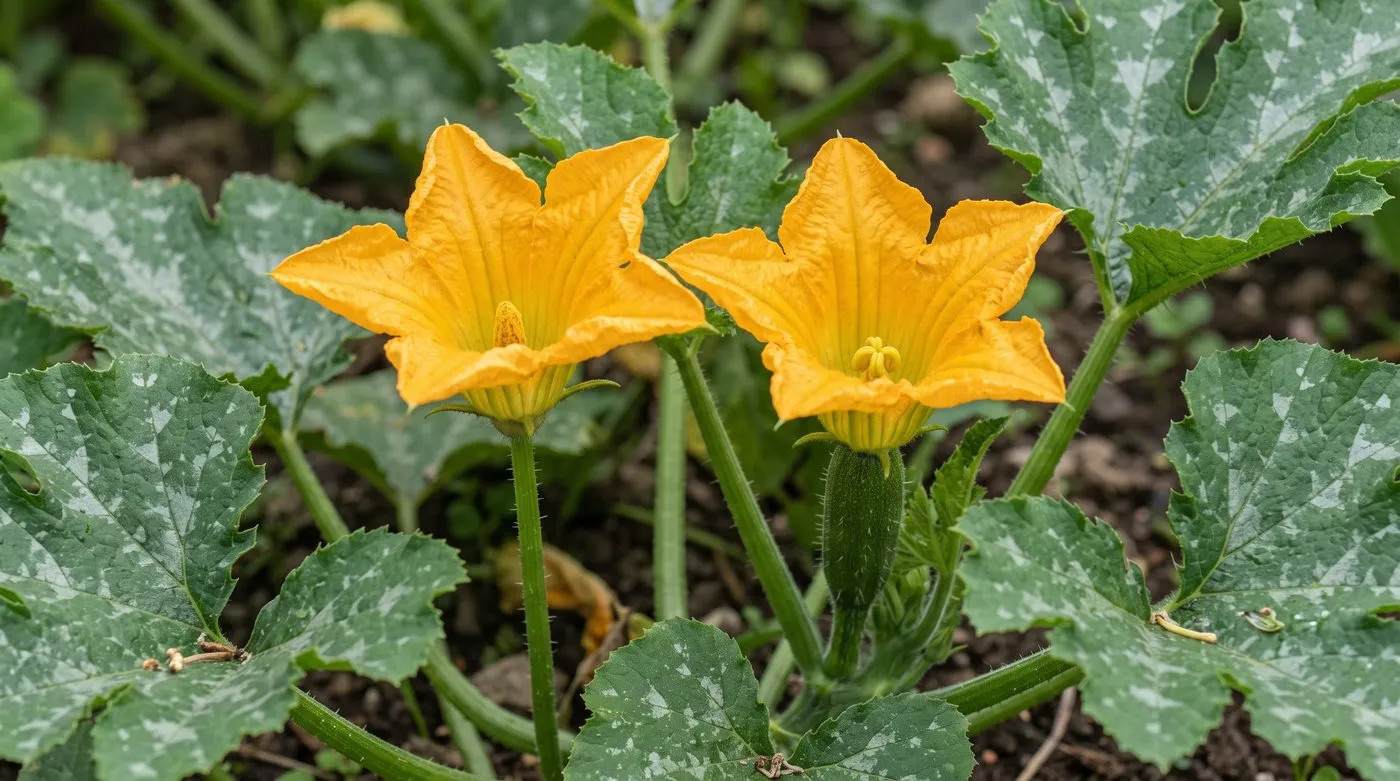
Female flowers have a tiny courgette behind the petals, while males sit on a thin stalk. Both need to be open at once for fruit to set.
Why does my courgette plant only have male flowers?
That’s normal early in the season. Plants often make male flowers for a week or two before any females appear. Cool June nights can make this last longer.
Keep watering and be patient. Female flowers usually follow. If there are still only males by mid-July, check the plant gets full sun and enough water. Male flowers aren’t wasted: pick a few to stuff or fry, leaving some for pollination.
When to hand-pollinate
In a cool, wet summer, bees may not visit every flower. Hand-pollinating takes about 30 seconds.
How to do it:
- Find an open male flower in the morning.
- Pick it and peel back the petals to show the yellow, pollen-covered middle.
- Dab it gently into the centre of an open female flower.
- One male flower can do two or three females.
Do this each morning in cool or cloudy spells. Growing bee-friendly plants nearby helps too.
How to harvest courgettes at the right size
Pick them small, at 10-15cm long, every two or three days. Leave them a few days too long and they turn into bland marrows. Regular picking keeps more coming.
When and how to pick
- Pick at 10-15cm long for the best flavour.
- Check plants every two or three days in July and August. They grow fast in warm weather.
- Cut the stalk cleanly with a knife or secateurs. Don’t twist or pull.
- Pick in the morning when the fruit is cool and firm.
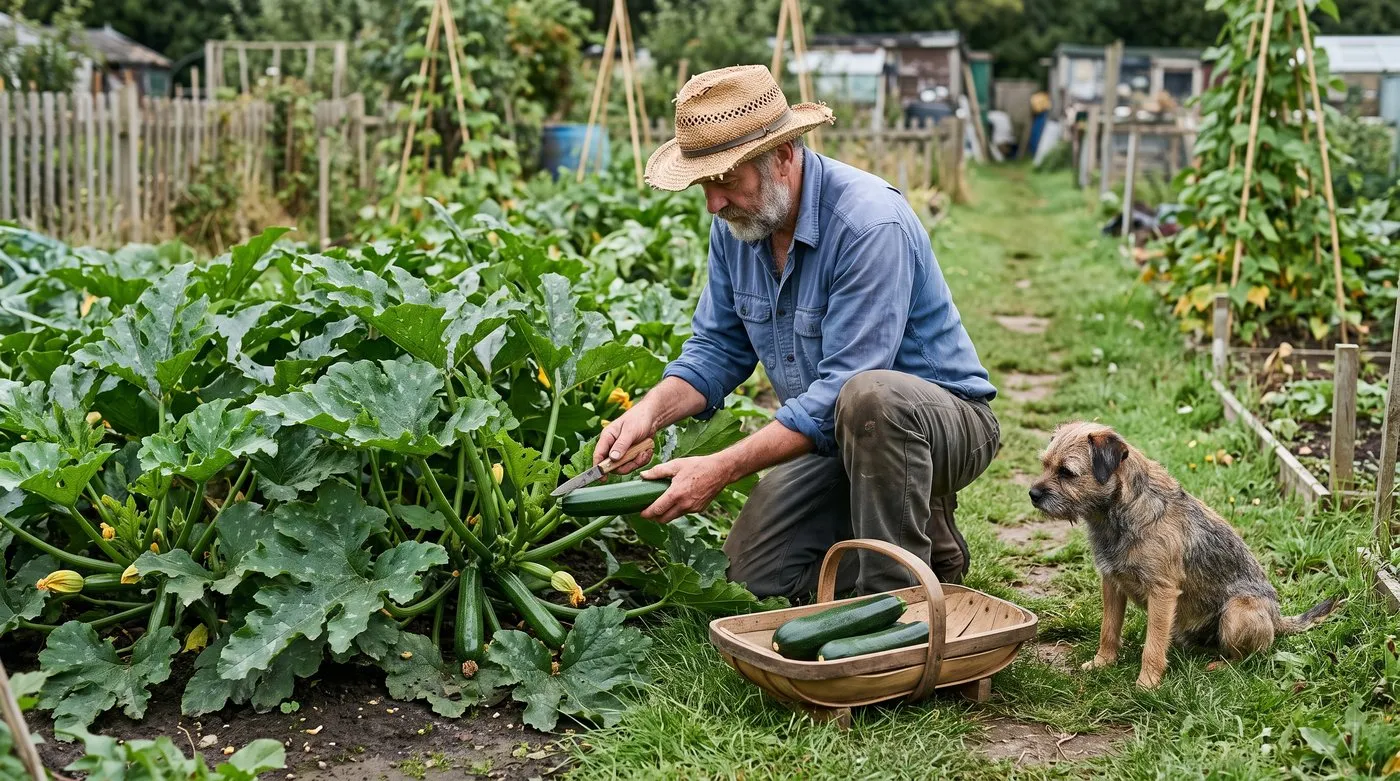
Pick at 10 to 15cm long every couple of days in summer. Cut the stalk cleanly rather than twisting, and the plant keeps on producing.
What to do with a glut
Even two plants can give more than you can eat. A few ideas:
- Grill and freeze: slice lengthways, char on a griddle, freeze flat, then bag.
- Blanch and freeze: cut into 1cm rounds, blanch for one minute, cool in iced water, drain and freeze.
- Make soup: courgette and mint soup freezes well.
- Bake: courgette cake is a family favourite.
- Share: neighbours and community fridges are usually glad of them.
Gardener’s tip: If one hides and turns into a marrow, stuff it with rice, mince and herbs and bake it. Nothing wasted.
How to grow courgettes in containers
Courgettes do well in pots at least 45cm wide, one plant per pot. Perfect for patios, balconies and small plots.
Container requirements
- Pot size: at least 45cm across and 40cm deep.
- Compost: rich multipurpose compost, with a handful of slow-release fertiliser mixed in.
- Drainage: clear drainage holes, with the pot raised on feet.
- One plant per pot.
Container care
Water daily in summer, as those big leaves lose water fast. In hot weather, check morning and evening. Give a tomato feed every 10-14 days once fruits swell.
Compact types like Midnight F1 and Defender F1 suit pots best. Skip climbers like Tromboncino, which need more root room.
Stand pots in full sun, ideally by a sunny wall.
Stopping powdery mildew on courgettes
Keep the roots moist, give plants room and remove bad leaves early. Powdery mildew shows as white, dusty patches on the leaves from midsummer. Plants short of water get it more, and badly affected plants crop less. The RHS powdery mildew page has more on it.
Prevention
- Keep the soil moist in dry spells.
- Water at the base, not over the leaves.
- Space plants 90cm apart so air can move.
- Remove lower leaves that touch the ground.
- Mulch to stop soil splashing up.
- Go easy on nitrogen, as soft lush growth catches it more easily.
Late in the season, a bit of mildew is almost certain and does little harm once most of the crop is in.
Are white patches on courgette leaves always mildew?
No. Many courgettes have natural silvery markings on their leaves. These follow the veins in a neat pattern, appear on healthy young leaves and won’t rub off.
Mildew starts as small dusty spots, often on older lower leaves. It smudges when rubbed and spreads within days. If unsure, watch the leaf for a week. Markings stay the same, mildew spreads. For other leaf problems, see our guide to common squash and courgette diseases.
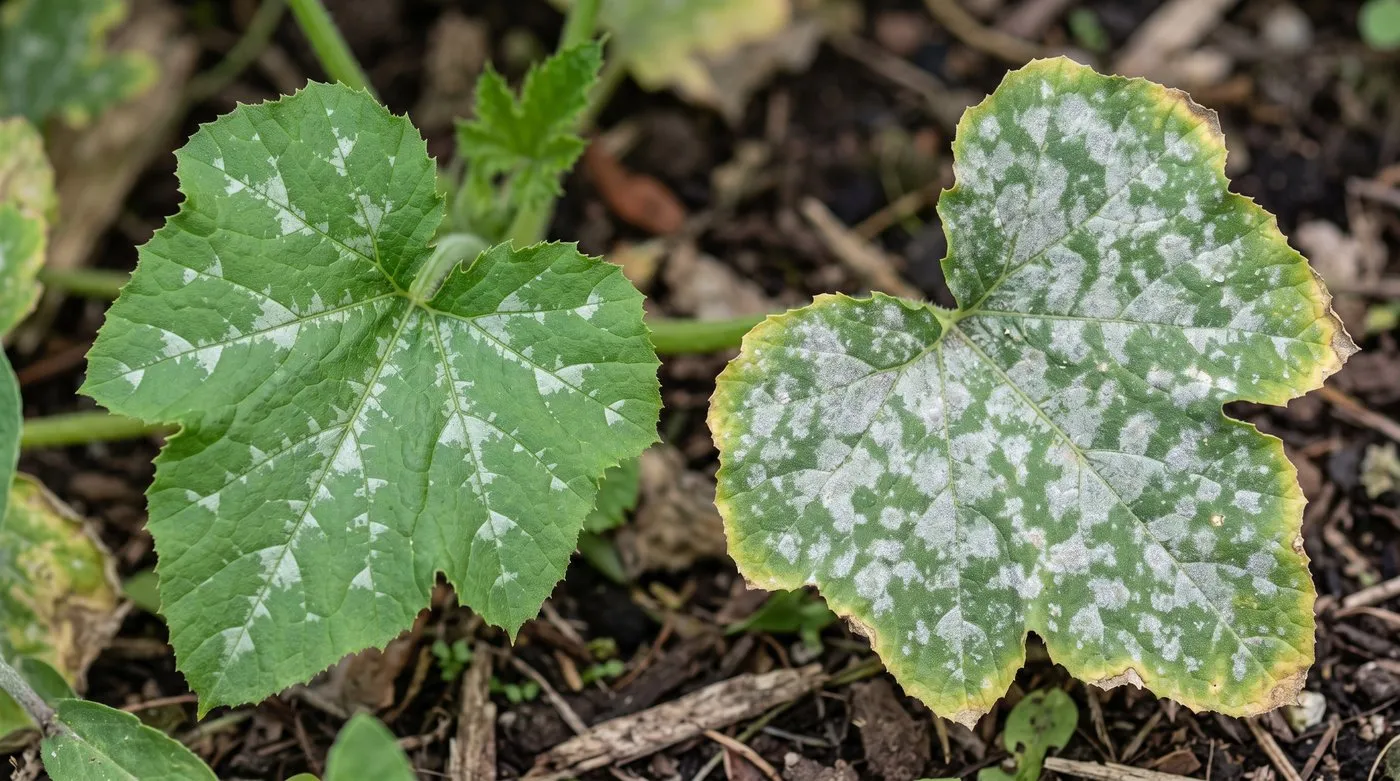
Natural silvery markings follow the veins neatly and stay put. Mildew starts as dusty spots on older leaves, smudges when rubbed and spreads within days.
When to remove affected leaves
Cut off leaves that are more than half covered. Put them in the bin or council green waste rather than your compost heap. New leaves will grow from the middle.
Month-by-month courgette growing calendar
| Month | Jobs |
|---|---|
| January | Browse catalogues and order seed. |
| February | Get raised beds ready with well-rotted manure. |
| March | Add compost to planting spots. Clean pots. |
| April | Sow indoors mid-month, one seed per pot, on its edge. |
| May | Harden off. Plant out after the last frost. Fleece if cold. |
| June | Water regularly. Mulch. First flowers. Feed pots once fruits swell. |
| July | Start picking every two or three days. Hand-pollinate in wet weather. |
| August | Peak picking. Freeze or share extras. Remove mildewed leaves. |
| September | Picking slows. Harvest the last before frost. Clear old plants. |
| October | Dig over and add compost for next year. |
| November | Clean and store pots. |
| December | Plan next year. See what to plant in May to plan ahead. |
Common mistakes when growing courgettes
The usual slip-ups are sowing too early, crowding, overwatering seedlings, leaving fruit to grow huge and missing pollination problems.
Sowing too early
March sowing feels keen, but courgettes can’t go out until late May. Early plants end up tall, leggy and pot-bound. April sowing gives sturdy plants ready at just the right time.
Planting too close together
Each plant spreads about a metre. Too close and they compete for water and get mildew. Give each one 90cm.
Overwatering seedlings indoors
Seeds and seedlings rot in soggy compost. Sow on edge, water before sowing, then wait until the surface feels dry.
Letting fruit grow too large
A few warm days is all it takes for a courgette to become a marrow. Big fruits also slow the plant down. Pick at 10-15cm every few days.
Ignoring pollination problems
When small fruits yellow and rot, more water or feed won’t help. Learn to spot male and female flowers and hand-pollinate in cool spells.
Companion planting with courgettes
Flowers that bring in pollinators make great courgette neighbours.
- Nasturtiums may lure aphids away, and their bright flowers attract pollinators.
- Borage has blue flowers that bees adore.
- French marigolds bring in hoverflies, whose young eat aphids.
- Sweetcorn grows tall while courgettes spread low, so they share space happily.
Courgettes, pumpkins, squash and cucumbers share pests and diseases, so move them to a new bed together each year. If you save seed, keep courgettes away from other squashes, as they cross.
Frequently asked questions
When should I sow courgettes in the UK?
Sow indoors in mid to late April. Push one seed on its edge, 1-2cm deep, into a 9cm pot of compost. Keep it warm and it should come up in about a week. Plant out after the last frost, usually late May in the south and early June further north.
How many courgette plants do I need?
Two or three plants will keep a family of four busy. One plant is plenty for a couple. Don’t grow more than you can pick every few days, as each plant spreads about a metre wide.
Why are my courgettes rotting before they grow?
Usually the flowers haven’t been pollinated. It happens in cold, wet weather when bees stay at home. Pick a male flower, peel back the petals and dab its pollen inside an open female flower in the morning.
Can I grow courgettes in pots?
Yes, in a big pot at least 45cm across and 40cm deep. Use rich compost, one plant per pot, in full sun. Water daily in summer and give a tomato feed every 10-14 days once fruits swell.
How do I stop powdery mildew on courgettes?
Keep the roots moist and give plants space. Water at the base, never over the leaves. Space plants 90cm apart, mulch to hold moisture and remove badly affected lower leaves.
What is the best courgette variety for beginners?
Defender F1 is a great easy choice. It’s bred to resist cucumber mosaic virus and crops well. Black Beauty is the trusty old favourite. Both have dark green fruit on compact plants.
Can I freeze courgettes?
Yes, but blanch them first. Slice into 1cm rounds, boil for one minute, then plunge into iced water. Drain, pat dry and freeze on a tray before bagging. They go soft when thawed, so use them in soups and stews.
Our team produces practical UK gardening guidance from source research, contributor records and established horticultural practice. Editorial standards are overseen by Matt W.


