Key takeaways
- Japanese maples are fully hardy in the UK but like shelter from cold wind
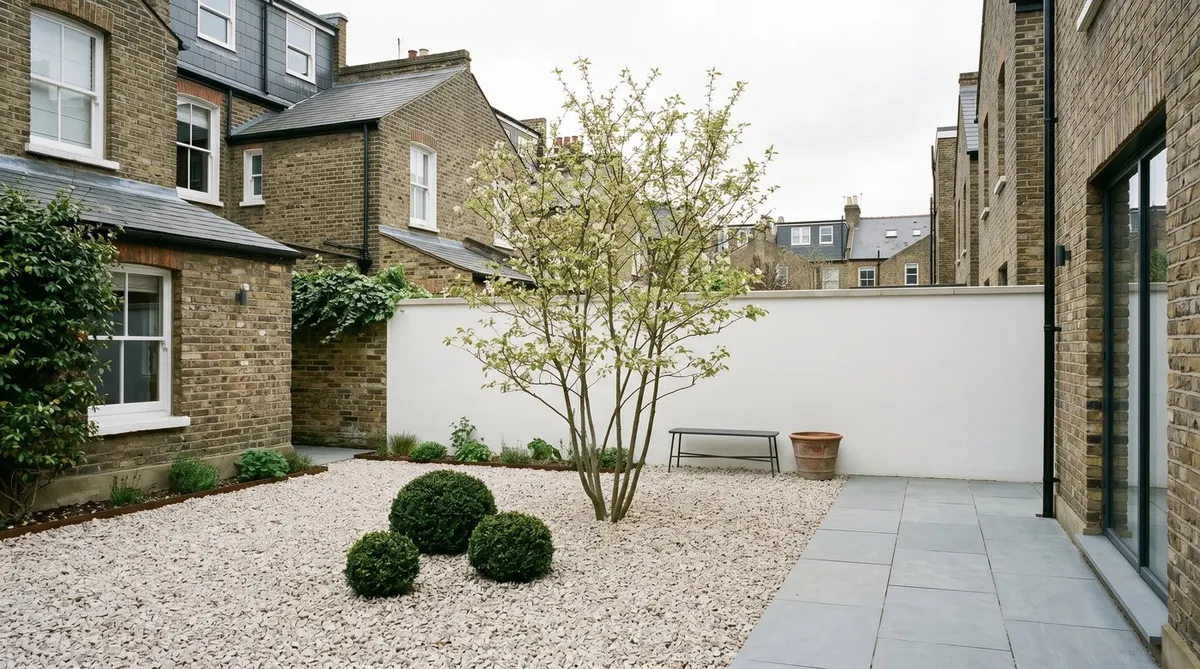
- A zen gravel garden can fit into a 3m square courtyard
- Moss grows happily in damp, shady UK gardens
- Yew is a reliable stand-in for box in clipped cloud shapes
- Keep ornaments to one lantern and one water basin, as less really is more
- On chalky soil, grow azaleas and acers in pots of ericaceous compost
A Japanese garden in Britain isn’t about copying a temple garden from Kyoto. It’s about borrowing a few simple ideas and making them work here. Happily, our weather is on your side.
Rain, mild winters and acid soil in many areas suit acers, azaleas, moss and bamboo, the very plants that give Japanese gardens their look. A 3m x 3m courtyard can hold a complete zen gravel garden, and a typical suburban plot can fit a pond, stepping stones and a lantern. Japanese style grew out of older Chinese traditions, and our Chinese garden design guide covers that style for UK plots.
Below you’ll find the key ideas, the best plants for UK gardens, rough budgets and upkeep. For more ideas on small spaces, see our small garden design ideas.
Core principles of Japanese garden design
Get these ideas right and the rest falls into place. They matter more than any particular plant or ornament.
Go asymmetric. Skip straight lines and matching pairs. Group stones in threes, fives or sevens. Let paths curve and keep planting natural and layered.
Borrow the view. Leave a gap in the planting to frame something beyond your fence, like a big tree or a church spire. It makes the garden feel bigger.
Reveal it bit by bit. Like the best courtyard garden designs, a Japanese garden shouldn’t show itself all at once. Wind paths around screening plants so each turn brings a new view.
Keep it simple. One well-placed stone beats a dozen. A clipped evergreen against raked gravel is all the drama you need. Done well, this makes for one of the easiest gardens to look after.
Love a bit of age. The Japanese idea of wabi-sabi finds beauty in the worn and imperfect. Mossy stones and weathered wood are better than shiny new ones. The British weather helps with that.
Essential elements of a Japanese garden
The main ingredients are stone, water, paths and a few ornaments, set among clipped evergreens and moss. You don’t need all of them.
Stone and rock
Stone is the heart of it. Rocks stand in for mountains and islands. Use local stone if you can. Yorkshire sandstone, Welsh slate and Scottish granite all look great and save shipping stone across the world.
Bury each rock by at least a third so it looks as if it’s always been there. Never just sit it on top. Group rocks in odd numbers, mixing one tall upright, one low and flat and one leaning.
Local quarries are cheaper than garden centres, and reclamation yards are cheaper still.
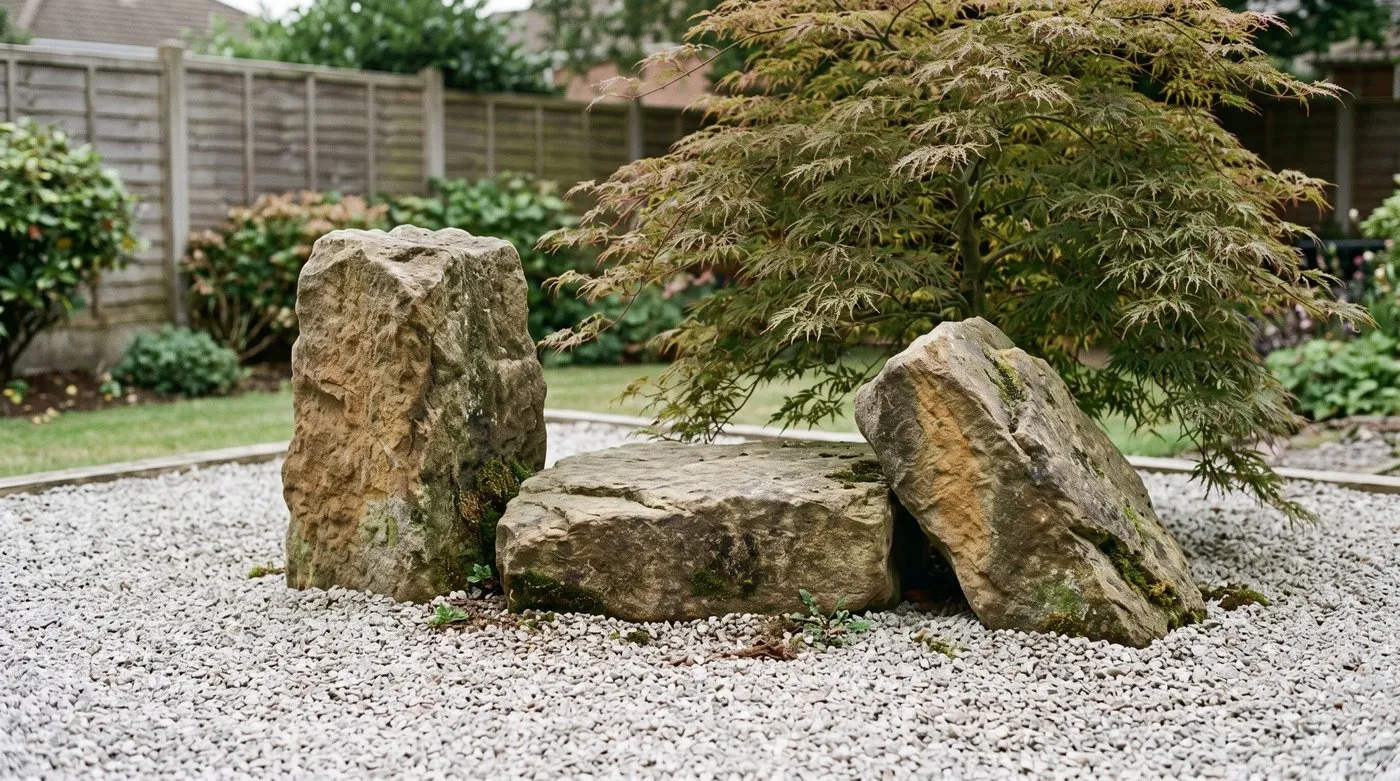
Bury each rock by at least a third and group them in odd numbers. Local stone looks right and saves shipping it across the world.
Water features
Water brings calm and movement. It can be as simple as a stone basin or as grand as a pond with a bridge.
A tsukubai is a low stone basin, first used for washing hands before a tea ceremony. Reconstituted stone versions are affordable, while natural granite costs more. Feed it with a bamboo spout. A shishi-odoshi, the tipping bamboo “deer scarer”, adds a gentle knock every so often.
In a bigger garden, a pond of still, dark water reflects the sky and plants. Line it with butyl rubber over a protective underlay. Our water feature ideas have more options.
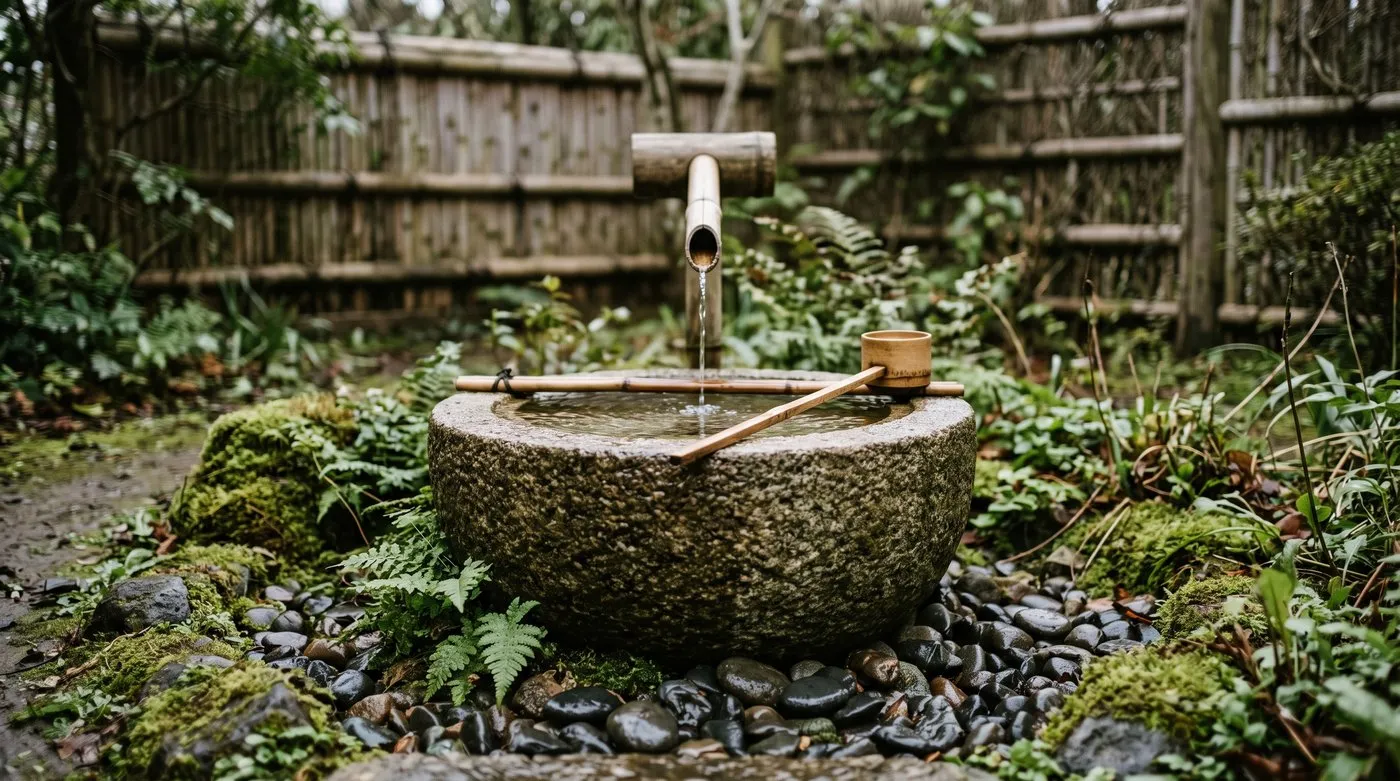
A tsukubai basin with a bamboo spout brings the sound of water to even a small garden. Drain the spout before hard frosts.
Paths and stepping stones
Paths in a Japanese garden are meant to slow you down. Stepping stones set into moss or gravel make you look down, then up at each new view. Space them at an easy stride, about 40-50cm from centre to centre.
Use flat-topped natural stones about 30-50cm across, set level with the ground around them. A single line suits a narrow garden. A staggered pattern gives a slower, more relaxed pace.
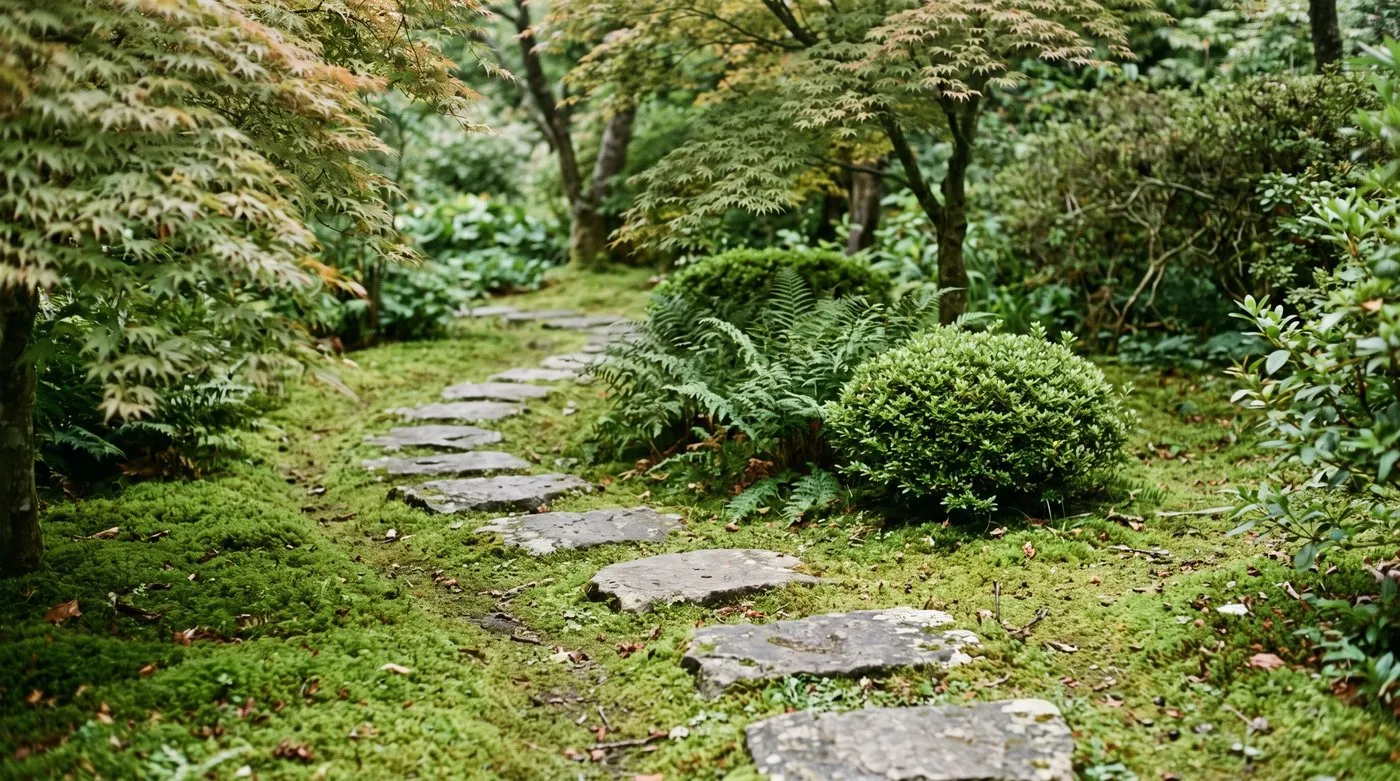
Space stepping stones at an easy stride, about 40-50cm apart. Curving the path makes you slow down and notice each new view.
Lanterns and ornaments
Stone lanterns are focal points more than lights. The squat yukimi-doro (snow-viewing lantern, with a wide cap) and the tall, formal kasuga are the most common. Reconstituted stone is affordable, and hand-carved granite is the luxury option.
Put a lantern by water, where paths meet or beside a gate, but never bang in the middle. One or two is plenty.
Best Japanese plants for UK gardens
Acers, cherries, pines, azaleas, camellias, bamboo, ferns and moss are the stars. Most are fully hardy here.
Trees
| Plant | Height | Likes | Why grow it |
|---|---|---|---|
| Acer palmatum ‘Bloodgood’ | 4-6m | Part shade, neutral to acid soil | Deep purple leaves, crimson in autumn |
| Acer palmatum Dissectum | 1.5-2.5m | Shelter, dappled shade | Fine, lacy, weeping leaves |
| Prunus ‘Kanzan’ | 8-10m | Sun, any soil | Double pink cherry blossom in April |
| Pinus mugo (dwarf mountain pine) | 1-2m | Sun, any soil | Evergreen, great for cloud pruning |
| Cornus kousa | 4-6m | Part shade, neutral to acid soil | White flowers in June, red fruit in autumn |
For more on Japanese maples, see our Japanese maple care guide. If clipped trees appeal on a smaller scale, our bonsai care guide for beginners uses the same ideas in a pot.
Shrubs and ground cover
| Plant | Height | Likes | Use |
|---|---|---|---|
| Evergreen azalea | 60cm-1.5m | Acid soil, part shade | Spring colour, clipped mounds |
| Camellia japonica | 2-4m | Acid soil, shelter | Winter and early spring flowers |
| Box (Buxus) | 30cm-4m | Any soil, sun or shade | Cloud pruning, topiary |
| Yew (Taxus baccata) | Clip to any height | Any soil, sun or shade | Clipped shapes, hedging |
| Pieris japonica | 1.5-3m | Acid soil, part shade | Red new leaves, white flowers |
What can you use instead of box in a Japanese garden?
Yew is the most reliable choice for clipped mounds and cloud shapes. Box blight and box tree caterpillar make box hard to keep healthy in much of the UK now. The RHS guide to box alternatives also suggests osmanthus, privet, boxleaf honeysuckle and podocarpus. Japanese holly (Ilex crenata) is often sold for Japanese gardens, but it dislikes wet winters and hot, dry summers, so only try it on well-drained neutral to acid soil. Yew and Pinus mugo both take well to regular clipping.
Ground layer and accents
Moss turns up by itself in damp, shady gardens. Keep the area moist, weed out competition and clear fallen leaves in autumn. In drier spots, mind-your-own-business (Soleirolia) makes a good stand-in.
Bamboo gives movement, rustle and screening. Fargesia murieliae and Fargesia nitida are clumping types that stay put without a barrier. For taller screens, black bamboo (Phyllostachys nigra) reaches 3-5m but needs a root barrier buried 60cm deep.
Hostas bring big, bold leaves to shady corners. Guard them against slugs with copper tape or nematodes. Japanese forest grass (Hakonechloa macra) adds a soft, flowing texture.
Ferns are a must in the shade. The autumn fern (Dryopteris erythrosora) has coppery new fronds, and the soft shield fern (Polystichum setiferum) is happy in deep shade under trees. Both are hardy and usually stay green through mild winters.
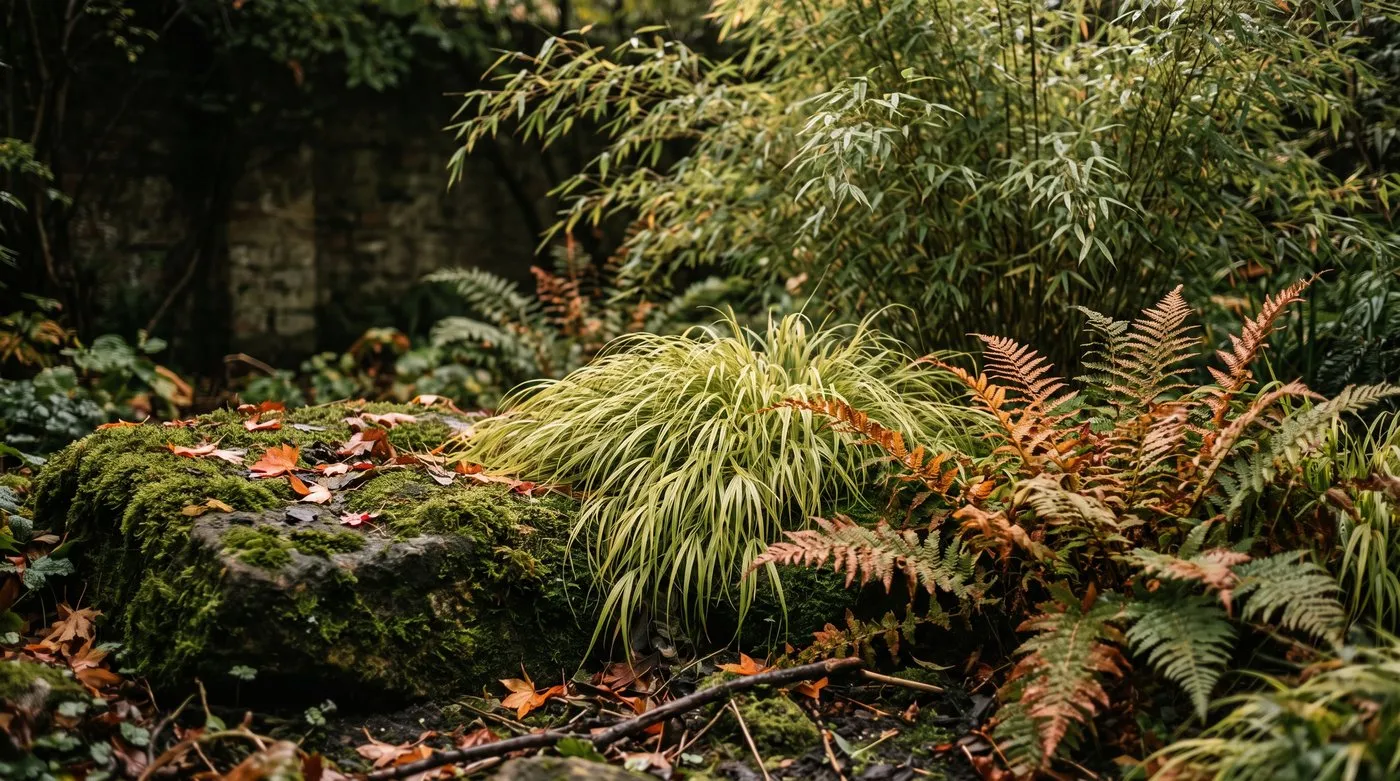
Japanese forest grass and ferns soften a shady corner beautifully. Clumping Fargesia bamboo stays put without a root barrier.
Can you make a Japanese garden on chalky or alkaline soil?
Yes. Choose plants that are happy on chalk for the ground, and grow the acid-lovers in pots. Azaleas, camellias and pieris need acid soil and turn yellow on chalk. Acers prefer neutral to slightly acid soil and often struggle on thin chalk. Grow these in glazed pots of ericaceous compost and water them with rainwater, as tap water in chalky areas is usually hard. In the ground, try yew, Pinus mugo, Phyllostachys and Fargesia bamboos, Hakonechloa, soft shield fern and flowering cherries. Stone, gravel and water do a lot of the work anyway.
Types of Japanese garden design
There are three main styles: the zen gravel garden, the tea garden and the stroll garden.
Zen dry garden (karesansui)
The classic look. Raked gravel stands for water and rocks stand for mountains or islands. There’s no real water at all.
You need as little as 3m x 3m. Lay a woven membrane first to keep weeds down. Spread angular granite gravel, about 10-14mm, 50-70mm deep. Place three to five rocks in an uneven group. Rake circles around the rocks and straight lines across the open gravel.
Rough cost: from around £500 for a small courtyard.
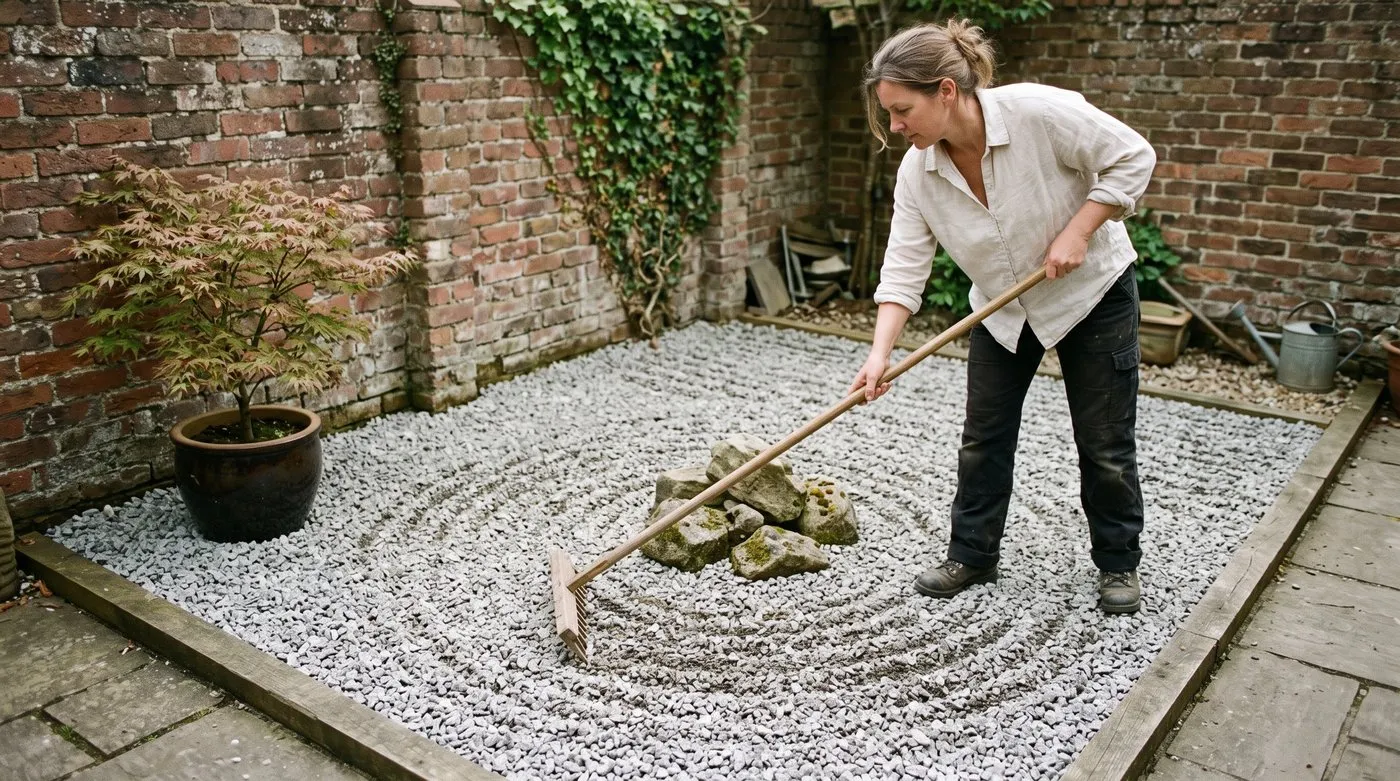
Rake circles round the rocks and straight lines across open gravel. A zen garden fits in as little as 3m by 3m.
Tea garden (roji)
A tea garden is a calm path from everyday life to the tea house. Stepping stones lead through simple planting, past a waiting bench and a stone basin for washing your hands.
Line the path with low evergreens, moss and ferns. Keep to greens, greys and browns and skip the showy flowers. It should feel quiet and peaceful.
Stroll garden (kaiyushiki)
The biggest style. A path loops around a central pond, showing a new view at every turn. It suits gardens of about 15m x 10m or more. Add a bridge (even a simple stone slab over a narrow bit), a lantern, a special tree or two and seasonal planting.
Where can you see Japanese gardens in the UK?
For inspiration, visit the Japanese garden at Tatton Park near Knutsford, or the Kyoto Garden in Holland Park, London. Kew has a Japanese Landscape around its Chokushi-Mon gateway, and Compton Acres in Dorset has a Japanese garden too. Go in late April or May for azaleas and fresh acer leaves, or late October for autumn colour. The Japanese Garden Society organises visits for members, including smaller private gardens. For gardens further afield, see the best gardens in the world to visit.
Budget breakdown for UK Japanese gardens
| Project | Size | Rough cost | What you get |
|---|---|---|---|
| Courtyard zen garden | 3m x 3m | £500-£1,500 | Gravel, membrane, 3-5 rocks, an acer in a pot |
| Small Japanese corner | 4m x 5m | £1,500-£3,500 | Gravel, stepping stones, lantern, basin, bamboo screen, a few plants |
| Mid-sized makeover | 6m x 8m | £3,500-£7,000 | Paving, gravel, small pond or rill, lantern, more plants, a mature acer |
| Full Japanese garden | 10m x 15m+ | £7,000-£15,000+ | Pond and bridge, tea area, several zones, big trees, stonework, lighting |
Ways to save: Buy stone from a local quarry rather than a garden centre. Grow bamboo and ferns from divisions. Take semi-ripe azalea cuttings in July. Let moss arrive by itself instead of buying moss mats.
Where to splurge: One or two good-sized trees. A mature acer gives you instant impact that would take years to grow from a small plant.
Seasonal interest through the year
Enjoying each season is a big part of a Japanese garden.
| Season | What to enjoy |
|---|---|
| Spring | Cherry blossom, azaleas, camellias, fresh moss, new acer leaves |
| Summer | Japanese iris by water, hostas, tall bamboo, ferns, layers of green |
| Autumn | Acer colour in October and November, golden Hakonechloa, Cornus kousa berries |
| Winter | Evergreen shapes (pine, yew, box), bare stone and gravel, frost on lanterns, branch silhouettes |
The Japanese idea of mono no aware is about enjoying how things change. Fallen blossom on raked gravel, autumn leaves on a still pond, frost on a lantern. These aren’t messes to tidy away. They’re the whole point.
Maintenance and care
Little and often: raking, clipping, clearing leaves and keeping water clean.
Gravel: Rake weekly and pick up fallen leaves by hand or with a blower on low. Top up the gravel once a year. Pull weeds as soon as you see them.
Pruning: Cloud-prune box and pine in late spring (May-June) and again in late summer (August-September). Prune acers in late autumn or winter when they’re dormant. Avoid spring, when they bleed sap.
Moss: Keep it shaded and damp. Sweep off fallen leaves with a soft brush. Don’t walk on it when it’s frozen. Keep lawn sand and sulphate of iron well away, as both kill moss.
Water features: Clean the basin monthly and pull out any algae. In ponds, oxygenating plants and floating leaves help keep algae down. Drain bamboo spouts before hard frosts.
Gardener’s tip: In Japan, looking after the garden is seen as part of the pleasure. Raking gravel can be wonderfully calming. Treat the jobs that way and the garden pays you back twice: once while you work, and again when you sit and enjoy it.
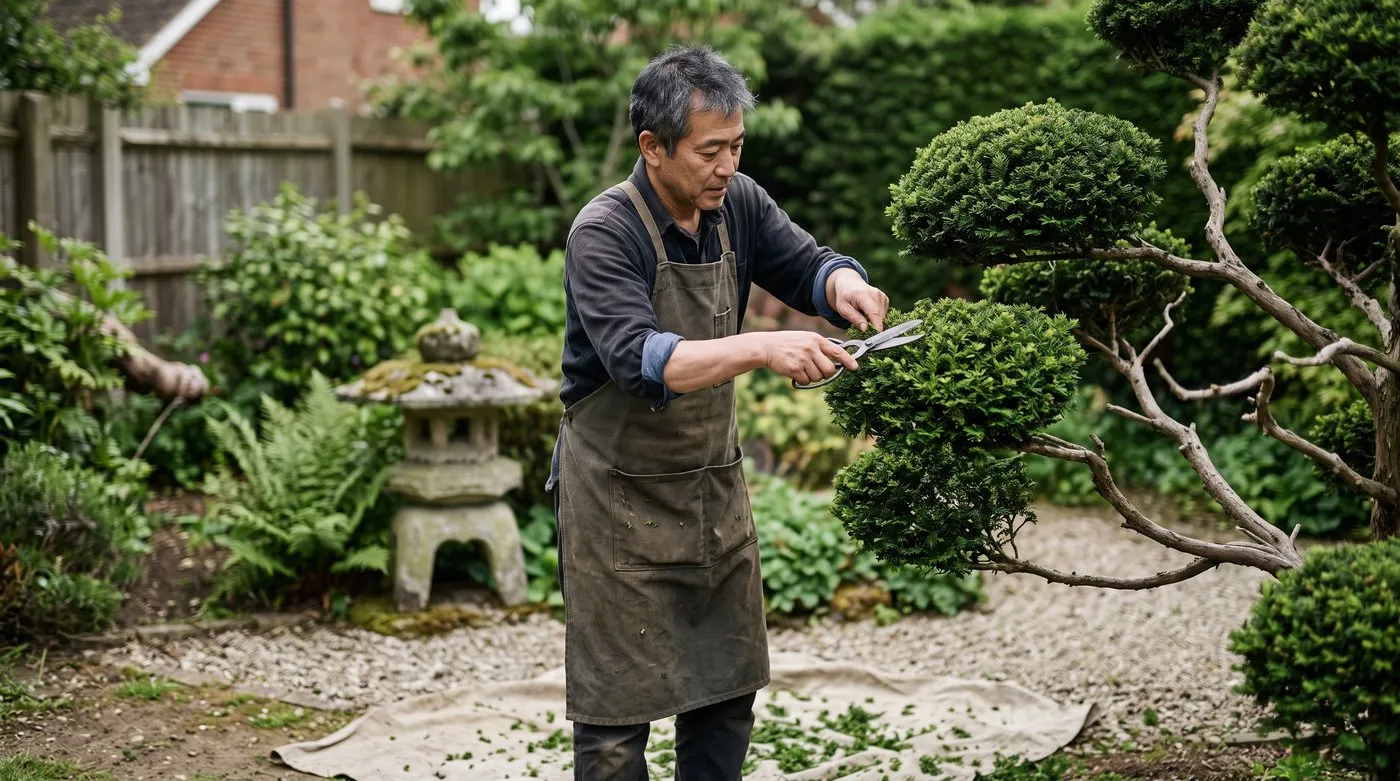
Clip cloud-pruned shapes in late spring and again in late summer. Yew is a reliable choice now box suffers from blight and caterpillar.
Common mistakes to avoid
Cramming it full. Empty space matters as much as planting. Gravel, stone and open ground are part of the design.
Too many ornaments. One lantern and one basin is enough for most gardens. A crowd of lanterns, pagodas and statues looks like a garden centre display.
Getting the scale wrong. A small plot needs rocks of 30-50cm, not huge boulders, and a dwarf acer rather than a big cherry. Match everything to the size of the space.
Too many flowers. Japanese gardens are about leaves, texture and shape. Azaleas and camellias bring seasonal colour, and the rest of the year it’s greens, greys and earthy tones. Fancy lots of flowers? Try a cottage garden planting plan instead.
Forgetting winter. Without evergreens, a Japanese garden looks bare from November to March. Build the planting around yew, pine, bamboo, evergreen azaleas and box or a box alternative.
Once you’ve planned your garden, read our guide on Japanese maple care in the UK to choose and grow the tree that sums up the style.
Frequently asked questions
Can you create a Japanese garden in the UK?
Yes, and our climate suits it well. Plenty of rain, mild winters and acid soil in many areas suit acers, azaleas, bamboo and moss. Where your soil is chalky, grow the acid-lovers in pots of ericaceous compost.
What are the best Japanese plants for UK gardens?
Japanese maples, bamboo, azaleas and camellias all do well here. Acer palmatum varieties are fully hardy. Phyllostachys nigra copes with UK winters but needs a root barrier. Pieris, hostas and ferns fill the shady spots under trees. Our Japanese maple care guide has lots more on acers.
How much does a Japanese garden cost in the UK?
A small zen courtyard can cost from around £500. A mid-sized design with a lantern and water feature costs a few thousand pounds. A full Japanese garden with a pond, big trees and a tea area can reach £10,000-£15,000 or more, depending on stone and plant sizes.
How do you maintain a zen gravel garden?
Rake it weekly and pick up fallen leaves. Top up the gravel once a year. Pull weeds by hand, or lay a woven membrane under the gravel to keep them down. A small courtyard only takes a few minutes.
What gravel is best for a Japanese garden?
Angular granite gravel, about 10-14mm, holds raked patterns best. Round pea gravel shifts too easily and won’t keep its lines. Choose pale grey, cream or warm buff shades. One tonne covers roughly 10 square metres at 50mm deep.
Do Japanese gardens need full sun?
No, they’re happier in part shade. Acers, azaleas, moss and ferns all prefer dappled light. A north or east-facing plot works well, as hot afternoon sun can scorch acer leaves. See our guide to the best plants for shade for more ideas.
How do I stop bamboo spreading in my garden?
Bury a plastic root barrier 60cm deep around it. Or grow bamboo in large pots sunk into the ground. Running bamboos like Phyllostachys always need a barrier. Clumping types like Fargesia murieliae and Fargesia nitida stay put on their own.
Further reading
- Small garden design ideas - layout ideas that work for Japanese courtyards
- Water feature ideas for gardens - ponds, rills and fountains
- Courtyard garden ideas - making the most of enclosed spaces
- Best trees for small gardens - compact trees, including Japanese maples
- Front garden ideas - Japanese-inspired ideas for front plots
- The intentional sparse garden - borrows the Japanese love of empty space
Our team produces practical UK gardening guidance from source research, contributor records and established horticultural practice. Editorial standards are overseen by Matt W.