
Key takeaways
- Netting on a frame is by far the best way to protect veg from pigeons
- Hold netting at least 30cm above the crop and peg it down with no gaps
- Spikes or tensioned wire stop pigeons perching on fences and walls
- Fake owls and other scarers only work for a short time, so move them often
- All wild birds are protected by law, so deter pigeons rather than harm them
Pigeons can be the biggest pest in a veg patch. They strip brassicas to bare stalks, wolf down pea shoots and leave droppings on every perch. They feed in groups, so a few visits can flatten a row of cabbages.
All wild birds are protected by law, so the answer is keeping pigeons off rather than harming them. Here’s how to protect your crops and stop them perching on fences and sheds.
Why pigeons love your garden
Two kinds of pigeon visit UK gardens. Wood pigeons are the big ones with white neck patches, and they’re usually behind the damage to veg. Feral pigeons, the grey town birds, are more of a problem for perching and droppings.
What pigeons eat
Pigeons go for soft, leafy plants they can easily reach.
| Crop | What you’ll see | When |
|---|---|---|
| Brassicas (cabbage, broccoli, kale) | Leaves stripped to the stalks | All year, worst in winter |
| Peas and beans | Shoots and leaves eaten | April to August |
| Lettuce and salad leaves | Seedlings gone, leaves shredded | March to October |
| Soft fruit (cherries, blueberries) | Fruit pecked and eaten | June to September |
| Newly sown seed | Seeds picked off the soil | Spring and autumn |
| Beetroot and chard | Young leaves eaten | April to October |
In winter, when wild food runs short, they lean on gardens even more. Once a group finds an open brassica bed, it won’t last long. Net your runner beans and peas from the moment the seedlings come up.

Shredded cabbage leaves, a sure sign pigeons have been at the brassicas.
Perching and droppings
Pigeons perch on fences, walls, shed roofs, pergolas and anything flat and high. Over time their droppings stain stone and paint, block gutters and make paths slippery when wet.
Their droppings can also carry germs. Wear gloves to clean them up, dampen them first rather than sweeping them dry, and wash your hands afterwards.
Pigeons and the law
All wild birds in the UK are protected, and that includes wood pigeons and feral pigeons.
It’s against the law to kill, injure or take a wild bird, or to damage a nest in use. The only exception is under the conditions of a licence. General licences allow pigeons to be killed only in specific situations, such as preventing serious crop damage, and only after non-lethal methods have failed. The rules differ a little between England, Scotland, Wales and Northern Ireland. In a home garden, deterring them is almost always the right answer.
What you can do freely: put up netting, spikes, wires, scarers and reflective strips. Take away food. Block off perching and nesting spots, as long as there’s no active nest with eggs or chicks.
The RSPB has clear advice on birds and the law.
Netting your crops
Netting is the most effective way to protect veg from pigeons. It’s a simple physical barrier they can’t get through.

Netting on hoops keeps pigeons off the brassicas.
Choosing netting
Pigeon netting with a mesh of around 50mm keeps pigeons out while letting in light and air. Fine butterfly netting works too, and also keeps cabbage white butterflies off. Avoid very large mesh, as pigeons can push their heads through.
Tougher, UV-resistant netting lasts far longer than cheap thin netting, so it’s worth paying a bit more for a permanent cage.
Building a frame
Don’t just drape netting over the plants. Pigeons sit on top and peck straight through. Hold it at least 30cm above the crop.
For a temporary bed: push tall bamboo canes in along the bed and join them at the top with more canes or string. Pop cane toppers on the ends to protect your eyes. Drape the net over and peg it down at ground level.
For a permanent bed: build a wooden or metal frame tall enough for your brassicas, with a lift-up or hinged panel so you can get in. Staple or clip the netting on.
Most important: pin the netting down all the way round with no gaps. Pigeons will happily walk under a loose edge. Keep netting taut and check it often, so no birds get tangled.
Netting fruit
A fruit cage is the answer for blueberries, cherries and currants. Make it tall enough to walk into. Keep the sides on all year, and put the roof net on from late spring to the end of the fruiting season.
Stopping pigeons perching
Spikes and wires stop pigeons landing on flat surfaces like walls, fences and shed ridges.

Metal spikes along a wall top give pigeons nowhere to land.
Pigeon spikes
Stainless steel spikes last for years in all weathers. Plastic ones are cheaper but go brittle in the sun. Glue or screw them on, and cover the full width and length. Pigeons will land on any bare gap.
Gel discs
Bird gel discs sit on ledges and put pigeons off landing. Fix them to a clean, dry surface. They need replacing every few years.
Tensioned wire
A thin wire held on small posts just above a flat surface stops pigeons landing. It’s almost invisible from the ground, so it’s a tidier choice than spikes. DIY kits are available.
Scarers and moving deterrents
Scarers work by startling pigeons. They’re handy in open areas where netting isn’t practical, but pigeons get used to them.
Motion-activated sprinklers
A sensor spots movement and fires a quick burst of water. Set it to work in the day for pigeons, unlike for fox deterrents, which need night mode. Move it now and then so the birds don’t get used to it.
Shiny things
Old CDs, reflective tape and holographic scare strips flash and flicker in the light. Hang them where they can spin freely. They help a bit, but pigeons get used to them, so use them alongside netting. Shiny windmills on canes work the same way.
Fake owls and hawk kites
Fake owls play on pigeons’ fear of birds of prey. A still plastic owl only works for a few days. One with a moving head or wings lasts a bit longer.
Hawk kites on tall poles are better, as they flutter in the wind like a hunting hawk. Move them every few days.
The best plan is to layer things up. A kite to put them off the area, shiny spinners to unsettle them, and netting to stop any that land.
Taking away food and water
A garden with nothing to eat soon loses its appeal.
Change your bird feeders. Pigeons love ground feeders and big bird tables. Switch to caged feeders that let small birds in but keep pigeons out, and sweep up spilled seed. Spilled seed can sprout in lawns and borders too, and our lawn weed guide can help if it does.
Cover the compost. Use a bin with a lid if you add food scraps.
Pick fruit promptly. Ripe fruit and windfalls tempt pigeons. Pick strawberries and cherries often, and clear windfalls quickly.
Rest the bird bath. If pigeon flocks are drinking from it, take it away for a few weeks until they move on.
Protecting specific crops
Brassicas
Brassicas are top of the menu, especially winter ones when other food is scarce. Net the bed from planting to harvest on a frame tall enough to keep the netting clear of the leaves. Pin it down at ground level. If pigeons visit your garden, this really is a must.
Peas and beans
Pigeons eat the shoots and flowers. Net peas and beans as soon as they come up. Twiggy pea sticks between the plants help too, as pigeons don’t like landing among wobbly twigs.
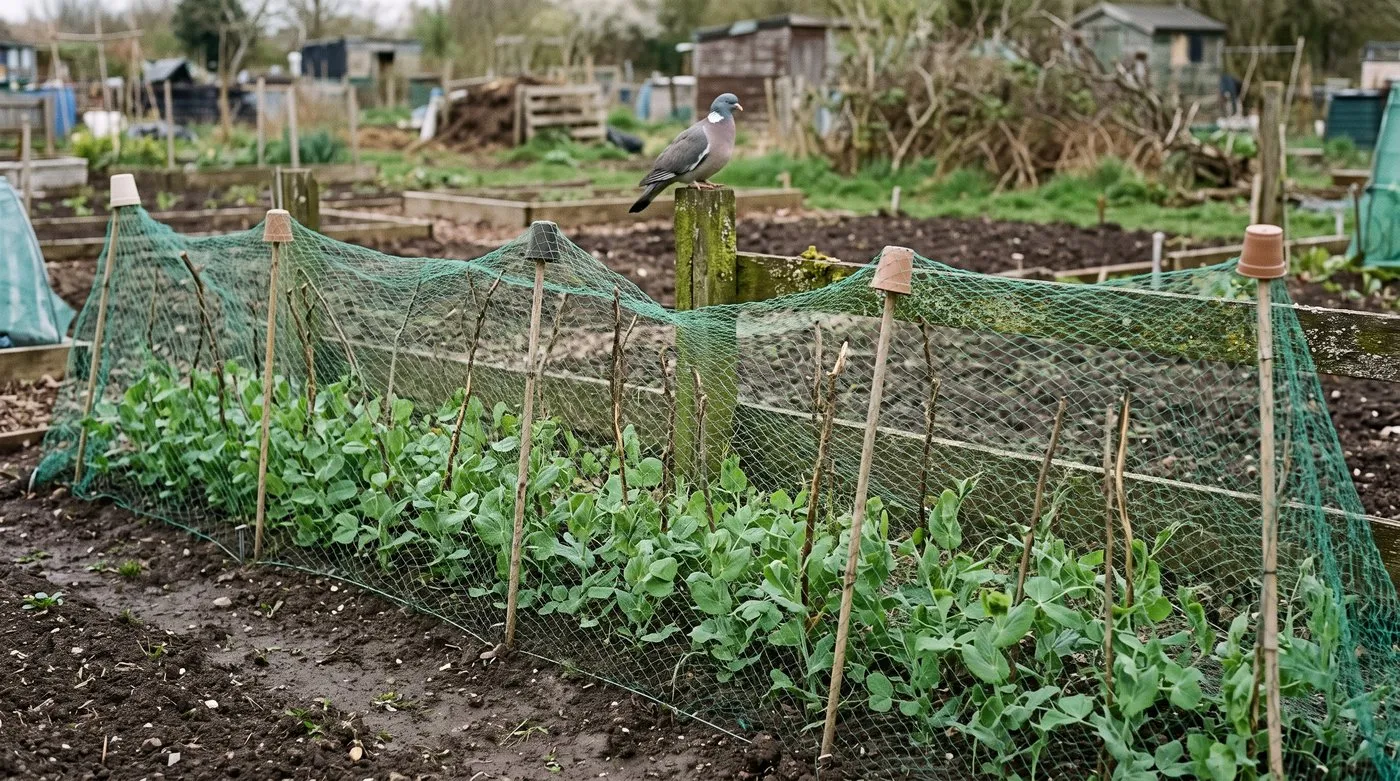
Net peas as soon as they come up and pin the edges down all the way round. Wobbly twiggy pea sticks put pigeons off landing too.
Newly sown seeds
Pigeons pick pea, bean and sweetcorn seeds straight off the soil. Cover new rows with fleece or netting until the seedlings are 10-15cm tall.
Pigeon calendar
| Month | What pigeons are doing | What to do |
|---|---|---|
| January to February | Food is scarce, gardens get hit hard | Net winter brassicas. Clear away spare food. |
| March to April | Nesting, eating seeds and seedlings | Cover seed beds with fleece. Net brassica beds. |
| May to June | Feeding young | Check netting for gaps. Protect soft fruit. |
| July to August | Young birds join the groups | Pick fruit promptly. Add scarers. |
| September to October | Feeding on seeds | Protect autumn-sown crops. |
| November to December | Food scarce again | Keep winter brassicas fully netted. |
Common pigeon mistakes
1. Relying on a fake owl. On its own, it stops working within a week. Pigeons are clever and soon twig that it never moves. Always use netting too.
2. Leaving gaps in netting. Pigeons will find any gap and squeeze through or walk under. Pin it down everywhere and check for holes.
3. Feeding birds on the ground. Ground feeding brings in pigeons. Switch to caged hanging feeders.
4. Buying ultrasonic gadgets. There’s little good evidence they work on pigeons. Spend the money on netting instead.
5. Waiting until the damage is done. Put netting up when you plant, not after pigeons have found the food. It’s much harder to shift them once they know where the dinner is.
Frequently asked questions
Is it legal to kill pigeons in the UK?
Not without meeting the conditions of a licence. All wild birds, pigeons included, are protected by law. General licences allow pigeons to be killed only in specific situations, such as preventing serious crop damage, and only after non-lethal methods have failed. In a garden, keeping them off is the right answer.
What is the best pigeon deterrent for a vegetable garden?
Netting held on a frame above the crop. Keep it at least 30cm above the plants so pigeons can’t peck through, and peg it down at the edges. It lets rain, light and insects through but keeps pigeons out.
Do ultrasonic pigeon deterrents work?
Not really, as there’s little good evidence they work. Pigeons don’t hear high-pitched ultrasound well. Noisy alarm-type devices may work for a short while before the birds get used to them. Netting is far more reliable.
Will a fake owl scare pigeons away?
Only for a few days. Pigeons soon work out it’s not real. Owls with moving heads or wings last a little longer. Move it every few days and use it alongside netting rather than on its own.
How do I stop pigeons sitting on my fence?
Fit anti-roosting spikes along the top. For something less obvious, use a tensioned wire just above the fence top. Cover the full length, as pigeons will land on any gap.
What damage do pigeons cause in gardens?
They strip brassicas, peas, beans and lettuce. They’ll eat cabbage leaves down to the stalks, gobble pea and bean shoots and peck at soft fruit. Their droppings also mess up paths, patios and garden furniture.
How do I protect my brassicas from pigeons?
Build a netted cage over the bed. Use canes or hoops tall enough that the netting sits well above the leaves, and peg it down at ground level. On raised beds, a permanent frame with a lift-up panel makes life easy.
Do pigeons carry diseases?
Yes, their droppings can carry germs that make people ill. So wear gloves when cleaning up droppings. Dampen them first rather than sweeping them dry, to avoid breathing in dust. Wash your hands well afterwards.
Our team produces practical UK gardening guidance from source research, contributor records and established horticultural practice. Editorial standards are overseen by Matt W.


