
Key takeaways
- Evergreens keep your garden looking full in winter when everything else is bare
- Sarcococca and Mahonia give scented flowers in the depths of winter
- Aucuba and Fatsia cope with deep shade where most shrubs sulk
- Most need just one light trim a year, straight after flowering
- Plant in autumn, from September to November, for the best start
- Mix five or six different shrubs for something to enjoy every month
Evergreen shrubs keep your garden looking alive in winter. While everything else dies back, they hold their shape and colour. A garden without them looks full in June and empty in January. With a few good evergreens, it looks furnished all year.
The ten shrubs below are all tough, reliable choices for British gardens. Between them they cover sun, shade, dry soil, clay and windy spots. Some flower in winter, others earn their place with leaves, berries or a bold shape. For shady spots in particular, see our guide to the best plants for shade.
Shrubs for winter flowers and fragrance
These evergreens flower when almost nothing else does. They feed early bees and fill the air with scent on still, frosty mornings. Plant them by doors, paths and benches so you catch the perfume as you pass. Our winter flowering plants guide has more winter colour ideas.
Mahonia
Mahonia x media ‘Charity’ is the one to grow. Upright spikes of bright yellow, honey-scented flowers appear from November to February, above spiky, holly-like leaves that stay green all year. It grows to about 3-4m and copes with shade, dry soil and cold.
Mahonia aquifolium (Oregon grape) is shorter, about 1-1.5m, and handy as ground cover or a low hedge. Birds love its blue-black berries. Both put up with neglect. To keep them bushy, cut one in three of the oldest stems down to the base after flowering.
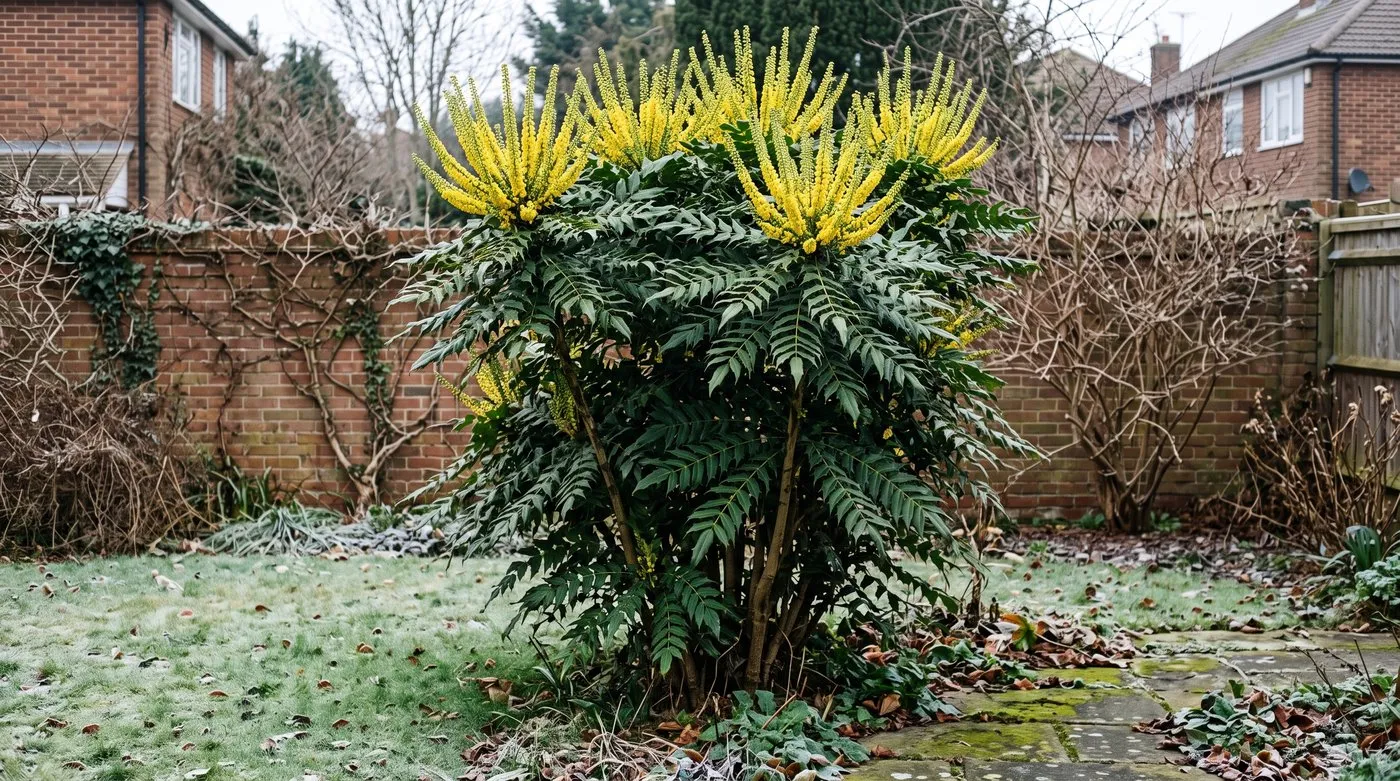
Mahonia ‘Charity’ flowers from November to February and copes with shade and dry soil. Plant it where you’ll catch its honey scent on a winter walk to the door.
Viburnum tinus
Viburnum tinus ‘Eve Price’ flowers from October all the way to April. Pink buds open to clusters of small white flowers against dark, glossy leaves. It grows into a neat, rounded shrub about 2-3m tall and wide without any pruning.
It’s almost impossible to kill. Sun or part shade, coastal wind, clay or chalk: it’s happy with the lot. Birds eat the blue-black berries. Use it as a hedge, a screen or a single shrub, and trim it after flowering in April if it needs it.
Sarcococca (Christmas box)
Sarcococca confusa is all about scent. From December to February, tiny white flowers give off a sweet perfume that carries several metres on cold air. The shrub itself is modest, a neat dome about 1-1.5m tall with glossy leaves and small black berries.
It loves shade, even the dry shade under trees where little else flowers. Plant it by the front door, along a path or under a window. It needs no pruning and no fuss. For a low, scented hedge, space plants 60cm apart. For winter scent in a shady garden, it’s hard to beat.
Shrubs for structure and form

For year-round shape, Rhododendron, Photinia and Fatsia are the stars. They give a solid backbone to a cottage garden planting scheme or a more formal design.
Rhododendron
Rhododendrons are the showstoppers of spring, and their leaves give structure for the rest of the year. For small gardens, choose compact ones like ‘Christmas Cheer’ (about 1.5m) or ‘Cunningham’s White’ (about 2m). Big ones like ‘Pink Pearl’ grow to 3-4m.
They need acid soil. If your soil is chalky or limy, grow them in big pots of ericaceous compost. They like dappled shade and shelter from cold, drying winds. Their roots are shallow, so mulch every year with bark or leafmould to keep them moist. Snap off faded flower heads carefully, without damaging the buds just below.
Photinia x fraseri ‘Red Robin’

Photinia is grown for its leaves, not its flowers. New shoots come out a glossy bright red in April and May, as eye-catching as any blossom, against the older dark green leaves. Left alone it reaches 3-4m, but it takes clipping well.
Trim in late May once the red shoots turn green. A lighter trim in August often brings another flush of red in early autumn. It makes a great hedge, screen or single shrub. Give it sun or part shade and well-drained soil, and shelter young plants from harsh east winds. Avoid wet clay, where the roots can rot.
Fatsia japonica
Fatsia japonica is the boldest evergreen you can grow. Its huge, glossy, hand-shaped leaves give a tropical look. Round white flower heads appear in October and November, followed by black berries. It grows about 2-3m tall and wide.
It’s brilliant in shade, even against a north wall. Once settled, it copes with town air, salty coastal wind and dry spells. Leaf tips may brown in exposed spots, so a sheltered corner is best. It looks great in a big pot by the door, or under trees with ferns and hostas for a lush woodland feel.
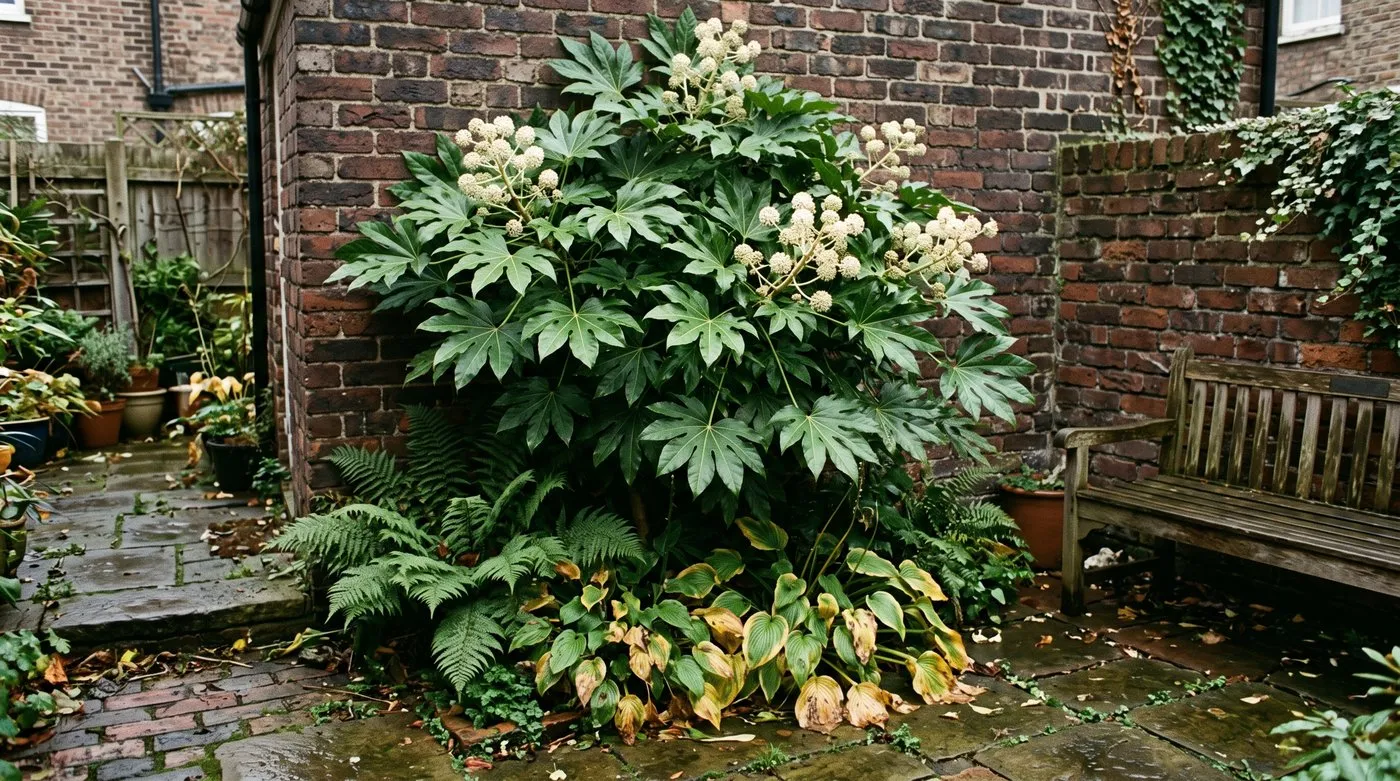
Fatsia is brilliant in shade, even against a north wall, and copes with town air. A sheltered corner stops the leaf tips browning.
What Can I Use Instead of Box?
Yew, Japanese holly (Ilex crenata), Euonymus, Lonicera nitida and Sarcococca are the most reliable swaps for box. All clip into low hedges or simple shapes.
Box has been hit hard by box blight and box tree caterpillar. The RHS guide to box alternatives says keeping on top of both isn’t realistic long term. Yew is the closest match for dense, dark clipped growth, and it bounces back from hard cutting. Ilex crenata looks very like box but needs neutral to acid soil. Lonicera nitida grows fast and needs trimming two or three times a year. For more ideas, see our guide to box hedge alternatives.
Shrubs for difficult spots and ground cover
For deep shade, poor soil and easy ground cover, Aucuba, Euonymus fortunei and Skimmia are the ones to go for.
Aucuba japonica (spotted laurel)
Aucuba japonica ‘Crotonifolia’ has bold, gold-spotted leaves that brighten the darkest corners. It copes with deeper shade than almost any other shrub, even the dry, rooty ground under big trees. Female plants have bright red berries if a male plant is nearby. It grows to about 2-3m.
It shrugs off neglect, town air, coastal wind and cold, and grows in any soil except waterlogged ground. Prune in April back to a leaf joint. For berries without needing two plants, choose ‘Rozannie’, a compact variety that berries on its own.
Euonymus fortunei
Euonymus fortunei is a great low evergreen. ‘Emerald Gaiety’ has green leaves edged in white and grows about 60cm tall and 1m wide. ‘Emerald ‘n’ Gold’ has gold edges. Both make lovely ground cover, edging or a mini hedge.
It grows in sun or shade, in most soils, and copes with windy, exposed spots. Use it to fill gaps at the front of a border, edge a path or cover bare ground under taller shrubs. Planted by a wall, it will even climb to 2m or more. Trim in late spring to keep it neat and bushy.
Skimmia japonica

Skimmia is a neat, dome-shaped shrub about 1-1.2m tall. Male plants like ‘Rubella’ carry red flower buds all winter, opening to scented white flowers in March. Female plants have bright red berries from autumn into spring. Plant one of each for the full show, or choose ‘Reevesiana’, which berries on its own.
It likes part shade and acid to neutral soil. On chalky ground the leaves turn yellow, so grow it in a pot of ericaceous compost instead. It needs almost no pruning. Lovely in a pot by the door or with heathers and rhododendrons.
Which Evergreen Shrubs Suit Full Sun and Dry Soil?
Pittosporum tenuifolium, Elaeagnus x ebbingei, Cistus, rosemary, Phlomis fruticosa and hebes all love hot, dry, sunny spots. Most come from Mediterranean or coastal places.
They need free-draining soil more than they need feeding. On heavy clay they can rot in wet winters, so add grit or plant on a slope. Elaeagnus x ebbingei is the toughest, coping with wind, salt and poor soil, with small scented flowers in autumn. Pittosporum makes a neat screen in southern and coastal gardens but can be damaged in a hard winter. Small-leaved hebes are tougher than large-leaved ones. Cistus and rosemary don’t like being cut into old wood, so trim them lightly after flowering.
Shrubs for year-round fragrance
Choisya ternata smells good from both its leaves and its flowers, so it joins the winter-scented Sarcococca and Mahonia above.
Choisya ternata (Mexican orange blossom)
Choisya ternata has glossy leaves that smell sharp and fresh when you brush them. White, starry flowers with a sweet orange-blossom scent appear in May, and often again in September. It grows into a neat, rounded shrub about 2-2.5m tall and wide.
Give it a sunny, sheltered spot and well-drained soil. It dislikes cold, wet clay. A south or west wall keeps off the worst winter winds. ‘Sundance’ has yellow-green leaves but fewer flowers. ‘White Dazzler’ is compact, about 1.5m, and flowers freely. Trim lightly after the spring flowers.
Evergreen shrub comparison table
| Shrub | Height | Flowers | Best for | Position |
|---|---|---|---|---|
| Mahonia x media ‘Charity’ | 3-4m | Yellow, Nov-Feb | Winter scent | Shade to part sun |
| Viburnum tinus ‘Eve Price’ | 2-3m | White and pink, Oct-Apr | Longest flowering | Sun or part shade |
| Sarcococca confusa | 1-1.5m | White, Dec-Feb | Winter scent | Shade, even dry shade |
| Rhododendron (compact) | 1.5-3m | Many colours, Apr-Jun | Spring flowers | Dappled shade, acid soil |
| Photinia ‘Red Robin’ | 3-4m | Not showy | Red spring leaves | Sun to part shade |
| Fatsia japonica | 2-3m | White, Oct-Nov | Bold leaves | Shade, even deep shade |
| Aucuba japonica | 2-3m | Not showy | Deepest shade | Anywhere |
| Euonymus fortunei | 0.6m | Not showy | Ground cover | Sun or shade |
| Skimmia japonica | 1-1.2m | White, Mar-Apr | Winter buds and berries | Part shade, acid soil |
| Choisya ternata | 2-2.5m | White, May and Sep | Scented flowers and leaves | Sunny, sheltered |
Handy tip: Water new evergreens once a week through their first winter if it’s dry. Unlike deciduous shrubs, they keep losing water through their leaves all winter. A young plant can dry out in a cold, dry February wind even when the soil looks damp on top.
How to plant evergreen shrubs
Autumn is the best time. The soil is still warm, rain is more reliable, and planting between September and November gives roots months to settle before spring. March and April are the next best.
Dig a hole twice as wide as the root ball and just as deep. Mix the soil you dug out with a good handful of garden compost. Set the plant at the same depth it was in its pot, firm it in gently and water well. Spread a thick mulch of bark or compost around it, keeping it a few centimetres off the stem.
On heavy clay, mix some grit into the soil to help drainage. On thin chalky soil, add plenty of compost to hold moisture. For acid-lovers like Rhododendron and Skimmia, check your soil with a simple kit from the garden centre first.
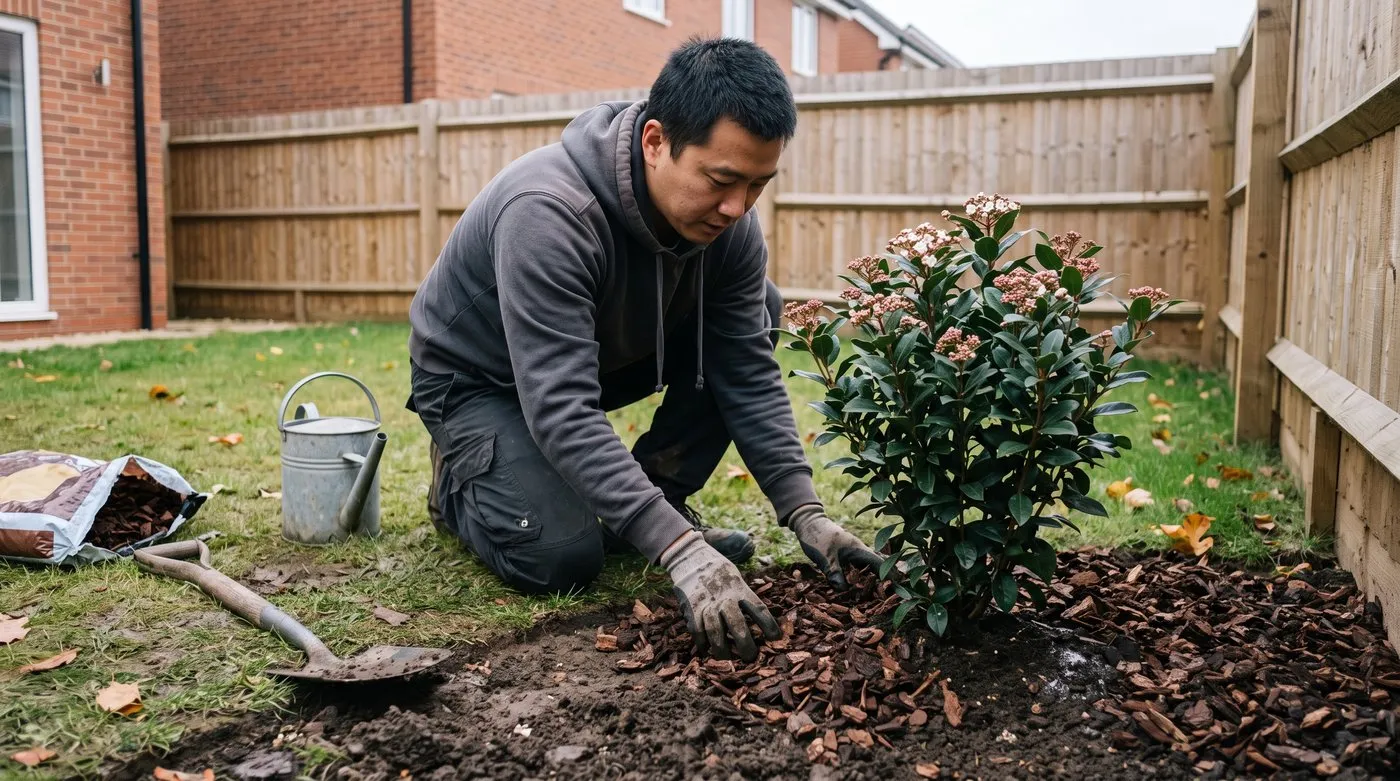
Autumn planting gives roots months to settle before spring. Mulch thickly after watering in, keeping it a few centimetres off the stem.
What Are the Best Evergreen Shrubs for a Small Garden?
Pick evergreens that stay under about 1.2m and look good all year. Sarcococca hookeriana var. humilis, Skimmia japonica ‘Rubella’, Pittosporum tenuifolium ‘Golf Ball’ and Euonymus fortunei are all great choices.
Sarcococca hookeriana var. humilis is a dwarf Christmas box about 60cm tall, with winter scent in shade. ‘Rubella’ gives red buds from autumn to spring and is perfect in a pot by the door. ‘Golf Ball’ makes a neat green ball about 1m tall in sun. On acid soil or in ericaceous compost, Pieris japonica ‘Little Heath’ adds variegated leaves and spring flowers at about 60cm. In a small space, one or two good evergreens beat several big ones you’re always cutting back.
Pruning evergreen shrubs
Most evergreens need much less pruning than deciduous shrubs. The simple rule: prune just after flowering. For spring-flowering Choisya and Rhododendron, that’s late May or June. For winter-flowering Mahonia and Sarcococca, it’s late March or April. Our guide to pruning shrubs has more on technique.
Photinia and Aucuba are grown for leaves, so trim them in late spring once the new growth has firmed up. Photinia can be clipped as a formal hedge two or three times a year. An overgrown Aucuba can be cut right back to about 30cm in April and will regrow.
Don’t prune evergreens in autumn or early winter. Any new growth it triggers can get hit by frost. Dead or damaged branches are the exception: cut those out whenever you see them.
Designing with evergreen shrubs
The best evergreen plantings mix heights, leaf shapes and seasons. Five or six different shrubs give you something to look at every month.
Put tall, bold shrubs like Fatsia or Mahonia at the back. Use medium ones like Viburnum tinus and Choisya in the middle, and edge with low Euonymus fortunei and Sarcococca. Even a narrow border along a fence gains depth this way.
Evergreens make a perfect backdrop for seasonal perennials and bulbs. Snowdrops, daffodils and tulips really pop against the dark leaves of Viburnum tinus or Aucuba. In summer the evergreens hold the border together while the perennials bring colour. In winter, the evergreens are the garden.
For a formal look, clip Photinia or Choisya into shapes or hedges. For a relaxed look, let Mahonia, Fatsia and Sarcococca grow naturally. Both work. Just get the evergreen framework in first and add seasonal colour around it.
Which Evergreen Shrubs Are Best for Wildlife?
Holly, Mahonia, Pyracantha and Viburnum tinus are the best evergreens for wildlife. They offer winter nectar, berries and thick cover for birds.
Mahonia flowers in winter, when early bumblebee queens are hungry. Native holly feeds thrushes and blackbirds with its berries, and holly blue butterflies lay their eggs on its spring flowers. Pyracantha is loaded with berries, and its thorns keep nesting birds safe. Dense evergreens also give small birds shelter on cold nights. Avoid trimming them from March to August, when birds are likely to be nesting. Active nests are protected by law, as our guide to when to cut hedges explains.
Common problems with evergreen shrubs
Most problems come down to winter wind, the wrong soil, no pruning or wet ground.
Brown leaves in winter are usually from wind or dryness, not cold. Evergreens lose water through their leaves all winter but can’t replace it if the ground is frozen or the roots are new. Water young plants in dry winter spells, and keep tender ones out of cold east winds.
Yellow leaves on Rhododendron or Skimmia mean the soil is too limy for them. Feed with ericaceous feed and mulch with pine bark. If that doesn’t help, move the plant into a pot of ericaceous compost. Checking your soil before planting avoids the problem.
Leggy, bare stems at the bottom of Mahonia or Viburnum happen when they’re never pruned. In April, cut a third of the oldest stems to the base, and repeat for three years. The shrub stays looking decent while new shoots fill in from below.
Root rot can hit Rhododendron, Viburnum and Choisya in waterlogged ground. Look for wilting even though the soil is wet, dark stem bases and branches that suddenly die. There’s no cure, so sort out drainage before planting, don’t overwater, and remove affected plants quickly.
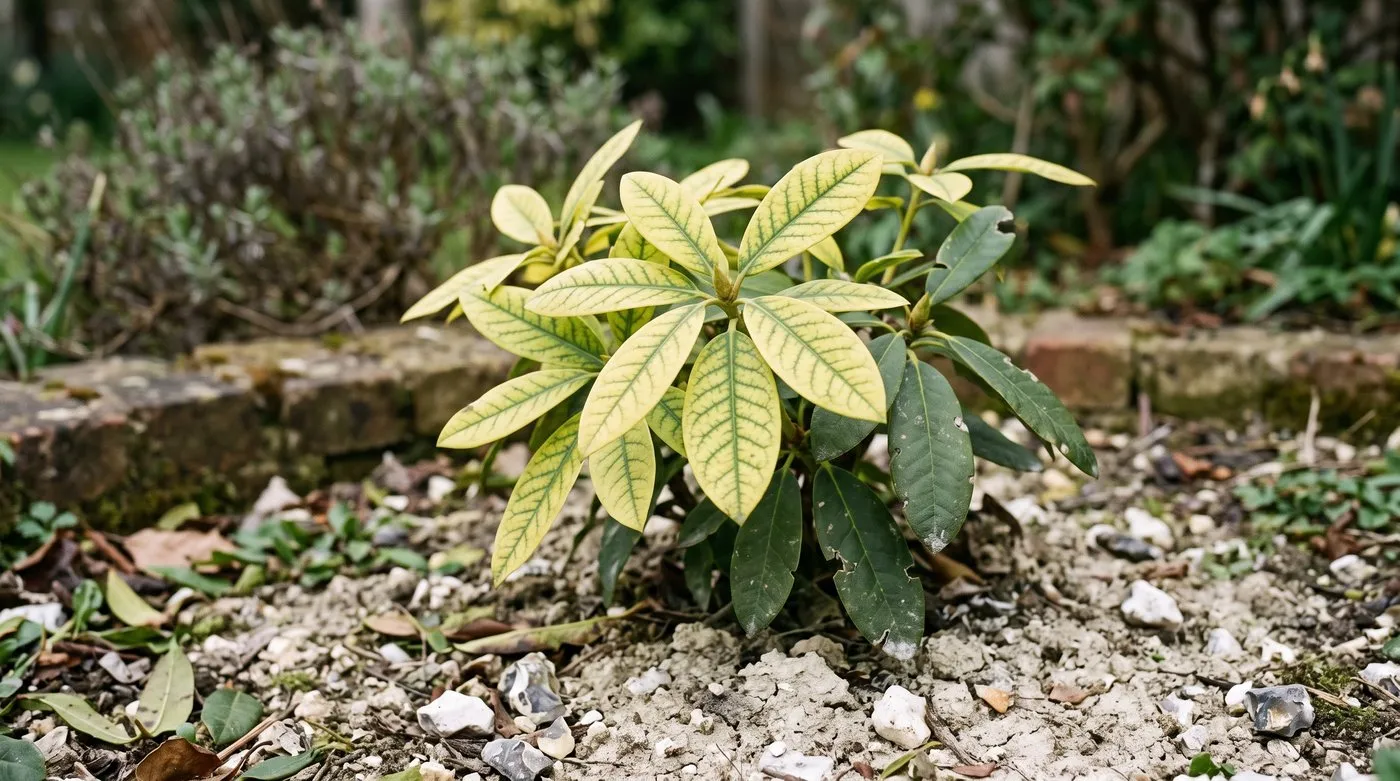
Yellow leaves with green veins on a rhododendron or skimmia usually mean the soil is too limy. Try an ericaceous feed and pine bark mulch, or move it into a pot.
Month-by-month evergreen shrub shows
Grow a mix of the ten shrubs above and you’ll have flowers, berries or bright leaves every month.
| Month | What’s looking good |
|---|---|
| January | Mahonia in flower, Sarcococca at peak scent, Viburnum tinus flowering |
| February | Sarcococca and Mahonia still flowering, Skimmia ‘Rubella’ buds at their reddest |
| March | Skimmia flowers open, Aucuba berries bright red, Viburnum tinus still flowering |
| April | Rhododendron buds opening, Photinia’s red shoots start, Choisya buds forming |
| May | Choisya in full flower, Photinia at its reddest, Rhododendron flowering |
| June | Rhododendron finishing, everything in full leaf, trim spring-flowerers now |
| July | Euonymus fresh and neat, evergreens framing summer flowers |
| August | A light Photinia trim now can bring more red shoots, evergreens giving structure |
| September | Choisya flowers again, Aucuba berries forming, Skimmia buds developing |
| October | Viburnum tinus starts flowering, Fatsia in flower, autumn berries |
| November | Mahonia flowers opening, Sarcococca buds swelling, Skimmia buds reddening |
| December | Sarcococca in flower, Mahonia at its best, evergreens holding the winter garden together |
Now you know your evergreens, read our guide on the best winter flowering plants for the next step.
If you need height fast, see our guide to fast-growing shrubs.
Frequently asked questions
When is the best time to plant evergreen shrubs?
Autumn, from September to November, is the best time. The soil is still warm enough for roots to grow, and the cooler air means the leaves lose less water. Spring, from March to April, works too. Pot-grown shrubs can go in at any time, but summer planting means a lot more watering. Don’t plant into frozen or waterlogged ground.
Do evergreen shrubs lose their leaves in winter?
No, they keep their leaves all winter. They drop a few old leaves here and there through the year, so they always look fully clothed. In a really hard frost, leaf edges may brown or curl, but they recover in spring. Semi-evergreens like privet may drop some leaves in a harsh winter and regrow them in spring.
Which evergreen shrubs grow well in shade?
Aucuba japonica copes with the deepest shade of any common shrub. It’s happy even in dry shade under big trees. Sarcococca flowers well in full shade, and Fatsia is great against a north wall. Skimmia prefers part shade and can scorch in full sun. For dappled shade, Rhododendron and Viburnum tinus do well. Photinia and Choisya need more light.
How do I prune evergreen shrubs?
Trim most of them once a year, just after flowering. Prune Choisya and Rhododendron in late spring when they finish flowering, and Photinia in late May once the red shoots turn green. Prune Mahonia and Sarcococca in late March. Cut just above a leaf joint with sharp secateurs. Avoid autumn pruning, as the new growth it triggers can be hit by frost.
Can evergreen shrubs grow in pots?
Yes, plenty of compact evergreens do well in pots. Sarcococca, Skimmia, Euonymus fortunei and compact Choisya all suit a large container. Use a loam-based compost like John Innes No 3, which is heavy enough to stop the pot tipping. Water regularly, even in winter. Feed with slow-release fertiliser each April, top up with fresh compost every year and repot every few years.
Which evergreen shrubs have fragrant flowers?
Sarcococca has the strongest winter scent, from December to February. Mahonia has honey-scented yellow flowers through the winter. Choisya ternata has orange-blossom-scented flowers in May, and Viburnum tinus smells faintly sweet on mild winter days. For scent all year, plant Sarcococca by a winter path and Choisya where you sit in summer.
How fast do evergreen shrubs grow?
It depends on the shrub, from slow to fairly quick. Photinia ‘Red Robin’ is one of the fastest. Viburnum tinus and Choisya grow at a steady pace, while Sarcococca and Skimmia are slow. Rhododendrons grow best in moist, acid soil. Good soil preparation, autumn planting and a yearly mulch all help them settle in faster.
Are evergreen shrubs deer resistant?
Several common evergreens are usually left alone by deer. Mahonia’s spiky leaves put deer off, and Aucuba and Fatsia are rarely touched. Rhododendron leaves are poisonous, so deer tend to leave them. Choisya’s strong-smelling leaves help too. Skimmia and Euonymus get nibbled more often, so protect them with netting where deer visit. No plant is completely deer proof.
Our team produces practical UK gardening guidance from source research, contributor records and established horticultural practice. Editorial standards are overseen by Matt W.


