Key takeaways
- Ilex crenata 'Dark Green' looks most like box, and clipping twice a year keeps it neat
- Ilex crenata hates waterlogged soil, so pick another hedge for wet clay
- Lonicera nitida is cheap and quick but needs clipping three times a year
- Yew copes with shade, clay and chalk, but it's toxic, so keep it away from horses and grazing animals
- Pittosporum and hebe only suit mild gardens, mostly in the south and west
- Clear out diseased box and its fallen leaves before you replant
Box was the go-to low hedge in British gardens for centuries. Then box blight arrived, and box tree caterpillar followed. Between them they’ve wrecked box hedges up and down the country. The good news is there are some lovely replacements, and most garden centres now stock several.
Why box has struggled in UK gardens
Box blight is a fungus that turns leaves brown, makes them drop in patches and causes stems to die back. It loves warm, wet weather, and the spores hang around in soil and fallen leaves for years, coming back every damp summer.
On top of that, box tree caterpillars can strip a hedge bare. A hedge that dodges blight can still get eaten, and the other way round. For help with the caterpillar, see our box tree moth guide. For most gardens, the simplest answer is to switch to a different plant.
The 8 best box hedge alternatives at a glance
| No. | Plant | Leaf size | Growth | Clips a year | Soil | Hardiness | Cost |
|---|---|---|---|---|---|---|---|
| 1 | Ilex crenata ‘Dark Green’ | Small | Medium | 2 | Most, not wet | Hardy | £££ |
| 2 | Euonymus japonicus ‘Jean Hugues’ | Medium | Medium | 2-3 | Well-drained | Hardy | ££ |
| 3 | Lonicera nitida ‘Maigrun’ | Small | Fast | 3 | Most | Hardy | £ |
| 4 | Pittosporum tobira ‘Nanum’ | Larger | Slow | 1-2 | Free-draining | Mild areas only | £££ |
| 5 | Compact Berberis darwinii | Small, spiny | Medium | 2 | Most | Hardy | ££ |
| 6 | Yew ‘Repandens’ | Small needles | Slow | 1-2 | Most, even chalk | Very hardy | ££ |
| 7 | Hebe ‘Sutherlandii’ | Small | Medium | 1-2 | Free-draining | Mild areas only | ££ |
| 8 | Yew, clipped low | Small needles | Medium | 1-2 | Most, even chalk | Very hardy | £ |
Choose for your soil and where you live first, then for looks. A pittosporum that thrives in Cornwall may not make it through a winter in Aberdeen. If you’re replanting a knot garden, the same order works: Ilex crenata first, then euonymus.
1. Ilex crenata ‘Dark Green’ looks most like box
Ilex crenata, or Japanese holly, is the favourite box replacement. The variety ‘Dark Green’ has small, dark, glossy leaves that clip into almost exactly the same look as box. From a few steps away, most people can’t tell the difference.
It grows a little slower than box. Clip twice a year, in mid-May and late August, for a sharp edge. It’s happy in most soils as long as they drain. In heavy clay that stays wet all winter it can get root rot, so pick something else for soggy spots.
It’s one of the pricier options, and it settles in better from pots than as bare-root plants. For more on the holly family, see our holly growing guide.
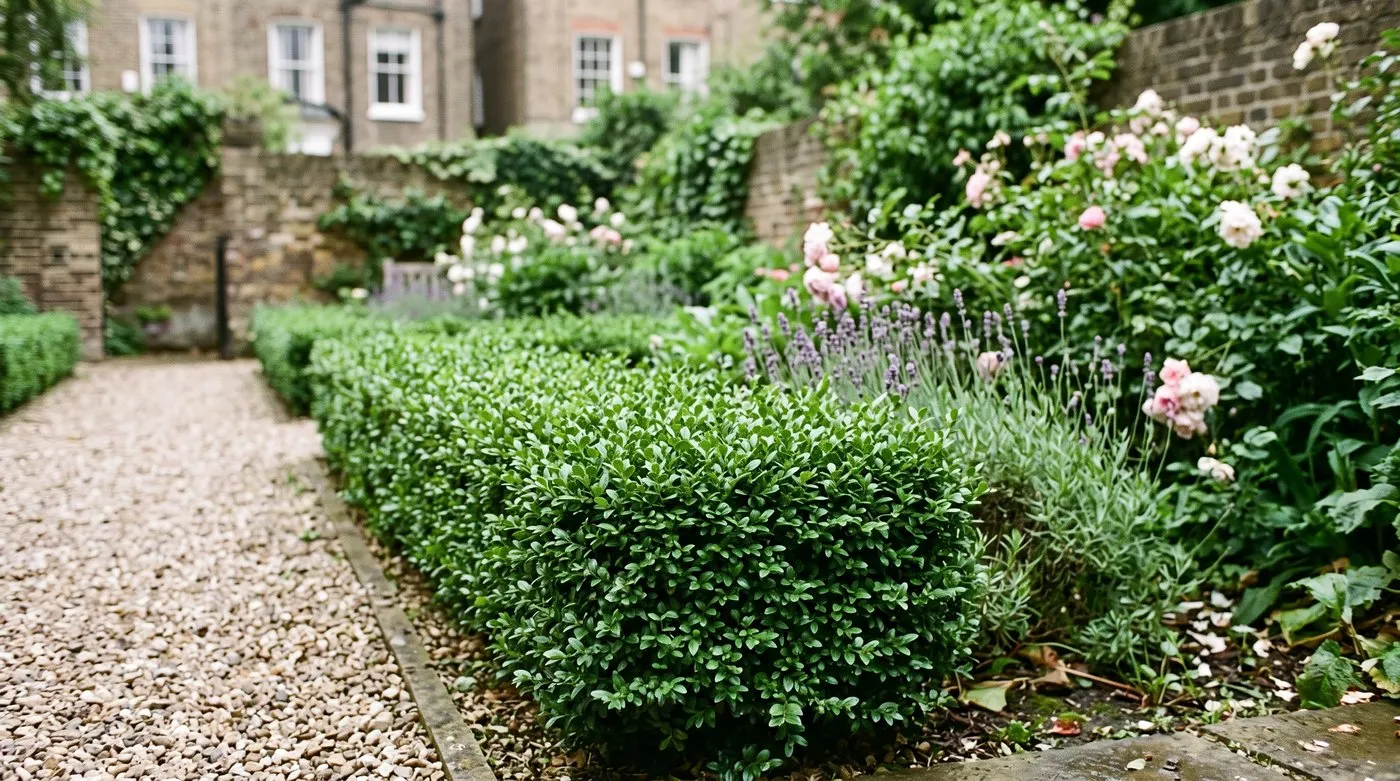
From a few steps away, a clipped Ilex crenata hedge passes for box. It needs soil that drains, so avoid soggy clay.
2. Euonymus japonicus ‘Jean Hugues’
Euonymus japonicus ‘Jean Hugues’ is the next closest match. Its leaves are a bit bigger and glossier than box, giving a brighter green, and it’s dense, compact and takes clipping well.
The one thing to watch for is euonymus scale, a tiny insect that leaves white flecks on stems and under leaves. Act as soon as you spot it: cut out and bin badly affected shoots. If you need more help, use an authorised product exactly as the label says. Our euonymus growing guide has the full care routine.
 A low hedge of Euonymus japonicus ‘Jean Hugues’. Two or three clips a year keep it crisp.
3. Lonicera nitida ‘Maigrun’
Lonicera nitida ‘Maigrun’, or box honeysuckle, is the cheapest and fastest box alternative. Its leaves are small, much like box, and it grows about 30cm a year once settled. Bare-root whips are inexpensive. Plant 4 to 6 per metre.
The catch is clipping three times a year instead of two. It puts on a burst of growth in spring, another in summer and a third in late August. Miss one and it looks shaggy by autumn.
It’s a little brittle too, and heavy snow can split it open. Knock snow off promptly. If it does get damaged, it regrows from the base after a hard cut. Our hedge planting guide covers bare-root planting.
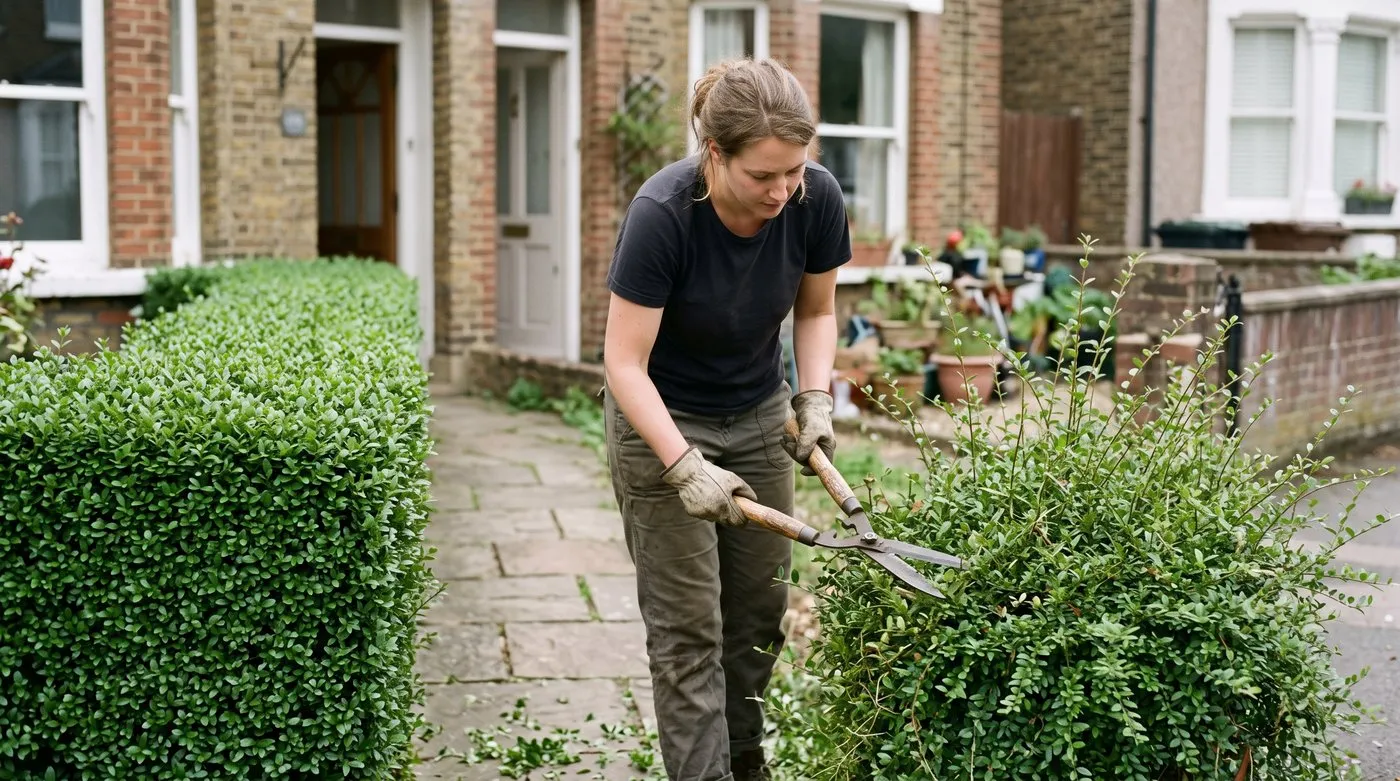
Lonicera nitida grows in three bursts a year, so it needs three clips. Miss one and it looks shaggy by autumn.
4. Pittosporum tobira ‘Nanum’
Pittosporum tobira ‘Nanum’ is the most eye-catching choice, but it needs mild weather. It has glossy dark leaves, a neat dome shape and sweetly scented creamy flowers in early summer. Think of it as box on holiday.
Choose it only for mild gardens, especially near the coast in the south and west, with soil that drains well. Plant in March or April once frosts are over, and clip once or twice a year. Our pittosporum growing guide covers the wider family.
 Fresh growth on Pittosporum tobira ‘Nanum’. Lovely in mild gardens, but colder spots need something tougher.
5. Compact Berberis darwinii
A compact Berberis darwinii, kept low with clipping, looks different from box but makes a handsome edge. It has small, dark, glossy, spiny leaves, orange-yellow flowers in spring and dark blue berries.
Clip twice a year, after the spring flowers and again in late summer. It grows in almost any soil, even poor chalk. Wear thick gloves when clipping, as the spines go straight through thin ones.
It’s handy where you want a low evergreen edge that also discourages people cutting across a bed.
6. Yew ‘Repandens’ (dwarf yew)
Taxus baccata ‘Repandens’ is a low, spreading form of English yew. It grows wider than tall but clips into a neat, low hedge. It has dark green needles and that classic churchyard look.
Yew lives for a very long time. It copes with shade better than anything else on this list and grows on chalk, clay or sand. It’s also very hardy.
The downsides are slow early growth and toxicity. All parts of yew, except the red flesh of the berry, are poisonous to people, dogs, horses and livestock. Don’t plant it where horses or grazing animals can reach.
 Low-clipped yew edging a Cotswold path. It’s the best choice here for deep shade.
7. Hebe ‘Sutherlandii’
Hebe ‘Sutherlandii’ is a small-leaved hebe with soft grey-green leaves and a rounded shape. The leaves are about the size of box, but the colour is cooler.
It’s fine through most winters in well-drained soil, but sulks in wet clay or very hard frost. It’s best in southern and western gardens as a soft, low edge rather than a sharp formal hedge.
Plant 4 to 5 per metre and clip once or twice a year. It looks lovely with silver-leaved plants.
8. Ordinary yew, clipped low
In a cold garden, ordinary yew clipped low is the safest pick. Bare-root whips are good value. Plant 4 per metre from November to March.
You can clip yew to any height from about 30cm up. Once settled, after 3 or 4 years, it grows steadily. One clip in late summer is enough, or two if you want it very crisp.
Which hedge suits your garden?
| Your garden | Best pick | Runner-up |
|---|---|---|
| Heavy, wet clay | Yew | Berberis darwinii |
| Free-draining loam | Ilex crenata | Euonymus japonicus |
| Chalk | Yew | Berberis darwinii |
| Sandy soil | Lonicera nitida | Hebe ‘Sutherlandii’ |
| Deep shade | Yew | Ilex crenata |
| Mild coast, south west | Pittosporum tobira | Euonymus japonicus |
| Cold, frosty north | Yew | Ilex crenata |
| Tight budget | Lonicera nitida | Bare-root yew |
| Formal parterre | Ilex crenata | Euonymus japonicus |
Month-by-month UK box alternative calendar
| Month | What to do |
|---|---|
| January | Plant bare-root lonicera, yew and berberis if the ground isn’t frozen. |
| February | Keep planting bare-root. Order potted plants for spring. |
| March | Last chance for bare-root. Plant pittosporum and hebe once frosts pass. |
| April | Spread leaf mould or composted bark around new hedges. |
| May | First clip of the year for Ilex crenata, euonymus, berberis and lonicera. |
| June | Feed if growth is slow. Look for scale on euonymus. |
| July | Light clip for lonicera and euonymus. Check any box nearby for caterpillars. |
| August | Main clip for Ilex crenata and berberis. Third lonicera clip. |
| September | Clip yew before winter. |
| October | Last chance to plant potted pittosporum and hebe. |
| November | Bare-root season starts. On clay, mix grit into planting holes. |
| December | Plant potted hedges on well-drained ground. Protect pittosporum from hard frost. |
Common mistakes
- Planting euonymus in heavy, unimproved clay. It’s prone to root rot in wet soil. Add grit, raise the bed or choose something else.
- Replanting box in the same soil. Blight spores linger for years. Use a clean part of the bed, or replace the top 5cm of soil.
- Choosing pittosporum for a frosty garden. It’s only reliably hardy in mild areas. Further north, go for Ilex crenata or yew.
- Buying tiny plugs for an instant hedge. They’re cheap but take years to fill out. Bigger potted plants fill in much sooner.
- Clipping lonicera only once a year. It grows three times a season, so one late clip leaves it shaggy.
Removing diseased box and switching to a different plant is far more reliable than trying to spray blight away.
For more on planting a hedge, see our full guide. If box tree caterpillars are still munching nearby, our box tree moth guide will help. You’ll find every plant guide in our plants section.
Three things to plan for
- Replanting too soon. Give it time after clearing diseased box, and clear every fallen leaf before you plant.
- Buying unnamed seedlings. Seedling Japanese holly varies a lot in leaf size and habit. Always buy the named variety, ‘Dark Green’.
- Forgetting to mulch in year one. New hedges dry out fast. Spread 50mm of composted bark in April and water through the first dry spell.
Bringing it all together
For most gardens, Ilex crenata ‘Dark Green’ is the one for formal edging, and yew is the answer for heavy or shady spots. Lonicera nitida is the budget pick for quick results. Pittosporum is for mild gardens only. Choose for your soil first, then for the look.
Now you’ve picked your plant, our hedge planting guide covers spacing, soil and bare-root timings.
Frequently asked questions
What is the best alternative to a box hedge in a UK garden?
Ilex crenata ‘Dark Green’ is the best all-rounder. Its small, glossy leaves clip into the same neat shape as box. It’s happy in most soils and copes with some shade, as long as the ground doesn’t stay wet.
Does Ilex crenata get box blight?
No, box blight doesn’t affect it. Its main weakness is root rot in waterlogged soil, so plant it where water drains away. Get that right and it’s one of the safest box replacements around.
How fast does a Lonicera nitida hedge grow?
Fast, about 30cm a year once settled. That makes it the quickest box alternative. It needs three clips a season, roughly May, July and September, to stay tidy. Bare-root whips planted 4 per metre fill in within about three growing seasons.
Is yew a good box hedge replacement?
Yes, yew makes a lovely low evergreen hedge. The spreading form ‘Repandens’ stays low with little pruning. Yew copes with shade, clay and dry chalk. It’s slow to get going, and all parts except the red flesh of the berry are toxic to people, pets and livestock.
How much does it cost to replace a box hedge?
It depends a lot on the plant and pot size. Lonicera nitida whips are the cheapest, while potted Ilex crenata costs far more. Bare-root plants, planted in winter, are always the cheapest way to make a hedge.
Can I plant a box alternative next to existing diseased box?
Yes, but clear out the diseased box first. Remove the plants, fallen leaves and the top 5cm of soil, because blight spores linger for years. Plant into fresh soil or a clean part of the bed. Clean your tools and boots so you don’t carry spores about.
Which box alternative is best for a parterre or knot garden?
Ilex crenata ‘Dark Green’ is the usual choice. Its small leaves and neat habit look the most like box when clipped. For very low edging under 30cm, Lonicera nitida ‘Maigrun’ or a compact Berberis darwinii work well too.
Our team produces practical UK gardening guidance from source research, contributor records and established horticultural practice. Editorial standards are overseen by Matt W.