Key takeaways
- Plant bare-root hedging from November to March, when it's cheapest
- Space most plants 30-60cm apart, or use a staggered double row for a thicker hedge
- Cut thin, sparse plants back by up to a third after planting so they bush out
- Water weekly in dry spells through the first spring and summer
- Check for nesting birds before trimming between March and August
A good hedge outlasts any fence. Beech or yew can stand for generations. Hedges soften noise, slow the wind, give birds somewhere to nest and look better every year. A fence can’t do any of that.
Here you’ll find seven reliable hedge plants, how to choose between bare-root and potted plants, and how to plant, water and trim. Whether you want a crisp formal screen, a wildlife hedge or a low box edge, the method is the same. If you’d rather have trees than a hedge, see our guide to the best trees for privacy.
Choosing the right hedging species
For a formal green hedge, choose beech or hornbeam. For the best evergreen, choose yew. For wildlife, go for hawthorn. Then think about your soil and how much trimming you fancy.
Formal hedges (beech, yew, hornbeam, box, privet) are clipped into a neat shape once or twice a year. Informal hedges (hawthorn, mixed native) are left looser so they flower and fruit. If you already grow bee-friendly plants in your borders, a flowering native hedge fits right in.
Evergreen hedges (yew, laurel, box, privet) screen all year. Deciduous hedges lose their leaves, but beech and hornbeam keep their dry brown leaves through winter, so they still give you some privacy.
Hedge species comparison table
| Hedge plant | Speed | Evergreen? | Soil | Trims a year |
|---|---|---|---|---|
| Beech | Medium | Keeps brown leaves in winter | Well-drained, not wet clay | 1 |
| Yew | Slow | Yes | Any but waterlogged | 1 |
| Hornbeam | Medium | Keeps brown leaves in winter | Any, including wet clay | 1-2 |
| Privet | Fast | Mostly | Any | 2-3 |
| Laurel | Fast | Yes | Most, not very dry chalk | 1-2 |
| Hawthorn | Fast | No | Almost any | 1-2 |
| Box | Very slow | Yes | Well-drained | 2 |
Beech (Fagus sylvatica)
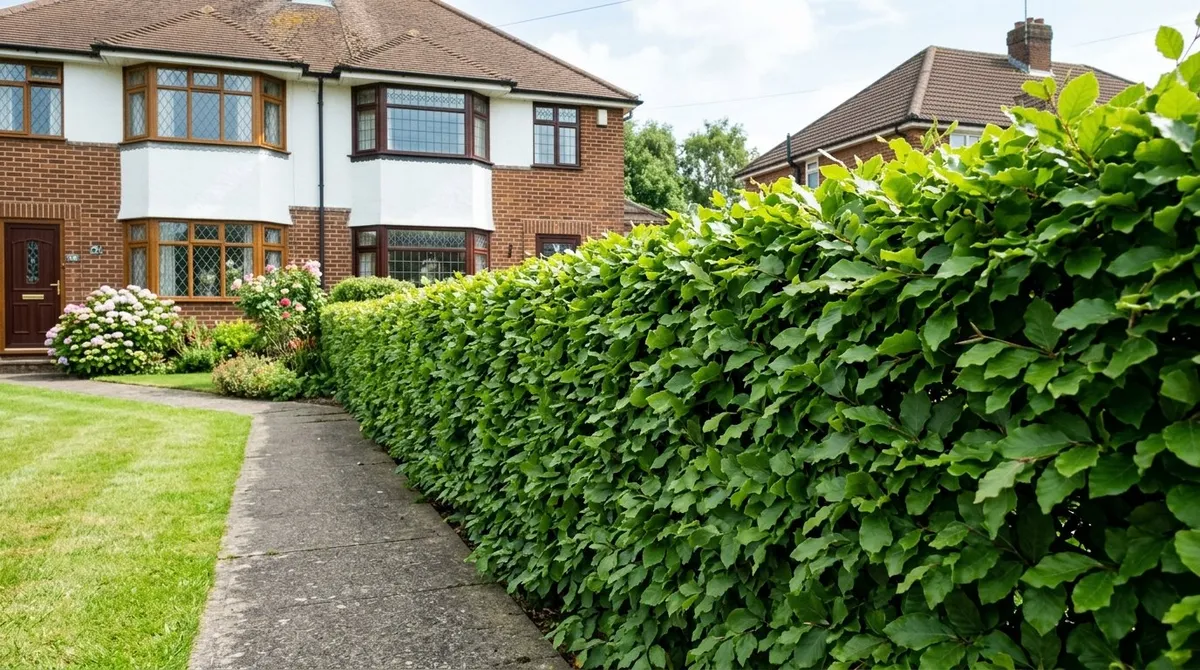
Beech is a favourite for formal hedges because it keeps its leaves through winter. Fresh green leaves open in April, turn copper in October, then cling on until spring. So you get screening all year from a deciduous plant.
You can keep beech anywhere from 1m to 5m tall, though most garden hedges sit at 1.5-2m. Plant 45-60cm apart and trim once, in August.
Beech loves chalk, sand and loam, but hates waterlogged ground. On heavy, wet clay, pick hornbeam instead. Copper beech has deep purple leaves, and a few dotted through a green beech hedge look lovely.

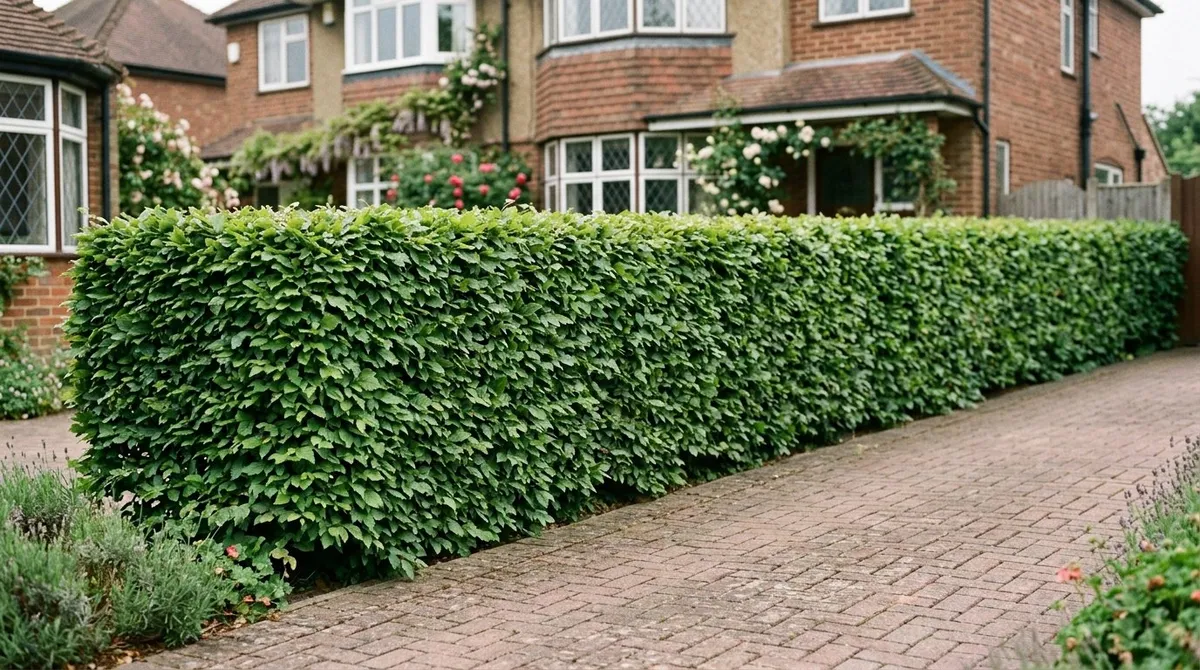
A mature beech hedge in autumn. Those copper leaves hang on all winter.
Yew (Taxus baccata)
Yew makes the finest, densest hedge of any British plant. Some yew hedges at old country houses are centuries old.
It’s slow growing, which means less trimming. One cut in late summer keeps it neat all year. The dark green makes a perfect backdrop for a flower border.
Yew grows on almost any soil, as long as it isn’t waterlogged. It also copes well with deep shade, so it’s great for a north-facing boundary.
All parts of yew are poisonous to people, pets and livestock, apart from the red flesh of the berry (the seed inside is poisonous). Don’t plant it where horses, cattle or goats can reach it. Our guide to pet-safe garden plants has safer choices.
Gardener’s tip: Yew bounces back from hard pruning better than almost any other conifer. If an old yew hedge has got too wide, cut one side back hard in April. It regrows from bare wood, though it may take a couple of seasons to green up. Do the other side the following year.
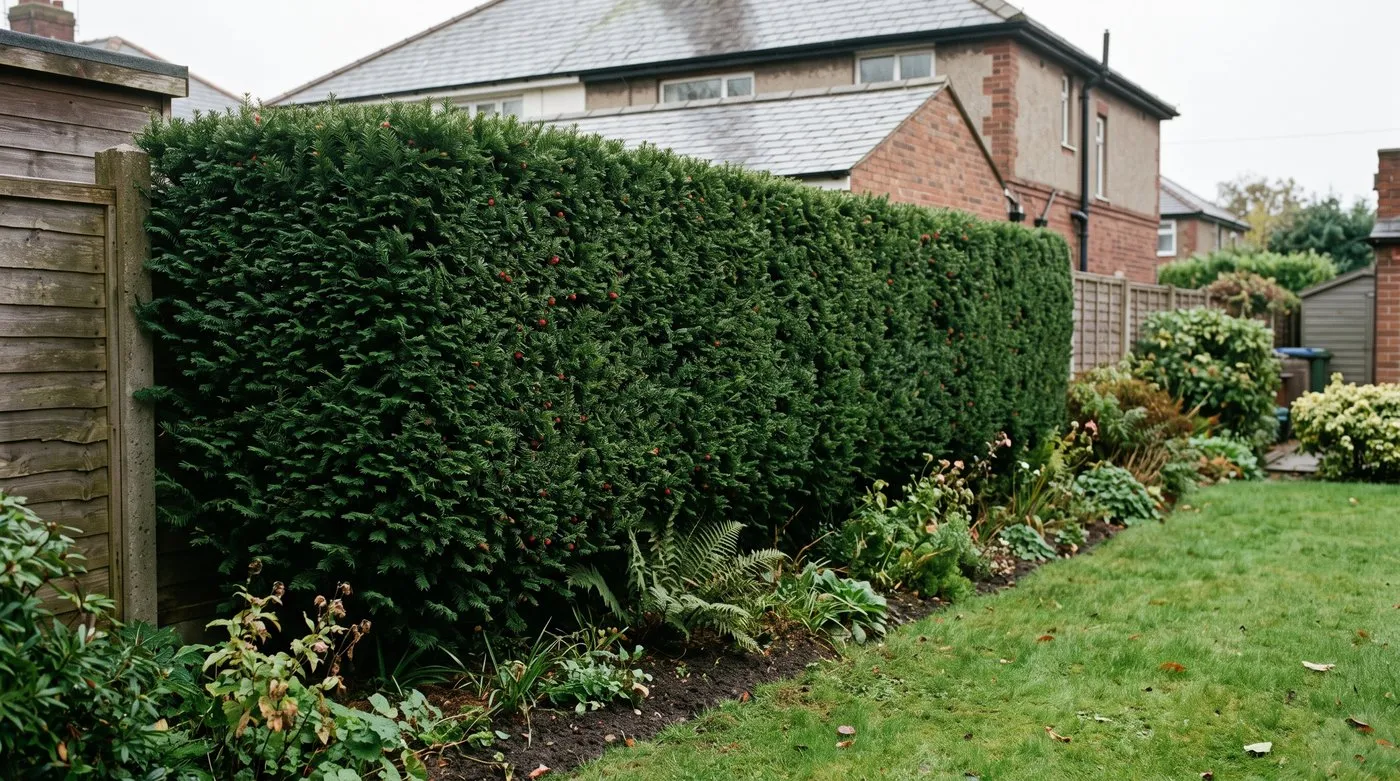
Yew is happy in deep shade, so it’s a smart pick for a gloomy north-facing boundary. Keep it away from spots where livestock or pets might nibble it.
Hornbeam (Carpinus betulus)
Hornbeam is the go-to for heavy, wet clay. Like beech, it holds its brown leaves through winter. The leaves are a little smaller, more crinkled and a lighter green.
It grows at a similar speed to beech and copes with shade, pollution and windy spots. It’s also twiggier at the base, so it’s good at stopping wind at ground level.
On free-draining soil, beech usually looks a touch smarter. On clay or damp ground, hornbeam does much better.
If you garden on clay, our guide to improving clay soil has more ideas. A hornbeam hedge is one of the easiest wins for a clay garden.
Privet (Ligustrum ovalifolium)
Privet is the classic suburban hedge. It grows fast, makes a dense screen and puts up with hard clipping. In mild winters it keeps most of its glossy leaves. In a hard winter it drops them but soon regrows.
The catch is trimming. Privet needs 2-3 cuts a year to stay tidy. Golden privet has cheerful yellow-green leaves. Privet copes with any soil, shade, pollution and seaside air. Our privet hedge care guide covers planting, pruning and rescuing an overgrown one.
Laurel (Prunus laurocerasus)
Cherry laurel is the fastest evergreen hedge. Big glossy leaves make a bold screen that muffles noise and wind. Plant 45-60cm apart. It copes with shade and most soils, but not very dry chalk or waterlogged ground. For more quick options, see these fast-growing hedging plants.
Trim laurel with sharp secateurs rather than a hedge trimmer. A trimmer slices the big leaves in half, and the cut edges go brown and ragged. Cut each shoot just above a leaf. Portuguese laurel is a smarter-looking option with smaller leaves and red stems.
Hawthorn (Crataegus monogyna)
Hawthorn is the backbone of the British countryside hedge. It makes a thick, thorny barrier. Bees love the May blossom, and birds feast on the red berries from September. It’s one of the best hedges for wildlife.
It grows quickly and copes with almost any soil, including heavy clay and thin chalk. It’s happy in windy, exposed and coastal gardens too.
For a mixed native hedge, use mostly hawthorn and add blackthorn, hazel, field maple, dog rose and holly. It’s just like a country hedgerow, with food and shelter all year. The Woodland Trust’s hedge planting guide shows the planting and protection steps.

A young mixed native hedge in spring flower, with hawthorn, blackthorn and field maple.
The thorns can catch children beside a path, but they also make the hedge almost impossible to push through. For a front garden, beech or yew looks tidier.
Box (Buxus sempervirens)
Box is the classic plant for low edging, knot gardens and topiary. It clips into crisp shapes and holds them well. It grows very slowly.
Most box edging is kept at 30-60cm. Two trims a year, in May and August, keep it immaculate. It likes well-drained soil in sun or part shade.
Box blight, a fungal disease, and box tree caterpillar have hit box hard across the UK. Blight causes brown patches, leaf drop and dieback. If they’re common near you, try one of these instead:
- Ilex crenata (Japanese holly) has similar small dark leaves and clips just as neatly.
- Euonymus japonicus ‘Green Spire’ makes a tight column of glossy leaves. Great for low edging.
- Lonicera nitida clips well and grows faster than box, so it needs trimming more often.
Bare-root vs container-grown hedging
For most new hedges, bare-root is the way to go. The plants are much cheaper and settle in well. They’re dug up from nursery fields in winter (November to March) and sent out without soil on the roots. A hedge needs lots of plants, so the saving soon adds up.
Container-grown plants are on sale all year and are usually bigger, so you get a hedge faster. They’re the choice for planting in summer.
Order bare-root plants early from a specialist nursery. If you can’t plant straight away, heel them into a patch of moist soil for a few days.
How many plants? At 30cm spacing you need about 3 per metre (33 for 10m). At 45cm, about 2 per metre (22 for 10m). A staggered double row at 40cm needs 5 per metre. Laurel at 60cm needs fewer than 2 per metre. Order a few extra as spares.
Can you plant a hedge in spring or summer?
Yes, but only potted or root-balled plants, and you’ll need to keep up the watering. The bare-root season ends in late March or early April, when plants start to leaf up.
Potted hedging can go in whenever the ground isn’t frozen or waterlogged. Spring is next best after autumn and winter. Summer is hardest, because new roots can’t keep up in hot, dry weeks. If you plant between May and August, give each plant a good soak two or three times a week in dry spells, mulch well and pick a cool, cloudy day to plant.
Step-by-step planting method
Plant bare-root hedging between November and March in a dug trench, then water and mulch. These steps work for every bare-root hedge plant.
Preparation
Mark the line with string stretched between two canes. Dig a trench about 45cm wide and 30cm deep all along it. It’s quicker than digging lots of holes and the roots spread more easily. Fork over the bottom to loosen it.
On poor soil, mix some well-rotted garden compost into the base. On heavy clay, add some grit to help drainage. Don’t use fresh manure, as it can burn roots.
Planting
- Soak bare-root plants in a bucket of water for 1-2 hours before planting
- Trim off any broken or very long roots with sharp secateurs
- Lay plants along the trench at the right spacing. A marked cane helps keep the gaps even
- For a staggered double row, plant two lines 30cm apart, with each plant set between those in the other row
- Spread the roots out naturally. Don’t bend or coil them to fit
- Fill back in with the soil you dug out, firming round each plant with your foot
- Make sure the soil mark on each stem sits at ground level. Too deep can kill the plant
- Water the whole row well, about a bucketful per plant
- Mulch both sides with 5-8cm of bark or compost, keeping it a few centimetres off the stems

Bare-root hedge plants going into a dug trench, with a string line to keep the row straight.
The first cut
Cut back thin or sparse plants straight after planting. Shorten the main shoot and longer side shoots by up to a third, and repeat the next winter if needed. It feels harsh, but it makes the plant branch from the base instead of shooting up as one thin stem. Bushy plants need little or no cutting.
Yew and other conifers are different. Just tidy straggly side shoots, and leave the main shoot alone until the hedge nears the height you want.
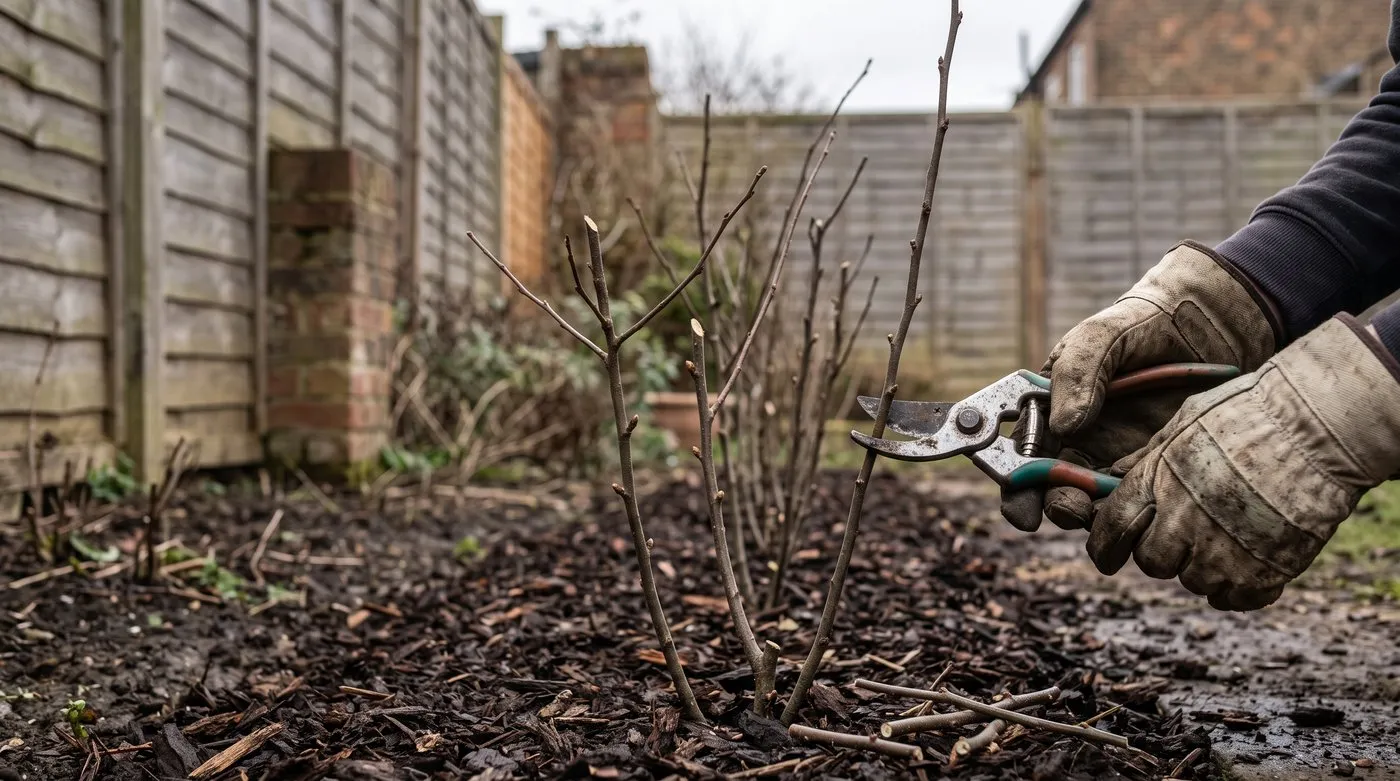
Shortening thin whips by up to a third feels harsh, but it makes them branch from the base. That’s how you avoid a hedge with bare legs later on.
First-year care
The first year is when most new hedges are lost, so water, weed and protect them. Water weekly in dry spells from April to September. Dry weather is a common reason new hedges fail. A soaker hose along the base makes this easy.
Keep the base weed-free for the first two years. A mulched strip about 30cm wide on each side stops weeds stealing water. Don’t trim in the first year, apart from the cut at planting. Let the hedge grow freely through its first season.
Replace any losses the following November. A plant with no new growth by July is probably dead. A few losses are normal.
Gardener’s tip: If rabbits visit your garden, fit spiral guards round each plant for the first two years. Rabbits nibble the bark off young stems and can kill them.
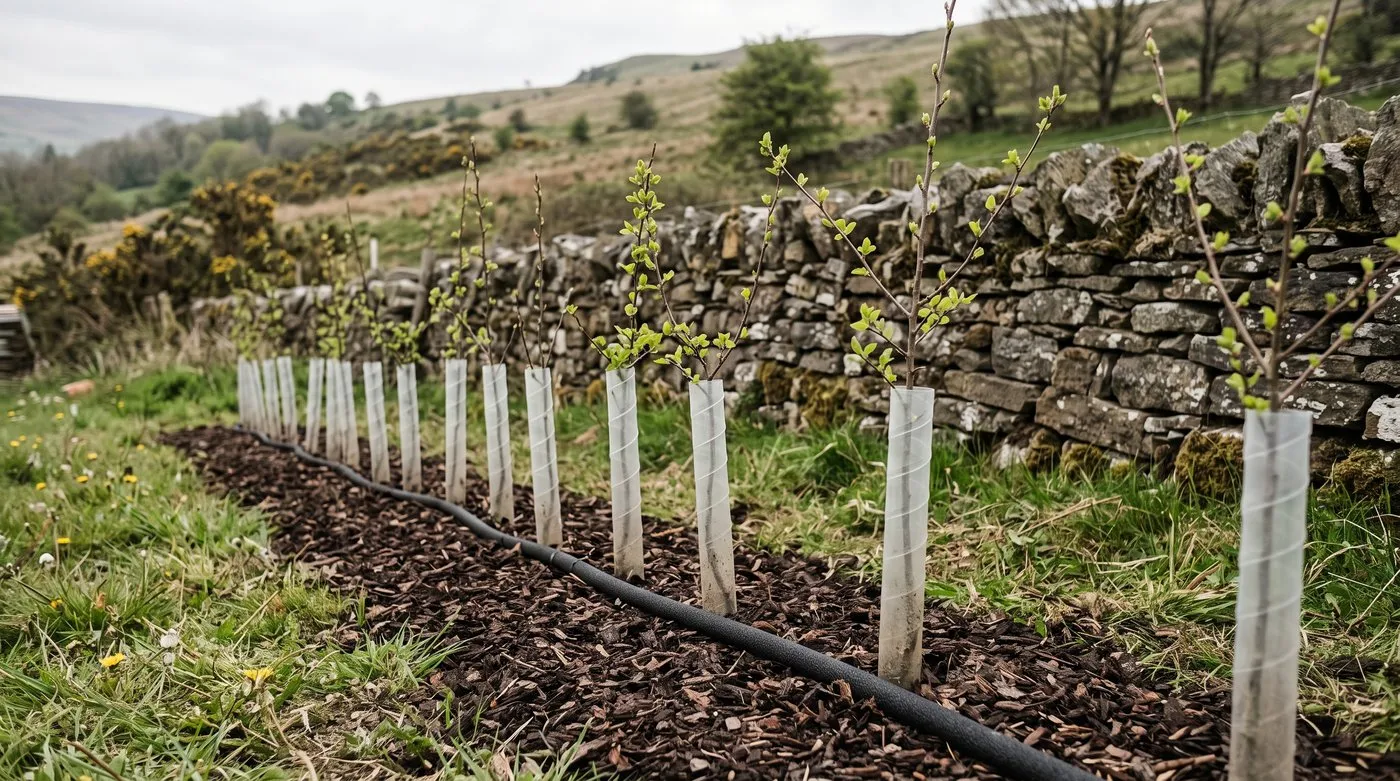
A clear mulched strip and a soaker hose along the row make first-year care much easier. Spiral guards keep hungry rabbits off the young bark.
When and how to trim an established hedge
Trim most formal hedges in late summer, and always check for nesting birds first. It’s against the law to damage or destroy an active bird’s nest, so try to avoid trimming between March and August. If you must cut then, look carefully first.
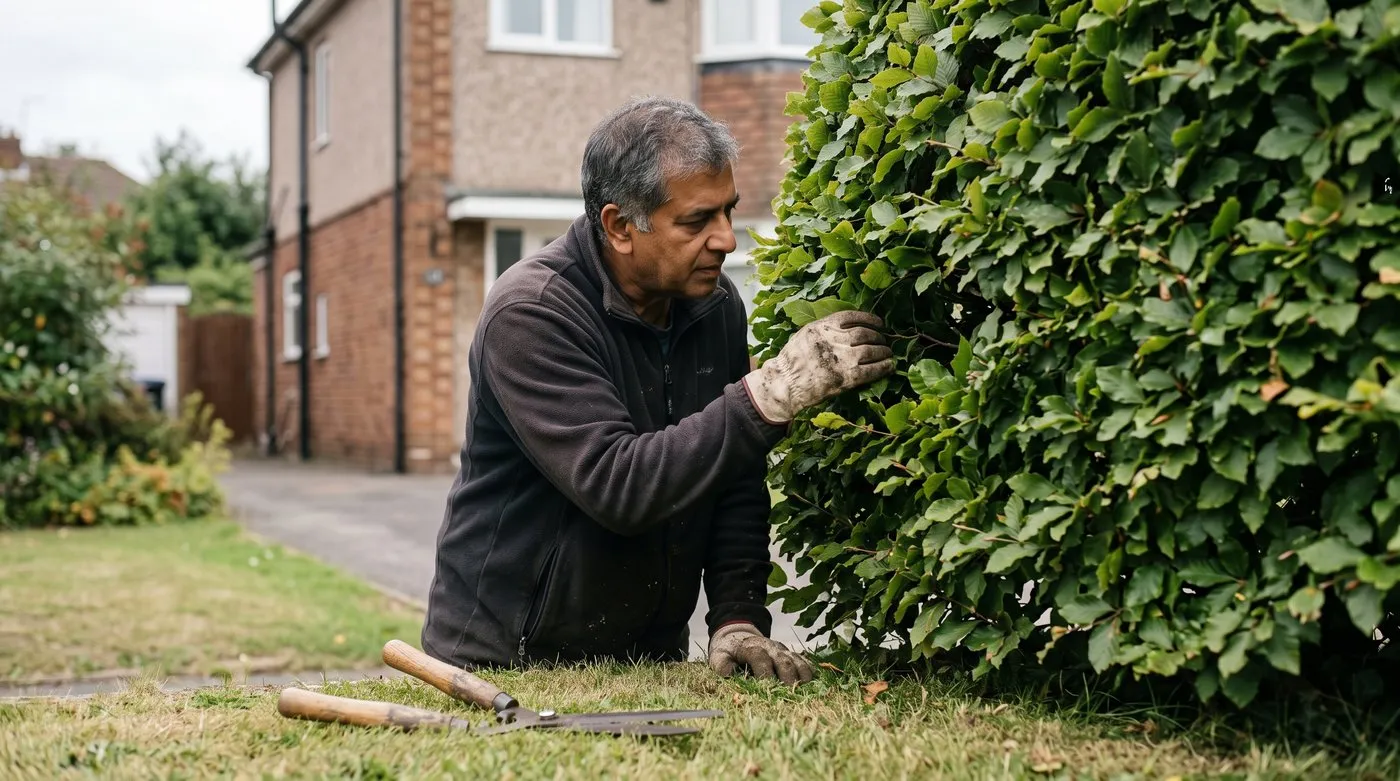
Have a careful look for nests before you cut. Keeping the hedge a little wider at the bottom lets light reach the lower branches so they stay leafy.
Is it illegal to cut a garden hedge in nesting season?
No, trimming a garden hedge in spring and summer isn’t banned. What’s illegal, all year round, is damaging or destroying a nest that’s in use or being built.
The March to August cutting ban you may have heard of applies to farm hedgerows, not garden hedges. So check carefully before you cut in spring and summer. If you find an active nest, leave that bit until the young have flown.
When to trim: Beech, hornbeam and yew need just one trim, in August. Faster hedges such as privet and Lonicera need 2-3 cuts between May and September, with the last one in late August or early September.
Get the shape right. Make the hedge a little wider at the bottom than the top. That way the lower branches get light and stay leafy. A hedge that’s wider at the top shades its own base, which goes bare. A string line helps keep the top level.
Rescuing an overgrown hedge: Cut one side back hard to the main stems in February, and leave the other side alone. The cut side regrows by summer. Do the other side the next February. Beech, hornbeam and hawthorn all cope with this. Yew is best done in mid-spring. Never cut Leylandii back past the green growth, because it won’t regrow from bare wood. For other seasonal jobs, see our autumn gardening guide.
How tall can a garden hedge be?
There’s no set height limit for a garden hedge. But if an evergreen or semi-evergreen hedge grows over 2 metres and spoils a neighbour’s enjoyment of their home, they can complain to the council.
The GOV.UK high hedges guidance explains how it works. The neighbour has to try to sort it out with you first, and the council usually charges a fee. If the complaint is upheld, the council can make you cut the hedge down and keep it lower, but not below 2 metres, and it can’t make you remove it. Deciduous hedges such as beech and hornbeam aren’t covered. Scotland has its own rules. Keeping laurel, privet or Leylandii at around 2m avoids most rows.
Common hedging mistakes
Skipping the first cut on thin plants gives a hedge with bare legs, which is hard to fix later. Cut sparse plants back by up to a third at planting.
Forgetting to water in the first summer kills lots of new hedges. Water weekly in dry spells from April to September.
Trimming too late (October onwards) leaves soft new shoots that frost can damage. Finish trimming by early September.
Letting grass and weeds grow up to the stems. Keep a clear, mulched strip for at least the first three years.
Choosing Leylandii for a garden boundary. It grows very fast and turns into a big tree unless you trim it at least twice a year. Yew, laurel or beech is a better bet for most gardens. In a small garden, plants that stay in proportion make all the difference.
Avoid wet ground for conifers, as soggy roots are a common cause of conifer hedge browning.
Now your hedge is in, read our guide on planting bee-friendly plants for the next step towards a wildlife-friendly boundary.
Frequently asked questions
When is the best time to plant a hedge in the UK?
Plant bare-root hedging between November and March, while plants are dormant. That gives the roots time to settle before spring growth. Container-grown hedging can go in at any time of year, but autumn and winter are still best. Avoid frozen or waterlogged ground.
How far apart should I space hedge plants?
Most hedges need 30-60cm between plants in a single row. For a thicker hedge, plant a staggered double row with 40cm between plants and 30cm between the rows. Laurel needs about 60cm, and box edging goes in closer at 15-25cm. Order a few spares in case any fail.
How long does it take for a hedge to grow?
Privet and laurel are quickest, reaching about 1.5m in 3-4 years. Beech and hornbeam take a little longer, and hawthorn fills in within a few years. Yew is the slowest, but it makes the densest hedge of all. Regular light trimming helps any hedge thicken up.
What is the cheapest way to plant a hedge?
Plant bare-root whips yourself between November and March. They cost far less than container-grown hedging. Small whips are the cheapest of all and often settle in better than big plants. A 10m hedge at 30cm spacing needs 33 plants.
Do I need to cut back new hedge plants?
Yes, if they’re thin or poorly branched. Shorten the main shoot and long side shoots by up to a third after planting. This makes them branch from the base. Bushy plants need little or no cutting, and with yew and other conifers just tidy straggly side shoots.
Which hedge is best for privacy?
Cherry laurel gives the fastest evergreen screen. Yew makes the densest hedge but takes longer. If you’d like a deciduous hedge, beech hangs on to its coppery dead leaves through winter, so it still screens well. A beech or hornbeam hedge at about 1.8m blocks the view nicely.
Can I plant a hedge next to a fence?
Yes, but leave a gap of at least 30-45cm. That gives the hedge room to grow and you room to trim it. Plant on your side of the boundary. A hedge planted tight against a fence will push it over as it grows.
What is the best low-maintenance hedge?
Yew is the easiest, needing just one trim a year. Beech also needs only one cut, in August. Privet and Leylandii grow fast and look scruffy soon after trimming, so skip them if you want an easy life.
Our team produces practical UK gardening guidance from source research, contributor records and established horticultural practice. Editorial standards are overseen by Matt W.