Key takeaways
- Check your lease and the balcony's weight limit before adding big pots
- Keep the heaviest pots against the building wall, not the outer edge
- Fibreglass and plastic pots are much lighter than terracotta and don't crack in frost
- Wind is the big challenge higher up, so add a screen and choose tough plants
- Put a saucer under every pot so water doesn't drip on the neighbours below
- Self-watering pots mean you can skip a day or two of watering in summer
A balcony can be a lovely little garden, with herbs for the kitchen, tomatoes in summer and flowers spilling over the railings. You just need to think about weight, wind and water a bit more than you would on the ground. Here’s how to make the most of yours.
Weight limits and balcony safety
Check how much your balcony can hold before you add big pots. This comes first, because overloading a balcony is a safety problem, not just a gardening one.
Find out your balcony’s limit
Every balcony is different, and older ones may take less. Wet compost is much heavier than you’d think. A big terracotta pot full of damp compost can weigh as much as a small child.
How to find out:
- Ask the building’s management company or freeholder
- Check your lease or tenancy agreement for balcony rules
- If nobody can tell you, ask a structural engineer before adding anything heavy
Spread the weight sensibly
Put the heaviest pots against the building wall, not the outer edge. The part nearest the wall is the strongest, and the outer edge is the weakest. Spread pots out rather than bunching them in one corner.
Shelving and plant stands double your growing space, but they pile the weight onto a few small feet. If you use them, stand them against the wall and keep heavy pots on the bottom shelf.
Big ceramic and stone pots are heavy even when empty. Several grouped in one corner add up fast. Always think about the weight when the compost is wet after rain.
If you can’t find out your balcony’s limit, play it safe. Stick to a few light pots and spread them out.
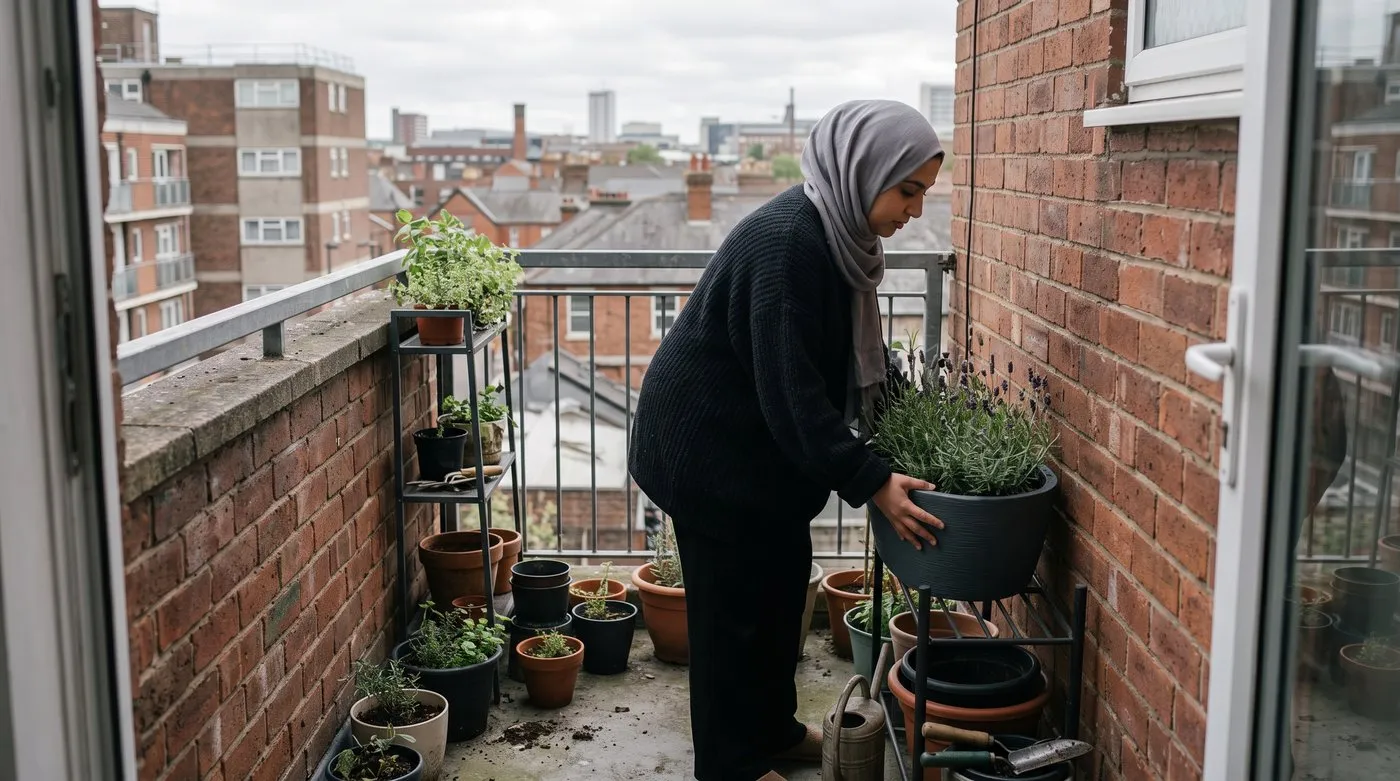
Keep the heaviest pots against the building wall, where the balcony is strongest. Spread the rest out rather than crowding one corner.
What to check before you start
- Your lease or tenancy: some limit pot sizes, ban trailing plants or railing planters
- Insurance: check whether balcony garden damage is covered
- Drips: make sure water won’t pour onto the balcony below, and use saucers under every pot
- Fixings: drilling into walls, floors or railings may need written permission
Choosing lightweight pots
On a balcony, light pots are best. The less the pot weighs, the more room you have for compost and plants.
Pot materials compared
| Material | Weight | Frost-proof | Price | Best for |
|---|---|---|---|---|
| Terracotta | Heavy | No, can crack | Medium | Ground level |
| Glazed ceramic | Heavy | Sometimes | Medium to high | Sheltered spots |
| Fibreglass | Light | Yes | Higher | Balconies, the top pick |
| Plastic | Very light | Yes | Low | Budget and moving around |
| Fabric grow bags | Lightest | Yes | Low | Summer veg |
| Galvanised metal | Medium | Yes | Medium | Troughs and railing boxes |
Fibreglass is the star for balconies. It’s far lighter than terracotta, doesn’t crack in frost and can look like stone, metal or concrete. It just costs a bit more. The RHS container gardening guide has more on pot sizes and compost.
Fabric grow bags weigh almost nothing, fold flat and let air reach the roots. They’re more practical than pretty, but great for summer veg.
Railing planters
Railing planters hook over the top rail, so they use no floor space at all. Most are 40-60cm long.
Make sure yours locks on firmly. A planter falling from a balcony is dangerous. Choose ones with adjustable brackets that clamp tightly to your railing.
Good plants for railing planters: trailing petunias, geraniums, lobelia, thyme, oregano, trailing rosemary, small lettuces and strawberries.

Wind protection for balcony gardens
The higher you are, the windier it gets, so shelter makes a big difference.
Windbreak options
| Windbreak | Blocks wind | Blocks light | How to fit |
|---|---|---|---|
| Clear Perspex panels | A lot | No | Bolt to the railings |
| Bamboo roll | Some | A little | Cable ties |
| Woven willow panels | Quite a lot | Some | Cable ties or wire |
| Reed screening | Some | A little | Cable ties |
| Climbers on trellis | Quite a lot | Some | Trellis plus a big pot |
Clear Perspex screens block wind without blocking light. On an exposed balcony, they’re the best upgrade you can make.
But solid screens catch the wind like a sail. Bolt Perspex firmly to the railing frame, never just cable ties or plastic clips, and get permission first. If you’re high up and unsure, go for a screen that lets some air through.
Bamboo and reed screens are cheaper and safer in strong winds because air passes through the gaps. They’re the better choice on high floors. Put them on the windy side and leave the sunniest side open.
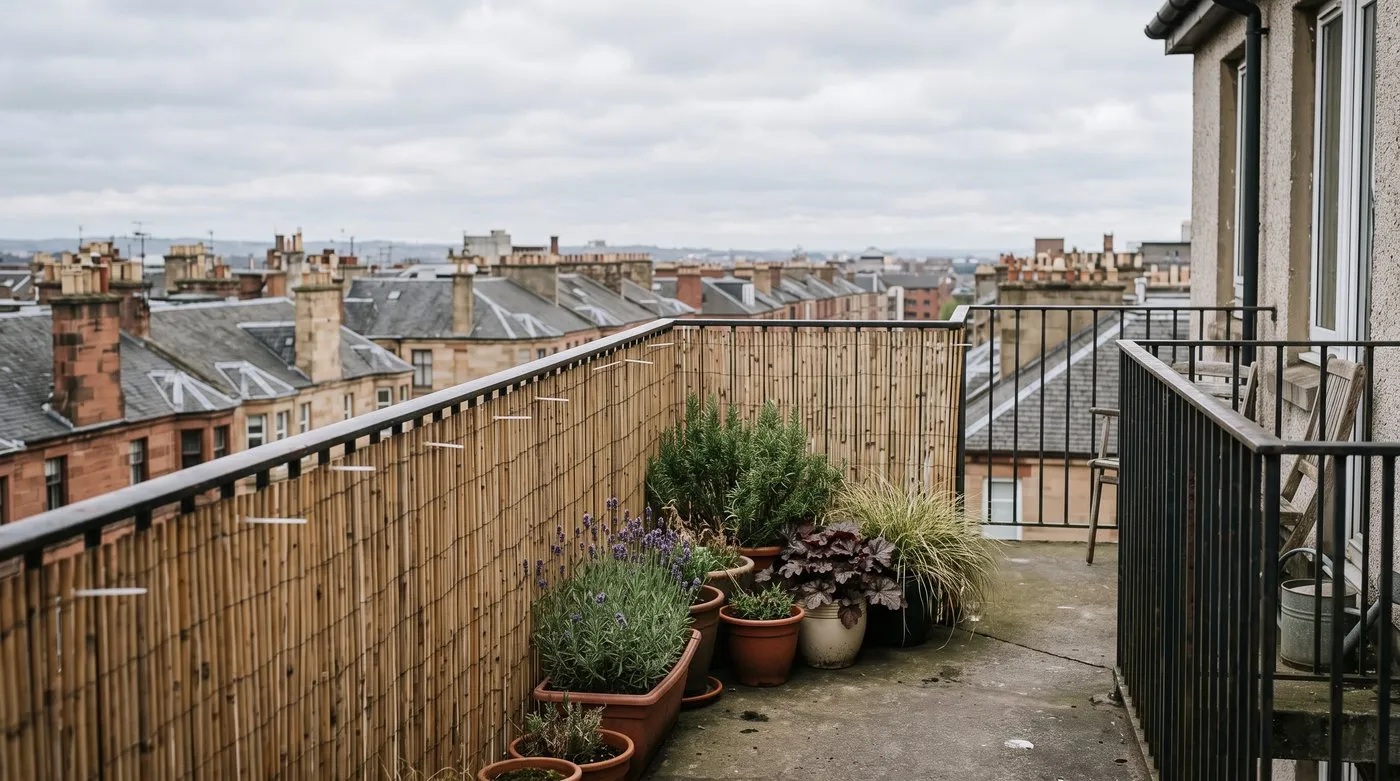
Bamboo lets some air through, so it’s safer than a solid screen on a high floor. Put it on the windy side and leave the sunny side open.
Plants that cope with wind
Tough choices: lavender, rosemary, box, carex grasses, heuchera, sedum, thyme and santolina. They’re low and compact, or have bendy stems that don’t snap.
Avoid on windy balconies: tall delphiniums, standard roses, big-leaved hostas, Japanese maples and anything top-heavy in a light pot. They catch the wind and topple over.
Stop pots blowing about
Wind doesn’t just damage plants. It moves pots, and a light pot sliding off a balcony is a real hazard.
Tie light pots down by threading wire through the drainage holes and fixing it to the base of the railing. Group pots so they steady each other, with the heaviest on the windy side.
Never leave empty pots outside. They weigh almost nothing and blow away in the first storm. Bring them in, or fill them with compost.
Gardener’s tip: Group pots in clusters of three to five. They shelter each other, with the toughest plants on the windy side and the softer ones tucked behind.
Best plants for balconies
Flowers for colour
- Geraniums flower from May to October with little fuss. They love heat, cope with dry spells and suit railing planters.
- Lavender handles wind, drought and poor soil, and bees love it. Trim it after flowering to keep it neat.
- Trailing petunias tumble down from railing planters and baskets. Feed them weekly to keep the flowers coming.
- Cyclamen brightens up autumn and winter when little else is flowering.
- Heuchera gives colourful leaves all year in purple, bronze, lime and silver. It copes with shade and wind.
Herbs for a balcony kitchen garden
Balconies are brilliant for herbs. The warmth, good drainage and shelter from the wall suit Mediterranean herbs perfectly.
Easy balcony herbs: rosemary (evergreen), thyme (compact and tough), sage (needs a 30cm pot), basil (summer only, likes warmth), mint (give it its own pot so it doesn’t take over) and chives (hardy, with flowers bees love). Garden Organic suggests peat-free compost for herbs in pots.
A 60cm railing trough fits five or six herb plants and keeps you picking from spring to autumn. Put it somewhere sunny, close to the kitchen.

Vegetables for balcony growing
Growing food on a balcony is easy with the right pots and varieties. Choose compact or dwarf types bred for containers. Our guide to dwarf vegetables for small spaces has plenty of ideas.
| Vegetable | Pot size | Sun | Ready in |
|---|---|---|---|
| Bush tomatoes | 40-50 litres | Full sun | 12-16 weeks |
| Chillies | 20-30 litres | Full sun | 16-20 weeks |
| Salad leaves | 15-20 litres | Part shade is fine | 4-6 weeks, then keep cutting |
| Radishes | 15-20 litres | Part shade is fine | 4-5 weeks |
| Runner beans | 40-50 litres | Full sun | 12-14 weeks |
| Strawberries | 25-30 litres | Full sun | Crops every summer |
| Courgettes | 40-50 litres | Full sun | 8-10 weeks |
Tomatoes are the most rewarding balcony crop. Bush varieties like ‘Tumbling Tom’, ‘Totem’ and ‘Losetto’ stay small and need no pinching out. Feed weekly with tomato feed once they start flowering. Our beginner’s guide to tomatoes has the full how-to.

Watering balcony pots
Balcony pots dry out fast, thanks to wind, heat bouncing off walls and no damp ground underneath. Plan your watering before you plant.
How often to water
| Season | Ordinary pots | Self-watering pots | Hanging baskets |
|---|---|---|---|
| Spring | Every 2-3 days | About weekly | Every 2 days |
| Summer | Daily, twice in a heatwave | Every few days | Twice a day |
| Autumn | Every 3-4 days | About weekly | Every 2-3 days |
| Winter | Only when dry | Rarely | Rarely |
Be kind to the neighbours below
Water from your pots goes somewhere, often onto the balcony below. Without saucers, muddy water runs across the floor and drips onto your neighbour’s washing. Not a great way to make friends.
Put a saucer or drip tray under every pot. Choose saucers a bit wider than the pot so they catch heavy rain too. Empty them after long wet spells so the roots don’t sit in water.
Self-watering pots with a sealed base solve the problem completely. The extra water stays inside the pot, so nothing drips.
If you use drip irrigation, run it in short bursts rather than one long go. Point the drippers into the middle of the pot, not by the rim.
On sloping balcony floors, check where the drainage channel empties. If it drains onto the balcony below, raise pots on feet and catch every drop in saucers.
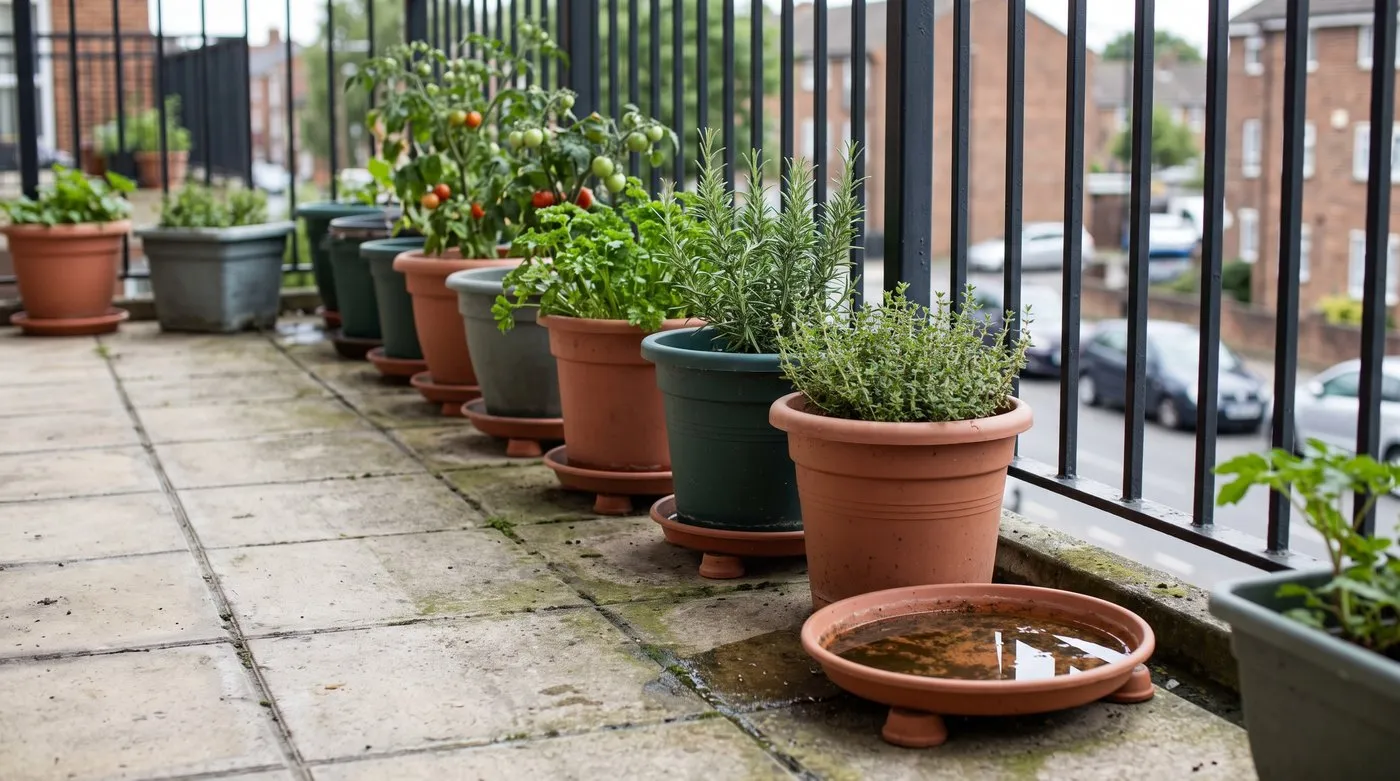
A saucer a little wider than each pot catches the drips before they reach the balcony below. Empty them after long wet spells.
Self-watering pots
Self-watering pots have a water tank in the base that feeds the roots. They cost more than ordinary pots but mean far less watering. If you’re out all day in a July heatwave, they can save your plants.
Plenty of makers do self-watering pots in balcony sizes. Depending on the pot and plant, the tank lasts a few days.
Simple drip watering
If you’ve got lots of pots, a drip kit saves a lot of time. Small kits connect to an outside tap, or to an indoor tap through a window connector.
A battery timer runs it for a few minutes once or twice a day in summer. Each pot gets its own dripper on a thin tube, so it waters while you’re at work or away.
Privacy screening with plants
Plants make a softer screen than fences or panels. They’re handy if your balcony overlooks neighbours or a busy street. For more ideas, see our guide to vertical gardening.
Climbers on balcony trellis
Fix a trellis panel to the inside of the railing and plant a climber in a big pot at the base. By the end of the season, you’ll have a green screen.
Good climbers for balconies:
- Star jasmine is evergreen with sweet-scented flowers. It grows well in pots and likes a south or west-facing spot.
- Clematis such as ‘Nelly Moser’ or ‘The President’ flowers at railing height. It loses its leaves in winter.
- Ivy is the most reliable evergreen screen for any aspect, even north-facing.
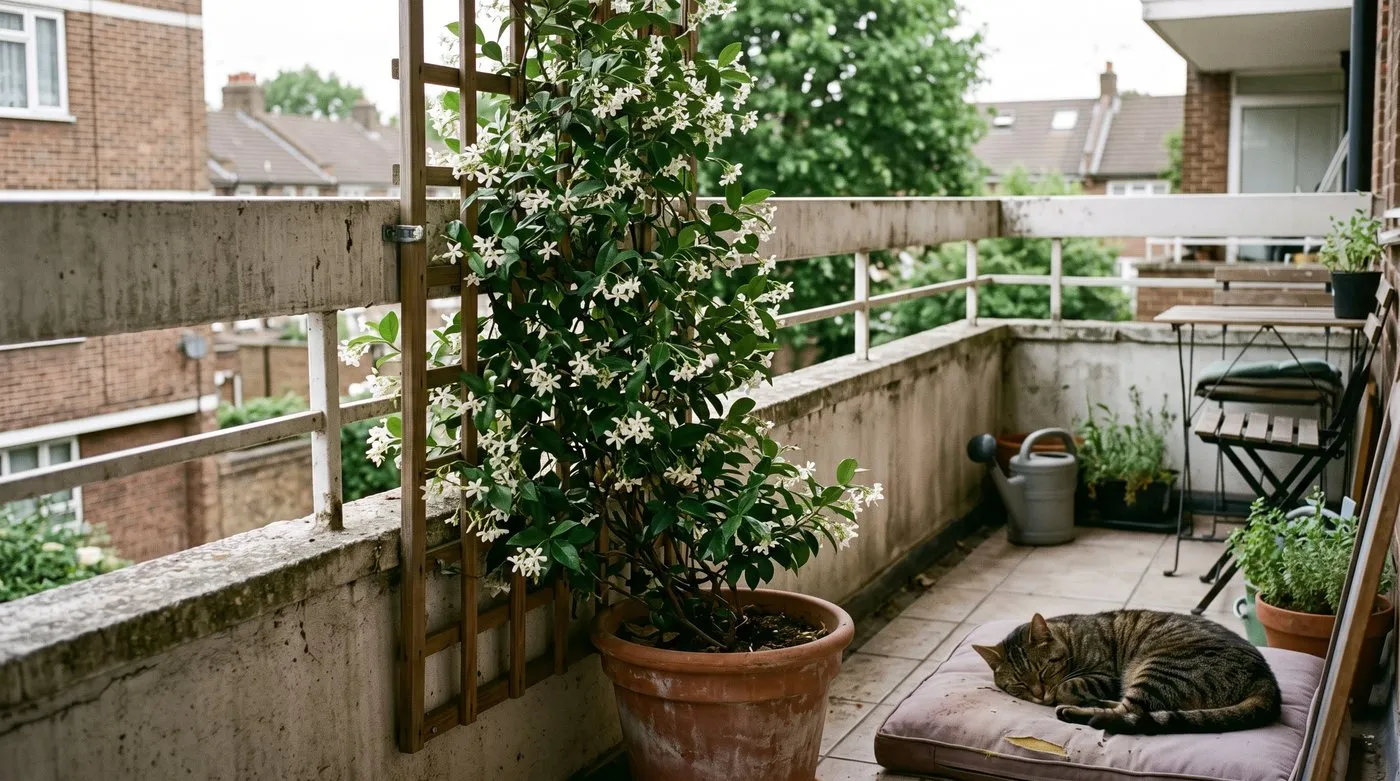
Star jasmine stays green all year and smells wonderful on summer evenings. It’s happiest in a big pot on a south or west-facing balcony.
Tall grasses for screening
Grasses in tall pots make a soft, swaying screen. Miscanthus sinensis ‘Gracillimus’ grows tall and graceful in a big pot. Calamagrostis ‘Karl Foerster’ grows upright and keeps its shape through winter.
Line them up along the railing. The feathery stems soften the wind and block the view from outside.
Balcony garden lighting
A little lighting lets you enjoy your balcony on spring and autumn evenings. Keep it simple and safe.
Battery or solar festoon lights are the easiest. Warm white bulbs at head height make it cosy with no wiring.
Solar stake lights pushed into big pots add soft pools of light at floor level.
Battery LED strips under the railing cap or a shelf give a gentle glow.
Avoid mains lights unless an electrician fits a proper outdoor socket. Extension leads through windows are a fire risk.
Balcony garden budget
You can start small and add to it as you go.
| Level | What you’ll need |
|---|---|
| Starter | Four pots with saucers, compost, a few herbs or flowers |
| Middle | Eight pots, railing planters, a windbreak, some lights |
| Full balcony | Twelve or more pots, a drip kit, screening and climbers |
Fibreglass pots cost more at first but last for years and are much lighter than terracotta. Fabric grow bags are the cheapest way to grow summer veg.
Seasonal balcony planting plan
Spring (March to May)
Plant pots of rosemary, thyme and chives. Start tomatoes and chillies on a sunny windowsill, ready to go out in May. Violas and primroses give early colour while it’s still cool.
Summer (June to August)
The best time of year. Move tomatoes, peppers and courgettes outside after the last frost, around mid-May in most of England. Plant petunias and geraniums in the railing planters. Sow salad leaves every three weeks and keep picking herbs. Water daily and feed weekly.
Autumn (September to November)
Swap tired summer plants for cyclamen, ornamental cabbages and winter pansies. Plant spring bulbs in layers in October: tulips deepest at about 20cm, daffodils at 15cm and crocus at 8cm. Cut back herbs, apart from rosemary and thyme. Water less as it gets cooler.
Winter (December to February)
Evergreens like box, heuchera and carex keep it looking good. Fairy lights add cheer. Group tender pots against the wall and wrap them in fleece or bubble wrap. Water only when the top 3cm of compost is dry.
Common mistakes with balcony gardens
1. Ignoring weight limits
A few big terracotta pots full of wet compost add up to a serious weight. Think about the pots, wet compost, plants and furniture together. If you’re close to the limit, switch to fibreglass or plastic.
2. Forgetting about the wind
Plants that are happy on the ground can get shredded a few floors up. Tie a ribbon to the railing for a week. If it’s flying out sideways most days, you need a windbreak and tough plants.
3. Choosing pots that are too small
Small pots dry out in hours in summer and cramp the roots. Use 30-45cm pots for anything bigger than a small herb. A few big pots always beat lots of little ones.
4. Forgetting about drainage
Soggy compost kills roots. Every pot needs drainage holes and a saucer underneath. Lifting pots slightly on pot feet helps air get underneath.
5. Planting without checking the lease
Read your lease or tenancy before you buy anything, especially railing planters, trellis or heavy pots. Once you know the rules, potscaping with grouped pots makes a small balcony feel planted rather than cluttered.
For more fruity ideas, see our guides to growing strawberries and growing chilli peppers in pots.
Frequently asked questions
What are the best plants for a balcony UK?
Lavender, box, grasses and heuchera cope well with wind and sun. For food, try tomatoes, herbs, salad leaves and strawberries. Trailing plants like ivy and lobelia soften the railings and handle exposed spots. Pick compact varieties bred for pots.
How much weight can a balcony hold?
It depends on the building, so ask before you load it up. Check your lease or ask the building’s management company for the rating. Remember wet compost is heavy. Keep heavy pots against the building wall, not the railing edge, and spread the weight across the floor.
Can I grow vegetables on a balcony?
Yes, lots of vegetables grow happily in balcony pots. Tomatoes, peppers, chillies, salad leaves, radishes, runner beans and herbs all do well. A south-facing balcony with six or more hours of sun suits most of them. Use 40-50 litre pots for tomatoes and beans, and 20-30 litres for salad and herbs.
How do I protect balcony plants from wind?
Fix a screen of Perspex, bamboo or willow to the railings. Put tall plants behind shorter ones. Choose tough plants like lavender, grasses and box. Avoid tall, top-heavy plants that catch the wind like a sail.
Do I need permission for a balcony garden?
Check your lease or tenancy agreement first. Most allow pots but limit fixings, trailing plants that stain walls, or heavy structures. Some buildings ban railing planters for safety. Always check before you drill or fix anything to the railings.
How often should I water balcony plants?
Every day in summer for ordinary pots. In a heatwave, small pots and baskets may need watering twice. Self-watering pots can go a few days. Wind dries balcony pots faster than pots at ground level. Push a finger into the compost, and if it’s dry, water well.
What size pots work best on a balcony?
Pots of 30-45cm across suit most plants. Bigger pots stay moist longer and are less likely to blow over. Pots under 20cm dry out in hours in summer. Choose light fibreglass or plastic to keep the weight down.
Can I grow a herb garden on a balcony?
Yes, balconies are brilliant for herbs. Rosemary, thyme, sage, mint, basil and chives all thrive in 20-30cm pots in a sunny spot. A 60cm railing trough fits five or six herb plants. Mediterranean herbs love the warmth and good drainage a balcony gives them.
Our team produces practical UK gardening guidance from source research, contributor records and established horticultural practice. Editorial standards are overseen by Matt W.