
Key takeaways
- Split the garden into play, growing, wildlife and grown-up zones
- Put soft bark chip or rubber matting under swings and climbing frames
- Cover or fence ponds and water butts while children are small
- Swap poisonous plants like foxglove and laburnum for safe ones
- Start with quick crops like cress, radishes and sunflowers
- Plan features that can change as children grow
A garden with children in it looks a bit different. Mud on the path, a ball in the border, sunflower seedlings in yoghurt pots on the windowsill. That’s not a problem. It’s a garden doing its job.
The best family gardens do three things at once: room to play, room to grow things and room to discover wildlife. What children need changes as they grow. A toddler needs soft ground and no open water. An eight-year-old wants a den, a digging patch and something to climb. A teenager wants somewhere to hang out with friends. Plan with that in mind and you won’t need to rip everything out every few years.
Zoning a family garden
Split the garden into zones rather than one big space. That way the play kit doesn’t take over, and there’s still room for the grown-ups.
Play zone
Put the main play area where you can see it from the kitchen window. Choose a flat spot with a soft surface, and keep it a little way from neighbours’ fences if noise is a worry.
An area of about 4m x 6m fits a swing, a small sandpit and some grass to run about on. Bigger gardens can add a climbing frame or playhouse. Leave plenty of clear space, about 2m, around swings and climbing frames.
Growing zone
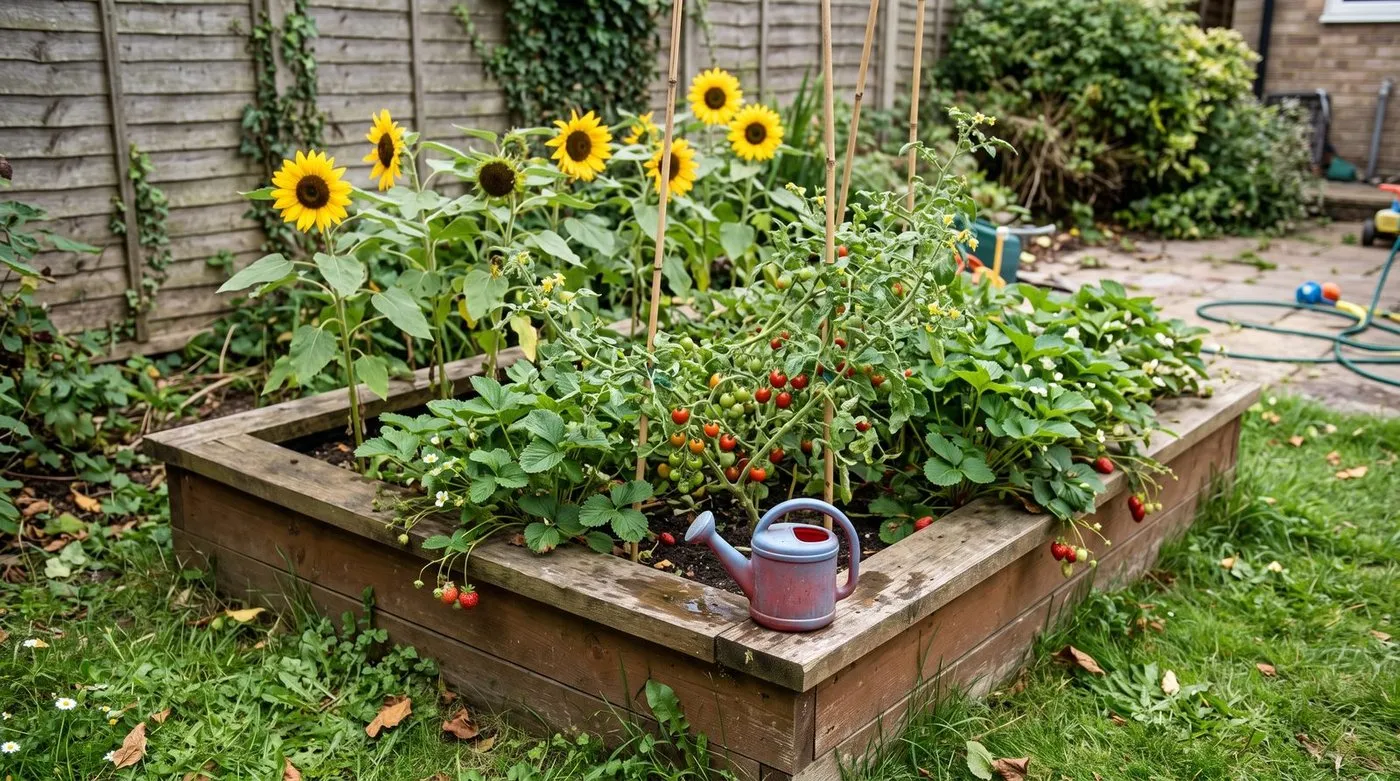
A child-height raised bed full of sunflowers, strawberries and cherry tomatoes keeps little gardeners busy all summer.
A raised bed about 2m x 1m is plenty for children’s growing projects. Put it in full sun, near a tap or water butt. Raise it 30-40cm so children can reach in easily, and toddlers are less likely to trample the seedlings.
Build it from untreated timber, like scaffold boards or new sleepers. Avoid old railway sleepers, which can ooze creosote. Fill it with a mix of topsoil and peat-free compost.
Wildlife zone
Leave one corner a little wild. A log pile, a patch of long grass, a bug hotel and a few nectar-rich flowers bring in beetles, butterflies, bees and birds. Children love checking under the logs to see who’s moved in.
Adult zone
Keep at least one seating area away from the play zone. A screened patio or decking area with climbers on a trellis gives a nice break. Grown-ups need a spot that feels like theirs, even in a family garden.
Safe plants for family gardens
Plant safety matters most while children are under five, as toddlers put everything in their mouths. Older children usually understand “don’t eat that”.
Plants to avoid
| Plant | Harmful part | How serious |
|---|---|---|
| Foxglove | All parts | Very serious |
| Laburnum | Seeds and pods | Very serious |
| Yew | Berries, seeds and leaves | Very serious |
| Monkshood | All parts | Very serious |
| Lily of the valley | All parts | Serious |
| Castor oil plant | Seeds | Very serious |
| Daphne | Berries | Serious |
| Euphorbia | Milky sap | Irritates skin and eyes |
| Rhubarb | Leaves (not the stalks) | Harmful if eaten |
| Oleander | All parts | Very serious |
The RHS keeps a list of potentially harmful plants. Have a look before planting anything new in a family garden.
Safe plants for children’s areas
Pick plants that are safe, fun to touch or smell, or give something tasty.
| Plant | Why children love it | Where it grows |
|---|---|---|
| Sunflower | Grows taller than them | Sun |
| Strawberry | Pick and eat from June | Sun, pots or beds |
| Lavender | Smells lovely, brings butterflies | Sun, well-drained soil |
| Lamb’s ears | Soft, furry leaves | Sun |
| Snapdragon | Squeeze the flowers to make them “talk” | Sun |
| Nasturtium | Edible flowers, easy from seed | Sun, any soil |
| Sweet pea | Scented flowers to pick | Sun, with supports |
| Marigold | Bright and easy from seed | Sun |
| Mint | Strong smell | Anywhere, but keep it in a pot |
| Apple tree | Blossom, fruit, branches to climb | Sun |
Play features by age group
Different ages want different things. Plan so the garden changes with them.
Ages 1-3: toddler garden
What matters: soft ground, a closed-in space, things to touch and smell, and you being able to see them from indoors.
- Rubber matting or artificial grass over the main play area. It cushions tumbles and dries quickly.
- Sandpit with a lid to keep cats out. Use washed play sand, not builders’ sand, and change it each year.
- Water table, not a pond. A shallow tray on legs at their height. Empty it after each use.
- Plants to touch and sniff within reach: lavender, rosemary, lamb’s ears and grasses to run their hands through.
- Secure fences with childproof gate latches up high.
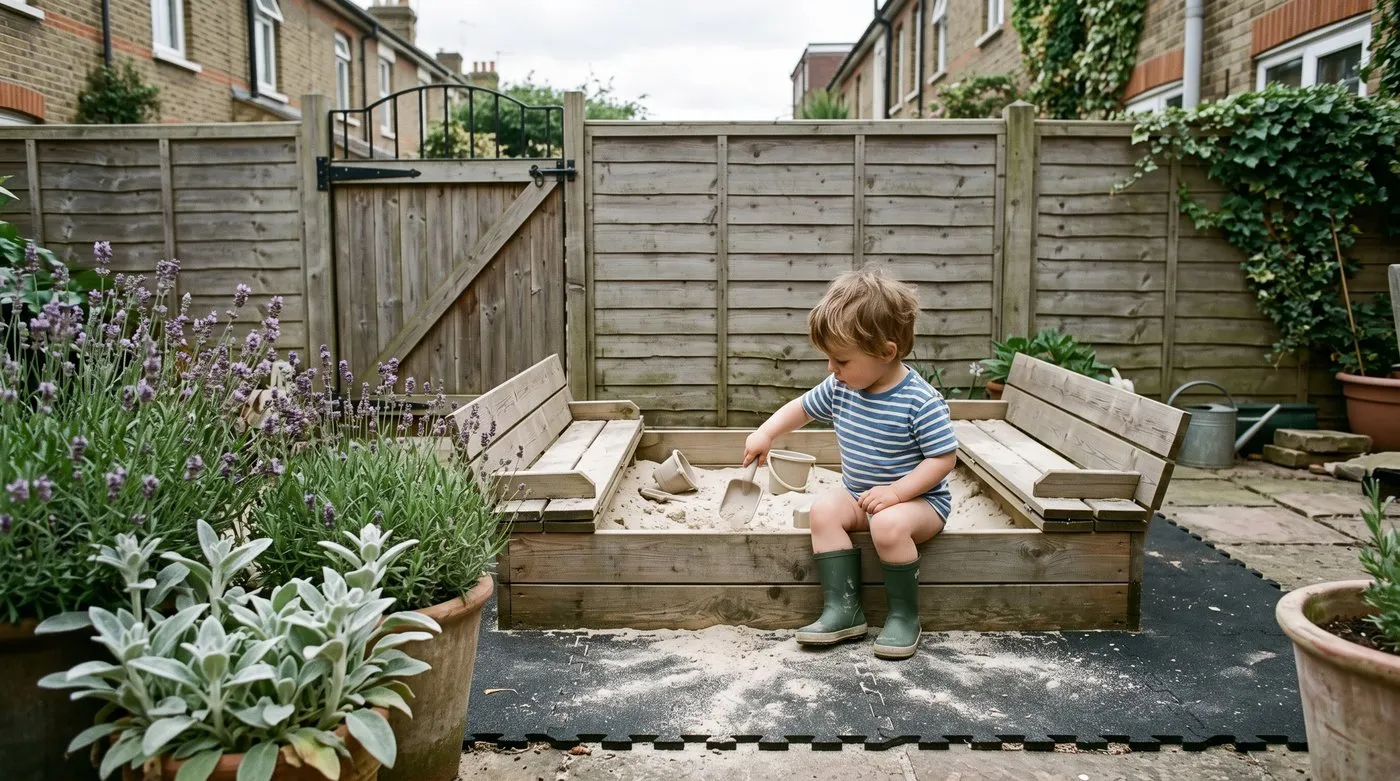
A lidded sandpit keeps cats out, and washed play sand is kinder than builders’ sand. Soft matting underneath cushions the tumbles.
Ages 4-7: explorer garden

A wooden playhouse, a stepping stone path and a wild corner make a perfect play zone.
What matters: running about, growing things, finding bugs and make-believe.
- Swing on a sturdy frame, with plenty of space around it.
- Playhouse or den. Put it somewhere shady and add curtains, a little table and a few pots.
- Mud kitchen. Old pots and pans on a pallet or shelf. Stand it on bark chip so it drains.
- Growing beds. Start with sunflowers, radishes and strawberries. Give each child their own labelled patch.
- Bug hotel from pallets, bamboo canes and pine cones, in a sheltered spot.
Ages 8-12: growing independence
What matters: a bit of challenge, some responsibility, nature projects and space for friends.
- Climbing frame or rope swing. Check the weight limits suit their age.
- Veg patch. Move on to bigger crops: potatoes, runner beans, pumpkins and sweetcorn.
- Wildlife pond. Once children are older and with supervision, a small pond brings in frogs, newts and dragonflies. Give it a gently sloping edge so wildlife can get in and out.
- Fire pit. A simple fire pit with log seats makes for lovely family evenings, with a grown-up in charge.
- Cold frame. Lets them start seeds early and grow tomatoes or cucumbers.
Ages 13+: teen space
- Seating area with festoon lights for hanging out.
- Growing space for their own interests, like chillies or giant veg.
- Hammock or swing seat for reading and relaxing.
- Remove play kit they’ve outgrown and turn the space into a patio or planting.
Growing projects for children
Growing food shows children where their dinner comes from. Pick crops that are quick and rewarding.
Quick-win crops (results in 4-8 weeks)
| Crop | Sow | Ready in | Why children love it |
|---|---|---|---|
| Cress | Any time, indoors | About a week | Super quick, great in egg sandwiches |
| Radish | March-September | About 4 weeks | Pulling them up feels like magic |
| Cut-and-come-again lettuce | April-August | 6-8 weeks | Pick, eat, and it grows back |
| Spring onion | March-July | About 8 weeks | Easy to sow, fun to pull |
Show-off crops (impressive results)
| Crop | Sow | Harvest | Why children love it |
|---|---|---|---|
| Sunflower | April-May | Summer | Height contests |
| Pumpkin | May, indoors | October | Huge fruit for Halloween |
| Runner bean | May | July-September | Climbs tall wigwams, bright red flowers |
| Sweetcorn | May | August-September | Sweet cobs straight from the plant |
| Strawberry | Plant in spring | June onwards | Warm berries picked in the sun |
Our guide to growing sunflowers has all the details. For pumpkins, see our pumpkin and squash growing guide, and for berries, our growing strawberries guide.
The bean wigwam project
This is a brilliant project for younger children. They build it, plant it, grow it, pick it, and it turns into a den.
- Push 6-8 tall bamboo canes into the ground in a circle about 1.2m across.
- Tie the tops together with garden twine.
- Leave a gap between two canes for a door.
- Sow two runner bean seeds at the foot of each cane in mid-May.
- Water regularly. By July the beans should cover the wigwam in leaves.
- Pick beans from July to September. The more you pick, the more you get.
It’s cheap to make, and the wigwam becomes a shady den with dangling beans. Children can sit inside and pick their own snack.
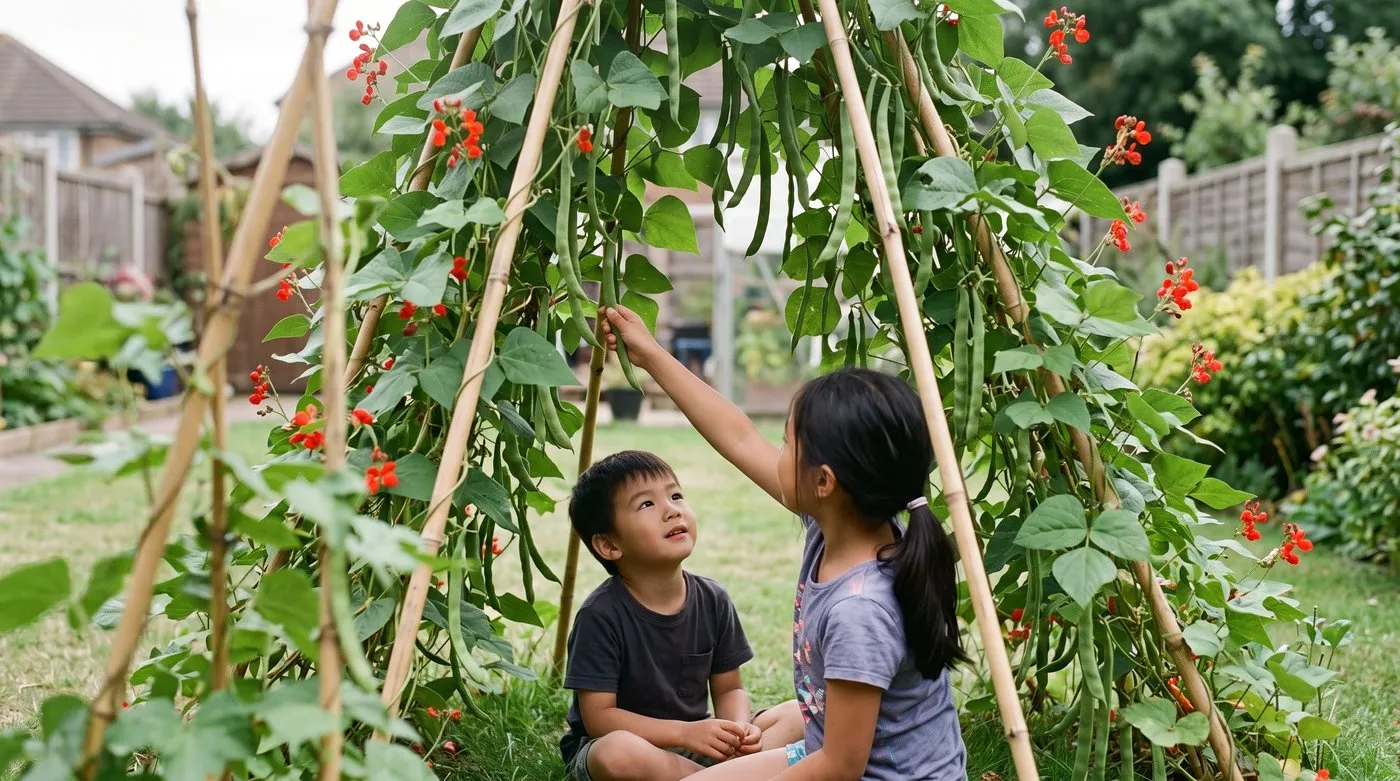
By July the canes disappear under leaves and the wigwam becomes a den. The more beans the children pick, the more the plants make.
Sensory garden features

Bright flowers, fuzzy lamb’s ears and scented herbs are irresistible to little hands.
A sensory garden wakes up all five senses, and every child can enjoy it, including those with additional needs.
Touch: lamb’s ears, grasses to run fingers through, rough tree bark, smooth pebbles, trickling water.
Smell: lavender, rosemary, mint, chocolate cosmos (it really does smell of chocolate), lemon balm and sweet peas.
Sound: rustling bamboo, a trickling water spout, wind chimes, swishing grasses and birdsong.
Taste: strawberries, mint, basil, chives, peppery nasturtium flowers, cherry tomatoes and peas from the pod.
Sight: bright flowers at child height, butterflies on buddleia, pond life and sunflowers.
Handy tip: Plant scented herbs along paths children use every day. A rosemary bush by the back door gets touched and sniffed far more than one hidden at the end of the garden. Plant at child nose height, not grown-up height.
Water safety in family gardens
Water is the biggest danger in a family garden. Toddlers can drown in just a few centimetres of water, quickly and quietly. The RoSPA water safety guidance is well worth a read.
Ponds: Fill in, fence off or securely cover any pond while children are small. Bring one back when they’re older, with a sloping edge.
Water features: Choose a feature where water trickles over pebbles into a hidden tank underground. Children get the sound and sparkle of water with nothing to fall into.
Water butts: Fit a secure lid and keep them out of reach. An open water butt is as risky as a pond to a climbing toddler.
Paddling pools: Watch children the whole time. Empty after every use and store upside down so rain can’t collect.
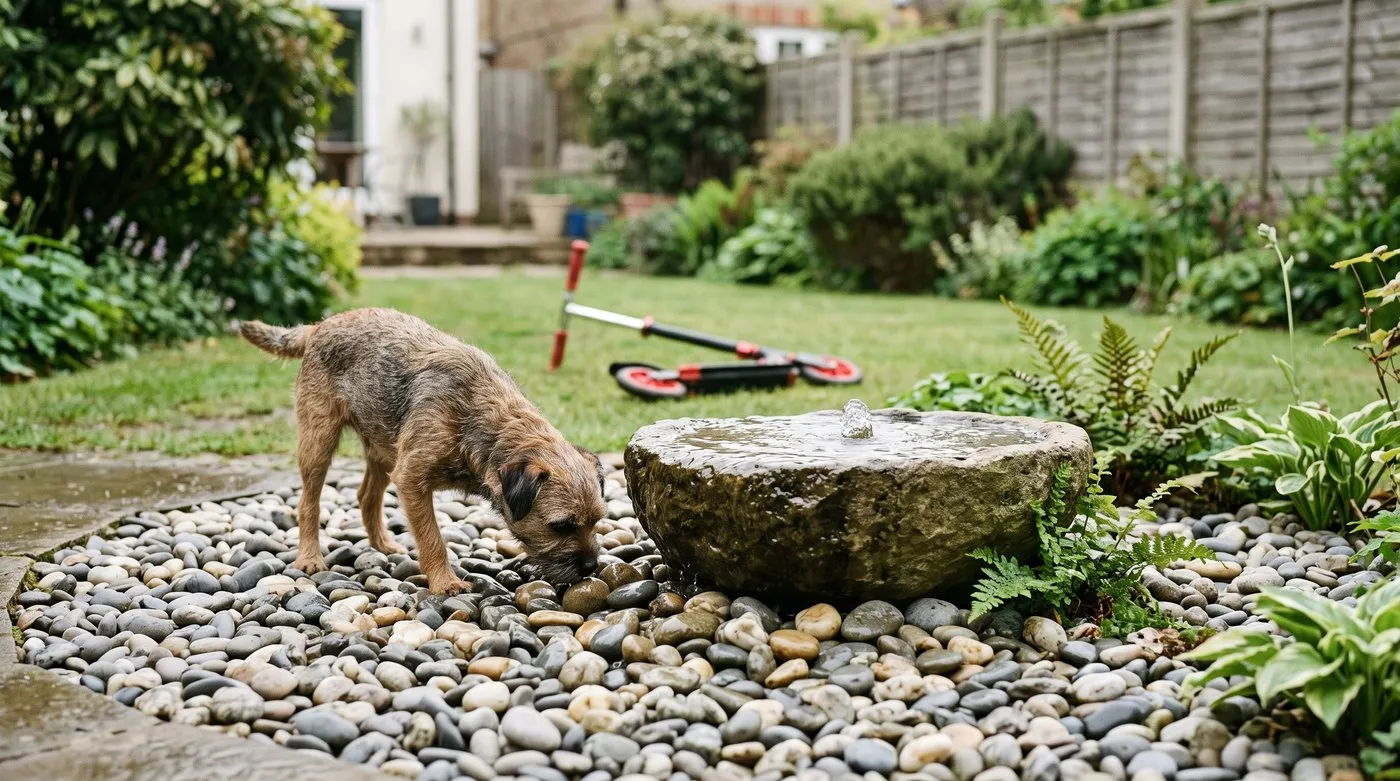
Water that trickles over pebbles into a hidden tank gives children the sound and sparkle with nothing to fall into.
Play surfaces compared
| Surface | Cost | Softness | Upkeep | Good for |
|---|---|---|---|---|
| Rubber safety tiles | Higher | Very good | Sweep now and then | Under fixed swings and frames |
| Play-grade bark chip | Low | Good, if laid deep | Top up each year | Bigger play areas on a budget |
| Artificial grass | Medium | OK, better with a shock pad | Brush and rinse | Busy family lawns |
| Real grass | Low | Poor | Mow and patch | General play, not under swings |
| Paving or concrete | Medium | None | Very little | Paths, never under play kit |
In short: rubber tiles under fixed swings and climbing frames, bark chip for bigger play areas on a budget, and artificial grass for a lawn that gets heavy use. Check the equipment maker’s advice on surfacing too.
Budget breakdown for family garden features
| Feature | DIY cost | Notes |
|---|---|---|
| Timber sandpit | Low | Add a hinged lid to keep cats out |
| A-frame swing | Medium | Needs plenty of clear space around it |
| Timber playhouse | Medium to high | Allow extra for a base and surfacing |
| Mud kitchen | Low | Old pots and pans from charity shops |
| Raised growing bed | Low | Untreated scaffold boards or new sleepers |
| Bug hotel | Free to low | A great family project from scrap |
| Rubber safety surface | High | Best fitted by a professional |
| Bark chip play area | Low to medium | Lay it deep for a soft landing |
A sandpit, a raised bed, a bark chip play area and a mud kitchen make a great start for children up to about seven, without a big garden makeover.
Educational garden elements
A garden is an outdoor classroom. Almost everything in it can teach something.
Weather station. A rain gauge, a thermometer and a wind sock let children keep a daily weather diary. Handy for school projects.
Sundial. Fix a simple sundial to a south-facing wall and watch the shadows tell the time.
Compost bin. Show children how peelings turn into soil. Worms and beetles are endless entertainment, and waiting for compost teaches patience.
Plant labels. Let children write their own labels on lolly sticks or bits of slate. It helps them learn plant names and feel proud of their patch.
Common mistakes to avoid
Making the whole garden a play area. Keep some space for grown-ups and some for nature. Children are usually happy with “that’s the wildlife corner, we leave it alone”.
Choosing plastic over natural. Plastic play kit fades and cracks in the sun. Timber swings, rope ladders and log stepping stones last longer and look nicer.
Forgetting about mess. Mud kitchens make mud and sandpits scatter sand. Put them where mess can drain away, not right by the back door.
Planting for looks, not safety. You can have a garden that’s pretty and safe. Swap foxgloves for hollyhocks, or laburnum for a crab apple.
Not thinking ahead. A swing for a five-year-old will bore a twelve-year-old. Choose features that can change. A sandpit can become a raised bed, and a playhouse can become a garden store.
Frequently asked questions
What are the best plants for children to grow?
Sunflowers, strawberries, pumpkins and cress are brilliant starters. Sunflowers come up quickly and grow taller than the kids, which they love. Strawberries give fruit they can pick and eat straight from the plant.
Which garden plants are poisonous to children?
Foxglove, laburnum, yew, monkshood and lily of the valley are the main ones. Castor oil plant seeds are very toxic too. Remove these, or fence them off, where young children play.
How do I make a garden safe for toddlers?
Start by covering or fencing off any water. That includes ponds and water butts. Put soft surfaces under play equipment, remove poisonous plants, fit childproof gate latches and lock tools and chemicals away.
What surface is safest under a swing or climbing frame?
Rubber safety tiles or a deep layer of play-grade bark chip. Rubber tiles are tidy and last for years. Bark chip is cheaper and soft underfoot. Grass soon wears thin under swings and isn’t much of a cushion.
How do I build a mud kitchen for children?
An old pallet or a plank shelf at child height is all you need. Add old pots, pans, bowls, wooden spoons and a washing-up bowl for water. Charity shops are great for kit. Stand it on bark chip to keep the mess down.
What vegetables are easiest for children to grow?
Radishes are the quickest, ready in about four weeks. Cut-and-come-again lettuce is ready in six to eight weeks. Courgettes and runner beans give big, exciting crops. Peas are easy to sow and taste great straight from the pod.
How much space do I need for a children’s play area?
More than you’d think once you allow clear space around equipment. A swing needs plenty of room to move, so leave about 2m clear all round. A sandpit or mud kitchen fits in a small corner. A space of about 4m x 6m fits a swing, sandpit and a bit of grass.
Further reading
- Small garden design ideas for making the most of a smaller family space
- How to grow sunflowers, the best first plant for children
- Growing strawberries in the UK for pick-and-eat treats
- Front garden ideas for family-friendly front gardens
- Garden ideas for every budget for affordable play areas
Our team produces practical UK gardening guidance from source research, contributor records and established horticultural practice. Editorial standards are overseen by Matt W.


