
Key takeaways
- Ferns love steamy bathrooms and struggle in dry, heated living rooms
- Snake plant and ZZ plant cope with a small frosted window
- Peace lily, pothos and Chinese evergreen aren't safe for pets that chew, so keep them up high
- A windowless bathroom needs a grow light, as no plant lives without light
- Water less often than elsewhere, because steamy air keeps the soil damp
- Air plants need no soil at all and love bathroom humidity
Boston fern, spider plant, peace lily, pothos and maidenhair fern are the best bathroom plants for most UK homes. They love steam, but they still need light. Humidity alone won’t keep a plant alive, so the room needs a window or a grow light.
The RHS bathroom-plant guide suggests matching each plant to the light in the room and how often you use it. Here are 12 great choices, from tough trailing pothos to fussy ferns. For drier rooms, see our best indoor plants guide.
Why bathrooms are different from other rooms
A bathroom is unlike any other room in the house. Three things make the difference.
Humidity
A hot shower fills the room with steam, and the air stays damper than the rest of the house even afterwards. A heated living room is much drier. That’s why plants that sulk elsewhere love a bathroom. A Boston fern that drops leaves in the lounge grows lush and full beside the shower.
Light
Most UK bathrooms have small windows, often frosted for privacy. That means soft, low light. Frosted glass cuts the light a lot, so even a south-facing bathroom is dimmer than a bedroom with clear glass. If your bathroom is dim, our guide to low-light houseplants covers the toughest plants.
Temperature swings
Bathrooms cool down fast when nobody’s using them. An unheated bathroom can get chilly on a January night, then warm and steamy during a morning shower. Most tropical plants like steady warmth. The plants in this guide cope with those ups and downs better than most.
The 12 best bathroom plants
1. Boston fern (Nephrolepis exaltata)
Lush, arching green fronds that tumble from a hanging pot or high shelf. It’s the top bathroom plant for good reason. Boston fern loves damp air, which is exactly what a bathroom gives it. Keep it in bright, indirect light. Water every 5-7 days so the soil stays moist but never soggy. Safe with cats and dogs.
In most rooms of a British home, central heating makes the air too dry for this fern. A bathroom fixes that. Hang it near the shower or pop it on a high shelf where the steam rises. Snip brown fronds off at the base to make room for fresh ones. For more on growing it as a trailing plant, see our guide to hanging houseplants.

2. Peace lily (Spathiphyllum)
Glossy dark green leaves and elegant white flowers. It’s one of the few flowering houseplants that copes with low light, so it suits north-facing and frosted windows. Water when the top 2cm of soil feels dry, roughly every 7-10 days in a bathroom. It flops dramatically when thirsty, then perks up within an hour of a drink.
Peace lily isn’t safe for cats and dogs that chew it, so keep it on a high shelf if you have pets. It’s a great plant for beginners, and our beginner houseplants guide explains why.
3. Maidenhair fern (Adiantum raddianum)
Delicate, fan-shaped leaves on wiry black stems. It’s one of the prettiest ferns and one of the fussiest. It needs damp air and wilts fast in a dry room, so a bathroom suits it well. Give it bright, indirect light. Water every 3-5 days and never let the soil dry out. In most UK homes, a bright bathroom is the only room where it does well for long. It also loves a closed terrarium, which keeps the air moist.
If the fronds go crispy, cut them down to the soil and keep watering. New growth often appears within a few weeks if the roots stayed moist. Safe with cats and dogs. Put it where it gets soft light but still catches the steam from the bath or shower.
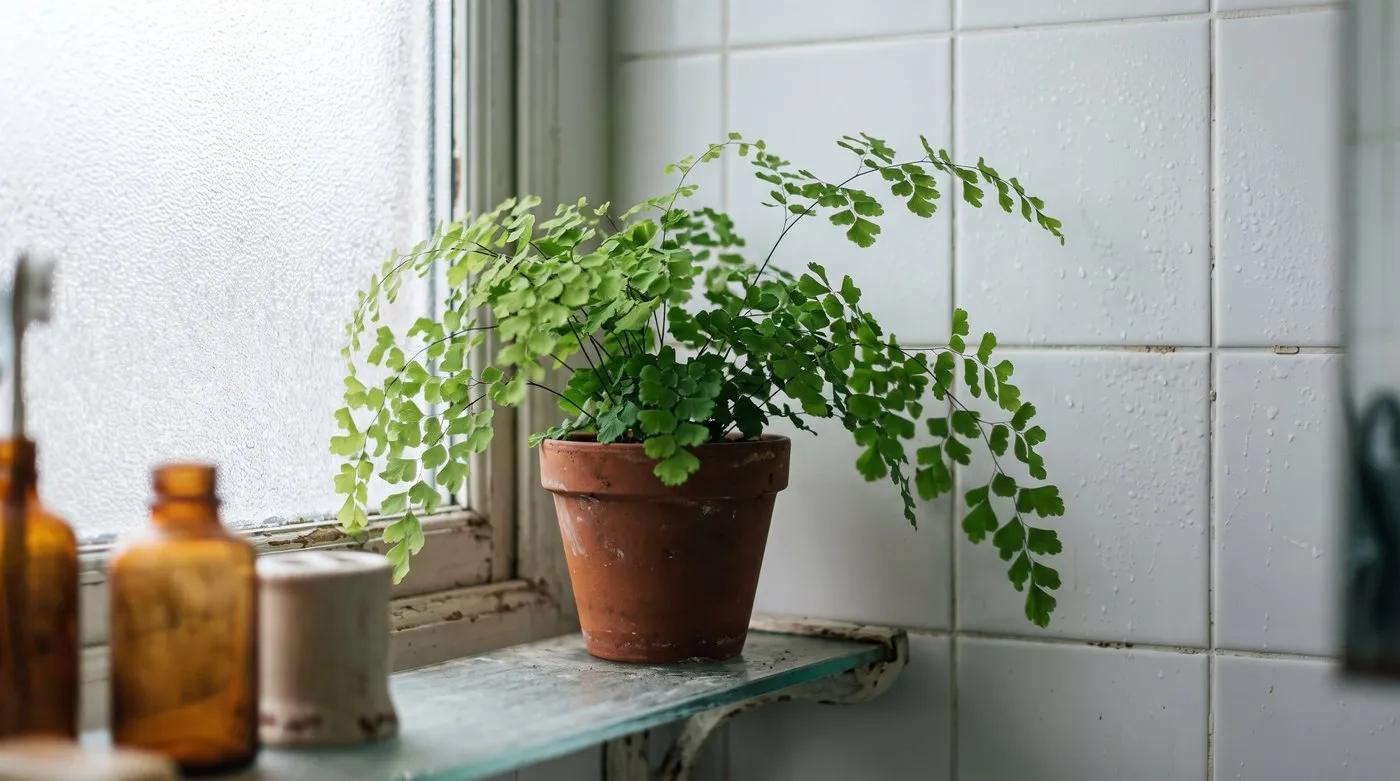
Maidenhair fern needs damp air and compost that never dries, so a bright bathroom is often its happiest spot.
4. Pothos (Epipremnum aureum)
Heart-shaped leaves on long trailing stems. It copes with most light levels and with dry or damp air, so it’s happy in almost any bathroom. The glossy leaves shrug off steam and splashes. Water every 7-14 days, but check first, as the soil stays damp longer in a steamy room.
Golden pothos is the most common. Neon pothos has bright lime-green leaves. Marble Queen has cream and green leaves but needs a bit more light to keep its markings. Trail it from a high shelf, hang it in a macrame planter or let it climb a moss pole. Not safe for cats and dogs. More trailing ideas are in our hanging houseplants guide.

5. Snake plant (Sansevieria trifasciata)
Stiff, upright, sword-shaped leaves with grey-green bands. It copes with the darkest corner of a bathroom and with damp air. Water every 2-3 weeks, letting the soil dry out completely in between. It stores water in its thick leaves and is almost impossible to kill by forgetting it.
The little ‘Hahnii’ type stays short, so it fits a narrow bathroom windowsill. Go easy on the watering in a bathroom, because the soil dries much more slowly than in a heated lounge. Not safe for pets that chew it.
6. Spider plant (Chlorophytum comosum)
Arching green and white striped leaves, with baby plants dangling on long stems. It’s happy in most light apart from deep shade, and copes with damp air. Water every 7-10 days. Spider plant is safe with cats, dogs and children, so it’s a great pick for a family bathroom.
Put it on a windowsill, a shelf or in a small hanging pot so the babies can dangle over the edge. It’s one of the easiest plants to make more of. Snip off a baby and root it in water for another room. For more easy-going plants, see our indoor plants guide.
7. Orchid (Phalaenopsis)
Graceful arching stems of moth-shaped flowers in white, pink, purple or yellow. The moth orchid is the one you see everywhere. It needs a bright window, ideally east-facing, out of hot midday sun. It won’t flower in a dark bathroom.
Bathroom humidity suits orchids nicely. Water every 7-10 days by soaking the roots for 10-15 minutes, then let it drain. Never let water sit in the middle of the plant, as it rots. After flowering, cut the spike just above the second joint from the base. A few weeks somewhere a bit cooler can help it flower again. Our orchid care guide covers the whole year.

8. Chinese evergreen (Aglaonema)
Broad, patterned leaves in green, silver, pink and red. Stays compact. It copes with dim light and loves damp air. Water every 7-14 days. It’s one of the most forgiving leafy plants for a dim, steamy room. The pink and red types need a little more light to keep their colour.
Keep it away from cold draughts and windows left open in winter, as it dislikes the cold. Keep it out of direct sun too, which scorches the leaves. Not safe for cats and dogs.
9. Calathea (Calathea / Goeppertia)
Beautifully patterned leaves in green, purple and cream. It needs medium, indirect light and damp air. In a dry living room the leaf edges curl and go brown, but in a bathroom they stay lush. Water every 7-10 days with water at room temperature. Calathea doesn’t like cold tap water, so leave it to stand overnight or use rainwater.
Its leaves fold up at night and open again in the morning, which is why it’s sometimes called a prayer plant. Safe with cats and dogs. Try Calathea orbifolia for big round leaves, or the rattlesnake plant (Calathea lancifolia) for long, wavy-edged ones.
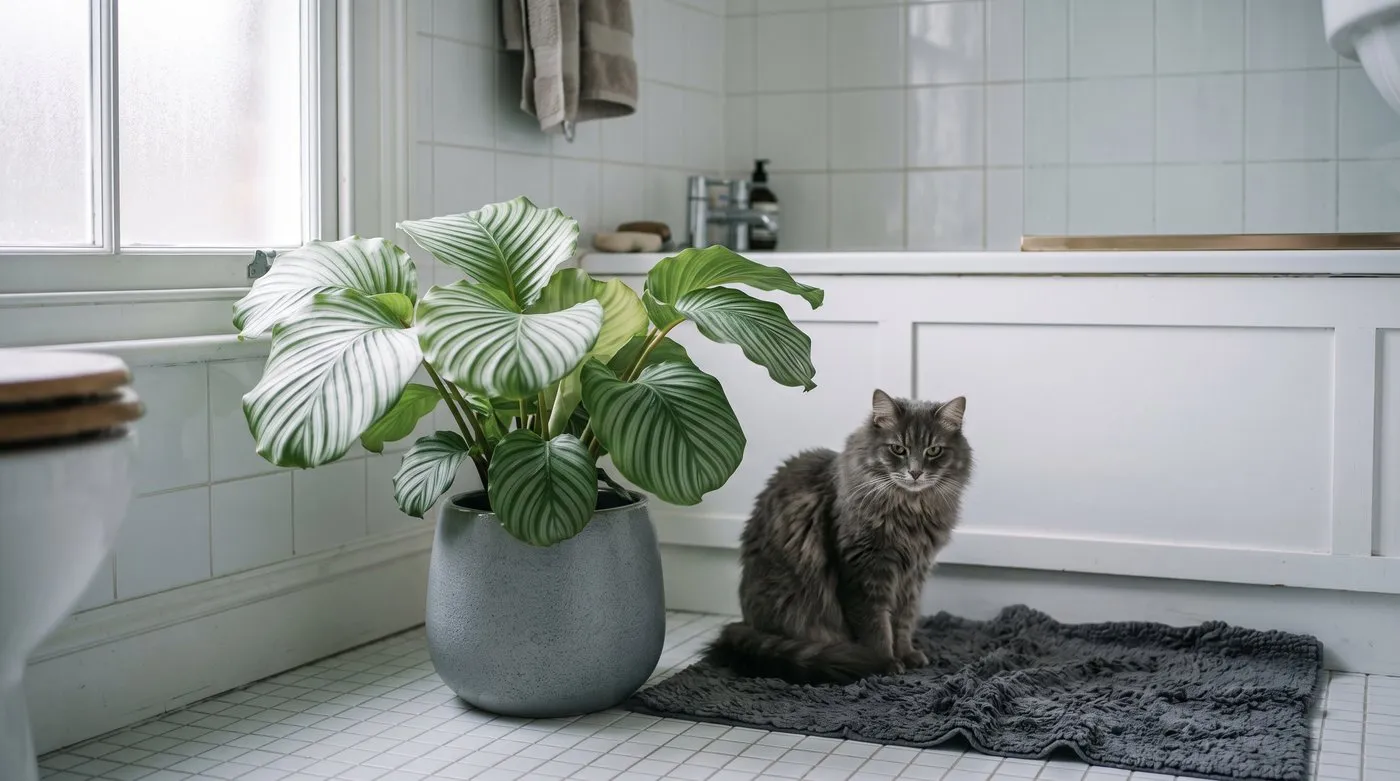
Calathea is safe with cats and dogs and loves bathroom steam. Water it with room-temperature water, not straight from the cold tap.
10. Aloe vera
Thick, fleshy, grey-green leaves in a rosette. It needs plenty of light, so only a bright south or west-facing bathroom window will do. It copes with damp air but hates wet soil. Water every 2-3 weeks and use a gritty cactus compost.
A bright bathroom windowsill suits it well. It’s tender, so keep it away from cold draughts by the window in winter. Aloe isn’t safe for cats and dogs if they chew it.
11. ZZ plant (Zamioculcas zamiifolia)
Waxy, dark green leaves on arching stems. It’s one of the toughest plants for a dim bathroom. Water monthly in winter and every 2-3 weeks in summer. It stores water in chunky roots, so it survives long dry spells. ZZ plant is nearly impossible to kill and suits even the most forgotten guest bathroom.
Its glossy leaves shrug off water spots. Wipe them now and then with a damp cloth to keep them shiny. Not safe for cats and dogs. For more on this plant in dark rooms, see our low-light houseplants guide.
12. Air plants (Tillandsia)
No soil needed. Air plants take in water through their leaves, so a steamy bathroom suits them nicely. Mist them lightly 2-3 times a week, or soak them in water for 20 minutes once a week. They like bright, indirect light. They’re small enough to sit on a shelf, in a wall holder or on a bit of driftwood.
They’re perfect for tiny bathrooms with no spare surfaces. Safe with cats, dogs and children. They grow slowly and stay small. Shake off extra water after misting so the middle doesn’t rot.
Bathroom plants at a glance
| Plant | Light | Steam lover? | Size | How easy | Pet safe |
|---|---|---|---|---|---|
| Boston fern | Bright, indirect | Yes | Trailing | Medium | Yes |
| Peace lily | Low to medium | Yes | Medium | Easy | No |
| Maidenhair fern | Bright, indirect | Very much | Small | Fussy | Yes |
| Pothos | Low to bright | Happy either way | Long trailing | Easy | No |
| Snake plant | Low to bright | Happy either way | Medium to tall | Very easy | No |
| Spider plant | Medium | Yes | Small, trailing babies | Easy | Yes |
| Orchid (Phalaenopsis) | Bright | Yes | Small | Medium | Yes |
| Chinese evergreen | Low to medium | Yes | Medium | Easy | No |
| Calathea | Medium, no direct sun | Yes | Medium | Medium | Yes |
| Aloe vera | Bright, sunny | Copes | Small | Easy | No |
| ZZ plant | Low to medium | Happy either way | Medium | Very easy | No |
| Air plants | Bright, indirect | Yes | Tiny | Easy | Yes |
What about windowless bathrooms?
Lots of UK bathrooms, especially in flats, have no window at all. That’s the hardest place for any plant, because no plant can live without light for long.
Grow light solutions
A grow light is the most reliable answer. LED grow bulbs now fit normal bayonet and screw light fittings. Swap one bathroom bulb for a full-spectrum LED grow bulb and run it for 10-12 hours a day on a timer plug. That’s enough for pothos, snake plant, spider plant and ZZ plant to grow steadily.
Modern white grow bulbs give a natural-looking light, not the purple glow of older ones. Keep the plants fairly close to the light, within about 60cm.
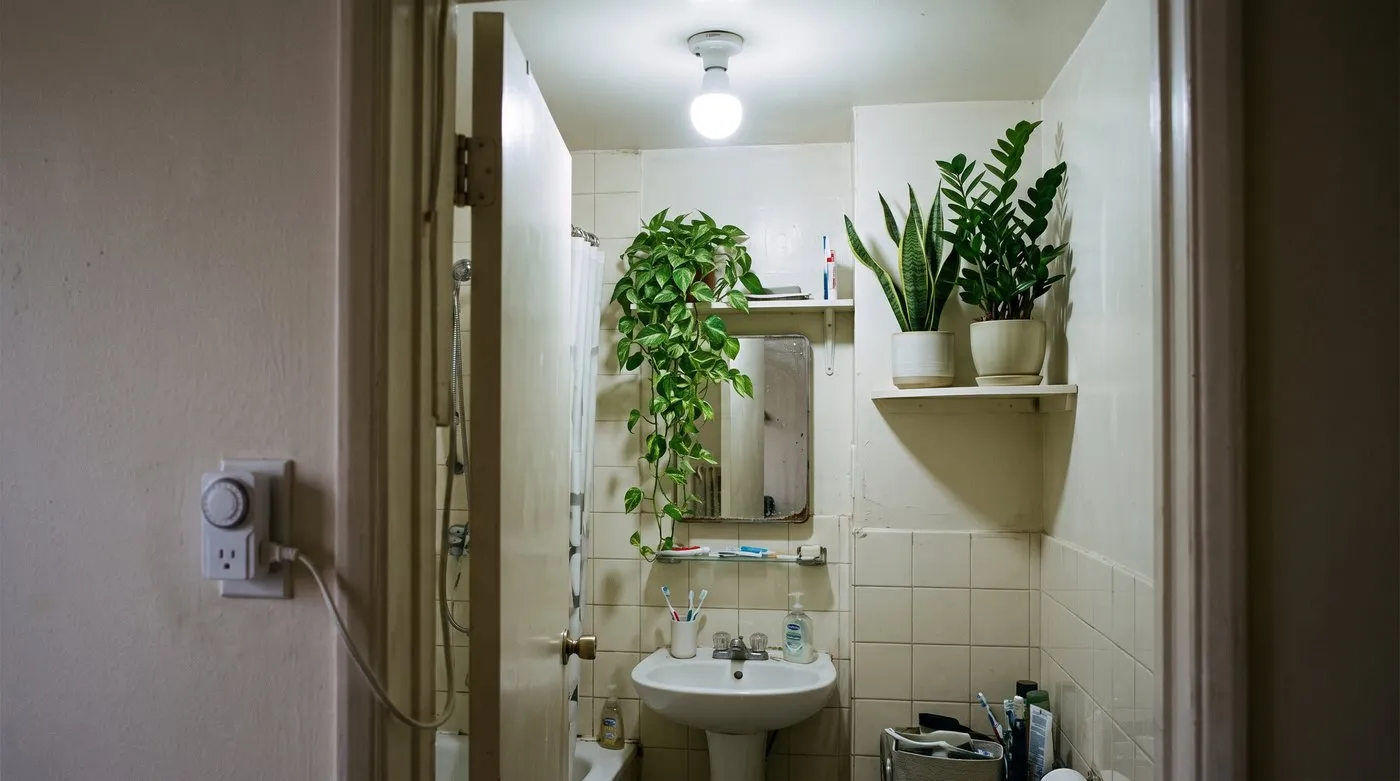
A white LED grow bulb on a timer for 10-12 hours a day lets tough plants grow even without a window. Keep them fairly close to the light.
Swapping plants around
If a grow light isn’t practical, use two of the same plant. Keep one in the bathroom for a week, then swap it with the other from a bright room. That gives each plant a week to recover. ZZ plant and snake plant cope with this best, as they grow slowly.
Plants to avoid in windowless bathrooms
Don’t try orchids, aloe vera, calathea or maidenhair fern in a windowless bathroom without a grow light. They need steady light, and all the steam in the world won’t make up for it.
Where to place plants in a small bathroom
UK bathrooms are often small, with no room for big floor pots. These ideas add green without cluttering the place up.
Windowsill
The brightest spot. Save it for the plants that need the most light, like orchids, aloe vera and spider plants. A 10-12cm pot fits most bathroom sills. Stand pots in saucers to protect painted sills.
High shelf above the door
Fit a slim floating shelf above the door frame. It catches the warm, steamy air rising from the shower. Perfect for trailing pothos and spider plant, and well out of reach of pets and children.
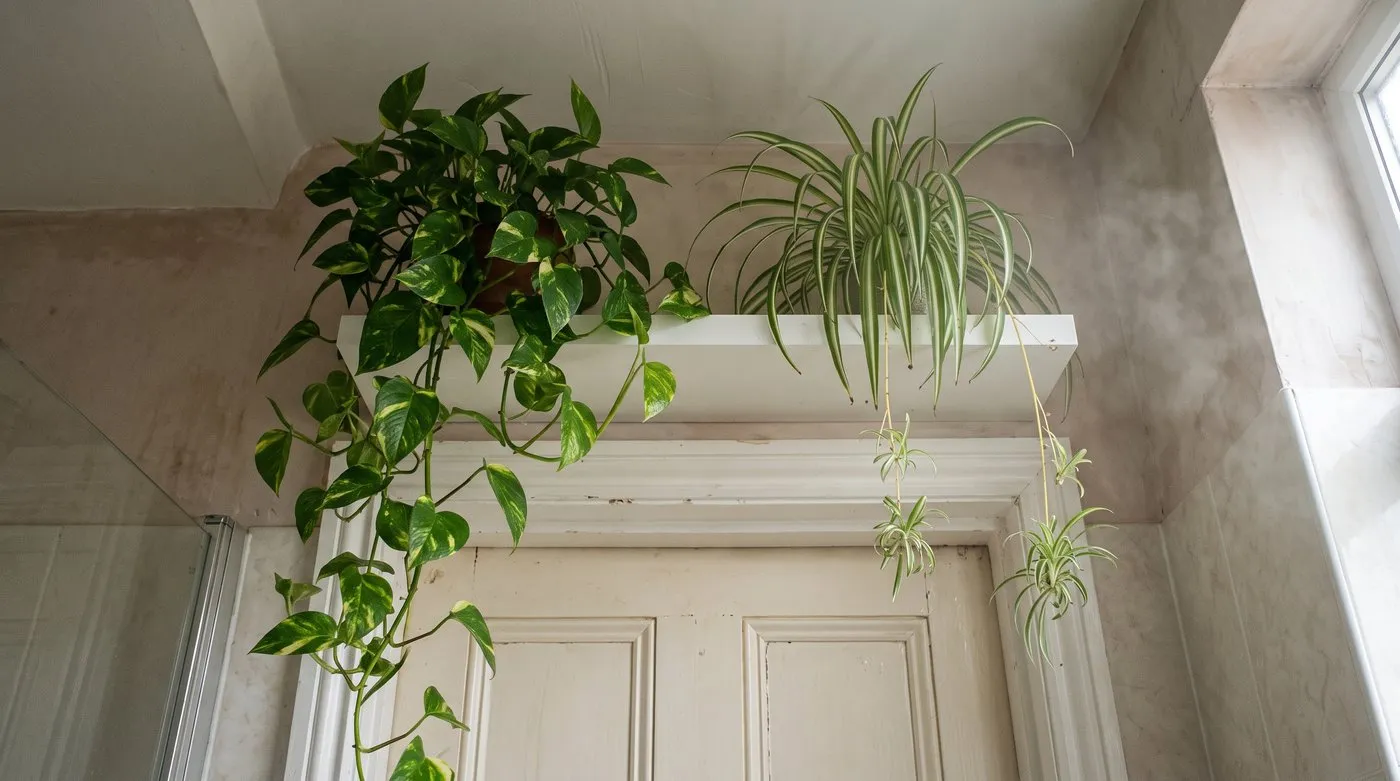
A shelf above the door catches warm, steamy air and keeps plants well out of reach of pets and children.
Hanging from the ceiling
A small hanging planter above the bath suits Boston fern or pothos. Screw the hook into a ceiling joist so it’s secure, and hang it high enough not to bump your head. Macrame hangers look lovely in a relaxed bathroom.
Wall-mounted holders
Small wire or ceramic wall planters hold air plants, little pothos cuttings or succulents. Fix them with adhesive strips or screws. Keep them away from direct splashes from the shower.
On top of the cistern
The flat top of a toilet cistern is handy spare space. Pop a small ZZ plant, snake plant or Chinese evergreen there in a 10-15cm pot with a saucer. It usually gets soft light from the window.
Which bathroom plants are toxic to pets?
If your cat explores every surface, this quick list will help.
| Plant | Safe with cats and dogs? |
|---|---|
| Boston fern | Yes |
| Peace lily | No |
| Maidenhair fern | Yes |
| Pothos | No |
| Snake plant | No |
| Spider plant | Yes |
| Orchid | Yes |
| Chinese evergreen | No |
| Calathea | Yes |
| Aloe vera | No |
| ZZ plant | No |
| Air plants | Yes |
If you’re ever unsure about a plant, check with your vet.
Common mistakes with bathroom plants
Overwatering
The number one plant killer. Steamy air keeps soil moist for longer, so water less often than you would in the lounge. Poke a finger in first. If it’s still damp 2cm down, wait a few more days.
Choosing plants that need too much light
Succulents, cacti and most flowering plants need lots of light, and most bathrooms are quite dim. Match the plant to the light you really have. If you only have a small frosted window, pick from the low-light plants in the table above.
Ignoring temperature swings
A plant right next to a radiator or under the extractor fan gets stressed. Radiators get very hot up close and fans cause cold draughts. Keep plants at least 30cm from both.
Forgetting to feed
Steam doesn’t feed plants. Give them a balanced liquid houseplant feed at half strength once a month from April to September. Stop feeding from October to March when growth slows down.
Blocking ventilation
Too many plants on the windowsill can stop the window opening properly. Mould loves a stuffy bathroom, so keep the window and extractor fan clear. Good airflow is good for you and your plants.
Why Boston fern suits many bathrooms: it likes bright, indirect light and moist compost, and damp air stops its frond tips drying out. It’s a poor choice for a windowless room unless you add a grow light.
Now you’ve got your bathroom sorted, read our guide on the best hanging houseplants for the next step.
Frequently asked questions
Can plants survive in a windowless bathroom?
Not without help, because every plant needs light. Fit a grow light bulb into a normal light fitting and run it for 10-12 hours a day on a timer. Or swap two plants each week between the bathroom and a bright room.
What is the best plant for a dark bathroom?
ZZ plant is the best choice for a dark bathroom. It copes with very little light and doesn’t mind the steam. Snake plant and cast iron plant are good backups. All three handle the ups and downs of a north-facing or frosted bathroom.
Are bathroom plants safe for cats and dogs?
Some are and some aren’t. Spider plant, Boston fern, calathea and air plants are safe choices. Peace lily, pothos, ZZ plant and Chinese evergreen can upset a pet that chews them, so keep those on high shelves.
Do bathroom plants reduce mould?
No, plants won’t stop mould. The best way to beat mould is good airflow. Run the extractor fan for about 15 minutes after each shower, or open the window.
How often should I water plants in a bathroom?
Less often than plants in other rooms. Steamy air means the soil dries out more slowly. Check the soil with your finger every week or so rather than watering on a schedule. Overwatering is the biggest risk.
Our team produces practical UK gardening guidance from source research, contributor records and established horticultural practice. Editorial standards are overseen by Matt W.


