Key takeaways
- Golden pothos is the easiest hanging plant and copes with most rooms
- String of hearts loves a bright east or west-facing window
- Hanging pots dry out faster than floor pots, so check them more often
- Sunny rooms suit hoya, lipstick plant and string of pearls
- Spider plant and Boston fern are safe with cats and dogs
- Fix ceiling hooks into a joist, or use a toggle bolt rated for at least 10kg
Trailing plants bring bare walls and empty shelves to life. They go where upright plants can’t: hanging from the ceiling, tumbling off bookcases and spilling from wall brackets. Light in UK homes varies a lot, from a sunny bay window to a gloomy north-facing bedroom, so picking the right plant for the spot makes all the difference.
Here are ten great hanging houseplants, with how much light each needs, how often to water and how easy they are.
Which trailing plants grow best in UK homes?
Pothos, string of hearts, spider plant, tradescantia and hoya do best in most UK homes, because they cope with dark winters and dry, heated air. Winter days are short, and central heating dries the air out. Rooms can also swing from toasty near a radiator to chilly by an old window.
Hanging plants have one extra challenge. Warm air rises, so a pot near the ceiling sits in the warmest, driest air in the room, and its compost dries faster. Plants that don’t mind drying out a bit between drinks are the safest picks for high spots.
The 10 best hanging houseplants ranked
1. Golden pothos (Epipremnum aureum)
Glossy, heart-shaped leaves splashed with gold, on stems that trail 2-3 metres. It copes with almost anything, from a dim hallway to a bright living room. Water when the top 3cm of compost is dry, roughly every 7-10 days in summer and every 2 weeks in winter. It droops a little when thirsty and perks up within hours of a drink. It even grows in plain water, so it’s lovely in a glass jar on a shelf.
Neon pothos has bright lime-green leaves that light up dark corners. Marble queen has creamy marbled leaves but needs a brighter spot, or it turns plain green. All pothos are poisonous to pets and children if chewed, and the sap can irritate skin, so the RHS suggests wearing gloves when you prune.

For more easy plants, see our guide to indoor plants for UK homes, with twelve options for every room.
2. String of hearts (Ceropegia woodii)
Tiny heart-shaped leaves on thread-thin stems that trail 1-2 metres. The leaves are grey-green on top and purple underneath, and older plants have small pink flowers in summer. It needs bright light without harsh sun, so an east or west-facing windowsill is perfect. Water every 10-14 days in summer and every 3-4 weeks in winter. It stores water in little bumps along the stems, so it’s tougher than it looks.
It hates soggy compost. Use a cactus mix, or mix half perlite into ordinary compost. It has small roots, so a 10-12cm pot lasts for years. To make more, lay a piece of stem on damp compost and pin the little bumps down with a hairpin.
3. Spider plant (Chlorophytum comosum)
Arching green and white striped leaves, plus long stems with baby plants on the ends. In a hanging pot, the babies dangle 30-60cm below. It copes with most light levels. Water every 7-10 days. The leaves look a bit pale when it’s thirsty.
The big bonus is it’s safe with cats and dogs. It also makes babies freely, so one plant can fill all your baskets. Snip one off and root it in water or damp compost. Our guide to beginner houseplants has more ways to make new plants.
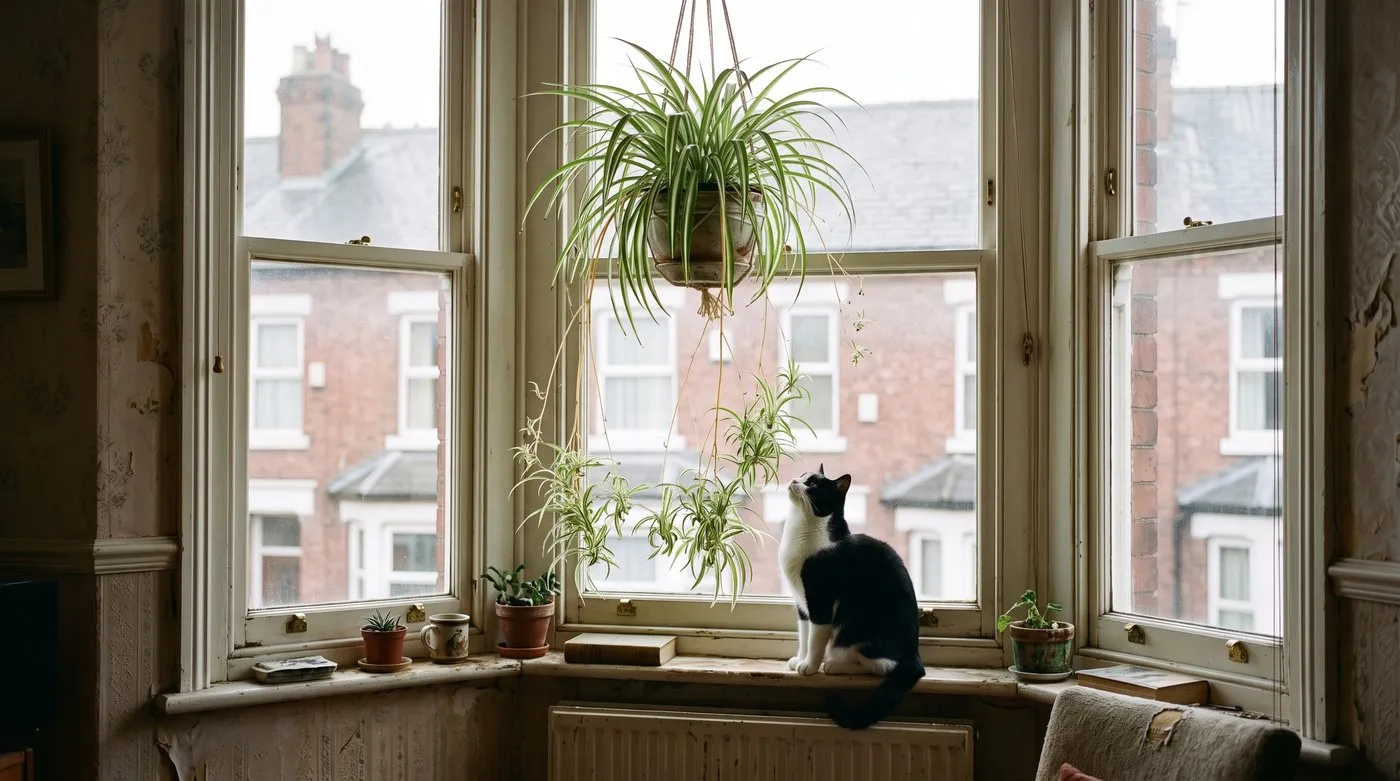
Spider plants are safe with cats and dogs, which is handy when the babies dangle within paw reach. Snip one off to start a new plant.
4. Tradescantia (Tradescantia zebrina)
Purple and silver striped leaves on fast stems that trail 60-90cm. You might see it sold as inch plant. It grows quickly in good light, but the purple fades to green in a dark spot. Water every 5-7 days in summer. Pinch out the tips now and then to keep it bushy at the top.
It’s one of the fastest trailers you can grow indoors. To make more, snip a 10cm piece, strip the lower leaves and stand it in water. Roots appear within a week or so. Our guide to rooting cuttings in water uses the same trick for lots of other plants. It can upset cats and dogs if they eat it.
5. Boston fern (Nephrolepis exaltata)
Lush, arching fronds that tumble 60-90cm from a hanging pot. When it’s happy, it’s a showstopper. It wants bright, indirect light and damp air, so a bathroom or kitchen suits it best. Water every 5-7 days, keeping the compost moist but never soggy.
It struggles in dry, heated rooms. Mist it daily in winter. Crispy brown tips mean the air is too dry. It’s safe with cats and dogs, which makes it one of the best pet-friendly hanging plants. Our pet-safe plants guide has more. For other shade-tolerant picks, see our low-light houseplants guide.
6. String of pearls (Curio rowleyanus)
Little round, bead-like leaves on thin stems that trail 30-60cm. It’s one of the most eye-catching succulents for a hanging pot. You may see it sold as Senecio rowleyanus. It needs lots of light, so a south or west-facing window is a must. Water every 10-14 days in summer. In winter, only water if the pearls start to shrivel, and keep it above 10°C. The pearls store water, so too much water rots it quicker than too little.
Once it’s settled, don’t move it. Use a gritty succulent compost. Feed once a month in spring and summer at half strength. It’s poisonous to cats and dogs. For more on succulents, read our succulent care guide.

7. Hoya (Hoya carnosa)
Thick, waxy leaves on twining stems that trail or climb 1-2 metres. It’s also called the wax plant. In good light it has clusters of scented, starry pink or white flowers. Give it a bright window, with a net curtain if it faces south. Water every 7-14 days, letting the compost dry in between.
Hoya is slow but lives for years, and flowers more as it gets older. Never cut off the short stubby spurs where the flowers grow, as new flowers come from the same spot each year. It copes with dry air much better than Boston fern. It’s considered safe with cats and dogs.
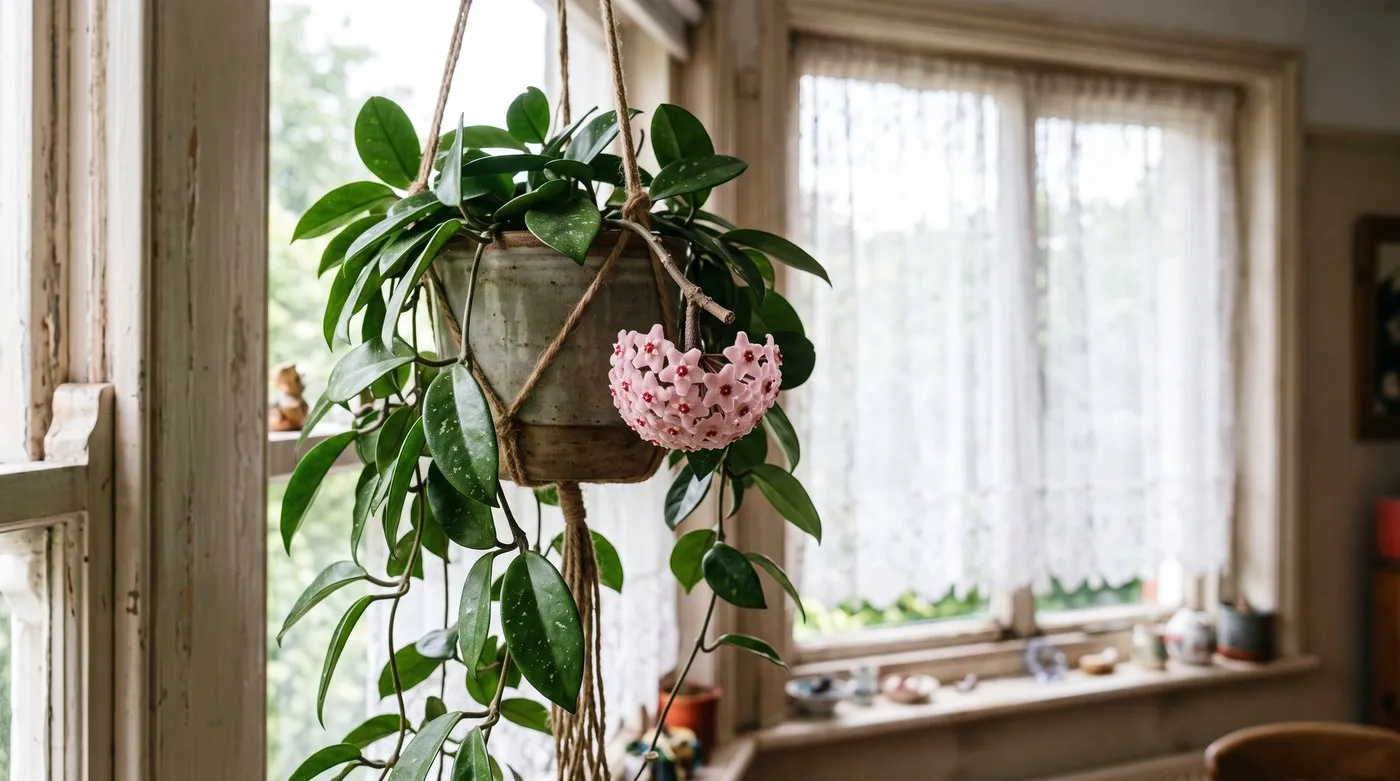
Hoya flowers from the same short spurs every year, so never cut them off. A bright window with a net curtain suits it well.
8. Lipstick plant (Aeschynanthus radicans)
Glossy dark leaves on arching stems that trail 40-60cm. It’s named for its bright red flowers, which poke out of dark buds like lipstick from a tube. It wants bright light without hot sun and flowers most in spring and summer. Water every 7-10 days, keeping the compost lightly moist.
To get it flowering, give it a cooler rest at 15-18°C for 4-6 weeks in winter. A bright, unheated bedroom or porch is ideal. Feed monthly from March to September with a high-potash feed. It’s considered safe with cats and dogs.
9. English ivy (Hedera helix)
Dark green, lobed leaves on stems that trail or climb 1-3 metres. Variegated types have cream or yellow edges. It copes with most light and actually prefers it cool, around 10-18°C. That makes it one of the few trailers for a chilly spare room or hallway.
Ivy is tough. It shrugs off draughts, temperature swings and dry spells. Water every 7-10 days. In warm, dry rooms, watch for red spider mite. Spraying the leaves with water helps keep them away, as the RHS guide to ivy as a houseplant explains. It’s poisonous to cats and dogs if chewed.
10. Maidenhair fern (Adiantum raddianum)
Dainty, fan-shaped leaflets on wiry black stems that arch and trail 30-50cm. It’s one of the prettiest hanging plants, and one of the fussiest. It wants indirect light, damp air and compost that never dries out. A bright bathroom is the best spot. Water every 3-5 days.
It crisps up fast in dry air. If the fronds die, cut them back to the compost and keep watering. New fronds often come back within a few weeks if the roots stayed damp. It’s considered safe with pets. Be patient with it and it’ll reward you.
Hanging plant comparison table
| Plant | Light | Watering | Growth | Trail | How easy | Pet safe |
|---|---|---|---|---|---|---|
| Golden pothos | Low to bright | Every 7-14 days | Fast | 2-3m | Easy | No |
| String of hearts | Bright | Every 10-14 days | Medium | 1-2m | Medium | Yes |
| Spider plant | Low to bright | Every 7-10 days | Fast | 30-60cm | Easy | Yes |
| Tradescantia | Medium to bright | Every 5-7 days | Very fast | 60-90cm | Easy | No |
| Boston fern | Medium, no direct sun | Every 5-7 days | Medium | 60-90cm | Medium | Yes |
| String of pearls | Very bright | Every 10-14 days | Slow | 30-60cm | Hard | No |
| Hoya | Bright | Every 7-14 days | Slow | 1-2m | Medium | Yes |
| Lipstick plant | Bright | Every 7-10 days | Medium | 40-60cm | Medium | Yes |
| English ivy | Low to bright | Every 7-10 days | Fast | 1-3m | Easy | No |
| Maidenhair fern | Medium, no direct sun | Every 3-5 days | Medium | 30-50cm | Hard | Yes |
Which rooms suit hanging plants best?
Bright east and west-facing rooms suit the most hanging plants. North-facing rooms suit only the toughest.
South-facing rooms
The brightest spot in the house. All ten plants grow here, but keep Boston fern and maidenhair fern at least 1.5m from the glass so they don’t scorch. String of pearls, hoya and lipstick plant love it. Use a sheer curtain to soften the midday sun from June to August.
East and west-facing rooms
The sweet spot for most trailing plants. Morning sun from the east is gentler than afternoon sun from the west. Pothos, string of hearts, tradescantia and spider plant are happy either way. Hang them within 1m of the window for the best growth.
North-facing rooms
The hardest spot, especially in winter. Only pothos, spider plant and English ivy really cope. Skip string of pearls, hoya and lipstick plant. Variegated plants will lose their markings and turn plain green. Our low-light houseplant guide has more ideas for dim rooms.
Bathrooms and kitchens
Plants that like damp air love a bit of steam. Boston fern, maidenhair fern, pothos and tradescantia all do well in a bathroom with a window. Kitchens work too, as cooking adds moisture to the air.

How to hang indoor plants safely
Fix into a ceiling joist, use a rated toggle bolt in plasterboard, or use a wall bracket or high shelf. Wet compost is heavy, so a big hanging pot can weigh several kilos after watering.
Ceiling hooks
Find a ceiling joist with a stud finder and screw the hook into solid wood. Plasterboard alone won’t hold a wet planter. If there’s no joist, use a spring toggle bolt rated for at least 10kg. Drill a pilot hole first so the wood doesn’t split.
Macrame hangers
Macrame hangers spread the weight evenly and look lovely. Pick one rated for at least 5kg. Cotton and jute suit a relaxed look. Synthetic cord lasts longer in a steamy bathroom.
Wall-mounted brackets
A bracket screwed firmly into the wall holds a hanging pot without any ceiling fixings. Fix it high so the stems can trail freely, and pick one that sticks out at least 15cm so the plant has room and doesn’t mark the wall.
Shelf trailing
The easiest way of all. Pop a trailing plant on a high shelf, mantelpiece or bookcase and let it spill over the edge. No drilling needed. It works brilliantly for pothos, tradescantia and ivy. Turn the pot every couple of weeks so it grows evenly.
How to water and care for hanging plants
Check hanging plants more often than floor pots, and only water when the top 2-3cm of compost is dry. Warm air around the pot dries it faster, and many hanging pots have no tray.
Watering tips
Water until it runs out of the drainage holes. If there’s no tray, take the pot down and water it in the sink or bath. Or use a long-spouted can with a saucer underneath. Check every 5-7 days in summer and every 10-14 days in winter. Push a finger 2-3cm into the compost. Dry means water. Damp means wait.
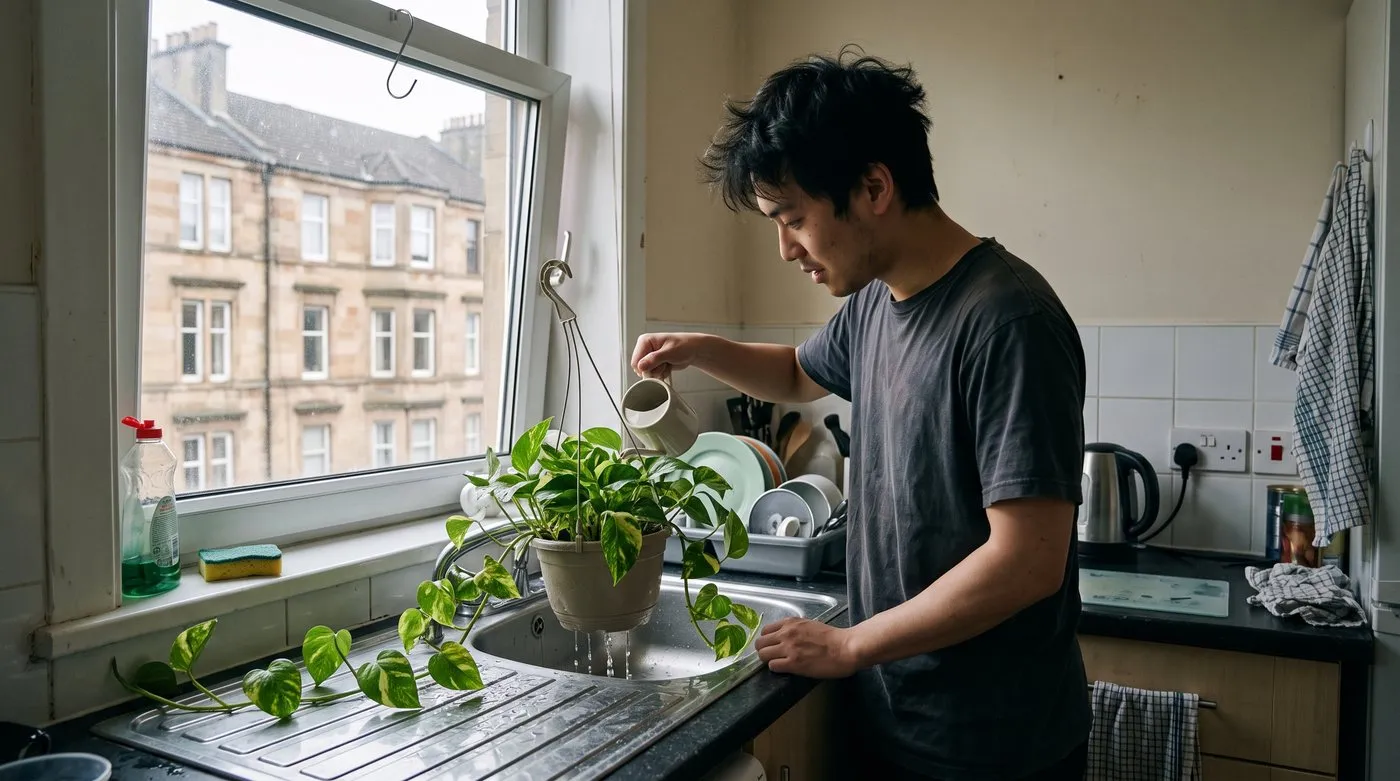
Taking a hanging pot down to the sink lets you water until it drains through, with no drips on the floor. Wait until the top 2-3cm feels dry.
Feeding
Feed monthly from April to September with a houseplant feed at half the label strength. Small pots run out of food faster than big floor pots. Stop in October as growth slows, and start again when you see new leaves in spring.
Humidity
Heated rooms get very dry in winter. Boston fern, maidenhair fern and tradescantia like damper air. Group these plants together, mist them every 2-3 days, or run a small humidifier nearby.
What compost should you use for hanging plants?
Use a peat-free houseplant compost for most trailing plants, and a gritty cactus compost for string of pearls and string of hearts. Good drainage matters most in a hanging pot, because you can’t easily see water sitting at the bottom.
Skip heavy soil-based composts like John Innes No 3 for ceiling pots, as they get very heavy when wet. For ferns, use a peat-free mix that holds moisture, with no grit. Hoya and lipstick plant like an open mix, so add a handful of bark chips or perlite. Repot every two to three years in spring, or when roots fill the pot and water runs straight through.
Light and rotation
Trailing plants grow towards the light. If you never turn them, one side goes lush and the other thin. Give hanging pots a quarter turn every two weeks. In winter, move them closer to the window.
Common problems with hanging houseplants
Leggy growth with sparse leaves
Not enough light makes stems stretch towards the window, with big gaps between leaves. Move the plant somewhere brighter. Cut leggy stems back to 10-15cm and it’ll grow back bushier. Use the bits you cut off as cuttings.
Brown, crispy leaf tips
Usually the air is too dry. Hanging plants sit in the warmest, driest air near the ceiling. Mist often, group plants together or move them to a steamier room. Boston fern and maidenhair fern suffer most.
Yellow leaves and mushy stems
Too much water. Pots with no drainage holes leave the roots sitting in water. Always use pots that drain. If the roots are soggy, repot straight away into fresh, dry compost and snip off any black, mushy roots.
Pests
Fungus gnats (tiny black flies) love wet compost, so let the top dry out between waterings. Mealybugs look like white fluffy blobs on stems and leaf joints. Wipe them off with a cotton bud. Spider mites leave fine webbing under the leaves, especially on ivy in dry rooms. Rinse the plant under a lukewarm shower each week to keep them away.
Dropping leaves
Sudden leaf drop usually means a chill or a draught. Make sure the plant isn’t above a radiator, by an open window in winter or in a draughty doorway. Most trailing plants like a steady 15-24°C.
Can hanging houseplants go outside in summer?
Some can. Spider plant, tradescantia and English ivy enjoy a summer holiday in a sheltered, shady spot from June to early September. Bring them in before the nights turn cold.
Wait until nights are reliably mild, usually from June, and a bit later in the north and Scotland. Keep them out of hot midday sun, which scorches leaves used to indoor light. Wind dries baskets fast, so check them daily in warm spells. Before bringing them back in, look under the leaves and round the pot for aphids, slugs and vine weevil. Tropical plants like pothos, hoya and string of pearls are best left indoors, as our summer nights are often too cool for them.
Do hanging plants need a grow light in winter?
Most don’t, but a grow light helps in north-facing rooms and dark corners from November to February. Short winter days slow growth, and plants hung away from windows can go leggy.
A simple full-spectrum LED bulb in a pendant or clip-on lamp works well for one pot. Hang it 30-50cm above the plant and run it 10-12 hours a day on a plug-in timer. LEDs stay cool, so they won’t scorch the stems. String of pearls, hoya and lipstick plant gain most. Pothos, spider plant and ivy usually manage without if they’re within a metre or two of a window.
How to propagate trailing houseplants
Most trailing houseplants root easily from cuttings in water or compost.
Pothos, tradescantia and English ivy: Cut a 10-15cm piece just below a node (the bump where a leaf joins the stem). Take off the bottom 2-3 leaves and stand it in a glass of water on a bright windowsill. Roots appear in a week or two. Pot it up once the roots are 3-5cm long.
Spider plant: Snip off a baby once it has little roots at the base. Pop it in a small pot of damp compost and keep it moist for two weeks.
String of hearts: Lay a piece of stem on damp compost with the little bumps touching the surface. Pin it down with a hairpin. Roots grow in 2-4 weeks. Keep it bright and mist gently.
String of pearls: Lay a 10cm cutting on damp succulent compost. Press the stem lightly onto the surface but don’t bury it. Mist every 2-3 days. Roots appear in 2-3 weeks. Don’t overwater while it roots.
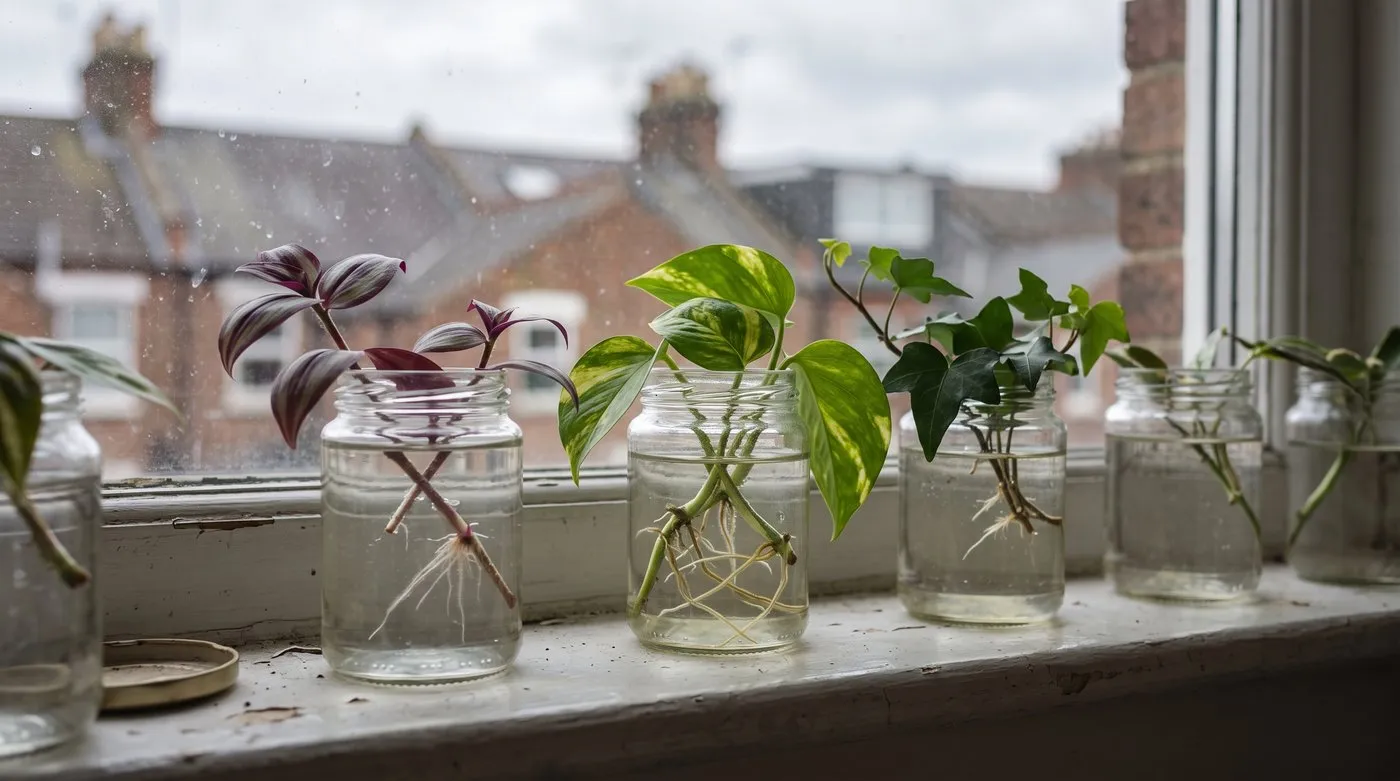
Cut just below a node and strip the lower leaves before standing it in water. Pot it up once the roots are 3-5cm long.
Choosing the right hanging planter
Pick a light planter with drainage holes, matched to how quickly the plant likes to dry out.
Terracotta: Breathes and dries evenly, but it’s heavier. Best for succulents and plants that like it dry, like string of pearls and hoya. Use a matching saucer to catch drips.
Plastic: Light and holds moisture longer. Best for ferns. Cheap, and often comes with a built-in drip tray.
Ceramic: Pretty but often has no drainage holes. Use it as an outer cover with a plastic pot inside that you can lift out to water. It’s heavier, so check your hook can take it.
Woven and macrame: Natural baskets look great but dry out fast. Line them with plastic. Replace natural fibre hangers every year or two, as water weakens them.
Ready for more? Our guide to the best indoor plants for UK homes is a great next step.
Frequently asked questions
What is the easiest hanging plant for beginners?
Golden pothos is the easiest hanging plant. It copes with low light, forgotten watering and dry air. It even grows in plain water. The stems trail a couple of metres or more without any help.
How often should I water hanging plants?
Roughly every 5-7 days in summer and every 10-14 days in winter. Hanging pots dry faster than floor pots because warm air rises around them. Push a finger 2-3cm into the compost. If it’s dry, water well until it runs out of the bottom.
Can hanging plants survive in a north-facing room?
Yes, but only the tough ones. Pothos, spider plant and English ivy cope with the dim winter light of a north-facing room. String of pearls, hoya and lipstick plant need more light and will struggle there.
Are trailing houseplants safe for cats?
Spider plant and Boston fern are safe for cats. Pothos, string of pearls, English ivy and tradescantia can upset a cat that chews them. Hang those well out of reach, or pick a pet-safe plant instead.
How do I hang a plant from the ceiling without damaging it?
Screw a hook rated for at least 10kg into a ceiling joist. Use a stud finder to find one. If there’s no joist, use a spring toggle bolt, as plasterboard alone won’t hold a wet pot. Or skip the drilling with a freestanding hanger or wall bracket.
Why are the leaves on my hanging plant turning yellow?
Too much water is the usual cause. Hanging pots that don’t drain well leave the roots sitting wet. Make sure the pot has drainage holes and that water isn’t pooling in the outer cover. Let the top 3cm of compost dry before you water again.
Can I grow hanging plants in a bathroom?
Yes, Boston fern, pothos and tradescantia love bathrooms. The steamy air suits these tropical plants. The room does need a window, though. A windowless bathroom is too dark for any plant without a grow light.
Our team produces practical UK gardening guidance from source research, contributor records and established horticultural practice. Editorial standards are overseen by Matt W.