
Key takeaways
- Pothos copes with low light, but variegated types need a brighter spot to keep their colour
- Water when the top 3cm of compost is dry, roughly weekly in summer
- Golden and neon pothos are the best choices for darker rooms
- Cuttings root in a jar of water in a few weeks
- Yellow leaves usually mean too much water
- Pothos is toxic to cats and dogs, so keep it out of reach
Pothos is the plant that forgives almost everything. Forget to water it for a fortnight, pop it in a dim hallway, ignore it for months, and it keeps on growing. Its proper name is Epipremnum aureum, but most people call it devil’s ivy. It’s a trailing tropical climber that’s perfectly at home in a British house.
Here’s how to choose a variety, where to put it, how to water it and how to grow lots more plants for free.
Which pothos varieties grow best in UK homes?
Six varieties are easy to find and do well indoors here. The main difference is how much light they need. Variegated types lose their colour in a dim room, so match the plant to the spot.
Golden pothos
The original and the one you’ll see everywhere. Heart-shaped green leaves splashed with golden yellow. It copes with almost any room and trails 2-3 metres. You’ll find it in garden centres and supermarkets. Start here if you’ve never grown a houseplant.
Marble queen pothos
White and green marbled leaves, much more variegated than golden pothos. It needs brighter light to keep the white. In a dim room, new leaves come out mostly green. It grows more slowly than golden pothos. Lovely in a bright east or south-facing room.
Neon pothos
Bright lime-yellow leaves with no variegation. The brightest pothos of all and great for cheering up a dark corner. It copes with lower light better than marble queen. It’s a little harder to find in shops, but easy to buy online.
Manjula pothos
Large, rounded leaves splashed with cream, silver and green, every leaf a little different. It needs bright, indirect light and grows slowly and compactly. A favourite with collectors.
N’Joy pothos
Small leaves with crisp green and white variegation. It stays compact, so it’s handy for shelves and small spaces. Give it a bright spot.
Cebu blue pothos
Silvery-blue, arrow-shaped leaves that look quite different from other pothos. Given something to climb in good light, older leaves can develop splits. It’s less common in shops but becoming more popular.
 Golden, marble queen and neon pothos side by side. The colours really stand out.
Pothos variety comparison table
| Variety | Light | Growth | Best for |
|---|---|---|---|
| Golden | Low to bright | Fast | Beginners, any room |
| Marble queen | Medium to bright | Medium | Bright rooms |
| Neon | Low to bright | Fast | Dark corners |
| Manjula | Bright | Slow | Collectors |
| N’Joy | Medium to bright | Medium | Small shelves |
| Cebu blue | Medium to bright | Medium | Something different |
Light requirements for pothos in UK rooms
Pothos copes with a wider range of light than almost any houseplant, from a north-facing hallway to a bright living room. Knowing what each room offers helps you put the right variety in the right place.
Light indoors changes a lot with the direction of the window and the time of year. A north-facing room in December is very dim, while a south-facing window in summer is bright and hot. Our guide to low-light houseplants has more ideas for dim rooms.
North-facing rooms: Golden and neon pothos cope well. Marble queen and manjula lose their variegation. Growth slows right down in winter.
East or west-facing rooms: Ideal for every variety. This is where marble queen and N’Joy show off their best colours.
South-facing rooms: Everything grows well, but keep the plant a metre or two back from the glass so hot midday sun doesn’t scorch the leaves.
To see how other plants cope in different rooms, our indoor plants guide compares twelve favourites.

An east or west-facing room suits every pothos. In a south-facing room, keep it a metre or two back from the glass so the leaves don’t scorch.
How to water pothos correctly
Water when the top 3cm of compost feels dry. In most UK homes that’s about every 7-10 days in summer and every 10-14 days in winter. The plant will tell you when it’s thirsty. The leaves droop a little, then perk up within a few hours of a drink.
How you water matters more than when. Water until it runs out of the drainage holes. Let the pot drain, then tip away anything left in the saucer after half an hour. Pothos roots rot if they sit in water.
Too much water is the biggest killer. Roots need air between drinks. In a cool room, compost stays wet for a long time. If in doubt, wait a few more days. A thirsty pothos bounces back in hours, but a waterlogged one may not recover.
For watering tips that apply to all houseplants, our beginner house plants guide covers the basics.
Temperature and humidity for UK homes
Pothos likes 18-24°C, which suits most heated UK rooms. It copes down to 10°C, but growth stops when it’s cool. In winter, the real danger is cold draughts near windows and outside doors.
It likes a bit of humidity. Central heating dries the air in winter, which can give brown leaf tips. Some easy fixes:
- Group pothos with other houseplants so they keep each other’s air moist
- Stand the pot on a tray of wet pebbles
- Mist the leaves a couple of times a week in winter
- Move it to a bathroom, where shower steam keeps the air moist
Keep it away from radiators. Hot, dry air right next to a radiator browns the leaves fast. Aim for at least a metre away.
How to propagate pothos for free
Water propagation (recommended method)
- Choose a healthy stem with 3-4 leaves
- Cut 1cm below a node (the little brown bump where roots grow)
- Remove the lowest leaf so at least one node sits under water
- Stand the cutting in a jar of clean water somewhere warm
- Keep it in bright, indirect light
- Change the water every 5-7 days
- White roots appear in a week or two
- Pot it into compost when the roots are 5-8cm long
 Pothos cuttings rooting in water on a kitchen windowsill.
The common mistake is leaving cuttings in water for too long. Roots grown in water find it harder to adjust to compost the longer they stay there. Pot them up once the roots reach 5-8cm.
For more on division, layering and air layering, read our plant propagation guide.
Soil propagation
You can also skip the jar. Push a cutting with a node or two straight into a small pot of moist, free-draining compost, and keep it warm and out of direct sun. Keep the compost just damp until new leaves show it has rooted. If you want to try other houseplants too, our houseplant propagation guide covers 15 popular species.
Potting mix and repotting
Use peat-free houseplant compost with a few handfuls of perlite mixed in. That gives the light, free-draining mix pothos roots love. Plain compost can stay too wet in a cool room. Our peat-free compost guide explains the options.
Repot every 18-24 months, or when roots circle the pot or poke out of the drainage holes. Go up just one pot size, say from 12cm to 15cm. A pot that’s too big holds too much water. Spring, from March to May, is the best time.
 Repotting a pothos. Go up one pot size and mix in perlite for drainage.
For step-by-step help, read our how to repot houseplants guide.
Common pothos problems and fixes
Yellow leaves
Too much water is the usual cause. Roots sitting in wet compost run out of air and start to rot. Check the drainage holes are clear, empty the saucer and let the top few centimetres dry before watering again. If the base of the stem is mushy, rot has set in. Cut off healthy stems above it and root them as new plants.
Brown leaf tips
Dry air browns the leaf tips. It’s common in winter when the heating’s on. Try the humidity tips above. Brown tips won’t turn green again, but new leaves will be fine once the air is moister.
Leggy growth with small leaves
Not enough light gives long, bare stems and small leaves. Move it nearer a window or to a brighter room. Cut leggy stems back to a node and root the cuttings in the same pot for a fuller plant.
Loss of variegation
Variegated types turn green in low light. The plant makes more green to catch what light there is. Move marble queen, manjula or N’Joy somewhere brighter, and cut out any all-green stems.
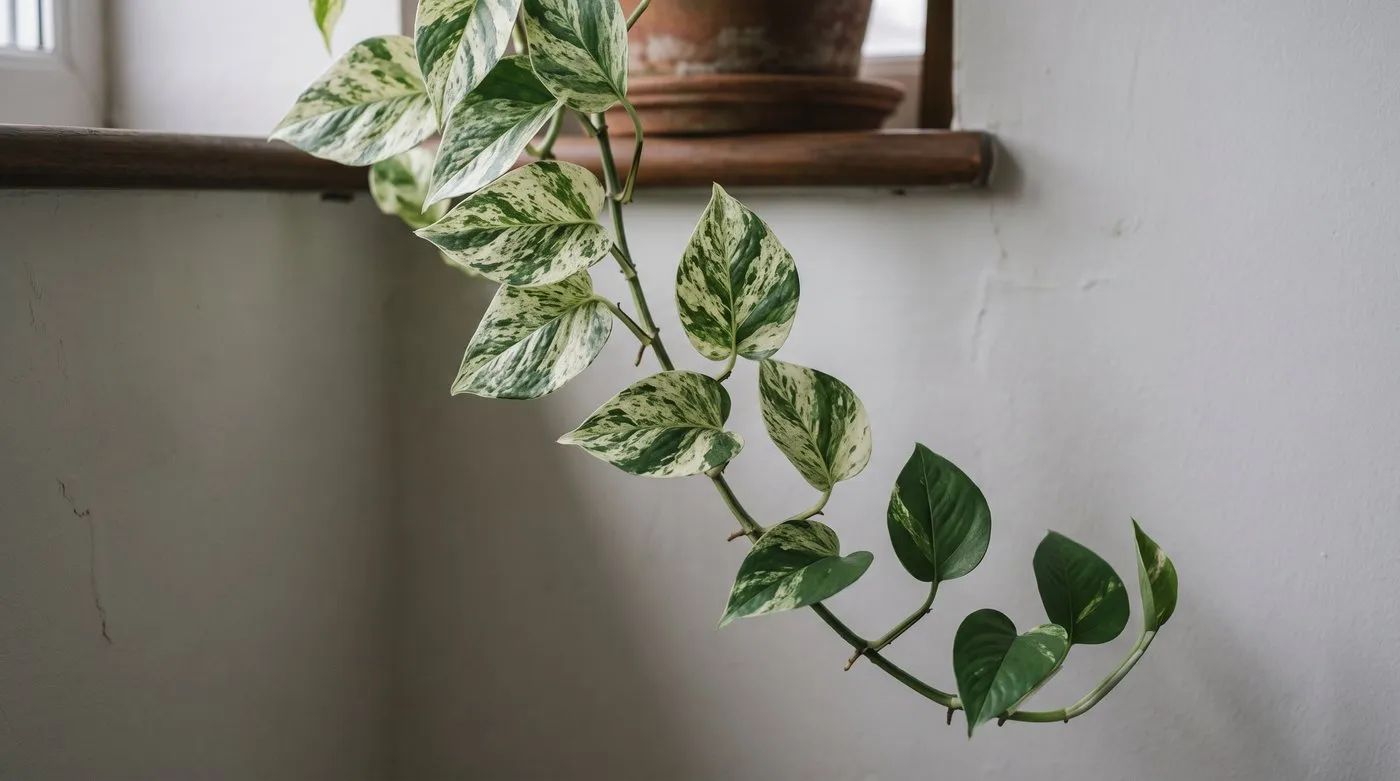
New leaves coming out plain green means the plant needs more light. Move it somewhere brighter and snip out any all-green stems.
Fungus gnats
Tiny black flies around the compost are fungus gnats. They breed in compost that’s always damp. Let the top 3cm dry out completely between drinks to break the cycle. A 1cm layer of grit on top also stops them laying eggs. Our houseplant flies guide has more ways to deal with them.
Pothos care calendar for the UK
| Month | What to do |
|---|---|
| January to February | Water every 12-14 days. No feeding. Check for cold damage near windows. |
| March | Water more as growth restarts. Repot if pot-bound. Start feeding monthly. |
| April to May | Water every 7-10 days. Half-strength feed every 4 weeks. Take cuttings. |
| June to August | Fastest growth. Keep out of hot midday sun. Mist in heatwaves. Can go outside in a sheltered, shady spot if nights are mild. |
| September | Bring outdoor plants in before nights turn cool. Feed less often. |
| October to November | Water less. Stop feeding by the end of November. Move away from cold windows. |
| December | Water every 12-14 days. No feeding. Keep above 10°C. |
Pothos safety and toxicity
Pothos is toxic to cats, dogs and people if chewed. It causes instant pain, swelling and drooling in the mouth. Pets may paw at their mouth, drool, be sick or struggle to swallow. Call your vet straight away if a pet has eaten some.
The RHS list of potentially harmful plants has more on plants to keep away from pets and children.
Frequently asked questions
Is pothos a good houseplant for beginners?
Yes, pothos is one of the best houseplants for beginners. It copes with low light, forgetful watering and dry, centrally heated air. It droops when thirsty and perks up within hours of a drink. You can even grow it in a jar of water.
Can pothos grow in a north-facing room?
Yes, pothos grows well in a north-facing room. It grows more slowly than in brighter spots, and heavily variegated types like marble queen may turn plain green. Golden and jade pothos are the best choices for darker rooms.
How often should I water pothos in winter?
Water pothos every 10-14 days in winter. Heating dries the air, but the low light slows growth, so it drinks less. Push a finger 3cm into the compost. If it’s dry, water until it runs out of the bottom. If it’s still damp, wait a few more days.
Is pothos toxic to cats and dogs?
Yes, pothos is toxic to cats and dogs. Chewing it causes pain, swelling and drooling in the mouth. Hang it out of reach, or choose a pet-safe plant such as spider plant or Boston fern.
Why are my pothos leaves turning yellow?
Too much water is the most common cause. Soggy compost starves the roots of air and they start to rot. Check the pot has drainage holes and tip away water left in the saucer. Let the top 3cm dry out between drinks. Cold draughts and hot direct sun can also yellow leaves.
How do I make my pothos grow faster?
Give it bright, indirect light and a warm room. Feed with a balanced houseplant food at half strength every 4 weeks from April to September. In a bright, warm spot it grows much faster than in a dim corner.
Can I grow pothos outdoors in the UK?
No, pothos can’t survive a UK winter outside. It’s a tropical plant that suffers below 10°C and dies in frost. You can stand it outside in a sheltered, shady spot in summer when nights stay mild, but bring it in before autumn.
Our team produces practical UK gardening guidance from source research, contributor records and established horticultural practice. Editorial standards are overseen by Matt W.


