
Key takeaways
- ZZ plants cope with dim rooms and hallways better than almost any other houseplant
- Water only when the top 5cm of compost is completely dry, roughly every 2-4 weeks in summer
- Too much water is the main killer, and yellow stems are the first warning sign
- Use free-draining compost and a pot with drainage holes
- Splitting a big plant is the quickest way to get new ones, as leaf cuttings take months
- It's toxic to cats, dogs and children if chewed, so keep it out of reach
The ZZ plant is one of the toughest houseplants you can grow in the UK. It copes with dim rooms and long gaps between watering. Its secret is a set of chunky underground tubers that store water like little potatoes. The one thing it can’t stand is too much water, so the main job is simply leaving it alone.
What light does a ZZ plant need?
A ZZ plant copes with low light better than almost any other houseplant. It grows naturally on shady forest floors in eastern Africa, so a dim corner suits it fine.
It does best in medium, indirect light, though. Here’s what to expect in different spots.
| Spot in your home | How it does |
|---|---|
| Dark hallway | Survives, but grows very slowly |
| North-facing room, back from the window | Healthy, steady growth |
| North or east-facing windowsill | Grows best |
| South-facing windowsill in summer | Too hot, leaves can scorch |
Hot midday sun through a south-facing window can scorch the leaves yellow-brown. If that’s your only spot, move it a metre or two back or use a net curtain. Our guide to low-light houseplants has more ideas for dim rooms.
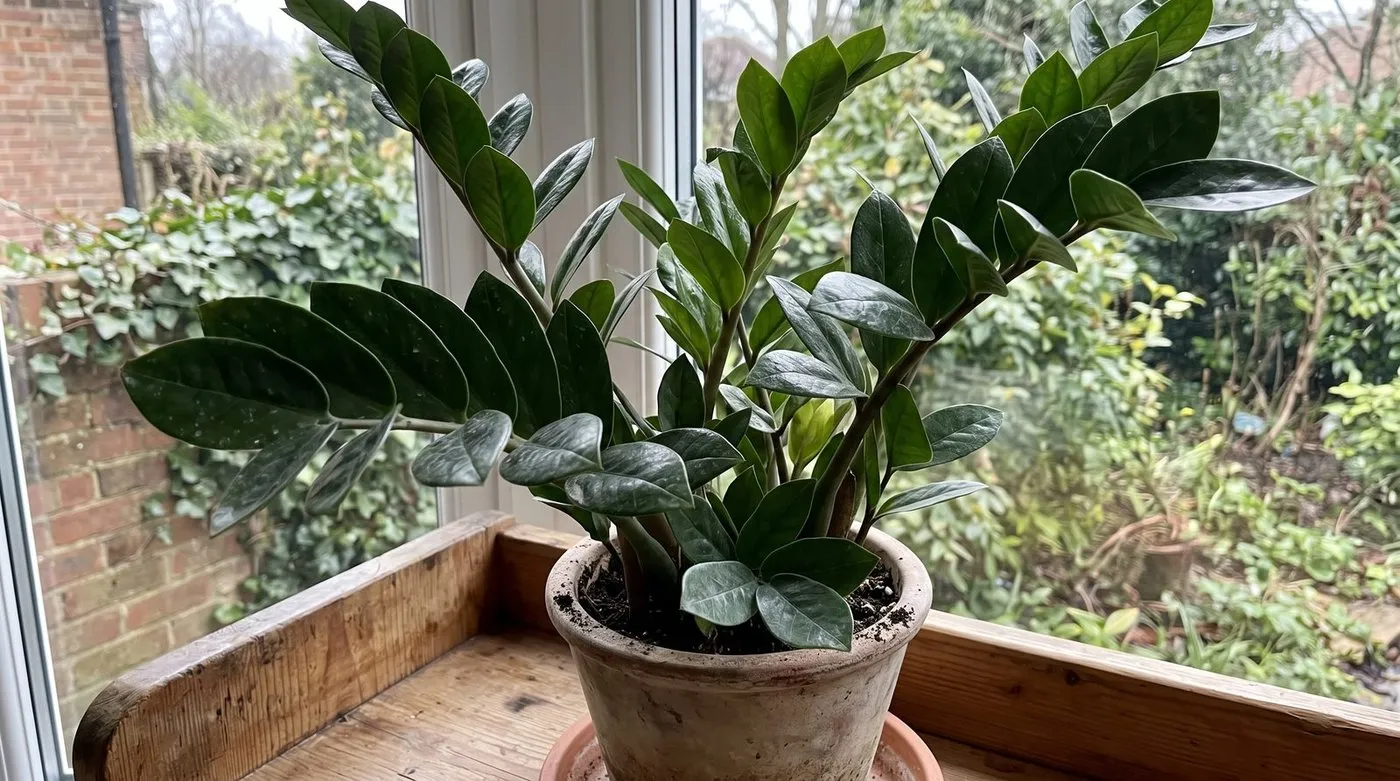 A ZZ plant’s glossy leaves catch the light, so it looks smart even in a shady corner.
The conditions a ZZ plant likes
The good news is that a normal UK home suits a ZZ plant very well.
- Warmth: Normal room temperature is perfect. Keep it away from cold glass on winter nights, as it dislikes the cold.
- Humidity: Dry centrally heated air doesn’t bother it. No misting or pebble trays needed, unlike peace lilies.
- Drainage: Always use a pot with drainage holes. Never let it sit in water.
In November, move it back from a draughty windowsill. You can bring it back in March.
ZZ plant varieties available in the UK
You’ll usually find three types in UK garden centres. They all like the same care.
 Left to right: standard green ZZ, dark Raven and compact Zenzi. All three like the same easy care.
| Variety | Size | Leaves | Best for |
|---|---|---|---|
| Standard green | Tall | Glossy dark green | Beginners, any room |
| Raven | Tall | Starts lime green, turns almost black | A striking statement plant |
| Zenzi | Compact | Dark green, tightly packed | Shelves and desks |
Raven is the eye-catcher. New stems come up bright lime green and slowly turn nearly black, so you always get a lovely mix of colours.
Zenzi stays small, with leaves packed closely on short stems. It’s ideal where the standard type would get too big.
The standard green is the easiest to find and usually the cheapest. If you’re choosing your first houseplants, it’s a great place to start.
How to water a ZZ plant
Too much water kills more ZZ plants than anything else. Those underground tubers hold plenty of water, so the plant is happy to go weeks without a drink.
The rule is simple. Let the top 5cm of compost dry out completely before you water. Push your finger in to the second knuckle. If it feels at all damp, wait.
When you do water, give it a good soak until water runs out of the bottom. Then empty the saucer. If it sits in water, the tubers go soft and rot.
| Season | How often to water |
|---|---|
| Spring | Every 2-3 weeks |
| Summer | About every 2 weeks |
| Autumn | Every 3-4 weeks |
| Winter | Every 4-6 weeks |
Always check the compost first rather than sticking to the calendar. Ordinary tap water is fine, even in hard water areas, unlike fussier plants such as orchids.
What compost and pot does a ZZ plant need?
It needs compost that drains quickly. Mix peat-free multipurpose compost with plenty of perlite and grit. Or use cactus and succulent compost straight from the bag. If you grow succulents, you’ll already have the right stuff.
Plain multipurpose compost holds too much water on its own. In a cool, dull UK winter it stays wet for weeks and the tubers can rot.
Pick a pot with drainage holes, only a little bigger than the roots. Terracotta is a good choice because it dries out faster than plastic. If you love a decorative pot without holes, keep the plant in a plastic pot inside it and lift it out to water.
How to propagate a ZZ plant
You can make new ZZ plants by splitting a big one or from leaf cuttings. Splitting is much quicker.
Splitting (division): When you repot in spring, ease the plant out and pull the clumps of tubers apart by hand or with a clean knife. Give each piece a few stems and a healthy tuber. Pot them up and water lightly. New growth usually appears within a couple of months. It’s the same idea as propagating houseplants by division.
Leaf cuttings: These work, but you’ll need patience. Cut a healthy leaf with a little stem, push it into moist perlite and keep it warm in bright, indirect light. A small tuber forms first, and the first shoot can take many months to follow.
 ZZ leaf cuttings rooting in water. It’s slow going, so it’s a fun project rather than a quick win.
You can root cuttings in water too. Move them into gritty compost once the roots are a few centimetres long, as they settle in better that way.
When and how to repot a ZZ plant
ZZ plants like being a bit snug in their pots. Repot only when the tubers push against the sides or roots poke out of the bottom, usually every few years. Spring is the best time. Our repotting guide shows you how.
Go up just one pot size. A pot that’s too big holds lots of wet compost, which rots the tubers. Use the gritty mix above and handle the tubers gently, as they can snap.
 Those potato-like tubers store the plant’s water, which is why it copes so well when you forget it.
Wait about a week before watering after repotting. That lets any broken bits dry over so rot can’t get in.
Month-by-month ZZ plant care calendar
| Month | Watering | Feeding | What to do |
|---|---|---|---|
| January | Every 5-6 weeks | None | Keep away from cold draughts |
| February | Every 5-6 weeks | None | Check for yellowing stems |
| March | Every 3-4 weeks | Half-strength, monthly | Repot if needed. Split big plants |
| April | Every 2-3 weeks | Half-strength, monthly | Look for new shoots |
| May | Every 2-3 weeks | Half-strength, monthly | Move back near the window if you moved it |
| June | About every 2 weeks | Half-strength, monthly | Main growing time |
| July | About every 2 weeks | Half-strength, monthly | Wipe dusty leaves with a damp cloth |
| August | About every 2 weeks | Half-strength, monthly | Take leaf cuttings if you fancy |
| September | Every 3 weeks | Last feed | Growth slows down |
| October | Every 3-4 weeks | None | Move away from draughty windows |
| November | Every 4-5 weeks | None | Water less once the heating is on |
| December | Every 5-6 weeks | None | Leave it be |
ZZ plant problems and how to fix them
Most problems come down to water or light. Change one thing at a time and give it a couple of weeks.
| What you see | Likely cause | What to do |
|---|---|---|
| Yellow stems at the base | Too much water | Stop watering. Check the tubers and repot if mushy |
| Leaves flopping or leaning | Too little light or too much water | Move somewhere brighter and check the compost |
| Wrinkled stems | Very thirsty | Give it a good soak |
| No new growth for ages | Too dark or very pot-bound | Move it brighter or repot |
| Brown scorched patches | Hot direct sun | Move it back from the window |
| Small brown bumps on stems | Scale insects | Scrape them off by hand. Keep it away from other plants |
| Small flies around the compost | Compost too wet | Let it dry out. Use yellow sticky traps |
Is a ZZ plant safe around pets and children?
No. A ZZ plant is toxic to cats, dogs and children if chewed. It causes a sore, swollen mouth and drooling. The sap can irritate skin, so wear gloves when you repot or take cuttings. The RHS has a handy list of potentially harmful garden plants if you want to check others.
If you have pets or little ones, spider plants and Boston ferns are safer choices for shady spots. Have a look at our pet-safe plants, and our lists of plants toxic to cats and plants toxic to dogs.
Want more company for your ZZ plant? See our pick of the best indoor plants for UK homes.
Frequently asked questions
How often should I water a ZZ plant?
Every 2-4 weeks in summer and every 4-6 weeks in winter. Push your finger 5cm into the compost first. If it feels at all damp, wait another week. Yellow stems and soft bases mean it’s getting too much water.
Can a ZZ plant survive in a dark room?
Yes, it copes with dim rooms better than most houseplants. It will grow very slowly in a really dark hallway, but it won’t give up. For a bit more growth, put it in a north-facing room or a few feet back from a window.
Is a ZZ plant toxic to cats and dogs?
Yes, it’s toxic to cats, dogs and children if chewed. Chewing it causes a sore mouth, swelling and drooling. The sap can irritate skin, so wear gloves when repotting. Spider plants, Boston ferns and calathea are safer choices for pet homes.
How do I propagate a ZZ plant from leaf cuttings?
Push a leaf with a little stem into moist perlite. Keep it warm in bright, indirect light. A tiny tuber forms first, and a new shoot follows months later, so be patient. Splitting a big plant when you repot is much quicker.
Why are my ZZ plant stems turning yellow?
Almost always too much water. The underground tubers rot when the compost stays wet. Tip the plant out, cut away any soft or brown bits with a clean knife, let the cuts dry for a day, and repot in fresh gritty compost. Then water less often.
How fast does a ZZ plant grow?
Slowly, even when it’s happy. New stems come up from the base as tight curls and unfurl over a few weeks. Most growth happens from spring to late summer. In winter and in dim rooms it barely grows at all.
What compost should I use for a ZZ plant?
Use a free-draining, gritty mix. Peat-free multipurpose compost with plenty of perlite and grit mixed in works well. Cactus compost straight from the bag is fine too. Always use a pot with drainage holes.
Our team produces practical UK gardening guidance from source research, contributor records and established horticultural practice. Editorial standards are overseen by Matt W.


