
Key takeaways
- Water every 2-4 weeks, only when the top 5cm of compost is dry
- Happy in shade, but grows faster in bright light out of hot sun
- Use cactus compost mixed with plenty of perlite, in a pot with drainage holes
- Keep it above 10C and away from cold winter windows
- Not safe for cats and dogs that chew leaves
Snake plants are wonderfully easy, and the one thing that kills them is too much water. UK homes are cool and damp in winter, so compost stays wet much longer than you’d think. Get the watering right and you’ve done most of the job.
Which snake plant varieties grow best in UK homes?

Four popular snake plants for UK homes: Laurentii, Zeylanica, Moonshine and the round-leaved cylindrica.
Snake plant variety comparison table
| Variety | Size | Looks | Light | Best for |
|---|---|---|---|---|
| ’Laurentii’ | Tall | Green with yellow edges | Bright | Living rooms, bright hallways |
| ’Zeylanica’ | Medium to tall | Dark green with silver bands | Shade to medium | North-facing rooms, offices |
| ’Moonshine’ | Medium | Pale silvery green | Medium | Bedrooms, modern rooms |
| Cylindrica | Medium to tall | Round, dark green spears | Bright | A statement corner |
| ’Hahnii’ (bird’s nest) | Small | Low rosette, green and yellow | Shade to bright | Desks and shelves |
‘Moonshine’ likes a bit more light than the others. In a dark room its silvery leaves turn darker, so keep it near an east or south-facing window.
Bird’s nest types stay small. They’re handy if you want indoor plants that fit on a desk or bookshelf. They also make our list of the best office houseplants, where slow growth is a bonus.
How much light does a snake plant need?
Snake plants cope with shade but grow faster in bright light. That makes them one of the best low light houseplants for British homes, where lots of rooms face north.

Bright light near a window, but out of hot direct sun, is the sweet spot.
- A metre back from a south-facing window: the fastest growth. Don’t sit it right on a south sill in summer, as the sun through glass scorches the leaves.
- On an east-facing sill: steady growth. Gentle morning sun suits it nicely.
- A north-facing room: it stays healthy but grows very slowly. Still a perfectly good spot.
Keep it out of hot afternoon sun. A sunny sill gets very hot behind glass in summer. That leaves yellow-brown scorch marks that won’t fade.
How often should you water a snake plant in the UK?
Water every 2 to 4 weeks, only when the top 5cm of compost is dry. This is the big one. More snake plants die from too much water than anything else.
Push a finger into the compost. Dry? Water well. Still damp? Wait another week.
Seasonal watering schedule for UK snake plants
| Season | How often | Tip |
|---|---|---|
| Spring (Mar-May) | Every 2-3 weeks | Growth starts again |
| Summer (Jun-Aug) | Every 2 weeks | Check the soil weekly |
| Autumn (Sep-Nov) | Every 3 weeks | Slowing down, ease off |
| Winter (Dec-Feb) | Every 3-4 weeks | Resting, water sparingly |
Water from the bottom if you can. Stand the pot in a tray of water for 20 minutes, then let it drain. This keeps water out of the middle of the leaves, where it can cause rot. Never leave the pot sitting in a full saucer overnight.
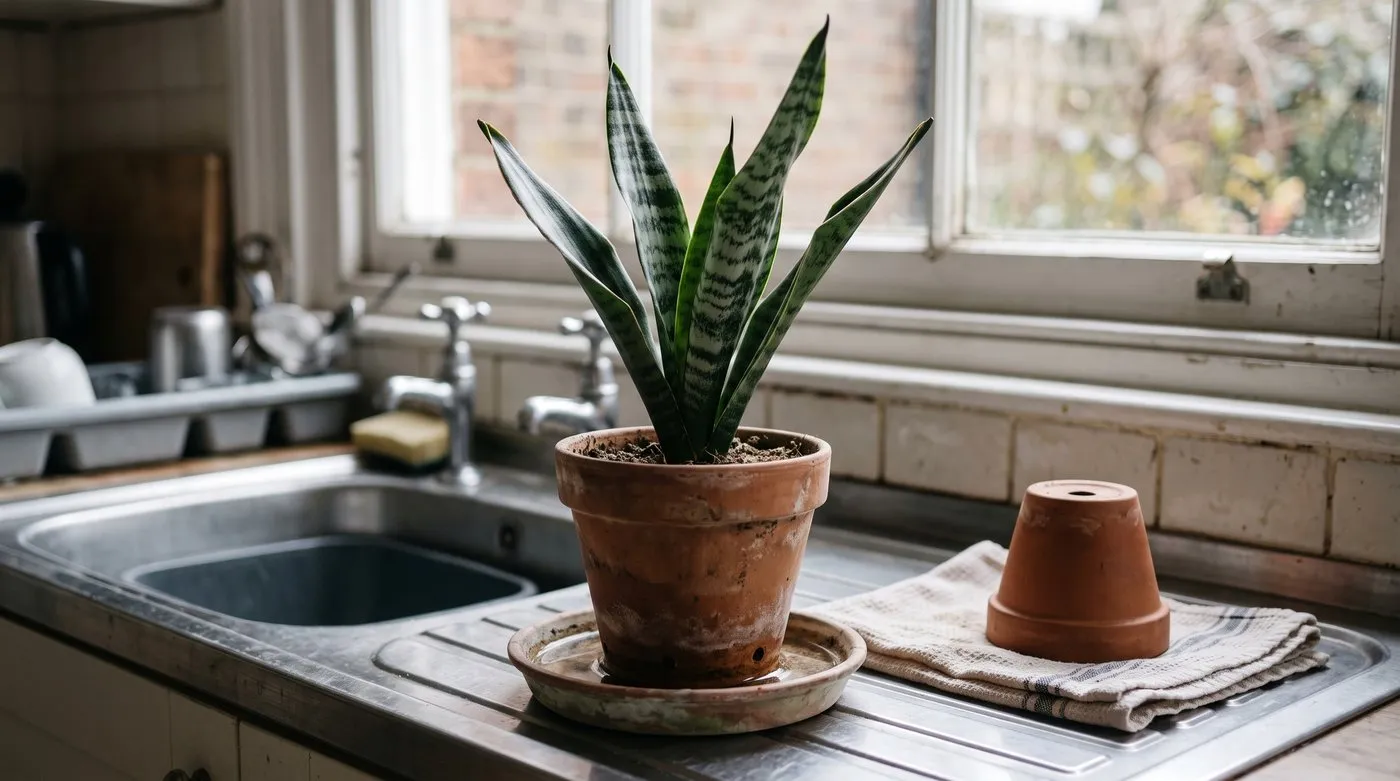
Bottom watering keeps water out of the centre of the leaves, where it can cause rot. Give it 20 minutes, then let the pot drain properly.
What soil mix do snake plants need?
Use cactus compost with plenty of perlite mixed in. About two parts compost to one part perlite is good. Ordinary compost holds too much water, and the roots need air.
No cactus compost? Mix equal parts multipurpose compost, horticultural grit and perlite. Water should run straight through.
The pot matters too. Always use one with drainage holes. Terracotta is ideal because it dries out quickly. Plastic and glazed pots are fine, but you’ll water less often.
Choose a pot just a little wider than the roots. Snake plants like a snug fit, and a big pot means lots of wet compost sitting around the roots.
What temperature and humidity do snake plants need?
Normal room warmth is perfect. Below 10C they can get cold damage, which shows as dark, soggy-looking patches.
The real risk is a cold windowsill in winter. If you close the curtains with the plant behind them, it can get very chilly overnight. Move it away from single-glazed windows from November to March, or keep the curtains behind the plant.
Normal home humidity is fine. No misting needed, and wet leaves can encourage rot. Just wipe the leaves with a damp cloth now and then to clear the dust.
Their tidy upright shape and easy care also make them a good pick for bedrooms.
How to feed a snake plant
Feed once a month from April to September with house plant feed at half strength. Don’t feed from October to March. Snake plants don’t need much, and too much feed burns the roots and browns the leaf edges.
If a white crust appears on the compost, run plain water through the pot a few times before you feed again.
How to fix common snake plant problems
Most snake plant problems come down to too much water. Spot the signs early and you can usually save the plant. New to house plants? Our beginner’s guide covers general troubleshooting too.
Problem diagnosis table
| What you see | Likely cause | What to do |
|---|---|---|
| Soft, mushy leaves at the base | Too much water, root rot | Unpot, cut off rotten roots, dry for a day, repot in dry compost |
| Brown, crispy tips | Too dry | Water a little more often |
| Yellow leaves | Too much water or cold | Check the compost, move away from cold draughts |
| Wrinkled, curling leaves | Very thirsty | Water well from the bottom, it should plump up in a day or two |
| Brown scorch marks | Hot direct sun | Move it back from the window |
| White fluffy spots | Mealybug | Wipe them off, keep the plant away from others |
| Floppy, leaning leaves | Root rot or pot too big | Check the roots, repot in a snugger pot |
Saving a plant with root rot. Take it out of the pot and rinse the compost off the roots. Cut away every brown or mushy root with a clean blade. Leave it on newspaper for a day so the cuts dry. Repot in dry cactus compost and don’t water for at least a week.
How to propagate a snake plant
Splitting the plant is the quickest way to get more, and you get a good-sized plant straight away. Spring (March to May) is the best time. For other house plants, see our propagation article.

Each piece with roots and a couple of leaves becomes a new plant.
Division method (the easy way)
- Take the plant out of its pot and brush off loose compost
- Look for separate clumps of leaves, each growing from its own chunky root
- Cut between them with a clean, sharp knife, so each piece has 2-3 leaves and some roots
- Leave the cut ends to dry for a day
- Pot each piece in cactus compost with perlite
- Wait a week before watering
Leaf cutting method
- Cut a healthy leaf from the outside of the plant
- Slice it into 10cm pieces and note which end was the bottom
- Leave the cuts to dry for 2 days
- Push each piece 2-3cm into damp perlite, bottom end down
- Keep it somewhere warm and bright
- Roots take 4-8 weeks, and new shoots a few months
Stripy types often come back plain green from leaf cuttings. If you want to keep the yellow edges of ‘Laurentii’, split the plant instead.
When it outgrows its pot, our guide to repotting houseplants walks you through it.
Do snake plants purify air?
A little, but not enough to notice in a real home. Early tests in small sealed chambers made snake plants famous as air cleaners. A real room with doors and windows holds far more air, so a few pots make little difference.
Better reasons to have one:
- It’s almost impossible to neglect. Forget it for a fortnight and it won’t mind
- It looks smart in any room, from a dark hallway to a sunny lounge
- Plants simply make a room feel nicer to be in
Are snake plants safe around pets?
No, snake plants can make cats and dogs poorly if chewed. Expect sickness or an upset stomach rather than anything serious, but it’s best avoided.
Keep them on a high shelf, in a hanging pot or in a room your pets don’t use. Cats are the bigger worry, as they like to nibble leaves. If you want a plant that’s safe with pets, a spider plant is a good choice.
Frequently asked questions
How often should I water a snake plant in the UK?
Every 2 to 4 weeks, once the top 5cm of compost is dry. That’s roughly every 2 weeks in summer and every 3 to 4 weeks in winter. Terracotta pots dry out faster than plastic ones, so check them a little sooner.
Can snake plants survive in a room with no windows?
Not for long. They put up with very little light, but not none at all. A room with even a small window is fine. For a windowless room, you’d need a grow light switched on for a good part of the day.
Why are my snake plant leaves going mushy?
Too much water has rotted the roots. Take the plant out of its pot and cut away anything brown, black or soft. Leave it to dry for a day, then repot in fresh, dry cactus compost and hold off watering for a week.
Are snake plants toxic to cats and dogs?
Yes, they can upset a pet’s tummy. Chewing the leaves can cause sickness and an upset stomach. Keep snake plants on a high shelf or in a room your pets don’t use.
What is the best soil mix for a snake plant?
Cactus compost with plenty of perlite mixed in. About two parts compost to one part perlite works well. Ordinary house plant compost stays too wet. Always use a pot with drainage holes.
How do I propagate a snake plant?
Split it in spring. Cut the clumps apart with a clean knife so each piece has a few leaves and some roots, then pot them up separately. Leaf cuttings work too, but they’re slow, and stripy types often come back plain green.
Do snake plants actually purify air?
Only a little in a real home. They do take in some pollution, but a room holds far too much air for a few pots to make a big difference. Enjoy them for their looks and keep opening the windows.
Our team produces practical UK gardening guidance from source research, contributor records and established horticultural practice. Editorial standards are overseen by Matt W.


