
Key takeaways
- Pick a rootstock to suit your space: M27 and M9 for tiny gardens, M26 and MM106 for more room
- Most apples need a partner variety nearby that flowers at the same time
- Plant bare-root trees from November to March, and stake dwarf trees for life
- Prune free-standing trees in winter, and go gently with tip-bearers
- Thin the fruit after the June drop for bigger, better apples
- Harvest runs from August for Discovery to October for Bramley
Apple trees grow well across most of the UK, in gardens of just about any size. Two choices make all the difference: the rootstock, which decides how big the tree gets, and a pollination partner, which decides whether it fruits.
Here’s how to pick the right tree, plant it, prune it and enjoy the crop. For other fruit, see our guides to pear trees, plum trees and cherry trees.
Which rootstock is right for your garden?
Garden apple trees are grafted onto a rootstock, which controls how tall the tree grows and how soon it fruits. The variety you chose sits on top.
M27 (very dwarfing, 1.2-1.8m) gives a tiny tree for pots and very small gardens. It needs rich, weed-free soil, watering in dry spells and a stake for life. Not one for poor soil.
M9 (dwarfing, 1.8-2.4m) is a favourite for small gardens and cordons. It needs a stake for life, weed-free soil and water in dry spells.
M26 (dwarfing, 2.4-3m) suits medium gardens and copes with average soil. It also needs a permanent stake.
MM106 (semi-dwarfing, 3-4m) copes with most soils, including poorer ones. Stake it for about five years, or longer on a windy site.
MM111 and M25 (vigorous, 4m and over) make big trees for orchards and large gardens. M25 is too big for most gardens.
Rootstocks at a glance
These sizes are for trees grown as bushes, from the RHS guide to fruit rootstocks.
| Rootstock | Height | Space between trees | Years to fruit | Staking |
|---|---|---|---|---|
| M27 | 1.2-1.8m | 1.2-1.5m | About 2 | For life |
| M9 | 1.8-2.4m | 2.4-3m | 2-3 | For life |
| M26 | 2.4-3m | 2.4-3.6m | 2-3 | For life |
| MM106 | 3-4m | 3.6m | 3-4 | About 5 years |
| MM111 | 4-4.5m | 4.5m | 4-5 | First 3 years if planted older |
| M25 | 4.5m+ | 6m | 5-6 | First 3 years if planted older |
Tip: A two or three-year-old tree from a specialist nursery already has a basic shape and crops sooner. A one-year-old “maiden” is cheaper and the better choice if you want to train a cordon or espalier.
How far apart should apple trees be planted?
Space trees by their rootstock, using the table above. Trees on M9 need about 2.4-3m between them, and MM106 trees about 3.6m.
Trained trees can go much closer. Cordons are planted about 75cm apart, so a short fence can hold several varieties. Leave room for paths, mowing and a ladder around free-standing trees. Crowded trees give shaded, poorly coloured fruit and more disease.
Understanding pollination groups
Most apples need pollen from a different variety that flowers at the same time. Nurseries sort apples into pollination groups 1 to 7, from earliest to latest flowering.
Plant at least two varieties from the same or neighbouring groups. A Group 3 apple pairs well with Groups 2, 3 or 4. Trees should ideally be within about 18m of each other. A crab apple or an apple tree next door often does the job.
Triploid varieties, like Bramley’s Seedling, have pollen that’s mostly no good for other trees. They need two other compatible varieties nearby.
Self-fertile varieties can fruit with their own pollen. Falstaff and Greensleeves are often sold as partly self-fertile. Even these crop better with a partner. If you’ve only room for one tree, choose a self-fertile variety or a family tree with several varieties grafted on.
The RHS fruit pollination guide explains it in more detail.
Example pollination groups
Groups vary a little between catalogues, so check the label before you buy.
| Group | Example varieties | Flowering |
|---|---|---|
| 2 | Egremont Russet, Rev W Wilks, Beauty of Bath | Early |
| 3 | Cox’s Orange Pippin, Discovery, James Grieve, Worcester Pearmain, Bramley (triploid) | Mid-season |
| 4 | Braeburn, Howgate Wonder | Mid to late |
| 6-7 | Edward VII, Crawley Beauty | Very late |
Best dessert apple varieties
Discovery, Cox’s Orange Pippin, James Grieve and Worcester Pearmain are great eaters for UK gardens. Between them they cover August into autumn.
Discovery ripens in August, with bright red skin and crisp flesh. It doesn’t keep, so eat it within a few weeks. It resists scab well. It’s a partial tip-bearer, so don’t cut back all the shoot tips.
Cox’s Orange Pippin is loved for its rich, aromatic flavour. It does best in warm, sheltered gardens in southern and central England. It’s prone to scab, mildew and canker, so it needs a bit more care.
James Grieve works for eating and cooking: sharp early on, sweeter later. It was raised in Edinburgh and copes well with cooler northern gardens. It can get canker on wet soil.
Worcester Pearmain ripens in September, with red skin and a sweet, strawberry-like taste. It doesn’t keep long. It’s a tip-bearer, so prune lightly.
Braeburn has crisp, sweet-sharp apples that store well. It needs a long, warm summer to ripen, so it suits sheltered southern gardens best.
Best cooking apple varieties
Bramley’s Seedling is the classic British cooker, with Howgate Wonder and Rev W Wilks as good alternatives. Cooking apples are sharp and turn soft and fluffy when cooked.
Bramley’s Seedling has big green apples that cook to a sharp, fluffy purée and keep well. It’s a vigorous triploid, so plant two pollination partners with it. It’s a partial tip-bearer and tends to crop heavily every other year.
Howgate Wonder has very large apples that cook well and keep into winter. It isn’t a triploid, so one partner is enough. Great for baking whole and a highlight of autumn harvesting.
Rev W Wilks is a compact, early cooker for smaller gardens. It cooks to a pale, sweet purée.
How to plant an apple tree
Plant bare-root trees between November and March, while they’re dormant. Potted trees can go in any time, but autumn to early spring is best.
Choosing the right spot

Planting a bare-root apple tree. Put the stake in first so you don’t damage the roots.
Apple trees want full sun and soil that holds moisture but drains well. Avoid frost pockets, low spots where cold air settles, as late frost kills blossom. Shelter from strong wind helps bees and stops fruit blowing off.
Check drainage first. Dig a hole 30cm deep, fill it with water and see how fast it drains. If water sits for hours, the spot is too wet. On heavy clay, plant on a low mound or choose MM106, which copes with heavier soil.
Planting step by step
- Dig a hole twice as wide as the roots and as deep as the soil mark on the trunk.
- Knock in a stake before you put the tree in.
- Set the tree so the graft union, the knobbly joint near the base, sits well above the soil. If it’s buried, the variety can root and lose the dwarfing effect.
- Spread the roots out evenly. Don’t bend or coil them.
- Backfill with the soil you dug out. No fertiliser needed on reasonable soil.
- Firm the soil gently with your foot, from the outside in.
- Fix the tree to the stake with a tree tie and spacer so the bark doesn’t rub.
- Water well to settle the soil.
- Spread a 5-8cm mulch of garden compost around the base, keeping it off the trunk.
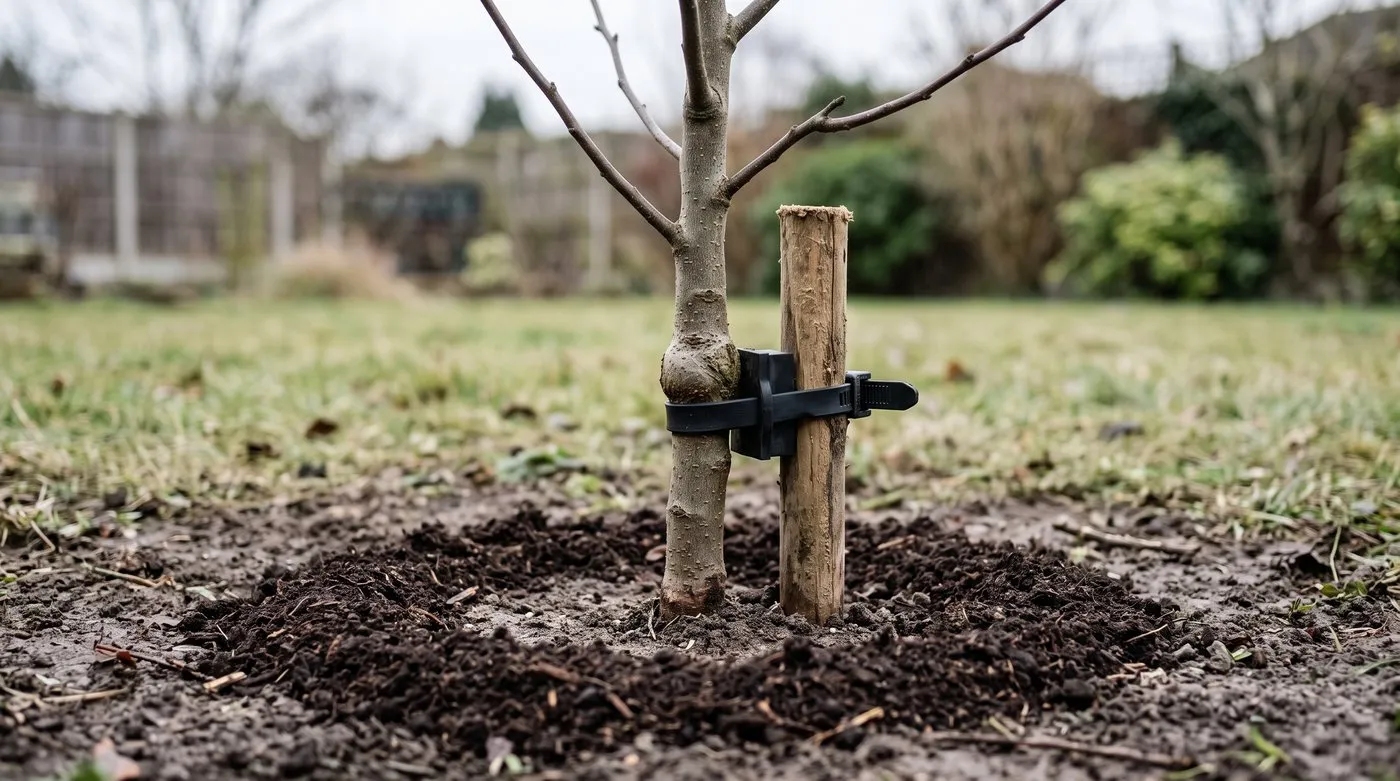
Keep that knobbly graft union well above the soil and the mulch. A tie with a spacer stops the stake rubbing the bark as the tree moves.
Staking
Trees on M27, M9 and M26 need a stake for life, as their roots never hold firm on their own. MM106 trees need one for about five years. Check the ties each spring and loosen them as the trunk grows.
Training forms for apple trees
Apples can grow as free-standing bushes or be trained flat as cordons, espaliers, fans and step-overs. The shape decides how much room the tree takes and how you prune it.

Cordons squeeze lots of varieties into a small space.
Bush is the usual garden shape: a short trunk with an open, cup-shaped head. Easy to pick and prune.
Cordon is a single stem grown at an angle against a wall or wires, about 75cm apart. Use M9 or M26 and a spur-bearing variety. Our guide to training fruit trees as espaliers covers wall-trained shapes in detail.
Espalier has a central trunk with flat tiers of branches. It takes a few years to build up. M26 or MM106 are common choices.
Fan spreads branches in a fan against a sunny wall. It’s more often used for cherries and plums than apples.
Step-over is a single low tier 30-45cm off the ground, a lovely living edge for a path. Use M27.
How to prune an apple tree
Prune free-standing trees in winter, between November and early March, when the leaves are off. How you prune depends on whether your variety is spur-bearing or tip-bearing.
Spur-bearing varieties
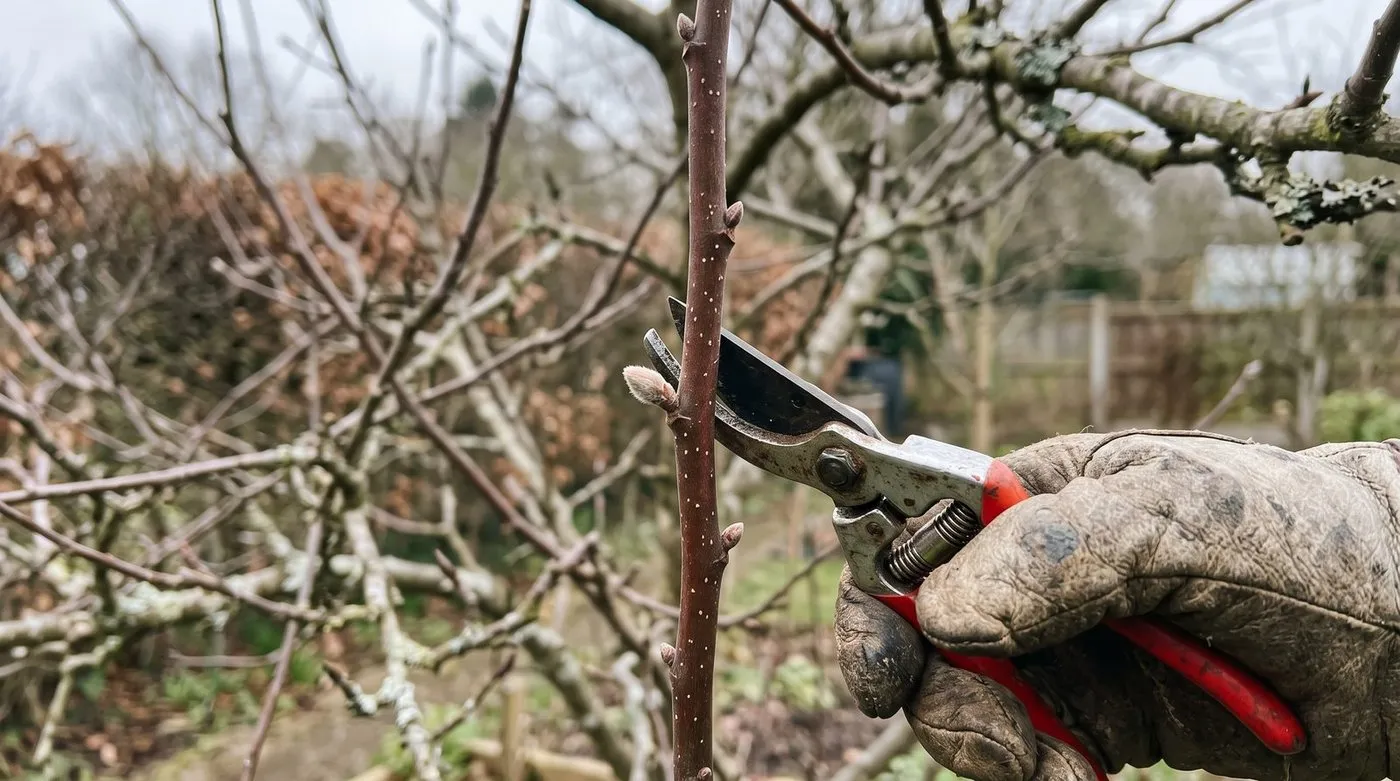
A clean cut just above an outward-facing bud.
Most apples are spur-bearers. They fruit on short, knobbly spurs on branches two years old or more.
- Take out dead, diseased and damaged wood first.
- Remove branches that cross or rub.
- Cut out branches growing inwards towards the middle.
- Shorten last year’s growth on the main branches by about a third, cutting to an outward-facing bud.
- Aim for an open centre so light and air get in.
- On older trees, thin crowded spurs by removing the weakest.
Use sharp, clean secateurs for thin shoots, loppers for thicker ones and a pruning saw for anything bigger.
Tip-bearing varieties
Tip-bearers like Worcester Pearmain fruit at the ends of last year’s shoots. Partial tip-bearers, like Bramley and Discovery, fruit on tips and spurs. Prune these in winter too, but lightly.
Leave most young shoot tips alone. Each winter, cut a few older branches that have fruited back to a younger shoot nearer the trunk. This stops branches getting too long and snapping. Trimming every shoot cuts off next year’s apples.
Month-by-month apple tree care
| Month | What to do |
|---|---|
| January | Winter prune free-standing trees. Check stakes and ties. |
| February | Finish winter pruning by early March. Scatter sulphate of potash around the roots. |
| March | Last chance for bare-root planting. Mulch with compost. |
| April | Blossom time. Cover small trees with fleece on frosty nights. |
| May | Don’t spray anything while trees are in flower, to protect bees. Hang codling moth traps early in the month. Water new trees in dry spells. |
| June | The “June drop”, when trees shed spare fruitlets. Then thin what’s left. |
| July | Finish thinning by mid-July. Water in dry spells. |
| August | Discovery ripens. Summer prune trained apples once shoot bases turn woody. |
| September | Pick mid-season apples. Apply codling moth nematodes after the grubs leave the fruit. |
| October | Bramley ripens. Fit grease bands to trunks. Clear fallen fruit. |
| November | Bare-root planting season starts. Begin winter pruning once leaves fall. |
| December | Keep planting and pruning. Check stored apples and remove any rotten ones. |
Thinning fruit in June
Thin apples by hand straight after the June drop, and finish by mid-July. Here’s the spacing to aim for:
- Eating apples: one or two fruits every 10-15cm
- Cooking apples: one fruit every 15-23cm
- Both: leave one fruit per cluster, and remove the central “king” fruit, which is often misshapen
Take off small, damaged and awkwardly placed fruitlets first. Use scissors or pinch through the stalk.
Thinning gives bigger apples and helps stop the “boom and bust” pattern, called biennial bearing, where a tree crops heavily one year and barely the next. Bramley is especially prone to it.
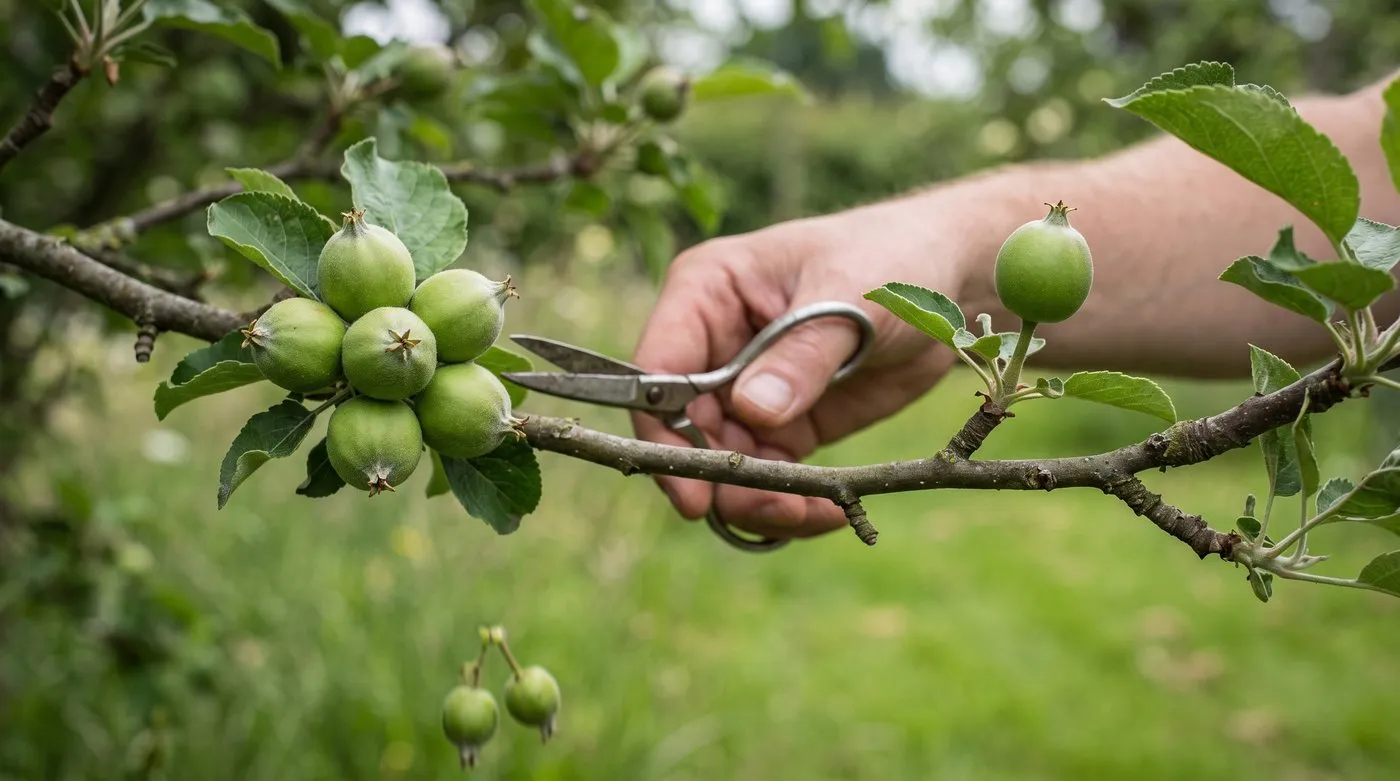
Thin each cluster to one good fruitlet after the June drop, removing the misshapen central king fruit first. You’ll get bigger apples and steadier crops.
How do you know when apples are ripe?
An apple is ripe when it comes away easily. Cup it in your palm, lift it slightly and twist. If it comes off with its stalk, it’s ready.
Other clues:
- A few good apples have dropped on their own
- The pips inside a test apple have turned brown
- The skin colour has deepened and the green background is turning yellow
Early apples like Discovery are best eaten straight from the tree. Late ones like Bramley are picked in October and stored. Pick apples for storing just before they’re fully ripe and handle them gently. Our guide on storing apples and pears explains how.
Can you grow an apple tree from a pip?
Yes, but it won’t be the same apple. Every pip is a cross with an unknown partner, so the fruit is a surprise, and usually a small, sour one.
A seedling also grows on its own roots, with no rootstock to keep it small. It can become a big tree and take many years to flower. To grow a variety you know, buy a grafted tree or graft a cutting onto a rootstock. Our guide to grafting fruit trees shows you how. A pip is still a fun project with children, and some seedlings make useful pollination partners.
Common pests and what to do
Codling moth, apple sawfly, woolly aphid and winter moth are the main apple pests in UK gardens.
Codling moth grubs tunnel into the core. Hang pheromone traps in early May to see when the moths are about. Nematodes sprayed onto the trunk, branches and soil in September or October can tackle the grubs over winter. A few spoilt apples are usually nothing to worry about.
Apple sawfly grubs bore into young fruit in early summer, and the fruitlets drop. Look for a ribbon-like scar on the skin. Pick off and destroy affected fruitlets before the grubs leave them.
Woolly aphid looks like white, fluffy tufts on the branches, often around old pruning cuts. Scrub small patches off with a stiff brush. Earwigs and other natural predators help. If you do need to treat, use an insecticide approved for apples and follow the label.
Winter moth caterpillars eat blossom and young leaves in spring. Fit grease bands around the trunk and stake in October. They trap the wingless females as they climb up to lay eggs.
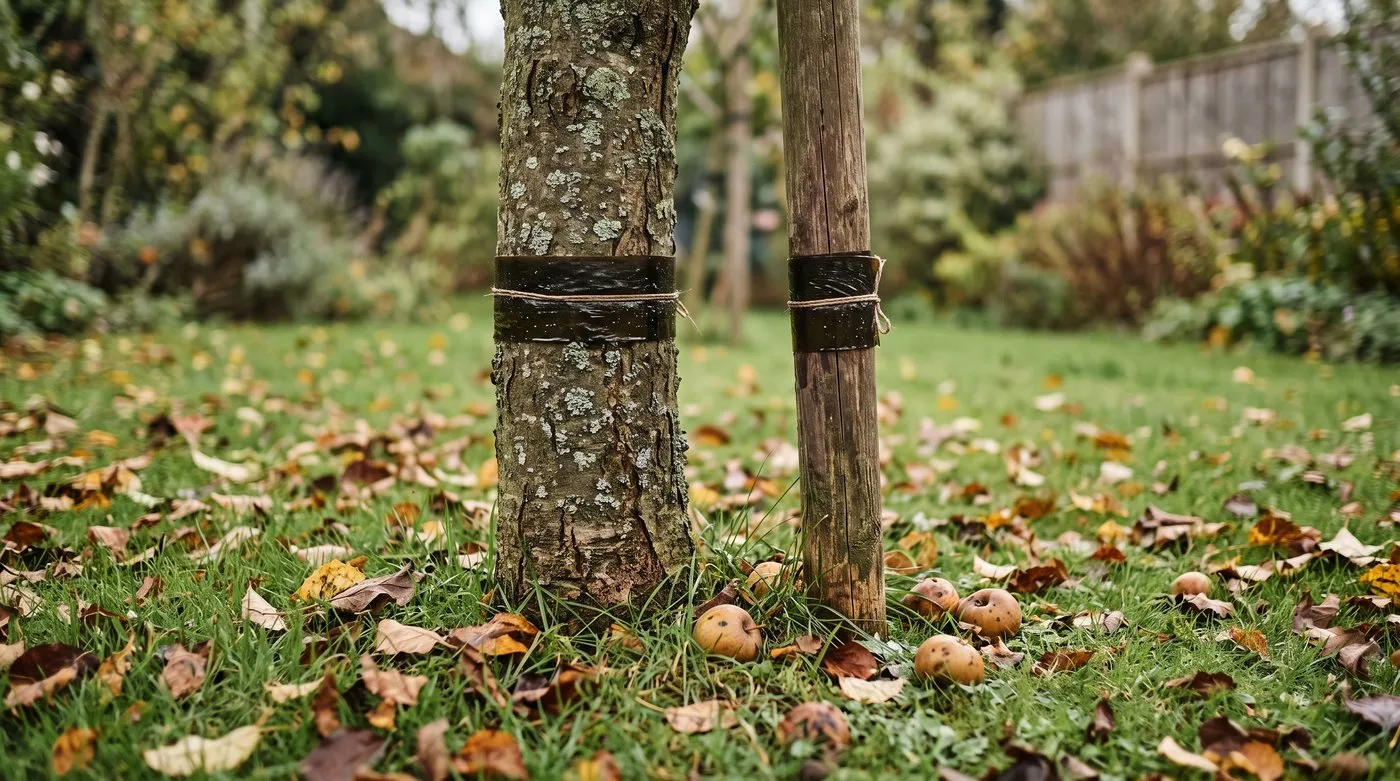
Fit grease bands round the trunk and the stake in October. They catch the wingless female winter moths as they climb up to lay eggs.
Common diseases and prevention
Apple scab, brown rot, powdery mildew and canker are the usual apple diseases in UK gardens.
Apple scab gives dark, crusty patches on fruit and olive-green spots on leaves. It loves wet springs. Prune for an open tree and clear fallen leaves in autumn. Grow resistant varieties like Discovery if scab keeps coming back.
Brown rot turns fruit brown with rings of creamy spots. It gets in through wounds, insect damage or bird pecks. Remove affected fruit from the tree and the ground. Thinning and gentle handling help.
Powdery mildew coats young leaves and shoot tips in white powder. Prune out affected shoots, and water in dry spells, as dry roots make it worse. Cox’s Orange Pippin is especially prone.
Canker causes sunken, cracked patches on branches and trunks, and can kill whole branches. Cut out cankered wood back to healthy wood and get rid of it. It’s worse on wet, badly drained soil.

Picking ripe Discovery apples. A gentle lift and twist is all it takes.
Common mistakes growing apple trees
Most apple problems come down to a few easy-to-avoid slips at planting and pruning time.
Picking the wrong rootstock
A tree on M25 soon swamps a small garden and fruits out of reach. An M27 tree on poor soil barely grows. Match the rootstock to your space and soil.
Forgetting about pollination
A lone tree with no partner can flower beautifully and still give hardly any apples. Check the pollination group before you buy. Short of space? Choose a self-fertile variety or a family tree.
Burying the graft union
The graft union is the knobbly joint near the base of the trunk. If it’s buried, the variety can root above it and lose the dwarfing effect. Keep soil and mulch clear of it.
Pruning at the wrong time or too hard
Trimming every shoot on a tip-bearer cuts off next year’s fruit. Hard pruning on any apple gives lots of leafy shoots instead of fruit buds. Prune free-standing trees in winter and remove no more than about a fifth of the tree in a year.
Skipping thinning
Leaving every fruitlet gives small apples and can set off biennial bearing. Thin after the June drop.
Leaving fallen fruit
Rotting windfalls spread brown rot. Clear them up regularly. Compost sound ones, but bin any with rot.
Bumper crop one year and hardly anything the next? See our guide to biennial bearing in fruit trees.
Frequently asked questions
When is the best time to plant an apple tree in the UK?
Plant bare-root trees from November to March, while they’re dormant. Potted trees can go in at any time, but autumn to early spring is best. If a bare-root tree arrives when the ground is frozen or waterlogged, heel it into a trench of moist soil until you can plant.
Do apple trees need a pollination partner?
Most do, yes. They need a different variety nearby that flowers at the same time. Choose a partner from the same or a neighbouring pollination group, ideally within about 18m. Triploids such as Bramley need two partners, as their own pollen is mostly no good.
Which rootstock should I choose for a small garden?
M9 suits most small gardens. It gives a tree of about 1.8-2.4m. M27 is smaller still at 1.2-1.8m, but needs good soil and regular watering. M26 reaches 2.4-3m and copes better with average soil. All three need a stake for life.
How long before an apple tree produces fruit?
Usually two to six years, depending on the rootstock. Trees on M27 often fruit after about two years, and on M9 or M26 after two or three. MM106 takes three or four years. Big MM111 and M25 trees take four to six.
Why is my apple tree not fruiting?
Poor pollination is a common cause. Check there’s a suitable partner flowering nearby. Late frost can kill the blossom. Too much nitrogen, often from lawn feed, gives leaves instead of fruit buds. Some varieties, like Bramley, crop well only every other year.
When should I prune an apple tree?
Prune free-standing trees in winter, from November to early March. Trained cordons and espaliers are pruned mainly in late summer. Go gently with tip-bearing varieties and leave most shoot tips alone.
What are the best apple varieties for the UK?
Discovery is a reliable early eater with good scab resistance. Cox’s Orange Pippin has the best-known flavour but needs a warm, sheltered spot. James Grieve suits cooler northern gardens. For cooking, Bramley’s Seedling is the classic choice.
Can I grow an apple tree in a pot?
Yes, on a dwarfing rootstock like M27 or M9. Use a 40-50 litre pot filled with John Innes No 3. Water regularly in summer, as pots dry out fast, and feed through the growing season. Repot or top up the compost every couple of years.
Our team produces practical UK gardening guidance from source research, contributor records and established horticultural practice. Editorial standards are overseen by Matt W.


