
Key takeaways
- Espaliers suit spur-bearing apples and pears, usually with three or four tiers
- Fans are the shape for cherries, plums, peaches and figs
- Slanted cordons 75cm apart fit lots of varieties along a short fence
- Put up strong wires 35-45cm apart, held 10cm off the wall, before you plant
- Prune apples and pears every summer to keep them neat and fruiting
- Never prune cherries and plums in winter
An espalier is an apple or pear tree trained flat against a wall or fence, with its branches in neat horizontal tiers. It looks lovely and gets a lot of fruit out of a small space. Cherries and plums are happier as fans. Get the right rootstock, strong wires and a summer trim each year, and you’re most of the way there.
This guide covers the four main shapes for UK gardens: espalier, fan, cordon and step-over. You’ll find wires, rootstock selection, pruning and a month-by-month calendar. It works whether you’re growing apples, pears or stone fruit.
What is a trained fruit tree?
It’s a tree grown flat instead of round and bushy. You tie it to horizontal wires on a wall, fence or posts, and guide the branches into a set pattern over the first few years. After that, a yearly trim keeps the shape.
Keeping the tree small and tidy nudges it into making fruit buds rather than long leafy shoots. A sunny wall also gives warmth and shelter, which helps fruit ripen in cooler parts of the UK.
Pick your shape before you plant. Each one suits different fruit and different spaces.
Training forms compared
| Shape | Best fruit | Space needed | Years to build | How easy? |
|---|---|---|---|---|
| Espalier | Spur-bearing apples, pears | 3-4.5m wide, about 1.8m tall | 3-5 | Medium |
| Fan | Cherries, plums, peaches, figs | 3-4m wide, 2-2.5m tall | 3-4 | Medium |
| Cordon (single, slanted) | Apples, pears | 75cm wide, 2m tall | 2-3 | Easy |
| Double/triple cordon | Apples, pears | 1.2-2m wide, 2m tall | 3-4 | Medium |
| Step-over | Apples, pears | 1.5-3m wide, 30-45cm tall | 2-3 | Easy |
Gardener’s tip: New to this? Start with a single slanted cordon. It’s the simplest shape, crops quickly and teaches you the pruning you’ll use for everything else.
Espalier training
An espalier has one upright trunk with pairs of branches running sideways along wires. The RHS guide to starting an espalier suggests wires 35-45cm apart. Most garden espaliers have three or four tiers and end up about 1.8m tall.

A four-tier espalier apple, with each tier on its own wire.
Apples and pears are perfect for this because they fruit on short spurs along older branches. A south or west-facing wall is ideal.
How to create an espalier
Start with a maiden whip, a one-year-old tree with no side branches. Plant it in winter, 15-20cm from the wall. Then cut it to a bud just above the first wire, about 40cm off the ground.
Year one: Buds below the cut will sprout. Train the strongest upright shoot as the new trunk. Tie the two best side shoots to canes at 45 degrees in summer. In autumn, lower them flat and tie them to the first wire. Lowering them slowly stops them snapping.
Year two: In winter, cut the trunk just above the second wire. Do the same again to make the second tier. Let the first tier grow along its wire, and rub out any other shoots on the trunk.
After that: Add one tier each winter until you reach the top wire. Then cut off the top of the trunk. Your framework is done.
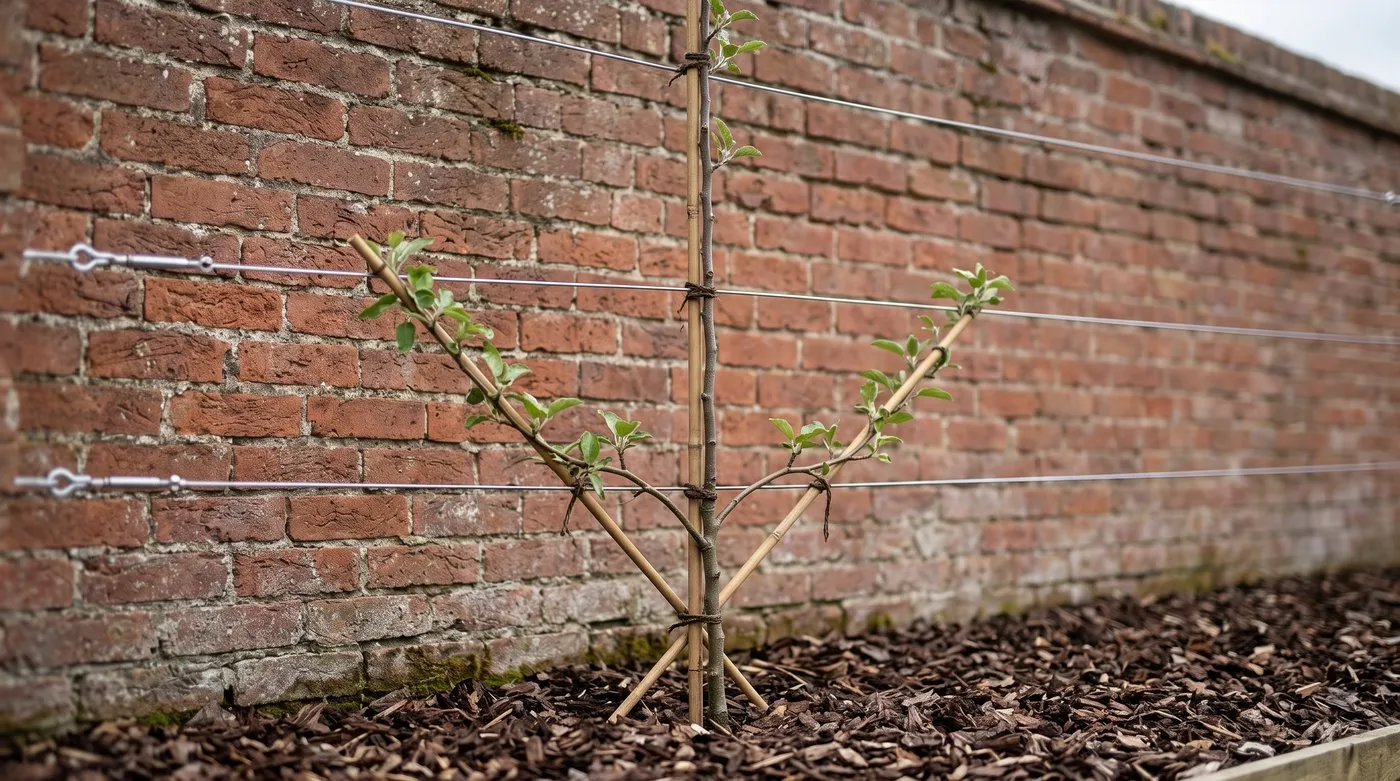
Tie the first side shoots to canes at 45 degrees in summer, then lower them onto the wire in autumn. Going slowly stops them snapping.
Which apple and pear varieties suit espalier?
Go for spur-bearers. They carry fruit all along each branch. Tip-bearers fruit at the ends of shoots, which summer pruning cuts off.
- Good apples: ‘Cox’s Orange Pippin’, ‘Egremont Russet’, ‘Sunset’, ‘Fiesta’ and ‘James Grieve’.
- Possible with extra care: partial tip-bearers. ‘Discovery’ and ‘Charles Ross’ are easier, while ‘Worcester Pearmain’ and ‘Bramley’s Seedling’ are harder.
- Avoid: full tip-bearers such as ‘Irish Peach’.
- Pears: most garden pears, including ‘Conference’ and ‘Concorde’, train well.
With partial tip-bearers, leave some short shoots of 20cm or less unpruned in summer. They often have a fruit bud at the tip.
Best rootstocks for espalier
The rootstock decides how big the tree grows.
| Rootstock | Espalier width | Best for |
|---|---|---|
| M27 | Very small | Step-overs only |
| M9 | Small | Cordons and small espaliers in good soil |
| M26 | 3-3.6m | Three or four tiers in good soil |
| MM106 | 3.6-4.5m | Three or four tiers, average soil |
| MM111 | 4.5-5.5m | More than four tiers |
| Quince A (pears) | 3.6-4.5m | Pear espaliers |
M26 is a popular pick for garden espaliers in good soil. MM106 grows a bit wider and copes better with average soil. M9 suits tight spots but needs good soil, regular watering and permanent support. Measure your space first, then choose.
Can you espalier against a fence?
Yes, as long as the fence is solid and will last. Aim for at least 3m wide and 1.8m tall. A trained tree will outlive a wobbly fence, so check the posts are sound.
Fix the wires to the posts, not the thin panels, and hold them at least 10cm off the surface. If the fence is shared, have a chat with your neighbour first, as branches and fruit may poke over. South or west-facing fences ripen fruit best. On a north-facing fence, try a cooking apple or a Morello cherry fan.
Can you turn an existing tree into an espalier?
Usually not. The tiers have to come from buds low on a young trunk. An older bush tree has its branches in the wrong places, and old wood snaps if you bend it flat.
A one or two-year-old tree with well-placed side shoots can sometimes be trained. Pick two opposite shoots near the first wire and remove the rest. For anything older, start again with a maiden whip or a pre-trained espalier.
Fan training
A fan has branches spreading out from a short trunk, like the ribs of an open fan. It’s the shape for stone fruit such as cherries, plums, peaches, apricots and figs. Many of these fruit on younger wood, so you keep replacing shoots rather than keeping fixed spurs.

A fan-trained cherry. Fans suit stone fruit that don’t do well as cordons.
There’s a fan for most walls. South-facing walls suit peaches and apricots. West-facing walls suit plums and gages. Even a north-facing wall will grow a Morello cherry.
Creating a fan framework
Start with a feathered maiden, a one-year-old tree that already has side branches. Plant it 15-20cm from the wall.
Year one: Pick two strong side branches about 30-40cm up, one each side. Remove the central stem and all other branches. Tie the two arms to canes at 45 degrees.
Year two: Each arm sends out new shoots. Keep about four evenly spaced ones on each side and tie them to canes fanning out from the trunk. Remove shoots growing straight towards or away from the wall.
Year three onwards: Keep filling in the fan with well-spaced branches. A mature fan needs 3-4m of wall and 2-2.5m of height.
Warning: Don’t prune cherries, plums or other stone fruit in winter. Winter cuts let in silver leaf and bacterial canker. Prune in spring as growth starts, and in summer, when cuts heal fast.
Cordon training
A cordon is a single stem grown at a slant, with short fruiting spurs all along it. It’s the most space-saving shape of all. Plant them 75cm apart and you can fit about eight apple varieties along a 6m fence.

A row of cordons. A great way to squeeze in lots of varieties.
Single slanted cordons suit spur-bearing apples and pears on M9 or M26 rootstock. The slant slows growth and helps the tree fruit sooner.
Planting and training a cordon
Plant bare-root maidens in winter at 45 degrees, all leaning the same way. Tie each stem to a bamboo cane, and tie the cane to the wires.
Space plants 75cm apart, with rows 1.8m apart if you have more than one. Trim any side shoots to 3-4 buds at planting. Let the leader grow until it reaches the top wire, about 2m up. After that, cut it back each May to keep the height in check.
Double and triple cordons
A double cordon (U-cordon) has two upright arms. A triple cordon adds a third stem in the middle. They carry more fruit per tree but need more room, about 1.2-2m between plants.
Step-over training
A step-over is a single-tier espalier at knee height, about 30-45cm off the ground. It uses the very dwarfing M27 rootstock and makes a charming, fruity edge for paths and veg beds.
Each arm stretches 75cm-1.5m from the trunk. You won’t get huge crops, but every apple gets full sun.
Creating a step-over
Plant a maiden whip on M27 in winter. Run a single wire at 30-40cm between two posts. In late winter, cut the maiden just above the wire. Train two shoots along the wire, one each way, lowering them slowly over summer so they don’t snap.
By the second winter the arms are in place. Remove any upright shoots and summer prune like other trained trees. M27 has weak roots, so give step-overs good soil, regular water and permanent support.
Gardener’s tip: Step-overs look great around a kitchen garden or along a path. Dessert apples such as ‘Fiesta’ or ‘Sunset’ give you fruit to pick as you walk past.
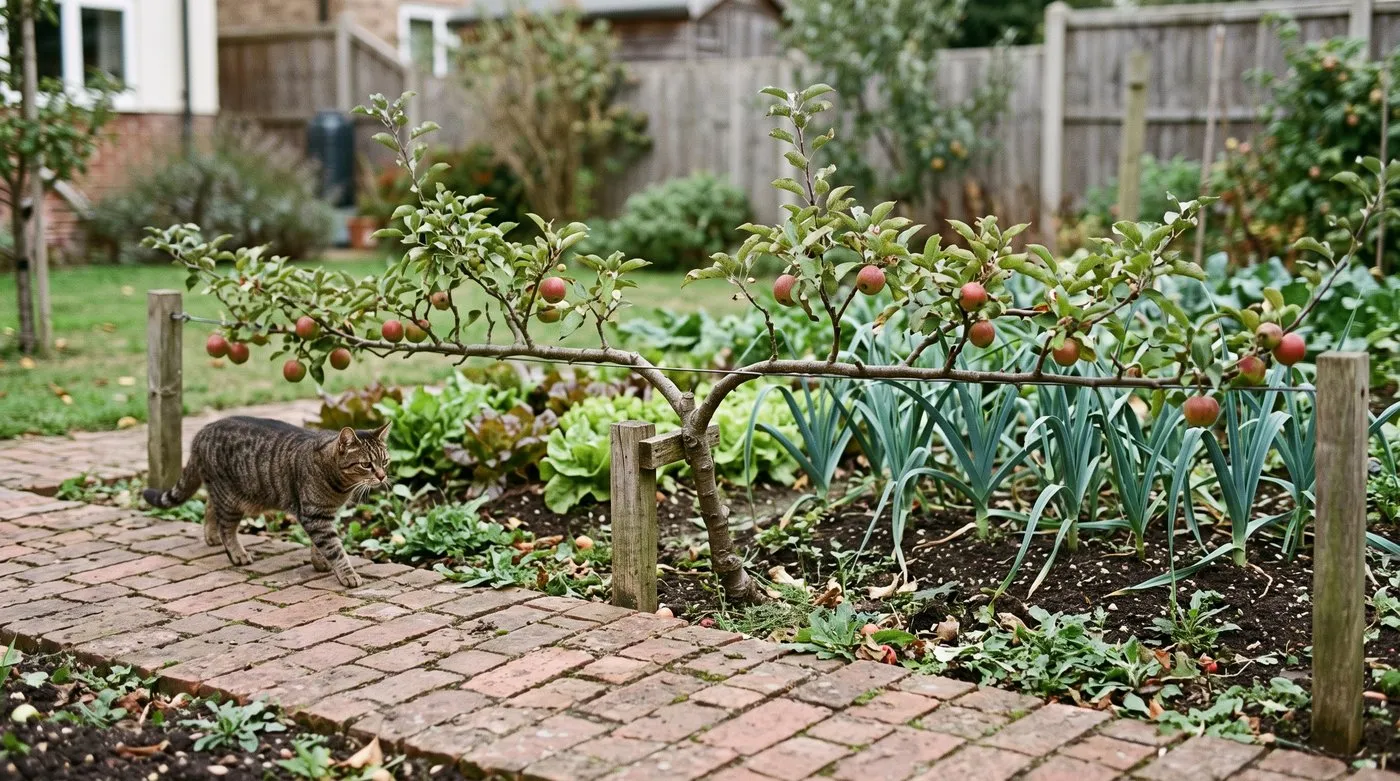
Step-overs make a lovely fruity edge for a path or veg bed. Their dwarfing rootstock needs good soil, regular water and permanent support.
Setting up a wire support system
Put up strong, permanent wires before you plant. Flimsy supports mean sagging branches and broken ties.
Wall-mounted wires

Vine eyes screwed into the wall, with tensioners to keep the wires tight.
Screw vine eyes into the wall at each end and about every 1.8m. They should hold the wire at least 10cm from the wall so air can flow behind the branches, which helps keep disease away.
Run 2.5mm galvanised wire between them and tighten it with a wire tensioner at one end. Space wires 35-45cm apart, starting about 40cm above the ground.
Freestanding post-and-wire
In open ground, use 2.4m treated timber posts set 2-3.5m apart and about 60cm deep. Run wires at the same spacing as on a wall. Brace the end posts with angled struts so the tight wires don’t pull them over.
Pruning trained fruit trees
There are two kinds of pruning: winter shaping while you build the framework, then a summer trim every year. Stone fruit has its own timing.
Formative pruning (early years)
Shape apples and pears while they’re dormant, from November to February. Each winter you add a tier (espalier) or let the leader grow on (cordon).
- Keep the strongest, best-placed shoots as permanent branches
- Remove shoots growing straight towards or away from the wall
- Cut the trunk just above the next wire to make it branch there
- Tie new branches to canes at 45 degrees first, then lower them bit by bit
Shape stone fruit fans in spring as the buds open, never in winter.
The Modified Lorette System (summer pruning)
This is the standard summer trim for trained apples and pears. The RHS summer pruning guide says to start when the bottom third of this year’s shoots feels stiff and woody. That’s usually from late July for pears and mid to late August for apples, a little later in the north.
- Cut side shoots longer than 20cm back to three leaves above the basal cluster (the little rosette of leaves at the base)
- Cut shoots growing from existing side shoots or spurs back to one leaf above the basal cluster
- Leave shoots shorter than 20cm, as they often end in fruit buds
- Remove strong upright shoots completely
If new growth pops up afterwards, cut it back to one leaf in September, or October if you pruned late.
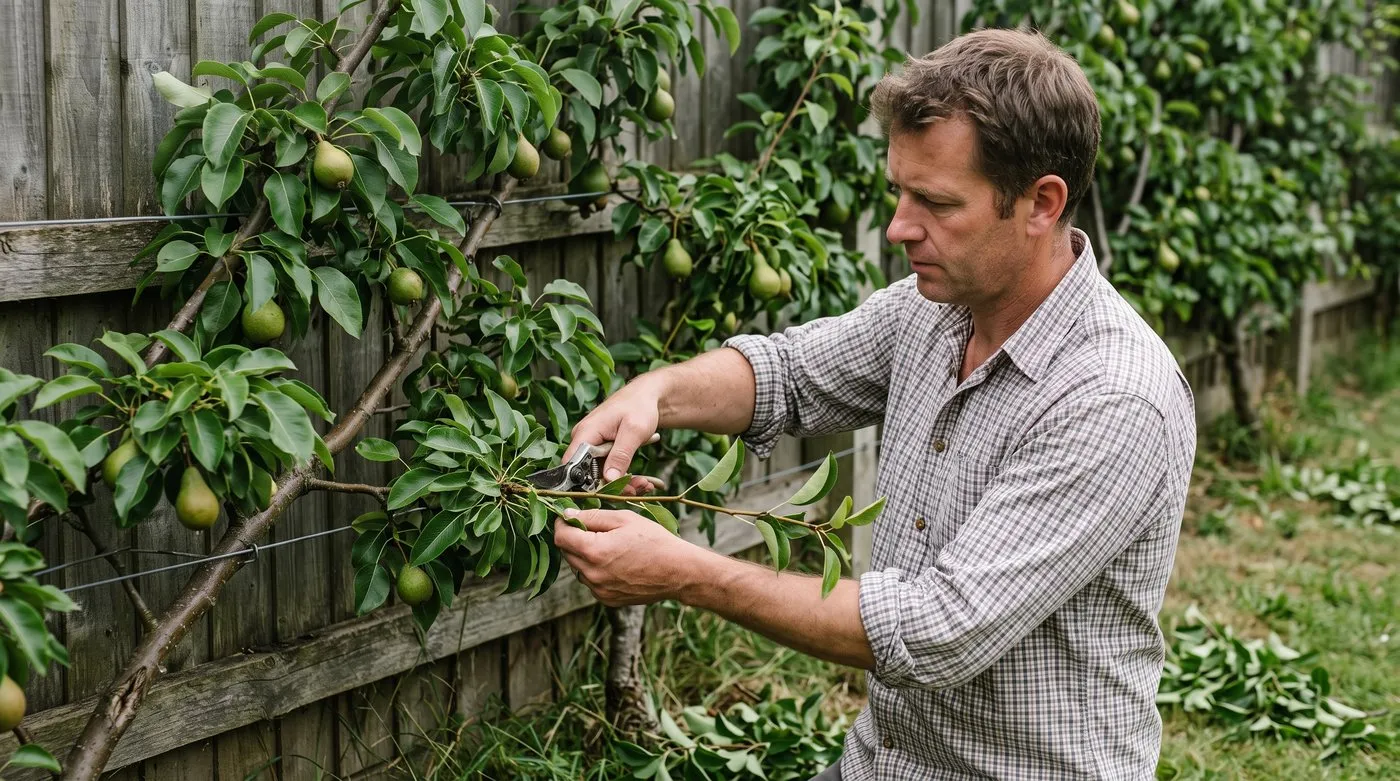
Start summer pruning once the bottom third of new shoots feels woody. Shoots under 20cm can stay, as they often end in fruit buds.
Spur pruning
After some years the spurs get crowded. Every few winters, thin them out. Remove the oldest and weakest, leaving two or three healthy fruit buds per spur. More light and air means bigger fruit.
Pruning stone fruit
Prune cherry, plum and peach fans in spring and summer, never in winter. It works a bit differently:
- After picking, cut branches that have fruited back to a new young shoot
- Tie in the young shoot to fill the gap
- Remove shoots growing straight towards or away from the wall
- Thin crowded areas by taking out weak or crossing shoots
This keeps a steady supply of young, fruitful wood. Peaches and nectarines fruit on last year’s growth, so replacing shoots every year really matters.
Month-by-month training calendar
| Month | Job |
|---|---|
| January | Order bare-root trees. Plan your wires and buy vine eyes and tensioners. |
| February | Put up wires. Plant bare-root trees. Finish winter pruning of apples and pears. |
| March | Finish planting before buds open. Shape stone fruit fans as buds break. |
| April | Tie in new growth on fans. Check ties aren’t cutting into bark. Remove blossom on newly planted trees. |
| May | Tie new espalier shoots to canes at 45 degrees. Cut back cordon leaders that are past the top wire. Water new trees in dry spells. |
| June | Pinch out and tie in shoots on fans. Water in dry spells. |
| July | Thin heavy apple crops. Start summer pruning pears from late July. Prune fans after picking. |
| August | Summer prune apples once shoot bases are woody, from mid to late August. |
| September | Cut back any regrowth to one leaf. Lower espalier branches flat. Pick fruit. |
| October | Pick the last fruit. Check wires are tight. Replace broken ties. |
| November | Start winter pruning apples and pears. Thin crowded spurs. Plant bare-root trees. |
| December | Carry on winter pruning. Shape espalier tiers and tie in branches. |
For what to pick across the rest of the garden, see the monthly harvest guide.
Common mistakes when training fruit trees
1. Choosing the wrong rootstock or variety
Too vigorous a rootstock and the tree outgrows its wires. A tip-bearing variety on an espalier loses much of its crop to summer pruning. Check both before you buy.
2. Pruning stone fruit in winter
Winter cuts on cherries and plums let in silver leaf disease. Prune them in spring and summer, when cuts heal quickly. This is the big rule for stone fruit.
3. Tying branches down too quickly
Young branches snap if you force them flat in one go. Lower them a little at a time over a few months. Tie them to a cane first, then lower the cane.
4. Neglecting summer pruning
Skip the summer trim and you get long leafy shoots, fewer fruit buds and a tangled tree. It soon loses its shape.
5. Planting too close to the wall
Soil right at the foot of a wall stays dry, because the wall blocks the rain. Plant 15-20cm out and lean the trunk slightly towards the wall. Water well for the first two summers. A 5-8cm mulch of compost helps hold moisture in.
Buying pre-trained trees vs starting from scratch
A maiden whip is the cheapest way in and gives you full control. You can match every tier to your wires. The catch is time: it takes a few years to build the framework. Untrained maidens mostly come from specialist fruit nurseries.
A pre-trained tree usually arrives with one or two tiers. It costs more and still needs training, but you’ll pick fruit sooner. Its tiers may not line up with your wires, so set the wires to suit the tree. Trees labelled “selected for espalier training” are often just lightly pruned one-year-olds, so check with the seller.
In small garden designs, a pre-trained tree gives you an instant feature. For allotments and bigger gardens, maidens are better value.
Gardener’s tip: Check whether each variety needs a pollination partner. Most apples need a different variety flowering at the same time nearby. Cordons make this easy, as you can grow several side by side.
Once the fruit comes, our guide on how to store apples and pears will help you make it last.
Frequently asked questions
How long does it take to espalier a fruit tree?
About three to five years from a young unbranched tree. You add one new tier each winter. A pre-trained tree saves a year or two, but costs more and still needs training.
Can I espalier any fruit tree?
Spur-bearing apples and pears work best. They fruit on short stubby spurs along older wood, which suits the flat tiers. Tip-bearing apples aren’t a good choice. Cherries and plums are better trained as fans.
What rootstock should I use for an espalier apple?
M26 suits a three or four-tier espalier in good soil, about 3-3.6m wide. MM106 gives a slightly wider tree, 3.6-4.5m. MM111 suits bigger espaliers with more tiers. For knee-high step-overs, use the very dwarfing M27.
When should I prune trained fruit trees?
Shape apples and pears in winter, then trim them every summer. Summer prune pears from late July and apples from mid to late August. Prune cherries and plums in spring and summer only, to avoid silver leaf disease.
Do I need a south-facing wall for espalier fruit trees?
South or west-facing walls are best for eating apples and pears. East-facing walls can work for later-flowering varieties. North-facing walls suit Morello cherries and some cooking apples. Avoid early-flowering varieties on east walls, where morning sun thaws frosted blossom too fast.
What is the Modified Lorette System?
It’s the usual way to summer prune trained apples and pears. Cut side shoots longer than 20cm back to three leaves above the little cluster of leaves at their base. Cut shoots growing from existing side shoots to one leaf. Trim any regrowth to one leaf in September or October.
Should I buy a pre-trained tree or start from a maiden whip?
A pre-trained tree saves a year or two but costs more. It usually comes with one or two tiers. A maiden whip is cheaper and lets you match the tiers to your wires. Specialist fruit nurseries sell both bare-root over winter.
How far apart should I plant cordon fruit trees?
Plant single slanted cordons 75cm apart. A 6m fence holds about eight. Use M9 or M26 rootstock. Double and triple cordons need 1.2-2m between plants.
Our team produces practical UK gardening guidance from source research, contributor records and established horticultural practice. Editorial standards are overseen by Matt W.


