
Key takeaways
- The rootstock, not the variety, decides how big a fruit tree gets
- An apple on M27 stays under 2m, perfect for the smallest gardens
- Use a pot at least 45cm wide with John Innes No. 3 compost
- Stella cherry and Victoria plum fruit without a partner tree
- Step-overs and columnar apples fit along paths and on balconies
- Dwarf trees need a stake for life
Dwarf fruit trees let you pick your own apples, pears, cherries and plums from a garden not much bigger than a parking space. The trick is the rootstock: the roots the fruiting variety is grafted onto. A Cox apple on vigorous roots can grow 6 metres tall. The same Cox on M27 roots stays under 2 metres. Same apples, a fraction of the space.
Here’s how to pick the right rootstock and variety, grow a tree in a pot, try space-saving shapes like step-overs and columns, and look after your tree through the year.
What makes a fruit tree “dwarf”?
It’s the roots. Nurseries graft your chosen variety onto a rootstock that keeps it small. Any named apple, pear, cherry or plum can be grown on small or large roots. The fruit is just the same. Only the tree size changes.
A big grower like Bramley will still be larger than most, but dwarfing roots keep it far smaller than it would be otherwise.
Dwarfing roots also bring trees into fruit sooner. Apples on M27 often start in about two years, while those on bigger MM106 roots take three or four. The catch is that a smaller tree gives a smaller crop, but it’s plenty for a household.
Handy tip: Always check the rootstock before you buy. Labels often show only the variety name. MM106, the most commonly sold apple rootstock, is too big for most small gardens, so ask.
Dwarf rootstocks explained
Each fruit has its own dwarfing roots: M27, M9 and M26 for apples, Quince C for pears, Gisela 5 for cherries and Pixy for plums. The heights below are for free-standing trees.
Apple rootstocks

An apple on M27 roots. At under 2m tall, it fits most patios.
M27 is the smallest. Trees reach about 1.2-1.8m. The roots are tiny, so the tree needs a stake for life, good soil and regular watering. It’s the one used for step-overs and very small patio trees.
M9 gives trees of about 1.8-2.4m. A great all-rounder for small gardens, in the ground or a big pot. Needs a stake for life.
M26 is a little bigger at about 2.4-3m. It copes with poorer soil better than M9 and is very good in pots. Still needs a stake.
Pear rootstock
Quince C keeps pears to about 2.5-3m. It likes fertile soil that drains well, and needs a stake for life. Pears usually start fruiting after about four years. Our guide to growing pear trees covers varieties and pruning.
Cherry rootstock
Gisela 5 is what made sweet cherries possible in small gardens. It keeps trees to about 2.4-3m, where older roots gave trees twice that size. Expect fruit after three or four years. Give it a sunny, sheltered spot, a stake and netting against birds.
Plum rootstock
Pixy is the usual choice for plums, damsons and gages. Trees reach about 3-4m, though pruning and growing in a pot keep them smaller. It likes good soil that doesn’t dry out. Fruit usually comes in three or four years. See our guide to growing plum trees for the best varieties.
Rootstock comparison table
Here are the main choices at a glance. The RHS guide to fruit rootstocks has more detail.
| Rootstock | Fruit | Size | Height | First fruit |
|---|---|---|---|---|
| M27 | Apple | Very small | 1.2-1.8m | About 2 years |
| M9 | Apple | Small | 1.8-2.4m | 2-3 years |
| M26 | Apple | Small | 2.4-3m | 2-3 years |
| Quince C | Pear | Small | 2.5-3m | About 4 years |
| Gisela 5 | Cherry | Small to medium | 2.4-3m | 3-4 years |
| Pixy | Plum | Small to medium | 3-4m | 3-4 years |
Remember: all of these need a stake for life, as the roots never hold the tree up on their own. Use a stout treated stake driven well into the ground.
Best self-fertile varieties for small gardens
If you’ve only got room for one tree, pick a self-fertile variety, which can pollinate itself. Most apples and pears, and some cherries and plums, need a partner tree that flowers at the same time. The RHS guide to choosing fruit trees explains pollination groups. “Partly self-fertile” trees crop alone but do better with a partner.
Self-fertile apples
- Greensleeves: crisp green apple with a sharp taste. Partly self-fertile and crops heavily.
- Red Devil: red apple with pink-tinged flesh. Partly self-fertile.
- Falstaff: red-flushed eating apple. Partly self-fertile and a heavy cropper.
Our guide to growing apple trees has more varieties and their pollination groups.
Self-fertile pears
- Conference: the classic British garden pear. Long green fruit with russet patches. Partly self-fertile and reliable.
- Concorde: compact and sweet, great for small spaces. Partly self-fertile.
Self-fertile cherries
- Stella: dark red, sweet and a heavy cropper. Fruits in July. Our cherry growing guide covers netting and care.
- Sunburst: big dark red cherries, ripening around the same time as Stella.
Self-fertile plums
- Victoria: Britain’s favourite plum. Sweet, for eating or cooking. It crops so heavily you may need to thin the fruit to save the branches.
- Opal: an early purple plum, sweet and juicy.
Which dwarf fruit tree is easiest for beginners?
An apple on M26 or M9 roots. Apples are fully hardy, cope with most soils and fruit within two or three years. M26 is a bit more forgiving than M27, as its bigger roots cope better if you miss a watering.
A Victoria plum on Pixy is a close second. It fruits alone, crops heavily and needs little pruning beyond taking out dead or crossing branches in summer. Cherries on Gisela 5 are easy too, but you’ll need a net or the birds will get them first.
Pears are the trickiest. They flower early, so frost can catch the blossom, and most crop better with a partner. In a cold or windy garden with room for one tree, start with an apple.
Trained forms for tiny spaces
Trained shapes like step-overs, columns and espaliers squeeze fruit into the smallest spots. They’re brilliant along walls, fences and paths.
Step-over apples
A step-over is an apple on M27 roots with two arms trained along a low wire at knee height, about 40-45cm off the ground.

A step-over apple at knee height: a pretty edge that gives you apples too.
They make a lovely edge for paths, raised beds and borders. One step-over spreads about 2 metres, so plant a row for a fruity border. In late summer, cut new side shoots back to three leaves above the cluster at their base.
Columnar and ballerina apples
Columnar apples grow as one upright stem with short fruiting spurs all the way up. They take up only about 50cm of floor, so they’re great for balconies and narrow paths. Popular ones include:

A columnar apple on a balcony. The slim shape needs very little pruning.
- Flamenco: crisp, sweet red apple.
- Bolero: sharp green apple, good for cooking too.
- Waltz: sweet red apple with pretty blossom.
- Polka: red-green apple with good flavour.
They grow 2-3 metres tall but stay narrow. Grow them in 40cm pots or in a narrow bed by a wall.
Minarette trees
Minarettes are ordinary varieties pruned to a single upright stem. Unlike columnar apples, they need pruning every year to keep that shape. They grow about 2-2.5 metres tall and stay slim.
Espalier and fan training
Espaliers are flat trees trained against walls and fences. A dwarf espalier on M9 or M26 roots covers about 3 metres of wall. Cherries and plums can be fan-trained the same way. Both shapes make picking and netting easy.
Growing dwarf fruit trees in containers
Dwarf trees grow happily in pots at least 45-50cm wide, filled with John Innes No. 3. You’ll need to water a lot in summer. Stick to dwarfing roots, as a big tree soon outgrows any pot.
Choosing the right pot
Pick a pot at least 45-50cm wide and deep. Smaller ones dry out too fast. Heavy pots like terracotta, stone or thick plastic won’t blow over. Make sure there’s a drainage hole.
Pop a bit of broken pot or mesh over the hole so the compost doesn’t wash out. Standing the pot on feet helps drainage more than a layer of gravel. Soggy compost soon kills fruit tree roots.
Compost for containers
John Innes No. 3 is the one to use. It’s soil-based, heavy enough to keep the pot steady and holds food for longer than multipurpose compost. A layer of bark on top helps keep moisture in. Our guide to growing fruit in containers has more tips.
Watering and feeding
Pots dry out quickly, so water thoroughly whenever the top of the compost is dry. In warm weather from spring to late summer, that often means every day. Water until it runs out of the bottom.
In early spring, sprinkle a slow-release feed on top. From flowering, give a high-potash liquid feed every two weeks. Tomato feed is ideal. Stop by September so the new growth can toughen up before winter.
Winter repotting
Every two to three years, repot in winter (November to February). Ease the tree out, shake off old compost, trim any circling roots and replant in fresh John Innes No. 3. If it’s already in its biggest pot, slice a few centimetres off the sides of the rootball and put it back in the same pot. In other years, scrape off the top 5cm of compost each spring and replace it.
Do potted fruit trees need winter protection?
Yes, in long hard frosts. Roots in a pot freeze far more easily than roots in the ground. The branches are fully hardy, but a frozen rootball can kill the tree.
In late autumn, move pots against a house wall, out of cold winds, and group them together. In long cold spells, wrap the pots in hessian, bubble wrap or old blankets, keeping the drainage holes clear. In spring, throw fleece over blossom on frosty nights, especially early pears and plums. Our guide to winter care for potted fruit trees has more.
Handy tip: Stand pots on feet or bricks so they don’t sit in puddles. Waterlogging in winter is a common way to lose a potted fruit tree.
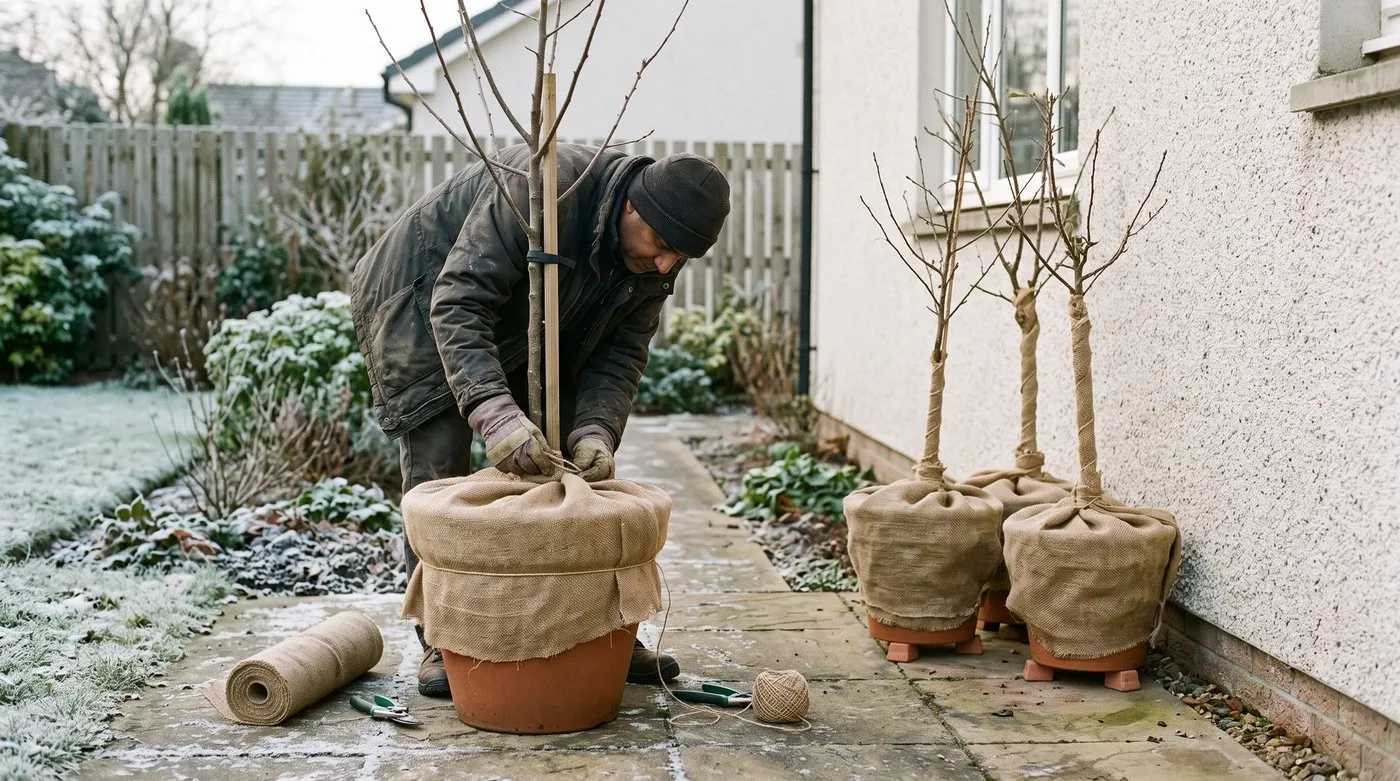
Roots in a pot freeze far more easily than roots in the ground. Group pots against a house wall and wrap them in long cold spells, keeping the drainage holes clear.
Family trees for maximum variety
A family tree has two or three varieties grafted onto one rootstock. An apple family tree might carry Braeburn, Cox and Discovery on one trunk. You get several kinds of apple from one spot, and they pollinate each other too.

Two apple varieties on one tree, so no need for a separate pollination partner.
You can buy family trees for apples, pears and plums from many UK nurseries. A family apple on M9 roots grows to about 2.4 metres. The varieties are chosen to flower together. You’ll get a little less of each kind, but more variety from the same space. Perfect if you’ve only got room for one tree.
Month-by-month care calendar
| Month | Jobs |
|---|---|
| January | Prune apples and pears on dry days. Order bare-root trees. Check stakes and ties. |
| February | Finish pruning before buds open. Sprinkle a general feed around the base and mulch with compost. |
| March | Plant bare-root trees by the end of the month. Look out for aphids on new buds. |
| April | Fleece blossom on frosty nights. Start feeding potted trees every two weeks at flowering. Water pots as needed. |
| May | Net cherries against birds. Keep watering and feeding. Check ties aren’t cutting into bark. |
| June | After the natural “June drop”, thin apples and pears to one or two per cluster. Watch for woolly aphid and sawfly. |
| July | Pick cherries and early apples. Prop up heavy branches. Water pots daily in hot spells. Start summer pruning trained trees late in the month. |
| August | Pick apples, pears and plums. Prune plums and cherries now, in summer, to avoid silver leaf disease. See what to harvest this month. |
| September | Pick later apples and pears and store the good ones somewhere cool and dark. Stop feeding potted trees. |
| October | Clear fallen fruit and bin any with brown rot. Rake up leaves. Order bare-root trees. |
| November | Plant bare-root trees. Check stakes. Move pots somewhere sheltered. |
| December | Keep planting in mild spells. Check stored fruit and remove any that’s rotting. |
Common mistakes with dwarf fruit trees
Planting too deep
The graft union is the bump where the variety joins the rootstock. Keep it well above the soil, about 5-10cm. If you bury it, the top of the tree can grow its own roots and the dwarfing effect is lost.
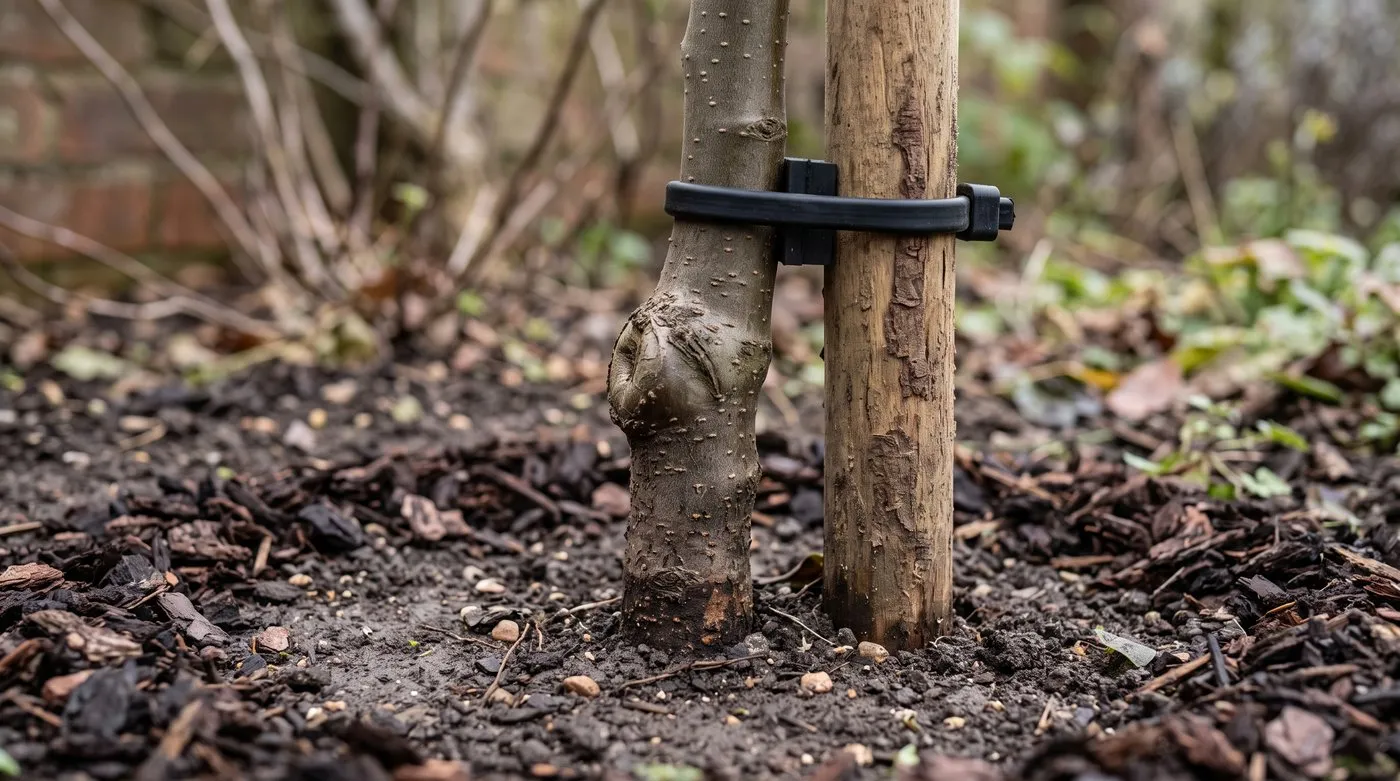
Look for the bump where the variety joins the rootstock and keep it well above the soil. Bury it and the tree can grow its own roots and lose its dwarfing effect.
Forgetting to stake
Dwarf trees have small roots and can blow over without a stake. Give them a stake for life. Put it in the hole before the tree, and use a proper rubber tree tie, not wire or string. Check ties twice a year.
Skipping summer pruning
Trained and compact trees need summer pruning from late July to September. Cut new shoots back to three leaves above the cluster at their base. Without it, trained shapes get messy within a season.
Using the wrong compost in containers
Multipurpose compost is too light. It dries out fast, slumps within a season and won’t hold the tree steady. Use John Innes No. 3.
Choosing non-self-fertile varieties without a partner
If a healthy tree flowers but never fruits, it may be missing a partner. With room for one tree, choose a self-fertile variety from the list above. Our small garden design ideas show how to fit fruit into a tight space.
Where to grow dwarf fruit trees in the UK
Anywhere that gets about six hours of sun a day in spring and summer. That covers most patios, balconies, allotments and front gardens.
Patios and courtyards are perfect for potted trees. A south or west-facing wall gives extra warmth and shelter, which helps protect blossom from late frost.
Balconies suit columnar apples and small potted trees on M27 roots. Check how much weight your balcony can take, as a big pot of wet soil-based compost is very heavy.
Allotments are great for step-overs along the edges, where they won’t shade your neighbours. Check your site rules first, as some limit trees.
Front gardens suit fans and espaliers against the house wall. Even a north-facing wall suits a Morello cherry for cooking.
For veg in small spaces, see our container vegetable gardening guide. Our guide to growing fig trees covers another great choice for a warm wall. Keep potted apples evenly watered to avoid bitter pit.
How close to a house or fence can you plant a dwarf fruit tree?
About 15-25cm from a wall for trained trees, and about 1-1.5m for free-standing ones. Dwarf trees have small, shallow roots, so they’re far less of a worry near a house than big trees.
The real limit is room for the branches. An apple on M27 spreads about 1.5m, so leave enough space to prune and pick. The soil right at the foot of a wall is often dry, so plant a little way out, lean the stem back to the wires and water well for the first two summers. Avoid planting over drains, or where branches would hang over next door.
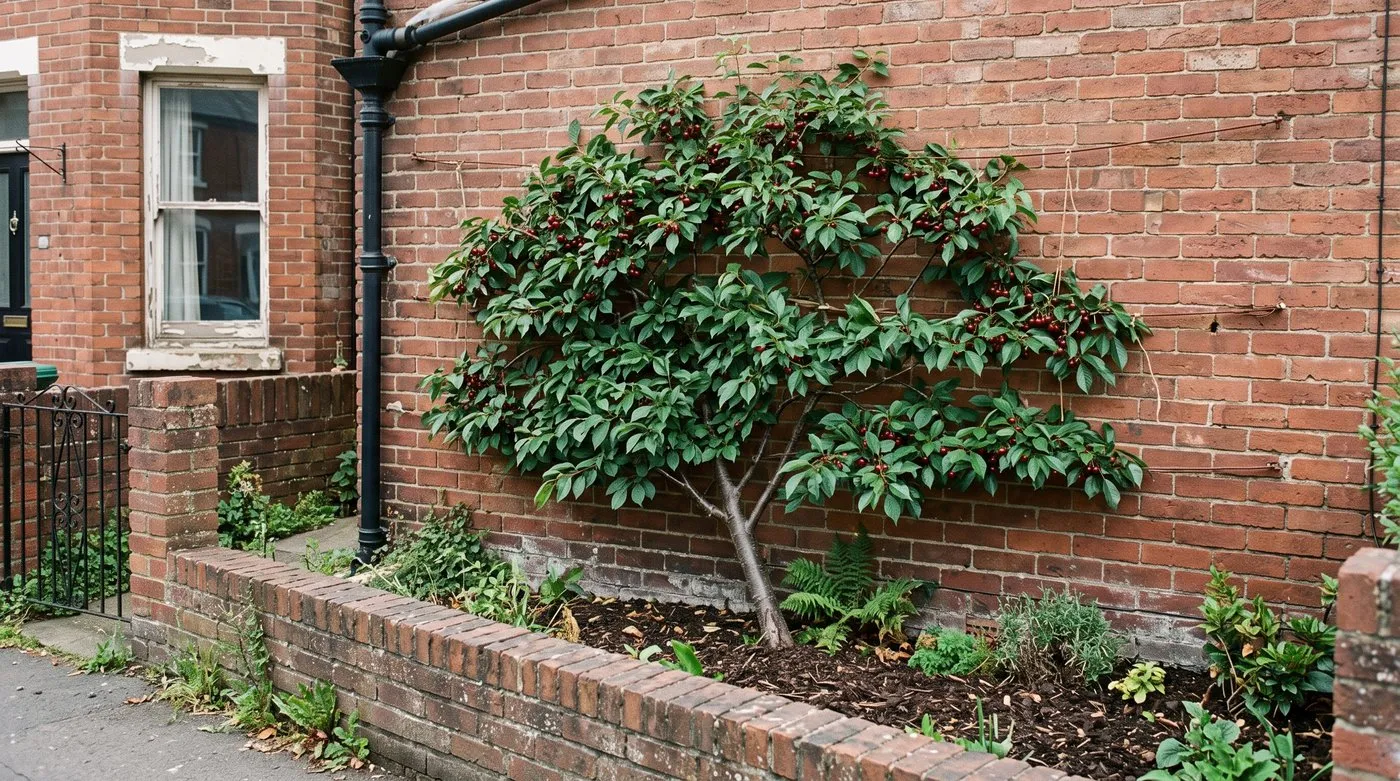
Trained trees can go about 15-25cm from a wall. Plant a little way out where the soil is less dry, and a Morello cherry will even crop on a north-facing wall.
Frequently asked questions
How tall do dwarf fruit trees grow?
Most reach 1.2 to 3 metres. Apples on M27 roots reach about 1.2-1.8m, and on M9 about 1.8-2.4m. Pears on Quince C and cherries on Gisela 5 grow to about 2.5-3m. Plums on Pixy reach 3-4m. The rootstock decides the height far more than the variety.
Can I grow a dwarf fruit tree in a pot?
Yes, they’re perfect for pots. Use one at least 45cm wide and deep, filled with John Innes No. 3. Water often in summer, daily in hot weather. Feed every two weeks with tomato feed from flowering until late summer.
Do dwarf fruit trees need a pollination partner?
Self-fertile ones don’t. Stella cherry and Victoria plum fruit on their own. Greensleeves apple and Conference pear crop alone but do better with a partner nearby. Most other varieties need another tree that flowers at the same time close by.
How long before a dwarf fruit tree produces fruit?
Usually two to four years. Apples on M27 and M9 often fruit within two or three years. Pears, cherries and plums take three or four. If a new tree flowers in its first spring, pick off the flowers so it can put its energy into roots.
What is a step-over apple tree?
A tiny apple tree trained flat at knee height. It grows on M27 roots, with two arms stretched along a low wire about 40-45cm off the ground. Step-overs make a pretty, fruity edge for paths and raised beds.
When should I plant a dwarf fruit tree?
Plant bare-root trees from November to March. That’s when the trees are dormant and settle in easily. Pot-grown trees can go in any time, though autumn and winter are best. Don’t plant into frozen or waterlogged soil.
How much fruit does a dwarf tree produce?
Enough for a household rather than a glut. How much depends on the variety, the weather and your care. Trees on M27 crop least, while M26 and Pixy trees crop more. A few small trees of different varieties spread the picking over a longer season.
Our team produces practical UK gardening guidance from source research, contributor records and established horticultural practice. Editorial standards are overseen by Matt W.


