Key takeaways
- Strawberries, blueberries, figs and dwarf apples are the best fruits to start with
- Use pots at least 30cm wide for soft fruit and 45-50cm for fruit trees
- John Innes No.3 gives trees weight and stability; blueberries need ericaceous compost
- Feed weekly with tomato feed from flowering until harvest
- Wrap pots in bubble wrap or fleece in winter so the roots don't freeze
- Repot trees every two or three years, trimming the roots and refreshing the compost
You can grow fruit in pots almost anywhere. A sunny patio, courtyard, balcony or even a wide doorstep can give you real harvests of strawberries, blueberries, figs, apples and more. It’s perfect if you rent, have a small garden or just want fresh fruit without planting an orchard. Strawberries even make their own replacements: our strawberry runners guide shows how one pot can become a whole patch.
The big plus is that you’re in charge. You pick the compost, control the watering and can move tender plants under cover when frost is coming. Here’s what to grow, which pots and compost to use, how to feed, and what to do each month. For veg in pots, see our guide to container vegetable gardening.
Which fruits grow best in pots?
Almost any fruit grows in a pot if you choose the right variety and rootstock. Some even do better in pots than in the ground. Figs are the classic example. Keeping their roots in a pot makes them fruit rather than just grow lots of leaves.
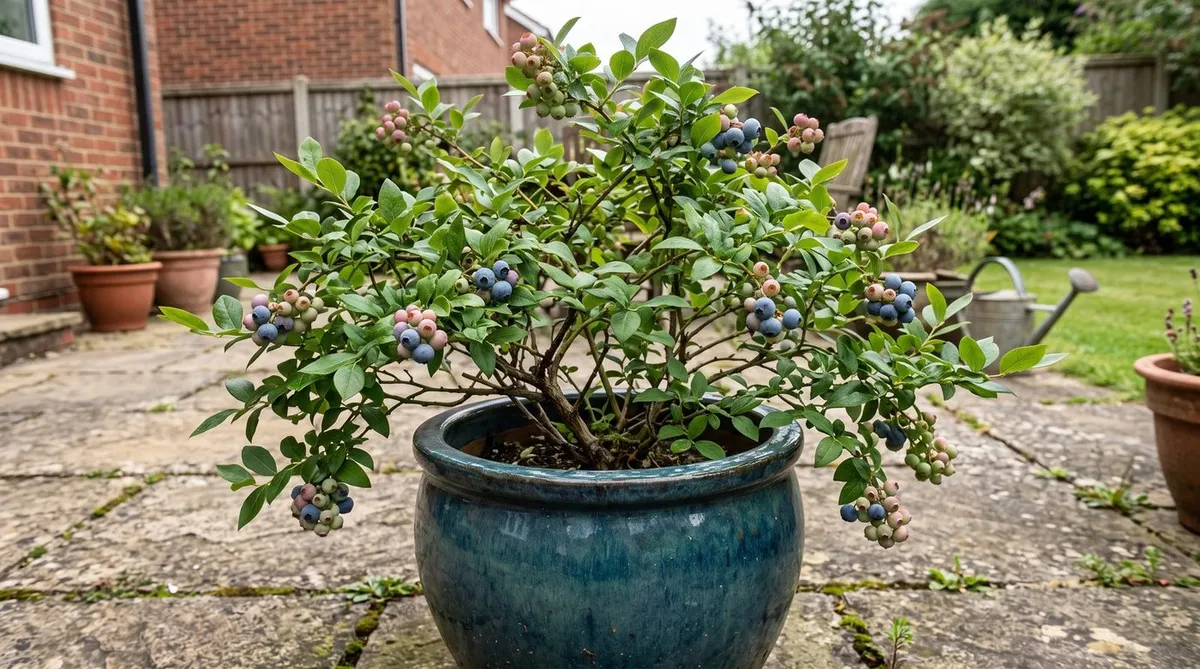
 A patio full of fruit in pots. Almost any fruit grows well in the right container.
The best fruits for pots stay compact and crop reliably in the UK. Here are the top choices.
Soft fruit for containers
Strawberries are the easiest place to start, and our strawberry growing guide has the details. They crop within months of planting and fit any container, from a hanging basket to a window box. Everbearing varieties like ‘Flamenco’ keep fruiting from mid-summer into autumn.
Blueberries love pots, because you can give them the ericaceous (acid) compost they need. Most UK garden soil isn’t acid enough for them. A grown-up bush in a big pot gives a generous crop every year.
Redcurrants and gooseberries grow well as single-stem cordons in 30cm pots, trained flat against a wall or fence to save space. Both cope with some shade, so they’re handy for a north-facing wall.
Raspberries suit big pots if you choose autumn-fruiting varieties like ‘Autumn Bliss’ or ‘Polka’. They fruit on this year’s canes, so you just cut everything to the ground in February. No fiddly pruning. Summer-fruiting raspberries need supports that get awkward in a pot.
Tree fruit for containers
Figs are brilliant in pots, as our fig growing guide explains. ‘Brown Turkey’ is the most reliable variety for the UK, and usually ripens its crop in late summer. A pot of at least 45cm is ideal. Stand it against a sunny, south-facing wall.
Dwarf apple trees on M27 rootstock only grow to about 1.5-2m tall. Most apples need a partner to pollinate them, so grow two varieties that flower at the same time, or choose one sold as self-fertile and check the label. A 50cm pot of John Innes No.3 keeps a tree cropping for years.
Dwarf cherries on Gisela 5 rootstock stay compact. ‘Stella’ is self-fertile and gives heavy crops of dark sweet cherries. Net the tree as soon as the fruit starts to colour, or the birds will strip it overnight.
Dwarf plums on Pixy rootstock stay small too. ‘Victoria’ is the classic UK choice and is self-fertile, so one tree is enough. Plums flower early, so drape fleece over the tree on frosty nights to protect the blossom.
Citrus trees like lemons, limes and kumquats can live outside on a sunny patio from May to September. Bring them in before it drops below about 5C. A cool conservatory or bright porch is perfect for winter. Feed them with citrus feed and water with rainwater.
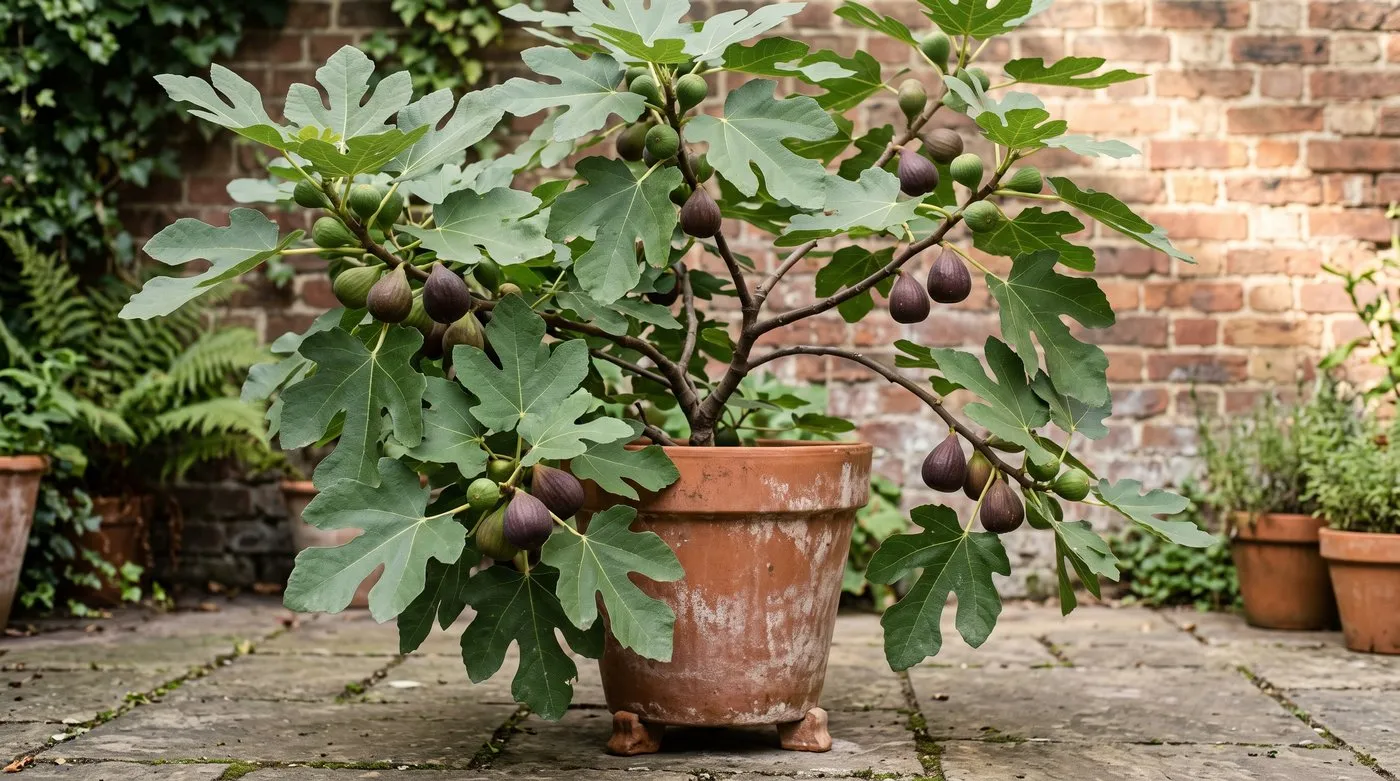
Keeping a fig’s roots in a pot makes it fruit rather than just grow leaves. Stand it against a sunny, south-facing wall to ripen the crop in late summer.
Fruit comparison table
Use this to plan your pots.
| Fruit | Smallest pot | Picking time | How easy | Light | Good variety for pots |
|---|---|---|---|---|---|
| Strawberries | 25cm | Jun-Oct | Easy | Full sun | ’Flamenco’ (everbearing) |
| Blueberries | 40cm | Jul-Aug | Easy | Full sun | ’Bluecrop’ |
| Raspberries (autumn) | 40cm | Aug-Oct | Medium | Full sun | ’Autumn Bliss’ |
| Redcurrants | 30cm | Jul | Easy | Sun or part shade | ’Jonkheer van Tets’ |
| Gooseberries | 30cm | Jun-Jul | Easy | Sun or part shade | ’Invicta’ |
| Figs | 45cm | Aug-Sep | Easy | Full sun, sheltered | ’Brown Turkey’ |
| Dwarf apples (M27) | 50cm | Aug-Oct | Medium | Full sun | Check the label for pollination |
| Dwarf cherries (Gisela 5) | 50cm | Jul | Medium | Full sun | ’Stella’ |
| Dwarf plums (Pixy) | 50cm | Aug-Sep | Medium | Full sun | ’Victoria’ |
| Citrus (lemon) | 40cm | Varies | Harder | Full sun, indoors in winter | ’Meyer’ |
Choosing the right pot
The pot matters as much as the plant. Too small and it dries out in hours on a hot day. Too heavy and you can’t move it. The wrong material can crack in frost or bake in the sun.
Pot size guide
Soft fruit (strawberries, blueberries, currants, gooseberries) needs a pot at least 30cm wide and deep. Bigger is always better. A big pot for blueberries means less watering and more room for roots.
Fruit trees (apples, cherries, plums, figs) need pots at least 45-50cm wide. Start young trees at that size and move them up to 50-60cm after two or three years. Make the final pot the biggest you can manage, as the weight helps keep it upright in wind.
Pot materials
| Material | Best for | Good points | Downsides |
|---|---|---|---|
| Terracotta | Fruit trees | Heavy and stable, looks lovely | Can crack in frost, dries fast |
| Plastic | Soft fruit | Light, cheap, holds moisture | Heats up, can blow over |
| Glazed ceramic | Figs, citrus | Attractive, holds moisture | Heavy, check it’s frost-proof |
| Fabric grow bags | Raspberries, strawberries | Great drainage | Dries fast, doesn’t last long |
| Self-watering | Blueberries, strawberries | Built-in water tank, less watering | Costs more |
Drainage
Every pot needs drainage holes, no exceptions. Stand pots on pot feet or bricks so water drains away and air gets underneath. Roots sitting in cold, wet compost in winter kill more potted fruit than the cold itself.
Balcony weight: A big pot of damp John Innes No.3 with a tree in it is very heavy. Check what your balcony can take first. For a lighter setup, use plastic pots and multipurpose compost.
Compost and planting
The right compost depends on the fruit. Get it wrong and you’ll see slow growth and poor crops.
Compost types for container fruit
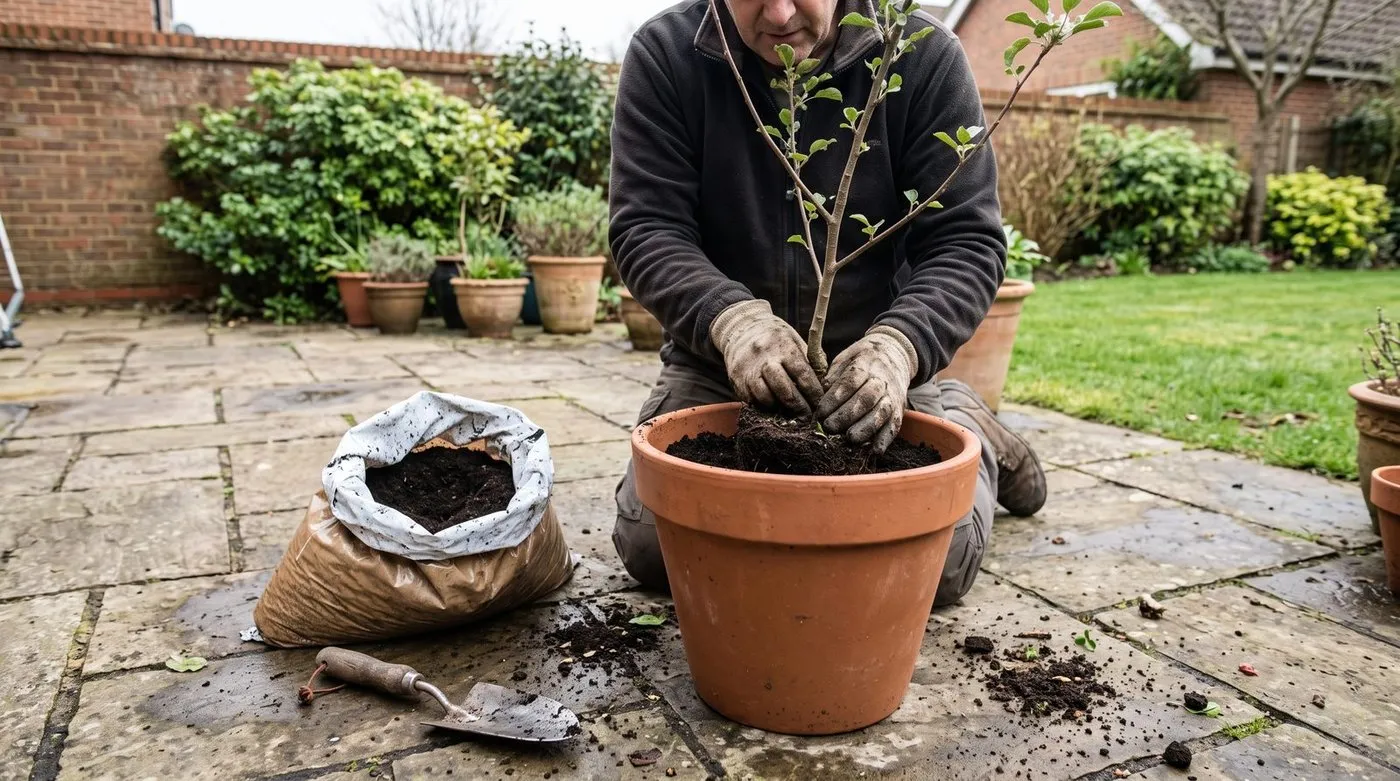 Planting a dwarf fruit tree. A layer of crocks in the base helps drainage.
John Innes No.3 is the best choice for fruit trees. It’s soil-based, so it’s heavy enough to keep pots steady in wind, holds on to food well and doesn’t shrink away from the sides when it dries. Mix in some perlite for extra drainage.
Ericaceous compost is a must for blueberries. They need acid conditions, and in ordinary compost their leaves soon turn yellow. Water them with rainwater where you can, as hard tap water slowly makes the compost less acid.
Peat-free multipurpose compost works for strawberries, raspberries, currants and gooseberries. Add slow-release fertiliser when you plant, and some perlite or grit for drainage.
Planting steps
- Put a few crocks or stones over the drainage holes
- Fill the pot about two-thirds full with the right compost
- Set the plant at the same depth it was in its old pot
- Fill in around the roots and firm gently
- Water well until it drains from the bottom
- Mulch the top with bark chips to keep moisture in
For bare-root trees, spread the roots over a mound of compost in the middle of the pot rather than coiling them round. Plant between November and March while the trees are dormant.
Watering and feeding
Fruit in pots dries out much faster than fruit in the ground, because the roots can’t go looking for water. In summer that means watering most fruit every day, and strawberries in small pots twice a day in hot spells.
Watering schedule
Spring (March to May): Water every two or three days as growth starts, more as it warms up. Keep the compost moist but not soggy.
Summer (June to August): Water every day, and morning and evening in a heatwave. Push a finger a few centimetres into the compost. If it’s dry, water until it runs out of the bottom. Don’t leave pots standing in saucers of water.
Autumn (September to November): Water less as growth slows, only when the top of the compost feels dry.
Winter (December to February): Water now and then in dry spells. Dormant trees still need a little moisture, but soggy, frozen compost kills roots.
Self-watering pots make life much easier. They have a water tank underneath that the compost draws up from. Just top up the tank. They’re great for blueberries and strawberries, which hate drying out.
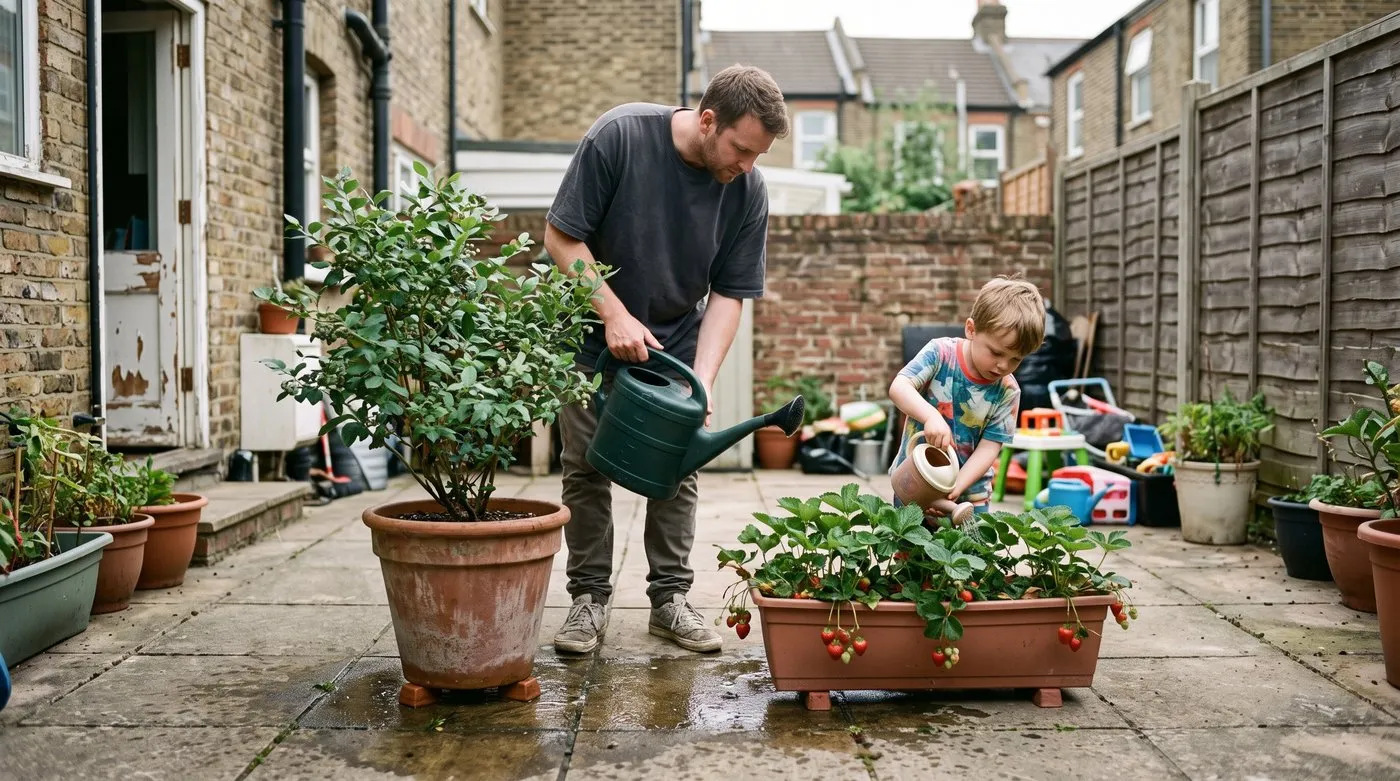
In summer, water most fruit in pots every day, in the morning if you can. If the compost is dry a few centimetres down, water until it runs out of the bottom.
Feeding schedule
Fruit in pots relies on you for food, and the goodness in fresh compost soon runs out.
- March: Scatter slow-release fertiliser over the compost. It feeds steadily for months.
- From flowering to harvest: Feed weekly with tomato feed. It’s high in potash, which helps flowers and fruit.
- Blueberries: Use an ericaceous plant food so you don’t make the compost less acid.
- Citrus: Use a citrus feed all year, switching to the winter version when they’re indoors.
Stop liquid feeding once the harvest is over. Late feeding makes soft growth that frost can damage.
Month-by-month container fruit calendar
These timings suit most of England. Northern gardens and Scotland may be a couple of weeks later in spring.
| Month | What to do |
|---|---|
| January | Order bare-root trees and soft fruit. Check pots for frost damage. Water dormant trees in dry spells. |
| February | Prune apple trees while dormant (leave cherries and plums until summer). Cut autumn raspberry canes to the ground. Top up tree pots with fresh compost. |
| March | Plant bare-root trees and soft fruit. Add slow-release fertiliser. Start regular watering as buds break. Repot any plants with crowded roots. |
| April | Cover plum and cherry blossom with fleece on frosty nights. Start liquid feeding once flowers open. Plant new strawberry plants. |
| May | Move citrus outside after the last frost. Water more often. |
| June | Start daily watering. Pick strawberries. Net cherries against birds. Thin apples to one or two fruits per cluster once the natural early drop has happened. |
| July | Pick blueberries, cherries, gooseberries and currants. Keep up the weekly feed. Peg down strawberry runners for new plants. Water twice a day in heatwaves. Prune cherries and plums after picking. |
| August | Pick figs, plums and autumn raspberries. Summer-prune trained apple trees. |
| September | Pick late apples and autumn raspberries. Water less and stop liquid feeding. Order bare-root plants. |
| October | Plant new bare-root trees and soft fruit. Clear fallen fruit to stop disease. Bring citrus back indoors. Take hardwood cuttings of gooseberries and currants. |
| November | Wrap pots in bubble wrap or fleece. Move tender plants somewhere sheltered. Plant garlic in any spare pots. |
| December | Check winter wrapping is secure. Water in dry spells. Plan next year’s fruit. |
Winter protection for container fruit
Roots in pots freeze much more easily than roots in the ground. In the garden, the soil keeps roots snug. In a pot, there’s only a few centimetres of compost between the roots and the frost.
Insulation methods
 Wrapping pots for winter stops the roots freezing.
Bubble wrap is cheap and works really well. Wrap it around the outside of the pot, leaving the top open for rain, and tie it on with string.
Horticultural fleece wrapped around the pot and lower branches protects against cold wind and light frosts. Use two layers in cold areas, and take it off in mild spells.
Grouping pots together against a sunny wall makes a sheltered huddle. The wall gives off warmth at night, and the outer pots protect the ones in the middle.
Moving under cover
Being able to move your fruit is a big bonus. Bring citrus into a cool conservatory or bright porch before it drops below about 5C. Move figs somewhere sheltered against a wall. Young or tender plants are happier in an unheated greenhouse or cold frame.
Don’t bring hardy fruit trees into a heated room. They need a cold winter rest to fruit well next year. A cool, bright, frost-free spot is ideal.
Repotting and root pruning
Fruit in pots needs repotting every two to three years. Otherwise the roots fill the pot, the compost wears out and the food runs out. Signs it’s time: water runs straight through, roots circle the bottom of the pot, and crops get smaller.
How to repot
- Wait until the tree is dormant in winter (November to February)
- Tip the tree out of its pot and shake off the loose compost
- Trim back some of the outer roots with clean secateurs
- Cut away any roots circling the pot or dead roots
- Put it back in the same pot with fresh compost, or move up a size if it needs more room
- Water well and mulch the top
Root pruning sounds harsh, but it encourages lots of fresh young roots that drink and feed better. The RHS guide to trees in containers explains it in more detail.
For soft fruit like blueberries and currants, move up to a slightly bigger pot each time. Once you reach a 50-60cm pot, switch to trimming the roots and refreshing the compost in the same pot.
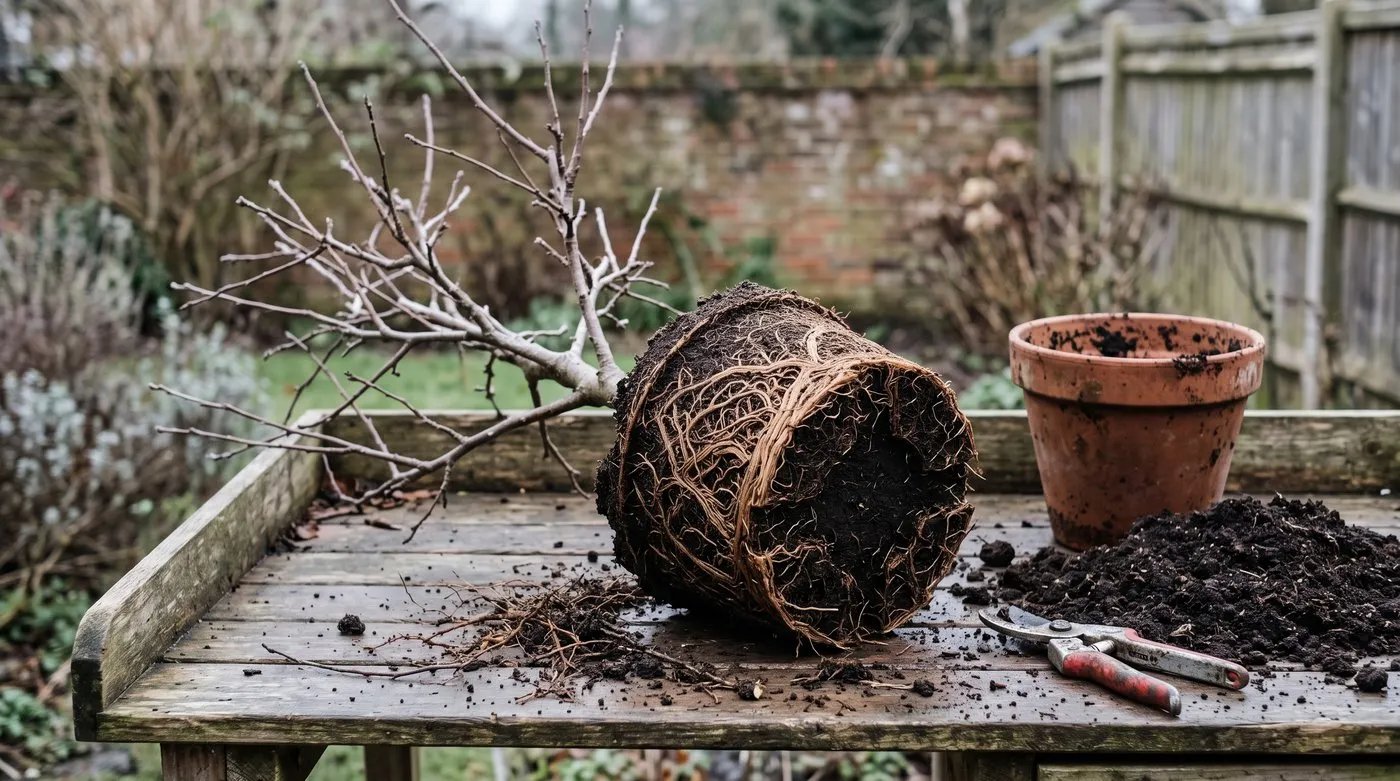
Every two to three years in winter, trim back some outer roots and cut away any circling the pot. Fresh young roots drink and feed far better.
Common mistakes with container fruit
Avoid these and your potted fruit will crop well for years.
Pots too small
The most common mistake. A dwarf apple in a small pot dries out by lunchtime in summer and has nothing to anchor it. Start with at least the sizes in the table and move up as the plant grows.
Wrong compost for blueberries
Ordinary multipurpose compost will slowly kill a blueberry. They need ericaceous compost. If the leaves turn yellow between the veins, the compost isn’t acid enough. Repot into ericaceous compost and water with rainwater.
Forgetting to feed
Compost in pots runs out of food quickly, especially with a crop to feed. Without weekly feeding from flowering to harvest, you get small, sparse, bland fruit.
No winter protection
One hard frost can kill the roots of a tree that sailed through mild winters before. Wrapping pots takes ten minutes in November. Do it every year.
Skipping drainage
Pots without holes, or pots sitting in saucers of water, lead to rotten roots. It happens slowly until the plant suddenly collapses. Make sure every pot has holes, raise it on feet, and take saucers away in autumn and winter.
Where to grow container fruit
Fruit in pots suits any outdoor space with enough sun. Most fruit wants at least six hours of direct sun a day. Currants and gooseberries are happy with less.
Patios and courtyards
 Fruit in pots on a balcony. Ideal if you rent or have no garden soil.
The classic spot. South or west-facing patios get the most sun and warmth. Put fruit trees at the back against a wall, which gives off stored warmth, and soft fruit in front. Paving reflects heat too, which helps fruit ripen.
Balconies
Check the weight limit before you bring in big pots. Lightweight plastic pots with multipurpose compost keep the weight down. Strawberries in hanging planters and blueberries in self-watering pots work well. Wind is the big problem up high, so a trellis or windbreak screen helps a lot.
Rental gardens
Pots are perfect if you rent, because everything comes with you when you move. Choose pots you can lift or wheel, or stand big ones on wheeled pot trolleys. Strawberries, blueberries and a fig or dwarf apple make a lovely starter collection you can take anywhere.
North-facing spaces
Your choice is smaller, but not zero. Gooseberries, redcurrants and Morello cherries (a cooking cherry) cope with a north-facing wall. They crop less than in full sun but still give a worthwhile harvest. Most other fruit trees and strawberries won’t do well in shade.
Getting started with container fruit
New to fruit in pots? Start with strawberries and a blueberry bush. Both are forgiving and crop in their first year. Add a fig or dwarf apple once you’ve got into a watering routine.
A sunny patio with a handful of pots of mixed fruit can keep you picking from early summer into autumn, and it needn’t cost much. A bag of compost, a few pots and some bare-root plants will crop for years. The Garden Organic guide to growing fruit has more on growing organically.
If you have beds to plant in, our guides to dwarf fruit trees and growing strawberries cover planting in the ground. Browse all our growing guides for more fruit and veg ideas through the year.
Now you know how to grow fruit in pots, read our guide on container vegetable gardening for the next step.
Frequently asked questions
What is the best fruit to grow in pots?
Strawberries are the easiest fruit to grow in pots. They crop in their first summer and suit window boxes, troughs and hanging baskets. Blueberries, figs and dwarf apple trees on very dwarfing rootstocks like M27 also do well. All cope with UK winters in pots with a little protection.
What size pot do I need for a fruit tree?
Start a dwarf fruit tree in a pot about 45-50cm across. Move it up to a 50-60cm pot after two or three years. Use a soil-based compost like John Innes No.3 for weight and stability. Heavy terracotta or stone pots help in wind too. Avoid anything under 40cm, as it will dry out too fast in summer.
Can I grow fruit trees on a balcony?
Yes, if it gets at least six hours of direct sun. Choose trees on dwarf rootstocks. Check the balcony’s weight limit first, as a big pot of damp compost is very heavy. Plastic pots and lighter compost reduce the load. Shelter from strong wind helps the flowers and fruit.
How often should I water fruit in pots?
Every day in summer for most fruit. Strawberries in small pots may need watering twice a day in hot spells. Push a finger a few centimetres into the compost to check. If it’s dry, water until it runs out of the drainage holes. Water less in winter, but don’t let the compost dry out completely.
What compost is best for fruit in containers?
John Innes No.3 is the best compost for fruit trees in pots. It’s soil-based, so it adds weight and holds on to food well. Blueberries need ericaceous compost, as they like acid conditions. Peat-free multipurpose compost suits strawberries. A little perlite or grit improves drainage in any mix.
Do fruit trees survive winter in pots?
Most hardy fruit trees are fine in pots with some protection. Roots in pots freeze more easily than roots in the ground. Wrap the pot in bubble wrap or hessian in cold spells and raise it on pot feet so it drains. Bring tender citrus indoors before frost.
How do I feed fruit in containers?
Use slow-release fertiliser in spring, then weekly tomato feed. Scatter the granules over the compost in March. Once the flowers open, feed weekly with a high-potash liquid feed such as tomato feed until the harvest ends. Compost in pots runs out of food faster than garden soil, so regular feeding really matters.
When should I repot fruit trees?
Every two to three years, in winter while they’re dormant. Lift the tree out and tease out any circling roots. Trim back some of the outer roots and repot into fresh compost. If it’s already in the biggest pot you can manage, trim the roots and put it back in the same pot. In other years, replace the top few centimetres of compost.
Our team produces practical UK gardening guidance from source research, contributor records and established horticultural practice. Editorial standards are overseen by Matt W.