Key takeaways
- Softwood cuttings from May to July root fastest, often in a few weeks
- Hardwood cuttings from November to February need no kit, just a trench outside
- Dividing perennials in spring or autumn is the easiest way to make new plants
- Layering is very reliable for climbers like clematis, jasmine and honeysuckle
- Rooting powder helps trickier cuttings but easy plants root fine without it
- Use a gritty, free-draining mix so cuttings root rather than rot
A cutting from your lavender costs nothing and can root in a few weeks. One big hosta can be split into several new plants in autumn. A clematis stem pinned into the ground becomes a new plant by next spring. Propagation turns one plant into many, and it’s one of the most satisfying things you can learn in the garden.
Understanding the three propagation methods
Cuttings, division and layering each suit different plants and different times of year. Knowing which to use is half the battle. The other half is good timing.
| Method | Best for | When | How easy | Kit |
|---|---|---|---|---|
| Softwood cuttings | Perennials, tender plants | May to July | Medium | Propagator or clear bag |
| Semi-ripe cuttings | Evergreen shrubs, hedging | July to September | Medium | Cold frame |
| Hardwood cuttings | Deciduous shrubs, roses, fruit bushes | November to February | Easy | None, just a trench |
| Division | Perennials, grasses, bulbs | March to April or September to October | Very easy | Fork, sharp knife |
| Layering | Climbers, bendy shrubs | Spring or autumn | Easy | Wire pin, soil |
You can fill a whole garden with free plants this way. A new privet hedge from hardwood cuttings costs nothing but time. A border of hostas, daylilies and hardy geraniums from division is truly free gardening.
Softwood cuttings: May to July
Softwood cuttings come from fresh, bendy new growth in late spring and early summer. They’re the quickest to root, often in a few weeks. They’re also the fussiest, as soft stems wilt fast and need damp air.
Which plants to propagate
Softwood cuttings work well for:
- Fuchsias, pelargoniums (geraniums) and penstemons
- Salvias, verbena and argyranthemums
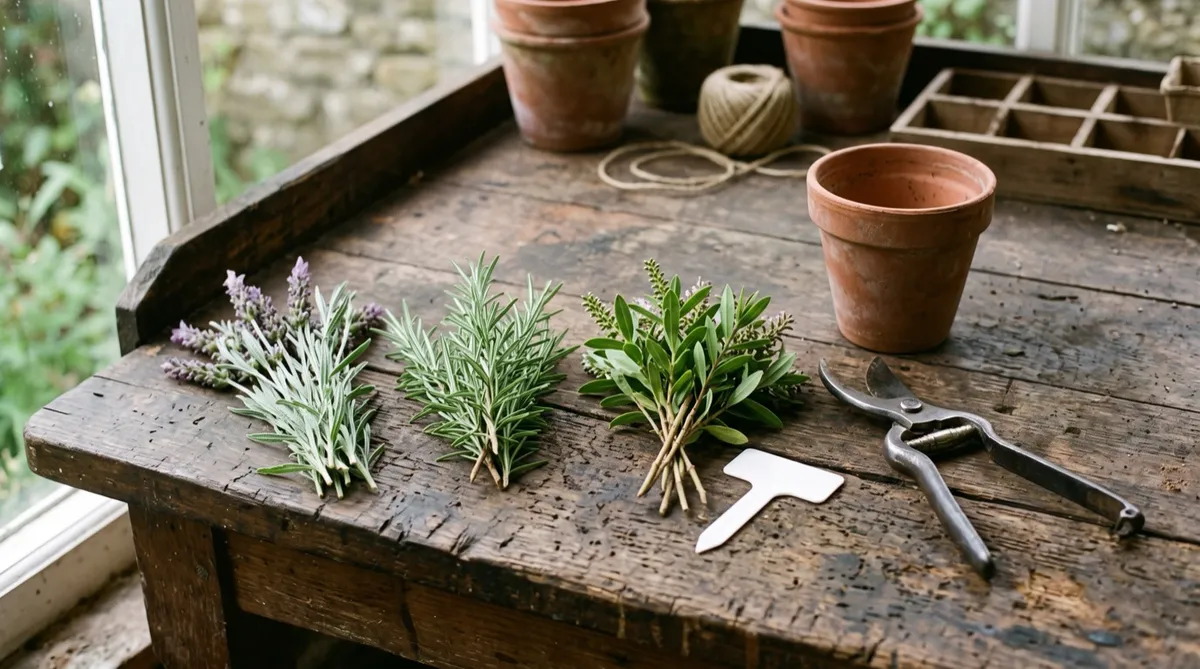
- Lavender (young shoots only, see our lavender guide)
- Hydrangeas (green tips, and our hydrangea guide helps with varieties)
- Mint, rosemary, sage and thyme
How to take softwood cuttings
- Timing: Go out early in the morning, when stems are full of water. Avoid the heat of the afternoon.
- Pick your shoots: Choose healthy shoots from this year’s growth without flowers. They should be green and bendy.
- Cut: Take pieces 7-12cm long, cutting just below a leaf joint (where a leaf meets the stem).
- Tidy up: Pull off the lower leaves, leaving the top two or three pairs. If the leaves are big, like hydrangea, cut each one in half to stop the cutting drying out.
- Rooting powder (optional): Dip the base in rooting powder and tap off the extra. Easy plants don’t need it.
- Pot up: Use a half-and-half mix of perlite and multipurpose compost. Make a hole with a pencil first, so you don’t damage the base pushing it in.
- Water and cover: Water gently, then cover with a clear plastic bag or propagator lid. Put them somewhere bright but out of direct sun.
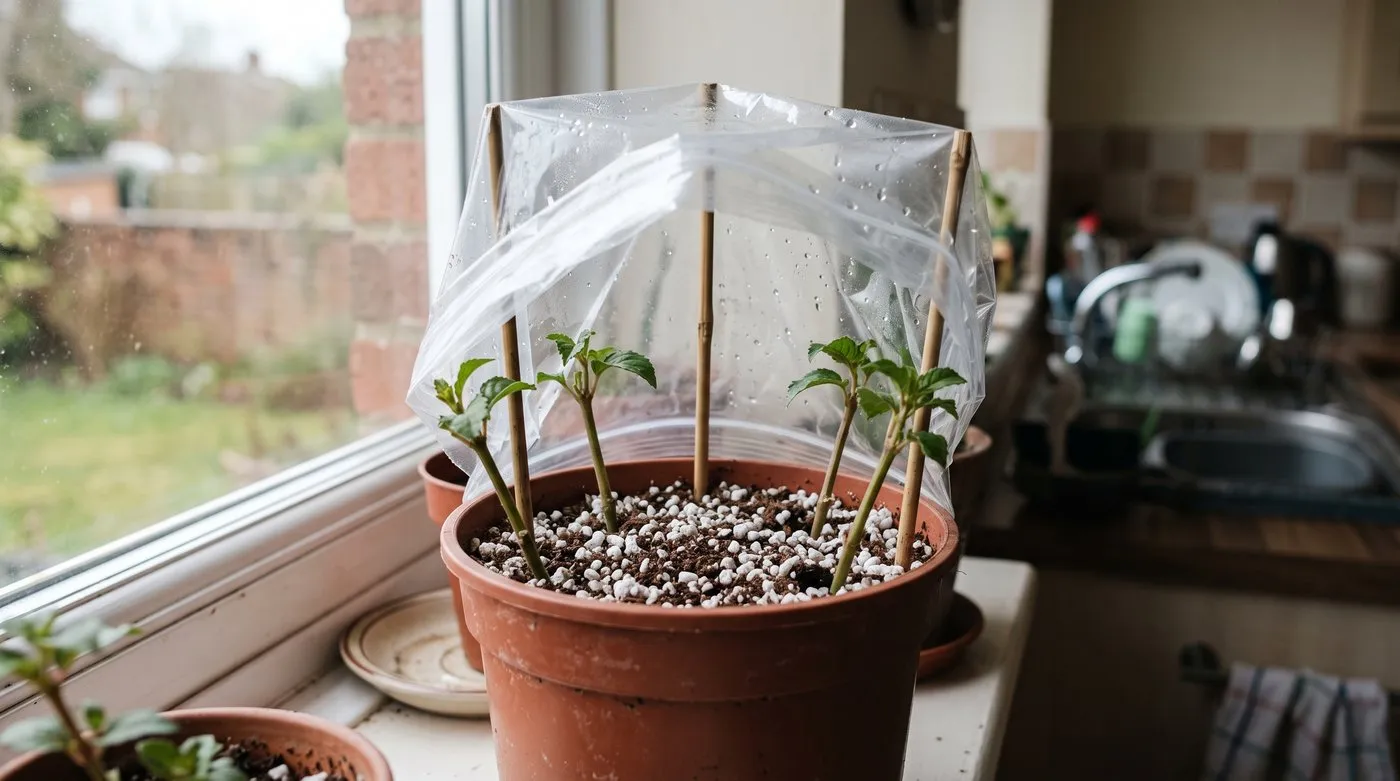
Set cuttings round the edge of the pot and cover them with a clear bag. The damp air stops the soft stems wilting while roots form.
Aftercare
Check your cuttings every day. Remove any that start to rot or go mouldy, as it spreads quickly. Lift the cover for 10 minutes a day to let in fresh air. Most softwood cuttings root within a few weeks.
Once they’ve rooted, pot each one into its own 9cm pot of multipurpose compost. Grow them on somewhere sheltered until they’re big enough to plant out.
Semi-ripe cuttings: July to September
Semi-ripe cuttings are taken when this year’s growth is firm at the base but still bendy at the tip. They’re tougher than softwood cuttings and don’t wilt as easily.
Which plants to propagate
Semi-ripe cuttings suit:
- Box (Buxus), privet, holly and yew
- Camellia, escallonia and ceanothus
- Hebe, photinia and viburnum
- Choisya, pyracantha and cotoneaster
- Rosemary, bay and myrtle
How to take semi-ripe cuttings
- Pick your shoots: Choose side shoots from this year’s growth. The base should feel firm and woody, with a slightly bendy tip.
- Cut: Take 10-15cm lengths, cutting just below a leaf joint.
- Wound the base: For woody plants like box and holly, scrape a thin strip of bark, about 2cm long, off one side of the base. This helps roots form.
- Tidy up: Strip the leaves from the bottom half and leave the top ones.
- Rooting powder: Semi-ripe cuttings really benefit from it. Look for one sold for semi-ripe or hardwood cuttings.
- Pot up: Use a gritty half-and-half mix of sharp sand or perlite with multipurpose compost. Good drainage is a must.
- Cold frame: Semi-ripe cuttings are slow, often taking 6-12 weeks. A cold frame keeps them sheltered without too much humidity.
Cuttings from hedging plants like box and privet are a cheap way to make a new hedge, though they need two or three years of growing before they’re ready to plant out. Rosemary roots well this way too, as our rosemary cuttings guide shows.
 Splitting a hosta clump with two forks back to back. Each piece needs a few shoots and a good chunk of root.
Hardwood cuttings: November to February
Hardwood cuttings are the easiest cuttings of all. No kit, no heat and no daily checking. Take them while plants are dormant, pop them in a trench outside and let winter do the work.
Which plants to propagate
Hardwood cuttings work for:
- Roses (see our rose growing guide for variety ideas)
- Gooseberries, blackcurrants and redcurrants
- Willows, dogwoods and poplars
- Buddleia, forsythia and philadelphus
- Deutzia and weigela
How to take hardwood cuttings
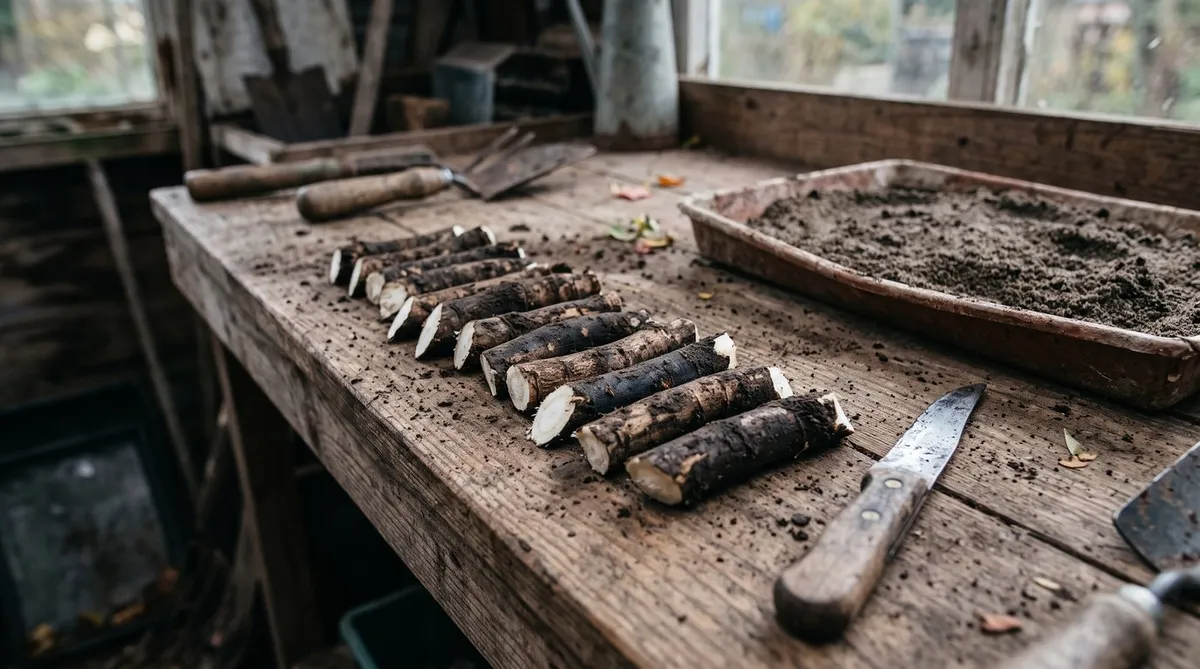
- Pick your stems: Choose straight, healthy stems from this year’s growth, about as thick as a pencil and fully woody.
- Cut: Take 20-30cm lengths. Cut straight across at the bottom, just below a bud, and on a slant at the top, just above a bud. The slanted top reminds you which way up it goes and lets rain run off.
- Rooting powder: Dip the bottom 2cm in rooting powder if you have some.
- Make a trench: Dig a narrow trench about 15cm deep somewhere sheltered. Sprinkle a little sharp sand in the bottom to help drainage.
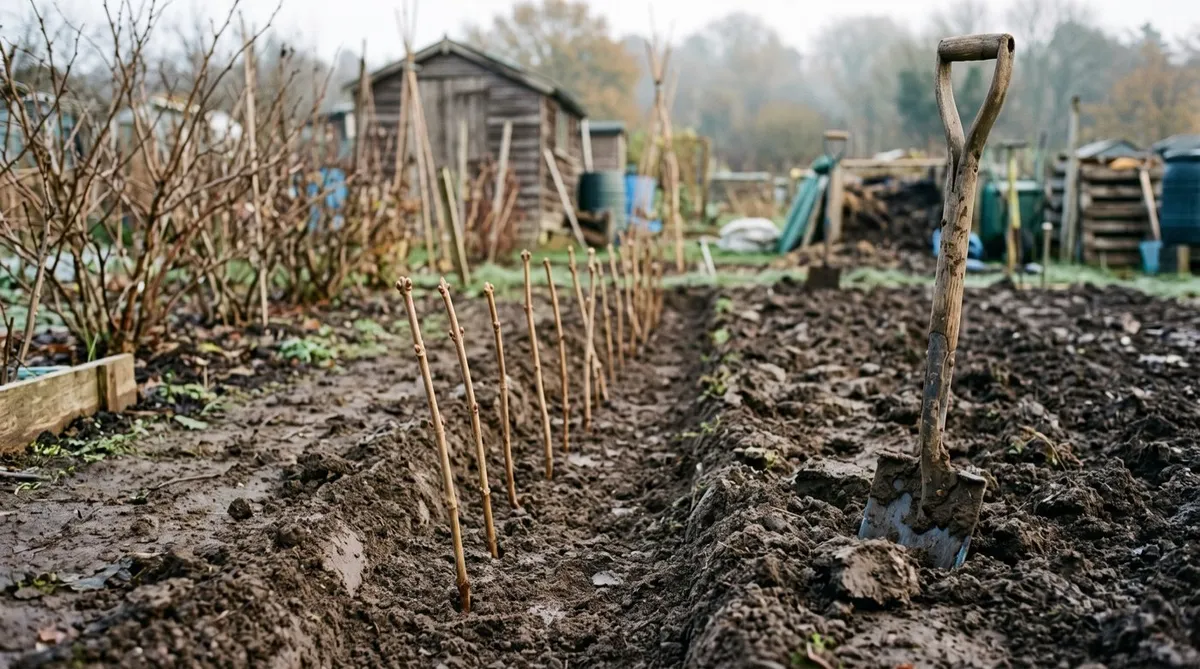
- Plant: Push each cutting in so about two-thirds is underground and a third, with two or three buds, sits above. Space them 10-15cm apart.
- Firm in: Push the soil back, firm it with your boot and water well.
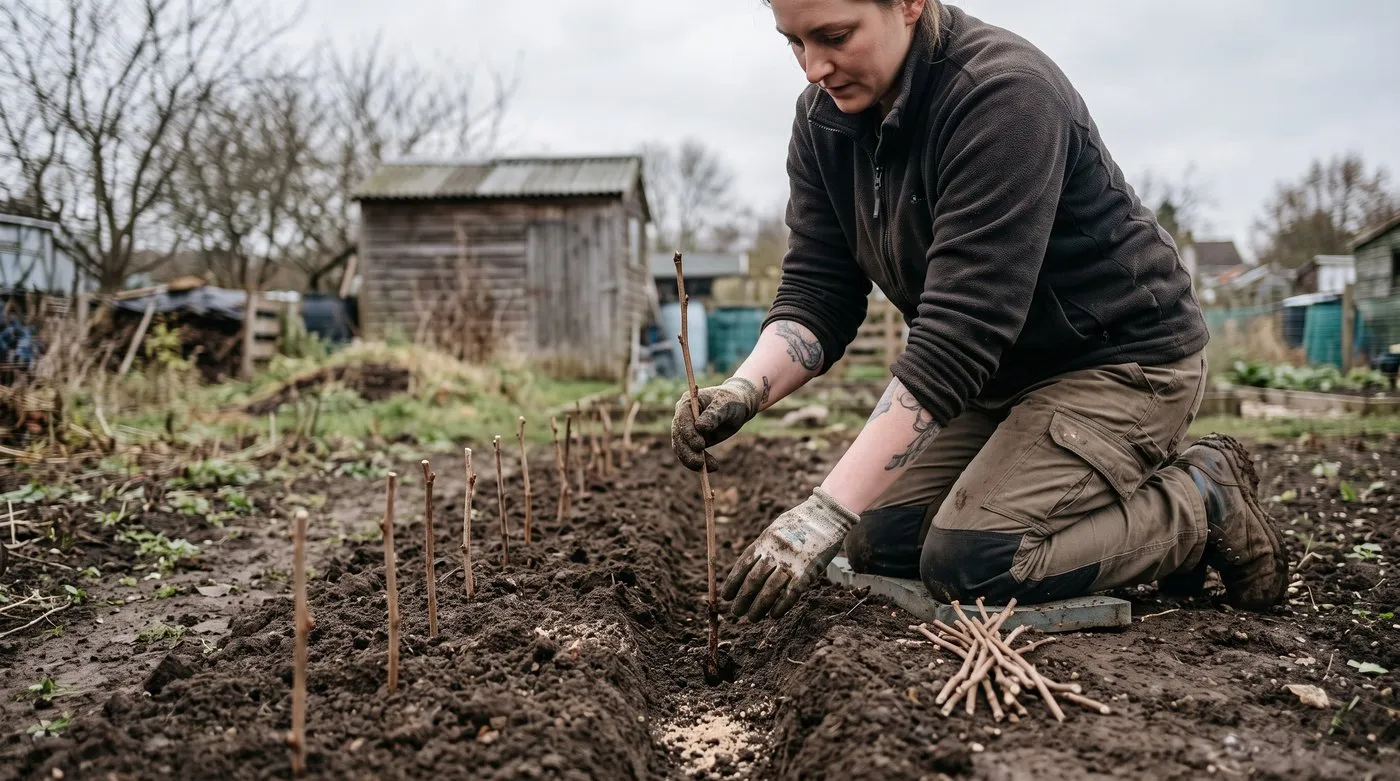
Bury two-thirds of each cutting and leave a few buds showing. Then firm them in and let winter get on with the rooting.
What happens next
The cuttings sit quietly through winter. Roots start forming as the soil warms in late winter, and buds open in spring. By the next autumn, each cutting should have roots and leafy growth.
Leave them in the trench for a full growing season, then move them to their final spots the following autumn. Slower ones, including some roses, may need another year.
Division: the simplest method
Division is the quickest and most reliable way to make new plants. Lift a clump, split it up and replant. Each piece is already a complete plant with roots and shoots.
When to divide
- Spring (March to April): Best for most perennials. New growth is just starting and the soil is warming up.
- Autumn (September to October): Good for plants that flower in spring or early summer. The soil is still warm, and autumn rain does the watering.
Avoid dividing in hot summer weather or a cold snap, as both stress the plants.
Which plants to divide
Any clump-forming perennial can be divided, including:
- Hostas, daylilies and agapanthus
- Hardy geraniums, astilbe and Japanese anemones
- Ornamental grasses like miscanthus, stipa and molinia
- Primulas, pulmonaria and bergenia
- Dahlias (split the tubers, as our dahlia guide explains)
- Bearded irises (divide the rhizomes after flowering in July)
How to divide perennials
- Lift the clump: Push a fork in all round the plant and rock it gently to loosen the roots, then lift it out.
- Have a look: Find natural gaps between shoots or bits that come apart easily. Throw away a woody old centre if it’s stopped growing well.
- Split it: Pull loose clumps like geraniums apart by hand. For tough clumps like grasses and hostas, push two forks in back to back and lever them apart. For very woody ones, use a sharp spade or an old bread knife.
- Check each piece: Each one needs a few shoots or buds and a good amount of healthy root. Tiny pieces with one shoot often struggle.
- Replant straight away: Plant at the same depth as before, water well and mulch. Don’t leave roots drying in the sun and wind.
Division also perks up tired plants. Many clumps get weaker in the middle after a few years. Splitting them and replanting the outer bits brings back strong growth and flowers. If you need to move a whole plant, see how to move perennials and shrubs.
Layering: high success, low effort
Layering gets a stem to grow roots while it’s still attached to the parent plant. The parent keeps feeding and watering it while it roots, so it rarely fails. It’s the easy option for plants that are tricky from cuttings. Strawberries do this all by themselves, and our strawberry runners guide shows how to pot up the baby plants for free.
Simple layering
This works for any plant with a stem bendy enough to reach the ground.
- Choose a stem: Pick a healthy, bendy, low stem from this year or last.
- Nick it: About 30cm from the tip, make a small cut on the underside, or scrape off a 3cm strip of bark. Dust with rooting powder if you have it.
- Pin it down: Bend the stem into a shallow hole about 10cm deep and hold the wounded bit down with a wire pin or forked stick. Cover with soil and firm it. Leave the tip sticking up.
- Wait: Roots form at the buried bit, usually within 6-12 months. Water in dry spells.
- Cut free and move: Once it’s rooted, cut the new plant away from the parent and plant it where you want it.
Best plants for layering
| Plant | When to layer | Roughly how long to root | Tips |
|---|---|---|---|
| Clematis | Spring | 6-12 months | Use the bendy stems near the base |
| Jasmine | Spring or summer | A few months | Roots quickly and easily |
| Rhododendron | Spring | Over a year | Wound the stem well and use acid soil |
| Magnolia | Spring | One to two years | Slow but reliable |
| Honeysuckle | Autumn | 6-9 months | Very easy, often does it by itself |
| Climbing hydrangea | Spring | 6-12 months | Pin the stem so it touches the soil |
| Wisteria | Summer | About a year | Use this year’s growth |
 A bendy stem pinned to the ground with a wire hoop. The nick on the underside is where the roots will grow.
Air layering
Air layering is for stems that won’t bend to the ground, like upright magnolias, acers and rubber plants.
- Pick a straight bit of stem about as thick as a pencil
- Make two cuts round the stem 3cm apart, just through the bark, and peel off the bark between them
- Dust the bare wood with rooting powder
- Wrap a handful of damp sphagnum moss around it
- Cover the moss with plastic wrap and tape both ends
- Roots grow into the moss over a few months
- When you can see roots through the plastic, cut the stem below them and pot it up
It takes a bit more fiddling than simple layering, but it works on plants with no low branches.
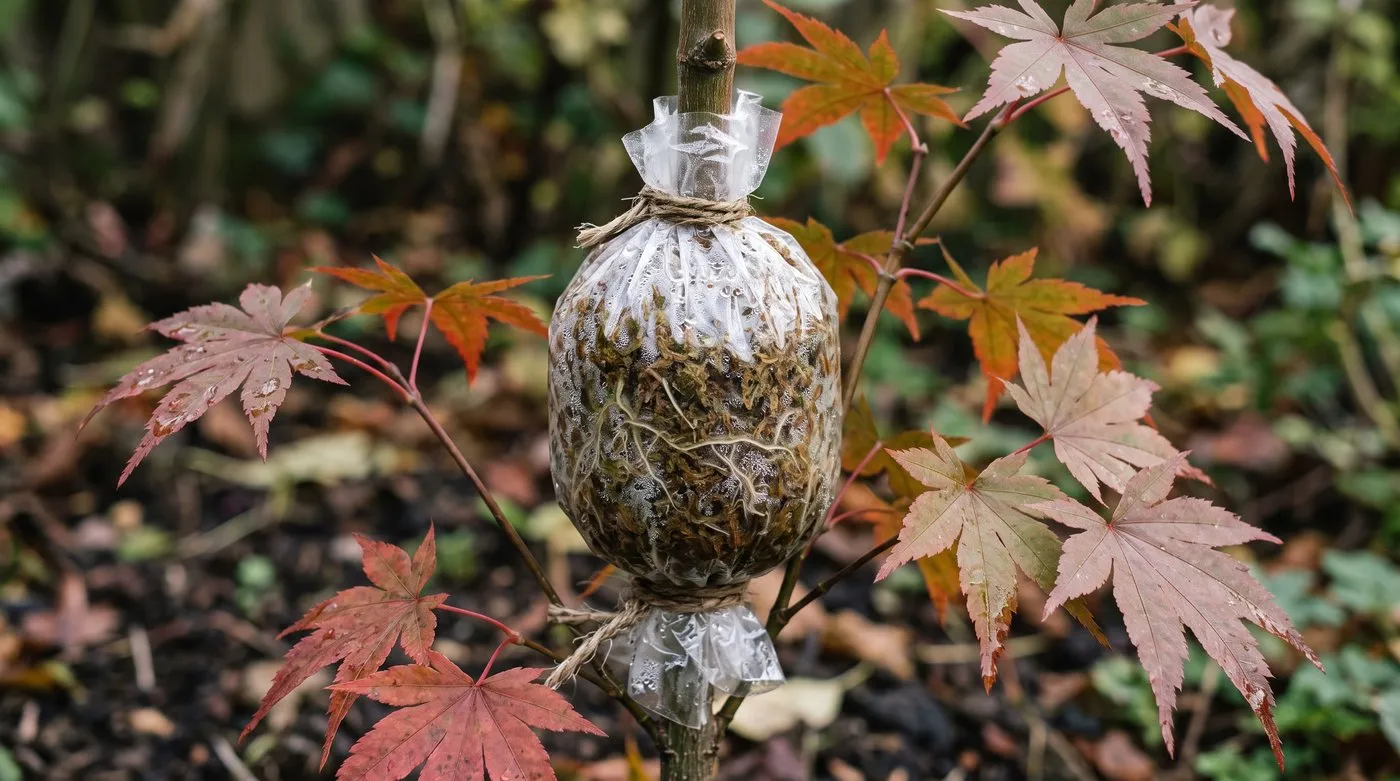
When you can see roots through the plastic, it’s ready. Cut just below the moss and pot the new plant up.
Compost mixes for propagation
Cuttings need a different mix from normal potting compost. They want great drainage and very little food. Rich compost makes them rot instead of root.
| Mix | Use it for | Ratio |
|---|---|---|
| Perlite and multipurpose compost | Softwood and semi-ripe cuttings | Half and half |
| Sharp sand and multipurpose compost | Semi-ripe cuttings in a cold frame | Half and half |
| Vermiculite and peat-free compost | Instead of seed compost | Half and half |
| Perlite on its own | Tricky cuttings | All perlite |
| Garden soil and sharp sand | Hardwood cutting trenches | Roughly two-thirds soil |
For sowing indoors, see our guide to sowing seeds indoors, which covers compost, warmth and light.
Rooting hormones explained
Rooting hormone is a copy of the natural plant hormone that tells cut stems to grow roots. You can buy it as a powder, liquid or gel.
Powder is the easiest to find and lasts several seasons. Dip the base of the cutting in, tap off the extra and pop it into the compost. Some products are made for softwood cuttings and others for woodier ones, so check the label.
Some plants root so easily they don’t need it at all. Willows, pelargoniums, fuchsias and mint will even root in a glass of water. For harder plants like box, camellia and magnolia, rooting hormone really helps.
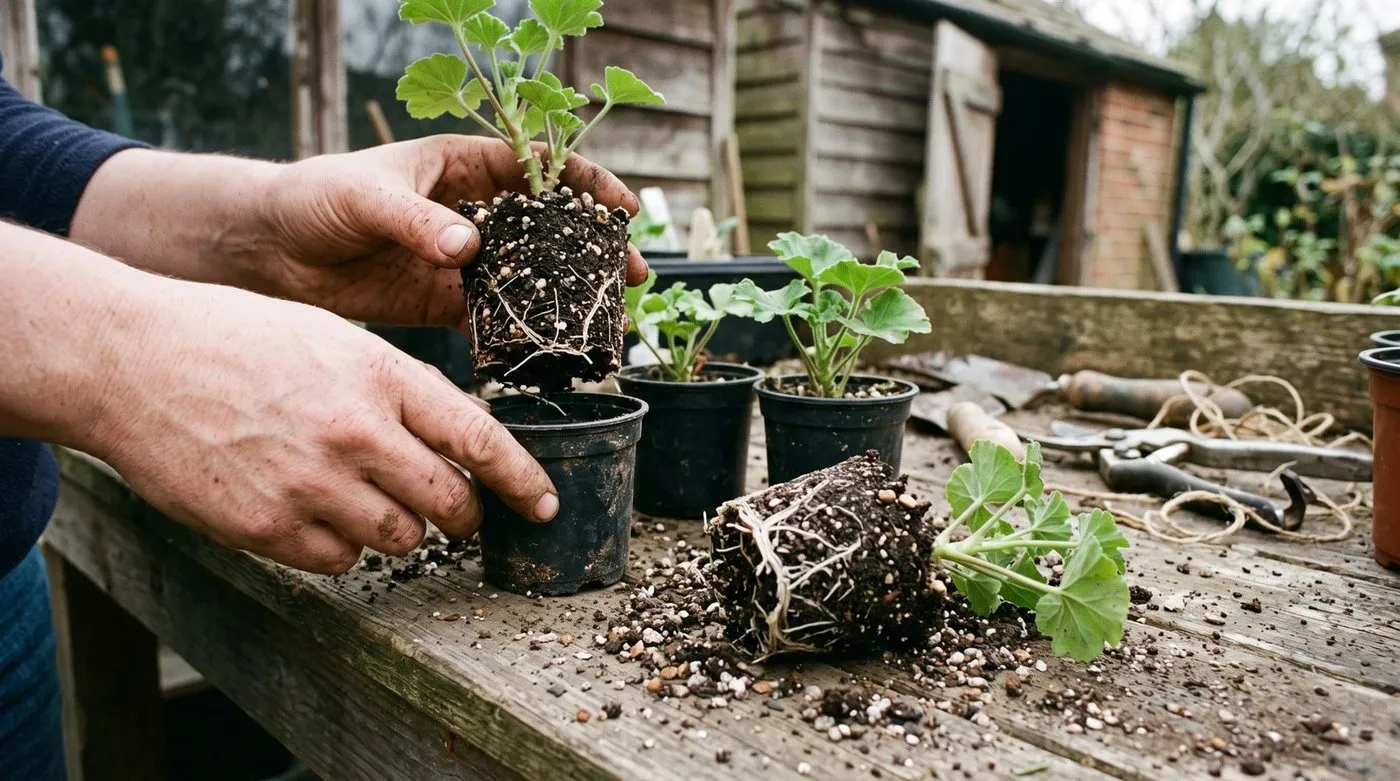 Rooted softwood cuttings in 9cm pots. Healthy white root tips are showing round the edges.
Propagation calendar for UK gardeners
Here’s a month-by-month guide, so you never miss the right moment.
| Month | Job |
|---|---|
| January | Take hardwood cuttings of fruit bushes and deciduous shrubs |
| February | Divide snowdrops “in the green” after flowering |
| March | Divide perennials as new growth appears. Start splitting dahlia tubers |
| April | Divide ornamental grasses. Take basal cuttings of delphiniums and lupins |
| May | Take softwood cuttings of tender perennials and shrubs |
| June | Layer clematis and jasmine. Keep taking softwood cuttings |
| July | Switch to semi-ripe cuttings as growth firms up. Divide bearded irises after flowering |
| August | Take semi-ripe cuttings of evergreen hedging like box, privet and yew |
| September | Divide spring-flowering perennials. Layer rhododendrons |
| October | Get hardwood cutting trenches ready. Last chance to divide perennials |
| November | Take hardwood cuttings of roses, dogwood and willow |
| December | Keep taking hardwood cuttings. Check cold frame cuttings for rot |
Troubleshooting common problems
Cuttings wilt and collapse
The cutting is losing water faster than it can drink. That happens when the air is too dry or it’s in direct sun. Move it into bright shade, cover with a clear bag or lid and mist the leaves daily. Pinch off any flowers and trim big leaves.
Cuttings rot at the base
The mix is too wet or too rich. Switch to a grittier mix with more perlite or sand. Water before putting cuttings in, then wait until the top dries a little before watering again. Open the propagator vent for 10 minutes a day for fresh air.
Divisions fail to establish
The pieces were probably too small. Each one needs a few shoots and plenty of root. Tiny bits often dry out before they can grow new roots. Water new divisions regularly for the first few weeks.
Layers do not root
The cut wasn’t deep enough, or the soil dried out in summer. Make a proper nick through the bark and keep the soil damp the whole time. A mulch over the buried bit helps keep it moist.
Filling a garden for free
Propagation is how keen gardeners fill big borders without spending a fortune. Buying a border’s worth of plants can cost a lot. Filling it with divisions from friends, cuttings from your own plants and layers from climbers costs nothing but a little time.
Set up a small propagation corner somewhere sheltered. A simple cold frame, or even a sheet of glass propped against a wall, is enough for semi-ripe and hardwood cuttings. A windowsill propagator handles softwood cuttings in summer. A spare patch of good soil gives young plants somewhere to grow on before they go into the border.
Ask friends and neighbours for cuttings, as most gardeners love to share. Gardening clubs and allotment societies often run plant sales and swaps too. Sharing plants is one of the nicest things about gardening in the UK.
Every plant you own could become a parent. It takes a little patience, as hardwood cuttings and layers can take a year, but there’s nothing quite like a border full of plants you grew yourself.
Ready for more? Our guide on sowing seeds indoors is the perfect next step.
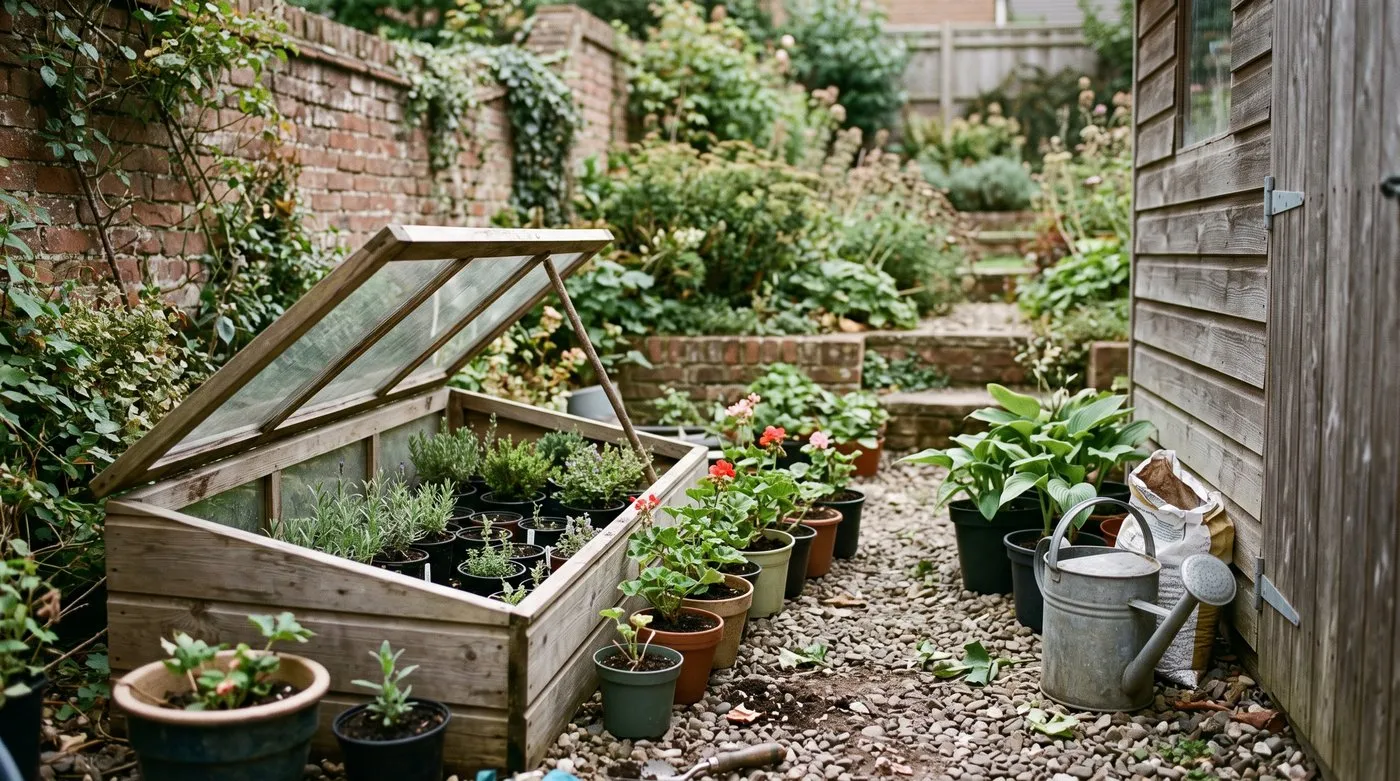
A cold frame and a sheltered corner are all the kit you need. In a year or two, it can fill a border for free.
Frequently asked questions
When is the best time to take cuttings in the UK?
It depends on the type of cutting. Take softwood cuttings in late spring and early summer, while stems are green and bendy. Take semi-ripe cuttings from mid to late summer, as stems start to firm up. Take hardwood cuttings from late autumn to late winter, while plants are dormant.
Do I need rooting hormone for cuttings?
No, but it can help. It’s most useful for semi-ripe and hardwood cuttings and for plants that are slow to root. Easy plants like pelargoniums and fuchsias usually root happily without it. Garden centres sell it as a powder or gel.
Why do my cuttings keep rotting?
Usually too much water and not enough air. Use a free-draining mix, such as half perlite or grit and half multipurpose compost. Water before you put the cuttings in, then keep it just damp. Air covered cuttings often, and pick off fallen or dying leaves quickly.
How do I know when cuttings have rooted?
The best sign is new leaves at the tip. You may also see roots poking out of the drainage holes. After a few weeks, a very gentle tug that meets resistance means roots have formed. Don’t pull cuttings out to check, as it damages the new roots.
Can I propagate roses from cuttings?
Yes, many roses root well from hardwood cuttings in autumn. Cut pencil-thick lengths of this year’s growth, about 20-25cm long, and take off the lower leaves. Push them into a trench of gritty soil outside, leaving about a third showing. They root over winter, and most can be moved the following autumn.
What is the difference between division and splitting?
There isn’t one, they’re the same job. You lift a big clump and break it into smaller pieces, each with its own roots and shoots. Spring or autumn is the best time, when the soil is damp and the weather mild.
Which plants can I propagate by layering?
Clematis, climbing hydrangeas, jasmine, honeysuckle, rhododendrons, magnolias and lots of bendy shrubs. Bend a low stem to the ground, nick the underside and pin it into the soil. Roots form where it’s buried, often within a year. It’s reliable because the stem stays attached to the parent while it roots.
Our team produces practical UK gardening guidance from source research, contributor records and established horticultural practice. Editorial standards are overseen by Matt W.