
Key takeaways
- The "geraniums" sold for pots are really pelargoniums, which are tender, unlike hardy cranesbill geraniums
- Zonal pelargoniums are the classic bedding type and flower from May until the first frost
- Take 10cm cuttings in August, as they root easily without rooting powder
- Bring plants in before frost, cut them back to 15cm and keep them bright and cool
- Give a tomato feed every two weeks from June to September for lots of flowers
- They prefer to be a little dry, and too much water is the main thing that kills them
The plants sold as “geraniums” in every garden centre are really pelargoniums. True geraniums are hardy cranesbills for the border. Pelargoniums are tender plants from South Africa that flower from May to October and die at the first frost unless you bring them indoors. For a closer look at how to tell them apart, see geranium vs pelargonium.
What is the difference between pelargoniums and geraniums?
Pelargoniums are tender plants from South Africa. Geraniums are tough perennials that stay in the garden all year. They’re in the same plant family, and garden centres still call pelargoniums “geraniums” because the old name stuck.
The quickest way to tell them apart is to look at a flower. On a pelargonium, the two top petals look different from the three lower ones. True geranium flowers have five matching petals in a neat, flat circle.
The difference matters when you plant. Hardy geraniums live outside all year and many cope with some shade. Pelargoniums are killed by frost and need full sun. For colour from May to October in pots, window boxes and hanging baskets, choose pelargoniums. For ground cover that comes back in the border every year, choose hardy geraniums.
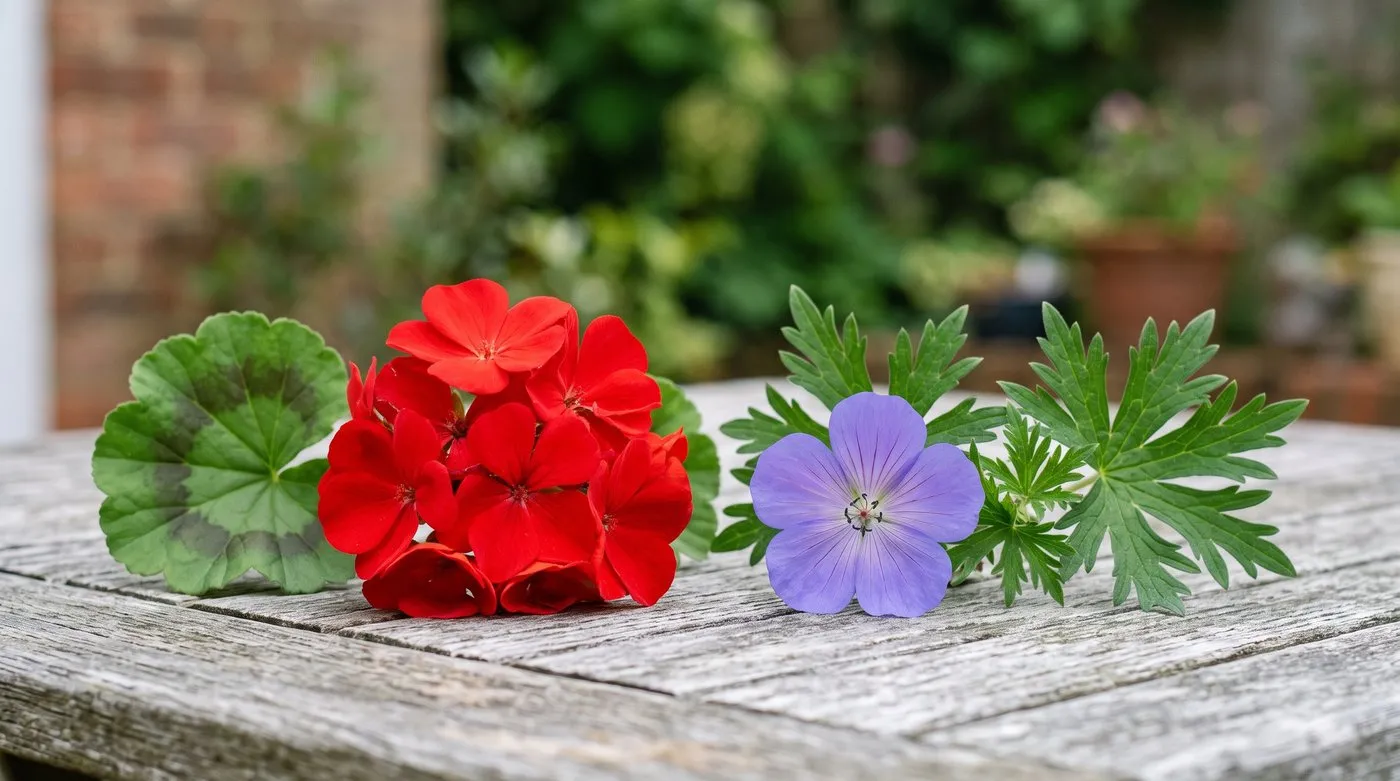
Look at the petals to tell them apart. Pelargoniums have two top petals that differ from the lower three, while hardy geraniums have five matching ones.
Which type of pelargonium should I grow?
There are four main types. Each has its own look and job, so it’s worth picking the right one.
 The four main types: upright zonal, trailing ivy-leaved, frilly regal and scented-leaf.
| Zonal | Ivy-leaved | Regal | Scented-leaf | |
|---|---|---|---|---|
| Shape | Upright | Trailing | Bushy | Bushy or upright |
| Flowers | Medium | Small to medium | Large and frilly | Small |
| Flowering | May to October | May to October | Early summer, for a few weeks | On and off in summer |
| Good for | Beds, pots, window boxes | Hanging baskets, wall pots | Conservatory, sheltered patio | Windowsills, near a path |
| Leaves | Dark horseshoe band | Shaped like ivy, glossy | Large, toothed | Smell lovely when touched |
| Copes with dry spells | Very well | Very well | Fairly well | Very well |
| Cuttings | Very easy | Easy | Fairly easy | Easy |
Zonal pelargoniums are the classic bedding “geranium”, with round leaves marked by a darker horseshoe band. They flower non-stop from May until frost. Single and semi-double flowers cope best outdoors. Fully double flowers hold rain and can rot in a wet summer.
Ivy-leaved pelargoniums trail down, making them the best choice for hanging baskets and wall pots. They cope with wind better than zonals and shrug off rain more easily. The ‘Balcon’ types were bred for European window boxes and handle exposed spots well.
Regal pelargoniums have the biggest, showiest flowers, but only for a few weeks. They need shelter from rain and wind, so they’re happiest in a conservatory or on a sheltered patio.
Scented-leaf pelargoniums are grown for their fragrant leaves rather than their flowers. You’ll find rose, lemon, peppermint and nutmeg scents, among others. Brush past them and the whole patio smells wonderful. They’re some of the best scented plants you can grow in a pot.
How to plant pelargoniums outdoors in the UK
Plant out after the last frost, once nights stay above about 5C. In most of England that’s late May. In Scotland and northern England, early June is safer.
Sun: Pelargoniums need full sun to flower well. South or west-facing spots are ideal. They cope with a little afternoon shade, but you’ll get fewer flowers.
Soil and compost: In beds, they need soil that drains well. On heavy clay, mix plenty of grit into the planting hole. In pots, use peat-free multipurpose compost with some perlite mixed in. Don’t use plain garden soil in pots, as it packs down and stays wet.
Spacing: Plant zonals 25-30cm apart in beds, or three to a 30cm hanging basket. Ivy-leaved types need 30-35cm. In window boxes, 20cm apart gives a full display by midsummer. A little space between plants lets air through, which helps keep rot away in damp summers.
Planting depth: Plant at the same depth as in the pot. Burying the stem makes it more likely to rot at the base. Water in, then let the compost dry before watering again.
How to take pelargonium cuttings
August is the best month for cuttings. The plants are growing strongly, the stems are firm but not woody, and it’s warm enough for them to root before autumn.
 Taking cuttings in August. Snip 10cm shoots without flowers just below a leaf joint and pop them into a gritty mix.
Step by step:
- Pick your shoots: Choose healthy shoots 8-10cm long without flowers. Skip leggy or yellow growth. Pinch off any flower buds.
- Make the cut: With a clean, sharp blade, cut just below a leaf joint.
- Tidy it up: Remove the lower leaves, leaving two or three at the top. Pull off the little papery flaps at the base of the leaves.
- Let it dry: Leave the cutting for a few hours so the cut end dries a little. This helps stop it rotting.
- Pot it up: Use a half-and-half mix of perlite and multipurpose compost. Make a hole with a pencil, push the cutting in about a third of its length and firm gently. You don’t need rooting powder.
- Water once: Give one light watering to settle it, then wait until the surface is completely dry before watering again.
- Find a spot: Somewhere bright but out of direct sun, like a windowsill, cold frame or shaded greenhouse bench. Don’t cover it with a plastic bag, as the damp air makes it rot.
Cuttings usually root in two to three weeks. A gentle tug tells you when they have. Pot each one into a 9cm pot and grow it on a bright windowsill or in a greenhouse. Pinch out the tip when it’s about 10cm tall to make it bushy.
How to overwinter pelargoniums in the UK
Pelargoniums can’t survive a UK winter outside, as frost kills them. To keep them, bring them in before the first autumn frost, usually by mid-October in most of England.
 Pelargoniums tucked up on a bright windowsill. Cut back in October, water sparingly, and start feeding again in spring.
Option 1: On a windowsill (good for a handful of plants)
Lift plants from beds or bring pots indoors. Cut stems back to 15cm and remove dead or yellow leaves. If they’re in big pots, you can move them into smaller ones. Stand them on a bright, cool windowsill where it stays around 5-12C. A spare bedroom or unheated conservatory is ideal. Water every two or three weeks, just enough to stop the compost drying out completely.
Option 2: In a greenhouse (good for lots of plants)
A greenhouse kept frost-free, at 5C or more, is perfect for a bigger collection. Cut the plants back in the same way and stand them close together on the staging. Water sparingly, and open the vents on mild days to keep the air moving and grey mould away.
Option 3: Bare-root (the old-fashioned way)
Lift the plants, shake off the soil and hang them upside down in a frost-free garage or shed. Some gardeners soak the roots in water now and then over winter. It takes up little space, but you’ll lose more plants this way than with the other options.
Whichever you choose, start watering more in March when new shoots appear. Begin feeding in April, and move plants outside after the last frost in May.
Pelargonium care month by month
| Month | What to do |
|---|---|
| January | Sow seed of F1 zonal varieties indoors in a heated propagator. |
| February | Pot on seedlings into 9cm pots. Check stored plants for grey mould. |
| March | Take early cuttings from stored plants. Water more as new growth starts. |
| April | Start feeding stored plants every two weeks. Begin hardening off. |
| May | Plant out after the last frost. Pinch out tips for bushy plants. |
| June | Switch to tomato feed. Snip off faded flower heads each week. |
| July | Flowers at their best. Water pots daily in hot weather and feed weekly. |
| August | Take cuttings for next year. Keep feeding and deadheading. Watch for whitefly. |
| September | Feed every two weeks. Clear a space indoors for winter. |
| October | Bring plants in before frost. Cut back to 15cm and remove dead leaves. |
| November | Water about every two weeks. Open greenhouse vents on mild days. |
| December | Water every couple of weeks. Check for grey mould and pick off dead leaves. |
Use this alongside a wider container gardening plan to keep your pots looking good all year.
Common pelargonium pests and diseases
Blackleg rots the base of the stem, turning it black and soft. Soggy compost, poor drainage and planting too deep are the usual causes. Once it starts, it can’t be cured, so bin the plant. Prevent it with free-draining compost, careful watering and pots with good drainage holes.
Whitefly is the most common pest, especially on plants brought indoors for winter. Hang yellow sticky traps nearby from October. If you need to spray, use an approved product exactly as the label says. In a warm greenhouse in summer, the tiny parasitic wasp Encarsia is a good natural control.
Vine weevil grubs eat roots in pots, so plants suddenly wilt in spring. Water on a nematode treatment in late summer or autumn while the compost is still mild. When repotting, look for the white, C-shaped grubs. The RHS pelargonium guide has more on keeping pests in check.
Oedema shows as corky bumps on the leaves. It isn’t a disease. It happens when the roots take up more water than the leaves can use, and it’s most common in late winter on overwintered plants kept in damp, still air. Let more air in and water less.
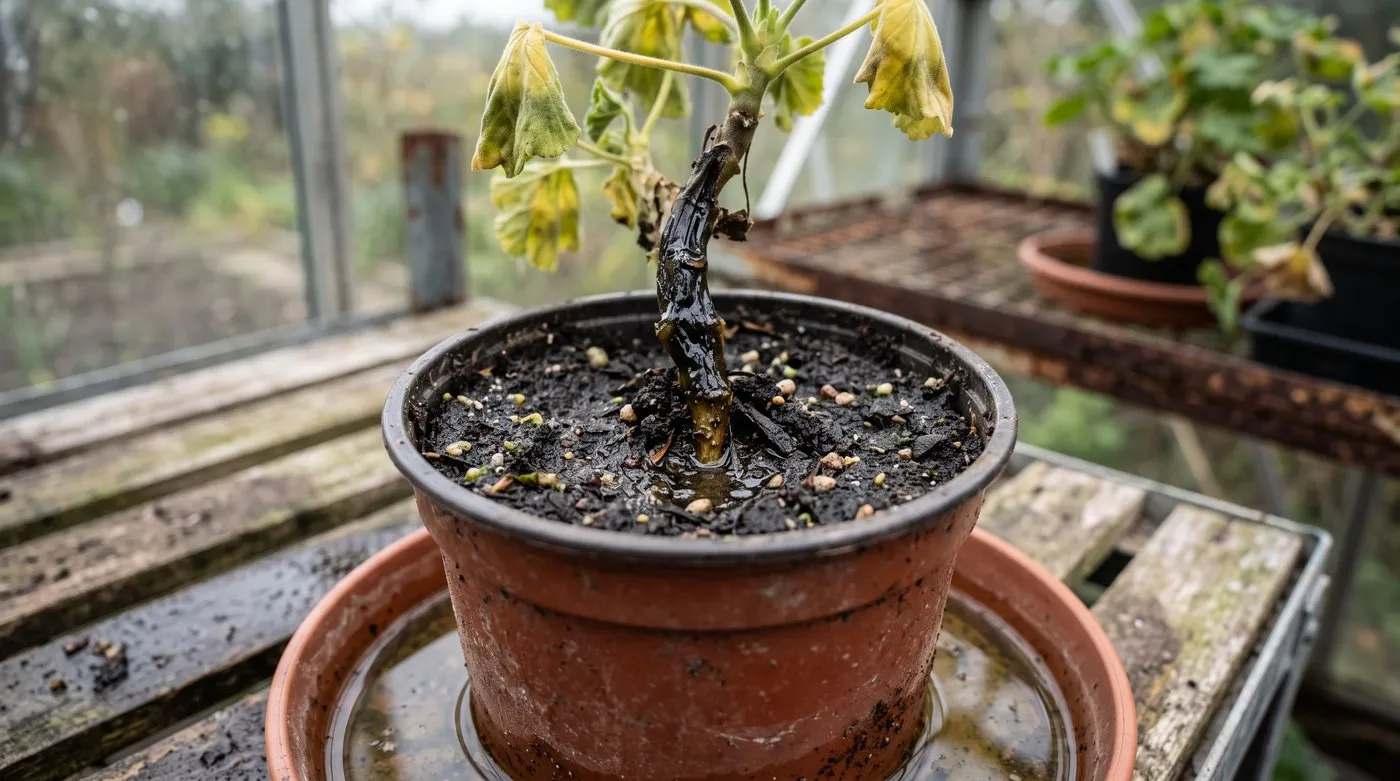
A black, soft stem base is blackleg, and it can’t be cured. Free-draining compost and letting it dry between drinks is the best prevention.
Feeding and watering pelargoniums
Pelargoniums are tough in a dry spell. They come from dry parts of South Africa, and too much water kills more of them than any pest.
Watering tips:
- Water only when the top 3cm of compost feels dry
- In beds, established plants rarely need watering except in long dry spells
- In pots, water until it runs out of the bottom, then let it dry before watering again
- In July and August, pots may need water every day
- Don’t leave pots standing in saucers of water
Feeding tips:
- April to May: a balanced liquid feed every two weeks
- June to September: a tomato feed every two weeks
- July to August: pots can have a weekly feed while they’re flowering hard
- October to March: no feed
A tomato feed is rich in potash, which means more flowers and sturdier stems. Feeds high in nitrogen give you floppy leaves and fewer flowers. It’s the same idea as feeding other summer flowers.
Growing pelargoniums in containers
Pelargoniums are some of the best plants for pots in UK gardens. They’re happy in anything from a small windowsill pot to a big patio container or hanging basket.
What they need in a pot:
- Size: At least 15cm across for one zonal, and 30cm for a mixed display
- Material: Terracotta is ideal, as it dries out between drinks. Plastic works too, just water a little less
- Drainage: Make sure there are holes in the bottom
- Compost: Peat-free multipurpose mixed with some perlite or grit
Window box idea: Put an upright zonal in the middle, a trailing ivy-leaved at each end, and fill the gaps with scented-leaf types. You get height, trailing colour and a lovely smell from one box. Use a box at least 20cm deep and 60cm long.
Hanging basket idea: Plant three ivy-leaved pelargoniums in a 35cm basket, through the sides as well as the top, for a ball of colour. Line it with a coir liner. ‘Balcon’ types cope well with the wind baskets get.
On a balcony, pelargoniums really shine. They put up with wind, dry spells and the heat bouncing off walls and railings.
Now you know how to grow pelargoniums from cuttings right through winter, read our guide on how to sow seeds indoors to raise your own from seed next January.
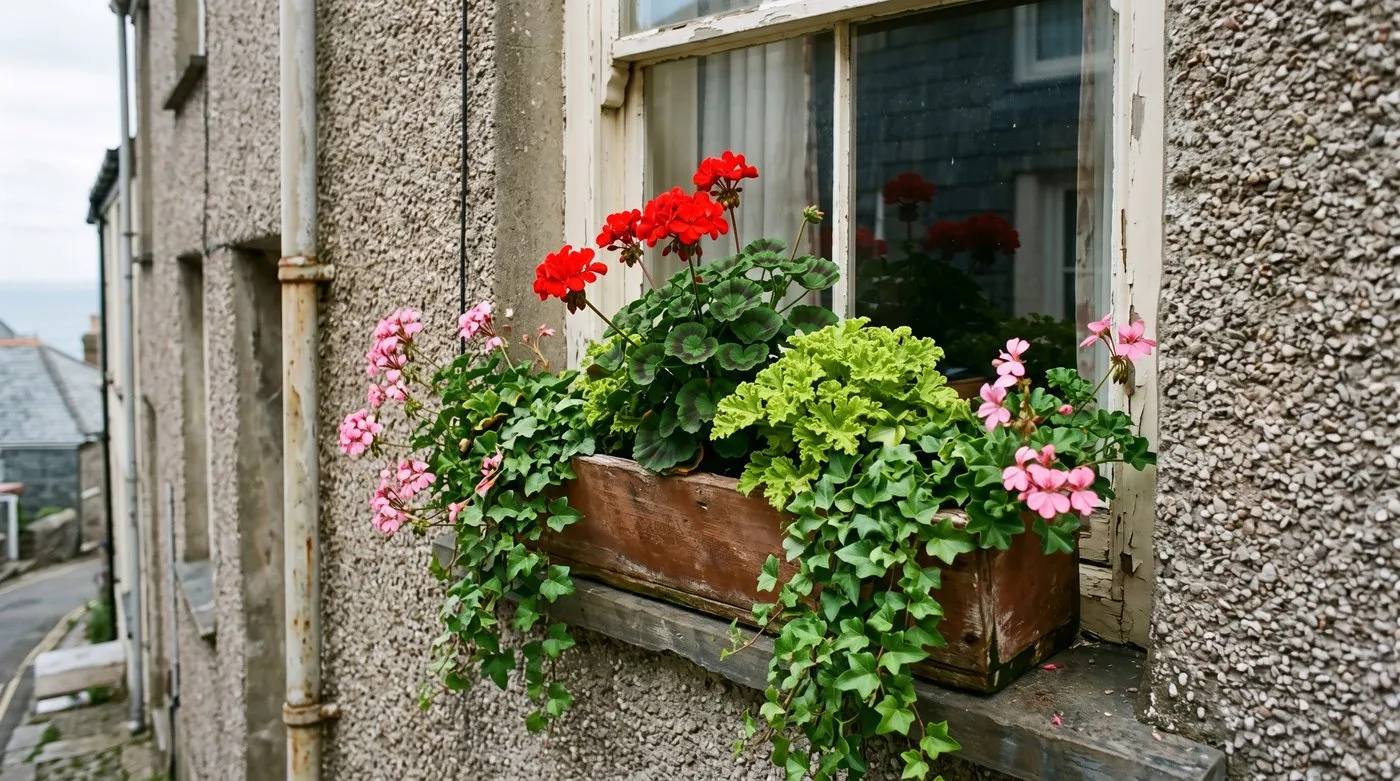
An upright zonal in the middle, trailers at each end and scented types in the gaps gives height, spill and scent. Ivy-leaved types cope with wind well.
Frequently asked questions
Are pelargoniums the same as geraniums?
No, they’re different plants in the same family. The “geraniums” sold for bedding and pots are really pelargoniums, which come from South Africa and are killed by frost. True geraniums, also called cranesbills, are hardy perennials for borders. An easy way to tell them apart is the flowers. Pelargonium petals are uneven, while true geranium petals are all the same.
When should I plant pelargoniums outside in the UK?
After the last frost, usually late May. In southern England, mid-May is often safe. In the Midlands and the north, wait until late May or early June. In Scotland, early to mid-June is safest. Harden them off for a week to ten days first.
How do I overwinter pelargoniums in the UK?
Bring them in before the first frost, usually October. Cut the stems back to 15cm, remove dead leaves and check for pests. Keep them somewhere bright and frost-free at 5-10C, such as a greenhouse, porch or cool windowsill. Water only every two or three weeks. Start watering and feeding again in spring when new growth appears.
Can you grow pelargoniums from seed in the UK?
Yes, sow indoors from January to March. Use modules of seed compost, cover lightly with vermiculite and keep them warm, ideally in a heated propagator at around 20C. Prick out when the first true leaves appear. F1 zonal varieties give the most even results from seed.
Why are my pelargonium leaves turning yellow?
Too much water is the usual cause. Let the compost dry between drinks and make sure the pot has drainage holes. Hunger, a pot full of roots or a chill can also turn leaves yellow. Yellow spots with brown dusty patches underneath are a sign of pelargonium rust.
How often should I feed pelargoniums?
Every two weeks from May to September. A tomato feed works well, as it’s rich in potash and boosts flowers. Avoid feeds high in nitrogen, which give you leaves instead of flowers. Pots can have a weekly feed in July and August. Stop feeding over winter.
Do pelargoniums come back every year in the UK?
Not if left outside, as frost kills them. Bring them indoors for winter, though, and they’ll come back year after year and get bigger and better. Many gardeners keep the same plants going for years, topping them up with cuttings.
Our team produces practical UK gardening guidance from source research, contributor records and established horticultural practice. Editorial standards are overseen by Matt W.


