Key takeaways
- Pick at least one scented plant for each season
- Sweet box, daphne and witch hazel bring scent in winter when you least expect it
- Lavender Hidcote and Rosa Gertrude Jekyll are reliable summer choices
- Plant fragrant plants by paths, doors and seats so you actually smell them
- Nicotiana and night-scented stock are lovely by a patio on summer evenings
Colour catches your eye, but scent is what makes you stop and breathe in. A fragrant plant by the door can lift the gloomiest day. The good news is that some of the world’s loveliest scented plants grow happily in British gardens.
For one of the richest indoor scents of all, see our guide to growing gardenia in the UK.
With a little planning you can have scent every month of the year. Start with honey-sweet Daphne in February and finish with the old rose perfume of Gertrude Jekyll in July and beyond.
The best scented plants by season
Winter scent (December to February)
Winter scent is the biggest treat because you don’t expect it. One sweet box by the front door brightens the dullest month.
Sarcococca confusa (sweet box): The best winter scented plant for UK gardens. Tiny white flowers from December to February smell of honey and vanilla. Evergreen, happy in shade and any soil, and grows to 1-1.5m. Plant it by a door or path and you’ll smell it every time you pass.
Daphne bholua Jacqueline Postill: One of the finest scents of any garden plant. Pink and white flowers from January to March smell of citrus and spice. Semi-evergreen, 2-3m tall. Give it well-drained soil and shelter from cold wind. It’s worth the effort.
Hamamelis (witch hazel): Spidery yellow or copper flowers on bare branches from January to March. The scent is sweet and gentle, so you need to get close. In a sheltered corner it builds up nicely. It prefers acid to neutral soil.
For another shrub that flowers on bare winter wood, try wintersweet for winter scent. It has waxy yellow flowers with a spicy fragrance that hangs on still December air.
Spring scent (March to May)
Clematis armandii: An evergreen climber with vanilla-scented white flowers in early spring. Grow it on a sheltered sunny wall, away from cold north winds.
Osmanthus x burkwoodii: Masses of small white flowers in April with a sweet, jasmine-like scent. Evergreen, dense and 2-3m tall. Good as a hedge or on its own. Far too few gardens grow it.
Viburnum carlesii: Rounded clusters of pink-white flowers in April that smell of cloves and vanilla. Deciduous, 1.5-2m tall. A classic cottage garden shrub.
Hyacinths: The strongest-scented spring bulb. Plant in October for April flowers. One pot on a patio table scents the whole seating area. Blue varieties such as Delft Blue and Blue Jacket tend to smell strongest.
Summer scent (June to September)
Lavender Hidcote: The classic English lavender. Dense purple spikes in July and August with a clean, fresh scent. Compact at 40-60cm. Needs full sun and well-drained soil. Plant it along a path so you brush against it as you walk.
Philadelphus (mock orange): Clouds of white blossom in June and July with a strong orange-blossom scent. Deciduous, 2-3m tall. One of the most fragrant shrubs you can grow. Belle Etoile is a good choice for smaller gardens.
Jasmine (Jasminum officinale): The classic summer evening scent. White flowers from June to September on vigorous twining stems. Grow it on a trellis, fence or wall. It smells strongest in the evening, so it’s perfect by a patio or seat.
Autumn scent (October to November)
Osmanthus heterophyllus: Small white flowers in autumn with a sweet scent. Evergreen with holly-like leaves, 2-3m tall. The scent carries well in still, damp autumn air. Pair it with an evergreen climber on a nearby wall for year-round green.
| Plant | Scent season | Height | Light | Soil | Scent |
|---|---|---|---|---|---|
| Sarcococca confusa | Dec-Feb | 1-1.5m | Shade or part shade | Any | Strong |
| Daphne bholua | Jan-Mar | 2-3m | Part shade | Well-drained | Very strong |
| Osmanthus burkwoodii | Apr | 2-3m | Sun or part shade | Any | Strong |
| Rosa Gertrude Jekyll | Jun-Sep | 1.2m | Full sun | Rich, moist | Very strong |
| Lavender Hidcote | Jul-Aug | 40-60cm | Full sun | Well-drained | Strong when brushed |
| Philadelphus Belle Etoile | Jun-Jul | 2-3m | Sun or part shade | Any | Very strong |
| Jasmine | Jun-Sep | 3-5m (climber) | Full sun | Any | Strong, best in the evening |
| Osmanthus heterophyllus | Autumn | 2-3m | Sun or part shade | Any | Gentle |

Daphne bholua Jacqueline Postill in February. Plant it by a path you use every day so you don’t miss the scent.
Designing a scented garden
Where to put scented plants
Scent is wasted if it drifts off unnoticed. The golden rule is to plant fragrant plants where people actually spend time.
Doorways: Sweet box, daphne and osmanthus look great either side of a front door. You smell them every time you come and go.
Path edges: Lavender, thyme and catmint along a path release their scent when you brush past. That’s more reliable than scent on the breeze, as it doesn’t depend on the wind.
Seats and patios: Jasmine, honeysuckle and evening-scented plants near a patio or bench. Still air in a sheltered corner holds the scent longer.
Below windows: Train climbing roses, jasmine or wisteria under windows you open in summer. The scent drifts indoors on warm evenings.
Shelter helps scent build up
Scent needs still air to build up. In an open, windy garden it blows away before you notice. Hedges, walls and fences make sheltered pockets where scent can gather.
A sunny, south-facing corner between two walls is perfect. The walls hold the warmth and keep the wind off.

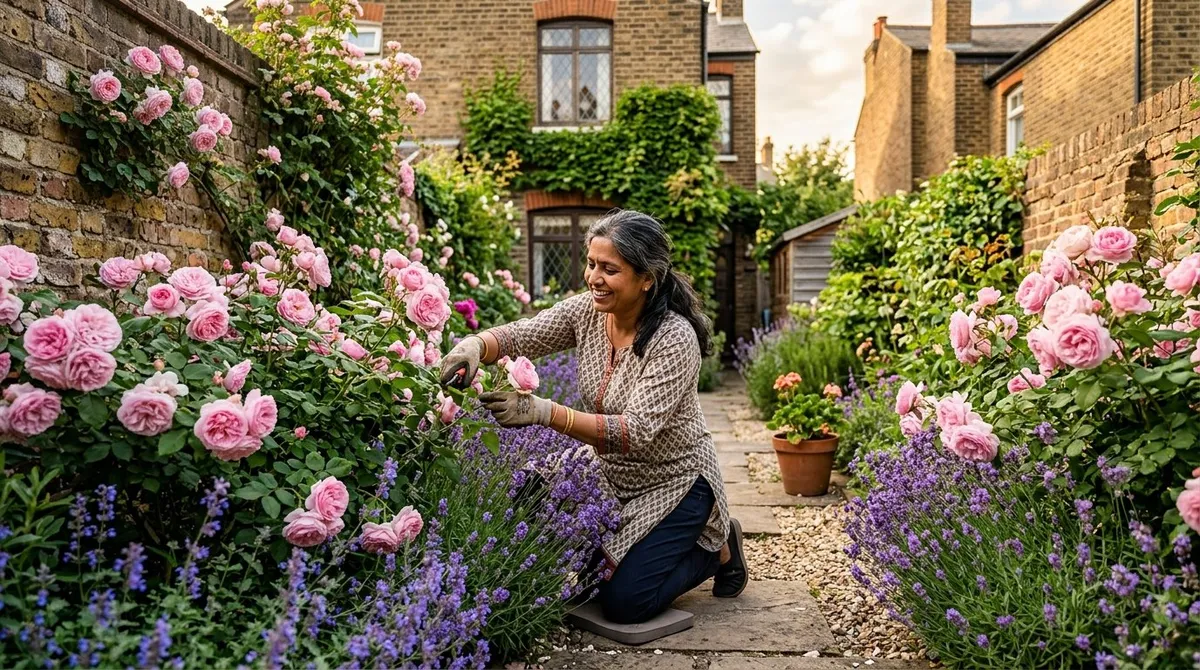
Lavender Hidcote and Rosa Gertrude Jekyll along a path. Brush the lavender as you pass and enjoy the rose on warm summer air.
Evening and night-scented plants
Summer evenings on the patio are when scent matters most. Some plants smell stronger after dark to attract night-flying moths. Give them a spot near your outdoor seating. Evening primrose is a good example, as its flowers open at dusk.
Nicotiana sylvestris (tobacco plant): Tall white trumpets that open at dusk with a sweet perfume. Annual, 1.5m tall. Sow under cover in March and plant out in May.
Night-scented stock (Matthiola longipetala): Plain little lilac flowers that close in the day and open at dusk with a strong clove scent. Annual, 30cm tall. Sow straight into the ground in April near where you sit.
Honeysuckle (Lonicera periclymenum): Our native honeysuckle smells much stronger in the evening. Train it on a trellis or fence near the patio.
Evening primrose (Oenothera biennis): Yellow flowers that open in the evening with a light lemony scent. Biennial, 1m tall. It seeds itself around once settled.
Scented plants for tricky spots
Shade
Sweet box, lily of the valley and Daphne laureola all smell lovely in partial shade. They like dappled woodland conditions better than full sun.
Clay soil
Most scented shrubs cope with clay soil as long as it drains reasonably. Mock orange, viburnum, roses and osmanthus all do well. Lavender and daphne need help. Add grit to the planting hole so they don’t sit wet in winter.
Containers
Lavender, jasmine, Daphne odora and scented-leaf pelargoniums grow well in 40cm containers. Put the pots where you sit. A small balcony or courtyard actually helps by trapping the scent. Under glass, freesias bring a gorgeous scent to pots too.

Nicotiana sylvestris and jasmine by a patio. Both smell stronger after dark, which makes summer evenings outside a real treat.
Frequently asked questions
What is the most fragrant plant for a UK garden?
Rosa ‘Gertrude Jekyll’ is one of the most fragrant shrub roses. It has a rich old rose scent and flowers again and again from June into autumn. It grows to about 1.2m in most fertile, well-drained soils. Plant it by a path or seat. Sweet peas, lilies and daphne are also beautifully fragrant.
What plants smell nice all year round UK?
No single plant does it, so mix a few that flower at different times. Sweet box scents the garden in winter, with Daphne odora following in late winter. Mock orange flowers in early summer and roses carry on from June into autumn. Osmanthus heterophyllus adds scent in autumn.
What is the best scented plant for winter UK?
Sarcococca confusa, also called sweet box or Christmas box, is the best. Its tiny white flowers appear from December to February with a strong honey and vanilla scent. It’s a compact evergreen that’s happy in shade and most soils. Plant it by a door or path you use in winter.
Where should I plant scented plants?
Plant them close to where people walk, sit or stand. Doorways, paths, benches and under windows that open in summer are all good spots. Wind blows scent away, so sheltered corners hold it better. Raised beds and pots bring low plants closer to your nose. Put evening-scented plants by a patio you use after dark.
What are the best scented climbers for UK gardens?
Common jasmine and honeysuckle are the best for most UK gardens. Jasmine scents the air in summer, while honeysuckle smells strongest in the evening. Star jasmine suits a sheltered, sunny wall. Climbing roses add scent too. Train them over an arch or near a seat.
Do scented plants need full sun?
Many smell strongest in full sun, because warmth brings out their scent. Lavender, roses and rosemary all like a sunny spot. Some lovely scented plants are happy in shade though. Sweet box, lily of the valley and many daphnes all do well in part shade. Match each plant to the light you have.
What scented plants grow well in pots UK?
Lavender, jasmine, Daphne odora and scented-leaf pelargoniums all do well in pots. Use pots around 40cm across for shrubs and climbers. Fill them with well-drained compost and make sure there are drainage holes. A sheltered spot helps trap the scent. Bring pelargoniums indoors before the first frost, as they aren’t hardy.
Related reading
- How to grow lavender UK
- How to grow roses UK
- Best plants for shade UK
- Cottage garden planting plan
- Fast growing climbers for fences and walls UK
Many of these scented plants also shine in a moon garden planned for evening use.
Our team produces practical UK gardening guidance from source research, contributor records and established horticultural practice. Editorial standards are overseen by Matt W.