Key takeaways
- Clematis montana is the best fast climber that stays manageable
- Russian vine is the fastest of all, but it's a thug that's very hard to get rid of
- Ivy, star jasmine and Clematis armandii give green cover all year
- Annual climbers like sweet peas cover a fence in a single summer
- Plant about 45cm out from the fence, where the soil gets rain
A fast climber can turn a bare fence into a green screen surprisingly quickly. Clematis montana covers a fence panel in a couple of years, and annual sweet peas do it in a single summer. A planted fence looks better, gives more privacy and brings in wildlife too. Here’s how to pick the right climber and get it going.
How fast do climbing plants actually grow?
Speed depends on the plant, the spot and how well it’s settled in. Most perennial climbers are slowish in their first year while they make roots, then take off. Annual climbers do all their growing in one season from a spring sowing.
| Climber | Speed | Evergreen? | Good for |
|---|---|---|---|
| Russian vine | Very fast (too fast) | No | Huge spaces only |
| Clematis montana | Very fast | No | Covering a fence quickly |
| Common hop | Fast, dies back each winter | No | Summer screening |
| Honeysuckle | Fast | No | Scent and wildlife |
| Ivy | Fast once settled | Yes | Shade and winter cover |
| Star jasmine | Slow at first | Yes | Scent on a sunny wall |
| Sweet peas | Fast, one season | No | Instant summer colour |
Which are the fastest growing climbers overall?
The three fastest perennial climbers are Russian vine, Clematis montana and common hop. All cover a lot of ground, but they’re very different to live with.
Russian vine (Fallopia baldschuanica) is so quick it’s nicknamed “mile-a-minute”. It has clouds of white flowers from July to October. It’s also a nightmare to control, so only plant it where you’ve got a really big space to fill and nothing nearby for it to smother. Getting rid of an old one means cutting it to the ground and dealing with regrowth for a few seasons.
Clematis montana covers a 3m fence in about two seasons and smothers itself in pink or white flowers in May. Unlike Russian vine, it stays manageable with a trim after flowering. ‘Elizabeth’ (soft pink, scented) and ‘Grandiflora’ (pure white) are easy to find. Our clematis growing guide explains the pruning groups.
Common hop (Humulus lupulus) dies right back each winter and shoots up again to about 3-4m by midsummer. The golden ‘Aureus’ has lime-green leaves that glow in the sun. Give it strong support, as the stems get heavy with papery hop flowers in late summer.
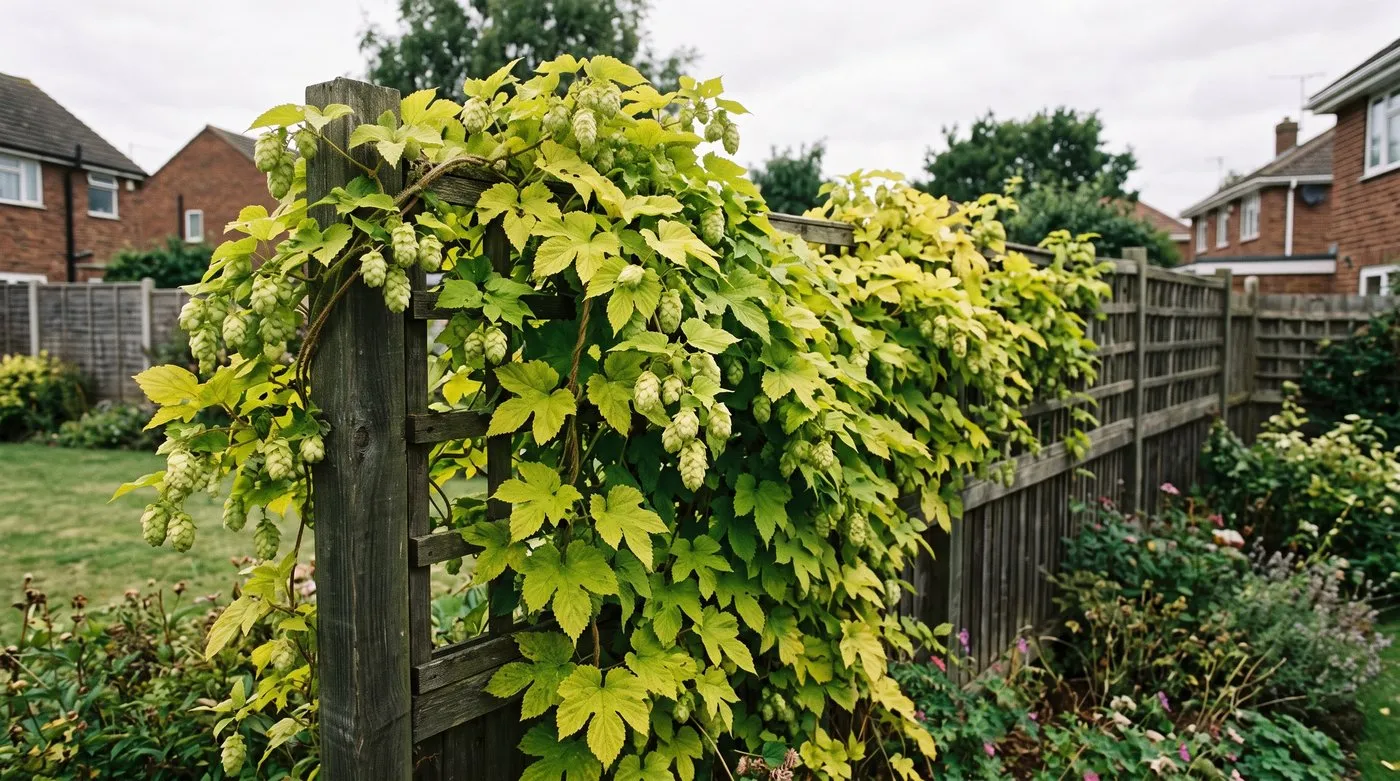
Golden hop dies right back each winter, then races up to about 3-4m by midsummer. Give it strong support, as the stems get heavy with hop flowers.
What are the best evergreen climbers for year-round fence screening?
Deciduous climbers leave fences bare from November to March. For winter privacy, choose an evergreen. These three are the best for UK gardens.
Common ivy (Hedera helix) is the fastest evergreen climber. It copes with any aspect, even deep shade, and clings on by itself. It’s great for wildlife: birds and insects shelter in it all winter, and its autumn flowers are one of the last meals of the year for bees. ‘Sulphur Heart’ and ‘Goldchild’ have prettier variegated leaves. Trim it in spring and late summer to keep it neat, checking first for nesting birds.
Star jasmine (Trachelospermum jasminoides) has glossy dark leaves and beautifully scented white flowers in summer. It’s slower than ivy but gets to about 6m in time. Give it a sheltered south or west wall. In colder areas, grow it in a big pot you can move somewhere sheltered in a hard frost. Our jasmine growing guide has the full care notes.
Clematis armandii is the evergreen clematis. It flowers in March with clusters of vanilla-scented white flowers against long, leathery leaves. It grows quickly to 5-6m. Give it a sheltered, sunny wall away from cold east winds. ‘Apple Blossom’ has pink-tinged buds that open white.
Which climbing plants flower best on fences and walls?
Flowering climbers bring colour, scent and bees to your walls. The best choice depends on which way your wall faces and when you want the show.
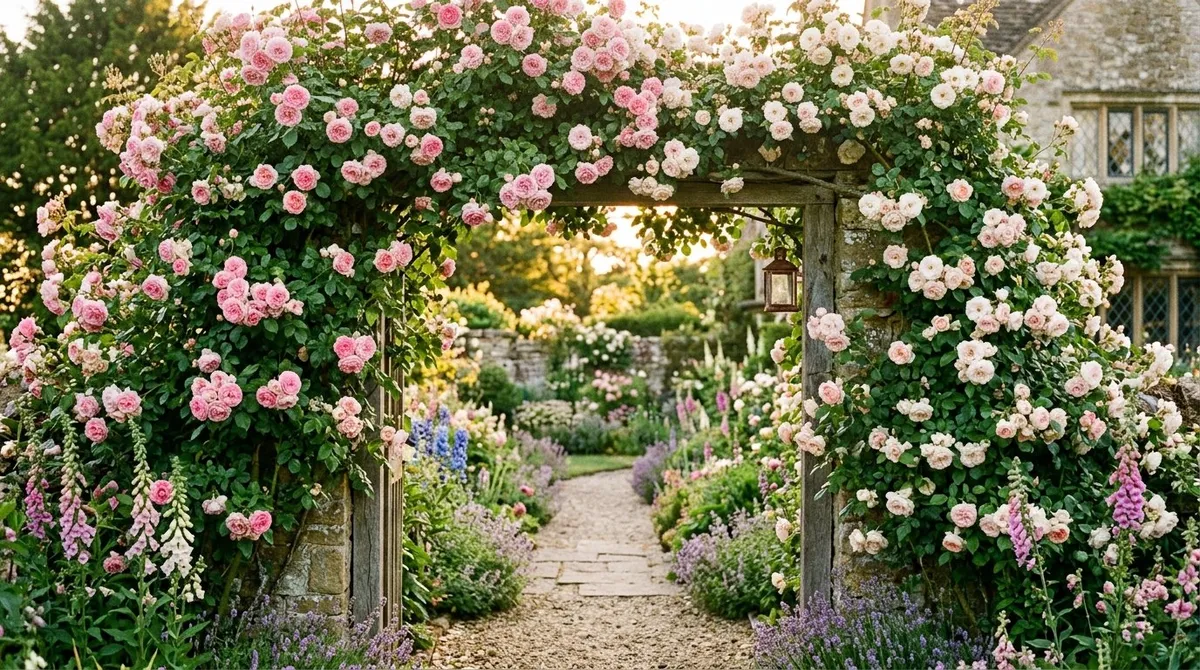
Climbing roses are the classic for sunny walls and fences. Good choices are ‘Madame Alfred Carriere’ (white, copes with some shade), ‘New Dawn’ (soft pink) and ‘Compassion’ (salmon-orange, very fragrant). Ramblers flower once in early summer, while many climbers repeat into autumn. Tie new stems in sideways to get more flowering side shoots. Our rose growing guide covers pruning and training.
Honeysuckle (Lonicera periclymenum) is a native climber whose evening scent from June to September is pure English summer. Moths love it. ‘Graham Thomas’ (cream and yellow) and ‘Belgica’ (pink and cream) are both excellent. It’s happy in part shade and perfect for cottage garden planting plans.
Passion flower (Passiflora caerulea) is tougher than it looks and does well on a sheltered wall in much of England. It has exotic blue and white flowers from July to September, and sometimes orange fruit in a warm year. Give it sun and free-draining soil, and mulch the base thickly in late autumn.
Wisteria grows steadily and eventually gets very big. Its cascades of flowers in May are one of the great sights of a British garden. It can take a few years to flower, so buy a grafted plant, ideally one already in flower. It needs pruning twice a year, as our wisteria pruning guide explains.
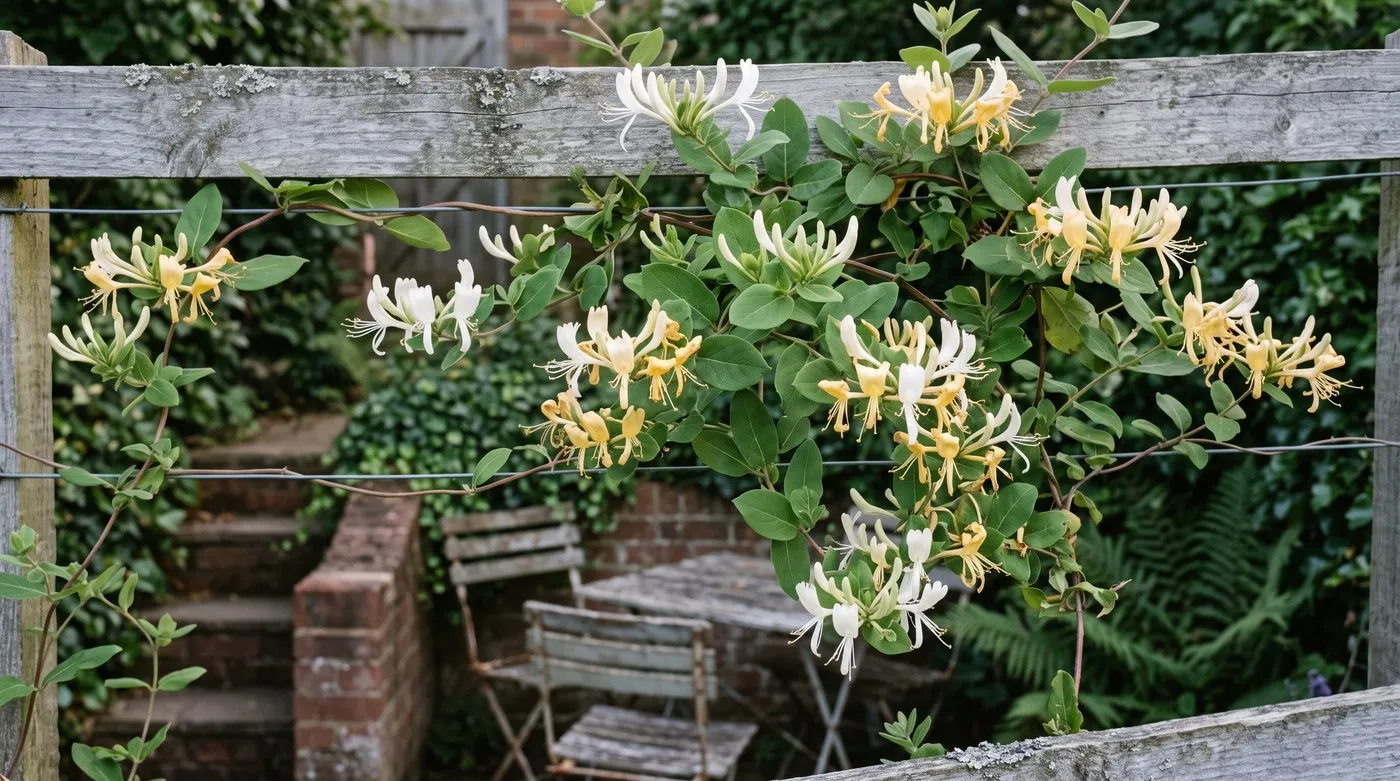
Native honeysuckle is happy in part shade, and its evening scent from June to September brings in moths. Plant it near where you sit after work.
What annual climbers give the fastest cover?
Annual climbers grow, flower and finish in one season. They’re perfect for instant screening, filling gaps while permanent climbers settle in, or dressing up an obelisk.
Sweet peas (Lathyrus odoratus) climb 2-3m and flower from June to September if you keep picking. Give them pea sticks, netting or strings. Sow in deep pots or root trainers in October or March. Pinch out the tip when plants are about 15cm tall to make them bushy. Our sweet pea growing guide has the full how-to.
Morning glory (Ipomoea purpurea) has trumpet flowers in bright blue, purple and pink. Each flower lasts a day, but new ones keep coming from July to October. Sow indoors in April, nicking the seed coat and soaking overnight first, and plant out after the last frost. It needs full sun and a warm wall. ‘Heavenly Blue’ is the favourite.
Black-eyed Susan vine (Thunbergia alata) climbs about 1.5-2m with cheery orange or yellow flowers with dark centres from July. It twines happily up string. Sow indoors in March. Great in a big pot with a small obelisk.
Climbing nasturtium (Tropaeolum majus) scrambles 1-2m with bright orange and red edible flowers. Sow straight into the ground in May. It flowers best on poor soil. Blackfly love it, so it’s handy as a decoy near broad beans.
For the quickest annual cover of all, try the cup-and-saucer vine (Cobaea scandens). It climbs 3-5m in one season, with bell flowers that open cream and turn deep purple, from July until the first frost.
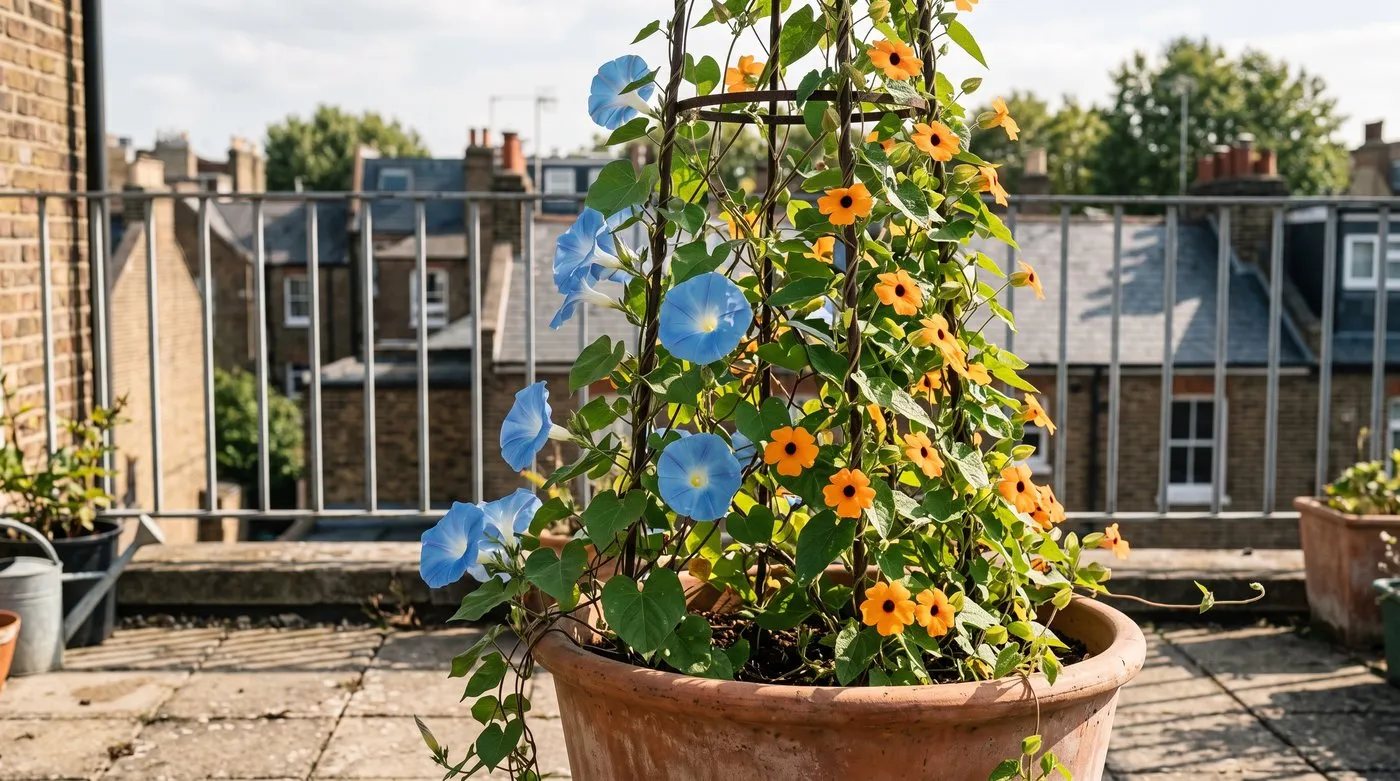
Annual climbers grow, flower and finish in one season. Morning glory and black-eyed Susan vine both need full sun, and are happy twining up a pot obelisk.
How do climbing plants climb: self-clinging vs twining vs support needed?
How a climber holds on tells you what support it needs. There are four types.
Self-clinging climbers stick to surfaces with tiny roots (ivy, climbing hydrangea) or sticky pads (Virginia creeper). They need no supports and are ideal for big walls. On old houses with soft lime mortar, the roots can get into cracks. On sound brick, render or stone they rarely cause damage, and the RHS explains that climbers can even help protect walls from the weather.
Twining climbers wrap their stems around supports. Honeysuckle, wisteria and hop all twine. Give them wires, poles or trellis that are thin enough for the stems to wrap round. Wisteria gets very thick and heavy, so it needs the strongest support of all.
Tendril climbers hold on with thin, curly tendrils or leaf stalks. Clematis, sweet peas and passion flower climb this way. They grip thin supports best, like mesh, netting, wire or other plants, and can’t hold on to thick posts or flat surfaces.
Scramblers, like climbing roses, don’t hold on at all. Tie them to wires, trellis or a pergola. Fan the stems out and train them sideways where you can to get more flowers.
What support systems work best for climbers?
The right support depends on the climber and the surface. Here are the usual options.
| Support | Best for | How long it lasts |
|---|---|---|
| Galvanised wire and vine eyes | Twiners and tendril climbers on walls and fences | Decades |
| Stainless steel wire kit | Wisteria and other heavy climbers | Decades |
| Timber trellis | Clematis, roses, lighter climbers | Many years |
| Willow or hazel obelisk | Sweet peas, clematis in borders | A few years |
| Netting or string | Annual climbers | One season |
| Metal wall trellis | Roses, wisteria | Decades |
Wires are the best-value permanent option. Screw vine eyes into fence posts or masonry, thread galvanised wire through and tighten it with a straining bolt at one end. It’s almost invisible and lasts for years. Space wires about 30cm apart for clematis and 45cm for roses and honeysuckle.
Trellis panels suit fence tops and freestanding screens. Fix them a few centimetres out from the fence on spacer blocks so air can flow behind the plant. Hinged trellis lets you fold the climber away when you need to paint the fence.
For more ideas on using climbers in your fence design, including living fences and fence colours that suit flowering climbers, see our fence ideas guide.
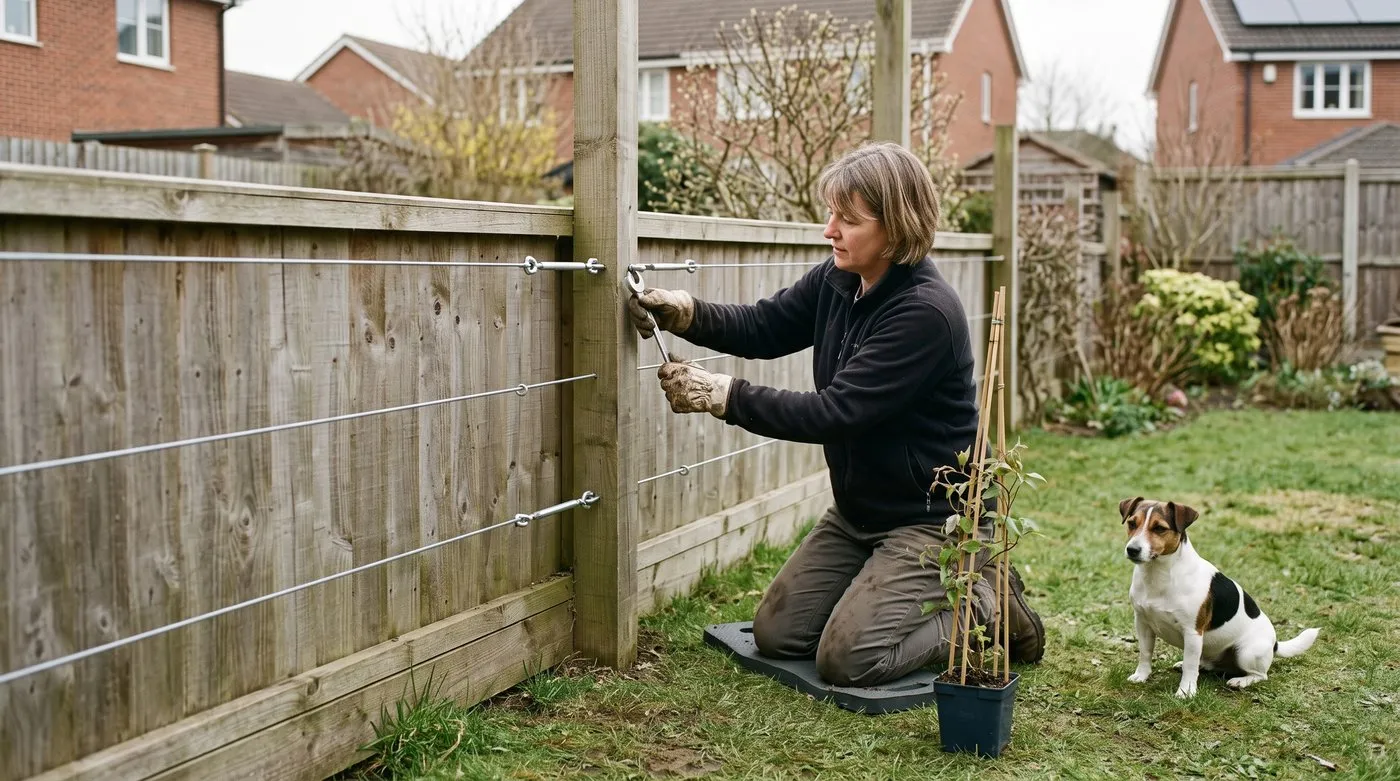
Wires on vine eyes are the best-value permanent support. Space them about 30cm apart for clematis and 45cm for roses and honeysuckle.
How do I plant a climber against a fence or wall?
Plant it well and a climber will settle in one season. Plant it badly and it can sulk for years.
Distance: Dig the hole about 45cm out from the wall or fence. The soil right at the base stays dry even in heavy rain. From 45cm out, the roots find moisture and the stems can lean back towards the support.
Hole: Make it at least twice as wide as the root ball and as deep. Fork over the bottom, especially on clay, and mix the soil with a bucket of garden compost or well-rotted manure.
Depth: Plant most climbers at the same level they were in the pot. Clematis is the exception: plant it a little deeper, about 5-10cm, so it can regrow from below if wilt strikes. Our clematis guide has more.
Water and mulch: Water really well after planting, then spread a thick mulch of bark or compost around the base, keeping it off the stems. Water weekly through the first summer even if it rains, as the ground by fences and walls stays dry.
Tie in: Tie stems to the lowest wire with soft twine in a figure of eight, so the tie doesn’t cut in as the stem thickens. Check ties every spring.
Which climbers suit a north-facing wall or fence?
Climbing hydrangea (Hydrangea anomala subsp. petiolaris) is the star of north walls. It clings by itself, has big white lacecap flowers in early summer and peeling bark in winter. It’s slow for the first couple of years, then speeds up. It needs no pruning beyond taking out dead wood. Our hydrangea guide covers this one too.
Ivy copes with deeper shade than any other climber. On a north fence where nothing else grows, ivy will. For a brighter look, try Persian ivy (Hedera colchica ‘Dentata Variegata’).
Winter jasmine (Jasminum nudiflorum) is really a wall shrub, but trained on wires it covers a north wall nicely. Bright yellow flowers appear on bare green stems from December to March, just when you need cheering up.
Virginia creeper (Parthenocissus quinquefolia) is happy on a north wall and gives its best crimson autumn colour in cooler spots. It clings by itself with sticky pads.
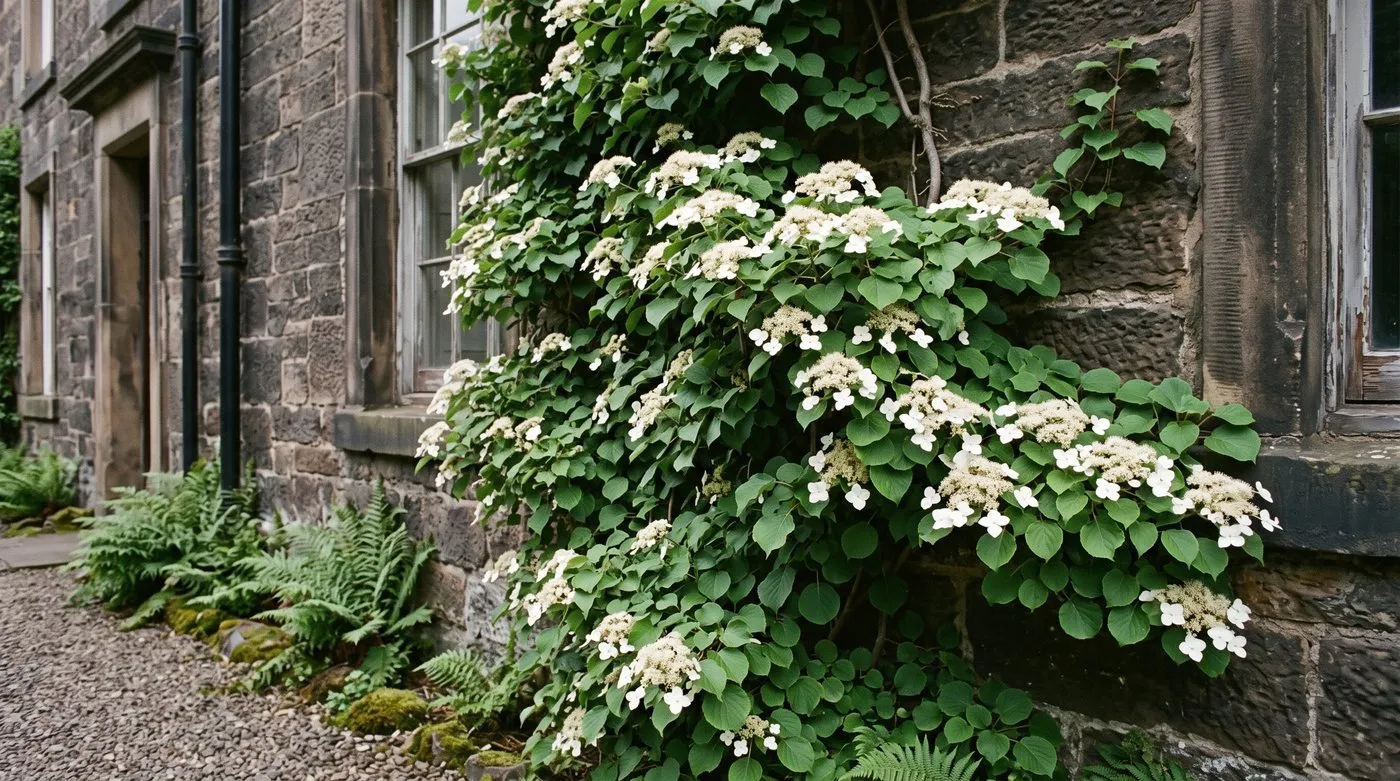
Climbing hydrangea is slow for the first couple of years, then speeds up. It clings by itself and flowers well even on a north wall.
Which climbers suit a south or west-facing wall?
Warm walls suit wisteria, climbing roses, summer jasmine, passion flower, star jasmine and grape vines. The extra warmth means more flowers, stronger scent and riper fruit.
Grape vines are brilliant on a south wall. Outdoor varieties like ‘Boskoop Glory’ (black, for eating) and ‘Phoenix’ (white, for wine) ripen against a south wall in much of England. Their big leaves give lovely shade over a patio or pergola. See our grape vine growing guide for varieties and pruning.
Chilean glory vine (Eccremocarpus scaber) is a half-hardy climber that races up 2-3m in a season, with tubular orange-red flowers from June to October. In mild areas it comes back each year. Elsewhere, treat it as an annual or mulch the base heavily in autumn.
How do I maintain and prune climbing plants?
Pruning keeps climbers flowering, healthy and in their space. When to prune depends on when they flower, because pruning at the wrong time cuts off the flower buds.
Spring flowerers: prune after flowering. Clematis montana, Clematis armandii and winter jasmine flower on last year’s stems, so prune them as soon as the flowers fade. Wisteria is the exception, with a summer prune in July and a winter prune in January.
Summer jasmine: prune after flowering too. Thin out the stems that have flowered once the show is over, taking a few of the oldest right down.
Late flowerers: prune in late winter. Late-flowering (Group 3) clematis such as Clematis viticella flower on this year’s growth. Cut them back hard in February to about 30cm from the ground. Trim passion flower back to a strong framework of main stems in early spring.
Tie in. Check all climbers in spring and midsummer. Wind pulls stems away from their supports, and new growth needs guiding into the gaps.
Feed once a year. Scatter a general fertiliser around the base in March, following the pack. Climbing roses like a rose feed. Mulch afterwards to keep moisture in.
Keep an eye out for pests and problems. Clematis wilt affects large-flowered hybrids. Aphids can twist honeysuckle shoot tips in summer, and a strong jet of water knocks them off. Climbing roses get the same blackspot, rust and aphids as bush roses, and our rose growing guide covers what to do.
Which climbing plants should I avoid?
Not every fast climber is a good idea. Some cause more trouble than they’re worth within a few years.
Russian vine (Fallopia baldschuanica) is the fastest climber you can buy, and that’s the problem. It smothers gutters, lifts roof tiles, swamps nearby plants and regrows from any bit of root left behind. It’s a relative of Japanese knotweed and shares some of its thuggish vigour. Only plant it where there’s an enormous space and nothing nearby to smother.
Japanese honeysuckle (Lonicera japonica) is evergreen and very vigorous, and can quickly get out of hand. Our native woodbine (Lonicera periclymenum) is a better choice. It’s easier to manage and better for UK wildlife.
Mile-a-minute weed (Persicaria perfoliata) is listed as an invasive non-native species. Don’t plant it.
Wisteria on a weak structure. Old wisteria stems get very thick and heavy and can pull down a timber fence or flimsy pergola. Only grow it on sound brickwork or a sturdy pergola built to take the weight.
What climbers work in pots and containers?
No soil at the bottom of your fence? Climbers in pots work well on patios, balconies and in courtyard gardens.
Use a big pot, at least 40 litres, with drainage holes. Fill it with a loam-based compost like John Innes No. 3 with some perlite mixed in for drainage. Water every day in summer, as pots against walls dry out fast.
Good climbers for pots: late-flowering clematis that you cut back each year, star jasmine, passion flower, sweet peas and compact climbing roses like ‘Warm Welcome’. Feed every two weeks from April to August with tomato feed. Repot every few years, or top up with fresh compost each spring.

Star jasmine on wires against a sunny brick wall. Evergreen leaves, and scented white flowers from June.

Sweet peas climb 2-3m in a single season and fill the garden with scent from June.
Frequently asked questions
What is the fastest growing climbing plant in the UK?
Russian vine is the fastest, but it’s a thug. It quickly gets out of hand and swallows everything nearby. Clematis montana is the fastest climber that stays manageable, covering a fence in a couple of years. For speed in one summer, sweet peas and morning glory climb 2-3m from seed.
What climbing plants grow well on a north-facing fence?
Climbing hydrangea, ivy and winter jasmine all do well on a north fence. Climbing hydrangea clings by itself and flowers well in shade. Ivy gives evergreen cover, and winter jasmine flowers from December to March. Virginia creeper colours up beautifully on a cool north wall. Avoid sun-lovers like wisteria and passion flower here.
Will climbing plants damage my fence panels?
Twining and tendril climbers won’t damage your fence. Clematis, honeysuckle and jasmine hold on to wires or trellis, not the fence itself. Ivy can push between overlapping panels over time, so keep it off wooden fences. On brick, self-clingers rarely harm sound mortar but can make crumbling old mortar worse.
How do I support climbing plants on a fence?
Fix horizontal galvanised wires 30-45cm apart on vine eyes. This is cheap, almost invisible and lasts for years. Trellis panels look more decorative. For annual climbers, netting or string is fine for a season. Leave a small gap between the support and the fence so air can get through.
When should I plant climbing plants in the UK?
October to March is best for bare-root climbers. Pot-grown climbers can go in at any time, but autumn gives roots a head start before spring. Sow annual climbers indoors in March or April and plant them out after the last frost in late May. Don’t plant into frozen or waterlogged ground.
What is the best evergreen climber for screening in the UK?
Common ivy is the toughest and quickest evergreen for screening. It grows on any aspect, even full shade, and needs no support. Star jasmine is a prettier choice with scented flowers, but it needs wires and a warm, sheltered wall. Clematis armandii flowers in March with vanilla-scented blooms and likes a south or west wall.
How far from a wall should I plant a climber?
About 45cm out from the wall or fence. The ground right at the base stays dry because the wall keeps off the rain. Planting further out lets the roots get water. Lean the root ball back towards the wall and tie the stems to the lowest wire with soft twine.
Our team produces practical UK gardening guidance from source research, contributor records and established horticultural practice. Editorial standards are overseen by Matt W.