Key takeaways
- Plant clematis 10cm deeper than it sat in the pot
- Keep the roots cool and shaded and let the stems climb into sun
- Group 1 flowers in spring and needs no regular pruning
- Group 2 has big flowers in early summer and gets a light trim in February
- Group 3 flowers from midsummer and is cut back to 30cm in February
- If wilt strikes, cut back to the ground, as deep-planted clematis often regrow
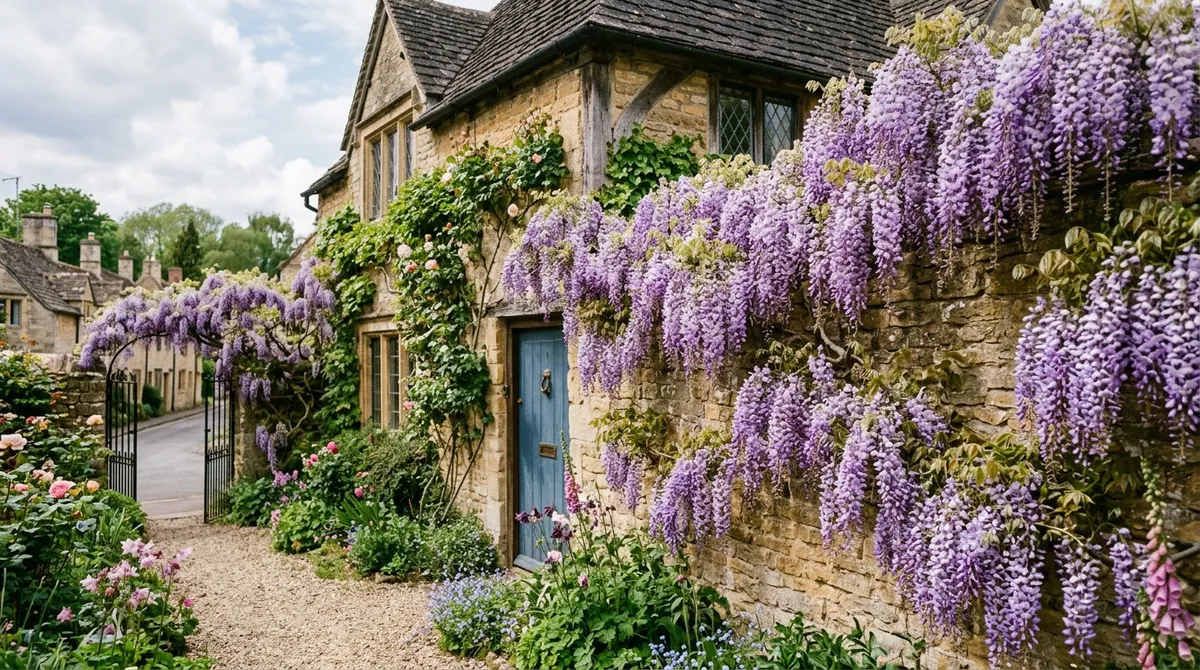
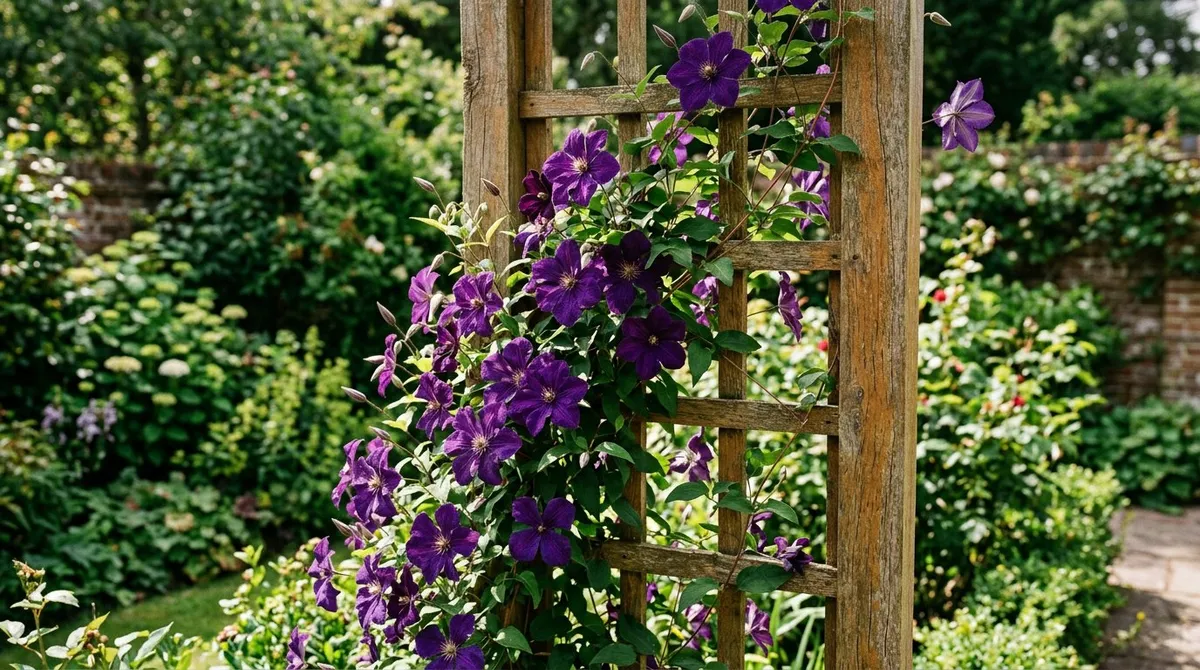
Clematis is one of the best-loved climbers in UK gardens, and it’s easy to see why. You can find one in flower from January to November, in almost any colour. They cover fences, scramble through trees and spill from pots. Grown up a garden obelisk, one clematis can be the star of a border.
Pruning puts a lot of people off, but it really needn’t. Once you know which of the three groups your plant is in, it’s simple. For more climbers, see our best climbing plants for UK gardens.
How should I plant clematis?
Plant clematis 10cm deeper than it sat in its pot. That buries a few buds under the soil. If disease ever kills the top growth, the plant can shoot again from those buried buds.
Step by step planting
- Dig a hole about 45cm wide and deep, at least 30cm out from the base of a fence or wall, where the soil is drier.
- Mix a bucket of well-rotted compost into the soil you dug out.
- Add a handful of blood, fish and bone to the bottom of the hole.
- Soak the plant in its pot in water for 30 minutes.
- Take it out of the pot and gently loosen any circling roots.
- Set it so the top of the rootball sits 10cm below the soil surface.
- Fill in, firm gently and water well.
- Spread a 5cm mulch around the base, keeping it off the stems.
Where to plant
Clematis like cool, shady roots and their heads in the sun. Plant on the shady side of a fence or arch and let the stems climb into the light. Many species are happy facing north or east. Shade the roots with a tile, a slate or a low plant in front.
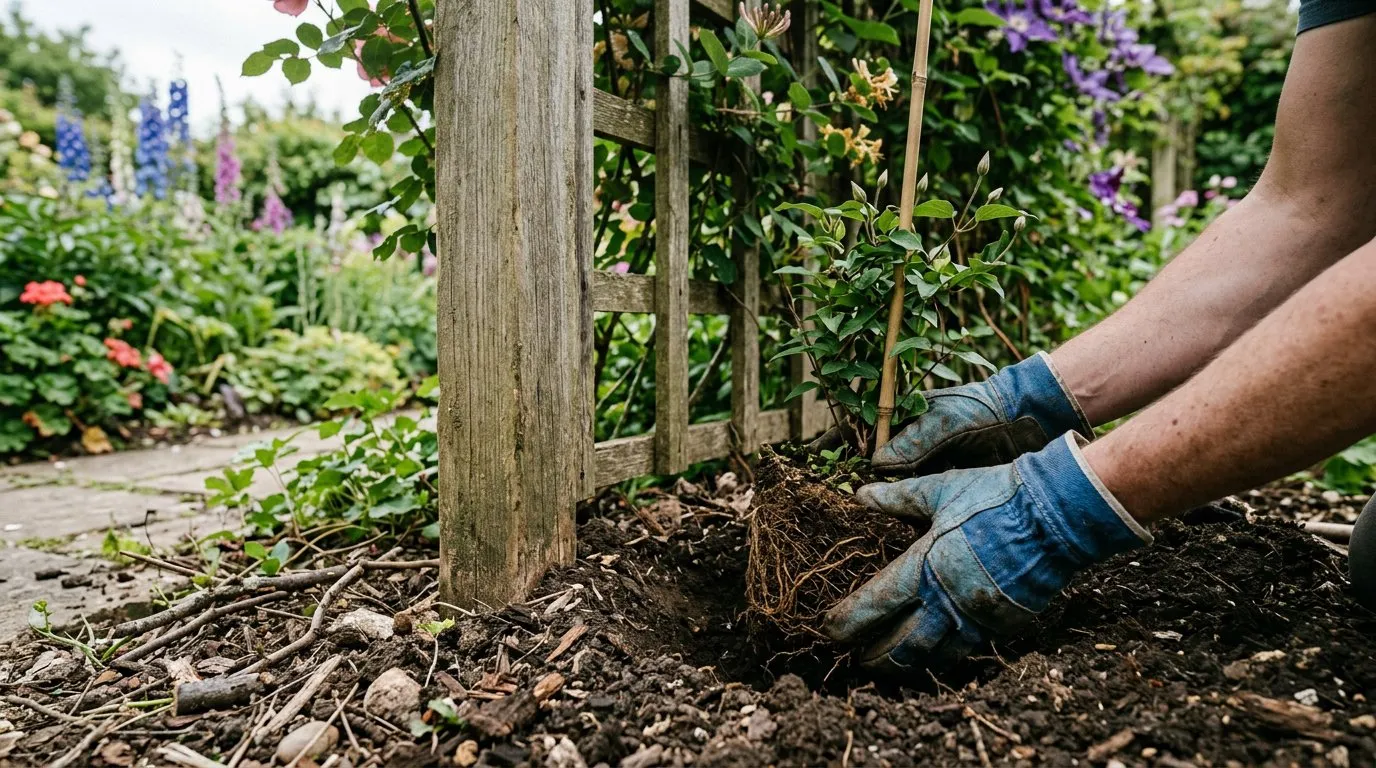
Plant 10cm deeper than the pot and at least 30cm out from the fence or wall.
What are the three clematis pruning groups?
Every clematis belongs to one of three groups, depending on when it flowers. Get it right and you’ll get loads of flowers. Prune a Group 1 like a Group 3 and you’ll cut off all the buds. Our step-by-step guide to pruning clematis by group shows exactly where to cut. The RHS clematis pruning guide explains each group too.
Group 1, early-flowering (no pruning needed)
When they flower: January to May, on last year’s stems.
How to prune: No regular pruning. If it outgrows its space, cut it back straight after flowering so it has time to grow next year’s flowering stems.
Popular Group 1 varieties:
- C. montana: very vigorous, with white or pink flowers in May
- C. armandii: evergreen, with scented white flowers in March. Needs a sheltered wall
- C. alpina: compact, with nodding blue, pink or white bells in April
- C. macropetala: like alpina, with frilly nodding flowers in April and May
- C. cirrhosa: evergreen, with cream bells through winter
Group 2, large-flowered hybrids (light prune)
When they flower: Late May and June, often with a second show in late summer.
How to prune: In February, take out dead and weak stems. Cut the rest back to the top pair of fat, healthy buds. After the first flowers in June, you can trim flowered stems by about a third for a second flush. This group is the most prone to wilt, so deep planting really matters here.
Popular Group 2 varieties:
- ‘Nelly Moser’: pale pink with darker stripes
- ‘The President’: rich purple and very reliable
- ‘Niobe’: deep ruby red and compact, great in pots
- ‘Henryi’: big white flowers with dark centres
- ‘Multi Blue’: double blue-purple and compact
Group 3, late-flowering (hard prune)
When they flower: July to October, on this year’s growth.
How to prune: In February, cut every stem back to about 30cm, just above a pair of strong buds. It feels drastic, but these clematis grow all their stems fresh each year. A hard prune gives the strongest growth and most flowers.
Popular Group 3 varieties:
- C. viticella ‘Étoile Violette’: masses of small purple flowers
- C. viticella ‘Polish Spirit’: deep purple and very reliable
- ‘Jackmanii’: the classic big purple clematis
- C. tangutica: yellow bells followed by fluffy seedheads
- C. ‘Bill MacKenzie’: vigorous, with yellow bells
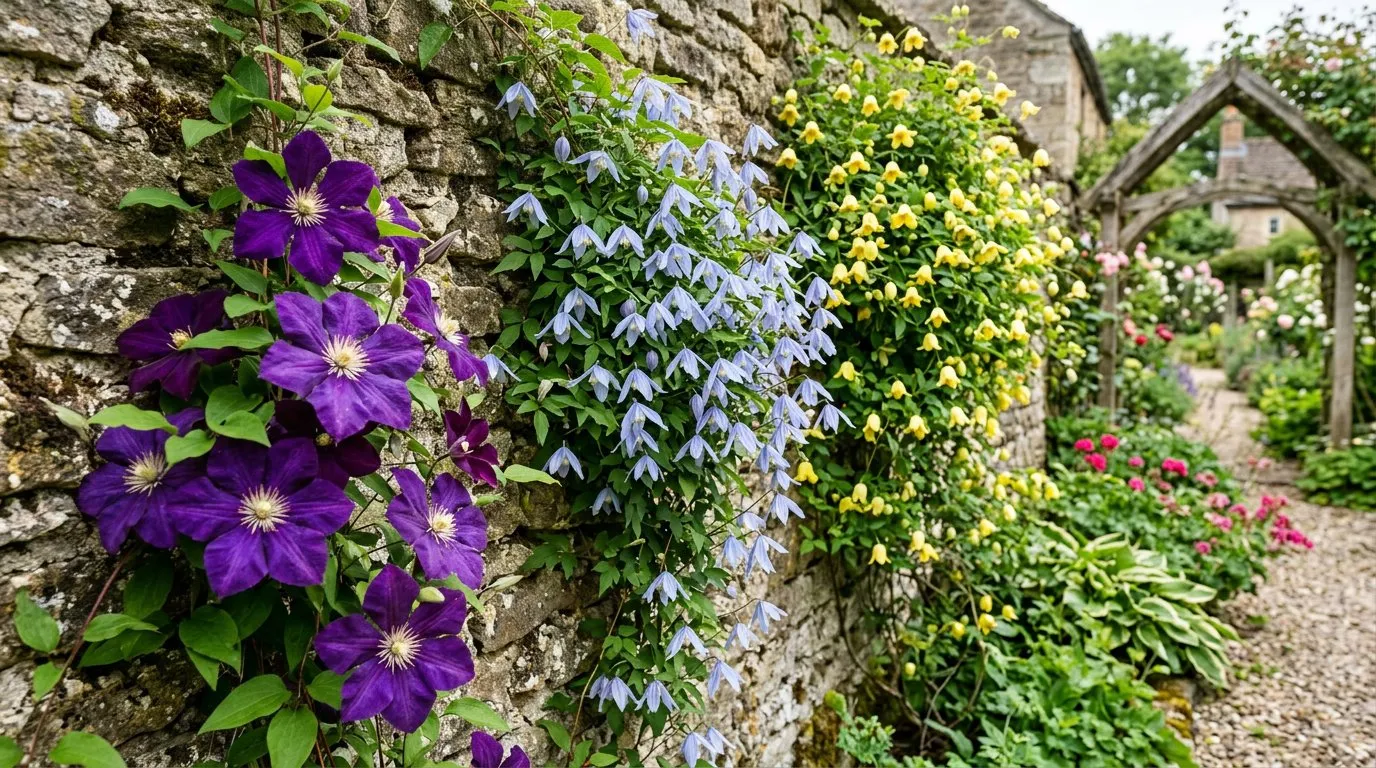
Once you know your pruning group, clematis care is easy.
How do I train clematis?
Young stems are fragile, so tie them in until the leaf stalks start curling round the support on their own. Use soft twine in a loose figure of eight.
Training on a trellis or fence
Fix trellis 3-5cm away from the wall or fence with small spacer blocks. That lets air through and gives the leaf stalks room to grip. Fan the stems out across the trellis and tie them in as they grow. A well-trained clematis is one of the nicest garden fence ideas there is.
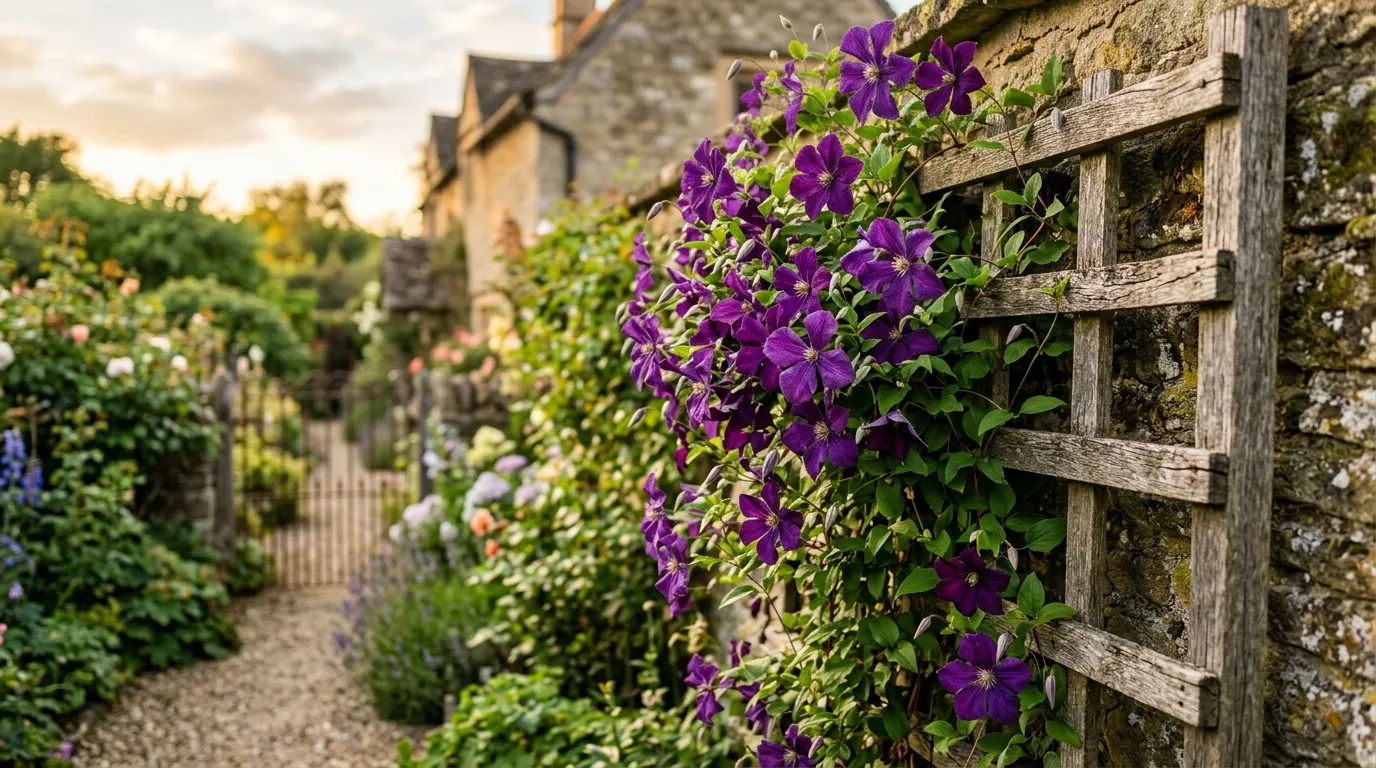
Fan the stems out across the trellis rather than letting them grow up in one column.
Training through trees and shrubs
Group 1 and Group 3 clematis look lovely growing through trees and big shrubs. Plant about 60cm from the trunk, on the side the wind usually comes from. Lean a cane from the clematis to the lowest branch and let it climb. Viticella types are especially good for this.
Training on an obelisk or arch
Wind the stems round the support in a spiral rather than straight up. You’ll get flowers all the way up, not just at the top.
Common clematis problems
Clematis wilt
This fungal disease makes stems suddenly wilt and go brown, mostly on large-flowered Group 2 types. Cut all affected stems down to the ground. A deep-planted clematis usually regrows from buried buds. Small-flowered types rarely get it.
Slugs and snails
They love the young shoots in spring. A collar of sharp grit helps, and our guide to slug control has more ideas. Clematis sap can irritate a pet’s mouth if chewed. Our list of plants toxic to dogs covers other climbers to watch for.
Earwigs
Earwigs chew holes in petals. Trap them in upturned pots stuffed with straw on top of canes. Empty them each morning.
Clematis for every situation
| Situation | Good choices |
|---|---|
| Shady wall | C. montana, C. alpina, C. viticella, ‘Nelly Moser’ (fades less in shade) |
| Hot, sunny wall | C. armandii, C. cirrhosa |
| Small garden or pot | ’Niobe’, ‘Multi Blue’, C. alpina, C. macropetala |
| Growing through a tree | C. montana, C. viticella ‘Étoile Violette’, C. tangutica |
| Pergola or arch | ’Jackmanii’, ‘The President’, C. viticella ‘Polish Spirit’ |
| Flowers most of the year | C. cirrhosa (winter), Group 2 (early summer), Group 3 (late summer) |
Clematis and climbing roses make a great team. Plant a Group 3 clematis at the foot of a rose and let them mingle. The clematis flowers after the rose, and the February cut back stops it smothering its partner. See our guide to pruning roses for the rose side of things.
Looking for more wall and fence plants? Browse our best climbing plants for UK gardens to find good partners for your clematis.
Frequently asked questions
What pruning group is my clematis?
Check the label, or watch when it flowers. Winter and spring flowerers are usually Group 1. Big-flowered types blooming in late spring or early summer are Group 2. Those flowering from midsummer on new growth are Group 3. If you’re unsure, leave it unpruned for a year and see.
When should I plant clematis?
Autumn is ideal, but early autumn to spring all works. Autumn planting lets roots settle while the soil is warm. Spring is fine too if you water well through the first summer. Avoid frozen or waterlogged ground.
Why did my clematis suddenly wilt and die?
It’s often clematis wilt, a fungal disease. It mainly hits large-flowered hybrids. Cut affected stems back to healthy growth, even to the ground. A deep-planted clematis can regrow from buds under the soil. Drought or root damage can look similar.
Can I grow clematis in a pot?
Yes, in a big pot at least 45cm across. Choose a compact variety made for pots. Use John Innes No.3, plant a little deeper than before, and add an obelisk or trellis. Water regularly and give a tomato feed through summer.
Will clematis grow in shade?
Yes, several cope well with part shade. Clematis montana, C. alpina and C. macropetala are good on shady walls. Pale or striped large-flowered types also keep their colour better out of strong sun. Most still flower best with a few hours of sun on top.
How fast does clematis grow?
It depends a lot on the type. Clematis montana can grow several metres a year once settled. Large-flowered hybrids are much gentler. Most cover their support in two or three years, and Group 3 types regrow from near the ground every year.
Can I move a clematis?
Yes, though clematis don’t love being moved. Do it in autumn or early spring. Dig up as big a rootball as you can, replant a little deeper and water well. Cut the top growth back. It may sulk and flower less for a year.
Our team produces practical UK gardening guidance from source research, contributor records and established horticultural practice. Editorial standards are overseen by Matt W.