Key takeaways
- Close-board fencing is sturdy and lasts longer than cheap overlap panels
- Dark colours like charcoal, slate and deep green make plants stand out
- Star jasmine, clematis and climbing hydrangea turn a fence into a living wall
- In England, fences up to 2m need no planning permission, or 1m next to a road
- Slatted and hit-and-miss fences let the wind through, so suit breezy gardens
Your fence is probably the biggest thing in your garden. It frames every border and sets the mood of the whole space. Yet most fences are plain panels left to go grey and tired.
With the right style, colour and plants, a fence can become a feature you love. Here are fence types, colours, climbers and ideas that work in real UK gardens. If a full fence feels like too much, slatted panels and screens are covered in our patio privacy screening ideas. For a boundary that lasts even longer, see our guide on how to build a garden wall.
Fence types compared
The four main types are overlap, close-board, horizontal slatted and hit-and-miss. The big differences are how long they last and how they cope with wind.
Overlap panels
The budget option. Thin wavy strips overlap inside a frame. They’re light, cheap and quick to put up.
Watch out for: wind. The flat face catches gusts and panels can blow out, so they’re not great for exposed gardens.
Close-board (featherboard)
Upright boards nailed to rails, each one overlapping the next. This is the sturdiest, longest-lasting type.
Why it’s good: thick boards make a solid barrier, and you can replace a single board if one gets damaged. On a very windy site a solid fence still takes the full force, so make sure the posts are strong. Our guide to garden fence repair and maintenance covers swapping boards, fixing posts and stopping rot.
Slatted (horizontal)
Horizontal timber slats, with or without gaps, for a clean modern look.
Best for: modern gardens and feature sections. The sideways lines make a narrow garden feel wider.

Horizontal slats look smart and modern, and they make a narrow garden feel wider.
Hit-and-miss
Boards fixed on alternate sides of the rails. You get privacy from straight on, but air and light pass through at an angle.
Best for: windy gardens. The wind blows through instead of pushing against a solid face.
Which fence suits you?
| Type | Price | How long it lasts | In wind | Privacy | Look |
|---|---|---|---|---|---|
| Overlap | Cheapest | Shortest | Poor | Full | Budget |
| Close-board | Mid | Long | Good | Full | Traditional |
| Slatted | Higher | Medium | OK | Full or partial | Modern |
| Hit-and-miss | Mid | Long | Very good | Some | Modern traditional |
| Trellis | Low | Shorter | Good | Partial | Decorative, as a topper |
Fence colours that transform a garden
Paint is the quickest, cheapest way to change a fence. One weekend and a few tins can change the whole feel of the garden. For more quick wins, see our garden ideas for every budget. Fence paint was the first thing bought in this £500 garden makeover.
Dark colours (best for most gardens)
Charcoal, slate grey, dark blue and deep green make the fence fade back. The boundary feels further away, and green leaves and bright flowers really pop against it.
It’s one of the cheapest design changes you can make, and it makes a garden look more thought-through than raw timber. For finishes that boost kerb appeal, see our guide to fence paint colours that add value.

Dark paint makes the fence fade back so the green leaves stand out.
Light colours
Pale grey, soft blue and off-white bounce light around. They’re great in north-facing or shut-in gardens, making a small, shady space feel brighter.
Colours to avoid
Bright orange stain is on a lot of UK fences, but it grabs all the attention and clashes with most plants. It also fades patchily. That matters most in front gardens, where the fence sets the tone for the whole house. Paint over it with a dark opaque colour.
Black suits very modern gardens but can feel heavy. Dark grey gives a similar effect with a little more warmth.
Tip: Use a wood preserver or primer before you paint. It helps the paint last, and you’ll need to repaint every few years.
Climbers and planting on fences
The loveliest fences are the ones you can barely see. Climbers turn plain panels into walls of flowers and scent, and give wildlife somewhere to live. A cottage garden planting plan works beautifully along a fence, with plants scrambling over and softening it.
Best climbers for UK fences
| Climber | Fence direction | Flowers | Evergreen | Speed |
|---|---|---|---|---|
| Star jasmine (Trachelospermum) | South or west | Summer, white, scented | Yes | Steady |
| Clematis montana | Any | Late spring, white or pink | No | Fast |
| Climbing hydrangea | North or east | Early summer, white | No | Slow, then fast |
| Honeysuckle | Any | Summer, scented | Partly | Fast |
| Climbing rose | South or west | Summer into autumn | No | Steady |
| Ivy (Hedera) | Any | Autumn | Yes | Fast |
| Wisteria | South or west | Late spring, scented | No | Fast once settled |
Star jasmine is a favourite. It’s evergreen, scented and tidy, and gets through most UK winters in a sheltered spot. Give it a south or west-facing fence and horizontal wires to climb.

Star jasmine trained along horizontal wires, flowering in summer.
Climbing hydrangea is the one for shady, north-facing fences. It clings on by itself and has lacy white flowers in early summer. It’s slow for the first couple of years, then romps away. Our guide to shade-friendly plants has more ideas.
Clematis and honeysuckle are easy, fast choices for almost any fence.
Giving climbers something to hold
Most climbers need support. Fix horizontal galvanised wires about 30cm apart, using vine eyes screwed into the posts. Or screw trellis panels to the fence.
Leave a gap of 5-10cm between the support and the fence. Air can then flow behind the leaves, which is better for the plant and the timber.
Can I grow climbers on or paint my neighbour’s fence?
Only if they say yes. A fence belongs to whoever owns that boundary, so painting it or fixing wires to it without asking can cause a row. If they’d rather you didn’t, put up your own trellis or wires on posts just inside your side. If your work shows on their side, like dark paint through the gaps, agree it in writing.
Living fences and green screens
A living fence uses trees or hedging instead of timber. It’s softer to look at and great for wildlife.
Pleached trees
Pleached trees are trained into a screen on bare trunks, giving privacy at head height with open ground below. Hornbeam and lime are the classic choices. Space them about 2-3m apart.
Instant hedging
Ready-grown hedging in troughs gives you a screen straight away. Privet, laurel and beech are all sold this way. It costs more than small bare-root plants, but saves years of waiting.
Mixed native hedging
A native hedge of hawthorn, blackthorn, field maple and holly is full of life. It gives birds places to nest, feeds insects, and brings blossom, berries and autumn colour.
Adding height with fence toppers
A topper is the cheapest way to make a low fence taller without replacing it.
Trellis: a 30-60cm trellis panel fixed to the top of the posts adds height but still lets light through. Grow climbers along it for extra screening.
Willow or hazel hurdles: woven natural panels wired to the top of the fence. They look lovely and rustic, though they won’t last as long as timber.
Plants: tall shrubs, bamboo or grasses along the fence give you a screen above fence height with no building at all.
Does trellis count towards fence height?
Yes. Height counts from the ground to the top of everything, trellis included. In England the Planning Portal sets the limit at 2m, or 1m next to a road used by vehicles or its footpath. So a 1.8m fence with a 30cm trellis on top reaches 2.1m and needs planning permission. Plants growing above the fence don’t count.
Good to know: Any fence at a listed building needs consent, whatever its height. An Article 4 direction or planning condition can also remove your right to put one up, and in a conservation area you may need permission to take one down. Check with your council first.
Which side of the fence is mine?
Often there’s no official record. In England and Wales, most Land Registry plans only show general boundaries, as GOV.UK explains. Start with your deeds, which may mark ownership with a “T” on the boundary line. If they don’t say, talk to your neighbour and agree it in writing.
Which way should a fence face?
No law says the smooth side must face next door, but that’s the usual habit. Posts and rails normally sit on the owner’s side, which makes repairs easier. If you’d like the good side facing you, have a quick word with your neighbour first.
Fences, pets and wildlife
A good fence keeps pets safely in. Dog owners should check for gaps at the bottom and wobbly panels. Our guide to designing a dog-friendly garden covers heights and escape-proofing. For cats, cat-proofing your garden explains roller bars and angled toppers.
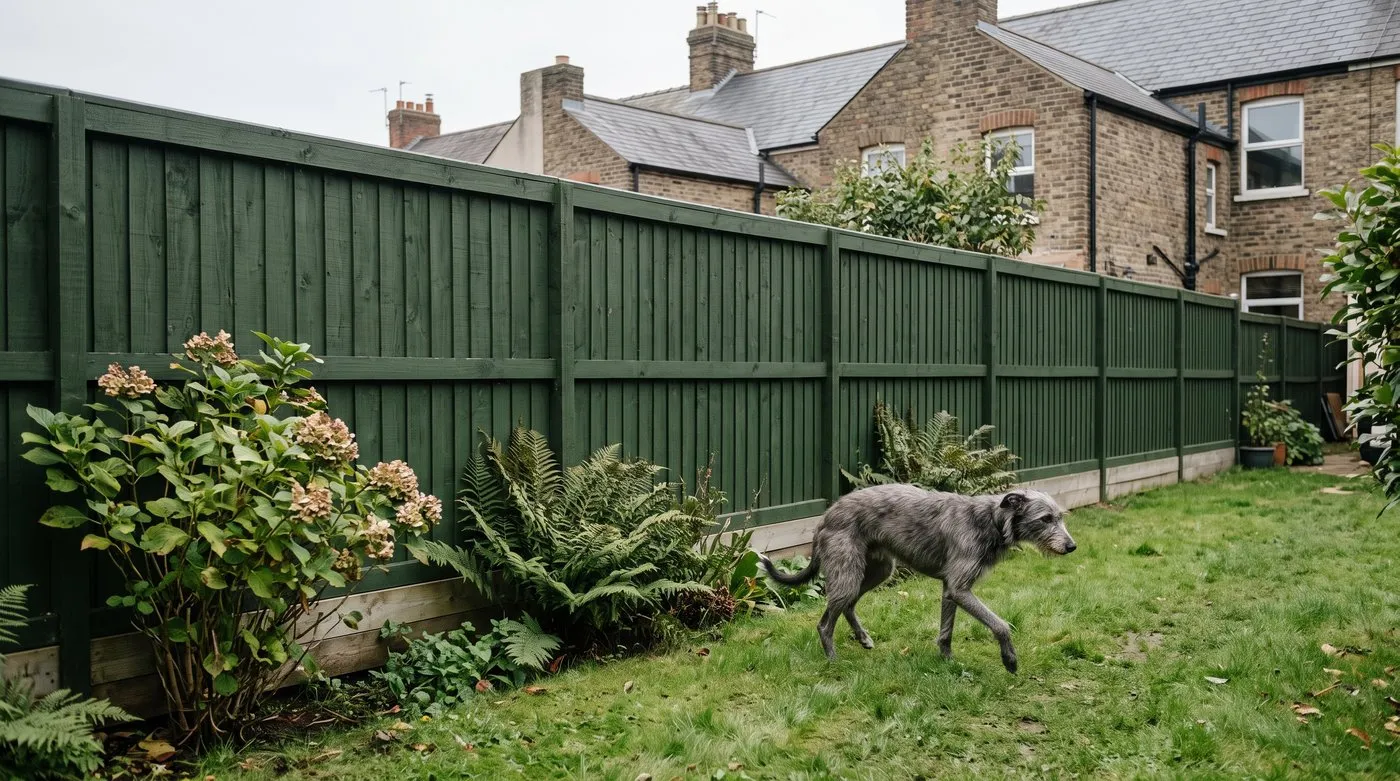
Check your fence for gaps at the bottom and wobbly panels before a dog finds them. A gravel board along the base also stops them digging underneath.
Frequently asked questions
What is the best type of garden fence?
Close-board fencing is the sturdiest choice for most gardens. Thick upright boards on strong rails stand up to knocks and weather far better than thin overlap panels. If a board gets damaged, you can replace just that one.
What colour should I paint my garden fence?
Charcoal, slate grey or deep green suit most gardens. Dark colours make the fence fade into the background and help green leaves and flowers stand out. Pale colours are handy for brightening a small, shady garden. Steer clear of bright orange stain, which takes over the view.
How high can a garden fence be without planning permission?
In England, up to 2m without planning permission. Next to a road used by vehicles, or its footpath, the limit is 1m. Listed buildings always need consent, and an Article 4 direction or planning condition can remove these rights. Wales has similar rules, but check with your council.
What is the cheapest garden fence?
Overlap panels are the cheapest fence to buy. They’re light and quick to put up, but they don’t last as long and don’t cope well with strong wind. Close-board costs more at the start but usually lasts longer, so it can work out better value.
What climbers grow well on fences?
Star jasmine, clematis, climbing hydrangea, honeysuckle and climbing roses all do well. Most need horizontal wires about 30cm apart or a trellis to hold on to. Climbing hydrangea and ivy cling on by themselves.
How do I stop a fence blowing down?
Set the posts firmly in concrete or postcrete, about 60cm deep. Use sturdy posts of at least 75mm x 75mm. On windy sites, pick slatted or hit-and-miss designs that let the wind through. Fit gravel boards at the bottom to stop the panels rotting.
Our team produces practical UK gardening guidance from source research, contributor records and established horticultural practice. Editorial standards are overseen by Matt W.