Key takeaways
- A £500 budget transforms a small garden if you focus on structure, not furniture
- 80% of visual impact comes from 20% of spend: paint, gravel, mulch, and key shrubs
- Secondhand paving and free plants from cuttings can save £400 on a typical project
- Fence paint at £30 gives the single biggest visual improvement per pound spent
- Skip new furniture until year two — it drains budget with low visual return
- Plant three structural shrubs first, then fill with cheap self-seeders and annuals
What does a £500 garden makeover really look like?
A £500 makeover works best on a 40 square metre plot or smaller. Beyond that the budget spreads too thin. The three real case studies below show what is possible at different price points. Each budget assumes you start with a tired but functional space, not a total clearance.
Case study 1: the £250 courtyard rescue
A 15 square metre concrete yard behind a Victorian terrace in Stoke-on-Trent. Starting point: grey concrete, a broken wooden bench, three dead pots, and a sagging fence panel. Budget: £250 hard cap.
The plan was to avoid digging and work entirely in containers. The fence was the biggest visual problem, so it got the first £30.
Cost breakdown
| Item | Cost |
|---|---|
| Fence paint (Cuprinol Urban Slate, 5L) | £32 |
| 6 bags horticultural grit for toppings | £24 |
| 4 terracotta pots (secondhand Marketplace) | £20 |
| 1 climbing rose Rosa ‘New Dawn’ | £18 |
| 3 lavender plants | £21 |
| 1 Hydrangea ‘Annabelle’ | £22 |
| 20L peat-free compost | £8 |
| Wire trellis and fixings | £15 |
| Outdoor string lights (solar) | £18 |
| 2 bags bark mulch | £14 |
| 5 annual trailing lobelia | £12 |
| Secondhand chiminea | £35 |
| Cheap doormat | £8 |
| Total | £247 |
What changed
The painted fence did more visual work than anything else. Suddenly the yard had a defined edge instead of a grey blur. The rose climbed the wire trellis within 6 weeks. Lavender and lobelia hid the pot rims. The chiminea gave a centre piece in the corner.
Case study 2: the £500 small garden restart
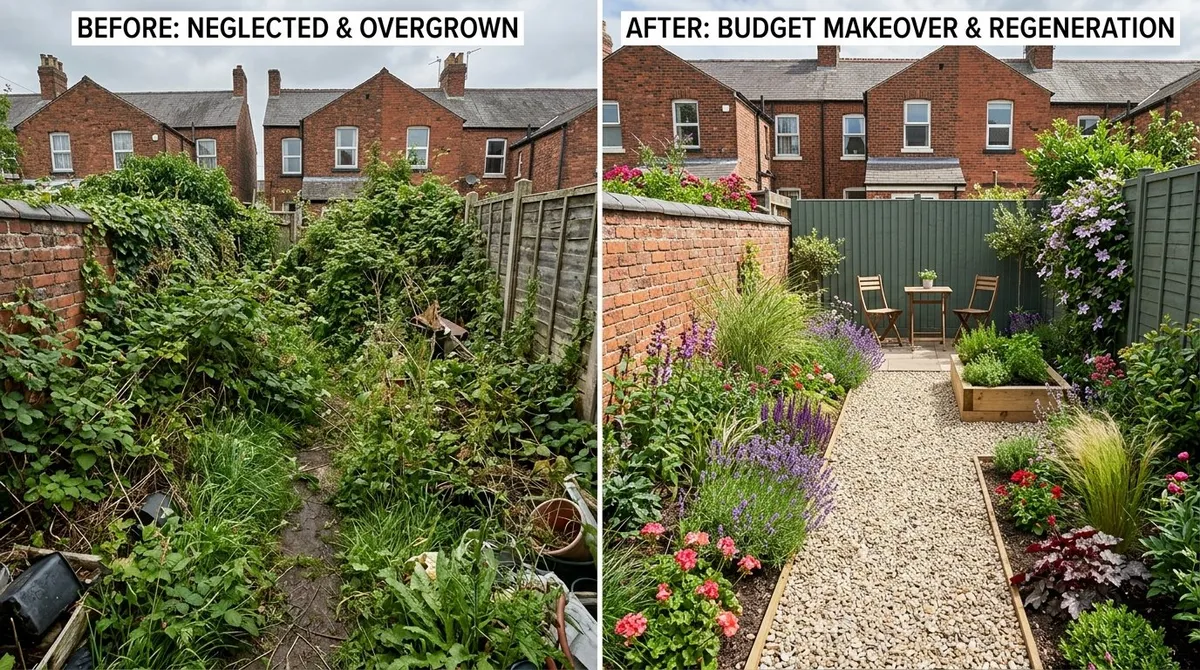
A 35 square metre rear garden in Wolverhampton with patchy lawn, overgrown shrubs, and a grey fence. Starting point: brambles in one corner, a rotting shed base, and tired mixed borders. Budget: £500.
This one tested the 80/20 rule properly. The first £100 went on fence paint and mulch and made the biggest visible difference of the whole project.
Cost breakdown
| Item | Cost |
|---|---|
| 10L Cuprinol fence paint | £58 |
| 6 bags cocoa shell mulch | £72 |
| 1 ton pea gravel (delivered) | £85 |
| 20m weed membrane | £22 |
| Secondhand paving (Marketplace) | £45 |
| 3 structural shrubs (Hydrangea, Choisya, Mahonia) | £66 |
| 12 perennials (local nursery end of season) | £48 |
| Seed potatoes and seeds for veg patch | £25 |
| Compost (peat-free, 120L) | £28 |
| 5 trailing plants for existing pots | £20 |
| Fence post repair spur | £18 |
| Solar lanterns x 4 | £32 |
| Total | £519 |
What changed
The fence paint transformed the backdrop. The gravel created a defined path and seating area. The cocoa shell mulch made the borders look properly gardened rather than scrubby. Three structural shrubs gave year-round shape. The perennials filled in gaps over summer.
The secondhand paving was the real win. Local marketplace listings had Indian sandstone at £2 per slab. New retail was £18 per slab. That single saving bought the three structural shrubs and the gravel. For full mulch guidance, see what is mulch and how to use it.
Case study 3: the £1,000 family garden revival
This budget finally allowed some proper planting density and one “hero” feature, a raised vegetable bed for the children.
Cost breakdown
| Item | Cost |
|---|---|
| 15L fence paint (two sides + shed) | £82 |
| Railway sleepers for raised bed | £120 |
| Topsoil (1 ton delivered) | £75 |
| Pea gravel and membrane | £110 |
| 6 structural shrubs | £130 |
| 25 perennials | £115 |
| 15 bags mulch | £68 |
| Secondhand paving | £85 |
| Children’s veg seeds and plants | £28 |
| Climbing frame refurbishment paint | £22 |
| Fairy lights, solar path lights | £48 |
| Secondhand wooden bench | £60 |
| Bird feeder and pond kit (small) | £55 |
| Total | £998 |
What changed
The garden went from unusable to the main family space within a month. The raised vegetable bed gave the children ownership of one corner. The secondhand bench cost £60 against a £200 new equivalent. The small pond kit attracted frogs within three months.
Budget comparison at a glance
Here is how the three makeovers compare directly. Read left to right to see what scales with budget.
| Element | £250 yard | £500 garden | £1,000 family garden |
|---|---|---|---|
| Fence paint coverage | 1 panel + trellis | Full back fence | All fences + shed |
| Hard landscaping | Gravel topping | Gravel path | Path + raised bed |
| Structural shrubs | 2 | 3 | 6 |
| Perennials | 8 | 12 | 25 |
| Mulch depth | 3cm in pots | 5cm borders | 7cm borders |
| Feature item | Chiminea | Secondhand paving | Raised veg bed |
| Lighting | Solar string | 4 solar lanterns | Path lights + string |
| Furniture | Reused | Reused | 1 secondhand bench |
How do I follow the 80/20 rule in my own garden?
Spend the first 20% of your budget on the items that deliver 80% of the visual change. For almost every small UK garden this means four things in this order:
- Paint the fences. £30-£80 depending on size. Biggest visual gain per pound.
- Mulch the borders 5cm deep. £40-£70. Makes tired beds look cared for.
- Define a path or seating area with gravel. £60-£100. Creates structure.
- Plant three structural shrubs. £40-£80. Provides year-round bones.
What should I never spend on in a budget makeover?
Skip new furniture, expensive pots, and garden buildings. These three categories consume budget faster than anything else and deliver the least visual return per pound.
New garden furniture starts at £150 for basic bistro sets. That same £150 buys enough gravel, mulch, and plants to improve the whole space. Buy secondhand or reuse what you have for year one.
Decorative pots over £25 are a budget trap. Three £8 terracotta pots look better than one £30 ceramic urn. Cluster them in threes for impact.
Garden buildings (sheds, arbours, pergolas) belong in year two at the earliest. A £300 arbour looks lost in a tired garden. Build the rest first then add structures.
Where do I find cheap materials?
Search terms that work:
- “paving slabs free”
- “garden plants free”
- “gravel unused”
- “topsoil excess”
- “patio slabs collection only”
How do I get free plants?
Cuttings, division, and self-seeders give endless free plants. Take softwood cuttings of hardy shrubs (hydrangea, fuchsia, lavender) in June. Root in water on a windowsill for 3 weeks. Pot on. Free plants from any established specimen.
Divide perennials in autumn. A single Geranium ‘Rozanne’ divides into 4-6 new plants every autumn. Hostas, astilbes, heucheras, and asters all divide easily.
A weekend makeover plan
Here is a workable plan for a £500 makeover completed across two weekends plus evenings.
Saturday 1: Clear the space. Remove dead plants, broken furniture, rubbish. Paint the fences. Let them dry overnight.
Sunday 1: Lay weed membrane. Spread gravel path and seating area. Move any existing pots into their new positions.
Weekday evenings: Plant structural shrubs. Spread mulch 5cm deep across all borders. Reposition furniture.
Saturday 2: Plant perennials in drifts of 3-5. Sow quick annuals for instant colour.
Sunday 2: Add lighting, tidy edges, photograph the finished result.
Frequently asked questions
Can you improve a garden for £500?
Yes, £500 improves a small UK garden if you focus on structure not furniture. Spend on fence paint, gravel, mulch, three structural shrubs, and secondhand paving. Skip new furniture, expensive pots, and garden buildings. Most of the visual impact comes from the first £100 of spend.
What is the 80/20 rule in garden design?
Roughly 80% of visual impact comes from 20% of the budget. Fence paint, gravel paths, deep mulch, and two or three structural shrubs deliver most of the before-and-after difference. Spending on furniture, ornaments, and large containers adds far less per pound than basic hard landscaping and paint.
What should I spend money on first in a garden makeover?
Spend on fence paint and a good mulch first. These two items give the biggest visual change for the least money. Paint costs £30 for a small garden. Mulch at 5cm deep costs about £60 for 20 square metres. Together they improve how a garden reads.
Where can I get free plants for a garden makeover?
Facebook Marketplace, plant swaps, and cuttings give endless free plants. Join local gardening groups for spare divisions. Take softwood cuttings of shrubs in June and root them in water. Sow seed from existing annuals. Self-seeders like Verbena bonariensis cost nothing after the first plant.
How long does a £500 garden transformation take?
Expect two full weekends plus evenings for a small garden makeover. Day one: clear, paint fences, lay weed membrane. Day two: spread gravel, plant shrubs. Evenings over the following week: mulch beds, add pots, and tidy edges. Rushing it on day one leads to mistakes.
Is it cheaper to DIY or hire a landscaper?
DIY is roughly 60% cheaper than hiring a landscaper for basic work. A landscaper charges £200-£300 per day plus materials. DIY on a £500 budget covers more ground because labour is free. Hire a professional for structural work like patios, retaining walls, or tree felling.
What should I avoid buying in a budget garden makeover?
Skip large furniture, fancy planters, and garden buildings on a £500 budget. They swallow the budget with low visual return. Secondhand furniture from Marketplace costs a fifth of new. Spend on plants, mulch, and hard landscaping first. Buy furniture in year two when the garden earns it.
Our team produces practical UK gardening guidance from source research, contributor records and established horticultural practice. Editorial standards are overseen by Matt W.