
Key takeaways
- Group 1 (montana, alpina) needs only a light tidy after flowering
- Group 2 (big-flowered hybrids) gets a light trim to strong buds in February
- Group 3 (viticella, Jackmanii) gets cut back to 15-30cm in February or March
- Pruning the wrong way is the usual reason clematis don't flower
- Cut every new clematis back hard in its first spring, whatever its group
Clematis pruning puzzles lots of gardeners. That’s because there are three pruning groups, and each one wants something different at a different time.
Get it right and you’ll have walls and fences covered in flowers from April to October. Get it wrong and you can snip off next year’s flowers without knowing it.
Understanding the three clematis pruning groups
Every clematis belongs to a group, based on when it flowers and whether it flowers on old stems, new stems or both. Find your group and the rest is easy.
Group 1 flowers on stems that grew last year. These are the early ones: montana, alpina, macropetala and armandii. They flower in winter or spring. Prune them in winter and you cut off the flower buds.
Group 2 flowers on old and new stems. These are the big-flowered hybrids like Nelly Moser, The President and Niobe. They flower in May and June on old stems, then again more lightly in late summer on new growth. That makes them the trickiest to prune.
Group 3 flowers only on new stems grown that year. Viticella types, texensis hybrids and late big-flowered ones like Jackmanii and Comtesse de Bouchaud are all here. They flower from July to September.
| Group 1 | Group 2 | Group 3 | |
|---|---|---|---|
| Flowers on | Old stems | Old and new stems | New stems |
| Flowers | Winter to May | May to June, then August | July to September |
| Prune | After flowering | February, lightly | February to March, hard |
| How much | A light tidy | Trim to strong buds | Cut to 15-30cm |
| Examples | Montana, alpina, armandii | Nelly Moser, The President | Jackmanii, viticella |
| Growth | Very vigorous | Moderate | Moderate to vigorous |
How to prune Group 1 clematis
Group 1 is the easiest because it needs the least doing. These are big, vigorous climbers (montana can reach 12m) and only need a light tidy after flowering.
When: Straight after flowering, usually late May to June.
What to cut: Take out dead or damaged stems. Shorten anything that’s outgrown its space. If the plant is young and still covering its support, leave it alone.
How much: No more than a third of the plant in one year. Montana will cope with harder pruning, but it takes a couple of years to flower fully again.

Clematis montana flowers on last year’s stems. Pruning just after flowering gives new stems time to grow before winter.
Got an overgrown Group 1 clematis? You can renovate it, but spread the job over two or three years. Each year, cut a third of the oldest stems back to about 60cm. It fills in from the base and still flowers on the stems you’ve left.
How to prune Group 2 clematis
Group 2 is the one most people get wrong. Cut it hard in winter and you lose the early summer flowers, ending up with just one late show instead of two.
When: February, before new growth starts. In mild winters, buds may be swelling by late January, so try to prune before they grow.
What to cut:
- Take out all dead and damaged stems
- Cut the rest back to the highest pair of strong, healthy buds
- That usually means losing just the soft tips from last autumn
- Remove any thin, weak stems that won’t hold big flowers
The key thing: you’re trimming, not cutting back. Each stem keeps most of its length.

Group 2 stems trimmed to strong buds in February. The old stems left behind carry the early summer flowers.
How to prune Group 3 clematis
Group 3 is the simplest job of all. It flowers on new growth, so cut everything back hard in late winter and fresh flowering stems grow from the base.
What to cut:
- Cut every stem down to 15-30cm above the ground
- Make each cut just above a pair of strong buds
- Pull away all the old top growth
- Clear up the bits from round the base
If you skip it: it still flowers, but only right at the top of last year’s growth. You get bare stems at the bottom and flowers 3m up where nobody can see them. Cutting back every year keeps the flowers at eye level.
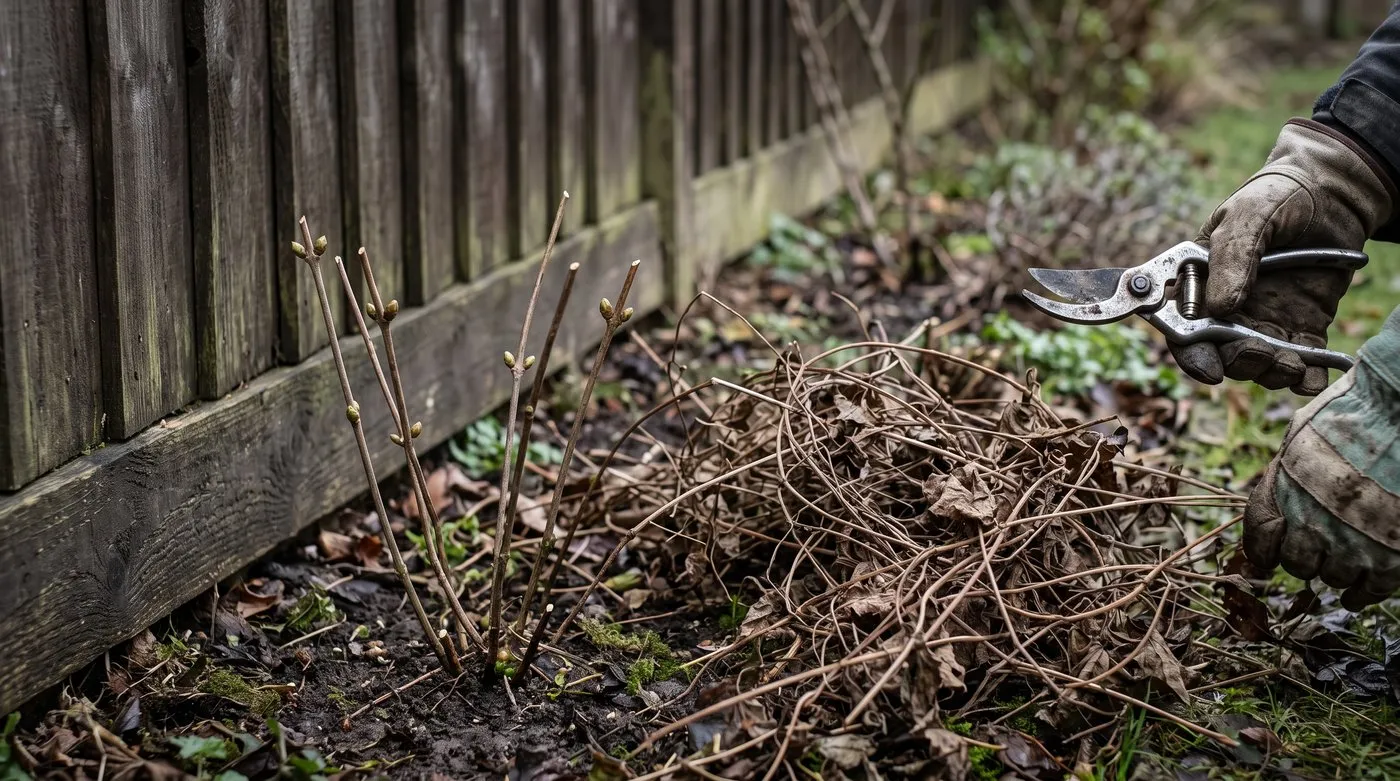
Cut each stem just above a pair of strong buds. A yearly hard prune keeps the flowers at eye level instead of 3m up.
Pruning newly planted clematis (all groups)
Whatever its group, cut every new clematis back hard in its first February or March. Cut all the stems to about 30cm above the soil, just above a pair of strong buds.
It feels harsh, especially if it arrived with a metre of growth. But clematis like to shoot up on a single stem. A hard prune in year one makes it send up lots of stems from the base, so you get a fuller plant with many more flowers.
From the second year on, prune it the normal way for its group.
Month-by-month clematis pruning calendar
| Month | Jobs | Groups |
|---|---|---|
| January | Check ties and supports | All |
| February | Prune Groups 2 and 3. Cut back first-year plants | 2, 3 |
| March | Finish Group 3 pruning. Mulch and feed | 3 |
| April | Tie new growth onto supports. No pruning | All |
| May | Prune Group 1 after it flowers | 1 |
| June | Finish Group 1 pruning. Deadhead Group 2’s first flowers | 1, 2 |
| July | Tie in new growth. Deadhead | 2, 3 |
| August | Keep deadheading. No pruning | 2, 3 |
| September | Secure tall growth so it doesn’t rock in the wind | All |
| October | Leave the fluffy seedheads for winter | All |
| November | No pruning, as plants are going to sleep | All |
| December | Plan next year and order new plants | All |
Common clematis pruning mistakes
Mistake 1: Cutting Group 2 hard in winter. This loses the early big flowers, leaving you with one late show instead of two. Just trim to strong buds.
Mistake 2: Never pruning Group 3. Without a yearly cut, Group 3 turns into a tangle with flowers only at the top and bare stems below. Cut it back every February.
Mistake 3: Pruning Group 1 in winter. Montana and alpina flower on last year’s stems, so winter pruning removes the whole spring show. Wait until just after flowering.
Mistake 4: Skipping the first-year prune. Every new clematis needs one hard prune to 30cm in its first spring. Skip it and you get one lanky stem instead of a bushy plant.
Mistake 5: Cutting above a single bud. Clematis buds come in pairs. Always cut just above a pair so you get two new stems rather than one.
Which clematis group is best for UK gardens?
All three groups are easy to grow in the UK, so pick by when you’d like flowers. On clay soil, all three are fine as long as it drains reasonably well. Add grit to the planting hole and plant a little deeper than it was in its pot, about 5-8cm. That helps it send up new shoots from below ground if wilt strikes.
Frequently asked questions
What month do you prune clematis in the UK?
Most clematis are pruned in February or March. Group 2 gets a light trim then and Group 3 gets cut back hard. Group 1 is different. Prune it straight after it flowers, usually in late spring, and only if it needs tidying.
What happens if you prune clematis at the wrong time?
You usually lose flowers, not the plant. Cutting Group 1 hard in winter removes the stems that carry its spring flowers. Cutting Group 2 too hard loses the early flowers, though later ones may still come. Prune it the right way next year and it’ll be back to normal.
How do I know which pruning group my clematis is in?
Check the label, or watch when it flowers. Group 1 flowers in winter or spring. Group 2 has big flowers in late spring or early summer, often with a second show later. Group 3 flowers from midsummer into autumn.
Should I prune clematis in the first year after planting?
Yes, cut every new clematis back in its first late winter or early spring. Cut the stems to 15-30cm above the ground, just above a pair of healthy buds, whatever its group. It makes the plant branch out from the base, so you get more stems and more flowers.
Can you kill clematis by pruning too hard?
Very unlikely, as established clematis are tough. Even Group 1 plants usually recover from a hard prune within a season or two. The real risk is losing a year of flowers. Renovate very old, neglected plants a bit at a time, and feed and water them afterwards.
Why is my clematis not flowering after pruning?
Most likely it was pruned at the wrong time for its group. Group 1 and Group 2 lose their flower buds if cut back hard in winter. Give it a season and it should recover. Too much shade or too little water can also mean fewer flowers.
Do you cut clematis back to the ground?
Only Group 3, and not quite to the ground. In February or March, cut each stem to 15-30cm above the soil, just above a pair of strong buds. Don’t do this to Group 1 or Group 2, as they flower on older stems.
Related reading
Our team produces practical UK gardening guidance from source research, contributor records and established horticultural practice. Editorial standards are overseen by Matt W.


