
Key takeaways
- Fix horizontal wires about 45cm apart, held off the wall by vine eyes
- Plant 30-45cm out from the wall, where the soil is less dry
- Keep 3-5 strong shoots as the main stems and fan them out on canes
- Tie in every couple of weeks in spring and summer, with soft twine in a figure of eight
- Bend rose stems towards horizontal in winter for flowers all along them
- Self-clingers such as ivy need no wires; most other climbers do
To train a climbing plant, give it a framework of horizontal wires, fan its young stems out wide, and tie them in loosely as they grow. Then bend the stems sideways over winter so they flower low down, where you can see them.
Left to itself, a young rose or honeysuckle on a flat wall shoots straight up. It flowers at the top and goes bare at the bottom. A little training in the first two years fixes that for good. This guide assumes your plant is in the ground and the wall or fence is bare. If you’re still choosing, the guide to the best climbing plants for UK gardens sorts them by aspect and vigour.
How do climbing plants hold on?
It depends on the plant, and it decides how much help it needs.
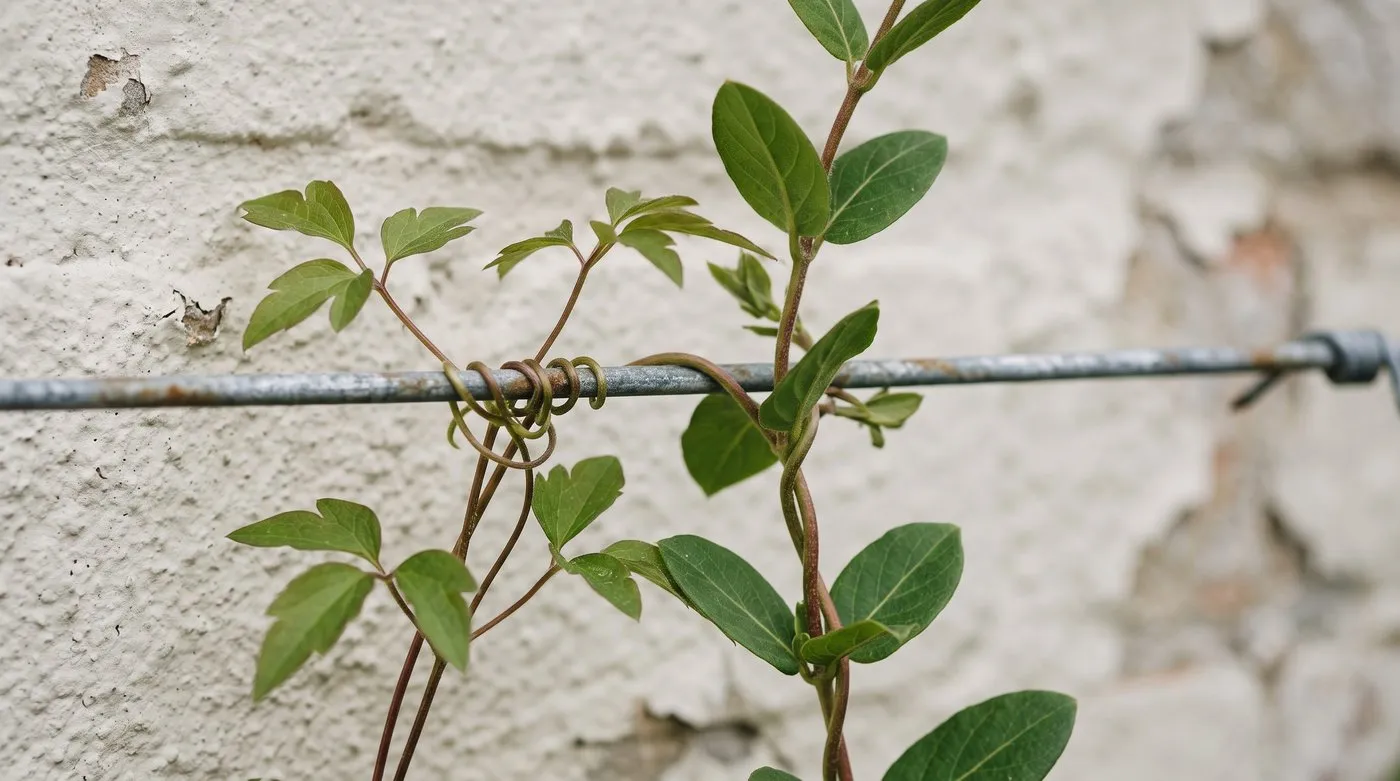
Clematis grabs the wire with its curling leaf stalks, while honeysuckle climbs by twining its whole stem around a support.
- Twiners such as honeysuckle and wisteria wrap their stems around a support.
- Tendril climbers such as clematis and sweet peas grab hold with curling leaf stalks or tendrils.
- Scramblers such as climbing and rambling roses hook on with thorns. They need tying to everything.
- Self-clingers such as ivy, climbing hydrangea and Virginia creeper stick to walls by themselves.
Everything except the self-clingers needs a framework of wires, mesh or trellis. For self-clingers, just point them at the wall and let them go. The guide to English ivy covers when that’s a good idea and when it isn’t.
How do you fix training wires to a wall?
Run horizontal galvanised wires about 45cm apart, held about 5cm off the wall by vine eyes. The lowest wire goes about 45cm above the soil. The gap behind the wire lets air move and gives stems room to wrap.
- Mark your rows with chalk. On a brick wall, six courses is about 45cm.
- Drill into the mortar joints with a masonry bit, which is kinder to old bricks than drilling the face.
- Push in a wall plug and screw in a vine eye.
- Fit one vine eye at each end of every row, and one every 1.2-1.8m in between.
- Thread the wire through and pull it tight with pliers.
- On long runs, add a tensioner at one end so you can take up the slack later.
On a fence, fix the vine eyes into the posts, not the thin panels. Posts are far stronger. Make sure the fence is sound first, as a mature climber is heavy and catches the wind.

A vine eye holds the wire a few centimetres off the wall, leaving room for stems and ties behind it.
Choosing the main stems on a young climber
Keep 3-5 strong, evenly spaced shoots and cut weak or crossing ones out at the base. These become the permanent framework, so pick stems that can fan out without tangling.
It varies by plant:
- Climbing roses often arrive with three or four usable stems. Keep them all unless one is damaged.
- Wisteria needs just one or two main stems, trained along the wires. The guide on how to prune wisteria covers the twice-yearly routine that keeps it flowering.
- Clematis benefits from a hard cut in its first February or March, back to about 15-30cm. It feels brutal, but it encourages several shoots from the base instead of one thin stem.
Once the main stems are tied in, side shoots grow from them each year. Those side shoots are the flowering part, pruned back on a timetable that depends on the plant.
Fan the stems out early for width
Width first, height second. Plant the climber 30-45cm out from the wall. Soil right at the base of a wall stays dry, because the wall blocks much of the rain.
Lean three to five bamboo canes from the roots to the lowest wire, fanned out at about 45 degrees. Tie one main stem along each cane. The plant then spreads sideways from day one, rather than racing up in a single line.
Water well through the first two summers, especially in dry spells. That rain-shadow soil can be dust-dry even when the lawn looks fine.
The fan shape is a looser version of what fruit growers use. If you fancy something neater, the guide to training fruit trees as espaliers uses the same wires. Ornamental climbers forgive far more mistakes, so just aim the stems at the gaps and keep the middle open.

Canes fanned out at about 45 degrees spread a young climber sideways across the fence from the start.
How to tie in a climbing plant
Use soft garden twine in a figure of eight: loop it around the wire, cross it over, then loop it around the stem. The crossing stops stem and wire rubbing together.
Tie loosely, leaving about a finger’s width of slack so the stem can thicken. Tie in new growth every couple of weeks from spring to late summer, while it’s soft and bendy. Fast twiners like honeysuckle need the most attention in early summer.
Check old ties every spring and late summer. Loosen or replace anything that’s starting to bite into the stem. Avoid wire or plastic ties that don’t stretch, as they can cut into the bark as the stem grows.

A loose figure-of-eight tie stops the stem rubbing on the wire and leaves room for it to thicken.
Why does bending stems sideways give more flowers?
A stem trained towards horizontal flowers along its whole length. An upright stem puts most of its energy into the tip, so it flowers mainly at the top.
Bend the stem sideways and the buds along it wake up. Each one grows into a short side shoot that carries flowers. It works especially well on climbing roses, and on many other flexible climbers too.
Do the bending between autumn and late winter, when stems are leafless and more pliable. Go gently. If a stem resists, tie it at 45 degrees for now and lower it further next winter. If it creaks, stop. For roses that respond well to this, see the best climbing roses for UK gardens.

A stem bent along the wire sends up flowering shoots from end to end, not just a tuft at the top.
The first two years at a glance
| When | What to do |
|---|---|
| Planting (autumn or spring) | Plant 30-45cm from the wall, fan stems onto canes, tie loosely |
| First spring and summer | Tie in new shoots every couple of weeks; water in dry spells |
| First winter | Cut out dead or weak stems; start bending rose stems sideways |
| Second spring and summer | Keep tying in; side shoots start to flower on most climbers |
| Second winter | Lower main stems further; check and loosen old ties |
Training methods for popular climbers
The wires are the same for nearly everything. The tying and timing differ.
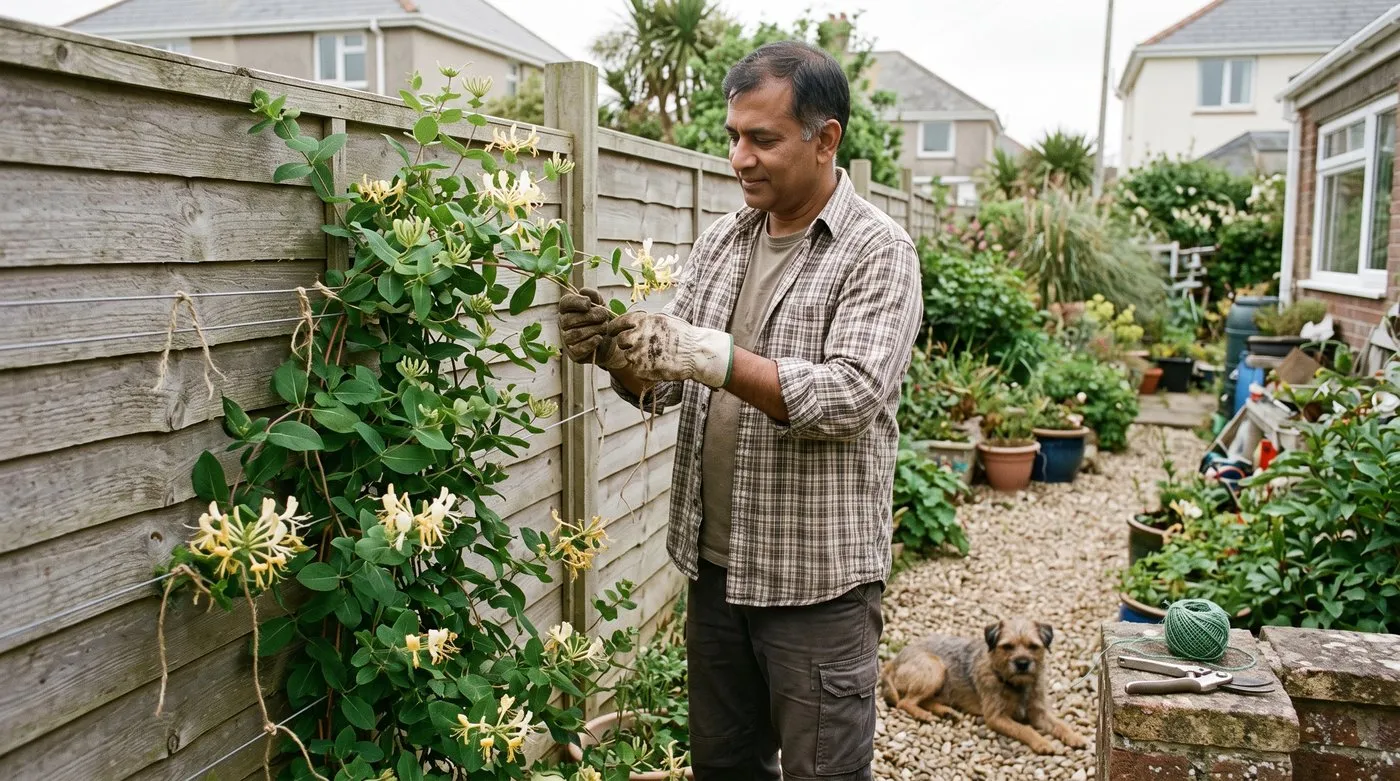
Honeysuckle twines fast in early summer, so untangle and tie it in before the stems knot together.
| Climber | How it holds on | Main training job |
|---|---|---|
| Climbing rose | Thorns, needs tying | Tie every stem; bend main stems sideways in winter |
| Clematis | Curling leaf stalks | Cut back hard in the first spring, then steer onto the wires |
| Honeysuckle | Twining stems | Tie main stems to the fan; untangle and thin after flowering |
| Wisteria | Strong twiner | One or two main stems along the wires; prune side shoots twice a year |
Honeysuckle twines so fast in early summer that a missed few weeks leaves a knot you can only cut out. The guide to growing honeysuckle covers the thinning that keeps it open. Clematis has its own pruning groups, explained in the guide on how to prune clematis by group. Wisteria gets very heavy with age, so check its wires and fixings every year.
Common mistakes when training climbers
- Planting tight against the wall. The soil there is dry. Plant 30-45cm out and lean the plant in on canes.
- Letting stems grow straight up. You get flowers only at the top and bare stems below. Fan them out early.
- Tying too tightly. Ties bite into stems as they thicken. Leave slack and check twice a year.
- Leaving it for a season. Stems that harden upright are hard to bend later. Little and often is easier.
- Fixing wires to fence panels. Thin panels can’t take the weight. Use the posts.
Frequently asked questions
How far apart should wires be for climbing plants?
About 45cm apart, with the lowest wire roughly 45cm above the soil. Fit a vine eye every 1.2-1.8m along each row, plus one at each end, so the wire can’t sag under a mature plant.
What is the best way to tie in a climbing plant?
Use soft garden twine tied loosely in a figure of eight. The twine crosses between stem and wire, so they don’t rub. Leave a finger’s width of slack and check ties each spring and late summer.
Why does horizontal training produce more flowers?
Bending a stem sideways makes the buds along it grow and flower. On an upright stem, the tip takes the lead and most flowers form at the top, out of sight.
When should I start training a new climber?
Straight after planting, while the shoots are soft and bendy. Fan them out onto canes and tie them loosely. A stem left to grow stiff and upright for a season is much harder to bend later.
Do self-clinging climbers like ivy need wires?
No, self-clingers grip the wall on their own. Ivy, climbing hydrangea and Virginia creeper hold on with aerial roots or sticky pads. Roses, clematis, honeysuckle and wisteria all need wires, mesh or trellis.
Can I train a climber on a fence instead of a wall?
Yes, fix vine eyes into the fence posts and run wires between them. Posts are much stronger than thin panels. Check the fence is sound first, as a heavy climber adds a lot of weight in wind.
Now your climber has a framework, read the guide to fast-growing climbers for fences and walls for more plants to fill the wires, or browse more how-to guides.
Our team produces practical UK gardening guidance from source research, contributor records and established horticultural practice. Editorial standards are overseen by Matt W.


