
Key takeaways
- Keep the roots cool and shaded and let the stems climb into sun
- Native honeysuckle smells strongest in the evening, so plant it near a seat or window
- Plant about 45cm from a wall or fence and mulch thickly
- Prune native honeysuckle after flowering in late summer
- Winter honeysuckle is a shrub with scented flowers from November to March
- Honeysuckle is brilliant for moths, bees and nesting birds
Honeysuckle is one of the loveliest plants in a British garden. Catch the scent of Lonicera periclymenum drifting across the garden on a warm July evening and you’ll know why people love it. It’s great for wildlife, and it’s easy to grow once you know its one secret: cool roots, sunny top. Our native honeysuckle is also the main food plant for the caterpillars of the white admiral, one of our rare woodland butterflies.
Here’s how to pick a honeysuckle, plant it, train it and prune it. For more climbers to grow alongside it, see our guide to the best climbing plants for UK gardens.
Which honeysuckle should I grow?
Honeysuckles come as climbers and as shrubs, and they’re grown and pruned quite differently. So it’s worth knowing which one you’ve got.
 A mix of honeysuckles, from creamy native types to bright coral hybrids.
Native honeysuckle (woodbine), Lonicera periclymenum
Our native honeysuckle is the best for wildlife and one of the most rewarding to grow. It’s a vigorous twining climber that flowers from June to September. The flowers are creamy white and yellow, flushed pink-purple outside, and the sweet scent gets much stronger after dusk. That’s when the moths come calling.
Some good named forms:
- ‘Belgica’ (Early Dutch): Flowers in May and June, often with a second flush later. Red-purple outside, cream inside. Lovely scent.
- ‘Serotina’ (Late Dutch): Flowers later, from July to October, in deeper purple-red. Great for stretching the season.
- ‘Graham Thomas’: Creamy flowers from summer into autumn. Very fragrant and long-flowering.
- ‘Scentsation’: Chosen for its strong scent, with creamy flowers through summer.
The RHS lists many more, but these are reliable and easy to find.
Japanese honeysuckle, Lonicera japonica
An evergreen or semi-evergreen climber that grows even more strongly than the native type. Its creamy flowers turn yellow as they age and keep coming from June to October. ‘Halliana’ is the one you’ll see most often, and it’s nicely scented.
It’s fully hardy, and it’s great for covering a big structure quickly. But it can swamp a small support or scramble into trees. Keep it in check with a yearly trim, and don’t plant it where it can escape into hedgerows.
Bright-flowered honeysuckles, L. × brownii and L. × tellmanniana
These are grown for their colourful flowers rather than scent. L. × brownii ‘Dropmore Scarlet’ has orange-red trumpets from June to September, and bees love it. L. × tellmanniana has golden-yellow flowers from May to July but no real scent. Both are fully hardy and smaller than the native type.
Winter honeysuckle, Lonicera fragrantissima
This one’s a shrub, not a climber. It makes a spreading bush about 2m high, with small creamy flowers on bare stems from November to March. And the scent is amazing: a strong lemony perfume that carries on a still winter day.
Plant it by a path, a door or a bench you use in winter, and it’ll earn its place. It won’t climb a fence, so grow it as a shrub in a border.
The Woodland Trust has more on our native honeysuckle and the wildlife it supports.
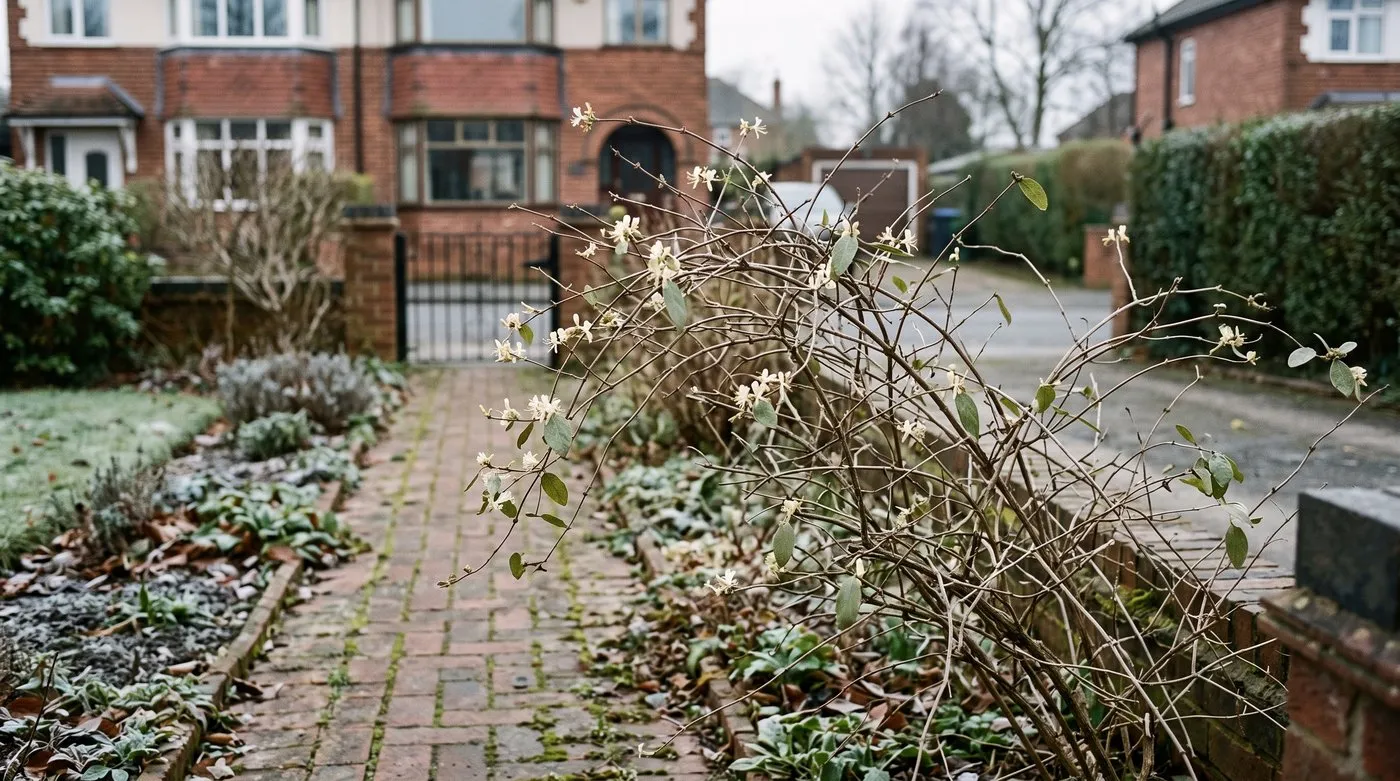
Plant winter honeysuckle by a path or door you use in winter. Its lemony scent carries a long way on a still day.
Honeysuckle comparison table
| Type | Climber or shrub | Scent | Flowers | Wildlife |
|---|---|---|---|---|
| Native honeysuckle (woodbine) | Climber | Very strong, evenings | June to September | Moths, bees, birds |
| ’Belgica’ | Climber | Strong | May to June, plus later | Moths, bees, birds |
| ’Serotina’ | Climber | Strong | July to October | Moths, bees, birds |
| ’Graham Thomas’ | Climber | Strong | Summer to autumn | Moths, bees, birds |
| Japanese ‘Halliana’ | Evergreen climber | Medium | June to October | Bees, hoverflies |
| ’Dropmore Scarlet’ | Climber | None | June to September | Bumblebees |
| L. × tellmanniana | Climber | None | May to July | Bees |
| Winter honeysuckle | Shrub | Very strong, lemony | November to March | Early bumblebees |
Where to plant honeysuckle
The golden rule: roots in cool, moist shade, stems in sun. In the wild, honeysuckle grows through hedges with its roots on the shady woodland floor. Copy that by planting where the base is shaded by a wall, paving or a low shrub, while the stems climb into sun.
South, west and east-facing walls and fences all work well. A south-west fence is close to perfect.
Native honeysuckle copes with more shade than most climbers and will grow on a north wall, though it flowers less there. L. × tellmanniana likes some shade and does well on an east-facing wall.
Avoid open, sunny spots where the roots bake. That’s the quickest way to get mildew, weak growth and few flowers.
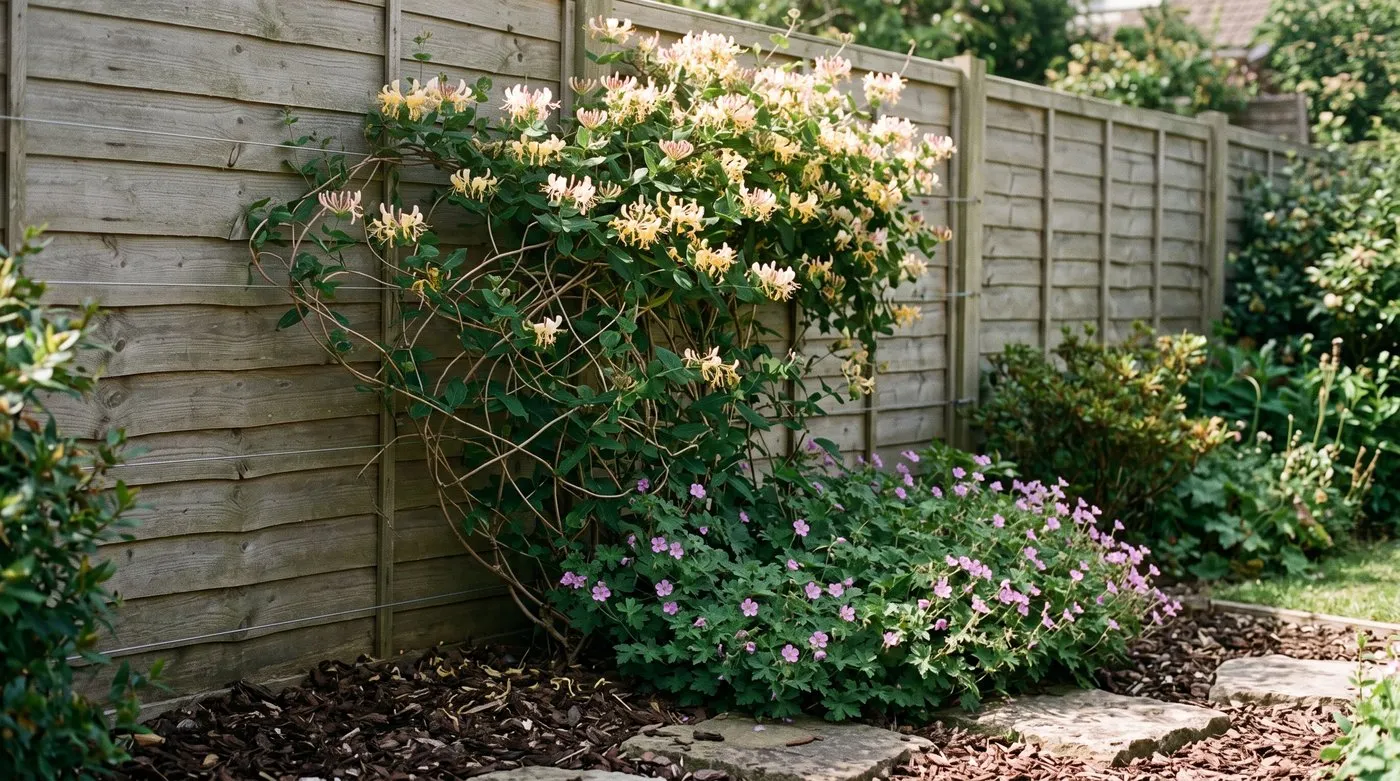
Keep the roots cool and the top in sun. A low plant or a few paving slabs over the base does the job nicely.
How to plant honeysuckle
Plant pot-grown honeysuckle from autumn to spring. October and November are ideal, as the soil is still warm and roots settle over winter. Spring planting is fine too, as long as you keep it watered through its first summer.
Planting step by step
- Dig a hole about 45cm wide and deep, about 45cm out from the wall or fence. The soil right at the base of a wall stays very dry.
- Mix plenty of garden compost or leaf mould into the soil you dug out.
- Stand the pot in a bucket of water for a while to soak the roots.
- Lean the plant towards the wall so the stems head for the support.
- Plant at the same depth it was in the pot.
- Fill back in, firm gently and water well.
- Mulch thickly with bark or compost, keeping it off the stems. This is the most important step for keeping the roots cool.
- Tie the main stems loosely to the support with soft twine.
In very dry summers, give honeysuckle a good soak once a week rather than little and often. This encourages deep roots.
How to train honeysuckle on arches, fences, and pergolas
Honeysuckle twines around supports by itself, so you don’t need to tie it every few centimetres. It does need something to grab, though, and spreading out the young stems makes a big difference to how full it looks.
Training on a trellis or fence wires
Fix trellis a few centimetres off the wall using spacers, or run horizontal wires about 30cm apart. The gap lets air flow and makes it easy to weave stems in. As it grows, guide new shoots sideways rather than straight up. Sideways stems make more side shoots, and more side shoots mean more flowers.
Training over an arch
An arch over a path is a perfect home for honeysuckle, as you get the scent right at nose height. Train a stem or two up each side and tie them in loosely. Later, guide them over the top so they spill down both sides. After a few years it looks wonderful and only needs a light yearly trim.
For a longer season, plant ‘Belgica’ on one side and ‘Serotina’ on the other. Together they flower from May to October.
 Tie stems in sideways along a support and you’ll get more flowers.
Training on a pergola
Let two or three main stems climb each post, then spread along the beams. Once the framework is in place it covers the beams with little help. Plant a fast-growing climber such as clematis or a climbing rose on the other posts for more colour.
Letting it scramble through a hedge
Native honeysuckle is very happy rambling through a hedge or big shrub, just as it does in the wild. No training needed, and birds love nesting in the tangle. Hawthorn, blackthorn, hazel and big shrub roses all make good hosts.
Honeysuckle pruning, by species
The key is knowing when each type flowers, so you don’t cut off this year’s blooms.
Pruning native honeysuckle and the bright-flowered hybrids
These flower on side shoots from a framework of older stems. You’re aiming to keep the framework, clear out the tangle and encourage fresh flowering shoots.
When: Late summer, straight after flowering.
How:
- Remove any dead, damaged or diseased stems.
- Cut flowered side shoots back to two or three buds.
- Take out about a third of the oldest, most crowded stems, down to the ground or to a young shoot lower down. This stops it becoming a tangle with flowers only at the top.
- Tie in new shoots to fill any gaps.
Rescuing an overgrown plant: If it’s a woody tangle with flowers only at the top, cut the whole thing back hard to about 60cm in late winter. It’ll grow back strongly. Feed and mulch it in spring.
Pruning Japanese honeysuckle
L. japonica flowers on this year’s growth, so trim it in spring to keep it to size and thin out crowded stems.
Pruning winter honeysuckle (L. fragrantissima)
Prune straight after flowering, in February or March. Cut flowered stems back to strong young growth and lightly shape the bush. Don’t prune in autumn, because the stems are already carrying the winter flower buds. Our guide on how to prune shrubs covers the general rules.
Pruning calendar by type
| Type | When to prune | What to do | Hard rescue prune |
|---|---|---|---|
| Native honeysuckle | Late summer, after flowering | Shorten flowered shoots, remove a third of old stems | Late winter, to about 60cm |
| ’Serotina’ | Autumn, after flowering | As above | Late winter, to about 60cm |
| Japanese ‘Halliana’ | Spring | Thin crowded growth, trim to size | Spring, to about 60cm |
| ’Dropmore Scarlet’ | Late summer, after flowering | Shorten flowered shoots | Late winter, to about 60cm |
| L. × tellmanniana | Summer, after flowering | Shorten flowered shoots | Late winter, to about 60cm |
| Winter honeysuckle | February to March, after flowering | Cut back flowered stems, shape lightly | Spring, by about half |
Honeysuckle scent, when is it strongest?
Native honeysuckle smells strongest in the evening and at night. That’s because it’s pollinated by moths, so it saves its best perfume for after dark. In the middle of a sunny afternoon you may barely notice it.
 A little care after flowering keeps honeysuckle full of flowers, and full of evening scent.
To get the most from the scent, plant it near:
- A patio or bench you use in the evening
- A bedroom window you open in summer
- A path you walk at dusk
- Your front door
Placing honeysuckle for its evening scent is one of the best moves in a scented garden. On a warm night you may even spot hawk-moths hovering at the flowers, which is quite a sight.
Honeysuckle wildlife value
Native honeysuckle is a superstar for UK wildlife. Its thick, twining stems make safe nesting spots for small birds. Moths sip nectar through the night and bumblebees visit by day. In late summer and autumn, birds eat the red berries.
- Moths: The long flower tubes suit long-tongued moths such as hawk-moths.
- Bees: Bumblebees visit during the day. Some short-tongued bees cheat by biting a hole at the base of the flower.
- Birds: Warblers and other small birds nest in dense honeysuckle, and thrushes and finches eat the berries.
- Butterflies: White admiral caterpillars feed on the leaves.
Common honeysuckle problems
Aphids
Honeysuckle aphids curl and yellow the leaves at the shoot tips from late spring. They hide inside the curled leaves, so sprays don’t reach them anyway. Just pinch off the affected tips. Blue tits love hunting them, so a healthy plant in a wildlife-friendly garden rarely suffers much.
Powdery mildew
The most common problem, especially on plants with dry roots and poor air flow. A white powdery coating appears on leaves, usually from July. Prevention is best: mulch deeply to keep roots cool and moist, give the plant some air, and water the soil, not the leaves.
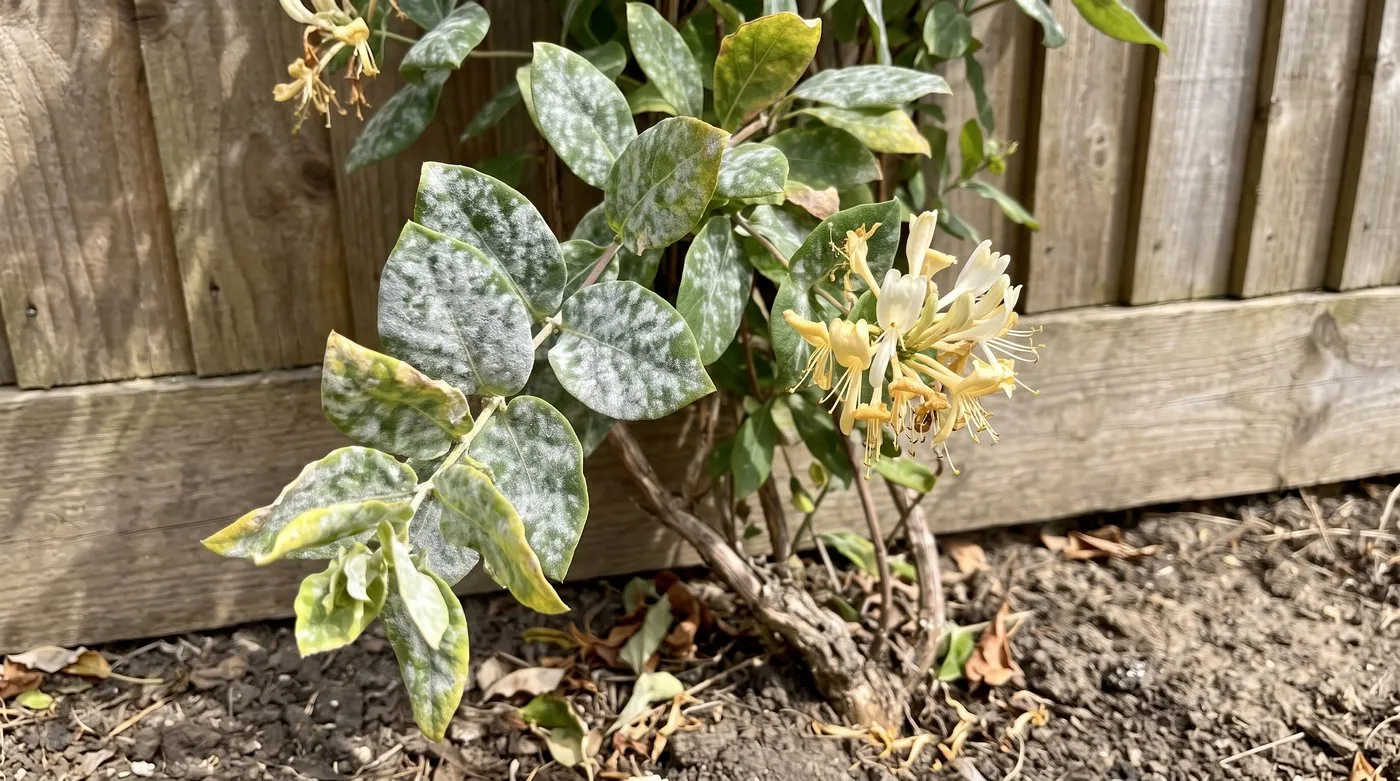
Powdery mildew is worst on plants with dry, baking roots. A thick mulch and a deep weekly soak in dry spells help a lot.
No flowers
Usually one of three things. Too much shade. Pruning at the wrong time, which can remove this year’s flowering shoots. Or too much feed, often from lawn fertiliser or lots of manure. Switch to a tomato feed from May to encourage flowers.
Bare at the bottom
This is normal in older plants, as honeysuckle grows from the tips and the base turns woody. Take out a third of the oldest stems each year, and tie some stems in low down to cover the base. A low shrub in front can hide bare stems too.
Frequently asked questions
When does honeysuckle flower in the UK?
Native honeysuckle flowers from June to September. ‘Belgica’ starts in May and ‘Serotina’ carries on into October. Japanese honeysuckle flowers from June to October. Winter honeysuckle, a shrub, flowers from November to March.
How fast does honeysuckle grow?
Fast, once it’s settled in. Expect fairly slow growth in the first year while the roots get going. From the second year it picks up speed, and Japanese honeysuckle is the quickest of all. With cool roots and a sunny top, native honeysuckle will cover an arch in a few years.
Does honeysuckle need full sun?
It likes its stems in sun but its roots in cool shade. Plant it behind low paving, a wall or a small shrub so the roots stay shaded, and let it climb up a sunny south, west or east-facing support. L. × tellmanniana is happy in more shade than most.
How do I prune honeysuckle?
Prune native honeysuckle after flowering, in late summer. Cut flowered side shoots back to two or three buds, take out about a third of the oldest stems and tie in new growth. Trim Japanese honeysuckle in spring. Prune winter honeysuckle just after it flowers, in February or March.
Is honeysuckle good for wildlife?
Yes, native honeysuckle is one of the best garden plants for wildlife. Moths visit the flowers at night and bumblebees by day. Birds eat the red berries in autumn and nest in the thick stems. It also feeds the caterpillars of the white admiral butterfly.
What is the most fragrant honeysuckle for UK gardens?
‘Graham Thomas’ and ‘Belgica’ are two of the most fragrant. Both are forms of our native honeysuckle, with a sweet scent that is strongest in the evening. ‘Belgica’ flowers in late spring and early summer, and ‘Graham Thomas’ from summer into autumn. For winter scent, grow winter honeysuckle.
Why is my honeysuckle not flowering?
Usually too much shade, too much feed or pruning at the wrong time. Pruning hard in spring can remove this year’s flowering shoots. Rich feeds and lawn fertiliser give you leaves instead of flowers, so switch to a tomato feed from May. In deep shade, flowering drops right off.
More climbers and scented plants
Our team produces practical UK gardening guidance from source research, contributor records and established horticultural practice. Editorial standards are overseen by Matt W.


