Key takeaways
- Match the climber to the wall: sun-lovers on south and west walls, tough self-clingers on north walls
- Ivy, Hydrangea seemannii and Pileostegia cling on by themselves and need no wires
- Star jasmine, Clematis armandii and evergreen honeysuckle need wires or trellis
- Plant about 45cm out from the wall, where the soil gets rain
- Prune most evergreen climbers just after flowering, and leave dense ones alone in the nesting season
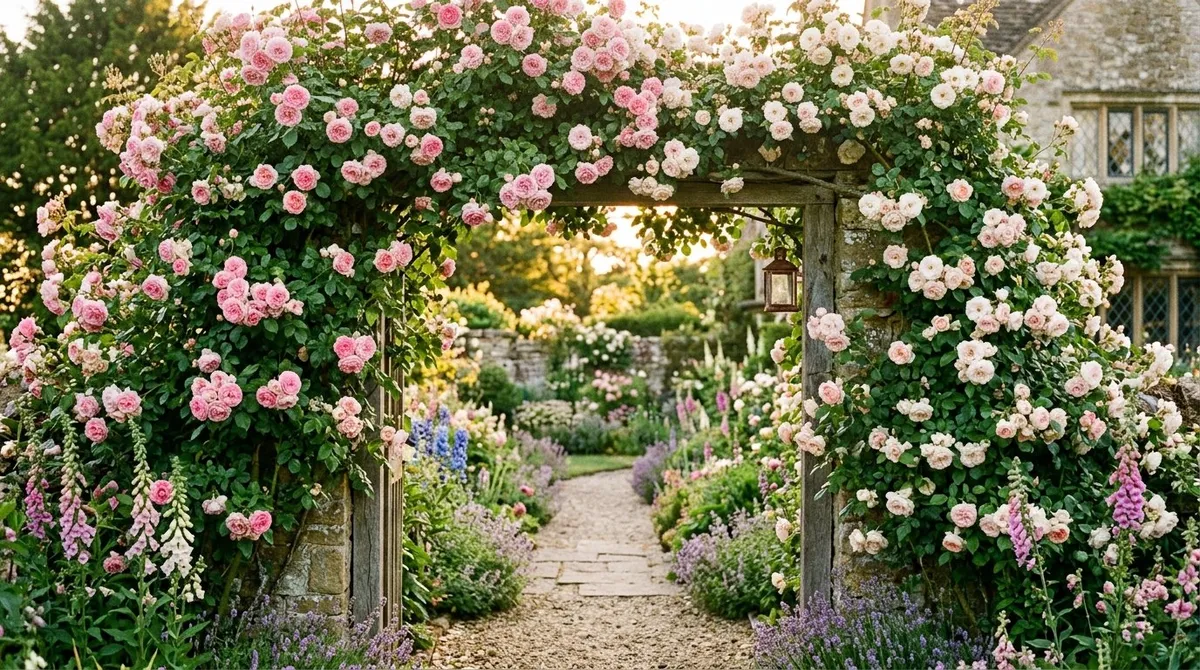
Evergreen climbers keep your walls and fences green all year. Deciduous climbers leave things bare from November to April, which means five months of plain brick, naked fence panels and not much privacy. An evergreen climber fixes all three at once. Here’s how to pick the right one for your wall and get it growing.
How evergreen climbers attach and why it matters
How a climber holds on tells you whether you need wires, trellis, or nothing at all. Getting this wrong is the most common reason climbers fail.
Self-clinging climbers stick to walls and fences with tiny aerial roots. Ivy, Hydrangea seemannii and Pileostegia viburnoides all do this, so you don’t need any supports. The downside is that pulling them off later takes paint with it, and they can damage soft, crumbling mortar on old houses.
Twining climbers wrap their stems around supports. Evergreen honeysuckle (Lonicera henryi), star jasmine and Akebia quinata are twiners. Give them horizontal wires 30-45cm apart, or a trellis. Fix wires a few centimetres out from the wall with vine eyes so air can get behind the leaves.
Scramblers don’t hold on at all. Pyracantha and Solanum laxum ‘Album’ need tying to wires or trellis with soft twine as they grow.
A quick wall check: On sound brickwork, self-clingers rarely cause trouble. On crumbling mortar, the roots creep into cracks and widen them. Check the mortar first, and repoint any gaps before planting a self-clinger.
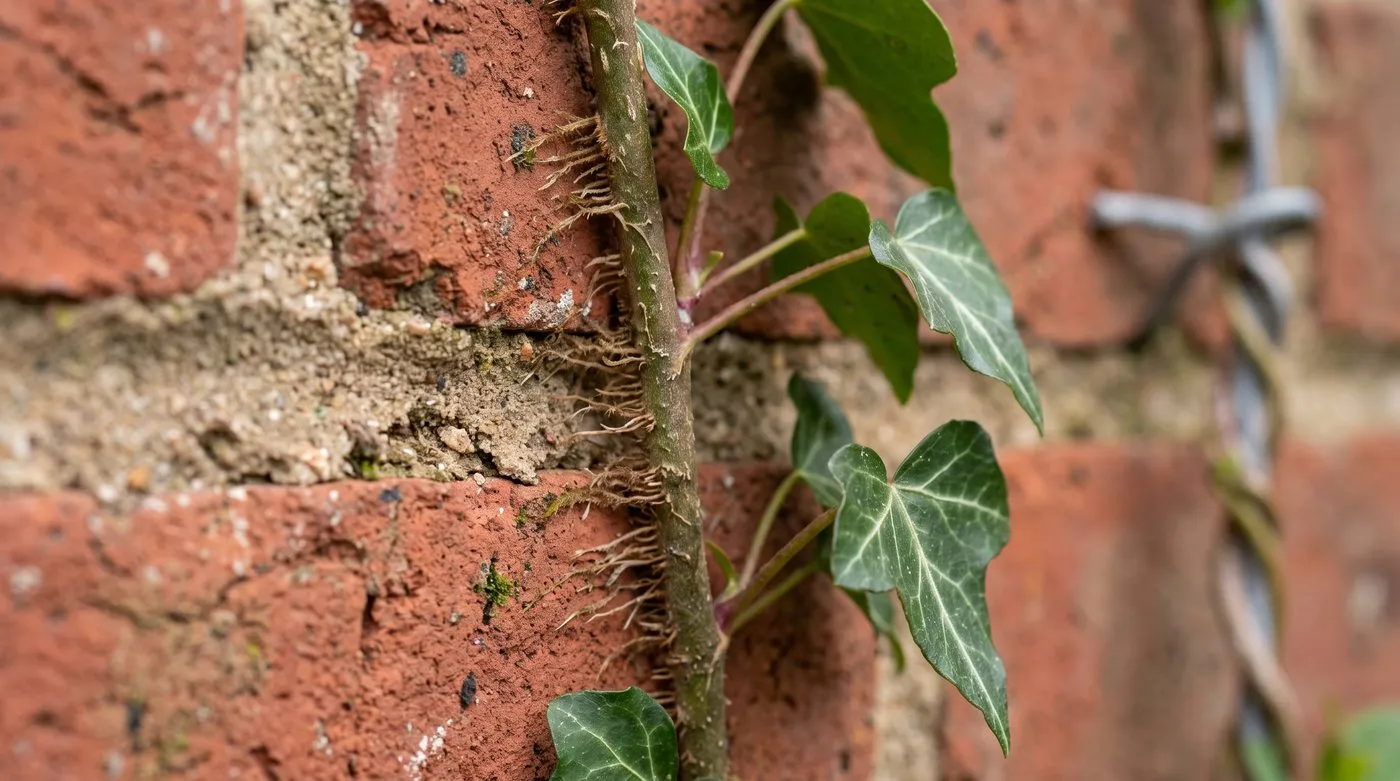
Self-clingers like ivy hold on with tiny aerial roots and need no supports. Check the mortar is sound first, as the roots can widen cracks in crumbling joints.
How wall aspect changes what will grow
The direction a wall faces makes a huge difference. A sunny south wall is much warmer than a north wall in the same garden, and that decides which climbers get through winter.
South-facing walls soak up sun all day and give off warmth at night. That’s why slightly tender climbers like star jasmine are happy here when they’d struggle in the open.
West-facing walls get the warm afternoon sun and suit most evergreen climbers. They catch a lot of rain from the south-west, so make sure the base drains well.
East-facing walls get morning sun, which can be harsh in winter. Frozen leaves that thaw too fast get scorched. Clematis armandii and star jasmine often brown on east walls after a hard frost, so keep tender climbers off them.
North-facing walls get little sun and stay cool and damp. Stick to the tough ones here: ivy, Hydrangea seemannii, Pileostegia viburnoides and climbing euonymus (Euonymus fortunei).
 Horizontal wires 30-45cm apart give twining climbers something to hold on to for good.
Evergreen climbers compared at a glance
| Climber | Best wall | How it climbs | Speed | Flowers or berries |
|---|---|---|---|---|
| Star jasmine | South, west | Twines, needs wires | Slow at first | Scented white, Jun-Aug |
| Clematis armandii | South, west, sheltered | Twines, needs wires | Fast | Scented white, March |
| Ivy | Any, including deep shade | Self-clinging | Fast once settled | Flowers autumn, berries winter |
| Hydrangea seemannii | North, east | Self-clinging | Slow | Creamy, July |
| Pileostegia | Any, including shade | Self-clinging | Slow | Creamy, September |
| Evergreen honeysuckle | Any | Twines, needs wires | Fast | Small yellow and red, Jun-Jul |
| Pyracantha | Any | Tie to wires | Medium | White flowers, then berries all winter |
| Climbing euonymus | Any, low walls | Self-clinging | Slow | Colourful leaves |
Star performers for every situation
Star jasmine (Trachelospermum jasminoides) for scented south-facing walls
Star jasmine is the evergreen climber most people ask for, and it’s easy to see why. Glossy dark leaves often turn bronze-red in cold weather, and white, pinwheel flowers fill the garden with scent from June to August. It twines, so it needs wires or trellis.
Star jasmine in full flower on a south-facing wall, one of the best scented evergreen climbers
The catch is cold. It’s happy down to about -10C on a sheltered south or west wall, but it suffers in exposed spots or on east walls. After a hard winter it may look a bit brown, but it usually recovers by late spring.
It’s slow for the first few years, so buy a bigger plant if you want cover sooner. It pairs beautifully with other fragrant plants, so see our best scented plants for UK gardens for ideas. Our jasmine growing guide covers the whole family.
Clematis armandii for early spring flowers
Clematis armandii is the evergreen clematis you’ll find in most garden centres. It flowers in March, well ahead of other clematis, with clusters of white or pale pink stars and a sweet vanilla scent. The long, leathery leaves look good all year.
Clematis armandii flowers in March, the earliest of the evergreen climbers
It grows fast once settled and can reach 5-6m. Give it a south or west wall out of cold north-east winds.
Prune straight after flowering in April or May, cutting flowered stems back to a strong pair of buds. It flowers on last year’s stems, so pruning at any other time cuts off next spring’s flowers. Our guide on how to grow clematis has more.
Ivy (Hedera helix) for any aspect including full shade
Common ivy is the toughest evergreen climber you can grow. Sun, deep shade, dry soil, wet soil, cold: it copes with the lot. It’s a native plant, and great for wildlife. Birds eat the berries in late winter and wrens and robins nest in it.
Young ivy has the familiar lobed leaves and climbs. Once it reaches the top of its support, it changes to plain, diamond-shaped leaves and starts to flower in autumn and berry over winter.
 Ivy gives full cover even on a shady north-facing wall.
Hydrangea seemannii for shaded walls
Hydrangea seemannii is the evergreen cousin of the familiar climbing hydrangea. It keeps its thick, leathery leaves through winter and has creamy white lacecap flowers in July. It clings by itself to brick, stone and wood.
Hydrangea seemannii is one of the few self-clinging evergreens that flowers on a shady wall
It’s happy on north and east walls, ideally out of the coldest winds. It’s slow to get going and may sit still for a couple of years while it builds roots, so be patient. A bigger plant gets you there sooner. For shade-loving partners, see our best shrubs for shade.
Pileostegia viburnoides for the lowest maintenance option
Pileostegia viburnoides deserves to be far better known. It’s evergreen, clings by itself, copes with any wall including shady ones, and flowers in September when little else does. Bees love the frothy cream flowers.
Its only drawback is speed. It grows slowly, but if you can wait, it’s about as trouble-free as climbers get.
Supporting evergreen climbers for specific roles
Holboellia coriacea for scented spring cover
Holboellia is a vigorous twining climber that can reach 6-8m. Its three-part leaves give dense cover, and in April it has small, sweetly scented flowers, purple on some and greenish-white on others. Give it strong wires to climb.
Akebia quinata (chocolate vine) for vigour and scent
Akebia quinata is semi-evergreen. It keeps its leaves in mild winters and in sheltered town or coastal gardens, but drops them in hard frost and grows back quickly in spring.
It’s vigorous and can reach 10m or more. The dark purple flowers in April and May have a lovely sweet, chocolatey scent. It copes with any aspect but needs a strong support, as the weight of growth can pull down flimsy trellis.
Lonicera henryi (evergreen honeysuckle) for wildlife screening
Evergreen honeysuckle (Lonicera henryi) gives thick, year-round leaves and small yellow and red flowers in June and July. It twines, grows fast, and handles any aspect including shade.
Bees and moths visit the flowers, small birds nest in the dense growth, and black berries follow in autumn. It’s less showy than common honeysuckle, but far better as a year-round screen. It’s also one of the cheapest evergreen climbers to buy.
Pyracantha for berries and security
Pyracantha (firethorn) is really a shrub, but it’s often trained flat against a wall on wires. It makes a dense evergreen screen with white flowers in May and June, then masses of red, orange or yellow berries from autumn through winter. The sharp thorns make it popular under windows.
It’s tough and copes with any aspect. Trim it after flowering to keep its shape, taking care to leave the clusters that will turn into berries.
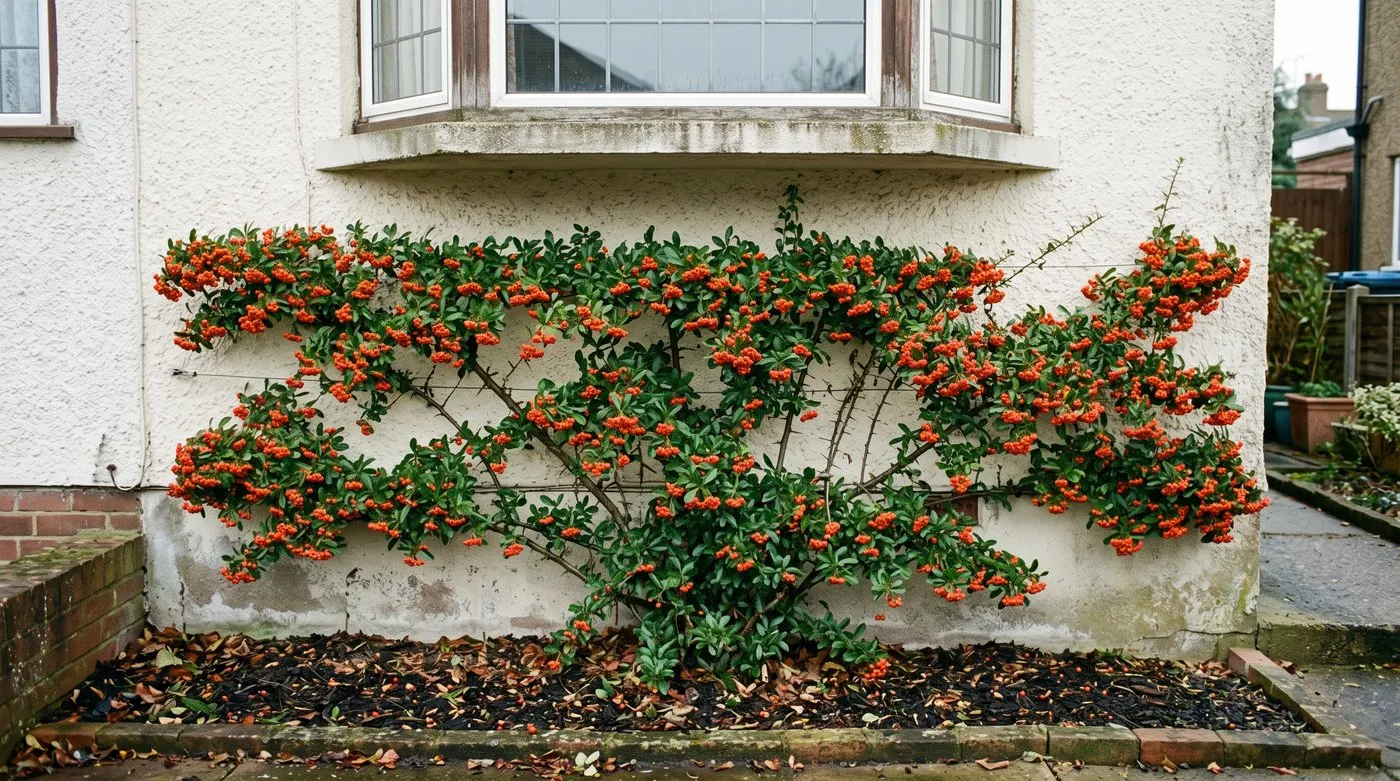
Pyracantha makes a thorny evergreen screen under windows. Trim after flowering but keep the flower clusters, as they become the winter berries.
Euonymus fortunei for low walls and ground cover
Climbing euonymus (Euonymus fortunei) is usually grown as ground cover, but it will slowly cling its way up a wall to 3m or so. Varieties like ‘Silver Queen’ (white-edged leaves) and ‘Emerald Gaiety’ (cream and green) brighten up low walls and old tree stumps.
It’s very tough and happy anywhere. It’s perfect at the base of taller climbers, hiding their bare lower stems with a neat evergreen skirt.
 Pairing a fast grower like evergreen honeysuckle with a slower scented climber gives cover sooner and interest for longer.
Solanum laxum ‘Album’ for long summer flowering
Solanum laxum ‘Album’ (potato vine) has clusters of white, yellow-centred flowers from June to October, one of the longest flowering seasons of any climber. It keeps its leaves through mild winters but drops them in hard frost, so give it a sheltered, sunny wall.
Month-by-month care calendar
| Month | What to do |
|---|---|
| January | Check ties and supports after winter storms. Leave frost-damaged leaves for now. |
| February | Clip ivy hard before birds start nesting. Mulch around the base of all climbers with compost. |
| March | Plant new evergreen climbers. Clematis armandii starts flowering. Feed established climbers with a general fertiliser, following the pack. |
| April | Tie in new growth. Prune Clematis armandii straight after flowering. Holboellia and Akebia flower. |
| May | Pyracantha flowers. Snip out any star jasmine shoots hit by late frost. Water new climbers weekly. |
| June | Star jasmine starts flowering. Train new shoots sideways along wires for wider cover. Evergreen honeysuckle flowers. |
| July | Hydrangea seemannii flowers. Trim Pyracantha after flowering, keeping the berry clusters. Feed climbers in pots every two weeks with tomato feed. |
| August | Tidy star jasmine once flowering ends. Take cuttings of star jasmine, Hydrangea seemannii and Pileostegia. |
| September | Pileostegia flowers. A great month to plant, especially further north. |
| October | Pyracantha berries colour up. Ivy flowers, feeding late insects. Mulch before winter and water less. |
| November | Cover tender climbers like star jasmine and Solanum with fleece on frosty nights. Check wall fixings before winter gales. |
| December | Enjoy the green. Note which climbers look best in the cold for future planting. |
Why evergreen climbers fail and how to fix it
Most failures come down to three simple causes.
Wrong aspect for the species
Putting a sun-lover on a cold, shady wall is the classic slip. Star jasmine and Clematis armandii on a north or east wall will struggle and scorch. Check which way your wall faces before you buy, and use the table above to match the plant to the spot.
Planting in the rain shadow
The soil right at the foot of a wall or fence stays dry even in heavy rain, because the wall keeps the rain off. New climbers planted hard against the wall often die of thirst.
The fix is easy. Plant about 45cm out from the wall and lean the root ball towards it. The roots get moist soil, and the stems can still reach the wires. Mulch thickly to keep the moisture in.
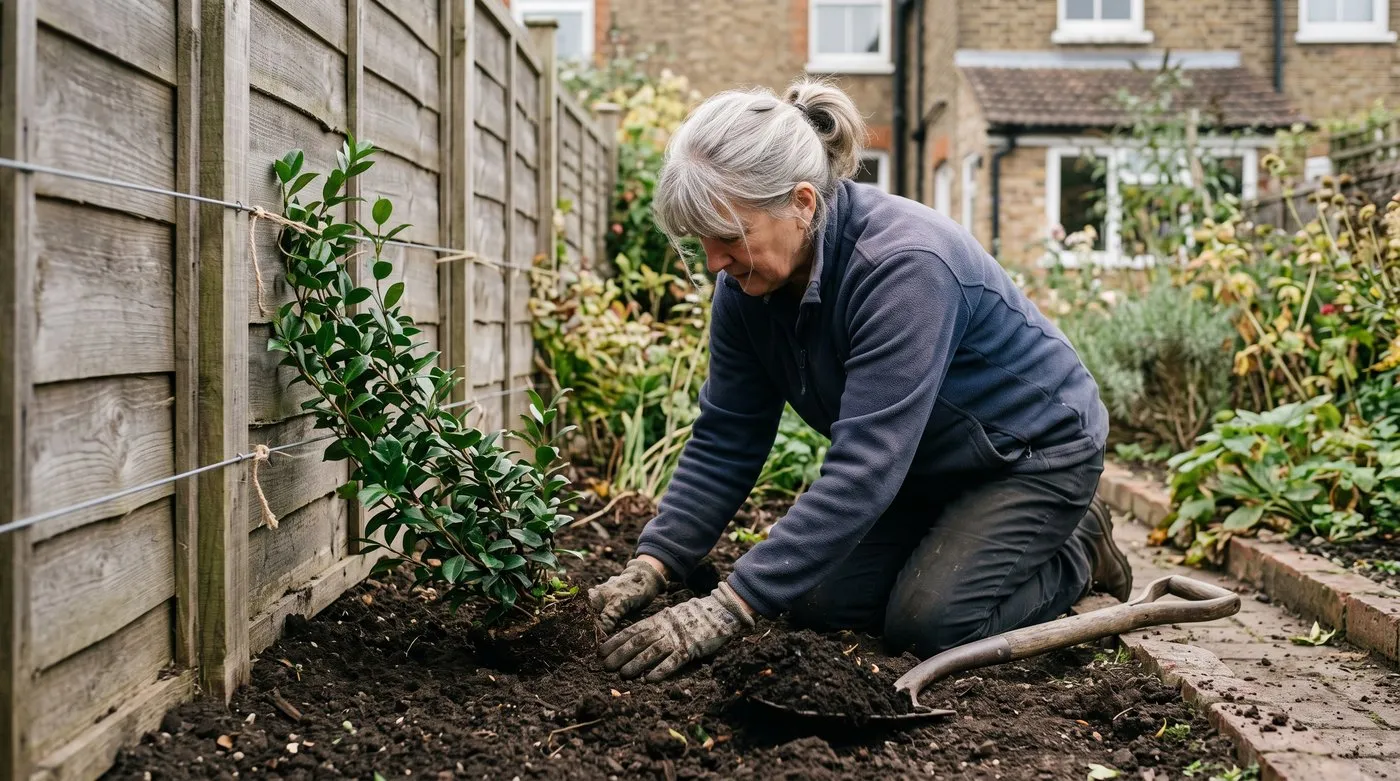
Soil right at the foot of a fence stays dry even in heavy rain. Plant about 45cm out and lean the root ball in, so the roots get moisture and the stems still reach the wires.
No support structure for twining species
Star jasmine, Clematis armandii and evergreen honeysuckle can’t grip smooth brick, wood or render. Without something to climb, they flop at the base. Fix horizontal galvanised wires 30-45cm apart on vine eyes, screwed into mortar joints or fence posts. Trellis panels work too and look a bit smarter.
Common mistakes with evergreen climbers
Mistake 1: Pruning Clematis armandii like other clematis
Clematis armandii flowers on last year’s stems. Pruning it in late winter, as you would summer clematis, removes every flower bud. Only prune it straight after flowering in April or May.
Mistake 2: Expecting fast results from star jasmine
Star jasmine is slow for its first few years, and plenty of people give up on it too soon. Buy the biggest plant you can and give it time. It’s worth the wait.
Mistake 3: Planting ivy directly against timber fences
Ivy roots can push between overlapping fence boards and force them apart. That’s not a problem on brick or stone, but on a wooden fence grow ivy on wires set 10-15cm in front, or choose evergreen honeysuckle instead.
Mistake 4: Ignoring the nesting season
It’s against the law to disturb nesting birds, and dense climbers like ivy and Pyracantha are favourite nesting spots from March to August. Clip ivy in February, before nesting starts. Check carefully for nests before trimming Pyracantha in summer.
Mistake 5: Skipping winter protection in the first year
Even hardy climbers are at risk in their first winter, before their roots have settled. Cover new star jasmine and other tender climbers with fleece on frosty nights, and take it off in the day.
What you’ll need for a 3m stretch of wall
A quick shopping list, so you don’t end up with too few plants or nothing to tie them to.
| Item | How much | Notes |
|---|---|---|
| Climber, small pot | One per 2-3m of wall | Cheaper, slower to cover |
| Climber, large pot | One per 1.5-2m of wall | Costs more, covers sooner |
| Galvanised wire | Three rows along the wall | For twining climbers |
| Vine eyes | One every 1.5m on each wire | Hold the wire away from the wall |
| Trellis panels | Instead of wire, if you prefer | Looks smarter |
| Garden compost | About two bags | To mix into the planting hole |
| Bark mulch | About one bag | Keeps moisture in |
For shady corners at ground level, our guide to the best plants for shade has options that sit nicely below climbers.
Month-by-month seasonal interest calendar
Every true evergreen keeps its leaves all year. This table shows when each one adds something extra.
| Month | Star jasmine | Clematis armandii | Ivy | Hydrangea seemannii | Pileostegia | Pyracantha | Akebia |
|---|---|---|---|---|---|---|---|
| Jan | Leaves | Leaves | Leaves + berries | Leaves | Leaves | Berries | Leaves |
| Feb | Bronze tints | Leaves | Leaves + berries | Leaves | Leaves | Berries | Leaves |
| Mar | Leaves | Flowers | Leaves | Leaves | Leaves | Leaves | Leaves |
| Apr | Leaves | Flowers | Leaves | Leaves | Leaves | Leaves | Flowers |
| May | Leaves | Leaves | Leaves | Leaves | Leaves | Flowers | Flowers |
| Jun | Flowers | Leaves | Leaves | Leaves | Leaves | Leaves | Leaves |
| Jul | Flowers | Leaves | Leaves | Flowers | Leaves | Leaves | Leaves |
| Aug | Flowers | Leaves | Leaves | Leaves | Leaves | Leaves | Leaves |
| Sep | Leaves | Leaves | Leaves | Leaves | Flowers | Leaves | Leaves |
| Oct | Leaves | Leaves | Flowers | Leaves | Leaves | Berries | Leaves |
| Nov | Leaves | Leaves | Flowers | Leaves | Leaves | Berries | Leaves |
| Dec | Leaves | Leaves | Leaves | Leaves | Leaves | Berries | Leaves |
Plant just three, Clematis armandii, star jasmine and Pyracantha, and you’ll have flowers or berries for most of the year.
Combining evergreen climbers for layered cover
One climber rarely covers a wall perfectly. Two or three with different heights and flowering times look much better.
Bottom layer (up to about 1.5m): Euonymus fortunei ‘Silver Queen’ or ivy makes a thick evergreen skirt that hides bare stems.
Middle (about 1.5-4m): Star jasmine, Clematis armandii or evergreen honeysuckle fills the main view with flowers and scent.
Top (above 4m): Akebia quinata or Holboellia coriacea runs along the top of a tall wall on wires, adding height.
 Low euonymus, mid-height jasmine and tall akebia together make a natural green wall.
Now you know which evergreen climbers suit your walls and fences, read our guide on how to grow wisteria for a beautiful deciduous climber to grow alongside them. For taller screening, our guide to the best trees for privacy covers trees that pair well with wall climbers.
Frequently asked questions
What is the best evergreen climber for a north-facing wall?
Ivy is the most reliable choice for a north wall. It clings by itself, copes with deep shade and grows on any soil. For something prettier, Hydrangea seemannii has creamy lacecap flowers in July and keeps its leaves all winter. Pileostegia viburnoides flowers in September and is just as happy in shade.
Will evergreen climbers damage my house walls?
Not if the wall is sound. On good brickwork, self-clinging climbers rarely cause problems. On old houses with soft, crumbling mortar, their roots can creep into cracks and widen them, so repoint first. Twining climbers like star jasmine grow on wires held away from the wall and never touch the brick.
Is star jasmine hardy enough for UK gardens?
Yes, on a sheltered, sunny wall it copes down to about -10C. In most of southern and central England it does well on a south or west wall. In colder or exposed spots, grow it in a large pot you can move somewhere sheltered in a long freeze. Older, woody plants handle cold better than young ones.
What is the fastest growing evergreen climber in the UK?
Common ivy is the quickest once it gets going. Clematis armandii is also fast on a sheltered, sunny wall, and evergreen honeysuckle isn’t far behind. Star jasmine is much slower. For a speed comparison that includes deciduous climbers, see our guide to fast-growing climbers for fences and walls.
How do I plant an evergreen climber against a fence?
Dig a hole about 45cm out from the fence. Make it twice as wide as the root ball and mix in some garden compost. Lean the root ball towards the fence and tie the stems to wires 30-45cm apart. Water well, mulch with bark or compost, and keep it watered through the first two summers.
Do evergreen climbers need pruning?
Most just need one light trim a year after flowering. Prune Clematis armandii in April or May and star jasmine once it finishes flowering in late summer. Clip ivy in February, before nesting. Pileostegia and Hydrangea seemannii need very little. Don’t trim dense climbers from March to August if birds might be nesting.
Can I grow evergreen climbers in pots?
Yes, star jasmine, ivy and evergreen honeysuckle all grow well in big pots. Use a large container and a loam-based compost such as John Innes No. 3. Feed every two weeks with tomato feed from April to August, and water often, as pots dry out fast. Wrap the pot in bubble wrap in winter to keep the roots from freezing.
Related reading
- Best Climbing Plants for UK Gardens, deciduous and evergreen climbers for every wall
- Fast-Growing Climbers for Fences and Walls, the quickest climbers when you need cover fast
- Best Plants for Shade, shade-lovers to plant below north-wall climbers
- Evergreen Shrubs for Year-Round Interest, evergreen shrubs to plant around the base of climbers
- Privacy Screening with Hedges and Trees, taller options when climbers alone aren’t enough
Our team produces practical UK gardening guidance from source research, contributor records and established horticultural practice. Editorial standards are overseen by Matt W.