Key takeaways
- Aucuba, sweet box and fatsia are the toughest picks for deep or north-facing shade
- Hydrangeas and camellias flower best with a few hours of brighter light
- Test your soil first, as several shade favourites need acid conditions
- Plant between October and March, avoiding frozen or waterlogged ground
- Under trees, mulch thickly and water each new shrub weekly in its first summer
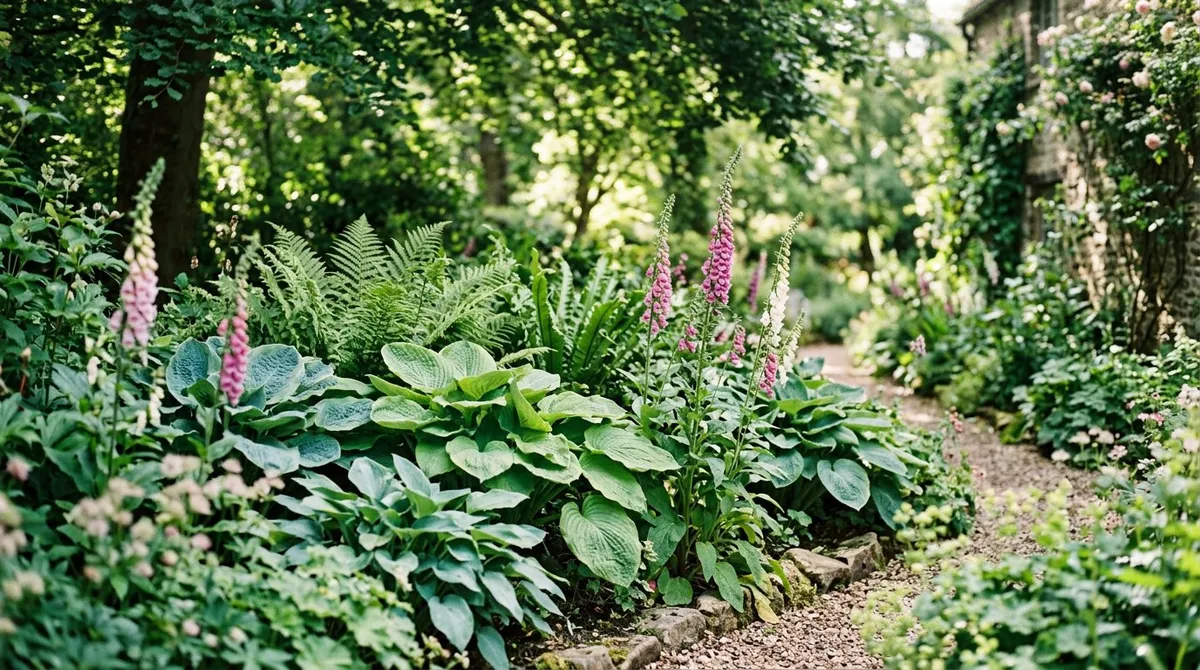
Every garden has a shady bit. Maybe it’s the strip down the side of the house, a bed under next door’s sycamore or a north-facing front garden that never sees the sun in winter. The good news is that plenty of shrubs actually prefer it there. Aucuba, sweet box, mahonia, fatsia, skimmia and hydrangeas are the dependable ones, and between them you can have leaves, flowers and scent all year round.
The RHS list of shrubs for shade is a useful extra reference. Below are 12 good picks, with their soil, size and flowering time, plus how to plant them so they actually get going. For a shady wall, garrya is worth a look for its winter catkins. And if you need perennials and ground cover to go underneath, start with our shade-plant guide.
How shade affects your shrubs
Before buying anything, have a proper look at what sort of shade you’ve got. “Shady” covers everything from a bright north wall to the bone-dry ground under a yew, and the plants that thrive in one will struggle in the other.
Types of shade in a UK garden
Part shade gets a few hours of direct sun, often in the morning, or bright light from open sky for most of the day. A north-facing wall with nothing tall opposite is typical. Most shade shrubs are happy here.
Dappled shade is what you get under light trees such as birch, where sunlight flickers through the leaves as they move. Hydrangeas, camellias and most woodland shrubs love it.
Deep shade is the ground right under dense evergreens like yew, holly and big conifers, or a narrow passage between two houses. Only a handful of shrubs cope with this, and few of them flower much.
Why shade shrubs grow more slowly
Less light means less food for the plant, so growth is slower. Shade-tolerant shrubs have adapted to make the most of what they get, which is why aucuba and sweet box carry on where other shrubs give up.
The flip side is that you need a bit of patience. A shrub in shade takes longer to fill out than the same plant in sun. Many shade shrubs are very long-lived, though. A camellia in the right spot can easily outlive the person who planted it.
 Shrubs growing under birch trees in dappled light, which most woodland shrubs love.
Why shade planting fails
When a shrub dies in a shady bed, people tend to blame the lack of light. Usually it’s something else: the soil, dryness or tree roots. All three can be fixed.
The wrong soil for acid-lovers
Camellias, rhododendrons, pieris and skimmia want acid soil. On chalky or limy ground their leaves go yellow between dark green veins and the plant slowly starves.
A lot of British soils are alkaline, especially across the chalk of southern and eastern England. Putting an acid-lover in that sort of ground is the most common shade-planting mistake, and an expensive one. The shrub often limps along for a year or two before giving up.
So test before you buy. A simple kit costs a few pounds and gives an answer in minutes. On alkaline soil, either stick to lime-tolerant shrubs such as aucuba, fatsia and mahonia, or make an acid planting pocket (there’s a step-by-step further down).
Dry shade under trees
Dry shade is the toughest spot in any garden. The tree canopy catches much of the rain, and the tree’s roots drink most of what gets through. Under a big oak or beech, the ground can be dust-dry in July while looking cool and damp from the patio.
In March, spread a bark mulch 7-10cm deep to hold in moisture. When planting, mix composted bark half and half with the soil from the hole. Then water each new shrub once a week through its first summer, a full 10-litre can each time. Once settled, most shade shrubs in a mulched bed will manage on their own.
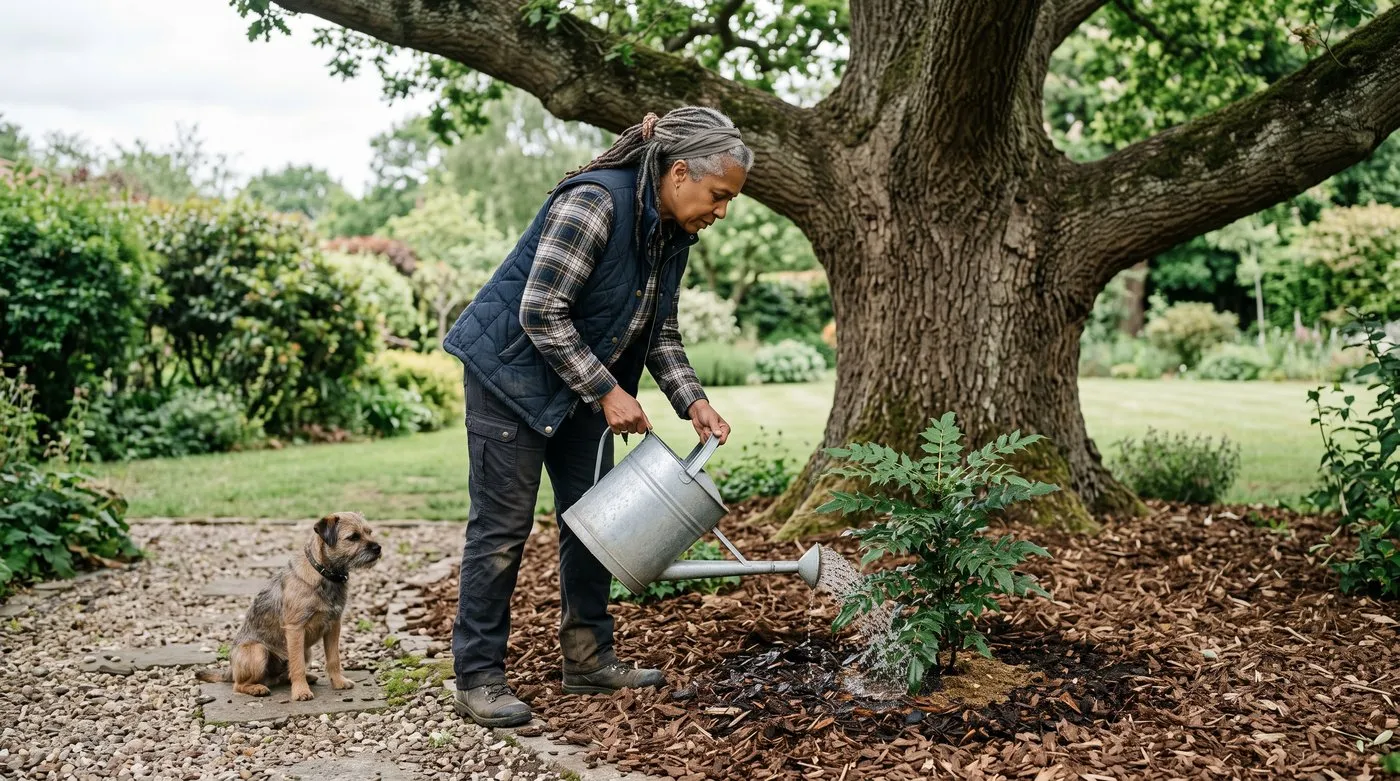
Tree canopies keep much of the rain off, so new shrubs need a full can each week in their first summer. Thick mulch holds the water in.
Tree roots
Tree roots fill the top layer of soil under the canopy, and a new shrub dropped in among them has to fight for every drop of water.
Plant at least 1m out from the trunk, where the roots are thinner and easier to work around. Dig a hole about 60cm wide and 45cm deep, steering round any thick roots rather than cutting them. Fill it with a half-and-half mix of composted bark and multi-purpose compost. That gives the shrub a comfortable start while it grows its own roots out into the surrounding soil.
The 12 best shrubs for shade UK
These run from the toughest deep-shade plants through to shrubs that need a brighter spot to flower well. Sizes and soil needs vary a little between varieties, so check the label before you buy.
Shade shrub comparison table
| Shrub | Shade | Flowers | When | Height | Soil | Evergreen | Good for |
|---|---|---|---|---|---|---|---|
| Aucuba japonica | Deep | Red berries | Mar-Apr (berries autumn) | 2-3m | Any | Yes | All-rounder |
| Sarcococca confusa | Deep | White, scented | Dec-Feb | 1-1.5m | Most | Yes | Winter scent |
| Fatsia japonica | Deep | White clusters | Oct-Nov | 2-3m | Most | Yes | Bold leaves |
| Mahonia x media | Deep to part | Yellow spikes | Nov-Jan | 2-3m | Most, chalk too | Yes | Winter colour |
| Skimmia japonica | Deep to part | White or pink | Mar-Apr | 1-1.5m | Acid | Yes | Small spaces |
| Camellia japonica | Part | Many colours | Feb-Apr | 2-4m | Acid | Yes | Spring show |
| Hydrangea macrophylla | Part | Blue, pink or white | Jun-Sep | 1.5-2m | Most | No | Summer colour |
| Pieris japonica | Part | White bells | Mar-Apr | 2-3m | Acid | Yes | Red spring leaves |
| Viburnum davidii | Part | White | Jun | 1-1.5m | Most | Yes | Ground cover |
| Daphne odora | Part | Pink, scented | Jan-Mar | 1-1.5m | Well-drained | Yes | Scent |
| Euonymus fortunei | Part | Hardly noticeable | Jun | 0.6-1m | Any | Yes | Edging |
| Cornus alba | Part | White | May-Jun | 2-3m | Most, wet too | No | Winter stems |
Shrubs for deep shade
Aucuba japonica, the spotted laurel, is about as tough as shade shrubs get. It puts up with very little light, almost any soil, traffic fumes and salty sea air. ‘Crotonifolia’ has leaves splashed with gold, which brightens a dark corner more than you’d expect. Female plants carry red berries through autumn and winter if there’s a male plant nearby. It’s fully hardy. For more ideas, see our guide to the best plants for shade UK.
Sarcococca confusa, or sweet box, should go by a front door or a path you use in winter. From December to February it opens tiny white flowers with a scent of honey and vanilla that carries several metres on a still day. It grows into a neat, rounded bush of 1-1.5m without any pruning, followed by glossy black berries. Fully hardy.
Fatsia japonica brings a touch of the jungle to a sheltered corner, with huge, glossy leaves shaped like a spread hand. In October and November it puts up creamy white flower clusters, which bees love late in the year, followed by black berries. Town gardens and seaside plots both suit it. It can reach 2-3m but takes a hard prune well. Keep it out of cold, drying winds, which brown the leaf edges.
 Aucuba and sweet box doing well in deep shade beside a north-facing wall.
Shrubs for part shade
Camellia japonica gives you glossy dark leaves all year and big white, pink or red flowers from February to April, just when the garden needs cheering up. It needs acid soil and shelter from early morning sun. That last point catches people out: frozen buds that thaw too quickly in the first sun of the day turn brown and drop. A north- or west-facing wall avoids the problem. Growth is slow, eventually reaching 2-4m. For more, see our guide on how to grow camellias UK. If you want a specific variety, ‘Donation’ is a popular one with semi-double pink flowers in late winter and spring.
Hydrangea macrophylla is probably the most planted shade shrub in Britain. Mophead and lacecap types flower from June to September in part shade. The flower colour depends on your soil: acid soil turns them blue, chalky soil turns them pink and anything in between gives mauve. ‘Endless Summer’ also flowers on new growth, so it still blooms after a hard winter has killed off the old buds. Give them a few hours of decent light or the flowers will be sparse. Our guide on how to grow hydrangeas UK has the full detail.
Mahonia x media is at its best when everything else has given up. ‘Charity’ sends up long spikes of scented yellow flowers from November to January, followed by blue-black berries the blackbirds strip. It copes with deep shade, dry soil and chalk, which makes it one of the most adaptable shrubs on this list. The spiny leaves keep the shape going all year. Cut it back after flowering to hold it at 2-3m.
Pieris japonica puts on two shows in one spring. First the new leaves come through bright red, pink or bronze, then sprays of white bell-shaped flowers hang underneath. ‘Forest Flame’ is the one you’ll see most often, growing to 2-3m. It needs acid soil and shelter from cold spring winds, which scorch the new leaves. Give it an ericaceous feed in March and a pine bark mulch each year.
Daphne odora has one of the most powerful scents of any shrub for shade. Pink buds open into waxy, pale pink flowers from January to March. ‘Aureomarginata’, with a thin cream edge to its leaves, is hardier than the plain form. Daphne must have good drainage and dies quickly in waterlogged soil, so on heavy clay mix plenty of grit into the planting hole. Expect 1-1.5m in time.
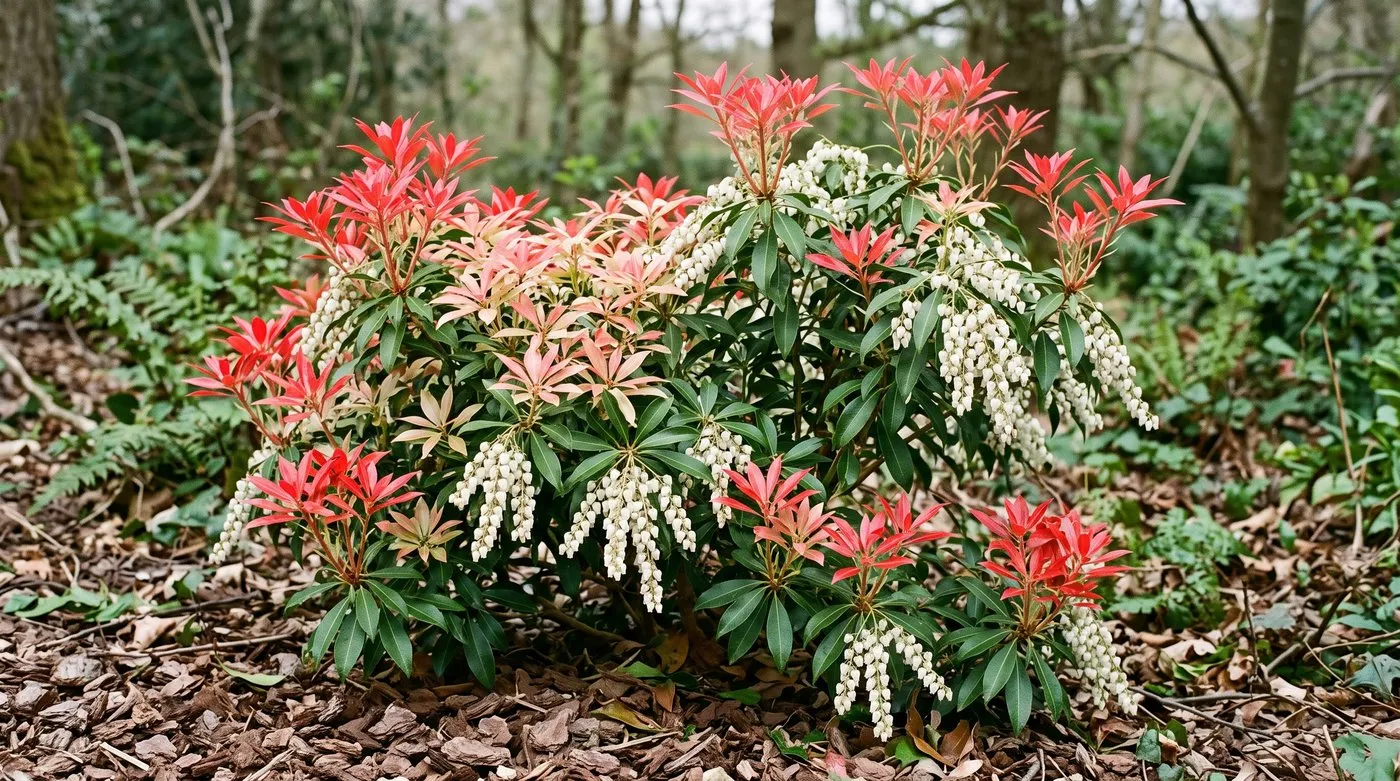
Pieris gives you red spring leaves and white bells in one go. It needs acid soil and shelter from cold winds that scorch the new growth.
Ground cover and edging shrubs for shade
Viburnum davidii forms a low, dense dome of deeply veined dark leaves, about 1-1.5m tall and wide. Female plants have striking metallic blue berries in autumn, but only with a male planted nearby. It’s hardy and doesn’t mind clay.
Euonymus fortunei varieties make colourful ground cover around 0.6-1m tall. ‘Emerald Gaiety’ has white-edged leaves and ‘Emerald ‘n’ Gold’ has yellow ones. Both are fine on chalk, where acid-lovers fail. Plant one against a wall and it’ll start climbing it.
Cornus alba, the red-barked dogwood, is all about winter. Once the leaves fall, varieties such as ‘Sibirica’ show off bright red stems from November to March. Cut every stem down to about 15cm in March for the brightest new growth. It’s happy on wet, heavy clay that most shrubs hate. For more border ideas, see our guide to evergreen shrubs for year-round interest. For something to carpet the ground underneath, our guide on how to grow brunnera covers a shade-loving perennial with blue spring flowers.
 A blue hydrangea on acid soil in part shade, getting a few hours of morning light.
How to plant shrubs in shade
A good start matters even more in shade. Shrubs grow slowly here, so a poor start takes much longer to recover from.
Planting acid-loving shrubs in alkaline soil
For camellias, pieris, rhododendrons and skimmia on chalky or limy ground:
- Dig a hole about 60cm wide and 45cm deep
- Fill it mostly with ericaceous compost, with some composted bark mixed in
- Set the root ball so its top sits level with the surrounding soil
- Mulch with 7-10cm of pine bark
- Test each spring, and add sulphur chips at the rate on the packet if it creeps back towards alkaline
On very chalky soil, honestly, a large pot of ericaceous compost is easier than keeping a small acid pocket going.
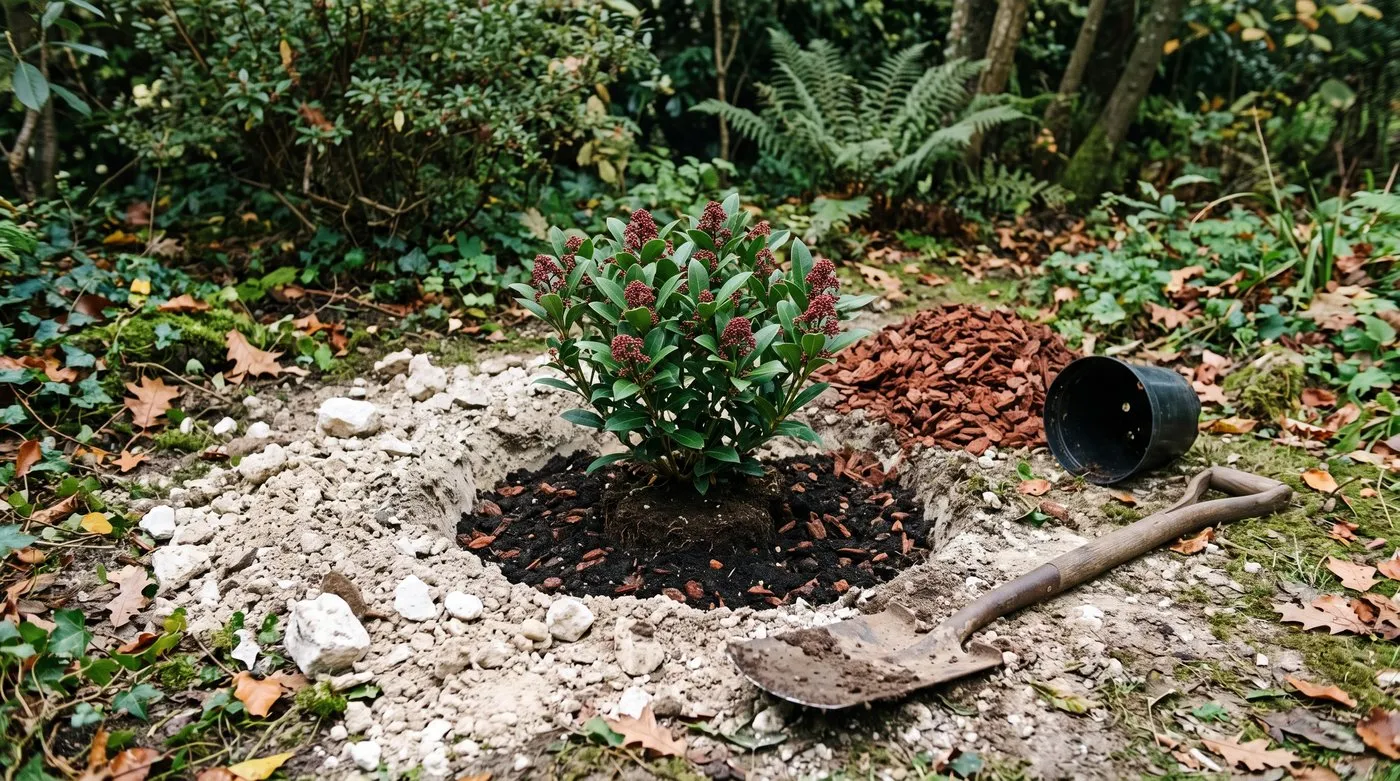
A pocket of ericaceous compost lets acid-lovers grow on chalk. Check the soil each spring, as it slowly creeps back towards lime.
Planting lime-tolerant shrubs
For aucuba, fatsia, mahonia, euonymus and cornus:
- Dig a hole twice as wide as the root ball and the same depth
- Fork over the bottom to break up hard clay
- Mix the soil you dug out half and half with composted bark or garden compost
- Backfill and firm gently to get rid of air pockets
- Water in with a full 10-litre can
- Mulch with 5-7cm of bark or well-rotted compost
Planting under trees
Within about 3m of a big tree:
- Dig the hole at least 1m from the trunk, where roots are thinner
- Work around thick tree roots rather than cutting through them
- Fill with a half-and-half mix of composted bark and multi-purpose compost
- Water weekly through the first summer, roughly 10 litres per shrub
- Spread a thick bark mulch well beyond the edge of the hole
Month-by-month shade shrub calendar
| Month | What to do |
|---|---|
| January | Enjoy the winter flowers on sweet box, mahonia and daphne. Check stakes after storms. |
| February | Camellias start to flower. Cut old hydrangea flower heads back to a strong pair of buds. Order bare-root shrubs. |
| March | Feed camellias, pieris and skimmia with ericaceous feed. Mulch shady beds with bark. Cut back dogwood stems. |
| April | Plant pot-grown shrubs. Deadhead camellias as they fade. Look for vine weevil notches on leaf edges. |
| May | Pinch back leggy growth on pieris and mahonia. Start watering new shrubs if it’s dry. |
| June | Hydrangeas start flowering. Take cuttings of aucuba and fatsia. |
| July | Water beds under trees weekly in dry spells. Deadhead hydrangeas to keep them going. |
| August | Take cuttings of camellias and hydrangeas. Check under camellia leaves for scale insects. |
| September | Stop feeding so new growth can toughen up for winter. Order bare-root shrubs. |
| October | Planting season starts. Plant new shrubs and make acid planting pockets. Water less. |
| November | A great month for planting. The soil is still warm and autumn rain settles the roots. Mulch for winter. |
| December | Mahonia and sweet box are in full flower. Cover daphne with fleece in a hard frost. |
Common mistakes with shade shrubs
Planting sun-lovers in shade and hoping for the best
Roses, lavender and most silver-leaved shrubs need lots of direct sun. In shade they stretch, flop and stop flowering, and no amount of feeding will change that. Check the label for light needs before you get to the till.
Ignoring soil for acid-loving shrubs
A camellia planted in chalk turns yellow and slowly fades, often over a couple of years, so it’s easy to miss the cause. Test your soil first. If it’s alkaline, make an acid pocket or go for aucuba, fatsia or mahonia instead.
Planting too deep
Bury the base of the stem and the bark stays permanently damp, then rots. The shrub dies from the bottom up, which is hard to spot until it’s too late. Keep the top of the root ball level with the soil, and pull mulch back a few centimetres from the stem.
Not watering in the first summer
New shrubs under trees are sitting in a rain shadow. Many won’t survive their first summer without help. Give each one about 10 litres a week from May to September in year one.
Pruning at the wrong time
Spring-flowering shrubs like camellias, mahonia and pieris form next year’s flower buds the summer before. Prune them in autumn or winter and you’ve cut off next spring’s show. Do it straight after flowering instead. With hydrangeas, leave the old flower heads on over winter to protect the buds, then cut back to a strong pair of buds in late February or early March. Cut dogwood stems down in March.
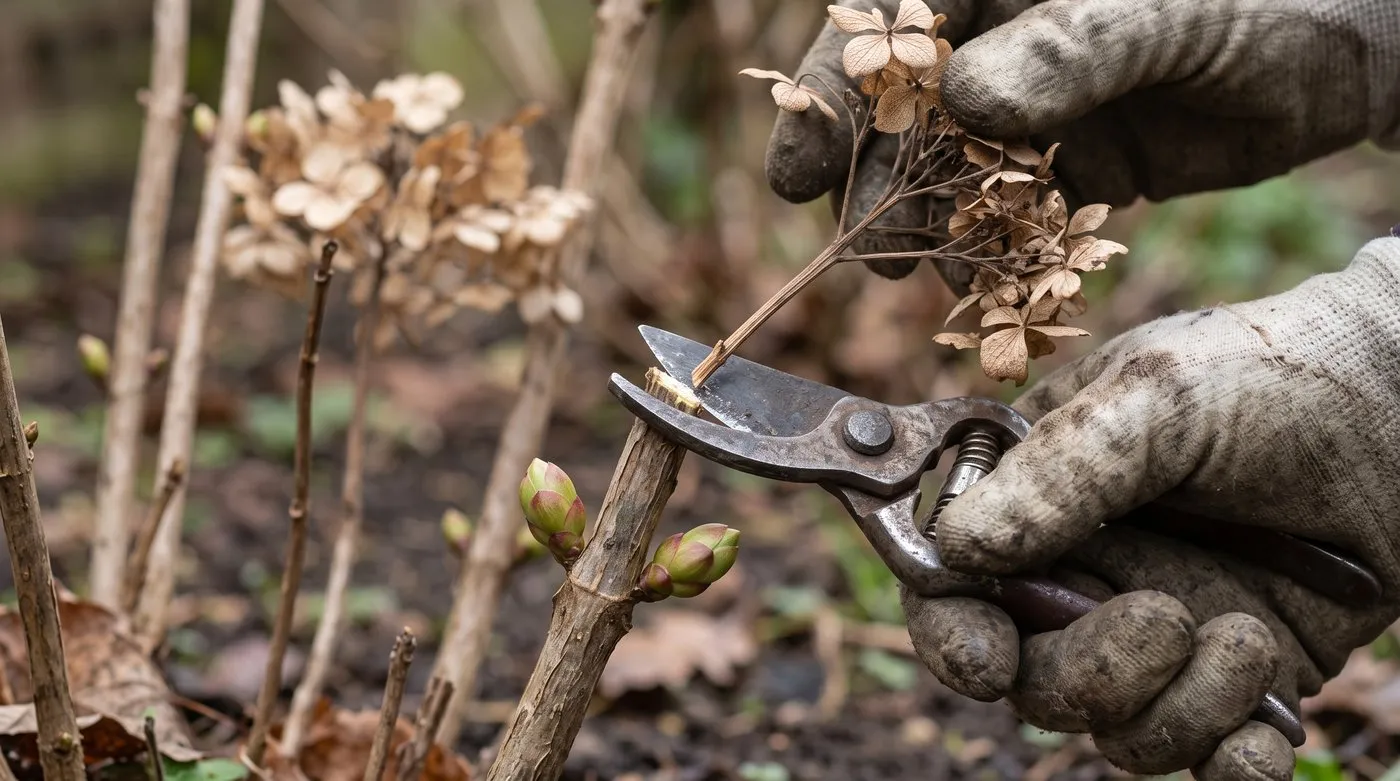
Leave old hydrangea heads on through winter, then cut back to the first fat pair of buds in early March. Those buds carry this summer’s flowers.
Frequently asked questions
What is the best evergreen shrub for deep shade UK?
Aucuba japonica, the spotted laurel. It manages on very little light, grows in almost any soil from acid to chalk, and eventually reaches 2-3m. The variety ‘Crotonifolia’ has gold-speckled leaves that lift a gloomy corner.
Can hydrangeas grow in full shade?
Not well. They need part shade, meaning a few hours of morning sun or bright filtered light. In deep shade you’ll get leaves but very few flowers. An east-facing bed or a north wall with open sky above both suit them.
What shrubs grow under trees in UK gardens?
Sweet box (sarcococca), mahonia and skimmia all cope with the dry shade and root competition under trees. Plant at least 1m from the trunk, where the roots are thinner, and mix composted bark into the hole to hold moisture.
When is the best time to plant shrubs in shade?
Any time from October to March. Autumn is best because the soil is still warm, so roots keep growing through winter. Bare-root shrubs are only sold in this window too. Avoid days when the ground is frozen or waterlogged.
Can I grow flowering shrubs on a north-facing wall?
Yes, quite a few. Climbing hydrangea covers a north wall in white flowers in June. Camellia japonica blooms from February to April without direct sun. Mahonia x media flowers yellow from November to January, and Garrya elliptica hangs with silver catkins from December to February.
Our team produces practical UK gardening guidance from source research, contributor records and established horticultural practice. Editorial standards are overseen by Matt W.