Key takeaways
- 'James Roof' has the longest, showiest catkins and is the one to buy
- It's one of the best evergreen shrubs for a north or east-facing wall
- Plant 30-45cm from the wall in autumn, leaning the plant slightly towards it
- It copes with town pollution, sea air and most soils, but not waterlogging
- Prune straight after the catkins fade in April, never in autumn
- It dislikes root disturbance, so buy a small plant in a pot
Garrya is one of the loveliest evergreen wall shrubs you can grow in the UK. From January to March, when almost nothing else is flowering, it’s draped in long silvery catkins. Here’s how to grow it, from picking the right variety to training it on a wall.
Its common name, silk tassel bush, comes from those catkins, which hang like silver-green tassels from every branch in the coldest months. It comes from the west coast of North America, but it’s very happy here, coping with wet winters, clay soil and shady walls.
Which garrya variety should I grow?
‘James Roof’ is the one to buy. It’s a male form of Garrya elliptica with the longest catkins, much longer than the ordinary species. It holds the RHS Award of Garden Merit.
There are a few others, but none put on quite the same winter show.
| ‘James Roof’ | G. elliptica (species) | ‘Glasnevin Wine' | 'Pat Ballard’ | |
|---|---|---|---|---|
| Catkins | Longest | Medium | Medium | Medium-long |
| Catkin colour | Silver-green | Grey-green | Purple-tinged | Purple-green |
| Height | 3-4m | 3-4m | 3-4m | About 3m |
| Spread | 3-4m | 3-4m | About 3m | About 2.5m |
| Good for | The biggest catkin show | A cheaper option | Something different | Smaller spaces |
| Where to buy | Widely available | Garden centres | Specialist nurseries | Specialist nurseries |
 ‘James Roof’ catkins in January. They slowly lengthen through the winter.
Where to plant garrya in the UK
A north or east-facing wall is ideal. That surprises a lot of people, but garrya is happy without full sun and does well in these cooler spots.
A wall helps in three ways. It shelters the evergreen leaves from cold, drying winds that can brown them. It gives a little warmth on the coldest nights. And it makes a dark backdrop that shows off the silvery catkins.
Soil is easy. Garrya grows in clay, loam, chalk and sandy soil. The one thing it hates is ground that stays waterlogged. On heavy clay soil, mix plenty of grit and compost into the planting hole to help drainage.
It’s tough, too. It copes with town pollution, so it’s great for city gardens, and it handles sea air and exposure. That makes it one of the most useful evergreen shrubs you can grow.
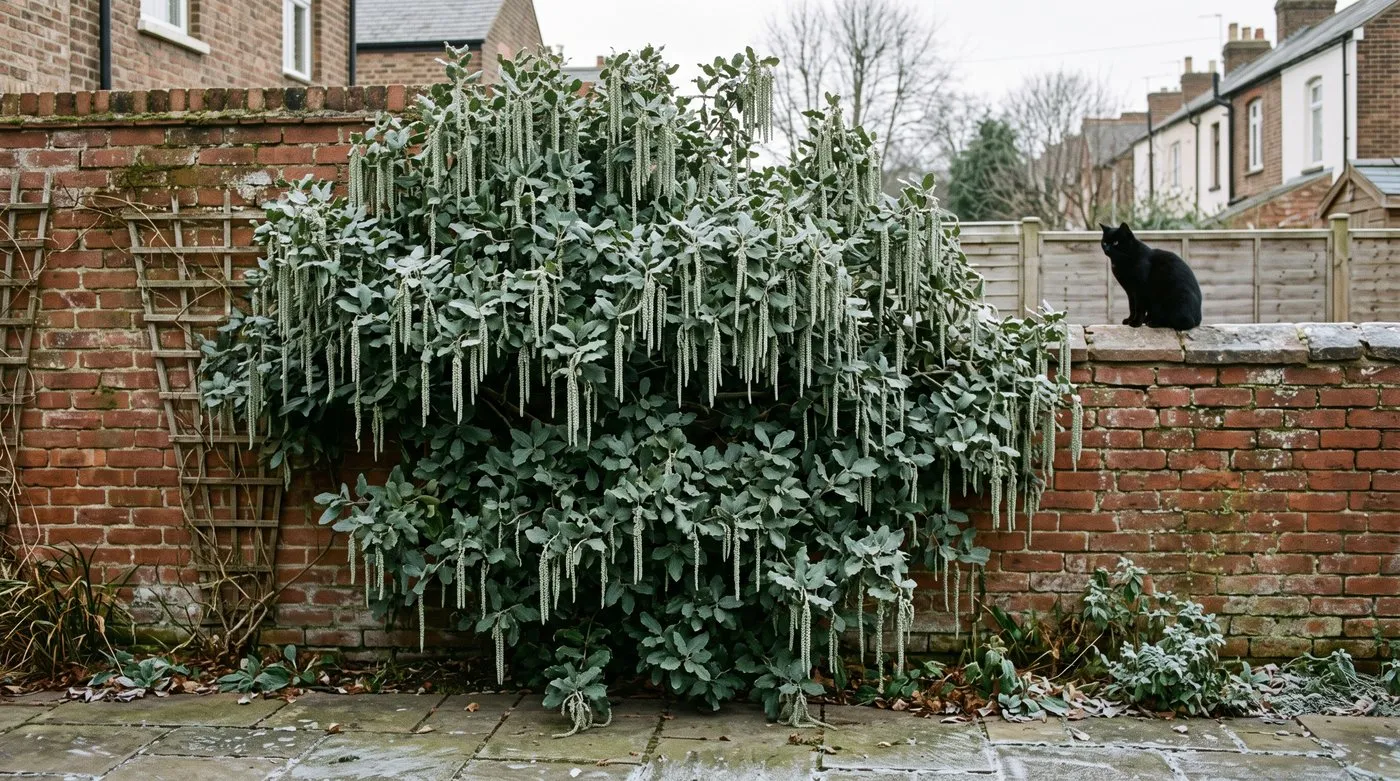
A north or east-facing wall suits garrya well. The dark brick sets off the silvery catkins beautifully in the depths of winter.
How to plant garrya against a wall
Garrya doesn’t like its roots disturbed. Buy a small plant in a pot, under about 60cm tall. Bigger plants are slower to settle and more likely to sulk. Avoid bare-root plants.
 Plant garrya 30-45cm out from the wall, leaning it slightly towards the wall.
How to plant:
- Dig a hole twice as wide as the pot and a bit deeper
- Loosen the bottom of the hole with a fork
- Mix the soil you dug out with some well-rotted compost
- Give the plant a good soak in a bucket of water first
- Set it 30-45cm out from the wall, leaning the top slightly towards the wall
- Fill in with the soil mix and firm gently with your foot
- Water well, with at least a full watering can
- Mulch with bark, keeping it a little away from the stem
First-year care: Water weekly in dry spells from April to September, giving a good soak each time. Soil by a wall dries out fast. Don’t feed in the first year, so the roots spread out into the surrounding soil.
How to train garrya on a wall
Training garrya on wires turns a floppy bush into a neat, eye-catching feature. Without support, branches grow outwards and the plant gets top-heavy. Fanned out on wires, the catkins hang freely against the wall.
 Fan-training garrya on wires. Tie the branches loosely, with space between them so the catkins can hang.
Put up wires before you plant:
| Wire | Height from ground |
|---|---|
| First | 45cm |
| Second | 90cm |
| Third | 135cm |
| Fourth | 180cm |
| Fifth | 225cm |
Use galvanised wire held on vine eyes every 1.2-1.5m, with tensioners to keep it taut. Galvanised or stainless fixings won’t leave rust stains on the wall.
Training: Choose 4-6 strong main branches and tie them to the wires with soft twine in a figure of eight. Fan the outer ones out at an angle. Remove any branches that grow straight out from the wall. Check and retie each spring after pruning. You’re aiming for a flat fan that shows off as many catkins as possible.
Young stems bend easily, but older wood gets stiff and snaps. So set up the shape in the first couple of years.
For other plants to cover a north-facing wall, try a climbing hydrangea alongside garrya for summer flowers too.
How to prune garrya
Prune as soon as the catkins fade, usually mid-April. Next winter’s catkins form on the new shoots that grow through summer. Prune later than spring and you’ll cut them off.
Each year:
- Cut flowered shoots back to a strong side shoot or outward-facing bud
- Take out any dead, damaged or crossing branches
- Shorten shoots growing straight out from the wall
- Thin out crowded growth so air can move through
- Tie in new shoots to the wires as they grow over summer
Hard pruning: If it’s outgrown its space, you can cut it right back to about 60cm in April. It’ll reshoot from old wood, but expect no catkins for a couple of years while it regrows. Our shrub pruning guide has more on hard pruning.
Month-by-month garrya care calendar
| Month | What to do |
|---|---|
| January | Catkins at their best. Enjoy them and leave the plant alone. |
| February | Catkins carry on. Check wire ties and fix any loose ones. |
| March | Catkins start to fade. Order plants for autumn planting. |
| April | Prune once the catkins have browned. Tie in. Mulch. |
| May | Give a general granular feed, following the pack. |
| June | New shoots grow. Tie them in. Water in dry spells. |
| July | Watch for scorched leaves on sunny walls. Water weekly in drought. |
| August | Keep watering in dry spells. Next winter’s catkins are forming. |
| September | Water less. Prepare holes for new plants. |
| October | The best month to plant. |
| November | Mulch around the base. Check ties before winter storms. |
| December | Catkins swelling. They may start to show in a mild winter. |
Common problems and how to fix them
Leaf scorch is the most common problem, mostly on sunny or exposed walls. Leaf edges turn brown and crispy when hot or cold, drying winds pull moisture out faster than the roots can replace it. Plant on a north or east-facing wall and water in long dry spells.
Damaged roots cause more trouble than any pest. Don’t dig within about 60cm of the main stem, and avoid planting near spots you dig often. Garrya’s shallow roots don’t recover well.
Coral spot shows as orange-pink pimples on dead or weak wood. Cut out affected branches well below the infection, wipe your secateurs clean between cuts and thin crowded growth. It rarely bothers healthy plants.
Pests are rare. The tough leaves put most insects off. You might see a few greenfly on soft new shoots in May. A jet of water from the hose knocks them off. Our organic pest control guide has more ideas.
Propagating garrya from cuttings
Take semi-ripe cuttings in August. Garrya can be slow and fussy to root, which is partly why plants aren’t cheap to buy.
How to do it:
- Choose healthy shoots from this year that are firm at the base but still green at the tip
- Cut 10-15cm lengths, just below a leaf joint
- Remove the lower two pairs of leaves
- Dip the ends in rooting powder
- Push them into a half-and-half mix of perlite and peat-free compost
- Put them in a closed propagator, ideally with gentle bottom heat
- Mist regularly. Rooting can take a couple of months
- Keep rooted cuttings in a cold frame or unheated greenhouse over winter
- Pot them on in spring and grow on for a year before planting out
Not all of them will root, so take plenty. Young plants are slow, so be patient.
Garrya shows that north-facing gardens can be full of interest. With the right plants, a shady wall becomes a great spot.
Best companion plants for garrya
Garrya looks best with plants that flower at the same time or give a contrast in leaf and shape.
Winter partners that flower alongside the catkins include hellebores, snowdrops and winter heather (Erica carnea). Together they give you layers of interest from the ground up to the wall.
Summer leafy contrast looks good at the base. Hardy ferns such as male fern add soft, arching fronds against garrya’s stiff leaves. Hostas like the shade by the wall, but keep the slugs off.
Climbers on the same wall keep the show going after the catkins. Climbing hydrangea flowers in June and July and is happy on a north-facing wall. Train it over the top half of the wall above the garrya.
For more shade-loving plants, choose ones that cope with the dry soil at the foot of a wall.
Now you know how to grow garrya, have a look at our guide to winter-flowering shrubs for even more colour in the coldest months.
Frequently asked questions
Can garrya grow on a north-facing wall?
Yes, it’s one of the best shrubs for a north-facing wall. The wall shelters its evergreen leaves from cold winds and gives the silvery catkins a lovely dark backdrop. An east-facing wall works well too.
When is the best time to plant garrya?
Autumn is the best time, in October or November. The soil is still warm, so the roots have months to settle before summer. You can plant in spring, but you’ll need to water regularly through the first summer. Never plant into frozen or waterlogged ground.
How do you prune a garrya elliptica?
Prune it as soon as the catkins fade, usually in April. Cut flowered shoots back to a strong side shoot or bud, and remove any dead, damaged or crossing branches. Don’t prune in summer, autumn or winter, as you’ll cut off next winter’s catkins. It copes with hard pruning but may take a couple of years to flower again.
Why is my garrya not producing catkins?
You may have a female plant, as only males have long catkins. Female plants have shorter, plainer catkins. If yours is a male, it may just be too young, as young plants can take a few years to get going. Pruning after spring also cuts off the developing catkins.
Is garrya poisonous to dogs and cats?
It isn’t known as a common pet hazard. The tough, bitter leaves aren’t something most animals want to eat. Keep an eye on puppies that chew everything, and call your vet if you’re worried a pet has eaten any plant.
How fast does garrya elliptica grow?
It grows at a steady, moderate pace once settled. It’s slow for the first couple of years while the roots get going, then speeds up. In time it reaches about 3-4m tall and wide, and a wall-trained plant can cover a good-sized patch of wall within several years.
Can I grow garrya in a container?
Yes, for a few years, but it does best in the ground. Use a pot at least 45cm wide and deep with drainage holes, filled with John Innes No. 3 mixed with some perlite. Water regularly and give a slow-release feed in April. Wrap the pot in very cold spells, as roots in pots are more exposed.
Our team produces practical UK gardening guidance from source research, contributor records and established horticultural practice. Editorial standards are overseen by Matt W.